LATE R E S P O N S E
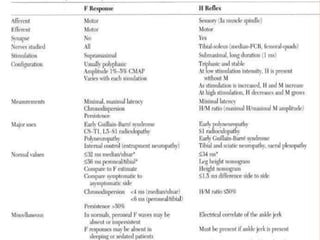
F wave H reflex
F-WAVE
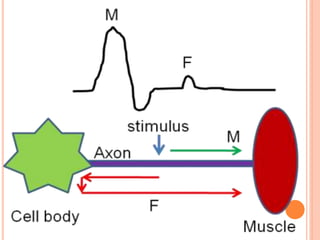
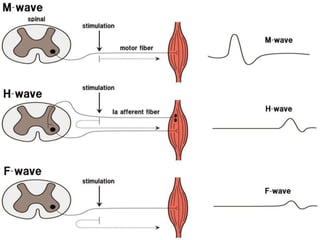
 F waves were named in reference to “foot”
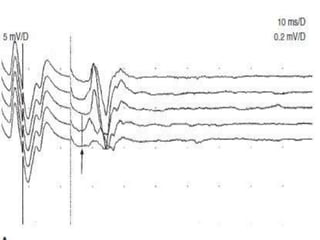
 A supramaximal stimulus applied at any
point along the course of a motor nerve
elicits an F wave in a distal muscle that
follows the CMAP (M response).
 The impulse travels antidromically to the
spinal cord and the F wave is produced by
backfiring of motor neurons. An average of
5–10% of the motor neurons available in the
motor neuron pool backfire after each
stimulus.
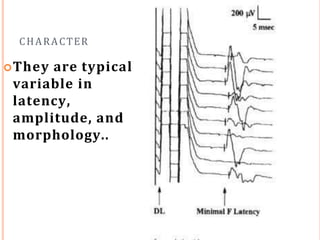
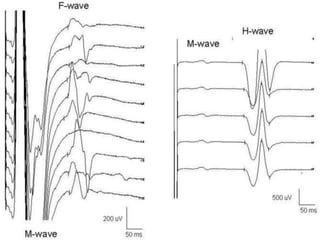
CHARACTER
They are typically
variable in
latency,
amplitude, and
morphology..
LATENCY ; MINIMAL F WAVE LATENCY IS
THE MOST RELIABLE AND USE FUL .
• It represents conduction of the largest
and fastest motor fibers.
• Depend on the length of motor axons
which correlates with the height and
limb length
• The most sensitive criterion of
abnormality in a unilateral disorder is a
latency difference between the two sides,
or between two similar nerves in the
same limb.
PARAMETERS
AVERAGE LATENCY
The average minimal F- wave latencies tend to
be 25-32 msec. in the upper extremities
and 45-56 msec in the lower extremities, height
dependent
Persistence >50%
Configuration :Usually polyphasic& varies
with each stimulation
Amplitude 1%-5% CMAP -the gain
should be increased 200 µv cant be
elicited in low amplitude of M response
This varies between individuals and is
inhibited by muscle activity while it is
enhanced by relaxation or the use of
Jendrassik maneuver.
F -wave chronodispersion
is the degree of scatter among consecutive F
waves and is determined by the difference
between the minimal and maximal F wave
latencies
Chronodispersion <4 ms (median/ulnar)
&<6 ms (peroneal/tibial)
SIGNIFICANT OF F WAVE
 1-- EARLY NEUROPATHY
 If the neuropathy is in its early stage, the delayed F
wave may be the first indication for the diagnosis.
 Guillain-Barre Syndrome can affect any segment of
the nerve, but it will commonly affect the most
proximal segment first
 As the patient starts to recover the F waves that
were absent will start to return, or the latencies that
were prolongated will return to a more normal
value.
 2-Plexipathy
3- SPINAL SHO CK
This is due to the altered state of
excitability of the motor neurons. In
acute paraparesis, the waves below the
injury or lesion in the spinal cord will
be absent or prolonged very soon after
injury and may not return for days or
weeks following
F WAVES. LIMITATIONS IN RADICULOPATHY
Slowing at the root level can be obscured
(“diluted”) by the normal conduction along the
long axon.
Most muscles are innervated by two or more roots.
In U L commonly used are F median & ulnar ns
which demonstrates C8& T1 roots ( uncommon
sites of radiculopathy)
If rediculopathy affects sensory nerve root
F wave affected when most of nerve fibers
involved
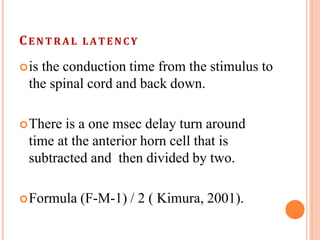
CE N T R A L LATENCY
is the conduction time from the stimulus to
the spinal cord and back down.
There is a one msec delay turn around
time at the anterior horn cell that is
subtracted and then divided by two.
Formula (F-M-1) / 2 ( Kimura, 2001).
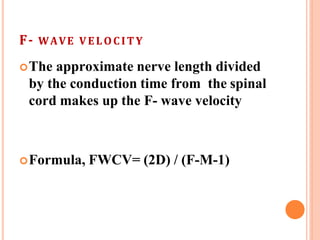
F- WAVE VELOCITY
The approximate nerve length divided
by the conduction time from the spinal
cord makes up the F- wave velocity
Formula, FWCV= (2D) / (F-M-1)
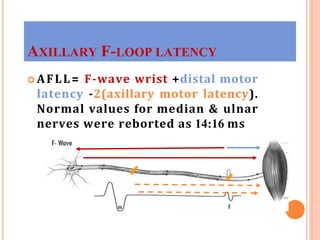
AXILLARY F-LOOP LATENCY
 AFLL= F-wave wrist +distal motor
latency -2(axillary motor latency).
Normal values for median & ulnar
nerves were reborted as 14:16 ms
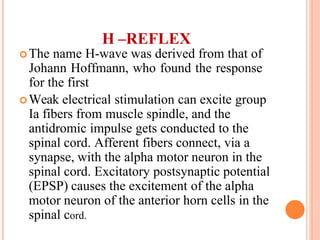
H –REFLEX
The name H-wave was derived from that of
Johann Hoffmann, who found the response
for the first
Weak electrical stimulation can excite group
Ia fibers from muscle spindle, and the
antidromic impulse gets conducted to the
spinal cord. Afferent fibers connect, via a
synapse, with the alpha motor neuron in the
spinal cord. Excitatory postsynaptic potential
(EPSP) causes the excitement of the alpha
motor neuron of the anterior horn cells in the
spinal cord.

H)

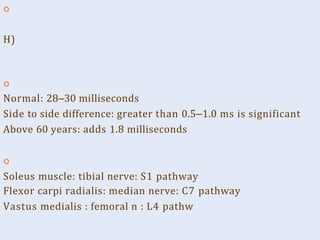
Normal: 28–30 milliseconds
Side to side difference: greater than 0.5–1.0 ms is significant
Above 60 years: adds 1.8 milliseconds

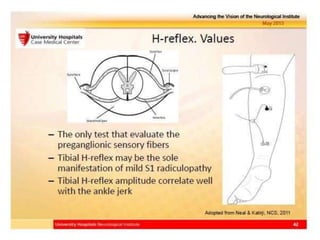
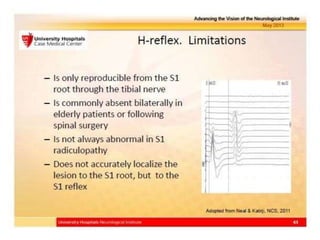
Soleus muscle: tibial nerve: S1 pathway
Flexor carpi radialis: median nerve: C7 pathway
Vastus medialis : femoral n : L4 pathw
late response# edited.             .pptx

late response# edited. .pptx

  • 1.
    LATE R ES P O N S E
  • 2.
    LATE R ES P O N S E F wave H reflex
  • 3.
    F-WAVE  F waveswere named in reference to “foot”  A supramaximal stimulus applied at any point along the course of a motor nerve elicits an F wave in a distal muscle that follows the CMAP (M response).  The impulse travels antidromically to the spinal cord and the F wave is produced by backfiring of motor neurons. An average of 5–10% of the motor neurons available in the motor neuron pool backfire after each stimulus.
  • 5.
    CHARACTER They are typically variablein latency, amplitude, and morphology..
  • 7.
    LATENCY ; MINIMALF WAVE LATENCY IS THE MOST RELIABLE AND USE FUL . • It represents conduction of the largest and fastest motor fibers. • Depend on the length of motor axons which correlates with the height and limb length • The most sensitive criterion of abnormality in a unilateral disorder is a latency difference between the two sides, or between two similar nerves in the same limb.
  • 8.
    PARAMETERS AVERAGE LATENCY The averageminimal F- wave latencies tend to be 25-32 msec. in the upper extremities and 45-56 msec in the lower extremities, height dependent Persistence >50% Configuration :Usually polyphasic& varies with each stimulation
  • 9.
    Amplitude 1%-5% CMAP-the gain should be increased 200 µv cant be elicited in low amplitude of M response This varies between individuals and is inhibited by muscle activity while it is enhanced by relaxation or the use of Jendrassik maneuver.
  • 10.
    F -wave chronodispersion isthe degree of scatter among consecutive F waves and is determined by the difference between the minimal and maximal F wave latencies Chronodispersion <4 ms (median/ulnar) &<6 ms (peroneal/tibial)
  • 11.
    SIGNIFICANT OF FWAVE  1-- EARLY NEUROPATHY  If the neuropathy is in its early stage, the delayed F wave may be the first indication for the diagnosis.  Guillain-Barre Syndrome can affect any segment of the nerve, but it will commonly affect the most proximal segment first  As the patient starts to recover the F waves that were absent will start to return, or the latencies that were prolongated will return to a more normal value.  2-Plexipathy
  • 12.
    3- SPINAL SHOCK This is due to the altered state of excitability of the motor neurons. In acute paraparesis, the waves below the injury or lesion in the spinal cord will be absent or prolonged very soon after injury and may not return for days or weeks following
  • 13.
    F WAVES. LIMITATIONSIN RADICULOPATHY Slowing at the root level can be obscured (“diluted”) by the normal conduction along the long axon. Most muscles are innervated by two or more roots. In U L commonly used are F median & ulnar ns which demonstrates C8& T1 roots ( uncommon sites of radiculopathy) If rediculopathy affects sensory nerve root F wave affected when most of nerve fibers involved
  • 14.
    CE N TR A L LATENCY is the conduction time from the stimulus to the spinal cord and back down. There is a one msec delay turn around time at the anterior horn cell that is subtracted and then divided by two. Formula (F-M-1) / 2 ( Kimura, 2001).
  • 15.
    F- WAVE VELOCITY Theapproximate nerve length divided by the conduction time from the spinal cord makes up the F- wave velocity Formula, FWCV= (2D) / (F-M-1)
  • 16.
    AXILLARY F-LOOP LATENCY AFLL= F-wave wrist +distal motor latency -2(axillary motor latency). Normal values for median & ulnar nerves were reborted as 14:16 ms
  • 17.
    H –REFLEX The nameH-wave was derived from that of Johann Hoffmann, who found the response for the first Weak electrical stimulation can excite group Ia fibers from muscle spindle, and the antidromic impulse gets conducted to the spinal cord. Afferent fibers connect, via a synapse, with the alpha motor neuron in the spinal cord. Excitatory postsynaptic potential (EPSP) causes the excitement of the alpha motor neuron of the anterior horn cells in the spinal cord.
  • 20.
     H)  Normal: 28–30 milliseconds Sideto side difference: greater than 0.5–1.0 ms is significant Above 60 years: adds 1.8 milliseconds  Soleus muscle: tibial nerve: S1 pathway Flexor carpi radialis: median nerve: C7 pathway Vastus medialis : femoral n : L4 pathw