LINEAR VARIABLE DISPLACEMENT TRANSDUCER (LVDT)LINEAR VARIABLE DISPLACEMENT TRANSDUCER (LVDT)
A basic transducer which is always useful in the field of
instrumentation
Principle of LVDT:
LVDT works under the principle of mutual
induction, and the displacement which is a non-
electrical energy is converted into an electrical energy.
And the way how the energy is getting
converted is described in working of LVDT in a detailed
manner.
Construction of LVDT:
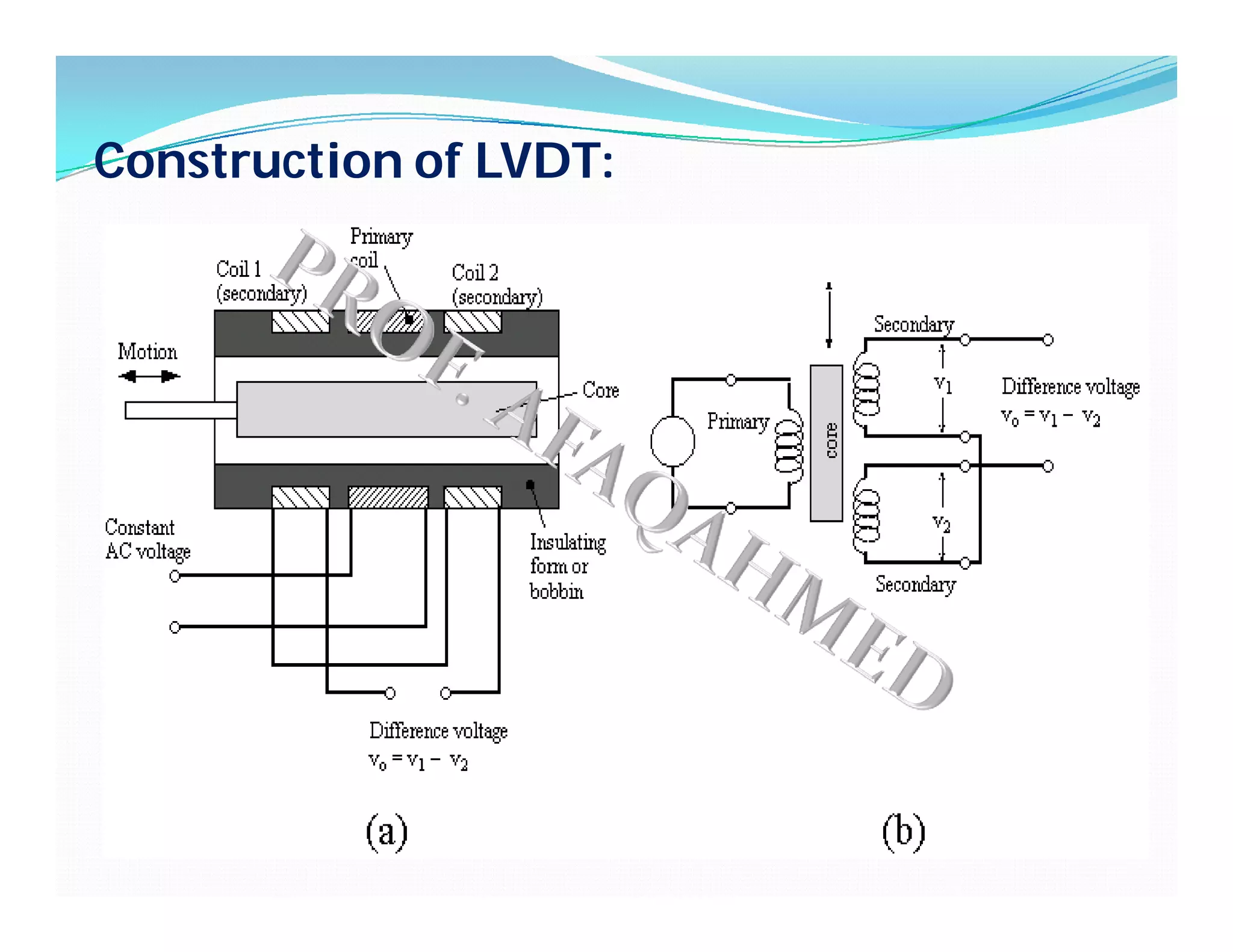
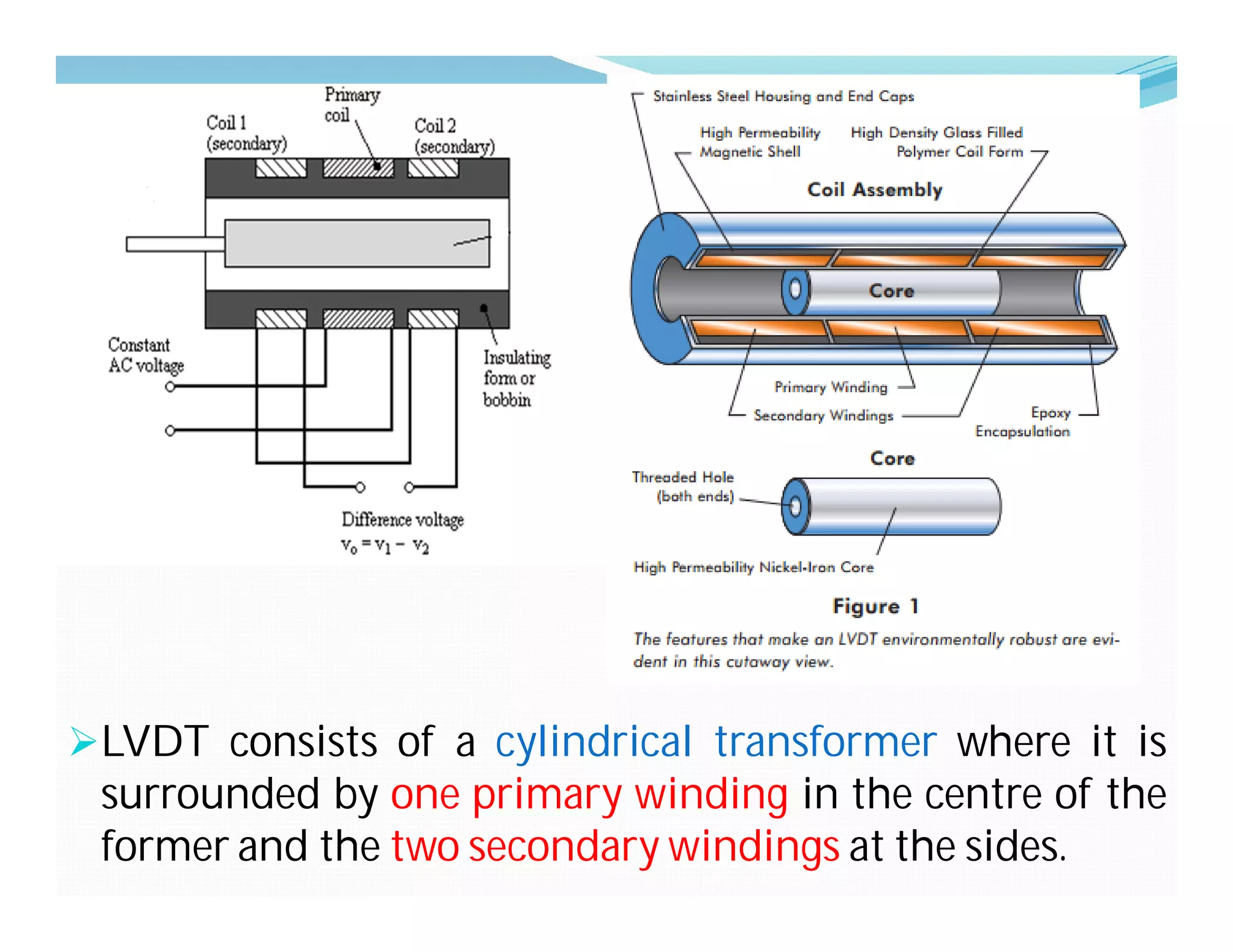
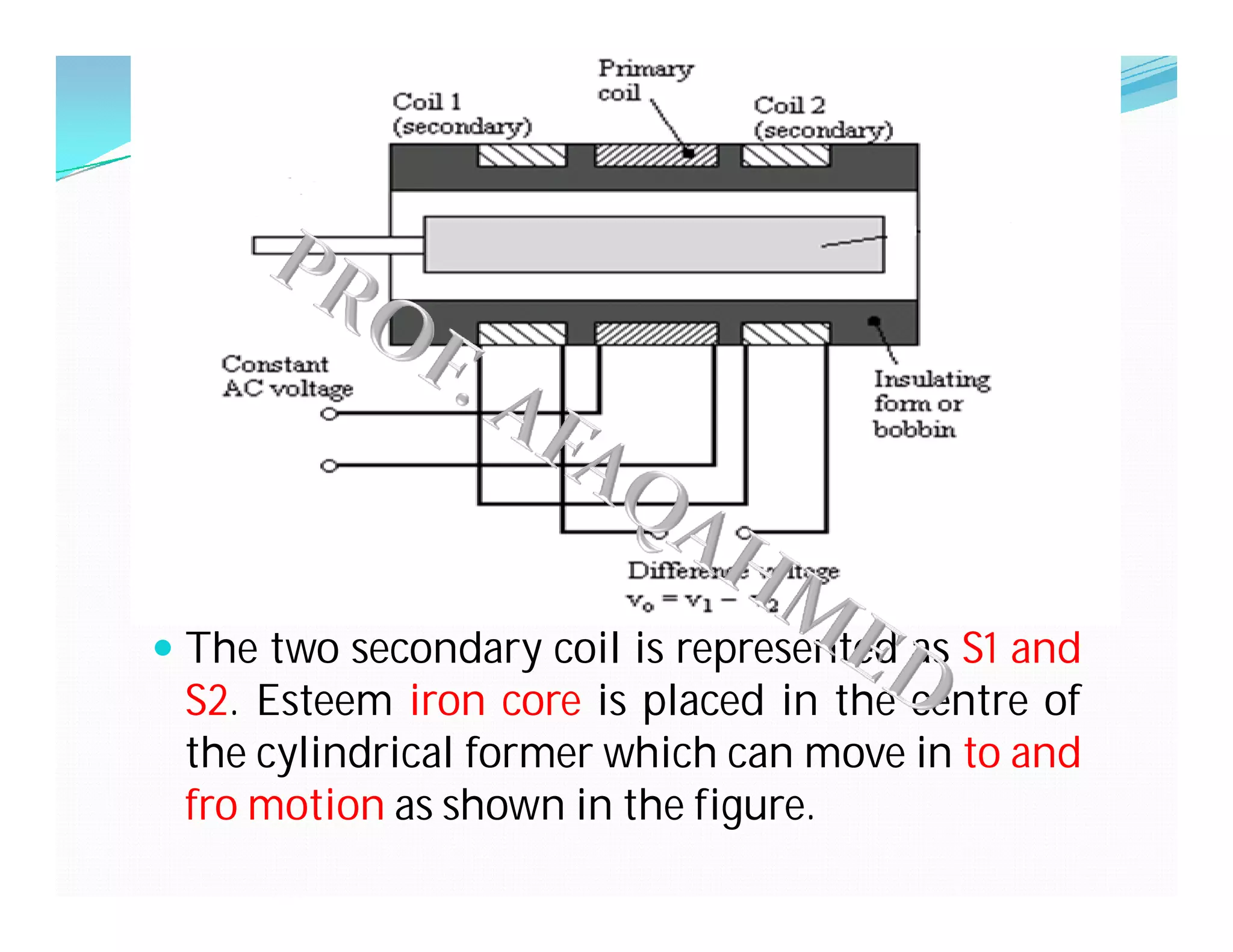
LVDT consists of a cylindrical transformer where it is
surrounded by one primary winding in the centre of the
former and the two secondary windings at the sides.
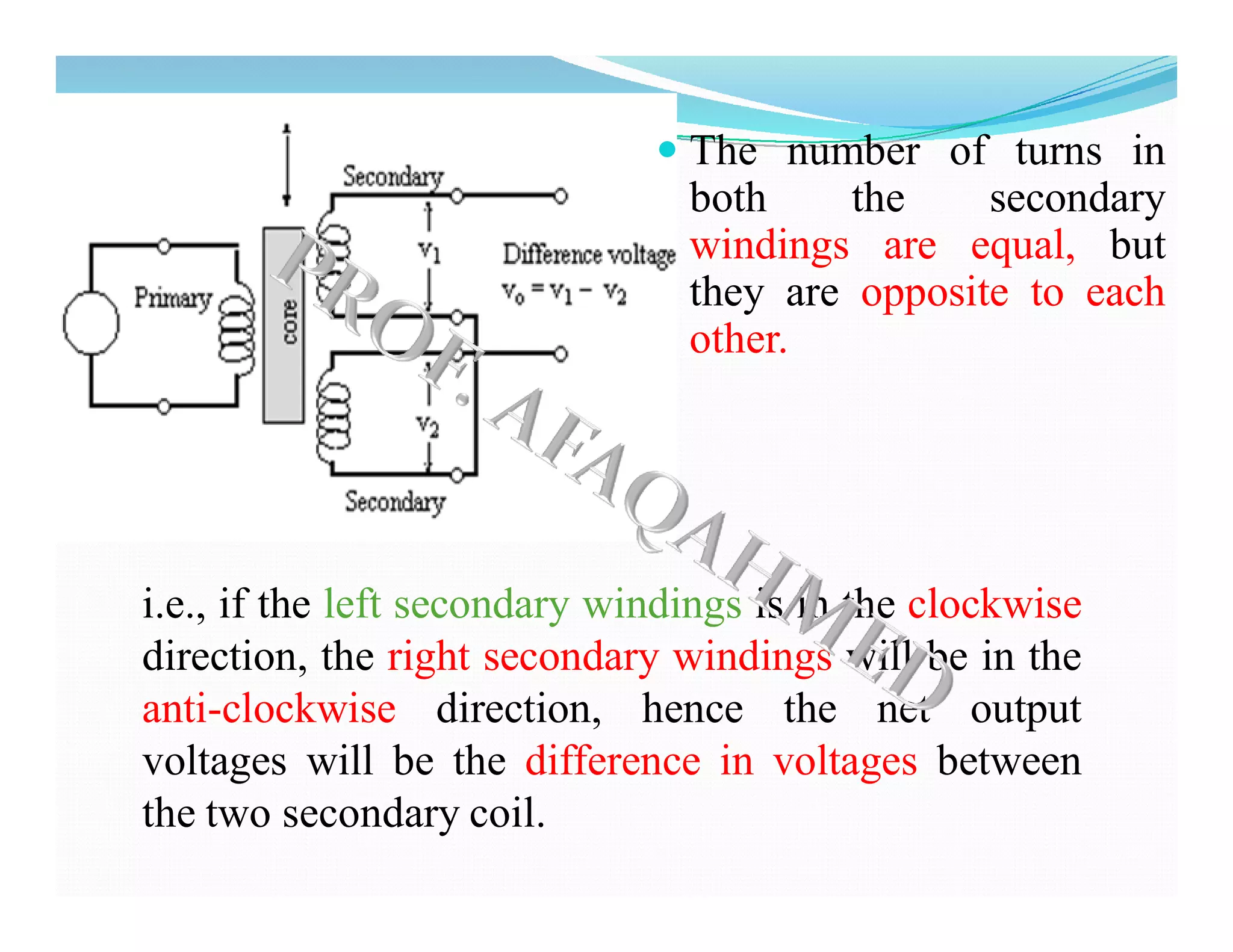
 The number of turns in
both the secondary
windings are equal, but
they are opposite to each
other.
i.e., if the left secondary windings is in the clockwise
direction, the right secondary windings will be in the
anti-clockwise direction, hence the net output
voltages will be the difference in voltages between
the two secondary coil.
 The two secondary coil is represented as S1 and
S2. Esteem iron core is placed in the centre of
the cylindrical former which can move in to and
fro motion as shown in the figure.
Working of LVDT:
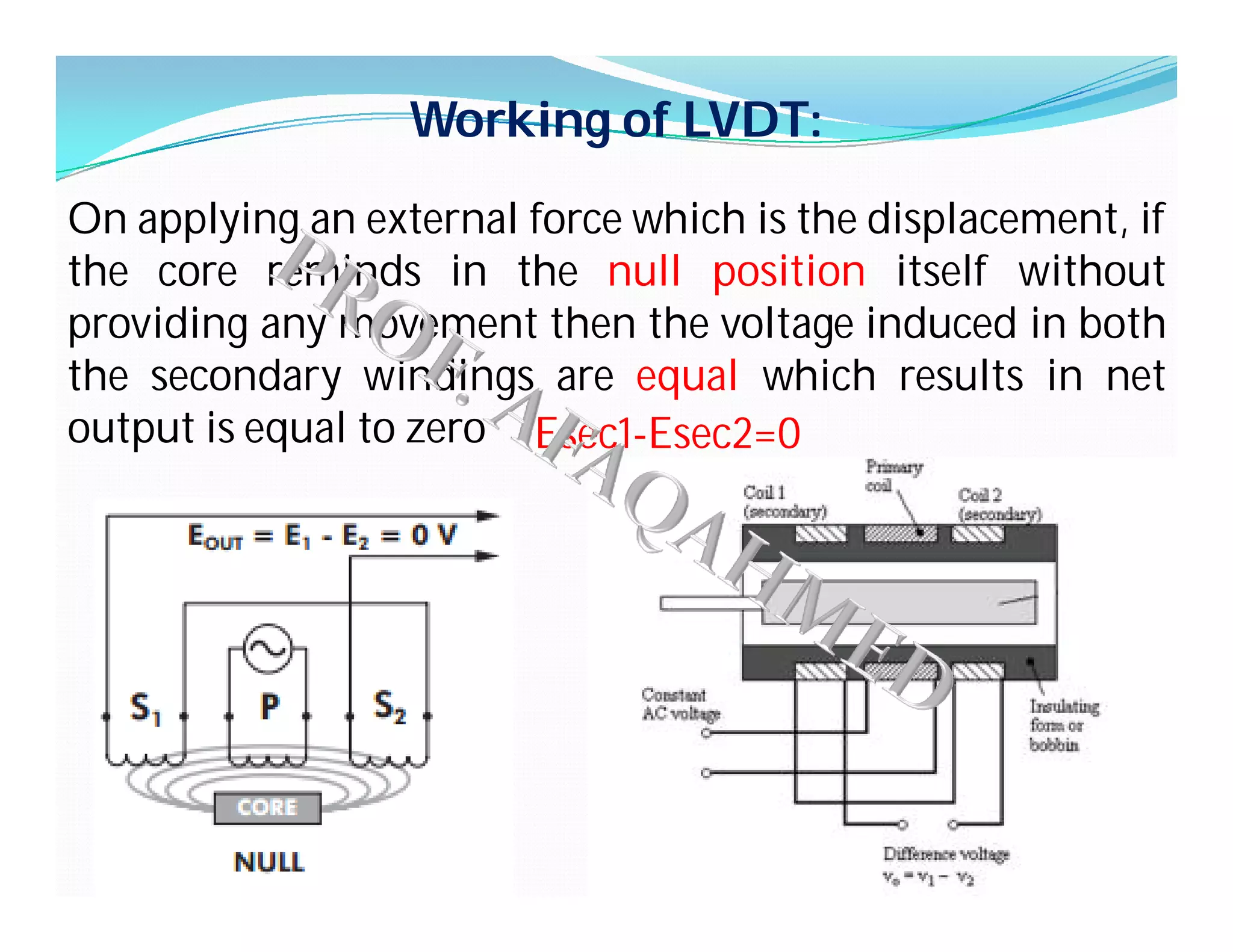
On applying an external force which is the displacement, if
the core reminds in the null position itself without
providing any movement then the voltage induced in both
the secondary windings are equal which results in net
output is equal to zero Esec1-Esec2=0
Working of LVDT:
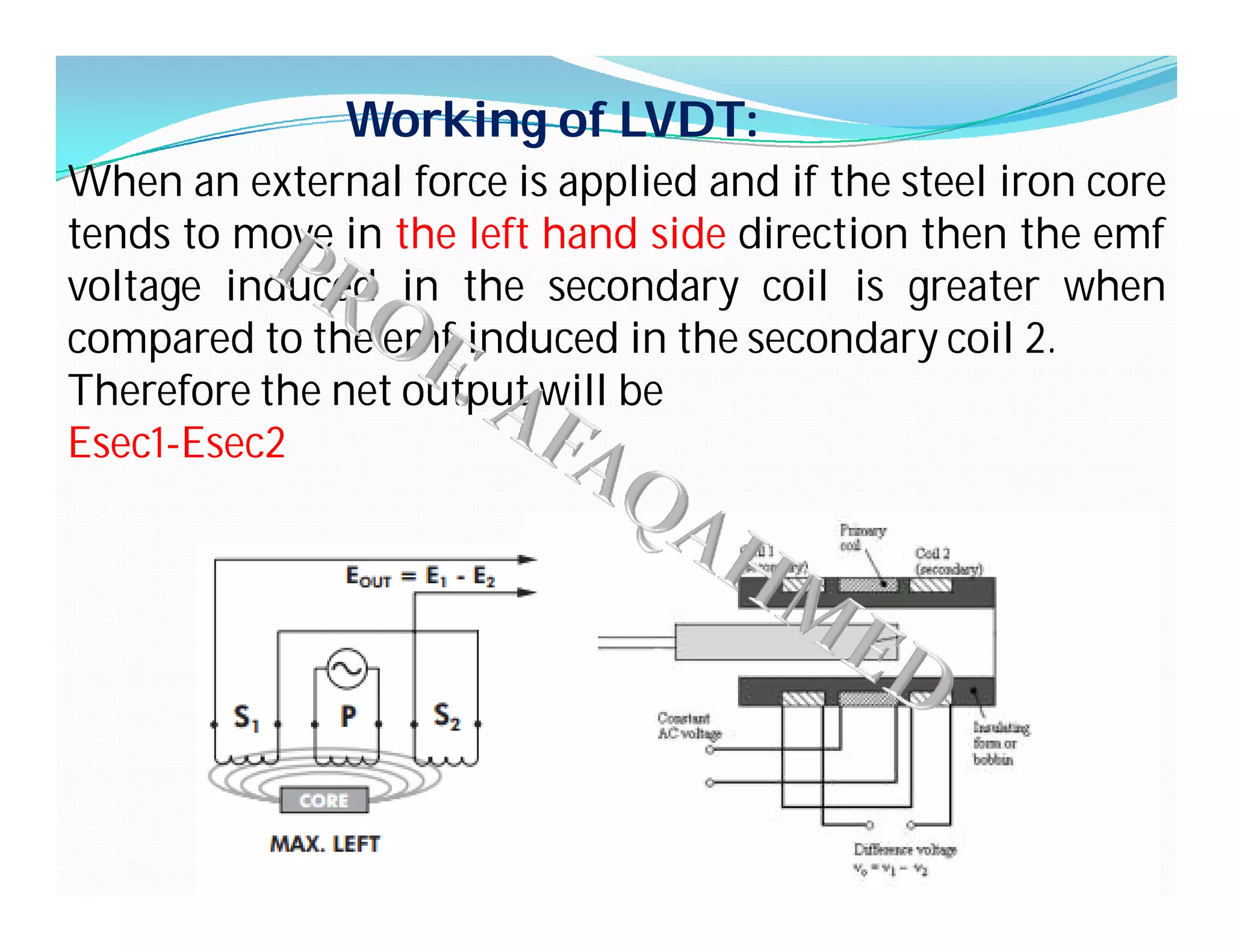
When an external force is applied and if the steel iron core
tends to move in the left hand side direction then the emf
voltage induced in the secondary coil is greater when
compared to the emf induced in the secondary coil 2.
Therefore the net output will be
Esec1-Esec2
Working of LVDT
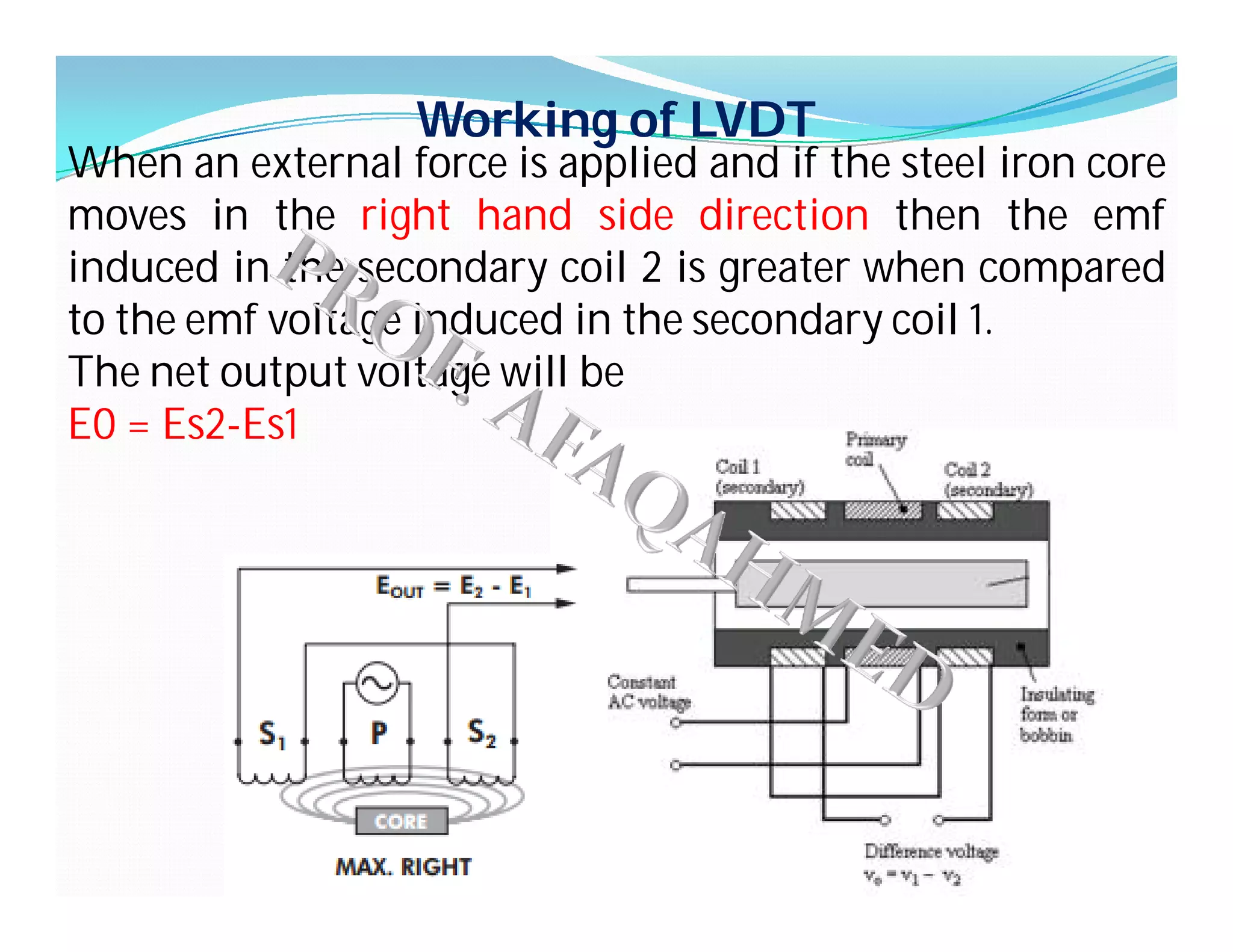
When an external force is applied and if the steel iron core
moves in the right hand side direction then the emf
induced in the secondary coil 2 is greater when compared
to the emf voltage induced in the secondary coil 1.
The net output voltage will be
E0 = Es2-Es1
Advantages of LVDT:
1) Infinite resolution is present in LVDT
2) High output
3) LVDT gives High sensitivity
4) Very good linearity
5) Ruggedness
6) LVDT Provides Less friction
7) Low hysteresis
8) LVDT gives Low power consumption.
Applications of LVDT:
1)LVDT is used to measure displacement ranging from fraction
millimeter to centimeter.
2)Acting as a secondary transducer, LVDT can be used as a device
to measure force, weight and pressure, etc..
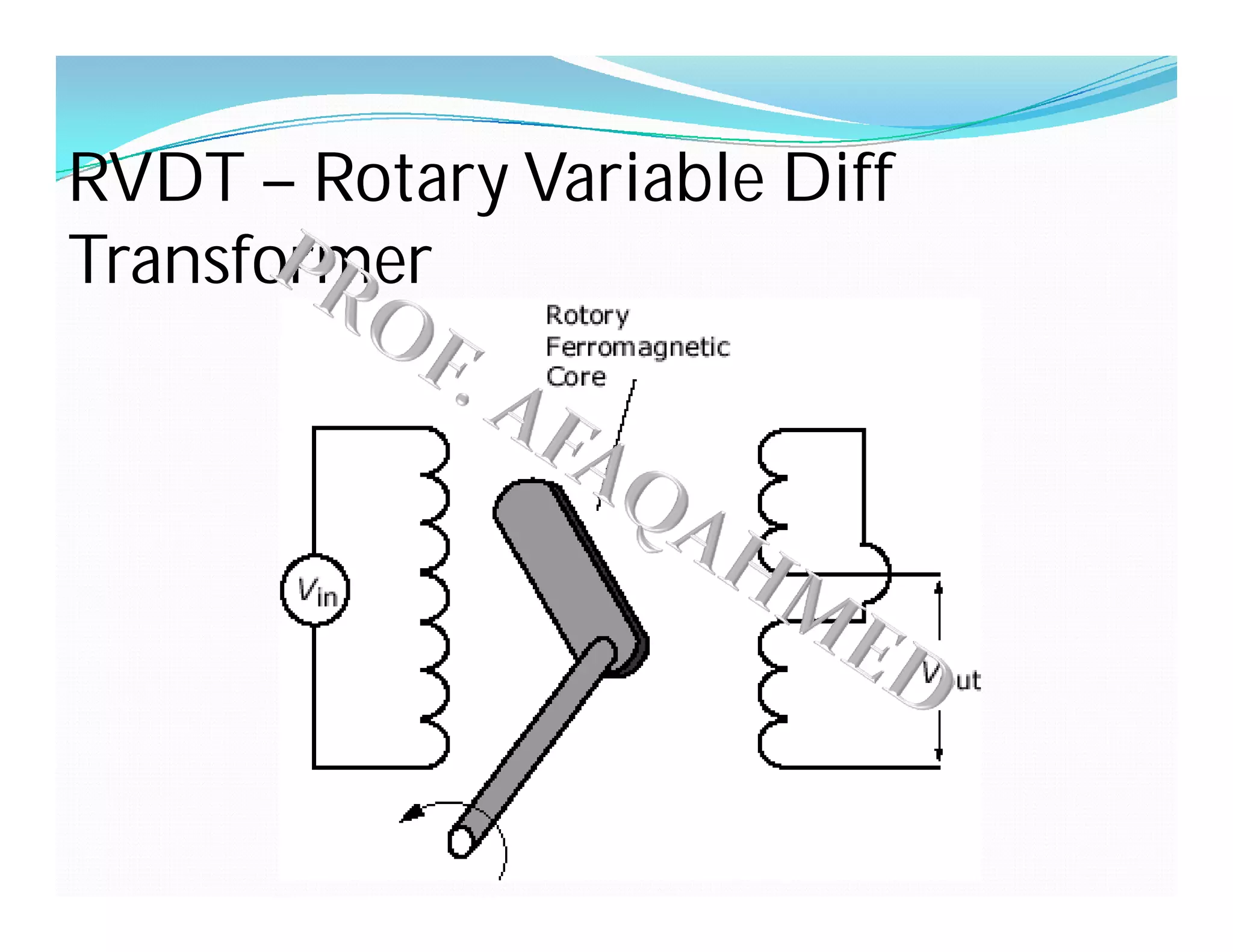
RVDT – Rotary Variable Diff
Transformer
Construction of RVDT and Working Principle
Basic RVDT construction and operation is provided by rotating an
iron-core bearing supported within a housed stator assembly.
The stator consists of a primary excitation coil and a pair of
secondary output coils.
A Rotary Variable Differential Transformer (RVDT) is an
electromechanical transducer that provides a variable alternating
current (AC) output voltage that is linearly proportional to the
angular displacement of its input shaft.
LINEAR POTENTIOMETER
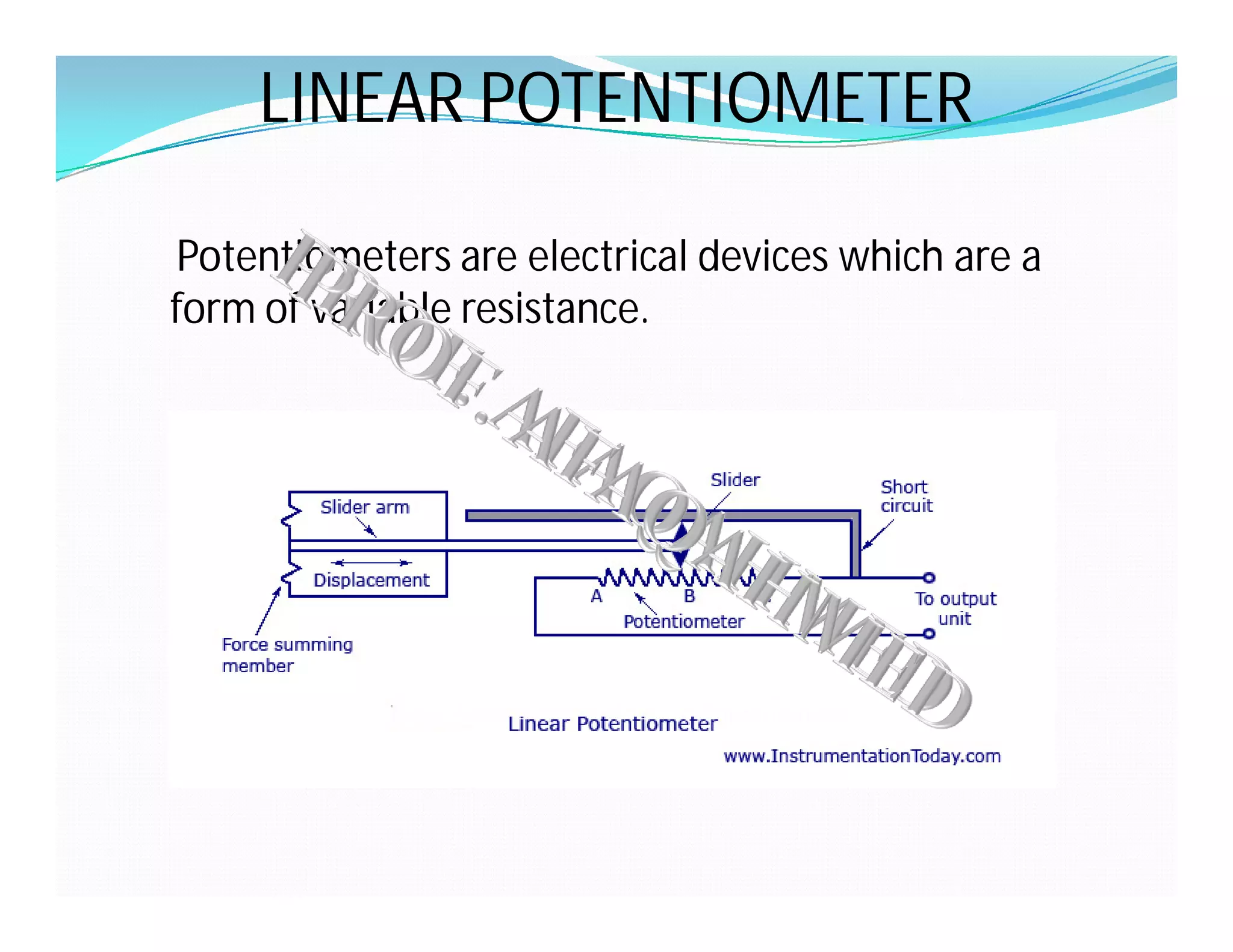
Potentiometers are electrical devices which are a
form of variable resistance.
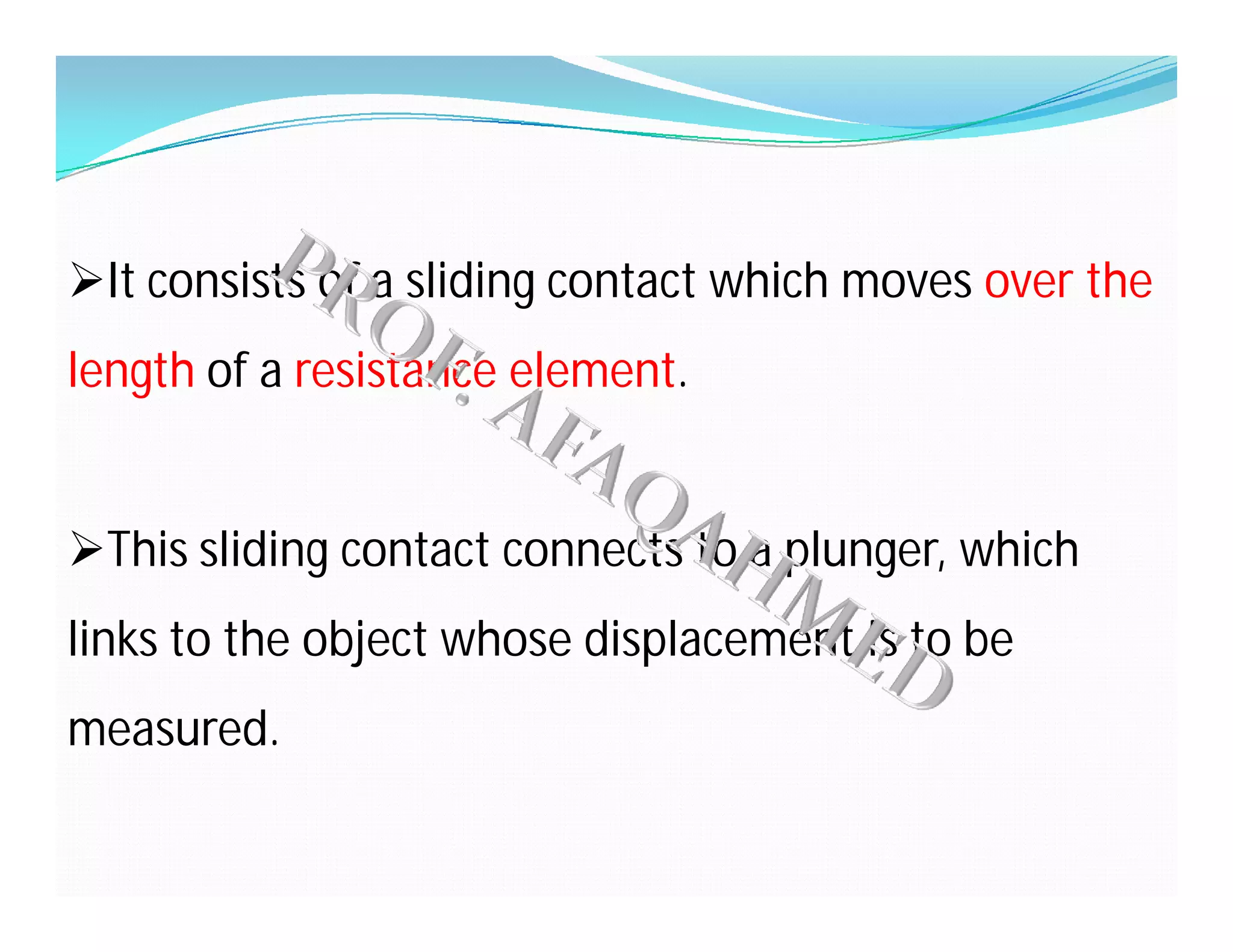
It consists of a sliding contact which moves over the
length of a resistance element.
This sliding contact connects to a plunger, which
links to the object whose displacement is to be
measured.
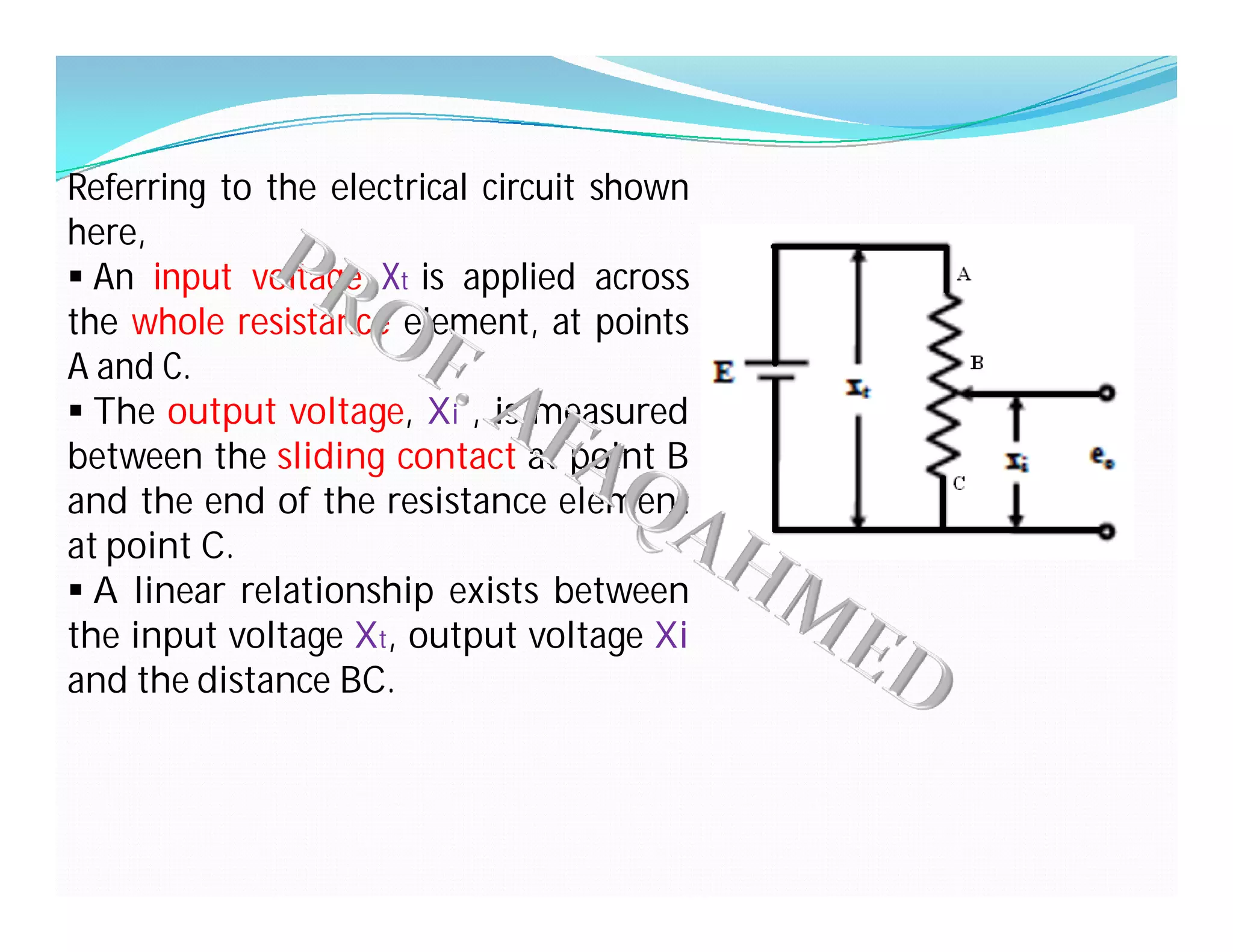
Referring to the electrical circuit shown
here,
 An input voltage Xt is applied across
the whole resistance element, at points
A and C.
 The output voltage, Xi , is measured
between the sliding contact at point B
and the end of the resistance element
at point C.
 A linear relationship exists between
the input voltage Xt, output voltage Xi
and the distance BC.
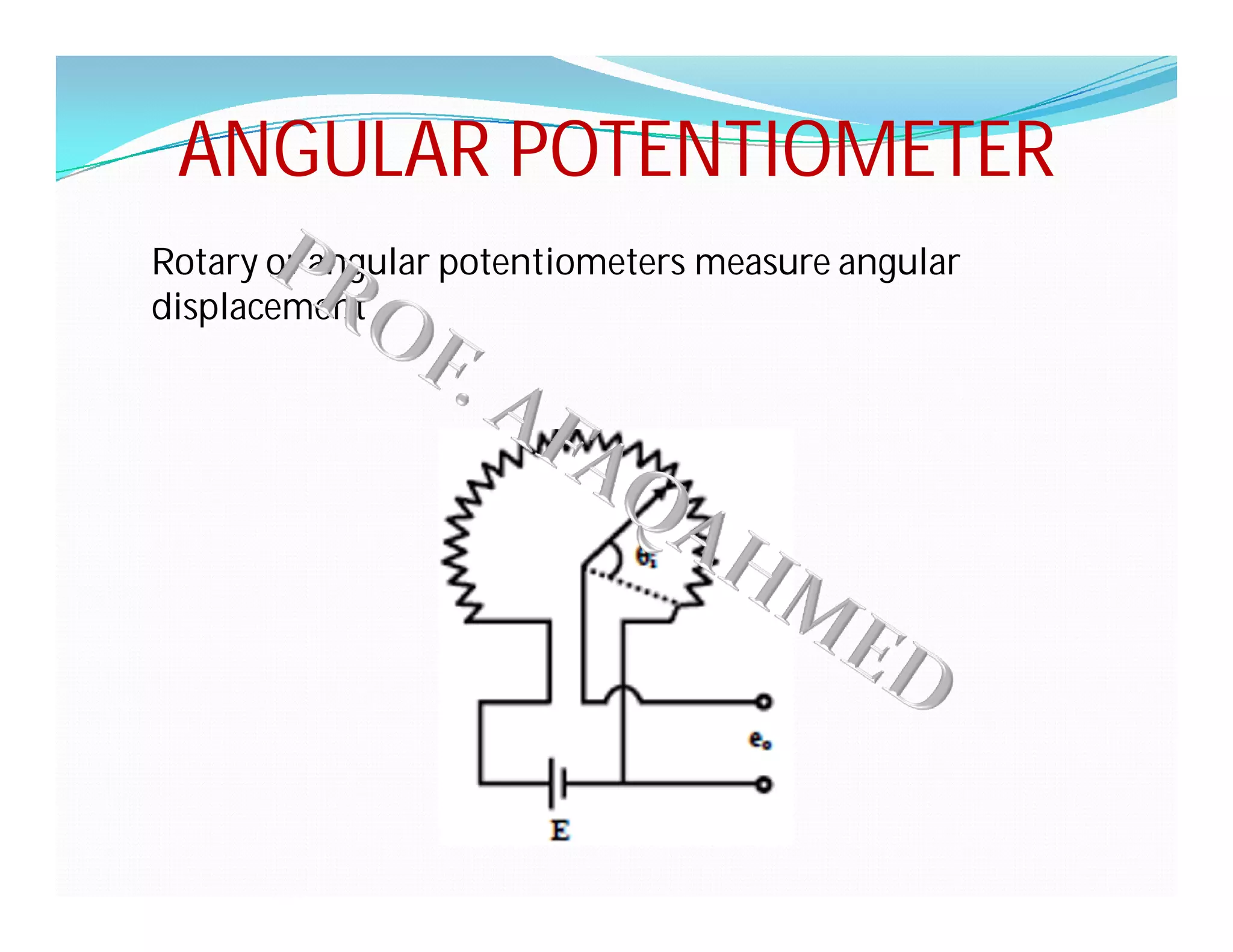
ANGULAR POTENTIOMETER
Rotary or angular potentiometers measure angular
displacement .
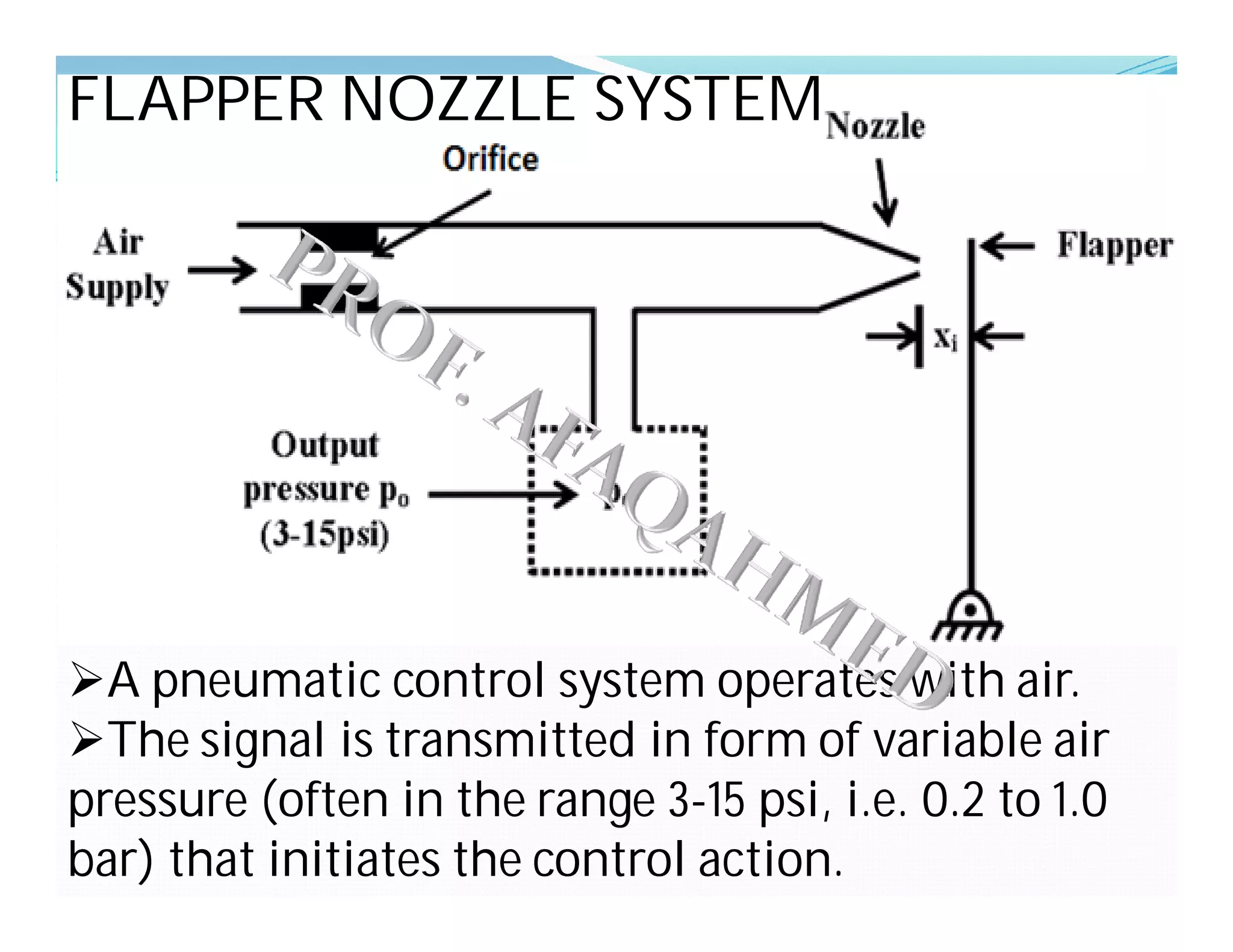
FLAPPER NOZZLE SYSTEM
A pneumatic control system operates with air.
The signal is transmitted in form of variable air
pressure (often in the range 3-15 psi, i.e. 0.2 to 1.0
bar) that initiates the control action.
 It converts very small displacement signal (in order of microns) to variation of air
pressure.

Displacement Measurement

  • 2.
    LINEAR VARIABLE DISPLACEMENTTRANSDUCER (LVDT)LINEAR VARIABLE DISPLACEMENT TRANSDUCER (LVDT) A basic transducer which is always useful in the field of instrumentation Principle of LVDT: LVDT works under the principle of mutual induction, and the displacement which is a non- electrical energy is converted into an electrical energy. And the way how the energy is getting converted is described in working of LVDT in a detailed manner.
  • 3.
  • 4.
    LVDT consists ofa cylindrical transformer where it is surrounded by one primary winding in the centre of the former and the two secondary windings at the sides.
  • 5.
     The numberof turns in both the secondary windings are equal, but they are opposite to each other. i.e., if the left secondary windings is in the clockwise direction, the right secondary windings will be in the anti-clockwise direction, hence the net output voltages will be the difference in voltages between the two secondary coil.
  • 6.
     The twosecondary coil is represented as S1 and S2. Esteem iron core is placed in the centre of the cylindrical former which can move in to and fro motion as shown in the figure.
  • 7.
    Working of LVDT: Onapplying an external force which is the displacement, if the core reminds in the null position itself without providing any movement then the voltage induced in both the secondary windings are equal which results in net output is equal to zero Esec1-Esec2=0
  • 8.
    Working of LVDT: Whenan external force is applied and if the steel iron core tends to move in the left hand side direction then the emf voltage induced in the secondary coil is greater when compared to the emf induced in the secondary coil 2. Therefore the net output will be Esec1-Esec2
  • 9.
    Working of LVDT Whenan external force is applied and if the steel iron core moves in the right hand side direction then the emf induced in the secondary coil 2 is greater when compared to the emf voltage induced in the secondary coil 1. The net output voltage will be E0 = Es2-Es1
  • 10.
    Advantages of LVDT: 1)Infinite resolution is present in LVDT 2) High output 3) LVDT gives High sensitivity 4) Very good linearity 5) Ruggedness 6) LVDT Provides Less friction 7) Low hysteresis 8) LVDT gives Low power consumption.
  • 11.
    Applications of LVDT: 1)LVDTis used to measure displacement ranging from fraction millimeter to centimeter. 2)Acting as a secondary transducer, LVDT can be used as a device to measure force, weight and pressure, etc..
  • 12.
    RVDT – RotaryVariable Diff Transformer
  • 13.
    Construction of RVDTand Working Principle Basic RVDT construction and operation is provided by rotating an iron-core bearing supported within a housed stator assembly. The stator consists of a primary excitation coil and a pair of secondary output coils. A Rotary Variable Differential Transformer (RVDT) is an electromechanical transducer that provides a variable alternating current (AC) output voltage that is linearly proportional to the angular displacement of its input shaft.
  • 14.
    LINEAR POTENTIOMETER Potentiometers areelectrical devices which are a form of variable resistance.
  • 15.
    It consists ofa sliding contact which moves over the length of a resistance element. This sliding contact connects to a plunger, which links to the object whose displacement is to be measured.
  • 16.
    Referring to theelectrical circuit shown here,  An input voltage Xt is applied across the whole resistance element, at points A and C.  The output voltage, Xi , is measured between the sliding contact at point B and the end of the resistance element at point C.  A linear relationship exists between the input voltage Xt, output voltage Xi and the distance BC.
  • 17.
    ANGULAR POTENTIOMETER Rotary orangular potentiometers measure angular displacement .
  • 18.
    FLAPPER NOZZLE SYSTEM Apneumatic control system operates with air. The signal is transmitted in form of variable air pressure (often in the range 3-15 psi, i.e. 0.2 to 1.0 bar) that initiates the control action.
  • 19.
     It convertsvery small displacement signal (in order of microns) to variation of air pressure.