1
SENSORS
Sensors are sophisticated devices that are frequently used to detect and respond to electrical or
optical signals. A Sensor converts the physical parameter (for example: temperature, blood
pressure, humidity, speed, etc.) into a signal which can be measured electrically. Let’s explain
the example of temperature. The mercury in the glass thermometer expands and contracts the
liquid to convert the measured temperature which can be read by a viewer on the calibrated glass
tube.
Industrial sensors are the eyes and ears of the new factory floor, and they come in all sizes,
shapes, and technologies. The most common technologies are inductive, capacitive,
photoelectric, magnetic, and ultrasonic. Each technology has unique strengths and weaknesses,
so the requirements of the application itself will determine what technology should be used.
INTEGRATED CIRCUITS (ICs)
An integrated circuit or monolithic integrated circuit (also referred to as an IC, a chip, or
a microchip) is a set of electronic circuits on one small flat piece (or "chip") of semiconductor
material, normally silicon. The integration of large numbers of tiny transistors into a small chip
resulted in circuits that are orders of magnitude smaller, cheaper, and faster than those constructed
of discrete electronic components. The IC's mass production capability, reliability and building-
block approach to circuit design ensured the rapid adoption of standardized ICs in place of designs
using discrete transistors. ICs are now used in virtually all electronic equipment and have
revolutionized the world of electronics. Computers, mobile phones, and other digital home
appliances are now inextricable parts of the structure of modern societies, made possible by the
small size and low cost of ICs.
In this report we will discuss some important sensors as well as ICs and their technologies and
their applications. This list will include Photo sensors, IR sensors and PIR sensors, Motor driver
IC, Relay and Soil moisture sensor.
2
Photo Sensors
This article is focused on photoelectric sensors and defines what they are, their advantages
and some basic modes of operation.
Photoelectric sensors are readily present in everyday life. They help safely control the opening
and closing of garage doors, turn on sink faucets with the wave of a hand, control elevators,
open the doors at the grocery store, detect the winning car at racing events, and so much more.
A photoelectric sensor is a device that detects a change in light intensity. Typically, this means
either non-detection or detection of the sensor’s emitted light source. The type of light and
method by which the target is detected varies depending on the sensor.
Photoelectric sensors are made up of a light source (LED), a receiver (phototransistor), a
signal converter, and an amplifier. The phototransistor analyzes incoming light, verifies that
it is from the LED, and appropriately triggers an output.
Photoelectric sensors offer many advantages when compared to other technologies. Sensing
ranges for photoelectric sensors far surpass the inductive, capacitive, magnetic, and ultrasonic
technologies. Their small size versus sensing range and a unique variety of housings makes
them a perfect fit for almost any application. Finally, with continual advances in technology,
photoelectric sensors are price competitive with other sensing technologies.
Sensing Modes
Photoelectric sensors provide three primary methods of target detection: diffused, retro-
reflective and thru-beam, with variations of each.
3
Diffused Mode: In diffused mode sensing, sometimes called proximity mode, the transmitter
and receiver are in the same housing. Light from the transmitter strikes the target, which
reflects light at arbitrary angles. Some of the reflected light returns to the receiver, and the
target is detected. Because much of the transmitted energy is lost due to the targets angle and
ability to reflect light, diffused mode results in shorter sensing ranges than is attainable with
retro-reflective and thru-beam modes.
The advantage is that a secondary device, such as a reflector or a separate receiver, is not
required. Factors affecting diffused mode sensing range include the target’s color, size, and
finish because these directly affect its reflectivity and therefore its ability to reflect light back
to the sensor’s receiver. The table below illustrates the effect of the target on the sensing range
for diffused mode sensing.
DIFFUSED MODE REFLECTIVITY TABLE
The values in this chart are intended only as guidelines, as a variety of factors determine the
exact sensing range in an application.
1:Diffused Convergent Beam Mode
Convergent beam mode is a more efficient method of diffused mode sensing. In convergent
beam mode, the transmitter lens is focused to an exact point in front of the sensor, and the
receiver lens is focused to the same point. The sensing range is fixed and defined as the focus
point. The sensor is then able to detect an object at this focal point, plus or minus some
4
distance, known as the “sensing window”. Objects in front of or behind this sensing window
are ignored. The sensing window is dependent on the target’s reflectivity and the sensitivity
adjustment. Because all of the emitted energy is focused to a single point, a high amount of
excess gain is available, which enables the sensor to easily detect narrow or low reflectivity
targets.
2:Diffused Mode with Background Suppression:
Diffused mode sensing with background suppression detects targets only up to a certain “cut-
off” distance, but ignores objects beyond the distance. This mode also minimizes sensitivity
to a target’s color among the diffused mode variations. One main advantage of diffused mode
with background suppression is the ability to ignore a background object that may be
incorrectly identified as a target by a standard diffused mode photoelectric sensor.
Diffused mode with background suppression can operate at a fixed distance or at a variable
distance. Background suppression can be accomplished technically in two ways, either
mechanically or electronically.
3:Diffused Mode with Mechanical Background Suppression
For mechanical background suppression, there are two receiving elements in the photoelectric
sensor, one of which receives light from the target and the other receives light from the
background. When the reflected light at the target receiver is greater than that at the
background receiver, the target is detected and the output is activated. When the reflected
light at the background receiver is greater than that at the target receiver, the target is not
5
detected and the output does not change state. The focal point can be mechanically adjusted
for variable distance sensors.
4:Diffused Mode with Electronic Background Suppression
With electronic background suppression, a Position Sensitive Device (PSD) is used inside the
sensor instead of mechanical parts. The transmitter emits a light beam, which is reflected back
to two different points on the PSD from both the target and the background material. The
sensor evaluates the light striking these two points on the PSD and compares this signal to the
pre-set value to determine whether the output changes state.
Retro-reflective mode: Retro-reflective mode is the second primary mode of photoelectric
sensing. As with diffused mode sensing, the transmitter and receiver are in the same housing,
but a reflector is used to reflect the light from the transmitter back to the receiver. The target
is detected when it blocks the beam from the photoelectric sensor to the reflector. Retro-
reflective mode typically allows longer sensing ranges than diffused mode due to the
increased efficiency of the reflector compared with the reflectivity of most targets. The target
color and finish do not affect the sensing range in retro-reflective mode as they do with
diffused mode.
6
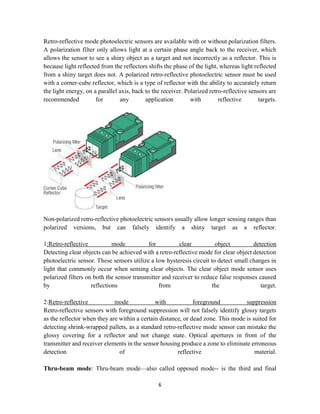
Retro-reflective mode photoelectric sensors are available with or without polarization filters.
A polarization filter only allows light at a certain phase angle back to the receiver, which
allows the sensor to see a shiny object as a target and not incorrectly as a reflector. This is
because light reflected from the reflectors shifts the phase of the light, whereas light reflected
from a shiny target does not. A polarized retro-reflective photoelectric sensor must be used
with a corner-cube reflector, which is a type of reflector with the ability to accurately return
the light energy, on a parallel axis, back to the receiver. Polarized retro-reflective sensors are
recommended for any application with reflective targets.
Non-polarized retro-reflective photoelectric sensors usually allow longer sensing ranges than
polarized versions, but can falsely identify a shiny target as a reflector.
1:Retro-reflective mode for clear object detection
Detecting clear objects can be achieved with a retro-reflective mode for clear object detection
photoelectric sensor. These sensors utilize a low hysteresis circuit to detect small changes in
light that commonly occur when sensing clear objects. The clear object mode sensor uses
polarized filters on both the sensor transmitter and receiver to reduce false responses caused
by reflections from the target.
2:Retro-reflective mode with foreground suppression
Retro-reflective sensors with foreground suppression will not falsely identify glossy targets
as the reflector when they are within a certain distance, or dead zone. This mode is suited for
detecting shrink-wrapped pallets, as a standard retro-reflective mode sensor can mistake the
glossy covering for a reflector and not change state. Optical apertures in front of the
transmitter and receiver elements in the sensor housing produce a zone to eliminate erroneous
detection of reflective material.
Thru-beam mode: Thru-beam mode—also called opposed mode-- is the third and final
7
primary method of detection for photoelectric sensors. This mode uses two separate housings,
one for the transmitter and one for the receiver. The light from the transmitter is aimed at the
receiver and when a target breaks this light beam, the output on the receiver is activated. This
mode is the most efficient of the three, and allows the longest possible sensing ranges for
photoelectric sensors.
Thru-beam mode sensors are available in a variety of styles. The most common includes one
transmitter housing, one receiver housing, and one light beam between the two housings.
Another type is “slot” or “fork” photoelectric sensors that incorporate both transmitter and
receiver into one housing, with no alignment required. Light grids are arrays of many different
transmitters in one housing and many different receivers in another housing, which, when
aimed at each other, create a virtual “sheet” of light beams.
Fiber optic sensing
Fiber sensors guide the light from the transmitter through either plastic or glass cables called
fiber optic cables. In applications involving small targets or unfavorable conditions, fiber
optic cables may be the optimum solution. Fiber optic cables allow either diffused mode or
thru-beam mode sensing.
Glass fiber optic cables are constructed from tiny strands of glass that are bundled together
inside an application-specific sheath. Glass fiber optic cables are typically more rugged than
plastic versions, more efficient in light transmission resulting in longer sensing ranges, and
work well with both visible red and infrared light.
Plastic fiber optic cables are manufactured from a light conductive plastic monofilament
material and are housed in a protective PVC jacket. Plastic fiber optic cables are typically
more flexible and cost-effective than glass versions, can be cut to length, and work only with
visible light.
SIDEBAR/BOX
Application Specific Photoelectric Sensors
In addition to the standard modes of operation for photoelectric sensors, several application
specific sensors also exist. These sensors are used to solve many non-traditional photoelectric
applications, such as detecting changes in a target’s color, porous targets, and invisible
markings on products.
Examples of application specific sensors include:
Color – Color sensors are available in a wide variety of styles and options. The most basic
color sensors are single channel units, which can be programmed to detect a single color.
8
More advanced units can detect up to ten or more unique colors and allow multiple shades to
be programmed on the same channel. Typical applications include quality control where
different colors are marked on the product, as a stage of production is complete. Another
possible application would be to program multiple shades of a color on the same channel.
These colors could indicate the manufacturers acceptable range of color variance for a
finished product in a dyeing or injection molding application.
Contrast – Contrast sensors are used to detect a difference in two colors or media. The sensor
is first taught two different conditions. Next, it evaluates the current conditions, and if the
current target’s reflected light is closer to the first condition the output will remain off. If the
current target’s reflected light is closer to the second condition, the output will change state.
A typical application for contrast sensing is registration mark detection before cutting or
converting paper in the packaging industry.
Luminescence – Luminescence sensors are used to detect inks, greases, glues, paints, chalks
and other materials with luminescent properties. Marks on irregular backgrounds and clear or
invisible markings are easily sensed using an ultraviolet light source. Typical applications for
luminescence sensors are detecting the clear tamper-proof seals on medicine bottles or
detecting a defective product that has been marked with chalk (i.e. a knot in a piece of wood).
Light grids – Light grids are used to create a grid or sheet of light. There are many variations,
sizes and applications for light grids. Miniature, high-resolution light grids can be used for
small parts counting. Larger grids can be used to ensure part ejection from a press before the
next press cycle. Safety light grids are used to create a safe “perimeter” around a machine so
that operators are protected from potentially dangerous parts of the machine.
Passive infrared - Passive infrared sensors are used to detect movement of an object within
a defined sensing area or zone. The term passive is used because the sensor does not emit any
light, but instead detects infrared emissions from an object with a temperature that is different
than the surrounding environment. A typical application for passive infrared sensors is
controlling automatic doors or lights.
Zone scanners – Much like passive infrared sensors, area scanners are used to detect the
presence or movement of an object within a defined sensing area or zone. The main difference
is that active infrared sensors emit light and are able to detect movement of an object in the
area when the temperature of the target cannot be determined. A typical application could be
detecting vehicles approaching an overhead door in a warehouse since neither the temperature
of the vehicle or the environment could be determined.
9
IR SENSOR
The small phototchips having a photocell which are used to emit and detect the infrared light are
called as IR sensors. IR sensors are generally used for designing remote control technology. IR
sensors can be used for detecting obstacles of robotic vehicle and thus control the direction of the
robotic vehicle. There are different types of sensors which can be used for detecting infrared lights.
How they work
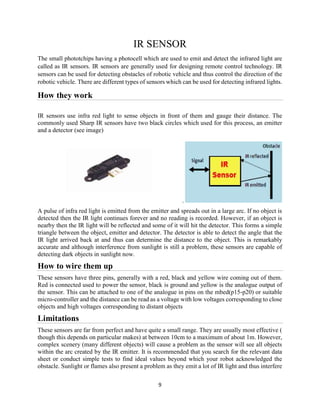
IR sensors use infra red light to sense objects in front of them and gauge their distance. The
commonly used Sharp IR sensors have two black circles which used for this process, an emitter
and a detector (see image)
.
A pulse of infra red light is emitted from the emitter and spreads out in a large arc. If no object is
detected then the IR light continues forever and no reading is recorded. However, if an object is
nearby then the IR light will be reflected and some of it will hit the detector. This forms a simple
triangle between the object, emitter and detector. The detector is able to detect the angle that the
IR light arrived back at and thus can determine the distance to the object. This is remarkably
accurate and although interference from sunlight is still a problem, these sensors are capable of
detecting dark objects in sunlight now.
How to wire them up
These sensors have three pins, generally with a red, black and yellow wire coming out of them.
Red is connected used to power the sensor, black is ground and yellow is the analogue output of
the sensor. This can be attached to one of the analogue in pins on the mbed(p15-p20) or suitable
micro-controller and the distance can be read as a voltage with low voltages corresponding to close
objects and high voltages corresponding to distant objects
Limitations
These sensors are far from perfect and have quite a small range. They are usually most effective (
though this depends on particular makes) at between 10cm to a maximum of about 1m. However,
complex scenery (many different objects) will cause a problem as the sensor will see all objects
within the arc created by the IR emitter. It is recommended that you search for the relevant data
sheet or conduct simple tests to find ideal values beyond which your robot acknowledged the
obstacle. Sunlight or flames also present a problem as they emit a lot of IR light and thus interfere
10
with the IR sensor providing false readings. However, these sensors are suitable for indoor use.
Interference from other sensors can also be a problem if there are multiple robots or parallel
sensors. As with all analogue signals, noise will exist in the readings taken from the sensor.
Circuit
A simple IR sensor circuit is used in our day-to-day life as remote control for TV. It consists of IR
emitter circuit and IR receiver circuits which can be designed as shown in the figure.
The IR emitter circuit which is used as remote by the controller is used for emitting infrared light.
This infrared light is sent or transmitted towards the IR receiver circuit which interfaces to the
device like TV or IR remote controlled robot. Based on the commands received the TV or robot is
controlled.
Passive infrared sensor
A passive infrared sensor (PIR sensor) is an electronic sensor that measures infrared (IR) light
radiating from objects in its field of view. They are most often used in PIR-based motion detectors.
Operating principles
All objects with a temperature above absolute zero emit heat energy in the form of radiation.
Usually this radiation isn't visible to the human eye because it radiates at infrared wavelengths, but
it can be detected by electronic devices designed for such a purpose.
The term passive in this instance refers to the fact that PIR devices do not generate or radiate any
energy for detection purposes. They work entirely by detecting the energy given off by other
objects. PIR sensors don't detect or measure "heat"; instead they detect the infrared radiation
emitted or reflected from an object.
11
Construction
Infrared radiation enters through the front of the sensor, known as the 'sensor face'. At the core of
a PIR sensor is a solid state sensor or set of sensors, made from pyroelectric materials—materials
which generate energy when exposed to heat. Typically, the sensors are approximately 1/4 inch
square (40 mm2
), and take the form of a thin film. Materials commonly used in PIR sensors
include gallium nitride (GaN), caesium nitrate (CsNO3), polyvinyl fluorides, derivatives
of phenylpyridine, and cobalt phthalocyanine. The sensor is often manufactured as part of
an integrated circuit.
PIR-based motion detector
A PIR motion detector used to control an outdoor, automatic light.
A PIR-based motion detector is used to sense movement of people, animals, or other objects. They
are commonly used in burglar alarms and automatically-activated lighting systems. They are
commonly called simply "PIR", or sometimes "PID", for "passive infrared detector".
Operation
An individual PIR sensor detects changes in the amount of infrared radiation impinging upon it,
which varies depending on the temperature and surface characteristics of the objects in front of the
sensor.[2]
When an object, such as a human, passes in front of the background, such as a wall, the
temperature at that point in the sensor's field of view will rise from room temperature to body
temperature, and then back again. The sensor converts the resulting change in the incoming
infrared radiation into a change in the output voltage, and this triggers the detection. Objects of
similar temperature but different surface characteristics may also have a different infrared emission
pattern, and thus moving them with respect to the background may trigger the detector as well.
PIRs come in many configurations for a wide variety of applications. The most common models
have numerous Fresnel lenses or mirror segments, an effective range of about ten meters (thirty
feet), and a field of view less than 180 degrees. Models with wider fields of view, including 360
degrees, are available—typically designed to mount on a ceiling. Some larger PIRs are made with
single segment mirrors and can sense changes in infrared energy over thirty meters (one hundred
feet) away from the PIR. There are also PIRs designed with reversible orientation mirrors which
12
allow either broad coverage (110° wide) or very narrow "curtain" coverage, or with individually
selectable segments to "shape" the coverage.
Differential detection
Pairs of sensor elements may be wired as opposite inputs to a differential amplifier. In such a
configuration, the PIR measurements cancel each other so that the average temperature of the field
of view is removed from the electrical signal; an increase of IR energy across the entire sensor is
self-cancelling and will not trigger the device. This allows the device to resist false indications of
change in the event of being exposed to brief flashes of light or field-wide illumination.
(Continuous high energy exposure may still be able to saturate the sensor materials and render the
sensor unable to register further information.) At the same time, this differential arrangement
minimizes common-mode interference, allowing the device to resist triggering due to nearby
electric fields. However, a differential pair of sensors cannot measure temperature in this
configuration, and therefore is only useful for motion detection.
PIR motion sensor design
The housing will usually have a plastic "window" through which the infrared energy can enter.
Despite often being only translucent to visible light, infrared energy is able to reach the sensor
through the window because the plastic used is transparent to infrared radiation. The plastic
window reduces the chance of foreign objects (dust, insects, etc.) from obscuring the sensor's field
of view, damaging the mechanism, and/or causing false alarms. The window may be used as a
filter, to limit the wavelengths to 8-14 micrometers, which is closest to the infrared radiation
emitted by humans. It may also serve as a focusing mechanism; see below.
13
MOTOR DRIVER IC
What Is Motor Driver IC?
A motor driver IC is an integrated circuit chip which is usually used to control motors in autonomous
robots. Motor driver ICs act as an interface between microprocessors and the motors. The most
commonly used motor driver IC’s are from the L293 series such as L293D, L293NE, etc. These ICs
are designed to control 2 DC motors simultaneously. L293D consist of two H-bridge. H-bridge is the
simplest circuit for controlling a low current rated motor. Here we will discuss L293 as it is widely
used in many circuits and applications.
L293D has 16 pins, they are comprised as follows.
Ground Pins - 4
Input Pins - 4
Output Pins - 4
Enable pins - 2
Voltage Pins - 2
The workings of the individual pins are explained in detail.
Why We Need Motor Driver IC?
Motor Driver ICs are primarily used in autonomous robotics only. Also most microprocessors operate
at low voltages and require a small amount of current to operate while the motors require a relatively
higher voltages and current. Thus current cannot be supplied to the motors from the microprocessor.
This is the primary need for the motor driver IC.
How Motor Driver Operates?
The L293D IC receives signals from the microprocessor and transmits the relative signal to the motors.
It has two voltage pins, one of which is used to draw current for the working of the L293D and the
other is used to apply voltage to the motors. The L293D switches it output signal according to the input
received from the microprocessor.
For Example: If the microprocessor sends a 1(digital high) to the Input Pin of L293D, then the L293D
14
transmits a 1(digital high) to the motor from its Output Pin. An important thing to note is that the
L293D simply transmits the signal it receives. It does not change the signal in any case.
L293D And Its Working
The L293D is a 16 pin IC, with eight pins, on each side, dedicated to the controlling of a motor. There
are 2 INPUT pins, 2 OUTPUT pins and 1 ENABLE pin for each motor. L293D consist of two H-
bridge. H-bridge is the simplest circuit for controlling a low current rated motor.
The Theory for working of a H-bridge is given below.
Working Of A H-bridge
H-bridge is given this name because it can be modelled as four switches on the corners of ‘H’. The
basic diagram of H-bridge is given below :
In the given diagram, the arrow on the left points to the higher potential side of the input voltage of the
circuit. Now if the switches S1 & S4 are kept in a closed position while the switches S2 & S3 are kept
in a open position meaning that the circuit gets shorted across the switches S1 & S4. This creates a
path for the current to flow, starting from the V input to switch S1 to the motor, then to switch S4 and
then the exiting from the circuit. This flow of the current would make the motor turn in one direction.
The direction of motion of the motor can be clockwise or anti-clockwise, this is because the rotation
of the motor depends upon the connection of the terminals of the motor with the switches.
For simplicity, lets assume that in this condition the motor rotates in a clockwise direction.
15
Now, when S3 and S2 are closed then and S1 and S4 are kept open then the current flows from the
other direction and the motor will now definitely rotates in counter-clockwise direction
When S1 and S3 are closed and S2 and S4 are open then the ‘STALL’ condition will occur(The motor
will break).
Stall Condition:
When the motor is applied positive voltage on both sides then the voltage from both the sides brings
the motor shaft to a halt
L293D Pin Diagram :
In the above diagram we can see that,
Pin
No.
Pin Characteristics
1
Enable 1-2, when this is HIGH the left part of the IC will work and when it is low the left part won’t
work. So, this is the Master Control pin for the left part of IC
2 INPUT 1, when this pin is HIGH the current will flow though output 1
3 OUTPUT 1, this pin should be connected to one of the terminal of motor
4,5 GND, ground pins
6 OUTPUT 2, this pin should be connected to one of the terminal of motor
7 INPUT 2, when this pin is HIGH the current will flow though output 2
8
VC, this is the voltage which will be supplied to the motor. So, if you are driving 12 V DC motors
then make sure that this pin is supplied with 12 V
16
16 VSS, this is the power source to the IC. So, this pin should be supplied with 5 V
15 INPUT 4, when this pin is HIGH the current will flow though output 4
14 OUTPUT 4, this pin should be connected to one of the terminal of motor
13,12 GND, ground pins
11 OUTPUT 3, this pin should be connected to one of the terminal of motor
10 INPUT 3, when this pin is HIGH the current will flow though output 3
9
Enable 3-4, when this is HIGH the right part of the IC will work and when it is low the right part
won’t work. So, this is the Master Control pin for the right part of IC
Soldering On A PCB
Given below is the circuit diagram for how the IC needs to be soldered on a PCB with the connectors
From a six pin relimate INPUT 2, INPUT 1, ENABLE 1-2,ENABLE 3-4,INPUT 3 and INPUT 4 are
given.
The inputs to the DC motors are to be given through a two pin relimates whose connectors is shown in
the left and right side of the figure.
17
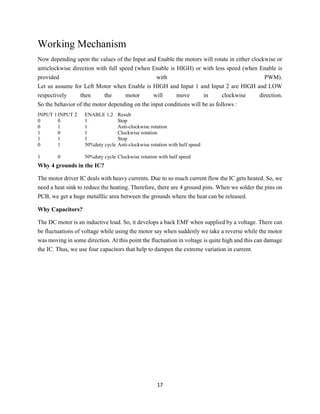
Working Mechanism
Now depending upon the values of the Input and Enable the motors will rotate in either clockwise or
anticlockwise direction with full speed (when Enable is HIGH) or with less speed (when Enable is
provided with PWM).
Let us assume for Left Motor when Enable is HIGH and Input 1 and Input 2 are HIGH and LOW
respectively then the motor will move in clockwise direction.
So the behavior of the motor depending on the input conditions will be as follows :
INPUT 1INPUT 2 ENABLE 1,2 Result
0 0 1 Stop
0 1 1 Anti-clockwise rotation
1 0 1 Clockwise rotation
1 1 1 Stop
0 1 50%duty cycle Anti-clockwise rotation with half speed
1 0 50%duty cycle Clockwise rotation with half speed
Why 4 grounds in the IC?
The motor driver IC deals with heavy currents. Due to so much current flow the IC gets heated. So, we
need a heat sink to reduce the heating. Therefore, there are 4 ground pins. When we solder the pins on
PCB, we get a huge metalllic area between the grounds where the heat can be released.
Why Capacitors?
The DC motor is an inductive load. So, it develops a back EMF when supplied by a voltage. There can
be fluctuations of voltage while using the motor say when suddenly we take a reverse while the motor
was moving in some direction. At this point the fluctuation in voltage is quite high and this can damage
the IC. Thus, we use four capacitors that help to dampen the extreme variation in current.
18
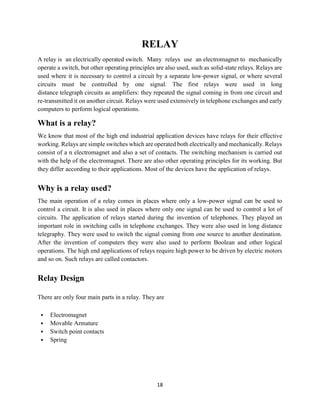
RELAY
A relay is an electrically operated switch. Many relays use an electromagnet to mechanically
operate a switch, but other operating principles are also used, such as solid-state relays. Relays are
used where it is necessary to control a circuit by a separate low-power signal, or where several
circuits must be controlled by one signal. The first relays were used in long
distance telegraph circuits as amplifiers: they repeated the signal coming in from one circuit and
re-transmitted it on another circuit. Relays were used extensively in telephone exchanges and early
computers to perform logical operations.
What is a relay?
We know that most of the high end industrial application devices have relays for their effective
working. Relays are simple switches which are operated both electrically and mechanically. Relays
consist of a n electromagnet and also a set of contacts. The switching mechanism is carried out
with the help of the electromagnet. There are also other operating principles for its working. But
they differ according to their applications. Most of the devices have the application of relays.
Why is a relay used?
The main operation of a relay comes in places where only a low-power signal can be used to
control a circuit. It is also used in places where only one signal can be used to control a lot of
circuits. The application of relays started during the invention of telephones. They played an
important role in switching calls in telephone exchanges. They were also used in long distance
telegraphy. They were used to switch the signal coming from one source to another destination.
After the invention of computers they were also used to perform Boolean and other logical
operations. The high end applications of relays require high power to be driven by electric motors
and so on. Such relays are called contactors.
Relay Design
There are only four main parts in a relay. They are
 Electromagnet
 Movable Armature
 Switch point contacts
 Spring
19
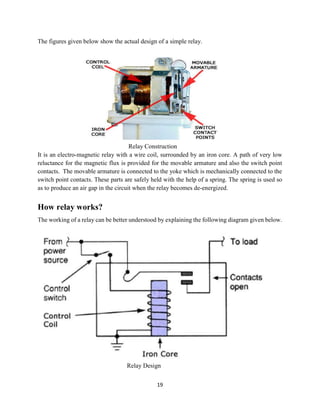
The figures given below show the actual design of a simple relay.
Relay Construction
It is an electro-magnetic relay with a wire coil, surrounded by an iron core. A path of very low
reluctance for the magnetic flux is provided for the movable armature and also the switch point
contacts. The movable armature is connected to the yoke which is mechanically connected to the
switch point contacts. These parts are safely held with the help of a spring. The spring is used so
as to produce an air gap in the circuit when the relay becomes de-energized.
How relay works?
The working of a relay can be better understood by explaining the following diagram given below.
Relay Design
20
The diagram shows an inner section diagram of a relay. An iron core is surrounded by a control
coil. As shown, the power source is given to the electromagnet through a control switch and
through contacts to the load. When current starts flowing through the control coil, the
electromagnet starts energizing and thus intensifies the magnetic field. Thus the upper contact arm
starts to be attracted to the lower fixed arm and thus closes the contacts causing a short circuit for
the power to the load. On the other hand, if the relay was already de-energized when the contacts
were closed, then the contact move oppositely and make an open circuit.
As soon as the coil current is off, the movable armature will be returned by a force back to its
initial position. This force will be almost equal to half the strength of the magnetic force. This
force is mainly provided by two factors. They are the spring and also gravity.
Relays are mainly made for two basic operations. One is low voltage application and the other is
high voltage. For low voltage applications, more preference will be given to reduce the noise of
the whole circuit. For high voltage applications, they are mainly designed to reduce a phenomenon
called arcing.
Relay Basics
The basics for all the relays are the same. Take a look at a 4 – pin relay shown below. There are
two colours shown. The green colour represents the control circuit and the red colour represents
the load circuit. A small control coil is connected onto the control circuit. A switch is connected
to the load. This switch is controlled by the coil in the control circuit. Now let us take the different
steps that occour in a relay.
relay operation Energized Relay (ON) De-Energized Relay (OFF)
21
Energized Relay (ON)
As shown in the circuit, the current flowing through the coils represented by pins 1 and 3 causes a
magnetic field to be aroused. This magnetic field causes the closing of the pins 2 and 4. Thus the
switch plays an important role in the relay working. As it is a part of the load circuit, it is used to
control an electrical circuit that is connected to it. Thus, when the relay in energized the current
flow will be through the pins 2 and 4.
De – Energized Relay (OFF)
As soon as the current flow stops through pins 1 and 3, the switch opens and thus the open circuit
prevents the current flow through pins 2 and 4. Thus the relay becomes de-energized and thus in
off position.
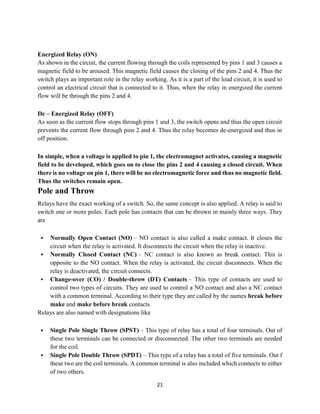
In simple, when a voltage is applied to pin 1, the electromagnet activates, causing a magnetic
field to be developed, which goes on to close the pins 2 and 4 causing a closed circuit. When
there is no voltage on pin 1, there will be no electromagnetic force and thus no magnetic field.
Thus the switches remain open.
Pole and Throw
Relays have the exact working of a switch. So, the same concept is also applied. A relay is said to
switch one or more poles. Each pole has contacts that can be thrown in mainly three ways. They
are
 Normally Open Contact (NO) – NO contact is also called a make contact. It closes the
circuit when the relay is activated. It disconnects the circuit when the relay is inactive.
 Normally Closed Contact (NC) – NC contact is also known as break contact. This is
opposite to the NO contact. When the relay is activated, the circuit disconnects. When the
relay is deactivated, the circuit connects.
 Change-over (CO) / Double-throw (DT) Contacts – This type of contacts are used to
control two types of circuits. They are used to control a NO contact and also a NC contact
with a common terminal. According to their type they are called by the names break before
make and make before break contacts.
Relays are also named with designations like
 Single Pole Single Throw (SPST) – This type of relay has a total of four terminals. Out of
these two terminals can be connected or disconnected. The other two terminals are needed
for the coil.
 Single Pole Double Throw (SPDT) – This type of a relay has a total of five terminals. Out f
these two are the coil terminals. A common terminal is also included which connects to either
of two others.
22
 Double Pole Single Throw (DPST) – This relay has a total of six terminals. These terminals
are further divided into two pairs. Thus they can act as two SPST’s which are actuated by a
single coil. Out of the six terminals two of them are coil terminals.
 Double Pole Double Throw (DPDT) – This is the biggest of all. It has mainly eight relay
terminals. Out of these two rows are designed to be change over terminals. They are designed
to act as two SPDT relays which are actuated by a single coil.
Relay Applications
 Relays are used to realize logic functions. They play a very important role in providing safety
critical logic.
 Relays are used to provide time delay functions. They are used to time the delay open and
delay close of contacts.
 Relays are used to control high voltage circuits with the help of low voltage signals. Similarly
they are used to control high current circuits with the help of low current signals.
 They are also used as protective relays. By this function all the faults during transmission and
reception can be detected and isolated.
Relay Selection
You must note some factors while selecting a particular relay. They are
 Protection – Different protections like contact protection and coil protection must be noted.
Contact protection helps in reducing arcing in circuits using inductors. Coil protection helps
in reducing surge voltage produced during switching.
 Look for a standard relay with all regulatory approvals.
 Switching time – Ask for high speed switching relays if you want one.
 Ratings – There are current as well as voltage ratings. The current ratings vary from a few
amperes to about 3000 amperes. In case of voltage ratings, they vary from 300 Volt AC to
600 Volt AC. There are also high voltage relays of about 15,000 Volts.
 Type of contact used – Whether it is a NC or NO or closed contact.
 Select Make before Break or Break before Make contacts wisely.
 Isolation between coil circuit and contacts
23
Soil Moisture Sensor
This sensor can be used to test the moisture of soil, when the soil is having water shortage, the
module output is at high level, else the output is at low level. By using this sensor one can
automatically water the flower plant, or any other plants requiring automatic watering technique.
Module triple output mode, digital output is simple, analog output more accurate, serial output
with exact readings.
Soil moisture is a key variable in controlling the exchange of water and heat energy between the
land surface and the atmosphere through evaporation and plant transpiration. As a result, soil
moisture plays an important role in the development of weather patterns and the production of
precipitation.
Features
 Sensitivity adjustable.
 Has fixed bolt hole, convenient installation.
 Threshold level can be configured.
 Module triple output mode, digital output is simple, analog output more accurate, serial
output with exact readings.
Applications
 Agriculture
 Landscape irrigation
Soil Moisture Sensor Technology
Tensiometers measure the soil moisture tension or suction. This device is a plastic tube with a
porous ceramic tip attached at one end and a vacuum gauge on the other end. The porous ceramic
tip is installed into the soil at the depth where the majority of the active root system is located. The
vacuum gauge measures the soil moisture tension or suction. It measures how much effort the roots
must put forth to extract water from the soil and is measured in centibars. The higher the reading,
the less moisture that is available and the harder roots must work to extract water. A lower reading
indicates more available water. A tensiometer can be used to take manual readings or a special
model can be installed to provide the capability for the tensiometer to be wired into the sprinkler
system to provide control. Also the tensiometer needs routine maintenance to make sure enough
liquid is in the tensiometer and that it hasn’t broken tension because the soil has separated away
from the ceramic tip. In climates where the ground freezes, tensiometers must be removed and
stored for the winter months and reinstalled the following year.
24
Electrical resistance blocks measure soil moisture tension with two electrodes imbedded in a
porous material such as gypsum, or a sand-ceramic mixture. The block allows moisture to move
in and out of it as the soil dries or becomes moist. The electrodes measure the resistance to electric
current when electrical energy is applied. The more moisture in the block, the lower the resistance
reading indicating more available moisture. The blocks use gypsum or similar material to be a
buffer against salts (such as fertilizer) that would also affect resistance readings. The sensors using
a granular matrix seem to work well and last for a longer time as compared to gypsum blocks.
Heat dissipation sensors measure soil moisture by measuring how much heat is dissipated in a
ceramic medium. The heat dissipated is directly proportional to the amount of water contained
within the ceramic’s void spaces. The more water that is contained in the ceramic, the more heat
is dissipated and the lower the sensor readings. This corresponds to a higher soil matric potential
or in other words, more available water for the plant. The sensor works when water moves in or
out of the ceramic due to capillary forces in the soil. The manufacturers claim this type of sensor
is independent of soil type or salinity influences.
Dielectric sensors have been developed that will calculate the soil moisture content by measuring
the dielectric constant of the soil. A dielectric is a material that does not readily conduct electricity.
Dielectric sensors use two different methods to measure soil moisture without measuring electrical
conductivity.
Capacitance sensors use frequency-domain-reflectometry and TDR sensors use time-domain-
reflectometry. Dielectric sensors are generally expensive and are used more in scientiSEfic
research than to actually control a lawn sprinkler system.
Capacitance sensors contain two electrodes separated by a dielectric. The electrodes are inserted
into the soil or in an access tube in the soil and the soil becomes part of the dielectric. A very high
oscillating frequency is applied to the electrodes, which results in a resonant frequency, the value
of which depends upon the dielectric constant of the soil. The moisture content of the soil will
change the dielectric constant of the soil, therefore more moisture in the soil will change the
frequency. This change is converted into a soil moisture measurement.
TDR measures the time required for an electromagnetic pulse to travel a finite distance along a
wave guide (steel rods or length of wire) and is dependent upon the dielectric properties of the
material surrounding (the soil) the wave guide. As moisture increases in the soil, the time taken
for the pulses to travel slows down. The signal is then converted into a soil moisture measurement.
This technology is very complex and quite expensive, but seems to provide high accuracy.
25
References:
1. Wikipedia
2. Engineersautomation.com
3. A pdf “ir-sensor”
4. Pdf “soil moisture sensor”
5. Austin Hughes ‘Electric Motors and Drives’.

Sensors and ics

  • 1.
    1 SENSORS Sensors are sophisticateddevices that are frequently used to detect and respond to electrical or optical signals. A Sensor converts the physical parameter (for example: temperature, blood pressure, humidity, speed, etc.) into a signal which can be measured electrically. Let’s explain the example of temperature. The mercury in the glass thermometer expands and contracts the liquid to convert the measured temperature which can be read by a viewer on the calibrated glass tube. Industrial sensors are the eyes and ears of the new factory floor, and they come in all sizes, shapes, and technologies. The most common technologies are inductive, capacitive, photoelectric, magnetic, and ultrasonic. Each technology has unique strengths and weaknesses, so the requirements of the application itself will determine what technology should be used. INTEGRATED CIRCUITS (ICs) An integrated circuit or monolithic integrated circuit (also referred to as an IC, a chip, or a microchip) is a set of electronic circuits on one small flat piece (or "chip") of semiconductor material, normally silicon. The integration of large numbers of tiny transistors into a small chip resulted in circuits that are orders of magnitude smaller, cheaper, and faster than those constructed of discrete electronic components. The IC's mass production capability, reliability and building- block approach to circuit design ensured the rapid adoption of standardized ICs in place of designs using discrete transistors. ICs are now used in virtually all electronic equipment and have revolutionized the world of electronics. Computers, mobile phones, and other digital home appliances are now inextricable parts of the structure of modern societies, made possible by the small size and low cost of ICs. In this report we will discuss some important sensors as well as ICs and their technologies and their applications. This list will include Photo sensors, IR sensors and PIR sensors, Motor driver IC, Relay and Soil moisture sensor.
  • 2.
    2 Photo Sensors This articleis focused on photoelectric sensors and defines what they are, their advantages and some basic modes of operation. Photoelectric sensors are readily present in everyday life. They help safely control the opening and closing of garage doors, turn on sink faucets with the wave of a hand, control elevators, open the doors at the grocery store, detect the winning car at racing events, and so much more. A photoelectric sensor is a device that detects a change in light intensity. Typically, this means either non-detection or detection of the sensor’s emitted light source. The type of light and method by which the target is detected varies depending on the sensor. Photoelectric sensors are made up of a light source (LED), a receiver (phototransistor), a signal converter, and an amplifier. The phototransistor analyzes incoming light, verifies that it is from the LED, and appropriately triggers an output. Photoelectric sensors offer many advantages when compared to other technologies. Sensing ranges for photoelectric sensors far surpass the inductive, capacitive, magnetic, and ultrasonic technologies. Their small size versus sensing range and a unique variety of housings makes them a perfect fit for almost any application. Finally, with continual advances in technology, photoelectric sensors are price competitive with other sensing technologies. Sensing Modes Photoelectric sensors provide three primary methods of target detection: diffused, retro- reflective and thru-beam, with variations of each.
  • 3.
    3 Diffused Mode: Indiffused mode sensing, sometimes called proximity mode, the transmitter and receiver are in the same housing. Light from the transmitter strikes the target, which reflects light at arbitrary angles. Some of the reflected light returns to the receiver, and the target is detected. Because much of the transmitted energy is lost due to the targets angle and ability to reflect light, diffused mode results in shorter sensing ranges than is attainable with retro-reflective and thru-beam modes. The advantage is that a secondary device, such as a reflector or a separate receiver, is not required. Factors affecting diffused mode sensing range include the target’s color, size, and finish because these directly affect its reflectivity and therefore its ability to reflect light back to the sensor’s receiver. The table below illustrates the effect of the target on the sensing range for diffused mode sensing. DIFFUSED MODE REFLECTIVITY TABLE The values in this chart are intended only as guidelines, as a variety of factors determine the exact sensing range in an application. 1:Diffused Convergent Beam Mode Convergent beam mode is a more efficient method of diffused mode sensing. In convergent beam mode, the transmitter lens is focused to an exact point in front of the sensor, and the receiver lens is focused to the same point. The sensing range is fixed and defined as the focus point. The sensor is then able to detect an object at this focal point, plus or minus some
  • 4.
    4 distance, known asthe “sensing window”. Objects in front of or behind this sensing window are ignored. The sensing window is dependent on the target’s reflectivity and the sensitivity adjustment. Because all of the emitted energy is focused to a single point, a high amount of excess gain is available, which enables the sensor to easily detect narrow or low reflectivity targets. 2:Diffused Mode with Background Suppression: Diffused mode sensing with background suppression detects targets only up to a certain “cut- off” distance, but ignores objects beyond the distance. This mode also minimizes sensitivity to a target’s color among the diffused mode variations. One main advantage of diffused mode with background suppression is the ability to ignore a background object that may be incorrectly identified as a target by a standard diffused mode photoelectric sensor. Diffused mode with background suppression can operate at a fixed distance or at a variable distance. Background suppression can be accomplished technically in two ways, either mechanically or electronically. 3:Diffused Mode with Mechanical Background Suppression For mechanical background suppression, there are two receiving elements in the photoelectric sensor, one of which receives light from the target and the other receives light from the background. When the reflected light at the target receiver is greater than that at the background receiver, the target is detected and the output is activated. When the reflected light at the background receiver is greater than that at the target receiver, the target is not
  • 5.
    5 detected and theoutput does not change state. The focal point can be mechanically adjusted for variable distance sensors. 4:Diffused Mode with Electronic Background Suppression With electronic background suppression, a Position Sensitive Device (PSD) is used inside the sensor instead of mechanical parts. The transmitter emits a light beam, which is reflected back to two different points on the PSD from both the target and the background material. The sensor evaluates the light striking these two points on the PSD and compares this signal to the pre-set value to determine whether the output changes state. Retro-reflective mode: Retro-reflective mode is the second primary mode of photoelectric sensing. As with diffused mode sensing, the transmitter and receiver are in the same housing, but a reflector is used to reflect the light from the transmitter back to the receiver. The target is detected when it blocks the beam from the photoelectric sensor to the reflector. Retro- reflective mode typically allows longer sensing ranges than diffused mode due to the increased efficiency of the reflector compared with the reflectivity of most targets. The target color and finish do not affect the sensing range in retro-reflective mode as they do with diffused mode.
  • 6.
    6 Retro-reflective mode photoelectricsensors are available with or without polarization filters. A polarization filter only allows light at a certain phase angle back to the receiver, which allows the sensor to see a shiny object as a target and not incorrectly as a reflector. This is because light reflected from the reflectors shifts the phase of the light, whereas light reflected from a shiny target does not. A polarized retro-reflective photoelectric sensor must be used with a corner-cube reflector, which is a type of reflector with the ability to accurately return the light energy, on a parallel axis, back to the receiver. Polarized retro-reflective sensors are recommended for any application with reflective targets. Non-polarized retro-reflective photoelectric sensors usually allow longer sensing ranges than polarized versions, but can falsely identify a shiny target as a reflector. 1:Retro-reflective mode for clear object detection Detecting clear objects can be achieved with a retro-reflective mode for clear object detection photoelectric sensor. These sensors utilize a low hysteresis circuit to detect small changes in light that commonly occur when sensing clear objects. The clear object mode sensor uses polarized filters on both the sensor transmitter and receiver to reduce false responses caused by reflections from the target. 2:Retro-reflective mode with foreground suppression Retro-reflective sensors with foreground suppression will not falsely identify glossy targets as the reflector when they are within a certain distance, or dead zone. This mode is suited for detecting shrink-wrapped pallets, as a standard retro-reflective mode sensor can mistake the glossy covering for a reflector and not change state. Optical apertures in front of the transmitter and receiver elements in the sensor housing produce a zone to eliminate erroneous detection of reflective material. Thru-beam mode: Thru-beam mode—also called opposed mode-- is the third and final
  • 7.
    7 primary method ofdetection for photoelectric sensors. This mode uses two separate housings, one for the transmitter and one for the receiver. The light from the transmitter is aimed at the receiver and when a target breaks this light beam, the output on the receiver is activated. This mode is the most efficient of the three, and allows the longest possible sensing ranges for photoelectric sensors. Thru-beam mode sensors are available in a variety of styles. The most common includes one transmitter housing, one receiver housing, and one light beam between the two housings. Another type is “slot” or “fork” photoelectric sensors that incorporate both transmitter and receiver into one housing, with no alignment required. Light grids are arrays of many different transmitters in one housing and many different receivers in another housing, which, when aimed at each other, create a virtual “sheet” of light beams. Fiber optic sensing Fiber sensors guide the light from the transmitter through either plastic or glass cables called fiber optic cables. In applications involving small targets or unfavorable conditions, fiber optic cables may be the optimum solution. Fiber optic cables allow either diffused mode or thru-beam mode sensing. Glass fiber optic cables are constructed from tiny strands of glass that are bundled together inside an application-specific sheath. Glass fiber optic cables are typically more rugged than plastic versions, more efficient in light transmission resulting in longer sensing ranges, and work well with both visible red and infrared light. Plastic fiber optic cables are manufactured from a light conductive plastic monofilament material and are housed in a protective PVC jacket. Plastic fiber optic cables are typically more flexible and cost-effective than glass versions, can be cut to length, and work only with visible light. SIDEBAR/BOX Application Specific Photoelectric Sensors In addition to the standard modes of operation for photoelectric sensors, several application specific sensors also exist. These sensors are used to solve many non-traditional photoelectric applications, such as detecting changes in a target’s color, porous targets, and invisible markings on products. Examples of application specific sensors include: Color – Color sensors are available in a wide variety of styles and options. The most basic color sensors are single channel units, which can be programmed to detect a single color.
  • 8.
    8 More advanced unitscan detect up to ten or more unique colors and allow multiple shades to be programmed on the same channel. Typical applications include quality control where different colors are marked on the product, as a stage of production is complete. Another possible application would be to program multiple shades of a color on the same channel. These colors could indicate the manufacturers acceptable range of color variance for a finished product in a dyeing or injection molding application. Contrast – Contrast sensors are used to detect a difference in two colors or media. The sensor is first taught two different conditions. Next, it evaluates the current conditions, and if the current target’s reflected light is closer to the first condition the output will remain off. If the current target’s reflected light is closer to the second condition, the output will change state. A typical application for contrast sensing is registration mark detection before cutting or converting paper in the packaging industry. Luminescence – Luminescence sensors are used to detect inks, greases, glues, paints, chalks and other materials with luminescent properties. Marks on irregular backgrounds and clear or invisible markings are easily sensed using an ultraviolet light source. Typical applications for luminescence sensors are detecting the clear tamper-proof seals on medicine bottles or detecting a defective product that has been marked with chalk (i.e. a knot in a piece of wood). Light grids – Light grids are used to create a grid or sheet of light. There are many variations, sizes and applications for light grids. Miniature, high-resolution light grids can be used for small parts counting. Larger grids can be used to ensure part ejection from a press before the next press cycle. Safety light grids are used to create a safe “perimeter” around a machine so that operators are protected from potentially dangerous parts of the machine. Passive infrared - Passive infrared sensors are used to detect movement of an object within a defined sensing area or zone. The term passive is used because the sensor does not emit any light, but instead detects infrared emissions from an object with a temperature that is different than the surrounding environment. A typical application for passive infrared sensors is controlling automatic doors or lights. Zone scanners – Much like passive infrared sensors, area scanners are used to detect the presence or movement of an object within a defined sensing area or zone. The main difference is that active infrared sensors emit light and are able to detect movement of an object in the area when the temperature of the target cannot be determined. A typical application could be detecting vehicles approaching an overhead door in a warehouse since neither the temperature of the vehicle or the environment could be determined.
  • 9.
    9 IR SENSOR The smallphototchips having a photocell which are used to emit and detect the infrared light are called as IR sensors. IR sensors are generally used for designing remote control technology. IR sensors can be used for detecting obstacles of robotic vehicle and thus control the direction of the robotic vehicle. There are different types of sensors which can be used for detecting infrared lights. How they work IR sensors use infra red light to sense objects in front of them and gauge their distance. The commonly used Sharp IR sensors have two black circles which used for this process, an emitter and a detector (see image) . A pulse of infra red light is emitted from the emitter and spreads out in a large arc. If no object is detected then the IR light continues forever and no reading is recorded. However, if an object is nearby then the IR light will be reflected and some of it will hit the detector. This forms a simple triangle between the object, emitter and detector. The detector is able to detect the angle that the IR light arrived back at and thus can determine the distance to the object. This is remarkably accurate and although interference from sunlight is still a problem, these sensors are capable of detecting dark objects in sunlight now. How to wire them up These sensors have three pins, generally with a red, black and yellow wire coming out of them. Red is connected used to power the sensor, black is ground and yellow is the analogue output of the sensor. This can be attached to one of the analogue in pins on the mbed(p15-p20) or suitable micro-controller and the distance can be read as a voltage with low voltages corresponding to close objects and high voltages corresponding to distant objects Limitations These sensors are far from perfect and have quite a small range. They are usually most effective ( though this depends on particular makes) at between 10cm to a maximum of about 1m. However, complex scenery (many different objects) will cause a problem as the sensor will see all objects within the arc created by the IR emitter. It is recommended that you search for the relevant data sheet or conduct simple tests to find ideal values beyond which your robot acknowledged the obstacle. Sunlight or flames also present a problem as they emit a lot of IR light and thus interfere
  • 10.
    10 with the IRsensor providing false readings. However, these sensors are suitable for indoor use. Interference from other sensors can also be a problem if there are multiple robots or parallel sensors. As with all analogue signals, noise will exist in the readings taken from the sensor. Circuit A simple IR sensor circuit is used in our day-to-day life as remote control for TV. It consists of IR emitter circuit and IR receiver circuits which can be designed as shown in the figure. The IR emitter circuit which is used as remote by the controller is used for emitting infrared light. This infrared light is sent or transmitted towards the IR receiver circuit which interfaces to the device like TV or IR remote controlled robot. Based on the commands received the TV or robot is controlled. Passive infrared sensor A passive infrared sensor (PIR sensor) is an electronic sensor that measures infrared (IR) light radiating from objects in its field of view. They are most often used in PIR-based motion detectors. Operating principles All objects with a temperature above absolute zero emit heat energy in the form of radiation. Usually this radiation isn't visible to the human eye because it radiates at infrared wavelengths, but it can be detected by electronic devices designed for such a purpose. The term passive in this instance refers to the fact that PIR devices do not generate or radiate any energy for detection purposes. They work entirely by detecting the energy given off by other objects. PIR sensors don't detect or measure "heat"; instead they detect the infrared radiation emitted or reflected from an object.
  • 11.
    11 Construction Infrared radiation entersthrough the front of the sensor, known as the 'sensor face'. At the core of a PIR sensor is a solid state sensor or set of sensors, made from pyroelectric materials—materials which generate energy when exposed to heat. Typically, the sensors are approximately 1/4 inch square (40 mm2 ), and take the form of a thin film. Materials commonly used in PIR sensors include gallium nitride (GaN), caesium nitrate (CsNO3), polyvinyl fluorides, derivatives of phenylpyridine, and cobalt phthalocyanine. The sensor is often manufactured as part of an integrated circuit. PIR-based motion detector A PIR motion detector used to control an outdoor, automatic light. A PIR-based motion detector is used to sense movement of people, animals, or other objects. They are commonly used in burglar alarms and automatically-activated lighting systems. They are commonly called simply "PIR", or sometimes "PID", for "passive infrared detector". Operation An individual PIR sensor detects changes in the amount of infrared radiation impinging upon it, which varies depending on the temperature and surface characteristics of the objects in front of the sensor.[2] When an object, such as a human, passes in front of the background, such as a wall, the temperature at that point in the sensor's field of view will rise from room temperature to body temperature, and then back again. The sensor converts the resulting change in the incoming infrared radiation into a change in the output voltage, and this triggers the detection. Objects of similar temperature but different surface characteristics may also have a different infrared emission pattern, and thus moving them with respect to the background may trigger the detector as well. PIRs come in many configurations for a wide variety of applications. The most common models have numerous Fresnel lenses or mirror segments, an effective range of about ten meters (thirty feet), and a field of view less than 180 degrees. Models with wider fields of view, including 360 degrees, are available—typically designed to mount on a ceiling. Some larger PIRs are made with single segment mirrors and can sense changes in infrared energy over thirty meters (one hundred feet) away from the PIR. There are also PIRs designed with reversible orientation mirrors which
  • 12.
    12 allow either broadcoverage (110° wide) or very narrow "curtain" coverage, or with individually selectable segments to "shape" the coverage. Differential detection Pairs of sensor elements may be wired as opposite inputs to a differential amplifier. In such a configuration, the PIR measurements cancel each other so that the average temperature of the field of view is removed from the electrical signal; an increase of IR energy across the entire sensor is self-cancelling and will not trigger the device. This allows the device to resist false indications of change in the event of being exposed to brief flashes of light or field-wide illumination. (Continuous high energy exposure may still be able to saturate the sensor materials and render the sensor unable to register further information.) At the same time, this differential arrangement minimizes common-mode interference, allowing the device to resist triggering due to nearby electric fields. However, a differential pair of sensors cannot measure temperature in this configuration, and therefore is only useful for motion detection. PIR motion sensor design The housing will usually have a plastic "window" through which the infrared energy can enter. Despite often being only translucent to visible light, infrared energy is able to reach the sensor through the window because the plastic used is transparent to infrared radiation. The plastic window reduces the chance of foreign objects (dust, insects, etc.) from obscuring the sensor's field of view, damaging the mechanism, and/or causing false alarms. The window may be used as a filter, to limit the wavelengths to 8-14 micrometers, which is closest to the infrared radiation emitted by humans. It may also serve as a focusing mechanism; see below.
  • 13.
    13 MOTOR DRIVER IC WhatIs Motor Driver IC? A motor driver IC is an integrated circuit chip which is usually used to control motors in autonomous robots. Motor driver ICs act as an interface between microprocessors and the motors. The most commonly used motor driver IC’s are from the L293 series such as L293D, L293NE, etc. These ICs are designed to control 2 DC motors simultaneously. L293D consist of two H-bridge. H-bridge is the simplest circuit for controlling a low current rated motor. Here we will discuss L293 as it is widely used in many circuits and applications. L293D has 16 pins, they are comprised as follows. Ground Pins - 4 Input Pins - 4 Output Pins - 4 Enable pins - 2 Voltage Pins - 2 The workings of the individual pins are explained in detail. Why We Need Motor Driver IC? Motor Driver ICs are primarily used in autonomous robotics only. Also most microprocessors operate at low voltages and require a small amount of current to operate while the motors require a relatively higher voltages and current. Thus current cannot be supplied to the motors from the microprocessor. This is the primary need for the motor driver IC. How Motor Driver Operates? The L293D IC receives signals from the microprocessor and transmits the relative signal to the motors. It has two voltage pins, one of which is used to draw current for the working of the L293D and the other is used to apply voltage to the motors. The L293D switches it output signal according to the input received from the microprocessor. For Example: If the microprocessor sends a 1(digital high) to the Input Pin of L293D, then the L293D
  • 14.
    14 transmits a 1(digitalhigh) to the motor from its Output Pin. An important thing to note is that the L293D simply transmits the signal it receives. It does not change the signal in any case. L293D And Its Working The L293D is a 16 pin IC, with eight pins, on each side, dedicated to the controlling of a motor. There are 2 INPUT pins, 2 OUTPUT pins and 1 ENABLE pin for each motor. L293D consist of two H- bridge. H-bridge is the simplest circuit for controlling a low current rated motor. The Theory for working of a H-bridge is given below. Working Of A H-bridge H-bridge is given this name because it can be modelled as four switches on the corners of ‘H’. The basic diagram of H-bridge is given below : In the given diagram, the arrow on the left points to the higher potential side of the input voltage of the circuit. Now if the switches S1 & S4 are kept in a closed position while the switches S2 & S3 are kept in a open position meaning that the circuit gets shorted across the switches S1 & S4. This creates a path for the current to flow, starting from the V input to switch S1 to the motor, then to switch S4 and then the exiting from the circuit. This flow of the current would make the motor turn in one direction. The direction of motion of the motor can be clockwise or anti-clockwise, this is because the rotation of the motor depends upon the connection of the terminals of the motor with the switches. For simplicity, lets assume that in this condition the motor rotates in a clockwise direction.
  • 15.
    15 Now, when S3and S2 are closed then and S1 and S4 are kept open then the current flows from the other direction and the motor will now definitely rotates in counter-clockwise direction When S1 and S3 are closed and S2 and S4 are open then the ‘STALL’ condition will occur(The motor will break). Stall Condition: When the motor is applied positive voltage on both sides then the voltage from both the sides brings the motor shaft to a halt L293D Pin Diagram : In the above diagram we can see that, Pin No. Pin Characteristics 1 Enable 1-2, when this is HIGH the left part of the IC will work and when it is low the left part won’t work. So, this is the Master Control pin for the left part of IC 2 INPUT 1, when this pin is HIGH the current will flow though output 1 3 OUTPUT 1, this pin should be connected to one of the terminal of motor 4,5 GND, ground pins 6 OUTPUT 2, this pin should be connected to one of the terminal of motor 7 INPUT 2, when this pin is HIGH the current will flow though output 2 8 VC, this is the voltage which will be supplied to the motor. So, if you are driving 12 V DC motors then make sure that this pin is supplied with 12 V
  • 16.
    16 16 VSS, thisis the power source to the IC. So, this pin should be supplied with 5 V 15 INPUT 4, when this pin is HIGH the current will flow though output 4 14 OUTPUT 4, this pin should be connected to one of the terminal of motor 13,12 GND, ground pins 11 OUTPUT 3, this pin should be connected to one of the terminal of motor 10 INPUT 3, when this pin is HIGH the current will flow though output 3 9 Enable 3-4, when this is HIGH the right part of the IC will work and when it is low the right part won’t work. So, this is the Master Control pin for the right part of IC Soldering On A PCB Given below is the circuit diagram for how the IC needs to be soldered on a PCB with the connectors From a six pin relimate INPUT 2, INPUT 1, ENABLE 1-2,ENABLE 3-4,INPUT 3 and INPUT 4 are given. The inputs to the DC motors are to be given through a two pin relimates whose connectors is shown in the left and right side of the figure.
  • 17.
    17 Working Mechanism Now dependingupon the values of the Input and Enable the motors will rotate in either clockwise or anticlockwise direction with full speed (when Enable is HIGH) or with less speed (when Enable is provided with PWM). Let us assume for Left Motor when Enable is HIGH and Input 1 and Input 2 are HIGH and LOW respectively then the motor will move in clockwise direction. So the behavior of the motor depending on the input conditions will be as follows : INPUT 1INPUT 2 ENABLE 1,2 Result 0 0 1 Stop 0 1 1 Anti-clockwise rotation 1 0 1 Clockwise rotation 1 1 1 Stop 0 1 50%duty cycle Anti-clockwise rotation with half speed 1 0 50%duty cycle Clockwise rotation with half speed Why 4 grounds in the IC? The motor driver IC deals with heavy currents. Due to so much current flow the IC gets heated. So, we need a heat sink to reduce the heating. Therefore, there are 4 ground pins. When we solder the pins on PCB, we get a huge metalllic area between the grounds where the heat can be released. Why Capacitors? The DC motor is an inductive load. So, it develops a back EMF when supplied by a voltage. There can be fluctuations of voltage while using the motor say when suddenly we take a reverse while the motor was moving in some direction. At this point the fluctuation in voltage is quite high and this can damage the IC. Thus, we use four capacitors that help to dampen the extreme variation in current.
  • 18.
    18 RELAY A relay isan electrically operated switch. Many relays use an electromagnet to mechanically operate a switch, but other operating principles are also used, such as solid-state relays. Relays are used where it is necessary to control a circuit by a separate low-power signal, or where several circuits must be controlled by one signal. The first relays were used in long distance telegraph circuits as amplifiers: they repeated the signal coming in from one circuit and re-transmitted it on another circuit. Relays were used extensively in telephone exchanges and early computers to perform logical operations. What is a relay? We know that most of the high end industrial application devices have relays for their effective working. Relays are simple switches which are operated both electrically and mechanically. Relays consist of a n electromagnet and also a set of contacts. The switching mechanism is carried out with the help of the electromagnet. There are also other operating principles for its working. But they differ according to their applications. Most of the devices have the application of relays. Why is a relay used? The main operation of a relay comes in places where only a low-power signal can be used to control a circuit. It is also used in places where only one signal can be used to control a lot of circuits. The application of relays started during the invention of telephones. They played an important role in switching calls in telephone exchanges. They were also used in long distance telegraphy. They were used to switch the signal coming from one source to another destination. After the invention of computers they were also used to perform Boolean and other logical operations. The high end applications of relays require high power to be driven by electric motors and so on. Such relays are called contactors. Relay Design There are only four main parts in a relay. They are  Electromagnet  Movable Armature  Switch point contacts  Spring
  • 19.
    19 The figures givenbelow show the actual design of a simple relay. Relay Construction It is an electro-magnetic relay with a wire coil, surrounded by an iron core. A path of very low reluctance for the magnetic flux is provided for the movable armature and also the switch point contacts. The movable armature is connected to the yoke which is mechanically connected to the switch point contacts. These parts are safely held with the help of a spring. The spring is used so as to produce an air gap in the circuit when the relay becomes de-energized. How relay works? The working of a relay can be better understood by explaining the following diagram given below. Relay Design
  • 20.
    20 The diagram showsan inner section diagram of a relay. An iron core is surrounded by a control coil. As shown, the power source is given to the electromagnet through a control switch and through contacts to the load. When current starts flowing through the control coil, the electromagnet starts energizing and thus intensifies the magnetic field. Thus the upper contact arm starts to be attracted to the lower fixed arm and thus closes the contacts causing a short circuit for the power to the load. On the other hand, if the relay was already de-energized when the contacts were closed, then the contact move oppositely and make an open circuit. As soon as the coil current is off, the movable armature will be returned by a force back to its initial position. This force will be almost equal to half the strength of the magnetic force. This force is mainly provided by two factors. They are the spring and also gravity. Relays are mainly made for two basic operations. One is low voltage application and the other is high voltage. For low voltage applications, more preference will be given to reduce the noise of the whole circuit. For high voltage applications, they are mainly designed to reduce a phenomenon called arcing. Relay Basics The basics for all the relays are the same. Take a look at a 4 – pin relay shown below. There are two colours shown. The green colour represents the control circuit and the red colour represents the load circuit. A small control coil is connected onto the control circuit. A switch is connected to the load. This switch is controlled by the coil in the control circuit. Now let us take the different steps that occour in a relay. relay operation Energized Relay (ON) De-Energized Relay (OFF)
  • 21.
    21 Energized Relay (ON) Asshown in the circuit, the current flowing through the coils represented by pins 1 and 3 causes a magnetic field to be aroused. This magnetic field causes the closing of the pins 2 and 4. Thus the switch plays an important role in the relay working. As it is a part of the load circuit, it is used to control an electrical circuit that is connected to it. Thus, when the relay in energized the current flow will be through the pins 2 and 4. De – Energized Relay (OFF) As soon as the current flow stops through pins 1 and 3, the switch opens and thus the open circuit prevents the current flow through pins 2 and 4. Thus the relay becomes de-energized and thus in off position. In simple, when a voltage is applied to pin 1, the electromagnet activates, causing a magnetic field to be developed, which goes on to close the pins 2 and 4 causing a closed circuit. When there is no voltage on pin 1, there will be no electromagnetic force and thus no magnetic field. Thus the switches remain open. Pole and Throw Relays have the exact working of a switch. So, the same concept is also applied. A relay is said to switch one or more poles. Each pole has contacts that can be thrown in mainly three ways. They are  Normally Open Contact (NO) – NO contact is also called a make contact. It closes the circuit when the relay is activated. It disconnects the circuit when the relay is inactive.  Normally Closed Contact (NC) – NC contact is also known as break contact. This is opposite to the NO contact. When the relay is activated, the circuit disconnects. When the relay is deactivated, the circuit connects.  Change-over (CO) / Double-throw (DT) Contacts – This type of contacts are used to control two types of circuits. They are used to control a NO contact and also a NC contact with a common terminal. According to their type they are called by the names break before make and make before break contacts. Relays are also named with designations like  Single Pole Single Throw (SPST) – This type of relay has a total of four terminals. Out of these two terminals can be connected or disconnected. The other two terminals are needed for the coil.  Single Pole Double Throw (SPDT) – This type of a relay has a total of five terminals. Out f these two are the coil terminals. A common terminal is also included which connects to either of two others.
  • 22.
    22  Double PoleSingle Throw (DPST) – This relay has a total of six terminals. These terminals are further divided into two pairs. Thus they can act as two SPST’s which are actuated by a single coil. Out of the six terminals two of them are coil terminals.  Double Pole Double Throw (DPDT) – This is the biggest of all. It has mainly eight relay terminals. Out of these two rows are designed to be change over terminals. They are designed to act as two SPDT relays which are actuated by a single coil. Relay Applications  Relays are used to realize logic functions. They play a very important role in providing safety critical logic.  Relays are used to provide time delay functions. They are used to time the delay open and delay close of contacts.  Relays are used to control high voltage circuits with the help of low voltage signals. Similarly they are used to control high current circuits with the help of low current signals.  They are also used as protective relays. By this function all the faults during transmission and reception can be detected and isolated. Relay Selection You must note some factors while selecting a particular relay. They are  Protection – Different protections like contact protection and coil protection must be noted. Contact protection helps in reducing arcing in circuits using inductors. Coil protection helps in reducing surge voltage produced during switching.  Look for a standard relay with all regulatory approvals.  Switching time – Ask for high speed switching relays if you want one.  Ratings – There are current as well as voltage ratings. The current ratings vary from a few amperes to about 3000 amperes. In case of voltage ratings, they vary from 300 Volt AC to 600 Volt AC. There are also high voltage relays of about 15,000 Volts.  Type of contact used – Whether it is a NC or NO or closed contact.  Select Make before Break or Break before Make contacts wisely.  Isolation between coil circuit and contacts
  • 23.
    23 Soil Moisture Sensor Thissensor can be used to test the moisture of soil, when the soil is having water shortage, the module output is at high level, else the output is at low level. By using this sensor one can automatically water the flower plant, or any other plants requiring automatic watering technique. Module triple output mode, digital output is simple, analog output more accurate, serial output with exact readings. Soil moisture is a key variable in controlling the exchange of water and heat energy between the land surface and the atmosphere through evaporation and plant transpiration. As a result, soil moisture plays an important role in the development of weather patterns and the production of precipitation. Features  Sensitivity adjustable.  Has fixed bolt hole, convenient installation.  Threshold level can be configured.  Module triple output mode, digital output is simple, analog output more accurate, serial output with exact readings. Applications  Agriculture  Landscape irrigation Soil Moisture Sensor Technology Tensiometers measure the soil moisture tension or suction. This device is a plastic tube with a porous ceramic tip attached at one end and a vacuum gauge on the other end. The porous ceramic tip is installed into the soil at the depth where the majority of the active root system is located. The vacuum gauge measures the soil moisture tension or suction. It measures how much effort the roots must put forth to extract water from the soil and is measured in centibars. The higher the reading, the less moisture that is available and the harder roots must work to extract water. A lower reading indicates more available water. A tensiometer can be used to take manual readings or a special model can be installed to provide the capability for the tensiometer to be wired into the sprinkler system to provide control. Also the tensiometer needs routine maintenance to make sure enough liquid is in the tensiometer and that it hasn’t broken tension because the soil has separated away from the ceramic tip. In climates where the ground freezes, tensiometers must be removed and stored for the winter months and reinstalled the following year.
  • 24.
    24 Electrical resistance blocksmeasure soil moisture tension with two electrodes imbedded in a porous material such as gypsum, or a sand-ceramic mixture. The block allows moisture to move in and out of it as the soil dries or becomes moist. The electrodes measure the resistance to electric current when electrical energy is applied. The more moisture in the block, the lower the resistance reading indicating more available moisture. The blocks use gypsum or similar material to be a buffer against salts (such as fertilizer) that would also affect resistance readings. The sensors using a granular matrix seem to work well and last for a longer time as compared to gypsum blocks. Heat dissipation sensors measure soil moisture by measuring how much heat is dissipated in a ceramic medium. The heat dissipated is directly proportional to the amount of water contained within the ceramic’s void spaces. The more water that is contained in the ceramic, the more heat is dissipated and the lower the sensor readings. This corresponds to a higher soil matric potential or in other words, more available water for the plant. The sensor works when water moves in or out of the ceramic due to capillary forces in the soil. The manufacturers claim this type of sensor is independent of soil type or salinity influences. Dielectric sensors have been developed that will calculate the soil moisture content by measuring the dielectric constant of the soil. A dielectric is a material that does not readily conduct electricity. Dielectric sensors use two different methods to measure soil moisture without measuring electrical conductivity. Capacitance sensors use frequency-domain-reflectometry and TDR sensors use time-domain- reflectometry. Dielectric sensors are generally expensive and are used more in scientiSEfic research than to actually control a lawn sprinkler system. Capacitance sensors contain two electrodes separated by a dielectric. The electrodes are inserted into the soil or in an access tube in the soil and the soil becomes part of the dielectric. A very high oscillating frequency is applied to the electrodes, which results in a resonant frequency, the value of which depends upon the dielectric constant of the soil. The moisture content of the soil will change the dielectric constant of the soil, therefore more moisture in the soil will change the frequency. This change is converted into a soil moisture measurement. TDR measures the time required for an electromagnetic pulse to travel a finite distance along a wave guide (steel rods or length of wire) and is dependent upon the dielectric properties of the material surrounding (the soil) the wave guide. As moisture increases in the soil, the time taken for the pulses to travel slows down. The signal is then converted into a soil moisture measurement. This technology is very complex and quite expensive, but seems to provide high accuracy.
  • 25.
    25 References: 1. Wikipedia 2. Engineersautomation.com 3.A pdf “ir-sensor” 4. Pdf “soil moisture sensor” 5. Austin Hughes ‘Electric Motors and Drives’.