© 2003 By Default!Slide 1
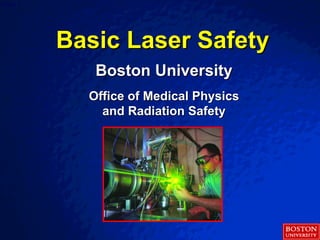
Basic Laser SafetyBasic Laser Safety
Boston UniversityBoston University
Office of Medical PhysicsOffice of Medical Physics
and Radiation Safetyand Radiation Safety
© 2003 By Default!Slide 2
AgendaAgenda
1. Introduction
2. Bioeffects
3. Hazards
4. Hazard Classes
5. Facility Requirements
6. Program Requirements
7. Laser Permit Application
8. Laser Safety Exercise
© 2003 By Default!Slide 3
IntroductionIntroduction
© 2003 By Default!Slide 4
DefinitionDefinition
■ What is a Laser?
–Light Amplification by Stimulated Emission of
Radiation
– The energy generated by a laser is in or near the
optical portion of the electromagnetic spectrum
© 2003 By Default!Slide 5
The optical spectrum.
Laser light is nonionizing and ranges from the:
•ultra-violet (100 - 400nm)
•visible (400 - 700nm), and
•infrared (700nm - 1mm).
ElectroElectro--Magnetic SpectrumMagnetic Spectrum
© 2003 By Default!Slide 6
■ Laser light is:
– Monochromatic
– Directional
– Coherent
■ Lasers pose more hazard than ordinary light
because they focus energy onto a small area
Laser LightLaser Light
© 2003 By Default!Slide 7
BioeffectsBioeffects
© 2003 By Default!Slide 8
BioeffectsBioeffects
■ Primary sites of damage
– eyes
– skin
■ Laser damage can be:
– Thermal
– Acoustic
– Photochemical
© 2003 By Default!Slide 9
Human
Eye
For wavelengths that focus on the retina (400-
1400nm) the optical gain of the eye is about 100,000
times. If the irradiance entering the eye is 1mw/cm2,
then the irradiance at the retina will be 100W/cm2
Optical GainOptical Gain
© 2003 By Default!Slide 10
Mid-infrared and
Far Infrared
(IR-B and IR-C)
1400nm-1mm
and Middle
Ultraviolet
180nm - 315nm
Bioeffects of IR-B, IR-C and Mid UV
© 2003 By Default!Slide 11
Bioeffects of Near UV
Near Ultraviolet
(UV-A)
315-390nm
© 2003 By Default!Slide 12
Bioeffects of Visible and IR-A
Visible and
Near-infrared
(IR-A)
400-1400nm
© 2003 By Default!Slide 13
First Law of PhotobiologyFirst Law of Photobiology
Structure must absorb light to have an effect on it
© 2003 By Default!Slide 14
HazardsHazards
© 2003 By Default!Slide 15
■ Common Causes of Accidents
– Reflective objects in beam path (clutter)
– Grounding
– Movement of beam path
– Accidental energization or firing of laser
– Bypass of Interlocks
At CRC Call 3-SAFE
At BUMC Call 4-4444
AccidentsAccidents
© 2003 By Default!Slide 16
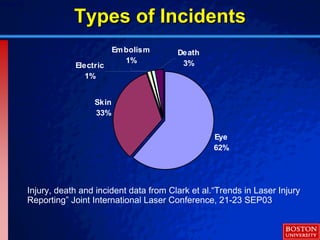
Types of IncidentsTypes of Incidents
Eye
62%
Death
3%Electric
1%
Embolism
1%
Skin
33%
Injury, death and incident data from Clark et al.“Trends in Laser Injury
Reporting” Joint International Laser Conference, 21-23 SEP03
© 2003 By Default!Slide 17
Common Causes of Death based onCommon Causes of Death based on
>1000 reports>1000 reports
■ 5 electrocution—all non-hospital events
■ 5 burns
■ 5 air or gas embolism—1 due to improper use
■ 3 airway tube fires
■ 2 bleeding
■ 2 improper use
■ 4 no information
© 2003 By Default!Slide 18
■ August 16, 1994 laser accident: A researcher working on the alignment
of the compressor for a femtosecond Ti:Sapphire laser system was struck
in the eye by a portion of the spectrally dispersed laser beam. The
resulting split-second exposure to a 1-kHz train of broadband 20-ps
pulses of at most 50 micro Joule centered at 800 nm, caused irreversible,
permanent retinal damage in the eye. The person in question lost vision
over a thin strip right in the middle of the central vision. While the brain
may adapt to correct for this loss of vision, the injury itself cannot
be remedied.
Ultrashort AccidentUltrashort Accident
© 2003 By Default!Slide 19
NonNon--Beam HazardsBeam Hazards
■ Electrical / High Voltage
– Most common
– Power supplies, capacitor banks
■ Chemical
– Dye lasers
– Compressed Gases
■ Laser Generated Air Contaminants
(LGAC)
© 2003 By Default!Slide 20
NonNon--Beam HazardsBeam Hazards
■ Optical
– UV from laser welding
– UV from discharge tubes and pumping
■ Fire/Explosion
– Ignition of gases and/or vapors
– Electrical Wiring and Capacitor banks
■ Noise
■ Safe during normal use
© 2003 By Default!Slide 21
Laser Hazard ClassesLaser Hazard Classes
Lasers are classified according to the level of laser
radiation that is accessible during normal operation.
© 2003 By Default!Slide 22
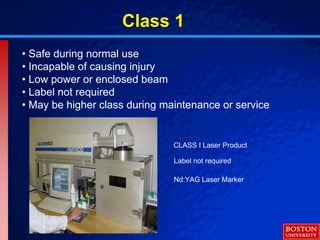
Class 1Class 1
CLASS I Laser Product
Nd:YAG Laser Marker
• Safe during normal use
• Incapable of causing injury
• Low power or enclosed beam
• Label not required
• May be higher class during maintenance or service
Label not required
© 2003 By Default!Slide 23
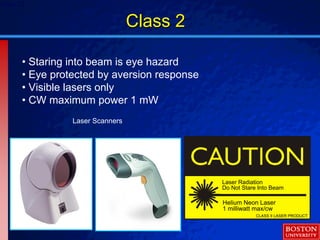
Class 2Class 2
CLASS II LASER PRODUCT
Laser Radiation
Do Not Stare Into Beam
Helium Neon Laser
1 milliwatt max/cw
Laser Scanners
• Staring into beam is eye hazard
• Eye protected by aversion response
• Visible lasers only
• CW maximum power 1 mW
© 2003 By Default!Slide 24
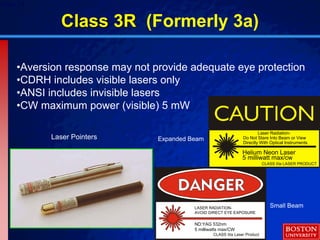
Class 3RClass 3R (Formerly 3a)
Small Beam
Expanded Beam
CLASS IIIa Laser Product
LASER RADIATION-
AVOID DIRECT EYE EXPOSURE
ND:YAG 532nm
5 milliwatts max/CW
Laser Pointers
CLASS IIIa LASER PRODUCT
Laser Radiation-
Do Not Stare Into Beam or View
Directly With Optical Instruments
Helium Neon Laser
5 milliwatt max/cw
•Aversion response may not provide adequate eye protection
•CDRH includes visible lasers only
•ANSI includes invisible lasers
•CW maximum power (visible) 5 mW
© 2003 By Default!Slide 25
Class 3BClass 3B
CLASS IIIb Laser Product
LASER RADIATION-
AVOID DIRECT EXPOSURE TO BEAM
2ω ND:YAG Wavelength: 532 nm
Output Power 80 mW
Courtesy of Sam’s Laser FAQ, www.repairfaq.org/sam/lasersam.htm, © 1994-2004
DPSS Laser with cover removed
•Direct exposure to beam is eye hazard
•Visible or invisible
•CW maximum power 500 mW
© 2003 By Default!Slide 26
Class 4Class 4
CLASS IV Laser Product
VISIBLE LASER RADIATION-
AVOID EYE OR SKIN EXPOSURE TO
DIRECT OR SCATTERED RADIATION
2ω Nd:YAG
Wavelength: 532 nm
Output Power 20 W
Photo: Keith Hunt - www.keithhunt.co.uk
Copyright: University of Sussex, Brighton (UK)
• Exposure to direct beam and scattered light is eye and
skin hazard
• Visible or invisible
• CW power >0.5 W
• Fire hazard
© 2003 By Default!Slide 27
M is for magnification.
A class 1M laser is class 1 unless magnifying optics are used.
A class 2M laser is class 2 unless magnifying optics are used.
M classes usually apply to expanded or diverging beams.
Class 1M & 2M
LASER
Condition 2
Diverging Beam
LASER
Condition 1
Expanded Beam
© 2003 By Default!Slide 28
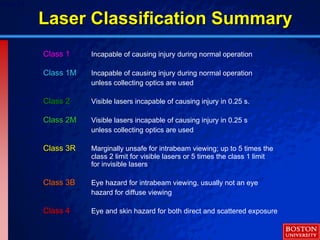
Class 1Class 1 Incapable of causing injury during normal operation
Class 1MClass 1M Incapable of causing injury during normal operation
unless collecting optics are used
Class 2Class 2 Visible lasers incapable of causing injury in 0.25 s.
Class 2MClass 2M Visible lasers incapable of causing injury in 0.25 s
unless collecting optics are used
Class 3RClass 3R Marginally unsafe for intrabeam viewing; up to 5 times the
class 2 limit for visible lasers or 5 times the class 1 limit
for invisible lasers
Class 3BClass 3B Eye hazard for intrabeam viewing, usually not an eye
hazard for diffuse viewing
Class 4Class 4 Eye and skin hazard for both direct and scattered exposure
Laser Classification SummaryLaser Classification Summary
© 2003 By Default!Slide 29
Facility RequirementsFacility Requirements
© 2003 By Default!Slide 30
Exposure LimitsExposure Limits
■ MPE (Maximum Permissible Exposure)
– The highest laser energy exposure for eye or
skin for a given laser
■ NHZ (Nominal Hazard Zone)
– Area within which the MPE can be met or
exceeded
© 2003 By Default!Slide 31
Typical LaboratoryTypical Laboratory
© 2003 By Default!Slide 32
Laser Facility SpecificationLaser Facility Specification
© 2003 By Default!Slide 33
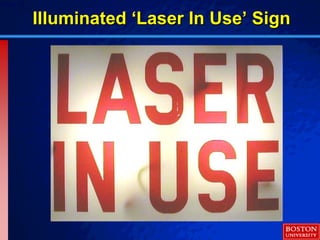
IlluminatedIlluminated ‘‘Laser In UseLaser In Use’’ SignSign
© 2003 By Default!Slide 34
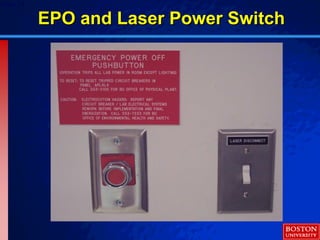
EPO and Laser Power SwitchEPO and Laser Power Switch
© 2003 By Default!Slide 35
Braided Ground WireBraided Ground Wire
© 2003 By Default!Slide 36
TwistTwist--lock Receptacleslock Receptacles
© 2003 By Default!Slide 37
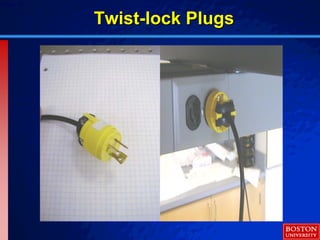
TwistTwist--lock Plugslock Plugs
© 2003 By Default!Slide 38
Laser CurtainsLaser Curtains
© 2003 By Default!Slide 39
Program RequirementsProgram Requirements
© 2003 By Default!Slide 40
■ ANSI Z136.1 specifies that any facility using Class 3b
or Class 4 lasers or laser systems should designate a
Laser Safety Officer to oversee safety for all
operational, maintenance, and servicing situations.
■ This person should have the authority and
responsibility to monitor and enforce the control of
laser hazards. This person is also responsible for the
evaluation of laser hazards and the establishment of
appropriate control measures.
Laser Safety Officer / LSOLaser Safety Officer / LSO
© 2003 By Default!Slide 41
■ Beam Housings
■ Shutters
■ Attenuators
■ Remote viewing devices
■ Interlocks/Twist-lock receptacles
■ Emergency Disconnects
■ Laser Curtains: Wilson LP 200
Engineering ControlsEngineering Controls
© 2003 By Default!Slide 42
■ Warning Signs
■ Labels
■ SOPs
■ Training
■ Security
Administrative ControlsAdministrative Controls
© 2003 By Default!Slide 43
TrainingTraining
■ Permit Holder
■ Authorized User
■ Coursework Experiments / Demonstrations
■ Initial
■ Annual Refresher
© 2003 By Default!Slide 44
■ Eyewear
– (appropriate for system – not necessarily
highest OD)
– Proper wavelength
– Sufficient number for users & visitors
– Centrally stored
■ Gloves
■ Viewing Devices
Personal Protective EquipmentPersonal Protective Equipment
© 2003 By Default!Slide 45
■ Laser Safety Committee/LSO
■ Laser Permits
■ Equipment Registration
■ Personnel Registration and Training
■ Eye Exams
■ SOPs and Signage
■ Emergency Procedures
■ Inspections and Monitoring
Elements of BU Laser Safety ProgramElements of BU Laser Safety Program
© 2003 By Default!Slide 46
■ Train users
■ Write SOPs
■ Select / provide PPE
■ Post emergency numbers and
procedures
■ Allow only authorized users to enter
hazard areas
■ Address non-beam hazards
Laser Permit HolderLaser Permit Holder’’s Roles Role
© 2003 By Default!Slide 47
Laser AlternateLaser Alternate’’s Roles Role
■ To fulfill all of the Permit Holder’s
responsibilities during his or her absence
© 2003 By Default!Slide 48
Laser LiaisonLaser Liaison’’s Roles Role
■ To serve as point of communication with LSO
■ To update all documentation and inform LSO
of additions / deletions / transfers
■ To coordinate training / eye exams /
inspections
© 2003 By Default!Slide 49
■ Eye Exam and Training
■ Follow SOP
■ Wear appropriate eyewear
■ Use minimum power required/reduce
output with attenuators
■ Keep beam path away from eye level
■ Remove unnecessary objects from table
Laser UserLaser User’’s Roles Role
© 2003 By Default!Slide 50
Communication with LSOCommunication with LSO
■ Equipment inventory updates 2 X per year
■ Personnel updates 3 X per year
■ Prior to acquiring a new laser
■ Prior to laser transfer / disposal
■ Immediately upon laser exposure incident or
near miss
© 2003 By Default!Slide 51
Equipment LabelsEquipment Labels
© 2003 By Default!Slide 52
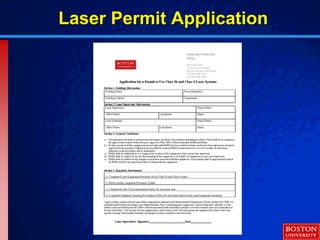
Laser Permit Application
© 2003 By Default!Slide 53
Complete the Application Form
Submit the necessary attachments
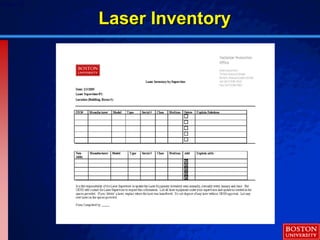
1. Laser Equipment Inventory (3b /4)
2. Laser Personnel List
3. Laser User Authorization Form for each
Laser User
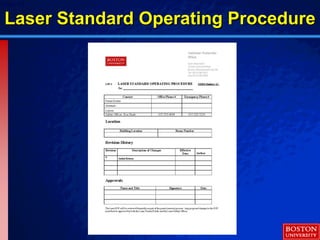
4. Laser SOP for each laser/laser system
© 2003 By Default!Slide 54
Laser Permit ApplicationLaser Permit Application
© 2003 By Default!Slide 55
Laser InventoryLaser Inventory
© 2003 By Default!Slide 56
Laser Personnel RosterLaser Personnel Roster
© 2003 By Default!Slide 57
Laser User AuthorizationLaser User Authorization
© 2003 By Default!Slide 58
Laser Standard Operating ProcedureLaser Standard Operating Procedure
© 2003 By Default!Slide 59
Laser Safety ExerciseLaser Safety Exercise
© 2003 By Default!Slide 60
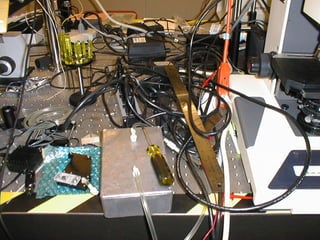
Can you identify safe and/orCan you identify safe and/or
unsafe conditions?unsafe conditions?
© 2003 By Default!Slide 61
© 2003 By Default!Slide 62
© 2003 By Default!Slide 63
© 2003 By Default!Slide 64
For Additional InformationFor Additional Information
■ Office of Medical Physics and Radiation Safety
– Laser Safety Officer: Ron Slade, 638-8828
– MC Main Office (Business Hours): 638-7052
– MC Emergency (24 Hours): 414-4444
– MC Fax: 638-7509
– CRC Main Office: 353-4094
– CRC Emergency (24 Hours): 353-7233 (SAFE)
– CRC Fax: 353-5646
– Web site: www.bu.edu/research/compliance/oehs/mprs
■ MA DPH Radiation Control Program
– 105 CMR 121.000 Regulations for the Control of Lasers
– Web site: www.state.ma.us/dph/rcp.radia.htm
■ ANSI Z-136 Series (esp. Z136.1 and Z136.5)

Laser safety-training

  • 1.
    © 2003 ByDefault!Slide 1 Basic Laser SafetyBasic Laser Safety Boston UniversityBoston University Office of Medical PhysicsOffice of Medical Physics and Radiation Safetyand Radiation Safety
  • 2.
    © 2003 ByDefault!Slide 2 AgendaAgenda 1. Introduction 2. Bioeffects 3. Hazards 4. Hazard Classes 5. Facility Requirements 6. Program Requirements 7. Laser Permit Application 8. Laser Safety Exercise
  • 3.
    © 2003 ByDefault!Slide 3 IntroductionIntroduction
  • 4.
    © 2003 ByDefault!Slide 4 DefinitionDefinition ■ What is a Laser? –Light Amplification by Stimulated Emission of Radiation – The energy generated by a laser is in or near the optical portion of the electromagnetic spectrum
  • 5.
    © 2003 ByDefault!Slide 5 The optical spectrum. Laser light is nonionizing and ranges from the: •ultra-violet (100 - 400nm) •visible (400 - 700nm), and •infrared (700nm - 1mm). ElectroElectro--Magnetic SpectrumMagnetic Spectrum
  • 6.
    © 2003 ByDefault!Slide 6 ■ Laser light is: – Monochromatic – Directional – Coherent ■ Lasers pose more hazard than ordinary light because they focus energy onto a small area Laser LightLaser Light
  • 7.
    © 2003 ByDefault!Slide 7 BioeffectsBioeffects
  • 8.
    © 2003 ByDefault!Slide 8 BioeffectsBioeffects ■ Primary sites of damage – eyes – skin ■ Laser damage can be: – Thermal – Acoustic – Photochemical
  • 9.
    © 2003 ByDefault!Slide 9 Human Eye For wavelengths that focus on the retina (400- 1400nm) the optical gain of the eye is about 100,000 times. If the irradiance entering the eye is 1mw/cm2, then the irradiance at the retina will be 100W/cm2 Optical GainOptical Gain
  • 10.
    © 2003 ByDefault!Slide 10 Mid-infrared and Far Infrared (IR-B and IR-C) 1400nm-1mm and Middle Ultraviolet 180nm - 315nm Bioeffects of IR-B, IR-C and Mid UV
  • 11.
    © 2003 ByDefault!Slide 11 Bioeffects of Near UV Near Ultraviolet (UV-A) 315-390nm
  • 12.
    © 2003 ByDefault!Slide 12 Bioeffects of Visible and IR-A Visible and Near-infrared (IR-A) 400-1400nm
  • 13.
    © 2003 ByDefault!Slide 13 First Law of PhotobiologyFirst Law of Photobiology Structure must absorb light to have an effect on it
  • 14.
    © 2003 ByDefault!Slide 14 HazardsHazards
  • 15.
    © 2003 ByDefault!Slide 15 ■ Common Causes of Accidents – Reflective objects in beam path (clutter) – Grounding – Movement of beam path – Accidental energization or firing of laser – Bypass of Interlocks At CRC Call 3-SAFE At BUMC Call 4-4444 AccidentsAccidents
  • 16.
    © 2003 ByDefault!Slide 16 Types of IncidentsTypes of Incidents Eye 62% Death 3%Electric 1% Embolism 1% Skin 33% Injury, death and incident data from Clark et al.“Trends in Laser Injury Reporting” Joint International Laser Conference, 21-23 SEP03
  • 17.
    © 2003 ByDefault!Slide 17 Common Causes of Death based onCommon Causes of Death based on >1000 reports>1000 reports ■ 5 electrocution—all non-hospital events ■ 5 burns ■ 5 air or gas embolism—1 due to improper use ■ 3 airway tube fires ■ 2 bleeding ■ 2 improper use ■ 4 no information
  • 18.
    © 2003 ByDefault!Slide 18 ■ August 16, 1994 laser accident: A researcher working on the alignment of the compressor for a femtosecond Ti:Sapphire laser system was struck in the eye by a portion of the spectrally dispersed laser beam. The resulting split-second exposure to a 1-kHz train of broadband 20-ps pulses of at most 50 micro Joule centered at 800 nm, caused irreversible, permanent retinal damage in the eye. The person in question lost vision over a thin strip right in the middle of the central vision. While the brain may adapt to correct for this loss of vision, the injury itself cannot be remedied. Ultrashort AccidentUltrashort Accident
  • 19.
    © 2003 ByDefault!Slide 19 NonNon--Beam HazardsBeam Hazards ■ Electrical / High Voltage – Most common – Power supplies, capacitor banks ■ Chemical – Dye lasers – Compressed Gases ■ Laser Generated Air Contaminants (LGAC)
  • 20.
    © 2003 ByDefault!Slide 20 NonNon--Beam HazardsBeam Hazards ■ Optical – UV from laser welding – UV from discharge tubes and pumping ■ Fire/Explosion – Ignition of gases and/or vapors – Electrical Wiring and Capacitor banks ■ Noise ■ Safe during normal use
  • 21.
    © 2003 ByDefault!Slide 21 Laser Hazard ClassesLaser Hazard Classes Lasers are classified according to the level of laser radiation that is accessible during normal operation.
  • 22.
    © 2003 ByDefault!Slide 22 Class 1Class 1 CLASS I Laser Product Nd:YAG Laser Marker • Safe during normal use • Incapable of causing injury • Low power or enclosed beam • Label not required • May be higher class during maintenance or service Label not required
  • 23.
    © 2003 ByDefault!Slide 23 Class 2Class 2 CLASS II LASER PRODUCT Laser Radiation Do Not Stare Into Beam Helium Neon Laser 1 milliwatt max/cw Laser Scanners • Staring into beam is eye hazard • Eye protected by aversion response • Visible lasers only • CW maximum power 1 mW
  • 24.
    © 2003 ByDefault!Slide 24 Class 3RClass 3R (Formerly 3a) Small Beam Expanded Beam CLASS IIIa Laser Product LASER RADIATION- AVOID DIRECT EYE EXPOSURE ND:YAG 532nm 5 milliwatts max/CW Laser Pointers CLASS IIIa LASER PRODUCT Laser Radiation- Do Not Stare Into Beam or View Directly With Optical Instruments Helium Neon Laser 5 milliwatt max/cw •Aversion response may not provide adequate eye protection •CDRH includes visible lasers only •ANSI includes invisible lasers •CW maximum power (visible) 5 mW
  • 25.
    © 2003 ByDefault!Slide 25 Class 3BClass 3B CLASS IIIb Laser Product LASER RADIATION- AVOID DIRECT EXPOSURE TO BEAM 2ω ND:YAG Wavelength: 532 nm Output Power 80 mW Courtesy of Sam’s Laser FAQ, www.repairfaq.org/sam/lasersam.htm, © 1994-2004 DPSS Laser with cover removed •Direct exposure to beam is eye hazard •Visible or invisible •CW maximum power 500 mW
  • 26.
    © 2003 ByDefault!Slide 26 Class 4Class 4 CLASS IV Laser Product VISIBLE LASER RADIATION- AVOID EYE OR SKIN EXPOSURE TO DIRECT OR SCATTERED RADIATION 2ω Nd:YAG Wavelength: 532 nm Output Power 20 W Photo: Keith Hunt - www.keithhunt.co.uk Copyright: University of Sussex, Brighton (UK) • Exposure to direct beam and scattered light is eye and skin hazard • Visible or invisible • CW power >0.5 W • Fire hazard
  • 27.
    © 2003 ByDefault!Slide 27 M is for magnification. A class 1M laser is class 1 unless magnifying optics are used. A class 2M laser is class 2 unless magnifying optics are used. M classes usually apply to expanded or diverging beams. Class 1M & 2M LASER Condition 2 Diverging Beam LASER Condition 1 Expanded Beam
  • 28.
    © 2003 ByDefault!Slide 28 Class 1Class 1 Incapable of causing injury during normal operation Class 1MClass 1M Incapable of causing injury during normal operation unless collecting optics are used Class 2Class 2 Visible lasers incapable of causing injury in 0.25 s. Class 2MClass 2M Visible lasers incapable of causing injury in 0.25 s unless collecting optics are used Class 3RClass 3R Marginally unsafe for intrabeam viewing; up to 5 times the class 2 limit for visible lasers or 5 times the class 1 limit for invisible lasers Class 3BClass 3B Eye hazard for intrabeam viewing, usually not an eye hazard for diffuse viewing Class 4Class 4 Eye and skin hazard for both direct and scattered exposure Laser Classification SummaryLaser Classification Summary
  • 29.
    © 2003 ByDefault!Slide 29 Facility RequirementsFacility Requirements
  • 30.
    © 2003 ByDefault!Slide 30 Exposure LimitsExposure Limits ■ MPE (Maximum Permissible Exposure) – The highest laser energy exposure for eye or skin for a given laser ■ NHZ (Nominal Hazard Zone) – Area within which the MPE can be met or exceeded
  • 31.
    © 2003 ByDefault!Slide 31 Typical LaboratoryTypical Laboratory
  • 32.
    © 2003 ByDefault!Slide 32 Laser Facility SpecificationLaser Facility Specification
  • 33.
    © 2003 ByDefault!Slide 33 IlluminatedIlluminated ‘‘Laser In UseLaser In Use’’ SignSign
  • 34.
    © 2003 ByDefault!Slide 34 EPO and Laser Power SwitchEPO and Laser Power Switch
  • 35.
    © 2003 ByDefault!Slide 35 Braided Ground WireBraided Ground Wire
  • 36.
    © 2003 ByDefault!Slide 36 TwistTwist--lock Receptacleslock Receptacles
  • 37.
    © 2003 ByDefault!Slide 37 TwistTwist--lock Plugslock Plugs
  • 38.
    © 2003 ByDefault!Slide 38 Laser CurtainsLaser Curtains
  • 39.
    © 2003 ByDefault!Slide 39 Program RequirementsProgram Requirements
  • 40.
    © 2003 ByDefault!Slide 40 ■ ANSI Z136.1 specifies that any facility using Class 3b or Class 4 lasers or laser systems should designate a Laser Safety Officer to oversee safety for all operational, maintenance, and servicing situations. ■ This person should have the authority and responsibility to monitor and enforce the control of laser hazards. This person is also responsible for the evaluation of laser hazards and the establishment of appropriate control measures. Laser Safety Officer / LSOLaser Safety Officer / LSO
  • 41.
    © 2003 ByDefault!Slide 41 ■ Beam Housings ■ Shutters ■ Attenuators ■ Remote viewing devices ■ Interlocks/Twist-lock receptacles ■ Emergency Disconnects ■ Laser Curtains: Wilson LP 200 Engineering ControlsEngineering Controls
  • 42.
    © 2003 ByDefault!Slide 42 ■ Warning Signs ■ Labels ■ SOPs ■ Training ■ Security Administrative ControlsAdministrative Controls
  • 43.
    © 2003 ByDefault!Slide 43 TrainingTraining ■ Permit Holder ■ Authorized User ■ Coursework Experiments / Demonstrations ■ Initial ■ Annual Refresher
  • 44.
    © 2003 ByDefault!Slide 44 ■ Eyewear – (appropriate for system – not necessarily highest OD) – Proper wavelength – Sufficient number for users & visitors – Centrally stored ■ Gloves ■ Viewing Devices Personal Protective EquipmentPersonal Protective Equipment
  • 45.
    © 2003 ByDefault!Slide 45 ■ Laser Safety Committee/LSO ■ Laser Permits ■ Equipment Registration ■ Personnel Registration and Training ■ Eye Exams ■ SOPs and Signage ■ Emergency Procedures ■ Inspections and Monitoring Elements of BU Laser Safety ProgramElements of BU Laser Safety Program
  • 46.
    © 2003 ByDefault!Slide 46 ■ Train users ■ Write SOPs ■ Select / provide PPE ■ Post emergency numbers and procedures ■ Allow only authorized users to enter hazard areas ■ Address non-beam hazards Laser Permit HolderLaser Permit Holder’’s Roles Role
  • 47.
    © 2003 ByDefault!Slide 47 Laser AlternateLaser Alternate’’s Roles Role ■ To fulfill all of the Permit Holder’s responsibilities during his or her absence
  • 48.
    © 2003 ByDefault!Slide 48 Laser LiaisonLaser Liaison’’s Roles Role ■ To serve as point of communication with LSO ■ To update all documentation and inform LSO of additions / deletions / transfers ■ To coordinate training / eye exams / inspections
  • 49.
    © 2003 ByDefault!Slide 49 ■ Eye Exam and Training ■ Follow SOP ■ Wear appropriate eyewear ■ Use minimum power required/reduce output with attenuators ■ Keep beam path away from eye level ■ Remove unnecessary objects from table Laser UserLaser User’’s Roles Role
  • 50.
    © 2003 ByDefault!Slide 50 Communication with LSOCommunication with LSO ■ Equipment inventory updates 2 X per year ■ Personnel updates 3 X per year ■ Prior to acquiring a new laser ■ Prior to laser transfer / disposal ■ Immediately upon laser exposure incident or near miss
  • 51.
    © 2003 ByDefault!Slide 51 Equipment LabelsEquipment Labels
  • 52.
    © 2003 ByDefault!Slide 52 Laser Permit Application
  • 53.
    © 2003 ByDefault!Slide 53 Complete the Application Form Submit the necessary attachments 1. Laser Equipment Inventory (3b /4) 2. Laser Personnel List 3. Laser User Authorization Form for each Laser User 4. Laser SOP for each laser/laser system
  • 54.
    © 2003 ByDefault!Slide 54 Laser Permit ApplicationLaser Permit Application
  • 55.
    © 2003 ByDefault!Slide 55 Laser InventoryLaser Inventory
  • 56.
    © 2003 ByDefault!Slide 56 Laser Personnel RosterLaser Personnel Roster
  • 57.
    © 2003 ByDefault!Slide 57 Laser User AuthorizationLaser User Authorization
  • 58.
    © 2003 ByDefault!Slide 58 Laser Standard Operating ProcedureLaser Standard Operating Procedure
  • 59.
    © 2003 ByDefault!Slide 59 Laser Safety ExerciseLaser Safety Exercise
  • 60.
    © 2003 ByDefault!Slide 60 Can you identify safe and/orCan you identify safe and/or unsafe conditions?unsafe conditions?
  • 61.
    © 2003 ByDefault!Slide 61
  • 62.
    © 2003 ByDefault!Slide 62
  • 63.
    © 2003 ByDefault!Slide 63
  • 64.
    © 2003 ByDefault!Slide 64 For Additional InformationFor Additional Information ■ Office of Medical Physics and Radiation Safety – Laser Safety Officer: Ron Slade, 638-8828 – MC Main Office (Business Hours): 638-7052 – MC Emergency (24 Hours): 414-4444 – MC Fax: 638-7509 – CRC Main Office: 353-4094 – CRC Emergency (24 Hours): 353-7233 (SAFE) – CRC Fax: 353-5646 – Web site: www.bu.edu/research/compliance/oehs/mprs ■ MA DPH Radiation Control Program – 105 CMR 121.000 Regulations for the Control of Lasers – Web site: www.state.ma.us/dph/rcp.radia.htm ■ ANSI Z-136 Series (esp. Z136.1 and Z136.5)