Laser Safety
Initial
Karen Janiga, MS
Radiation Safety Officer
Laser Safety Officer
Janette De La Rosa Ducut, Ed.D.
Training Manager
Rick Mannix
Laser Safety Officer
2
1. Determine laser classes and components
2. Identify hazards
Biological
Non-Beam
3. Implement controls
Engineering
Administrative
Work Practice
PPE
Objectives
Light
Amplification by
Stimulated
Emission of
Radiation
3
Lasers
Intense light that
can cause tissue
damage, burns, and
damage to the eye
and skin.
Ordinary light is incoherent, visible, dispersed,
and low powered.
4
Laser light is coherent, sometimes
invisible, directional, and high powered.
5
Pump
Lasing Medium
Mirror
Transparent
Mirror
Reflectant
6
Output
Continuous
Pulsed
> ¼ sec
< ¼ sec
7
Lasing Medium
Mirror
Transparent
Pump
What do you think?
Which component can be adjusted to control the
output power (or energy) of the laser?
8
Incorrect
9
Lasing Medium
Mirror
Transparent
Pump
What do you think?
Which component can be adjusted to control the
output power (or energy) of the laser?
10
Lasing Medium
Mirror
Transparent
Pump
Correct.
Adjust the pump to control the output power.
Which component can be adjusted to control the beam stability?
11
Incorrect
12
Lasing Medium
Mirror
Transparent
Pump
Correct.
Adjust the pump to control the output power.
Which component can be adjusted to control the beam stability?
13
Lasing Medium
Mirror
Transparent
Pump
Correct.
Adjust the optical resonator to control the beam stability.
14
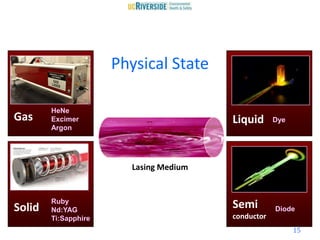
Semi
conductor
Diode
Liquid Dye
Solid
Ruby
Nd:YAG
Ti:Sapphire
Lasing Medium
Gas
HeNe
Excimer
Argon
Physical State
15
View
OSHA website
What do you think?
What type of lasing medium does a Nd:YAG laser use?
Gas
Pulsed
Incoherent
Continuous
Solid
16
Gas
Pulsed
Incoherent
Continuous
Solid
Incorrect
17
View
OSHA website
What do you think?
What type of lasing medium does a Nd:YAG laser use?
Gas
Pulsed
Incoherent
Continuous
Solid
18
Correct!
The Nd:YAG is a solid-state laser.
Use appropriate eye protection.
Solid
19
PROPERTIES
Allow user to leave interaction: Anytime
Show ‘Next Slide’ Button: Show always
Completion Button Label: Next Slide
21
Gauge risk using
classification
schemes.
Approach Class 3B
and Class 4 lasers as
hazardous lasers.
Classes
Skin
23
Injuries
Prevent exposure to eyes
and skin
Biological Effects
Eyes
XeCl gas excimer
Nd:YAG
invisible
200 nm 280 315 400 780 1400 3000 nm
Biological Effects
UV-C UV-B UV-A
Ultraviolet Visible Infrared
IR-A IR-B IR-C
nm = 1 billionth of a meter
24
180 280 315 400 700 1400 3000
Biological Effects
UV-C UV-B UV-A
Ultraviolet Visible Infrared
IR-A IR-B IR-C
Photokeratisis
(200 – 315 nm)
Photochemical Cataracts
(315 – 400 nm)
Thermal retinal
injury
(315 – 400 nm)
Cataracts
(750 – 1400 nm)
Corneal burn
(1400 – 1,000,000 nm)
Cornea
Lens
Retina
25
180 280 315 400 700 1400 3000
Biological Effects
UV-C UV-B UV-A
Ultraviolet Visible Infrared
IR-A IR-B IR-C
Cornea
Lens
Blue Light Hazards
• Do not stare at sun,
welding arcs, or blue lamps
• Prevent lengthy exposures
greater than 10 seconds
• Beware of delayed
appearance (24-48 hours)
Retina
Blue Light
Photobleaching
(400 – 500 nm)
26
Biological Effects
Intrabeam
Viewing
Specular
Reflections
Diffuse
Reflections
Direct viewing
Flat Surface
(mirror like)
ex: plastic, glass
Rough Surface
(diffusion)
ex: table top
27
Biological Effects
Specular
Reflections
Diffuse
Reflections
180 280 315 400 700 1400 3000
UV-C UV-B UV-A
Ultraviolet Visible Infrared
IR-A IR-B IR-C
28
Flat Surface
(mirror like)
ex: plastic, glass
Rough Surface
(diffusion)
ex: table top
Blink every
¼ seconds
Use laser
eye protection.
Do not rely on
your blink reflex
for protection.
29
Check for eye injury
 See: Flash and after-image in opposite
color OR difficulty detecting blue or
green colors
 Feel: Burning pain on cornea
 Hear: “Pop” sound
Before After
Burning
Pop Sound
Signs and Symptoms
Colors
30
180 280 315 400 700 1400 3000
Biological Effects
UV-C UV-B UV-A
Ultraviolet Visible Infrared
IR-A IR-B IR-C
Accelerated Aging
Increased Pigmentation
(280 – 315 nm)
Eurythema and Cancer
(200 – 315 nm)
Burns and Pigment
Darkening
(315 – 400 nm)
Burns and Photosensitive reactions
(400 – 780 nm)
31
Biological Effects
Follow emergency
procedures
Disable machine
Turn off, unplug, and post sign
Seek medical attention
Treat minor skin damage with first
aid OR transport major skin or any
eye injuries to medical facility
32
Non-Beam Hazards
Electrical
Chemicals
Housekeeping
Fire
Cryogens
Noise Pressure
What is the leading cause of death related to lasers?
What do you think?
Burns
34
Incorrect
35
What is the leading cause of death related to lasers?
What do you think?
Electrical
Chemicals
Housekeeping
Fire
Cryogens
Noise Pressure
Burns
36
Prevent injuries and death related to electrical shock
Electrical
Chemicals
Housekeeping
Fire
Cryogens
Noise Pressure
Burns
Correct!
37
Electrical
Chemicals
Housekeeping
Fire
Cryogens
Noise Pressure
Burns
Correct!
Non-Beam Hazards
Chemicals Fire
38
Electrical Hazard
High voltage risk
• Eliminate contact with
high voltage
• Arrange for repairs
• Lockout / Tagout
• Inspect cords and plugs
• Ground all equipment
• Complete training
Non-Beam Hazards
39
Electrocution
Emergency Procedures
• Kill the circuit
• Call 911
• Use nonconductor to
remove victim
• Initiate CPR (if trained)
Non-Beam Hazards
40
Chemical (Liquid)
Liquid phase dye lasers
are carcinogenic or mutagenic
• Mix in fume hood
• Wear PPE
• Use secondary
containment
• Review MSDS
Non-Beam Hazards
41
Chemical (Gas)
Excimers involve use of
toxic fluorine or chlorine gas
• Store in ventilated gas
cabinets
• Use halogen detection
and alarm systems or
halogen gas scrubbers
in rare cases
Non-Beam Hazards
42
Chemical (Gas)
Gases generate harmful
airborne contaminants
• Prevent from inhaling
• Ventilate adequately
• Use local exhaust
systems
Non-Beam Hazards
43
Fires
Irradiance greater than 10 W/cm2
Improperly ventilated beam enclosures
Flammable dyes
44
Non-Beam Hazards
Fire Hazard
Explosions and Radiation
• Separate flammables
• Construct with fire
resistant materials
• Keep fire extinguishers
nearby
• Shield against radiation
(X-ray, Plasma, RF, and Microwaves)
45
Laser
Engineering Controls
Protective
Housing
Eliminate exposure
Use physical structures
as your first line of defense
1. Protective housing
2. Interlocks
3. Aperture beam blocks
4. Warning lights
Interlock Warning Light
Beam Block
47
Engineering Controls Interlock
to laser or shutter
Laser curtain
at entry
Storage
of eyewear protection
Controlled Access
to laser area
Warning sign
on door
Warning light
Fire Extinguisher
Warning labels
on equipment
48
Use beam
attenuators on
high powered
lasers:
Class 3B
Class 4
49
51
Minimize risk by observing
policies and requirements
Complete
training
Restrict
access
Identify
hazards with
signs & labels
Obtain
permission
Administrative Controls
52
DANGER sign
High powered lasers (Class 3B, 3R, 4)
Eye damage (permanent) or burn possible.
NOTICE sign
Alignment, installation, or repair in progress.
Injury possible.
CAUTION sign
Strong lasers (Class 2, 2M)
Eye damage possible.
Administrative Controls
52
What do you think?
Which sign indicates presence of a Class 2 laser?
53
Incorrect
54
What do you think?
Which sign indicates presence of a Class 2 laser?
55
Correct!
Use a CAUTION sign (yellow) to indicate presence of
Class 2 or Class 2M lasers.
Low-powered lasers
56
What do you think?
Which sign indicates that an area is under temporary
control for service?
57
Incorrect
58
What do you think?
Which sign indicates that an area is under temporary
control for service?
59
Correct!
Indicate that an area is under temporary control for
service using a NOTICE sign (blue / white).
alignment
repair
60
What do you think?
Which sign indicates the presence of a high-powered
laser?
61
Incorrect
62
What do you think?
Which sign indicates the presence of a high-powered
laser?
63
Correct!
Use a DANGER sign (red/white) to indicate presence of
a high-powered laser.
Class 3B
Class 4
64
65
66
Administrative Controls
Laser Safety Training
(every 3 years)
First Aid / CPR
(recommended)
Laser Registration
SOP (template)
Laser Safety Manual
SOP
Alignment
procedures
Training Forms Guidelines
67
Laser Safety Manual
Requirements
Read and become familiar with
the Laser Safety Manual
View online at
http://ehs.ucr.edu/laser
68
Administrative Controls
Follow procedures Isolate laser operations
Never leave unattended
69
70
71
Implement
safe ways of
performing
your tasks
Work Practices
What do you think?
When do most injuries occur when working with lasers?
During
installation
During
alignment
When turning off
electricity
When turning on
electricity
72
During
installation
During
alignment
When turning off
electricity
When turning on
electricity
Incorrect
Incorrect
73
What do you think?
When do most injuries occur when working with lasers?
During
installation
During
alignment
When turning off
electricity
When turning on
electricity
74
Correct!
Follow safe work practices during alignment of lasers
During
alignment
75
76
Janette
77
What do you think?
What is an example of a safe work practice around an
embedded laser?
Embedded Laser
Ignore safety locks
when opening
Bypass protective
housing for service
Wear eye
protection
Access with
a hammer
78
Incorrect
Ignore safety locks
when opening
Bypass protective
housing for service
Wear eye
protection
Access with
a hammer
79
Embedded Laser
Ignore safety locks
when opening
Bypass protective
housing for service
Wear eye
protection
Access with
a hammer
What do you think?
What is an example of a safe work practice around an
embedded laser?
80
Embedded Laser
Correct!
Wear eye protection appropriate for a high-powered laser when
working with embedded lasers.
Wear eye
protection
81
83
PPE
The strategy of last resort.
Ensure proper fit and
select the correct PPE
for the job.
Personal Protective Equipment
PROPERTIES
Allow user to leave interaction: Anytime
Show ‘Next Slide’ Button: Show always
Completion Button Label: Next Slide
What do you think?
Which safety eyewear can protect
against lasers?
85
Incorrect
Safety eyewear that protects against chemicals
do not have the proper lens filters to protect
against laser beams.
86
What do you think?
Which safety eyewear can protect
against lasers?
87
Incorrect
Safety eyewear that protects against dust do
not have the proper lens filters to protect
against laser beams. Lack of side shields may
allow specular or diffuse reflections to damage
eyes.
88
What do you think?
Which safety eyewear can protect
against lasers?
89
Incorrect
Safety eyewear that protects against impact do
not have the proper lens filters to protect
against laser beams.
90
What do you think?
Which safety eyewear can protect
against lasers?
91
Incorrect
Safety eyewear that protects against heat do
not have the proper lens filters to protect
against laser beams.
92
What do you think?
Which safety eyewear can protect
against lasers?
93
Correct!
Use safety eyewear that protects against
optical radiation through neutral density,
bandpass, or cut-off lens filters and side shields.
Neutral density
absorbs and reflects
Bandpass
transmits weaker light
Cut-off
blocks light at one end
94
Eye protection
Select based on wavelength
Ultraviolet Visible Infrared
Argon
(488 nm and 514 nm)
KTP
(532 nm) Ruby
(694 nm) Nd:YAG
(1060 nm)
95
What do you think?
Which will provide minimum protection
during use of a solid state
Ruby laser (694 nm)?
Ruby
(694 nm)
Ultraviolet Visible Infrared
689 nm – 782 nm 190 nm – 532 nm 5,000 nm – 11,000 nm
96
Incorrect
The wavelength is greater than the range.
Ruby
(694 nm)
Ultraviolet Visible Infrared
190 nm – 532 nm
Argon
(488 nm and 514 nm)
KTP
(532 nm)
97
What do you think?
Which will provide minimum protection
during use of a solid state
Ruby laser (694 nm)?
Ruby
(694 nm)
Ultraviolet Visible Infrared
689 nm – 782 nm 190 nm – 532 nm 5,000 nm – 11,000 nm
98
There may be a better answer
The wavelength is too weak to use with
such a strong pair of
laser goggles.
Ruby
(694 nm)
Ultraviolet Visible Infrared
5,000 nm – 11,000 nm
Nd:YAG
(1060 nm)
99
What do you think?
Which will provide minimum protection
during use of a solid state
Ruby laser (694 nm)?
Ruby
(694 nm)
Ultraviolet Visible Infrared
689 nm – 782 nm 190 nm – 532 nm 5,000 nm – 11,000 nm
100
Correct!
Use eye protection that is adequate
for the wavelength you
are working with.
Ruby
(694 nm)
Ultraviolet Visible Infrared
689 nm – 782 nm
101
0
1
2
3
4
5
6
7
8
100 %
10
1
0.10
0.01
0.001
0.0001
0.00001
0.000001
Optical
Density (OD)
Light
transmission
100%
transmission
10%
transmission
1%
transmission
OD = 0
OD = 1
OD = 2
102
0
1
2
3
4
5
6
7
8
100 %
10
1
0.10
0.01
0.001
0.0001
0.00001
0.000001
Optical
Density (OD)
Light
transmission
100%
transmission
10%
transmission
1%
transmission
103
0
1
2
3
4
5
6
7
8
100 %
10
1
0.10
0.01
0.001
0.0001
0.00001
0.000001
Optical
Density (OD)
Light
transmission
0
10
100
1,000
10,000
100,000
1,000,000
10,000,000
100,000,000
Output
power
mW
104
0
1
2
3
4
5
6
7
8
100 %
10
1
0.10
0.01
0.001
0.0001
0.00001
0.000001
Optical
Density (OD)
Light
transmission
105
What do you think?
Which safety eyewear can
protect against lasers with
a wavelength of 930 nm ?
I need an
OD of 6
OD 5 @ 585-600 nm
OD 6 @ 600-605 nm
OD 6 @ 457-515 nm
OD 3 @ 515-530 nm
OD 5 @1065-1100
OD 6 @ 800-980
OD 7 @ 980-1065
106
Incorrect.
The wavelength is greater
than the range
I need an
OD of 6
OD 6 @ 457-515 nm
OD 3 @ 515-530 nm
107
What do you think?
Which safety eyewear can
protect against lasers with
a wavelength of 930 nm ?
I need an
OD of 6
OD 5 @ 585-600 nm
OD 6 @ 600-605 nm
OD 6 @ 457-515 nm
OD 3 @ 515-530 nm
OD 5 @1065-1100
OD 6 @ 800-980
OD 7 @ 980-1065
108
Incorrect.
The wavelength is greater
than the range
I need an
OD of 6
OD 5 @ 585-600 nm
OD 6 @ 600-605 nm
109
What do you think?
Which safety eyewear can
protect against lasers with
a wavelength of 930 nm ?
I need an
OD of 6
OD 5 @ 585-600 nm
OD 6 @ 600-605 nm
OD 6 @ 457-515 nm
OD 3 @ 515-530 nm
OD 5 @1065-1100
OD 6 @ 800-980
OD 7 @ 980-1065
110
Correct.
Select laser safety eyewear
based on the optical density
and wavelength of your laser.
I need an
OD of 6
OD 5 @1065-1100
OD 6 @ 800-980
OD 7 @ 980-1065
111
Ultraviolet Visible Infrared
Argon
(488 nm and 514 nm)
KTP
(532 nm)
Nd:YAG
(1060 nm)
Select laser safety eyewear
based on the optical density
and wavelength of your laser.
112
Select laser safety eyewear
based on the optical density
and wavelength of your laser.
In addition to…
Fit
Field of Vision
Prescription
Sensor Card Use
Degradation
Too much space Proper fit
113
115
1. Determine laser classes and components
2. Identify hazards
Biological
Non-Beam
3. Implement controls
Engineering
Administrative
Work Practice
PPE
Summary
116
For more information
ehs.ucr.edu
951 827 5528
ehs@ucr.edu
To receive credit for this course
please complete the test
Test
117
START
Test

laser20110330-110915145505-phpapp02.pdf