• Excimer lasers (the name is derived from the
terms excited and dimers) use reactive gases such as chlorine and
fluorine mixed with inert gases such as argon, krypton, or xenon. When
electrically stimulated, a pseudomolecule or dimer is produced and
when lased, produces light in the ultraviolet range.
• Dye lasers use complex organic dyes like rhodamine 6G in liquid
solution or suspension as lasing media. They are tunable over a
broad range of wavelengths.
• Semiconductor lasers, sometimes called diode lasers, are
not solid-state lasers. These electronic devices are generally very
small and use low power. They may be built into larger arrays, e.g.,
the writing source in some laser printers or compact disk players.
Lasers are also characterized by the duration of
laser emission - continuous wave or pulsed laser.
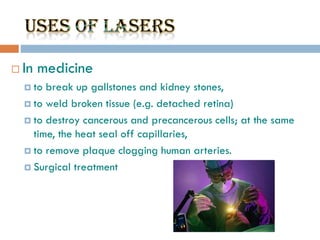
 In medicine
 to break up gallstones and kidney stones,
 to weld broken tissue (e.g. detached retina)
 to destroy cancerous and precancerous cells; at the same
time, the heat seal off capillaries,
 to remove plaque clogging human arteries.
 Surgical treatment
 In industry
 to drill tiny holes
in hard materials,
 for welding and machining,
 for lining up equipment precisely,
especially in inaccessible places.
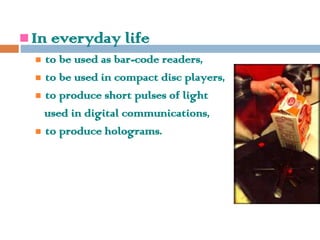
 In everyday life
 to be used as bar-code readers,
 to be used in compact disc players,
 to produce short pulses of light
used in digital communications,
 to produce holograms.
 Holography is the production of
holograms by the use of laser.
 A hologram is a 3D image
recorded in a special
photographic plate.
 The image appears to float in
space and to move when the
viewer moves.
In a fraction of a
second, your vision
can go dark.
NON-BEAM HAZARDS
Non-beam hazards refer to anything other than the laser
itself that can create a hazard. This type of hazard
includes:
 Electrical Hazards
 Fire Hazards
 Laser Generated Air Contaminants (LGAC)
 Compressed Gases
 Noise
 Class 2:
“Laser Radiation – Do Not Stare into Beam.”
 Class 2M:
“Laser Radiation – Do not Stare into Beam or
View Directly with Optical Instruments.”
 Class 3R:
“Laser Radiation – Avoid Direct Eye Exposure.”
 Class 3B:
“Laser Radiation – Avoid Direct Exposure to Beam”
 Class 4:
“Laser Radiation – Avoid Eye or Skin Exposure
to Direct or Scattered Radiation.”
Only Class 1 lasers require no labels. All other lasers must be labeled at the beam’s point of
origin.
” indicates a very dangerous situation that could
result in serious injury or death. This sign should be used for
Class 3R, 3B, and 4 lasers.
 “ ” indicates a potentially hazardous situation which
could cause a less serious injury. This sign should be used for
Class 2 and 2M lasers.
 “ does not indicate a hazardous situation. This sign
should only be used to make people aware of facility policies
regarding laser safety and/or to indicate that a service operation
is in progress.
“CAUTION” Warning Sign
CAUTION
Laser Class and system
Type of Laser, emitted
wavelength, pulse duration,
and maximum output
Safety Instructions may include:
• Eyewear Required
• Invisible laser
radiation
• Knock Before Entering
• Do Not EnterWhen Light
is On
• Restricted Area
Safety Instructions
“DANGER” WARNING SIGN
DANGER
Laser Class and system
Type of Laser, emitted
wavelength, pulse duration,
and maximum output
Safety Instructions may
include:
• Eyewear Required
• Invisible laser
radiation
• Knock Before Entering
• Do Not Enter When
Light is On
• Restricted Area
Safety Instructions
“NOTICE” Sign for Laser Repair
NOTICE
Safety Instructions
(such as “Laser Repair in
Progress”)
Laser Class and system
Type of Laser, emitted
wavelength, pulse duration,
and maximum output
Safety Instructions may
include:
• Eyewear Required
• Invisible laser
radiation
• Knock Before
Entering
• Do Not Enter When
Light is On
• Restricted Area
Control Measures
 There are several measures that can be taken to prevent injury from
lasers. These measures include:
 Engineering Controls:
Engineering controls are measures that are incorporated into the laser system and are designed to
prevent injury to personnel
 Administrative Controls:
Administrative controls are procedures that are designed to prevent personnel from injury
 Personnel Protective Equipment
 Warning Signs and Labels
Personnel Protective Equipment
 For skin :
Ultraviolet lasers and laser welding/cutting operations may
require that tightly woven fabrics be worn to protect arms and hands.
 For eyes:
Personnel Protective Equipment (PPE) for eyes
exposed to Class 3B or 4 lasers is mandatory.
Eyewear with side protection is best.
laser ppt

laser ppt

  • 10.
    • Excimer lasers(the name is derived from the terms excited and dimers) use reactive gases such as chlorine and fluorine mixed with inert gases such as argon, krypton, or xenon. When electrically stimulated, a pseudomolecule or dimer is produced and when lased, produces light in the ultraviolet range. • Dye lasers use complex organic dyes like rhodamine 6G in liquid solution or suspension as lasing media. They are tunable over a broad range of wavelengths. • Semiconductor lasers, sometimes called diode lasers, are not solid-state lasers. These electronic devices are generally very small and use low power. They may be built into larger arrays, e.g., the writing source in some laser printers or compact disk players.
  • 11.
    Lasers are alsocharacterized by the duration of laser emission - continuous wave or pulsed laser.
  • 12.
     In medicine to break up gallstones and kidney stones,  to weld broken tissue (e.g. detached retina)  to destroy cancerous and precancerous cells; at the same time, the heat seal off capillaries,  to remove plaque clogging human arteries.  Surgical treatment
  • 13.
     In industry to drill tiny holes in hard materials,  for welding and machining,  for lining up equipment precisely, especially in inaccessible places.
  • 15.
     In everydaylife  to be used as bar-code readers,  to be used in compact disc players,  to produce short pulses of light used in digital communications,  to produce holograms.
  • 16.
     Holography isthe production of holograms by the use of laser.  A hologram is a 3D image recorded in a special photographic plate.  The image appears to float in space and to move when the viewer moves.
  • 17.
    In a fractionof a second, your vision can go dark.
  • 18.
    NON-BEAM HAZARDS Non-beam hazardsrefer to anything other than the laser itself that can create a hazard. This type of hazard includes:  Electrical Hazards  Fire Hazards  Laser Generated Air Contaminants (LGAC)  Compressed Gases  Noise
  • 19.
     Class 2: “LaserRadiation – Do Not Stare into Beam.”  Class 2M: “Laser Radiation – Do not Stare into Beam or View Directly with Optical Instruments.”  Class 3R: “Laser Radiation – Avoid Direct Eye Exposure.”  Class 3B: “Laser Radiation – Avoid Direct Exposure to Beam”  Class 4: “Laser Radiation – Avoid Eye or Skin Exposure to Direct or Scattered Radiation.” Only Class 1 lasers require no labels. All other lasers must be labeled at the beam’s point of origin.
  • 20.
    ” indicates avery dangerous situation that could result in serious injury or death. This sign should be used for Class 3R, 3B, and 4 lasers.  “ ” indicates a potentially hazardous situation which could cause a less serious injury. This sign should be used for Class 2 and 2M lasers.  “ does not indicate a hazardous situation. This sign should only be used to make people aware of facility policies regarding laser safety and/or to indicate that a service operation is in progress.
  • 21.
    “CAUTION” Warning Sign CAUTION LaserClass and system Type of Laser, emitted wavelength, pulse duration, and maximum output Safety Instructions may include: • Eyewear Required • Invisible laser radiation • Knock Before Entering • Do Not EnterWhen Light is On • Restricted Area Safety Instructions
  • 22.
    “DANGER” WARNING SIGN DANGER LaserClass and system Type of Laser, emitted wavelength, pulse duration, and maximum output Safety Instructions may include: • Eyewear Required • Invisible laser radiation • Knock Before Entering • Do Not Enter When Light is On • Restricted Area Safety Instructions
  • 23.
    “NOTICE” Sign forLaser Repair NOTICE Safety Instructions (such as “Laser Repair in Progress”) Laser Class and system Type of Laser, emitted wavelength, pulse duration, and maximum output Safety Instructions may include: • Eyewear Required • Invisible laser radiation • Knock Before Entering • Do Not Enter When Light is On • Restricted Area
  • 24.
    Control Measures  Thereare several measures that can be taken to prevent injury from lasers. These measures include:  Engineering Controls: Engineering controls are measures that are incorporated into the laser system and are designed to prevent injury to personnel  Administrative Controls: Administrative controls are procedures that are designed to prevent personnel from injury  Personnel Protective Equipment  Warning Signs and Labels
  • 25.
    Personnel Protective Equipment For skin : Ultraviolet lasers and laser welding/cutting operations may require that tightly woven fabrics be worn to protect arms and hands.  For eyes: Personnel Protective Equipment (PPE) for eyes exposed to Class 3B or 4 lasers is mandatory. Eyewear with side protection is best.