ULTRASONIC WELDING
Introduction
Ultrasonic welding is an industrial
technique,
whereby high frequency ultrasonic
acoustic vibrations are ultrasonic
acoustic vibrations are locally applied to
work pieces being held together under
pressure to create a solid state weld.
Why to use Ultrasonic welding
 Ultrasonic assembly uses ultrasonic vibratory energy
which is transmitted through the parts to melt and bond
thermoplastic materials And joining thin sheet gauge
metals and other lightweight materials materials. And
joining thin sheet gauge metals and other lightweight
materials
 This technique is fast, efficient, noncontaminating
and requires no consumables.
Principle of Ultrasonic Welding
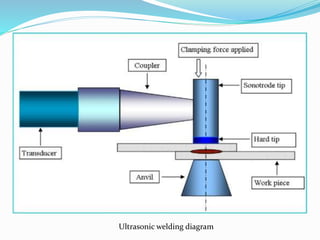
 In ultrasonic welding, frictional heat produced by the
ultrasonic waves and force is used for the joining process.
Ultrasonic waves (15 to 60 kHz) are transferred to the
material under pressure with a sonometer. Welding times
are lower than 3 s. The welding can proceed with or
without the application of external heat.
Ultrasonic welding diagram
Advantages
 Heat affected zone is minimized
 Very thin materials can be welded
 Surface deformation is minimum
 Welding of glass is also possible
 No defects due to gases, arc and filler metal
 Equipment is simple and moderate skill is
enough
 Dissimilar materials can be joined
Disadvantages
 Restricted to join thin materials
 Competitively not economical
 Materials being welded may tend to weld to the tip and
anvil
Application
Manufacturing of toys
Joining of electrical and electronic components
 Welding aluminium wire and sheet
 Mobiles, sports shoes , laminations, cars…….
Packing , medical industries, computers
Thank you

Ultrasonic welding

  • 1.
  • 2.
    Introduction Ultrasonic welding isan industrial technique, whereby high frequency ultrasonic acoustic vibrations are ultrasonic acoustic vibrations are locally applied to work pieces being held together under pressure to create a solid state weld.
  • 3.
    Why to useUltrasonic welding  Ultrasonic assembly uses ultrasonic vibratory energy which is transmitted through the parts to melt and bond thermoplastic materials And joining thin sheet gauge metals and other lightweight materials materials. And joining thin sheet gauge metals and other lightweight materials  This technique is fast, efficient, noncontaminating and requires no consumables.
  • 4.
    Principle of UltrasonicWelding  In ultrasonic welding, frictional heat produced by the ultrasonic waves and force is used for the joining process. Ultrasonic waves (15 to 60 kHz) are transferred to the material under pressure with a sonometer. Welding times are lower than 3 s. The welding can proceed with or without the application of external heat.
  • 5.
  • 6.
    Advantages  Heat affectedzone is minimized  Very thin materials can be welded  Surface deformation is minimum  Welding of glass is also possible  No defects due to gases, arc and filler metal  Equipment is simple and moderate skill is enough  Dissimilar materials can be joined
  • 7.
    Disadvantages  Restricted tojoin thin materials  Competitively not economical  Materials being welded may tend to weld to the tip and anvil
  • 8.
    Application Manufacturing of toys Joiningof electrical and electronic components  Welding aluminium wire and sheet  Mobiles, sports shoes , laminations, cars……. Packing , medical industries, computers
  • 9.