Unit Three: Exploring Self
• Identify your abilities and interests, and explain how they
motivate you
• Explain how your interest inventory results impact your major
exploration process
• Analyze your interest inventory results
• Develop a list of majors which reflect your interests and abilities
Learning Objectives
• Childhood dreams are what drive us to be who we are in
our future, whether we achieve the full dream or a piece
of the dream.
• What was your childhood dream?
• Are you still interested in achieving this dream? Why?
• What, if anything, is preventing you from pursuing that dream? Or what
is your new dream?
• If you’re not interested in pursuing your childhood dream, but
something about it still appeals to you, how else might you incorporate
that interest into your life?
Achieving your childhood dreams
Sometimes we think our childhood
dreams are silly. It’s important to
remember that these dreams are what
motivate us, and it’s good to reflect on
them.
Would you pursue a subject of study
that aligns with your childhood
career?
Why or why not?
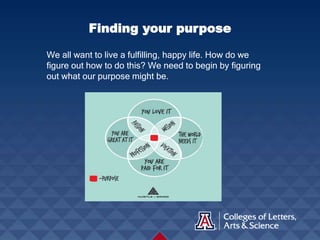
We all want to live a fulfilling, happy life. How do we
figure out how to do this? We need to begin by figuring
out what our purpose might be.
Finding your purpose
What is your purpose?
Think about the problem you want to solve most in
the world. What is it?
What would you do every single day without pay that
would help the world?
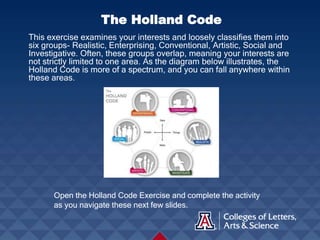
This exercise examines your interests and loosely classifies them into
six groups- Realistic, Enterprising, Conventional, Artistic, Social and
Investigative. Often, these groups overlap, meaning your interests are
not strictly limited to one area. As the diagram below illustrates, the
Holland Code is more of a spectrum, and you can fall anywhere within
these areas.
The Holland Code
Open the Holland Code Exercise and complete the activity
as you navigate these next few slides.
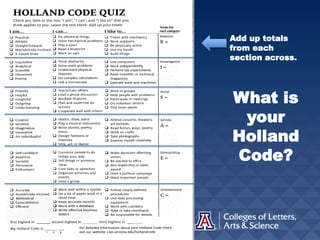
What is
your
Holland
Code?
Add up totals
from each
section across.
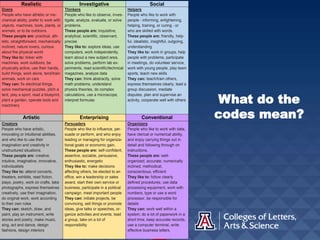
What do the
codes mean?
Realistic Investigative Social
Doers
People who have athletic or me-
chanical ability; prefer to work with
objects, machines, tools, plants, or
animals; or to be outdoors.
These people are: practical, ath-
letic, straightforward, mechanically
inclined, nature lovers, curious
about the physical world
They like to: tinker with
machines, work outdoors, be
physically active, use their hands,
build things, work alone, tend/train
animals, work on cars
They can: fix electrical things,
solve mechanical puzzles, pitch a
tent, play a sport, read a blueprint,
plant a garden, operate tools and
machinery
Thinkers
People who like to observe, inves-
tigate, analyze, evaluate, or solve
problems.
These people are: inquisitive,
analytical, scientific, observant,
precise
They like to: explore ideas, use
computers, work independently,
learn about a new subject area,
solve problems, perform lab ex-
periments, read scientific/technical
magazines, analyze data
They can: think abstractly, solve
math problems, understand
physics theories, do complex
calculations, use a microscope,
interpret formulas
Helpers
People who like to work with
people - informing, enlightening,
helping, training, or curing - or
who are skilled with words.
These people are: friendly, help-
ful, idealistic, insightful, outgoing,
understanding
They like to: work in groups, help
people with problems, participate
in meetings, do volunteer service,
work with young people, play team
sports, teach new skills
They can: teach/train others,
express themselves clearly, lead a
group discussion, mediate
disputes, plan and supervise an
activity, cooperate well with others
Artistic Enterprising Conventional
Creators
People who have artistic,
innovating or intuitional abilities,
and who like to use their
imagination and creativity in
unstructured situations.
These people are: creative,
intuitive, imaginative, innovative,
individualists
They like to: attend concerts,
theaters, exhibits, read fiction,
plays, poetry, work on crafts, take
photographs, express themselves
creatively, use their imagination,
do original work, work according
to their own rules
They can: sketch, draw, and
paint, play an instrument, write
stories and poetry, make music,
sing, act and dance, design
fashions, design interiors
Persuaders
People who like to influence, per-
suade or perform, and who enjoy
leading or managing for organiza-
tional goals or economic gain.
These people are: self-confident,
assertive, sociable, persuasive,
enthusiastic, energetic
They like to: make decisions
affecting others, be elected to an
office, win a leadership or sales
award, start their own service or
business, participate in a political
campaign, meet important people
They can: initiate projects, be
convincing, sell things or promote
ideas, give talks or speeches, or-
ganize activities and events, lead
a group, take on a lot of
responsibility
Organizers
People who like to work with data,
have clerical or numerical ability,
and enjoy carrying things out in
detail and following through on
instructions.
These people are: well-
organized, accurate, numerically
inclined, methodical,
conscientious, efficient
They like to: follow clearly
defined procedures, use data
processing equipment, work with
numbers, type or use a word
processor, be responsible for
details
They can: work well within a
system, do a lot of paperwork in a
short time, keep accurate records,
use a computer terminal, write
effective business letters
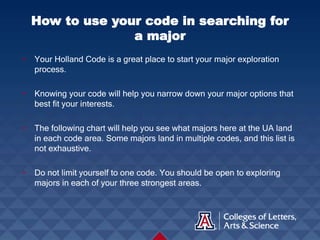
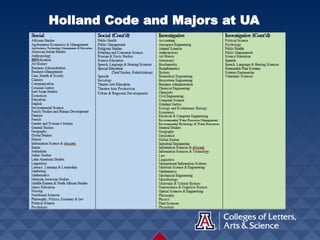
• Your Holland Code is a great place to start your major exploration
process.
• Knowing your code will help you narrow down your major options that
best fit your interests.
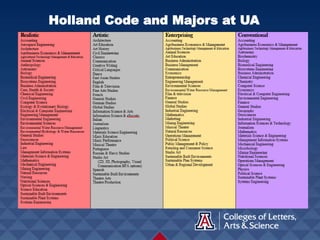
• The following chart will help you see what majors here at the UA land
in each code area. Some majors land in multiple codes, and this list is
not exhaustive.
• Do not limit yourself to one code. You should be open to exploring
majors in each of your three strongest areas.
How to use your code in searching for
a major
Holland Code and Majors at UA
How does your code relate the majors
you’ve been exploring? Do they align
with your interests, abilities and
skills?
If you are just beginning the process,
did it give you a place to start?
• Dreams inspired our interest areas as a child and have the ability
to influence where we go as an adult. They likely align with our
interests as adults, too.
• The Holland Code activity serves as a tool to identify our interest
areas today.
• What skills do you have that could lead you to your dream career? Or to
accomplishing a piece of your dream?
• How can you use your UA education and experiences to gain/develop any
necessary knowledge, skills and experience (i.e. classes, clubs/orgs)?
How do your dreams connect with
your skills?
• Now that you have learned about your interests and how majors
fit with those interests, you are ready to start narrowing down
your major options and make connections between your
dreams and what you would like to study.
• Reflect on your list of majors. Do they align with your interests,
abilities and skills? Complete the Majors List: Aligning your
Interests activity.
Let’s reflect!

LASC 197P Unit Three: Exploring Self

  • 1.
  • 2.
    • Identify yourabilities and interests, and explain how they motivate you • Explain how your interest inventory results impact your major exploration process • Analyze your interest inventory results • Develop a list of majors which reflect your interests and abilities Learning Objectives
  • 3.
    • Childhood dreamsare what drive us to be who we are in our future, whether we achieve the full dream or a piece of the dream. • What was your childhood dream? • Are you still interested in achieving this dream? Why? • What, if anything, is preventing you from pursuing that dream? Or what is your new dream? • If you’re not interested in pursuing your childhood dream, but something about it still appeals to you, how else might you incorporate that interest into your life? Achieving your childhood dreams
  • 4.
    Sometimes we thinkour childhood dreams are silly. It’s important to remember that these dreams are what motivate us, and it’s good to reflect on them. Would you pursue a subject of study that aligns with your childhood career? Why or why not?
  • 5.
    We all wantto live a fulfilling, happy life. How do we figure out how to do this? We need to begin by figuring out what our purpose might be. Finding your purpose
  • 6.
    What is yourpurpose? Think about the problem you want to solve most in the world. What is it? What would you do every single day without pay that would help the world?
  • 7.
    This exercise examinesyour interests and loosely classifies them into six groups- Realistic, Enterprising, Conventional, Artistic, Social and Investigative. Often, these groups overlap, meaning your interests are not strictly limited to one area. As the diagram below illustrates, the Holland Code is more of a spectrum, and you can fall anywhere within these areas. The Holland Code Open the Holland Code Exercise and complete the activity as you navigate these next few slides.
  • 8.
    What is your Holland Code? Add uptotals from each section across.
  • 9.
    What do the codesmean? Realistic Investigative Social Doers People who have athletic or me- chanical ability; prefer to work with objects, machines, tools, plants, or animals; or to be outdoors. These people are: practical, ath- letic, straightforward, mechanically inclined, nature lovers, curious about the physical world They like to: tinker with machines, work outdoors, be physically active, use their hands, build things, work alone, tend/train animals, work on cars They can: fix electrical things, solve mechanical puzzles, pitch a tent, play a sport, read a blueprint, plant a garden, operate tools and machinery Thinkers People who like to observe, inves- tigate, analyze, evaluate, or solve problems. These people are: inquisitive, analytical, scientific, observant, precise They like to: explore ideas, use computers, work independently, learn about a new subject area, solve problems, perform lab ex- periments, read scientific/technical magazines, analyze data They can: think abstractly, solve math problems, understand physics theories, do complex calculations, use a microscope, interpret formulas Helpers People who like to work with people - informing, enlightening, helping, training, or curing - or who are skilled with words. These people are: friendly, help- ful, idealistic, insightful, outgoing, understanding They like to: work in groups, help people with problems, participate in meetings, do volunteer service, work with young people, play team sports, teach new skills They can: teach/train others, express themselves clearly, lead a group discussion, mediate disputes, plan and supervise an activity, cooperate well with others Artistic Enterprising Conventional Creators People who have artistic, innovating or intuitional abilities, and who like to use their imagination and creativity in unstructured situations. These people are: creative, intuitive, imaginative, innovative, individualists They like to: attend concerts, theaters, exhibits, read fiction, plays, poetry, work on crafts, take photographs, express themselves creatively, use their imagination, do original work, work according to their own rules They can: sketch, draw, and paint, play an instrument, write stories and poetry, make music, sing, act and dance, design fashions, design interiors Persuaders People who like to influence, per- suade or perform, and who enjoy leading or managing for organiza- tional goals or economic gain. These people are: self-confident, assertive, sociable, persuasive, enthusiastic, energetic They like to: make decisions affecting others, be elected to an office, win a leadership or sales award, start their own service or business, participate in a political campaign, meet important people They can: initiate projects, be convincing, sell things or promote ideas, give talks or speeches, or- ganize activities and events, lead a group, take on a lot of responsibility Organizers People who like to work with data, have clerical or numerical ability, and enjoy carrying things out in detail and following through on instructions. These people are: well- organized, accurate, numerically inclined, methodical, conscientious, efficient They like to: follow clearly defined procedures, use data processing equipment, work with numbers, type or use a word processor, be responsible for details They can: work well within a system, do a lot of paperwork in a short time, keep accurate records, use a computer terminal, write effective business letters
  • 10.
    • Your HollandCode is a great place to start your major exploration process. • Knowing your code will help you narrow down your major options that best fit your interests. • The following chart will help you see what majors here at the UA land in each code area. Some majors land in multiple codes, and this list is not exhaustive. • Do not limit yourself to one code. You should be open to exploring majors in each of your three strongest areas. How to use your code in searching for a major
  • 11.
    Holland Code andMajors at UA
  • 12.
    Holland Code andMajors at UA
  • 13.
    How does yourcode relate the majors you’ve been exploring? Do they align with your interests, abilities and skills? If you are just beginning the process, did it give you a place to start?
  • 14.
    • Dreams inspiredour interest areas as a child and have the ability to influence where we go as an adult. They likely align with our interests as adults, too. • The Holland Code activity serves as a tool to identify our interest areas today. • What skills do you have that could lead you to your dream career? Or to accomplishing a piece of your dream? • How can you use your UA education and experiences to gain/develop any necessary knowledge, skills and experience (i.e. classes, clubs/orgs)? How do your dreams connect with your skills?
  • 15.
    • Now thatyou have learned about your interests and how majors fit with those interests, you are ready to start narrowing down your major options and make connections between your dreams and what you would like to study. • Reflect on your list of majors. Do they align with your interests, abilities and skills? Complete the Majors List: Aligning your Interests activity. Let’s reflect!

Editor's Notes

  • #4 https://www.youtube.com/watch?v=KuhVJFZS_qw
  • #8 Define each area more
  • #16 Delete? Replace? Advising/Catalog Holland Code Major List