Notetaking and
Notetaking
Systems
The goal of notetaking
Notetaking systems
Objective
Understand the role of notetaking in college courses
Identify different notetaking strategies
Utilize a notetaking strategy to organize important
information
Goals of notetaking
• Document what was covered in lecture or lab.
• Identify important concepts within the subject
matter.
• Helps to process information
• Helps to focus attention in a lecture
• Keeps ideas organize
Notetaking 101
Do this!
• Write down the main topic
with supporting details.
• Put the information in your
own words.
• Always take your own
notes!
• Be ready to hear and record
information in your lecture.
• Review notes to check for
holes in information.
Do not do this!
• Do not copy power point
slides or lecture notes word-
for-word.
• Do not rely on your memory.
• Do not rely on your friend,
peer, or office hours.
• Do not rely on electronics to
capture the nuances of the
lecture.
• Do not wait until the next
lecture to complete your
notes.
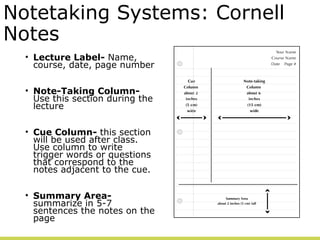
Notetaking Systems: Cornell
Notes
• Lecture Label- Name,
course, date, page number
• Note-Taking Column-
Use this section during the
lecture
• Cue Column- this section
will be used after class.
Use column to write
trigger words or questions
that correspond to the
notes adjacent to the cue.
• Summary Area-
summarize in 5-7
sentences the notes on the
page
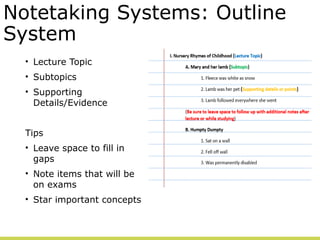
Notetaking Systems: Outline
System
• Lecture Topic
• Subtopics
• Supporting
Details/Evidence
Tips
• Leave space to fill in
gaps
• Note items that will be
on exams
• Star important concepts
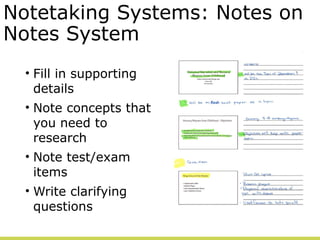
Notetaking Systems: Notes on
Notes System
• Fill in supporting
details
• Note concepts that
you need to
research
• Note test/exam
items
• Write clarifying
questions
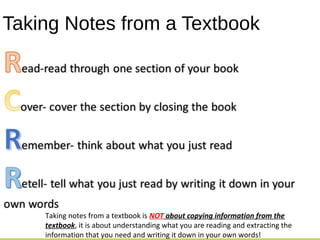
Taking Notes from a Textbook
Taking notes from a textbook is NOT about copying information from the
textbook, it is about understanding what you are reading and extracting the
information that you need and writing it down in your own words!
Study Methods
Reading a College Level Textbook
Study Methods
Objective
Identify study methods that will help you to be successful in
retaining course information
Identify learning preferences- environmental and learning
strategies that will help improve your study sessions
What does it mean to study?
Study: (noun) the devotion of time
and attention to acquiring
knowledge on an academic subject,
especially by means of books
Study: (verb) to devote time and
attention to acquiring knowledge on
(an academic subject), especially by
means of books. Whatusuallyhappens….
What should ideally happen…
Studying in College Vs High School
Studying in High School
• All content is controlled
and delivered by the
teacher.
• Study time may be 1-2
hours per day outside of
class (total=270 per year).
• School is very structured
and study time is directed.
Studying in College
• Professor introduces the
content, student
researches further.
• Study time may be 3-5
hours per day outside of
lecture (total= 560 per
semester).
• Student is responsible for
structuring their course
schedule and time outside
of classroom.
The Myth of Multi-tasking
• There is no such thing as multi-tasking! What is really happening is
task switching.
• Why task switching does not work:
• takes more time
• more prone to errors
• increased production of cortisol-stress hormone
• can lead to mental exhaustion
• has the same effects of sleep deprivation
• Science confirms that the human brain was not created to multi-task!
Studying requires DEVOTED ATTENTION and DEDICATED TIME. There
are no short cuts to solidified learning of information!
Studying 101
• Study with a purpose!
• What is (are) the objective(s) of the unit? Turn it into a question (s) and answer
the question(s)!
• Note vocabulary/ subject specific vocabulary.
• Know the definition of the vocabulary AND the application to the greater
content.
• Use your notes from lecture AND textbooks to get a full picture of the
concepts.
• Use your text book and notes to clarify any information that you do not know
and fill in any gaps in understanding.
• Note areas of confusion or misunderstanding.
• Use sticky notes to jot down areas of confusion to clarify later with your TA,
Professor, or Study group.
Corson Method
Begin with the question- What is it that I don’t understand?
-Be able to clearly name what your issue might be
What specifically is it that I do not understand?
-Be able to pinpoint your area of confusion-
Is it a concept? Is it a step in the process?
-Be able to show your documented effort-
What did you do before you asked for help?
Use the 15 minute method to get to your point of confusion!
-work on the problem or concept for a solid 15 minutes
-If after 15 minutes you are still confused note the area of
confusion and go seek help.
“First you must try- then you must ask!” -Matt Ringel
http://collegeinfogeek.com/blog/
Tips on Studying from your notes
Step 1. Clean up your notes as soon as you have an opportunity.
Step 2. Fill in the gaps of any information missing from your notes.
Step 3. Pose questions about the note topics.
Step 4. Identify in information that could be on a test.
Step 5. Identify any information that you are confused about or where you need
more information.
Step 6. Seek help for understanding items and areas of the content that you are
struggling with.
Revisiting Academic
Success
Revisiting your definition of Academic Success
Maintaining Academic Success
Revisiting your definition of
Academic Success
What is your definition of academic success? Your
definition will drive your goals and your actions. Does
your definition need additional tweaking?
Activity: Review your initial definition of
academic success. Given everything you have learned in
this chapter revisit your initial definition and change it if
necessary.
How do I maintain academic
success?
• Review your plan
• Revise if necessary
• Implementation
• Am I consistent?
• Is this relevant?
• Will this help me to reach my goal?
• Who can help?
• What are my go to resources?
• Have I asked for help?
• Re-evaluating my beliefs.
• Now that I have done this, how is it working for me?
• Do I need to do something different?
• Do I need help?

Academic Success Pt.3

  • 1.
    Notetaking and Notetaking Systems The goalof notetaking Notetaking systems
  • 2.
    Objective Understand the roleof notetaking in college courses Identify different notetaking strategies Utilize a notetaking strategy to organize important information
  • 3.
    Goals of notetaking •Document what was covered in lecture or lab. • Identify important concepts within the subject matter. • Helps to process information • Helps to focus attention in a lecture • Keeps ideas organize
  • 4.
    Notetaking 101 Do this! •Write down the main topic with supporting details. • Put the information in your own words. • Always take your own notes! • Be ready to hear and record information in your lecture. • Review notes to check for holes in information. Do not do this! • Do not copy power point slides or lecture notes word- for-word. • Do not rely on your memory. • Do not rely on your friend, peer, or office hours. • Do not rely on electronics to capture the nuances of the lecture. • Do not wait until the next lecture to complete your notes.
  • 5.
    Notetaking Systems: Cornell Notes •Lecture Label- Name, course, date, page number • Note-Taking Column- Use this section during the lecture • Cue Column- this section will be used after class. Use column to write trigger words or questions that correspond to the notes adjacent to the cue. • Summary Area- summarize in 5-7 sentences the notes on the page
  • 6.
    Notetaking Systems: Outline System •Lecture Topic • Subtopics • Supporting Details/Evidence Tips • Leave space to fill in gaps • Note items that will be on exams • Star important concepts
  • 7.
    Notetaking Systems: Noteson Notes System • Fill in supporting details • Note concepts that you need to research • Note test/exam items • Write clarifying questions
  • 8.
    Taking Notes froma Textbook Taking notes from a textbook is NOT about copying information from the textbook, it is about understanding what you are reading and extracting the information that you need and writing it down in your own words!
  • 9.
    Study Methods Reading aCollege Level Textbook Study Methods
  • 10.
    Objective Identify study methodsthat will help you to be successful in retaining course information Identify learning preferences- environmental and learning strategies that will help improve your study sessions
  • 11.
    What does itmean to study? Study: (noun) the devotion of time and attention to acquiring knowledge on an academic subject, especially by means of books Study: (verb) to devote time and attention to acquiring knowledge on (an academic subject), especially by means of books. Whatusuallyhappens…. What should ideally happen…
  • 12.
    Studying in CollegeVs High School Studying in High School • All content is controlled and delivered by the teacher. • Study time may be 1-2 hours per day outside of class (total=270 per year). • School is very structured and study time is directed. Studying in College • Professor introduces the content, student researches further. • Study time may be 3-5 hours per day outside of lecture (total= 560 per semester). • Student is responsible for structuring their course schedule and time outside of classroom.
  • 13.
    The Myth ofMulti-tasking • There is no such thing as multi-tasking! What is really happening is task switching. • Why task switching does not work: • takes more time • more prone to errors • increased production of cortisol-stress hormone • can lead to mental exhaustion • has the same effects of sleep deprivation • Science confirms that the human brain was not created to multi-task! Studying requires DEVOTED ATTENTION and DEDICATED TIME. There are no short cuts to solidified learning of information!
  • 14.
    Studying 101 • Studywith a purpose! • What is (are) the objective(s) of the unit? Turn it into a question (s) and answer the question(s)! • Note vocabulary/ subject specific vocabulary. • Know the definition of the vocabulary AND the application to the greater content. • Use your notes from lecture AND textbooks to get a full picture of the concepts. • Use your text book and notes to clarify any information that you do not know and fill in any gaps in understanding. • Note areas of confusion or misunderstanding. • Use sticky notes to jot down areas of confusion to clarify later with your TA, Professor, or Study group.
  • 15.
    Corson Method Begin withthe question- What is it that I don’t understand? -Be able to clearly name what your issue might be What specifically is it that I do not understand? -Be able to pinpoint your area of confusion- Is it a concept? Is it a step in the process? -Be able to show your documented effort- What did you do before you asked for help? Use the 15 minute method to get to your point of confusion! -work on the problem or concept for a solid 15 minutes -If after 15 minutes you are still confused note the area of confusion and go seek help. “First you must try- then you must ask!” -Matt Ringel http://collegeinfogeek.com/blog/
  • 16.
    Tips on Studyingfrom your notes Step 1. Clean up your notes as soon as you have an opportunity. Step 2. Fill in the gaps of any information missing from your notes. Step 3. Pose questions about the note topics. Step 4. Identify in information that could be on a test. Step 5. Identify any information that you are confused about or where you need more information. Step 6. Seek help for understanding items and areas of the content that you are struggling with.
  • 17.
    Revisiting Academic Success Revisiting yourdefinition of Academic Success Maintaining Academic Success
  • 18.
    Revisiting your definitionof Academic Success What is your definition of academic success? Your definition will drive your goals and your actions. Does your definition need additional tweaking? Activity: Review your initial definition of academic success. Given everything you have learned in this chapter revisit your initial definition and change it if necessary.
  • 19.
    How do Imaintain academic success? • Review your plan • Revise if necessary • Implementation • Am I consistent? • Is this relevant? • Will this help me to reach my goal? • Who can help? • What are my go to resources? • Have I asked for help? • Re-evaluating my beliefs. • Now that I have done this, how is it working for me? • Do I need to do something different? • Do I need help?

Editor's Notes

  • #8 Fill in supporting details on slides or notes. Make note of concepts that you need to research/ study further. Make notes of items that will be on exams. Write out clarifying questions to ask in class.
  • #17 Step 1. Clean up your notes as soon as you have an opportunity after class. Do you have gaps in your notes? Step 2. Fill in the gaps of any information by reaching out to your professor or the course teaching aide. Peers can help too! Step 3. Pose questions about the note topics. sections or slides that will help you to summarize all the information that you know without using your notes or the professor’s notes/slides. Step 4. Identify any information that you are confused about or where you need more information. Step 5. Seek help for understanding items and areas of the content that you are struggling with.