SHOWCASING
CREATIVE THINKING
AT
HURST VILLE PUBLIC SCHOOL
N S W D E P A R T M E N T O F E D U C A T I O N C O N F E R E N C E M A R C H 2 0 1 6
A M Y M O R T I M E R ( A M Y . M O R T I M E R @ D E T . N S W . E D U . A U )
& R U P I N D E R S I N G H ( R U P I N D E R . S I N G H @ D E T . N S W . E D U . A U )
TEACHING STANDARDS
2.1: Content and teaching strategies of the teaching area
3.3: Use teaching strategies
3.6: Evaluate and improve teaching programs.
5.1: Assess student learning
5.4: Interpret student data
6.2: Engage in professional learning and improve practice
6.3: Engage with colleagues and improve practice
7.4: Engage with professional teaching networks and broader communities.
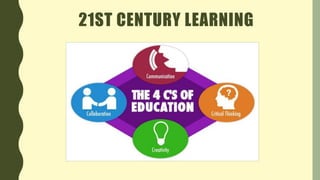
21ST CENTURY LEARNING
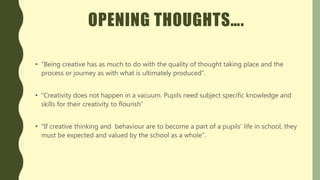
OPENING THOUGHTS….
• “Being creative has as much to do with the quality of thought taking place and the
process or journey as with what is ultimately produced”.
• “Creativity does not happen in a vacuum. Pupils need subject specific knowledge and
skills for their creativity to flourish”
• “If creative thinking and behaviour are to become a part of a pupils’ life in school, they
must be expected and valued by the school as a whole”.
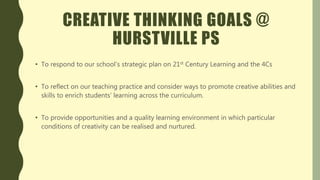
CREATIVE THINKING GOALS @
HURSTVILLE PS
• To respond to our school’s strategic plan on 21st Century Learning and the 4Cs
• To reflect on our teaching practice and consider ways to promote creative abilities and
skills to enrich students’ learning across the curriculum.
• To provide opportunities and a quality learning environment in which particular
conditions of creativity can be realised and nurtured.
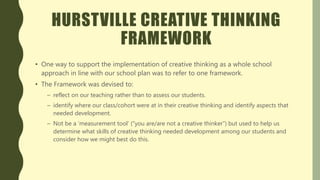
HURSTVILLE CREATIVE THINKING
FRAMEWORK
• One way to support the implementation of creative thinking as a whole school
approach in line with our school plan was to refer to one framework.
• The Framework was devised to:
– reflect on our teaching rather than to assess our students.
– identify where our class/cohort were at in their creative thinking and identify aspects that
needed development.
– Not be a ‘measurement tool’ (“you are/are not a creative thinker”) but used to help us
determine what skills of creative thinking needed development among our students and
consider how we might best do this.
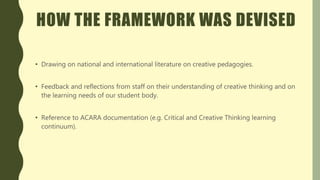
HOW THE FRAMEWORK WAS DEVISED
• Drawing on national and international literature on creative pedagogies.
• Feedback and reflections from staff on their understanding of creative thinking and on
the learning needs of our student body.
• Reference to ACARA documentation (e.g. Critical and Creative Thinking learning
continuum).
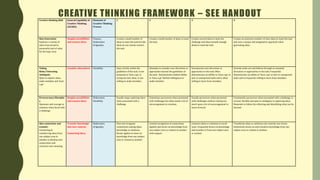
CREATIVE THINKING FRAMEWORK – SEE HANDOUTCreative thinking Skill General Capability of
Creative Thinking
(ACARA)
Elements of
Creative Thinking
Process
1 2 3 4
Idea Generation
Explores a variety of
ideas from broad to
purposeful and of value
for the topic area.
Imagine possibilities
and connect ideas
Fluency,
Elaboration
Originality
Creates a small number of
ideas to meet the task but the
ideas do not clearly connect
the task.
Creates a small number of ideas to meet
the task.
Creates several ideas to meet the
challenge and ideas include enough
detail to meet the task
Creates an extensive number of clear ideas to meet the task
and uses a unique and imaginative approach when
generating ideas
Taking
Risks/Tolerating
Ambiguity
Open to explore ideas,
make mistakes and ‘have
a go’
Consider alternatives Flexibility Stays strictly within the
guidelines of the task. Is not
prepared to ‘have a go’ at
trying out new ideas. Is not
willing to make mistakes.
Attempts to consider new directions or
approaches beyond the guidelines of
the task. Demonstrates limited ability
to ‘have a go’ limited willingness to
make mistakes
Incorporates new directions or
approaches to the task. Often
demonstrates an ability to ‘have a go’ at
new or unexpected tasks and is often
willing to learn from mistakes.
Actively seeks out and follows through on untested
directions or approaches to the task. Frequently
demonstrates an ability to ‘have a go’ at new or unexpected
tasks and is frequently willing to learn from mistakes.
Perseverance/Disciplin
e
Openness and courage to
continue when faced with
a challenge.
Imagine possibilities
and connect ideas
Elaboration
Flexibility
Usually stops exploring ideas
when presented with a
challenge.
Sometimes perseveres when presented
with challenges but often needs a lot of
encouragement to continue.
Usually perseveres when presented
with challenges without relying too
much upon a lot of encouragement to
move forward.
Consistently perseveres when presented with a challenge. Is
curious, flexible and open to ambiguity in exploring ideas.
Responds to failure by reflecting and identifying what can be
learned.
Idea connection and
transfer.
Connecting &
transferring ideas from
one subject area to
another to develop new
connections and
construct new meaning.
Transfer knowledge
into new contexts
Connecting Ideas
Elaboration
Originality
Does not recognize
connections among ideas,
knowledge or solutions.
Rarely applies or draw on
knowledge from one subject
area or context to another.
Limited recognition of connections.
Applies and draws on knowledge from
one subject area or context to another
with support.
Connects ideas or solutions in novel
ways. Frequently draws on knowledge
and transfers it from one subject area
or context.
Transforms ideas or solutions into entirely new forms.
Extensively draws on and transfers knowledge from one
subject area or context to another.
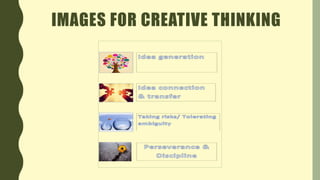
IMAGES FOR CREATIVE THINKING
SHOWCASE
• Stage 3 - Science
• OC – Website
• Year 1 – Creative thinking showcase & Kids Meet
• K6 - Cultural studies
• Stage 2- Maths
• Stage 1 – HSIE & Ryan’s Thinkers Keys
• Early Stage 1 –Literacy & De Bono’s Thinking Hats
CREATIVE THINKING SKILLS IN STAGE
3 SCIENCE
CREATIVITY IN SCIENCE PBL
• Business Project – Creating their own products to sell at Mini-
Fete:
• Idea Generation
– Students are learning to elaborate on their ideas
– Sharing ideas & learning from other students’ imaginative
approaches
• Perseverance/Discipline
– Imagining possibilities
– Students are becoming problem solvers – when resources/ideas
failed, they needed to improvise/change
• Idea Connection & Transfer
– Business Project incorporates skills/knowledge from several
KLAs including Science, Maths, English, Creative Arts &
Technology.
CREATIVE THINKING SKILLS
REFLECTIONS
• Some benefits:
– Students are becoming more ‘creative’ with practice
– Students are collaborating 
– Students are communicating more, learning from each other & getting insight
into how other students think & imagine
– Students are becoming better at tolerating ambiguity and the lack of one
correct answer (especially in Maths)
• Some challenges:
– When students struggle to generate ideas > Scaffold: Provide selection of ideas
for them to choose from, then ask them to make some adaptation of their own.
– When students struggle to persevere > Break challenges into smaller, defined
tasks. The ‘big picture’ is sometimes too daunting.
– When students struggle to transfer knowledge into new contexts – do a ‘mini-
lesson’ on the skill/knowledge needed and show how it connects to the task.
YEAR 6 OC
• Aims:
– For students in current OC to create a website for the incoming OC class that would inform them
of what to expect.
– To improve students’ capacity to think creatively and apply skills across the curriculum. After
collecting student data we focused on Idea Generation and Risk Taking.
– To explore ways of assessing and measuring students’ creative thinking skills.
• Students had to work collaboratively to create a number of different website pages that
used a diverse range of technology (I-Movies/ Prezi-s/ Cartoons/ Animations)
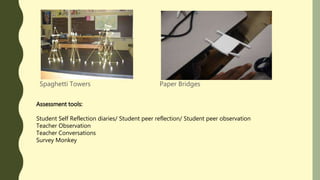
• In addition to the task there were isolated activities that focused on “idea generation” and
responsible “risk taking” The aim was to extend students beyond their comfort zones
(either in the way they worked or the tools they used to devise the page)
Spaghetti Towers Paper Bridges
Assessment tools:
Student Self Reflection diaries/ Student peer reflection/ Student peer observation
Teacher Observation
Teacher Conversations
Survey Monkey
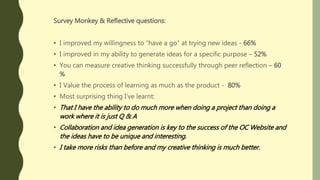
Survey Monkey & Reflective questions:
• I improved my willingness to “have a go” at trying new ideas - 66%
• I improved in my ability to generate ideas for a specific purpose – 52%
• You can measure creative thinking successfully through peer reflection – 60
%
• I Value the process of learning as much as the product - 80%
• Most surprising thing I’ve learnt:
• That I have the ability to do much more when doing a project than doing a
work where it is just Q & A
• Collaboration and idea generation is key to the success of the OC Website and
the ideas have to be unique and interesting.
• I take more risks than before and my creative thinking is much better.
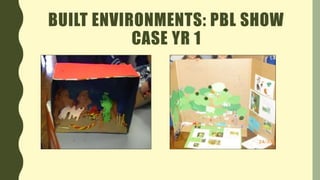
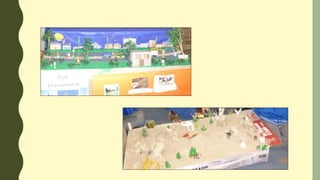
BUILT ENVIRONMENTS: PBL SHOW
CASE YR 1
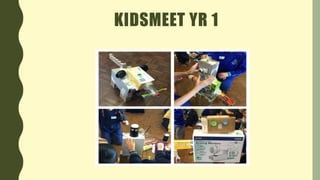
KIDSMEET YR 1
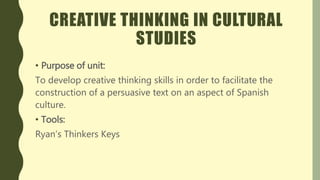
CREATIVE THINKING IN CULTURAL
STUDIES
• Purpose of unit:
To develop creative thinking skills in order to facilitate the
construction of a persuasive text on an aspect of Spanish
culture.
• Tools:
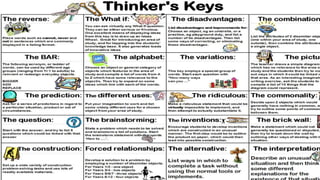
Ryan’s Thinkers Keys
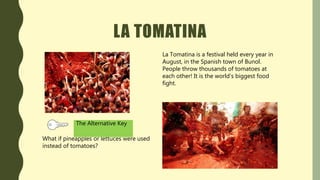
LA TOMATINA
La Tomatina is a festival held every year in
August, in the Spanish town of Bunol.
People throw thousands of tomatoes at
each other! It is the world’s biggest food
fight.
What if pineapples or lettuces were used
instead of tomatoes?
The Alternative Key
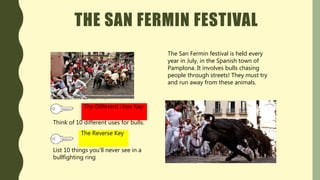
THE SAN FERMIN FESTIVAL
The San Fermin festival is held every
year in July, in the Spanish town of
Pamplona. It involves bulls chasing
people through streets! They must try
and run away from these animals.
Think of 10 different uses for bulls.
The Different Uses Key
List 10 things you’ll never see in a
bullfighting ring
The Reverse Key
CREATIVITY IN MATHS (D. PRATT)
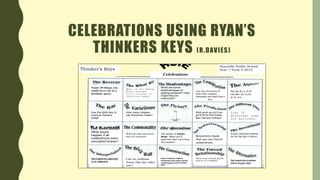
CELEBRATIONS USING RYAN’S
THINKERS KEYS (R.DAVIES)
What are some
disadvantages of
getting presents? How
might they be
overcome?
Thinker’s Keys
Hursville Public School
Year 1 Term 4 2015
Name 10 things you
could never do at a
birthday party.
List the attributes of
both then combine:
Halloween and New Year’s
Eve.
What if the Easter
Bunny brought
fruit instead of
chocolate eggs?
Do an A t o Z o f
cel ebr at i o ns
w o r d s.
Use the BAR key to
improve Santa’s
sleigh.
How many shapes
can fireworks make?
What would you do if you
got $100 for Eid/Chinese
New Year/your birthday?
List 10
different uses
for balloons.
What would
happen if all
celebrations were
cancelled forever?
What do cake and tinsel
have in common?
The answer is Naidoc
Week. What are 5
questions that could have
this answer?
Brainstorm foods
that you can find at
celebrations.
Give3reasonswhypeoplemight
cryat acelebration.
Can we celebrate
Anzac Day any other
way?
How could you make a
Christmas tree using a brick,
chewing gum and a cricket
bat?
What could a Diwali diya be
used for at a wedding?
Invent a personal tradition
for the last day of school.
Give3waystoblowupaballoon
without usingyour mouth.
Celebrations
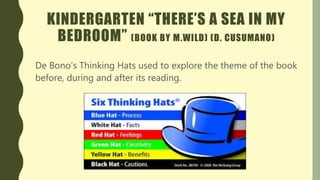
KINDERGARTEN “THERE’S A SEA IN MY
BEDROOM” (BOOK BY M.WILD) (D. CUSUMANO)
De Bono’s Thinking Hats used to explore the theme of the book
before, during and after its reading.
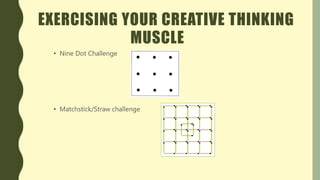
EXERCISING YOUR CREATIVE THINKING
MUSCLE
• Nine Dot Challenge
• Matchstick/Straw challenge
REFLECTION/DISCUSSION
• What approach, strategies and/or resources do you employ at your school to foster
creative thinking skills?
• What new knowledge or re-emphasised knowledge can you take from today’s
workshop to apply in your classroom?
• Sharing what we know, building learning communities and networks
• Twitter: @rsingh113
• Edmodo: Inspire Innovate Creative Thinking: zh9she

Creative Thinking Skills at Hurstville PS

  • 1.
    SHOWCASING CREATIVE THINKING AT HURST VILLEPUBLIC SCHOOL N S W D E P A R T M E N T O F E D U C A T I O N C O N F E R E N C E M A R C H 2 0 1 6 A M Y M O R T I M E R ( A M Y . M O R T I M E R @ D E T . N S W . E D U . A U ) & R U P I N D E R S I N G H ( R U P I N D E R . S I N G H @ D E T . N S W . E D U . A U )
  • 2.
    TEACHING STANDARDS 2.1: Contentand teaching strategies of the teaching area 3.3: Use teaching strategies 3.6: Evaluate and improve teaching programs. 5.1: Assess student learning 5.4: Interpret student data 6.2: Engage in professional learning and improve practice 6.3: Engage with colleagues and improve practice 7.4: Engage with professional teaching networks and broader communities.
  • 3.
  • 4.
    OPENING THOUGHTS…. • “Beingcreative has as much to do with the quality of thought taking place and the process or journey as with what is ultimately produced”. • “Creativity does not happen in a vacuum. Pupils need subject specific knowledge and skills for their creativity to flourish” • “If creative thinking and behaviour are to become a part of a pupils’ life in school, they must be expected and valued by the school as a whole”.
  • 5.
    CREATIVE THINKING GOALS@ HURSTVILLE PS • To respond to our school’s strategic plan on 21st Century Learning and the 4Cs • To reflect on our teaching practice and consider ways to promote creative abilities and skills to enrich students’ learning across the curriculum. • To provide opportunities and a quality learning environment in which particular conditions of creativity can be realised and nurtured.
  • 6.
    HURSTVILLE CREATIVE THINKING FRAMEWORK •One way to support the implementation of creative thinking as a whole school approach in line with our school plan was to refer to one framework. • The Framework was devised to: – reflect on our teaching rather than to assess our students. – identify where our class/cohort were at in their creative thinking and identify aspects that needed development. – Not be a ‘measurement tool’ (“you are/are not a creative thinker”) but used to help us determine what skills of creative thinking needed development among our students and consider how we might best do this.
  • 7.
    HOW THE FRAMEWORKWAS DEVISED • Drawing on national and international literature on creative pedagogies. • Feedback and reflections from staff on their understanding of creative thinking and on the learning needs of our student body. • Reference to ACARA documentation (e.g. Critical and Creative Thinking learning continuum).
  • 8.
    CREATIVE THINKING FRAMEWORK– SEE HANDOUTCreative thinking Skill General Capability of Creative Thinking (ACARA) Elements of Creative Thinking Process 1 2 3 4 Idea Generation Explores a variety of ideas from broad to purposeful and of value for the topic area. Imagine possibilities and connect ideas Fluency, Elaboration Originality Creates a small number of ideas to meet the task but the ideas do not clearly connect the task. Creates a small number of ideas to meet the task. Creates several ideas to meet the challenge and ideas include enough detail to meet the task Creates an extensive number of clear ideas to meet the task and uses a unique and imaginative approach when generating ideas Taking Risks/Tolerating Ambiguity Open to explore ideas, make mistakes and ‘have a go’ Consider alternatives Flexibility Stays strictly within the guidelines of the task. Is not prepared to ‘have a go’ at trying out new ideas. Is not willing to make mistakes. Attempts to consider new directions or approaches beyond the guidelines of the task. Demonstrates limited ability to ‘have a go’ limited willingness to make mistakes Incorporates new directions or approaches to the task. Often demonstrates an ability to ‘have a go’ at new or unexpected tasks and is often willing to learn from mistakes. Actively seeks out and follows through on untested directions or approaches to the task. Frequently demonstrates an ability to ‘have a go’ at new or unexpected tasks and is frequently willing to learn from mistakes. Perseverance/Disciplin e Openness and courage to continue when faced with a challenge. Imagine possibilities and connect ideas Elaboration Flexibility Usually stops exploring ideas when presented with a challenge. Sometimes perseveres when presented with challenges but often needs a lot of encouragement to continue. Usually perseveres when presented with challenges without relying too much upon a lot of encouragement to move forward. Consistently perseveres when presented with a challenge. Is curious, flexible and open to ambiguity in exploring ideas. Responds to failure by reflecting and identifying what can be learned. Idea connection and transfer. Connecting & transferring ideas from one subject area to another to develop new connections and construct new meaning. Transfer knowledge into new contexts Connecting Ideas Elaboration Originality Does not recognize connections among ideas, knowledge or solutions. Rarely applies or draw on knowledge from one subject area or context to another. Limited recognition of connections. Applies and draws on knowledge from one subject area or context to another with support. Connects ideas or solutions in novel ways. Frequently draws on knowledge and transfers it from one subject area or context. Transforms ideas or solutions into entirely new forms. Extensively draws on and transfers knowledge from one subject area or context to another.
  • 9.
  • 10.
    SHOWCASE • Stage 3- Science • OC – Website • Year 1 – Creative thinking showcase & Kids Meet • K6 - Cultural studies • Stage 2- Maths • Stage 1 – HSIE & Ryan’s Thinkers Keys • Early Stage 1 –Literacy & De Bono’s Thinking Hats
  • 11.
    CREATIVE THINKING SKILLSIN STAGE 3 SCIENCE
  • 12.
    CREATIVITY IN SCIENCEPBL • Business Project – Creating their own products to sell at Mini- Fete: • Idea Generation – Students are learning to elaborate on their ideas – Sharing ideas & learning from other students’ imaginative approaches • Perseverance/Discipline – Imagining possibilities – Students are becoming problem solvers – when resources/ideas failed, they needed to improvise/change • Idea Connection & Transfer – Business Project incorporates skills/knowledge from several KLAs including Science, Maths, English, Creative Arts & Technology.
  • 13.
    CREATIVE THINKING SKILLS REFLECTIONS •Some benefits: – Students are becoming more ‘creative’ with practice – Students are collaborating  – Students are communicating more, learning from each other & getting insight into how other students think & imagine – Students are becoming better at tolerating ambiguity and the lack of one correct answer (especially in Maths) • Some challenges: – When students struggle to generate ideas > Scaffold: Provide selection of ideas for them to choose from, then ask them to make some adaptation of their own. – When students struggle to persevere > Break challenges into smaller, defined tasks. The ‘big picture’ is sometimes too daunting. – When students struggle to transfer knowledge into new contexts – do a ‘mini- lesson’ on the skill/knowledge needed and show how it connects to the task.
  • 14.
    YEAR 6 OC •Aims: – For students in current OC to create a website for the incoming OC class that would inform them of what to expect. – To improve students’ capacity to think creatively and apply skills across the curriculum. After collecting student data we focused on Idea Generation and Risk Taking. – To explore ways of assessing and measuring students’ creative thinking skills. • Students had to work collaboratively to create a number of different website pages that used a diverse range of technology (I-Movies/ Prezi-s/ Cartoons/ Animations) • In addition to the task there were isolated activities that focused on “idea generation” and responsible “risk taking” The aim was to extend students beyond their comfort zones (either in the way they worked or the tools they used to devise the page)
  • 15.
    Spaghetti Towers PaperBridges Assessment tools: Student Self Reflection diaries/ Student peer reflection/ Student peer observation Teacher Observation Teacher Conversations Survey Monkey
  • 16.
    Survey Monkey &Reflective questions: • I improved my willingness to “have a go” at trying new ideas - 66% • I improved in my ability to generate ideas for a specific purpose – 52% • You can measure creative thinking successfully through peer reflection – 60 % • I Value the process of learning as much as the product - 80% • Most surprising thing I’ve learnt: • That I have the ability to do much more when doing a project than doing a work where it is just Q & A • Collaboration and idea generation is key to the success of the OC Website and the ideas have to be unique and interesting. • I take more risks than before and my creative thinking is much better.
  • 17.
  • 19.
  • 20.
    CREATIVE THINKING INCULTURAL STUDIES • Purpose of unit: To develop creative thinking skills in order to facilitate the construction of a persuasive text on an aspect of Spanish culture. • Tools: Ryan’s Thinkers Keys
  • 22.
    LA TOMATINA La Tomatinais a festival held every year in August, in the Spanish town of Bunol. People throw thousands of tomatoes at each other! It is the world’s biggest food fight. What if pineapples or lettuces were used instead of tomatoes? The Alternative Key
  • 23.
    THE SAN FERMINFESTIVAL The San Fermin festival is held every year in July, in the Spanish town of Pamplona. It involves bulls chasing people through streets! They must try and run away from these animals. Think of 10 different uses for bulls. The Different Uses Key List 10 things you’ll never see in a bullfighting ring The Reverse Key
  • 24.
  • 25.
    CELEBRATIONS USING RYAN’S THINKERSKEYS (R.DAVIES) What are some disadvantages of getting presents? How might they be overcome? Thinker’s Keys Hursville Public School Year 1 Term 4 2015 Name 10 things you could never do at a birthday party. List the attributes of both then combine: Halloween and New Year’s Eve. What if the Easter Bunny brought fruit instead of chocolate eggs? Do an A t o Z o f cel ebr at i o ns w o r d s. Use the BAR key to improve Santa’s sleigh. How many shapes can fireworks make? What would you do if you got $100 for Eid/Chinese New Year/your birthday? List 10 different uses for balloons. What would happen if all celebrations were cancelled forever? What do cake and tinsel have in common? The answer is Naidoc Week. What are 5 questions that could have this answer? Brainstorm foods that you can find at celebrations. Give3reasonswhypeoplemight cryat acelebration. Can we celebrate Anzac Day any other way? How could you make a Christmas tree using a brick, chewing gum and a cricket bat? What could a Diwali diya be used for at a wedding? Invent a personal tradition for the last day of school. Give3waystoblowupaballoon without usingyour mouth. Celebrations
  • 26.
    KINDERGARTEN “THERE’S ASEA IN MY BEDROOM” (BOOK BY M.WILD) (D. CUSUMANO) De Bono’s Thinking Hats used to explore the theme of the book before, during and after its reading.
  • 27.
    EXERCISING YOUR CREATIVETHINKING MUSCLE • Nine Dot Challenge • Matchstick/Straw challenge
  • 28.
    REFLECTION/DISCUSSION • What approach,strategies and/or resources do you employ at your school to foster creative thinking skills? • What new knowledge or re-emphasised knowledge can you take from today’s workshop to apply in your classroom? • Sharing what we know, building learning communities and networks • Twitter: @rsingh113 • Edmodo: Inspire Innovate Creative Thinking: zh9she