This document discusses fuel cells and their components and operation. It begins by defining a fuel cell as a device that converts chemical energy from a fuel into electricity through an electrochemical reaction with oxygen. It then describes the basic components of a fuel cell - the anode and cathode electrodes, proton-conducting electrolyte membrane, and catalyst. It explains the redox reactions that occur at each electrode when hydrogen gas is used as the fuel and oxygen as the oxidant, producing water and electricity. Applications of fuel cells in India are also listed. Advantages include high efficiency, low pollution, and fuel flexibility, while disadvantages are high costs and technical challenges associated with storing and handling hydrogen fuel.
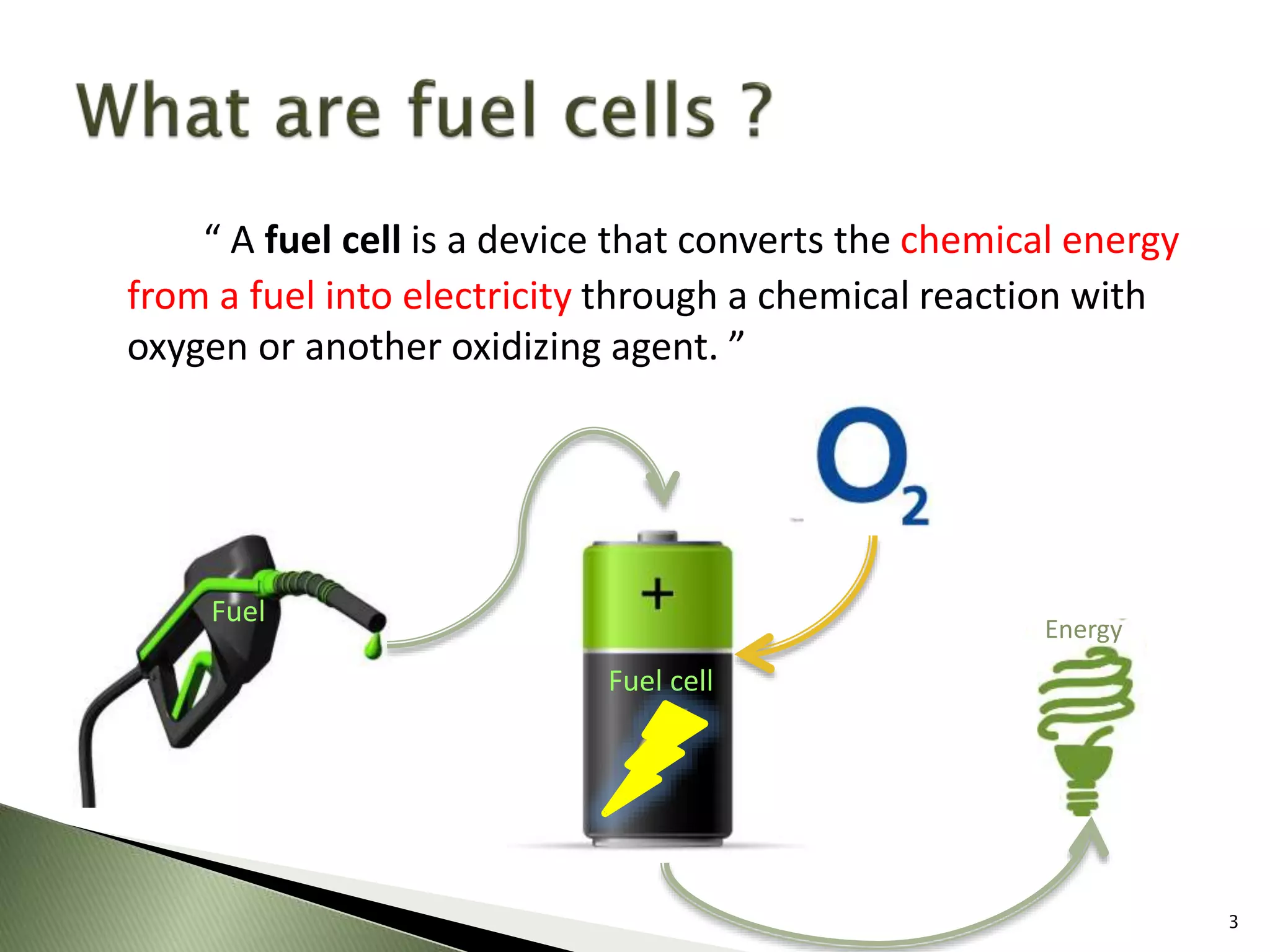
“ A fuelcell is a device that converts the chemical energy
from a fuel into electricity through a chemical reaction with
oxygen or another oxidizing agent. ”
3
Fuel
Fuel cell
Energy
4.
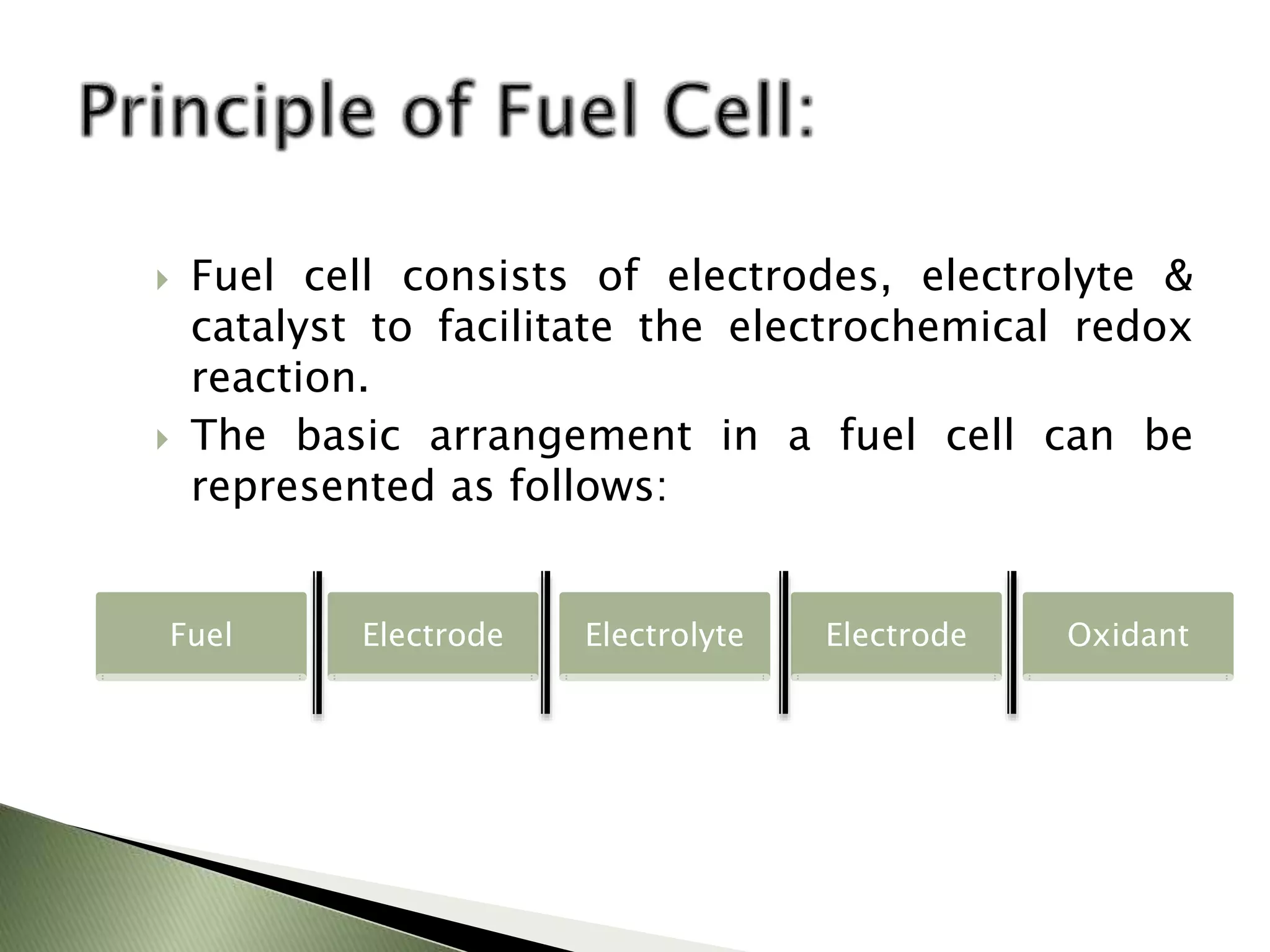
Fuel cellconsists of electrodes, electrolyte &
catalyst to facilitate the electrochemical redox
reaction.
The basic arrangement in a fuel cell can be
represented as follows:
Fuel Electrode Electrolyte Electrode Oxidant
5.
• Anode
– Negativepost of the fuel cell.
– Materials which have high electron conductivity & zero proton
conductivity .
• Cathode
– Positive post of the fuel cell.
– Have high electron conductivity & zero proton conductivity.
• Electrolyte
– Proton exchange membrane.
– Specially treated material, only conducts positively charged ions.
– Membrane blocks electrons.
• Catalyst
– Special material that facilitates reaction of oxygen and hydrogen
– Usually platinum powder very thinly coated onto carbon paper or
cloth.
6.
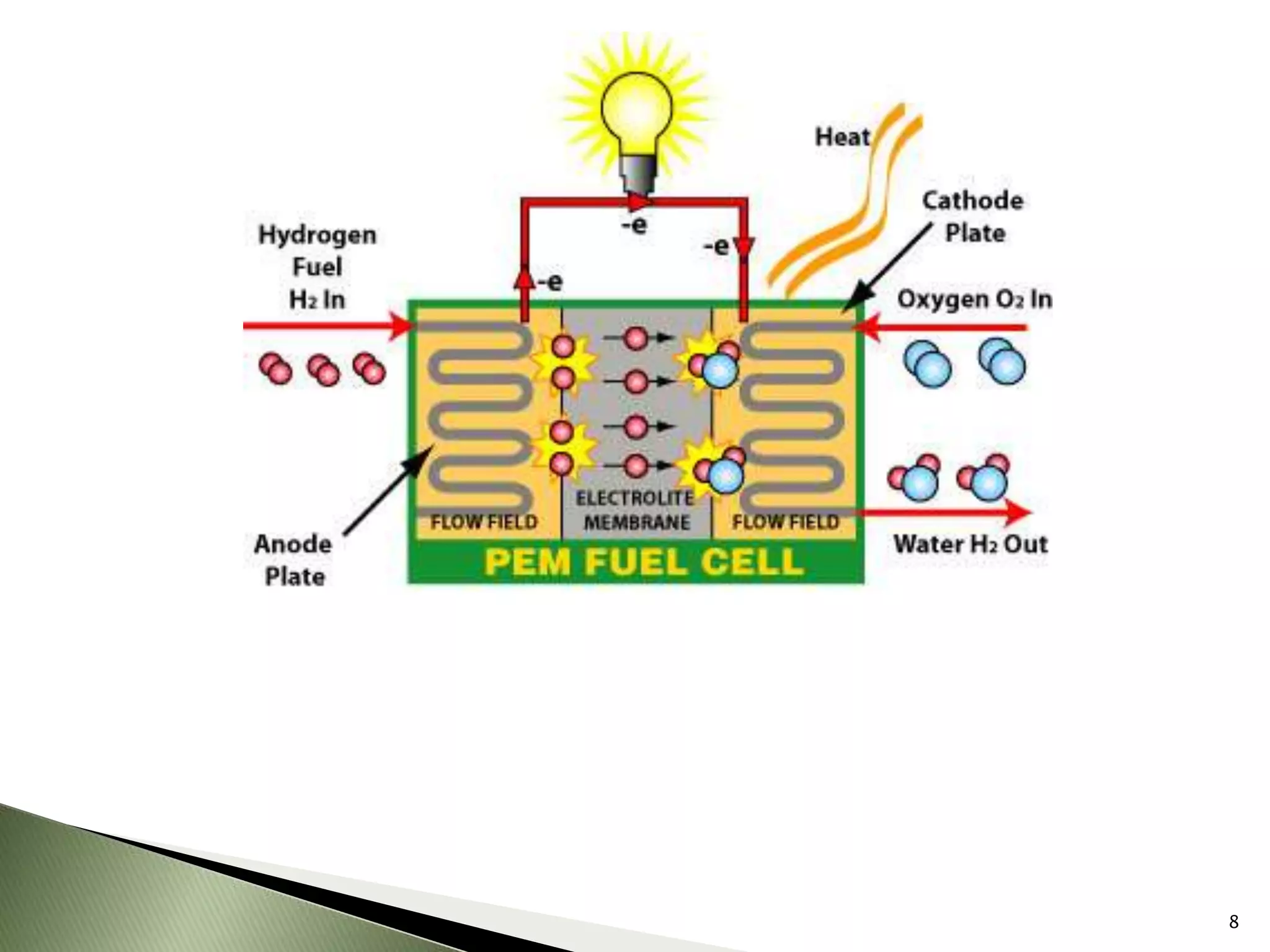
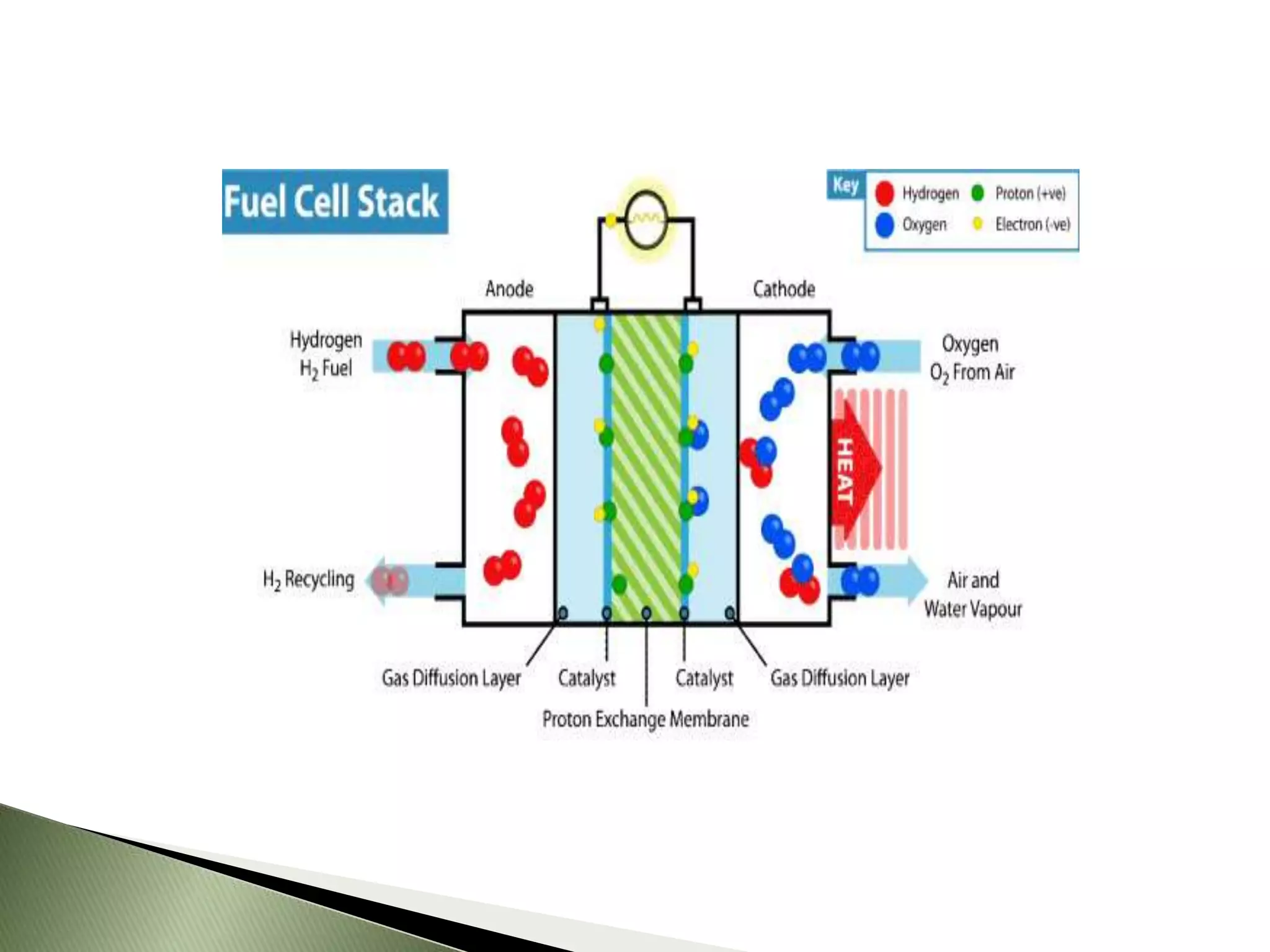
Pressurized hydrogengas (H2) enters cell on anode side.
Gas is forced through catalyst by pressure.
◦ When H2 molecule comes contacts platinum catalyst, it splits
into two H+ ions and two electrons (e-).
Electrons are conducted through the anode
◦ Make their way through the external circuit (doing useful work
such as turning a motor) and return to the cathode side of the
fuel cell.
On the cathode side, oxygen gas (O2) is forced through
the catalyst
◦ Forms two oxygen atoms, each with a strong negative charge.
◦ Negative charge attracts the two H+ ions through the
membrane,
◦ Combine with an oxygen atom and two electrons from the
external circuit to form a water molecule (H2O).
• 2H2 →4H+ + 4e-At
anode
• O2 + 4H+ + 4e- → 2H2O
At
Cathod
e
• 2H2 + O2 → 2H2O
Overall
Reactio
n
Large number of these cells are stacked together in
series to make a battery called as fuel cell battery or
fuel battery.
18.
Fuel Cells Applicationin India
Commercial establishments
Shops in Malls and Underground bazaars
1 to 3 kW systems / around 1,00,000
Small Business Establishments
5-10 kW systems / 50,000
Entertainment Industry
25-50 kW systems / 500 to 1,000
Hotels, restaurants & Resorts
100-200 kW systems / up to 500 units
Hospitals
200-500 kW systems / up to 200 units
Residential Complexes
50-200 kW systems / 30,000 to 50,000
19.
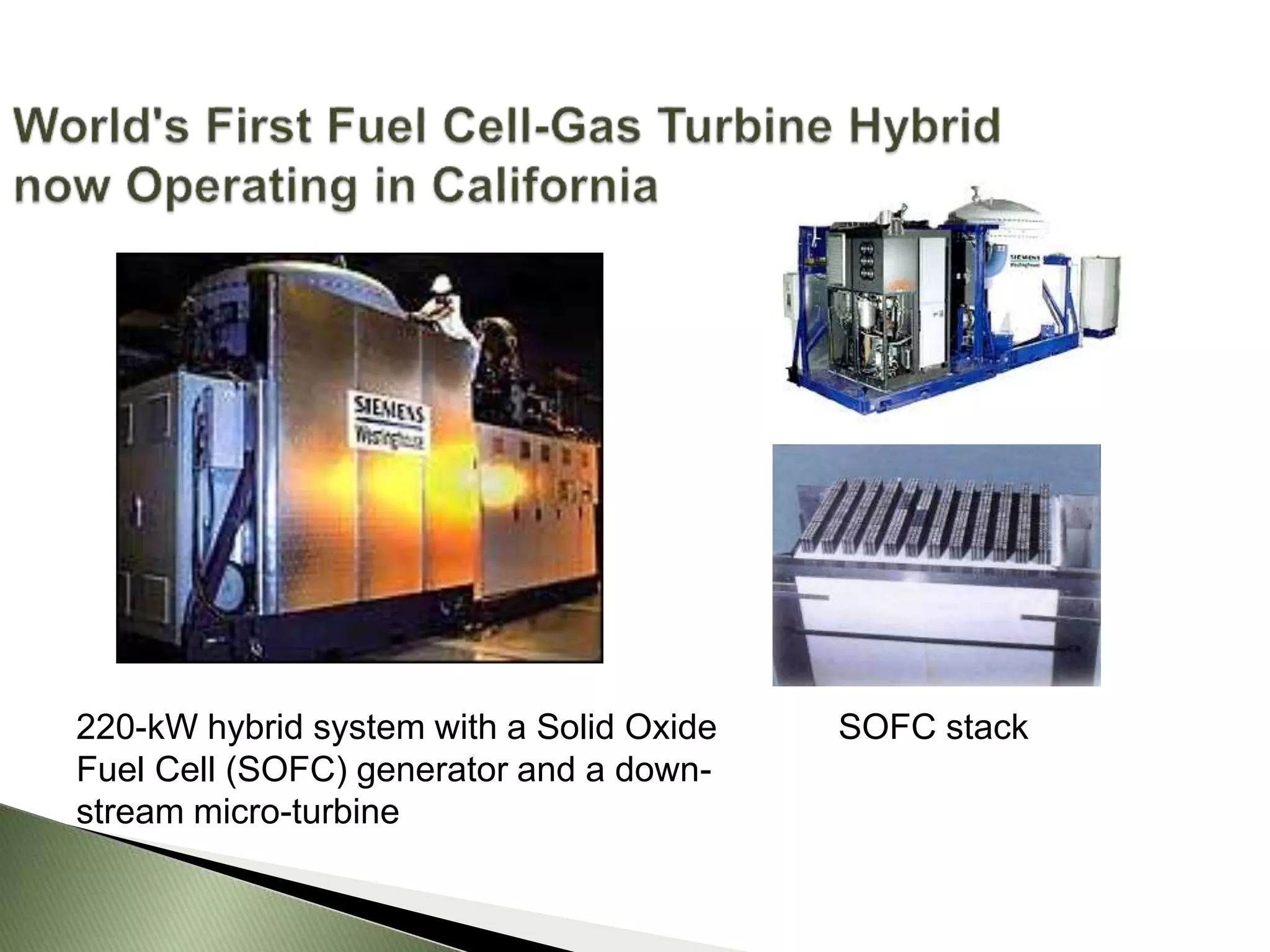
220-kW hybrid systemwith a Solid Oxide
Fuel Cell (SOFC) generator and a down-
stream micro-turbine
SOFC stack
20.
1. High efficiencyof energy conversion
(approaching 70%) from chemical energy to
electrical energy.
2. Low noise pollution & low thermal pollution.
3. Fuel cell power can reduce expensive
transmission lines & minimize transmission loses
for a disturbed system.
4. Saves fossil fuels.
5. Fuel cells are less polluting. Mostly the
byproducts are water & waste heat, which are
environmentally acceptable .
21.
6. Hydrogen-Oxygen fuelcells produce drinking
water of potable quality.
7. Low maintenance cost.
8. Fuel cells automotive batteries can render
electric vehicles, efficient & refillable.
22.
High initialcost.
Life times of the cells are not accurately
known.
Large weight and volume of gas fuel storage
system.
High cost of pure hydrogen.
Pure hydrogen is difficult to handle.
Hydrogen often created using “dirty” energy (e.g.,
coal)
23.
Fuel cells havemany advantages over conventional power
generating equipment: high efficiency, low emissions, flexibility,
high reliability, low maintenance, and multi-fuel capability.
Because of their efficiency and environmental advantages, fuel
cell technologies are viewed as an attractive 21st century solution
to energy problems.