Texture Mapping
Objectives
• Introduce Mapping Methods
• Texture Mapping
• Environment Mapping
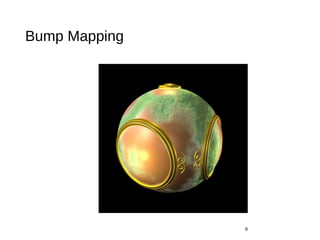
• Bump Mapping
• Consider basic strategies
• Forward vs backward mapping
• Point sampling vs area averaging
2
The Limits of Geometric Modeling
• Although graphics cards can render over 10 million polygons per
second, that number is insufficient for many phenomena
• Clouds
• Grass
• Terrain
• Skin
3
Modeling an Orange
• Consider the problem of modeling an orange (the fruit)
• Start with an orange-colored sphere
• Too simple
• Replace sphere with a more complex shape
• Does not capture surface characteristics (small dimples)
• Takes too many polygons to model all the dimples
4
Modeling an Orange (2)
• Take a picture of a real orange, scan it, and “paste” onto simple
geometric model
• This process is known as texture mapping
• Still might not be sufficient because resulting surface will be smooth
• Need to change local shape
• Bump mapping
5
Three Types of Mapping
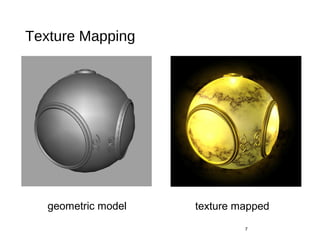
• Texture Mapping
• Uses images to fill inside of polygons
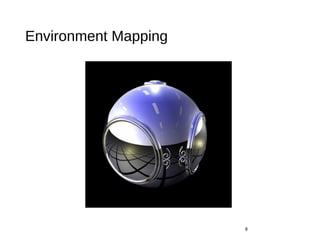
• Environment (reflection mapping)
• Uses a picture of the environment for texture maps
• Allows simulation of highly specular surfaces
• Bump mapping
• Emulates altering normal vectors during the rendering process
6
Texture Mapping
7
geometric model texture mapped
Environment Mapping
8
Bump Mapping
9
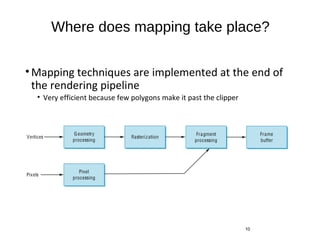
Where does mapping take place?
•Mapping techniques are implemented at the end of
the rendering pipeline
• Very efficient because few polygons make it past the clipper
10
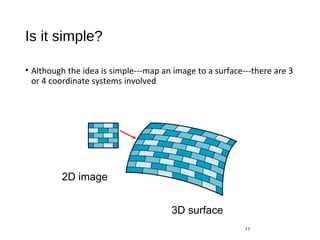
Is it simple?
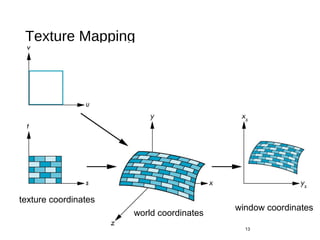
• Although the idea is simple---map an image to a surface---there are 3
or 4 coordinate systems involved
11
2D image
3D surface
Coordinate Systems
• Parametric coordinates
• May be used to model curves and surfaces
• Texture coordinates
• Used to identify points in the image to be mapped
• Object or World Coordinates
• Conceptually, where the mapping takes place
• Window Coordinates
• Where the final image is really produced
12
Texture Mapping
parametric coordinates
13
texture coordinates
world coordinates
window coordinates
Mapping Functions
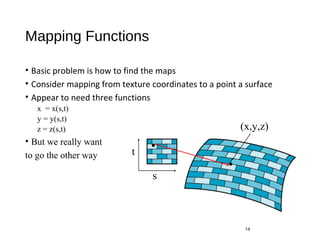
• Basic problem is how to find the maps
• Consider mapping from texture coordinates to a point a surface
• Appear to need three functions
x = x(s,t)
y = y(s,t)
z = z(s,t)
• But we really want
to go the other way
14
s
t
(x,y,z)
Backward Mapping
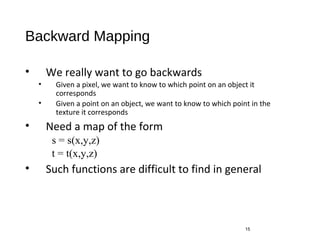
• We really want to go backwards
• Given a pixel, we want to know to which point on an object it
corresponds
• Given a point on an object, we want to know to which point in the
texture it corresponds
• Need a map of the form
s = s(x,y,z)
t = t(x,y,z)
• Such functions are difficult to find in general
15
Two-part mapping
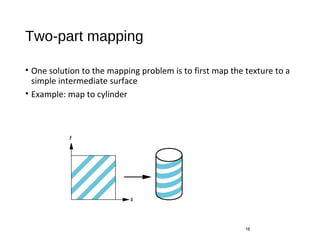
• One solution to the mapping problem is to first map the texture to a
simple intermediate surface
• Example: map to cylinder
16
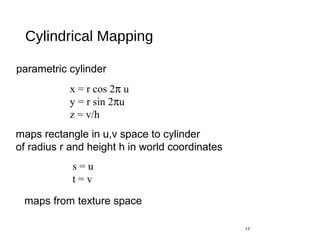
Cylindrical Mapping
17
parametric cylinder
x = r cos 2π u
y = r sin 2πu
z = v/h
maps rectangle in u,v space to cylinder
of radius r and height h in world coordinates
s = u
t = v
maps from texture space
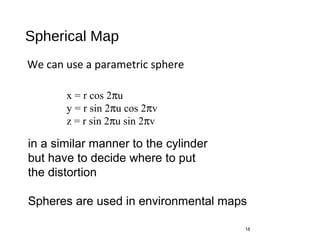
Spherical Map
We can use a parametric sphere
18
x = r cos 2πu
y = r sin 2πu cos 2πv
z = r sin 2πu sin 2πv
in a similar manner to the cylinder
but have to decide where to put
the distortion
Spheres are used in environmental maps
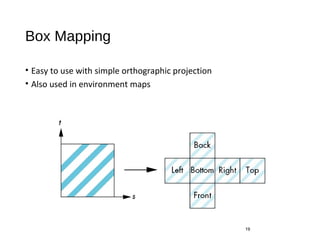
Box Mapping
• Easy to use with simple orthographic projection
• Also used in environment maps
19
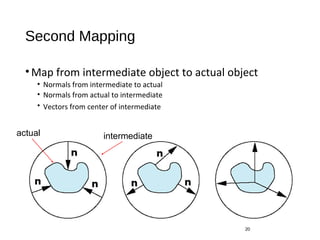
Second Mapping
•Map from intermediate object to actual object
• Normals from intermediate to actual
• Normals from actual to intermediate
• Vectors from center of intermediate
20
intermediateactual
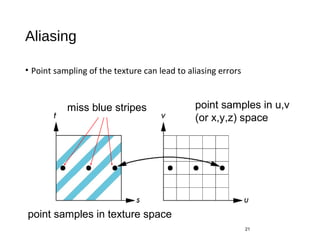
Aliasing
• Point sampling of the texture can lead to aliasing errors
21
point samples in u,v
(or x,y,z) space
point samples in texture space
miss blue stripes
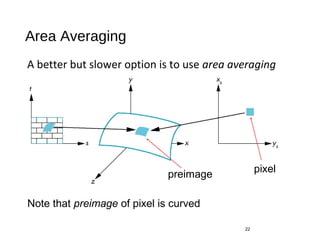
Area Averaging
A better but slower option is to use area averaging
22
Note that preimage of pixel is curved
pixel
preimage

Texture Mapping

  • 1.
  • 2.
    Objectives • Introduce MappingMethods • Texture Mapping • Environment Mapping • Bump Mapping • Consider basic strategies • Forward vs backward mapping • Point sampling vs area averaging 2
  • 3.
    The Limits ofGeometric Modeling • Although graphics cards can render over 10 million polygons per second, that number is insufficient for many phenomena • Clouds • Grass • Terrain • Skin 3
  • 4.
    Modeling an Orange •Consider the problem of modeling an orange (the fruit) • Start with an orange-colored sphere • Too simple • Replace sphere with a more complex shape • Does not capture surface characteristics (small dimples) • Takes too many polygons to model all the dimples 4
  • 5.
    Modeling an Orange(2) • Take a picture of a real orange, scan it, and “paste” onto simple geometric model • This process is known as texture mapping • Still might not be sufficient because resulting surface will be smooth • Need to change local shape • Bump mapping 5
  • 6.
    Three Types ofMapping • Texture Mapping • Uses images to fill inside of polygons • Environment (reflection mapping) • Uses a picture of the environment for texture maps • Allows simulation of highly specular surfaces • Bump mapping • Emulates altering normal vectors during the rendering process 6
  • 7.
  • 8.
  • 9.
  • 10.
    Where does mappingtake place? •Mapping techniques are implemented at the end of the rendering pipeline • Very efficient because few polygons make it past the clipper 10
  • 11.
    Is it simple? •Although the idea is simple---map an image to a surface---there are 3 or 4 coordinate systems involved 11 2D image 3D surface
  • 12.
    Coordinate Systems • Parametriccoordinates • May be used to model curves and surfaces • Texture coordinates • Used to identify points in the image to be mapped • Object or World Coordinates • Conceptually, where the mapping takes place • Window Coordinates • Where the final image is really produced 12
  • 13.
    Texture Mapping parametric coordinates 13 texturecoordinates world coordinates window coordinates
  • 14.
    Mapping Functions • Basicproblem is how to find the maps • Consider mapping from texture coordinates to a point a surface • Appear to need three functions x = x(s,t) y = y(s,t) z = z(s,t) • But we really want to go the other way 14 s t (x,y,z)
  • 15.
    Backward Mapping • Wereally want to go backwards • Given a pixel, we want to know to which point on an object it corresponds • Given a point on an object, we want to know to which point in the texture it corresponds • Need a map of the form s = s(x,y,z) t = t(x,y,z) • Such functions are difficult to find in general 15
  • 16.
    Two-part mapping • Onesolution to the mapping problem is to first map the texture to a simple intermediate surface • Example: map to cylinder 16
  • 17.
    Cylindrical Mapping 17 parametric cylinder x= r cos 2π u y = r sin 2πu z = v/h maps rectangle in u,v space to cylinder of radius r and height h in world coordinates s = u t = v maps from texture space
  • 18.
    Spherical Map We canuse a parametric sphere 18 x = r cos 2πu y = r sin 2πu cos 2πv z = r sin 2πu sin 2πv in a similar manner to the cylinder but have to decide where to put the distortion Spheres are used in environmental maps
  • 19.
    Box Mapping • Easyto use with simple orthographic projection • Also used in environment maps 19
  • 20.
    Second Mapping •Map fromintermediate object to actual object • Normals from intermediate to actual • Normals from actual to intermediate • Vectors from center of intermediate 20 intermediateactual
  • 21.
    Aliasing • Point samplingof the texture can lead to aliasing errors 21 point samples in u,v (or x,y,z) space point samples in texture space miss blue stripes
  • 22.
    Area Averaging A betterbut slower option is to use area averaging 22 Note that preimage of pixel is curved pixel preimage