By,
Chethan N
I MCA.
Karnaugh Map :-
Karnaugh Map is also called K-Map.
K-Maps are graphical representation of Boolean function.
It provides a systematic method for the
simplification of Boolean expression.
It is composed of adjacent cells.
Adjacent cells are those which differ by a
single variable.
Each cell represents a combination of variables in
product/sum form.
Ordering Of Variables :-
• It means cell of adjacency(side by side).
• The cells in a K-Map are arranged so that there is only
a single variable change b/w adjacent cells.
• Adjacency is defined by a single variable change.
• For Ex: In the 3 variable map the 010 cell is adjacent to
the 000 cell but it is not adjacent to the 101 cell.
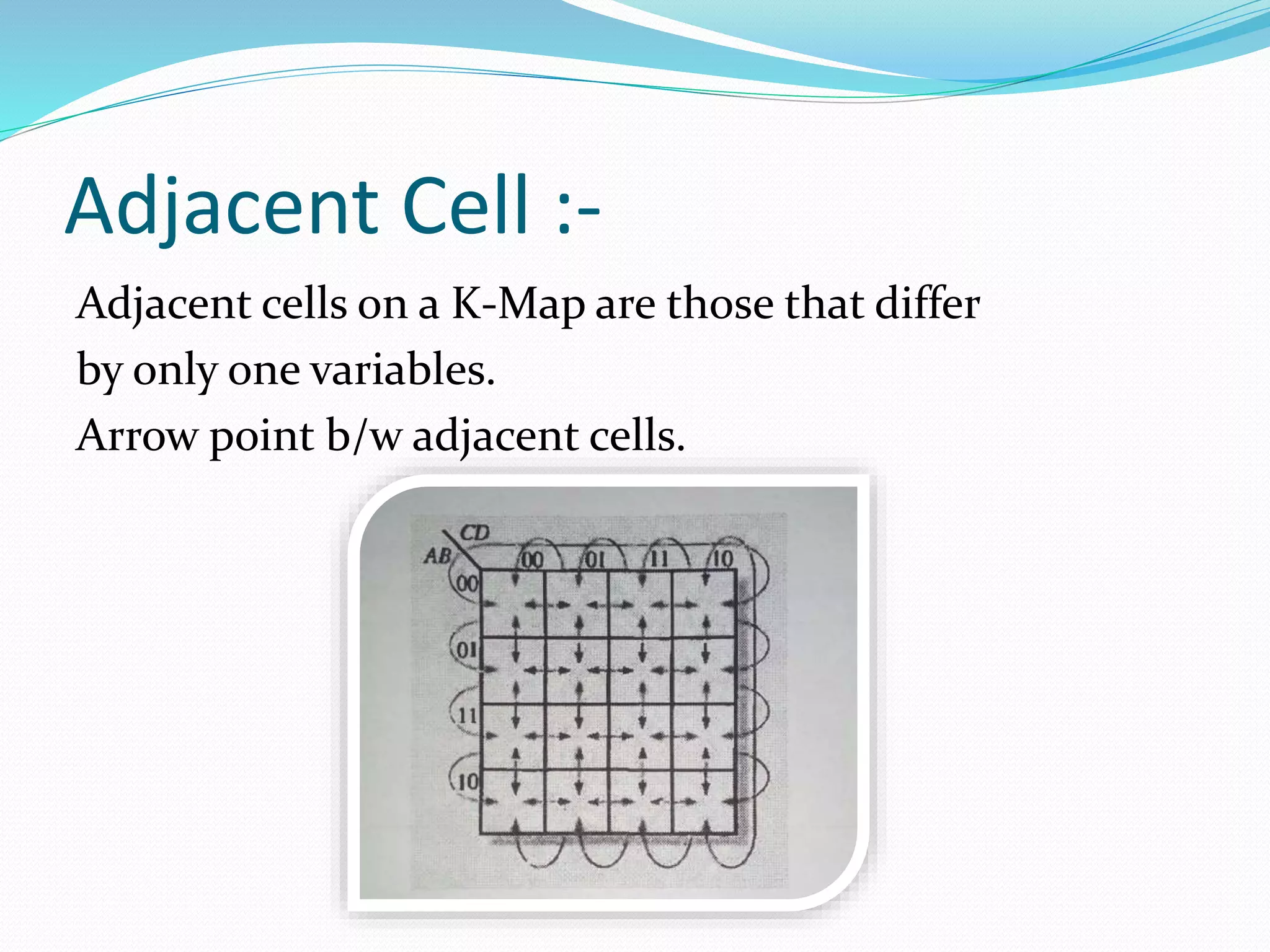
Adjacent Cell :-
Adjacent cells on a K-Map are those that differ
by only one variables.
Arrow point b/w adjacent cells.
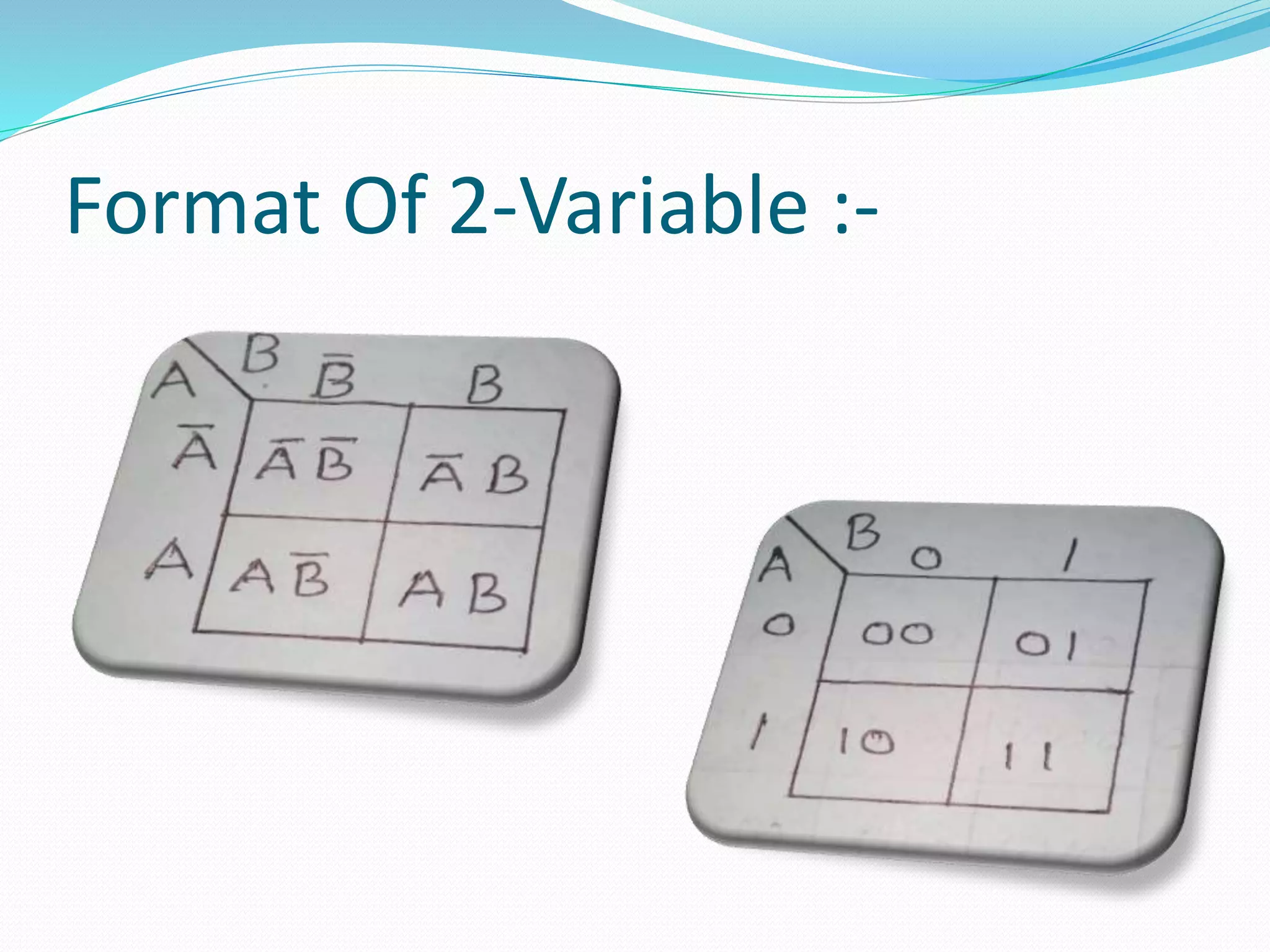
2 -Variable K-Map :-
 The 2 – variable K-Map is an array of 4 cells, as shown
in the below (2^2=4).
 Binary values of A/B along the left side & the values of
B/A are across the top.
 The values of a given cell is the binary values of A/B at
the left in the same row combined with the binary
values of B/A at the top in the same column.
Format Of 2-Variable :-
K-Map SOP Minimization :-
For an SOP expression in standard form, a 1 is
placed on the K-Map for each product term in
Expression. Each 1 is placed in a cell
corresponding to the value of product term.
For Ex: Now we studying the two variable map.
Simplification Of Boolean
Expression Using K-Map For 2/3/4
Variables :-
A given expression can be simplified on to K-Map with
the help of the following steps ;
1.Plotting the expression on to the K-Map.
2.Grouping of cells.
3.Simplification.
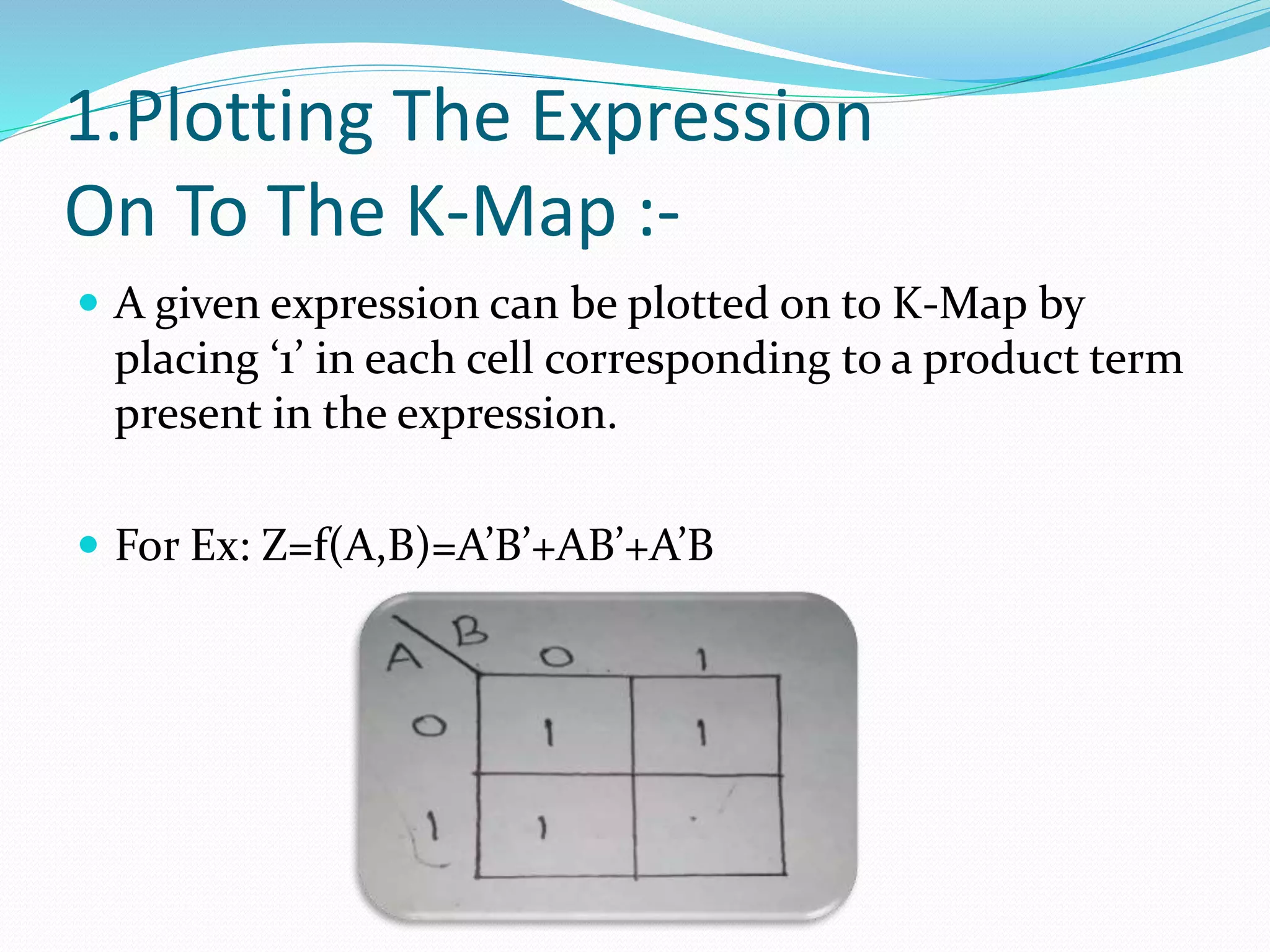
1.Plotting The Expression
On To The K-Map :-
 A given expression can be plotted on to K-Map by
placing ‘1’ in each cell corresponding to a product term
present in the expression.
 For Ex: Z=f(A,B)=A’B’+AB’+A’B
Grouping :-
Adjacent cells can be combined together to form a group
using the following rules ,
• Adjacent cells are those which differ by a single variable.
• Adjacent cells can be combined in groups of 1,2,4,8,16,….
• Each group is extended by merging with the adjacent
groups so that it includes as many adjacent cells as
possible.
• Each group represents a product term.
3-Variable K-Map :-
* The 3-variable K-Map is an array of eight cells
as shown in below.
• In this case, binary values A&B/B&C are along the left
side and the values of C/A are across the top.
• The value of a given cell is the binary values of A & B at
the left in the same row combined with the value of C
at the top in the same column.
Format Of 3-Variable :-
Example Of 3-Variable :-
1.Plotting The Expression
On To The K-Map . 2.Grouping .
Consider the equation ;
Z=f(A,B,C)=A’B’C’+A’BC’+AB’C’
+AB’C
3.Simplification .
Z=A’B’C’.A’BC’+AB’C’.A’B’C
The simplified equation is,
Z= A’C’+A’B’
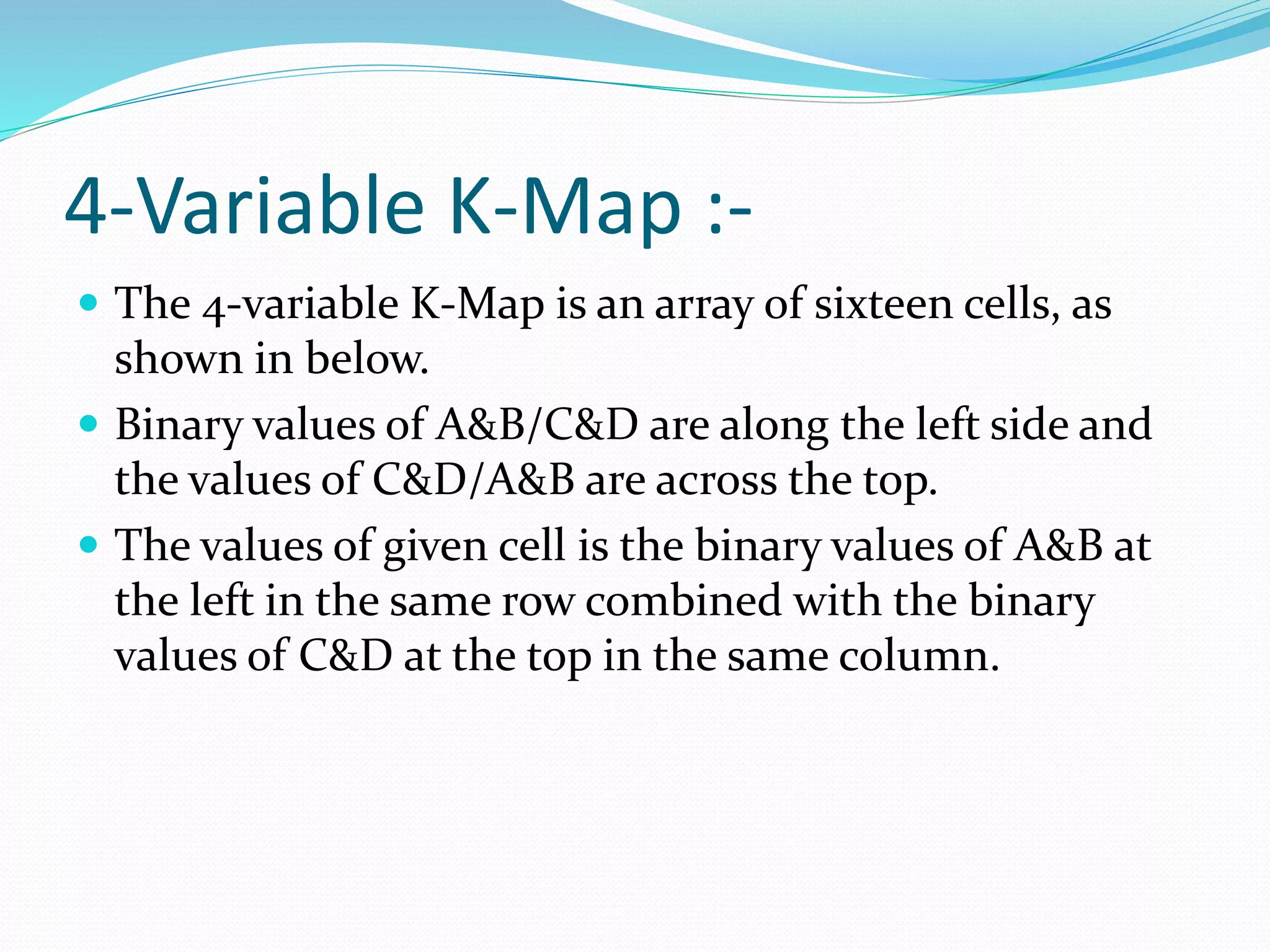
4-Variable K-Map :-
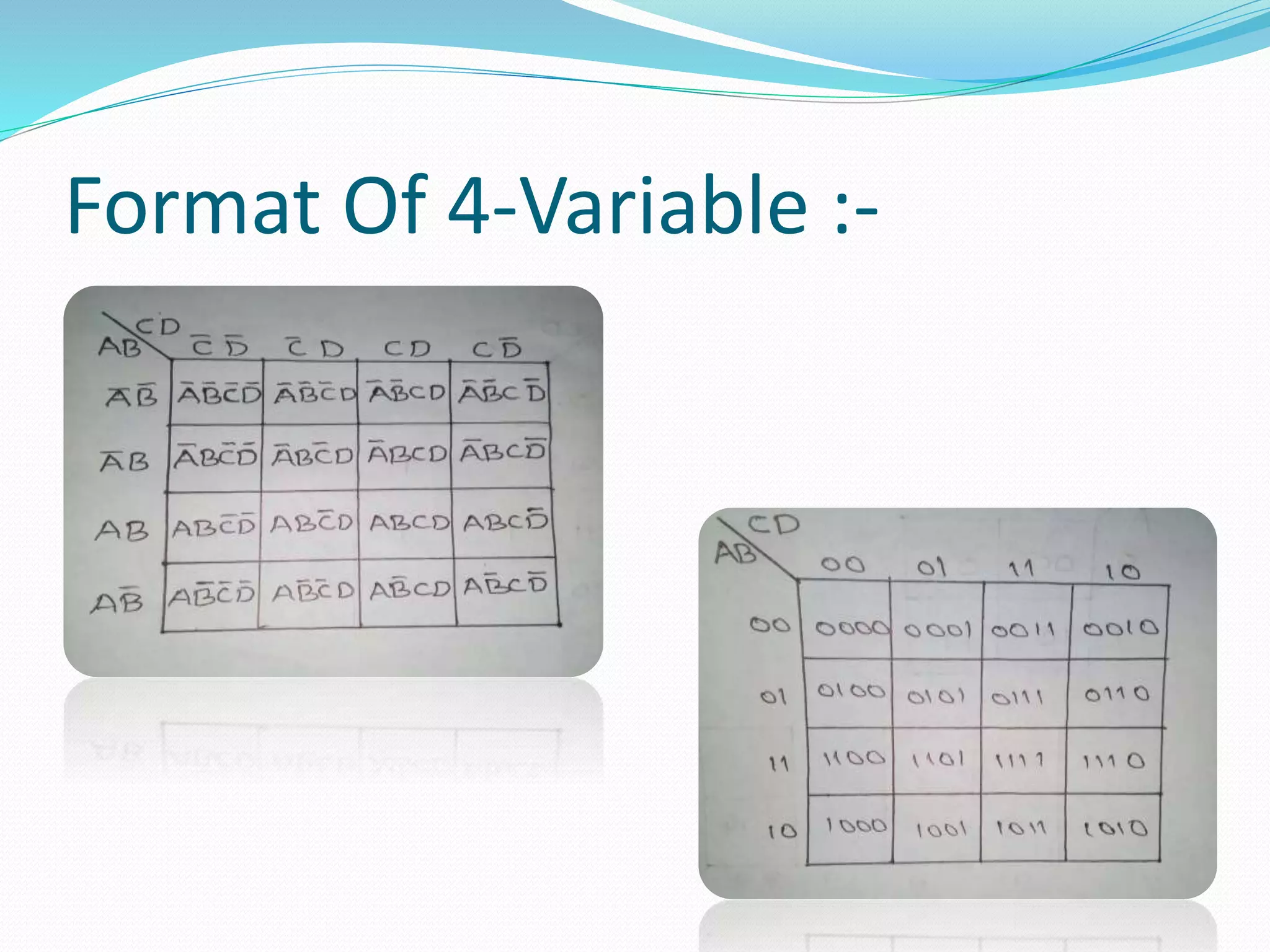
 The 4-variable K-Map is an array of sixteen cells, as
shown in below.
 Binary values of A&B/C&D are along the left side and
the values of C&D/A&B are across the top.
 The values of given cell is the binary values of A&B at
the left in the same row combined with the binary
values of C&D at the top in the same column.
Format Of 4-Variable :-
Simplification :-
Simplification involves the following steps ,
• Each group represents a product term composed of
variables in normal or in complemented form.
• In a term, if a variable presents both in normal and in
complemented form then it is discarded.
• The final simplified expression is the sum of all the
product terms.
• Z=A’B’A’B+AB’A’B’
• The simplified equation is Z=A’+B’.
Example Of 4-Variable :-
1.Plotting The Expression
On To The K-Map. 2.Grouping.
Consider a equation ,
Z=f(A,B)=A’BC’D+A’BCD+A’BC
D’+ABCD’+ABCD’+ABC’D
3.Simplification.
 Z=A’BC’D.A’BCD+A’BCD’.ABCD’+ABC’D.ABC’D’
 The Simplified Equation Is ,
 Z=A’BD+BCD’+ABC’
“ Don’t Care “ Condition :-
 Functions that have unspecified output for some input
c0mbinations are called incompletely specified functions.
 Unspecified minterms of a functions are called “don’t care”
conditions. We simply don’t care whether the value of
‘zero’ or ‘one’ is assigned to Z for particular minterm.
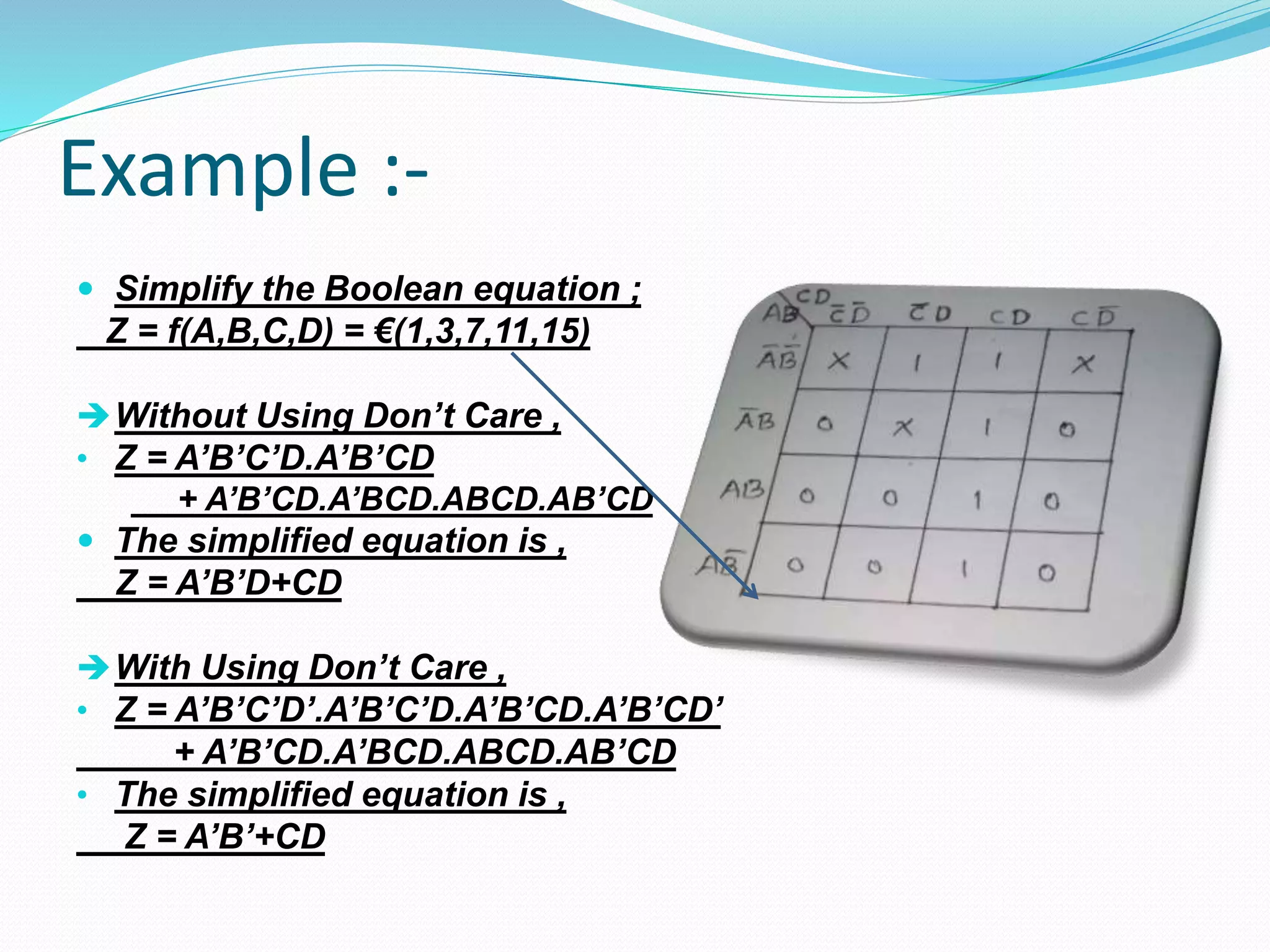
 Don’t care conditions are represented by X in the K-Map.
NOTE :Don’t care conditions play a central role in the
specification and optimization of logic circuits as they
represent the degrees of freedom of transforming a
network into a functionally equivalent one.
Example :-
 Simplify the Boolean equation ;
Z = f(A,B,C,D) = €(1,3,7,11,15)
Without Using Don’t Care ,
• Z = A’B’C’D.A’B’CD
+ A’B’CD.A’BCD.ABCD.AB’CD
 The simplified equation is ,
Z = A’B’D+CD
With Using Don’t Care ,
• Z = A’B’C’D’.A’B’C’D.A’B’CD.A’B’CD’
+ A’B’CD.A’BCD.ABCD.AB’CD
• The simplified equation is ,
Z = A’B’+CD
THANK YOU

K map.

  • 1.
  • 2.
    Karnaugh Map :- KarnaughMap is also called K-Map. K-Maps are graphical representation of Boolean function. It provides a systematic method for the simplification of Boolean expression. It is composed of adjacent cells. Adjacent cells are those which differ by a single variable. Each cell represents a combination of variables in product/sum form.
  • 3.
    Ordering Of Variables:- • It means cell of adjacency(side by side). • The cells in a K-Map are arranged so that there is only a single variable change b/w adjacent cells. • Adjacency is defined by a single variable change. • For Ex: In the 3 variable map the 010 cell is adjacent to the 000 cell but it is not adjacent to the 101 cell.
  • 4.
    Adjacent Cell :- Adjacentcells on a K-Map are those that differ by only one variables. Arrow point b/w adjacent cells.
  • 5.
    2 -Variable K-Map:-  The 2 – variable K-Map is an array of 4 cells, as shown in the below (2^2=4).  Binary values of A/B along the left side & the values of B/A are across the top.  The values of a given cell is the binary values of A/B at the left in the same row combined with the binary values of B/A at the top in the same column.
  • 6.
  • 7.
    K-Map SOP Minimization:- For an SOP expression in standard form, a 1 is placed on the K-Map for each product term in Expression. Each 1 is placed in a cell corresponding to the value of product term. For Ex: Now we studying the two variable map.
  • 8.
    Simplification Of Boolean ExpressionUsing K-Map For 2/3/4 Variables :- A given expression can be simplified on to K-Map with the help of the following steps ; 1.Plotting the expression on to the K-Map. 2.Grouping of cells. 3.Simplification.
  • 9.
    1.Plotting The Expression OnTo The K-Map :-  A given expression can be plotted on to K-Map by placing ‘1’ in each cell corresponding to a product term present in the expression.  For Ex: Z=f(A,B)=A’B’+AB’+A’B
  • 10.
    Grouping :- Adjacent cellscan be combined together to form a group using the following rules , • Adjacent cells are those which differ by a single variable. • Adjacent cells can be combined in groups of 1,2,4,8,16,…. • Each group is extended by merging with the adjacent groups so that it includes as many adjacent cells as possible. • Each group represents a product term.
  • 11.
    3-Variable K-Map :- *The 3-variable K-Map is an array of eight cells as shown in below. • In this case, binary values A&B/B&C are along the left side and the values of C/A are across the top. • The value of a given cell is the binary values of A & B at the left in the same row combined with the value of C at the top in the same column.
  • 12.
  • 13.
    Example Of 3-Variable:- 1.Plotting The Expression On To The K-Map . 2.Grouping . Consider the equation ; Z=f(A,B,C)=A’B’C’+A’BC’+AB’C’ +AB’C 3.Simplification . Z=A’B’C’.A’BC’+AB’C’.A’B’C The simplified equation is, Z= A’C’+A’B’
  • 14.
    4-Variable K-Map :- The 4-variable K-Map is an array of sixteen cells, as shown in below.  Binary values of A&B/C&D are along the left side and the values of C&D/A&B are across the top.  The values of given cell is the binary values of A&B at the left in the same row combined with the binary values of C&D at the top in the same column.
  • 15.
  • 16.
    Simplification :- Simplification involvesthe following steps , • Each group represents a product term composed of variables in normal or in complemented form. • In a term, if a variable presents both in normal and in complemented form then it is discarded. • The final simplified expression is the sum of all the product terms. • Z=A’B’A’B+AB’A’B’ • The simplified equation is Z=A’+B’.
  • 17.
    Example Of 4-Variable:- 1.Plotting The Expression On To The K-Map. 2.Grouping. Consider a equation , Z=f(A,B)=A’BC’D+A’BCD+A’BC D’+ABCD’+ABCD’+ABC’D
  • 18.
  • 19.
    “ Don’t Care“ Condition :-  Functions that have unspecified output for some input c0mbinations are called incompletely specified functions.  Unspecified minterms of a functions are called “don’t care” conditions. We simply don’t care whether the value of ‘zero’ or ‘one’ is assigned to Z for particular minterm.  Don’t care conditions are represented by X in the K-Map. NOTE :Don’t care conditions play a central role in the specification and optimization of logic circuits as they represent the degrees of freedom of transforming a network into a functionally equivalent one.
  • 20.
    Example :-  Simplifythe Boolean equation ; Z = f(A,B,C,D) = €(1,3,7,11,15) Without Using Don’t Care , • Z = A’B’C’D.A’B’CD + A’B’CD.A’BCD.ABCD.AB’CD  The simplified equation is , Z = A’B’D+CD With Using Don’t Care , • Z = A’B’C’D’.A’B’C’D.A’B’CD.A’B’CD’ + A’B’CD.A’BCD.ABCD.AB’CD • The simplified equation is , Z = A’B’+CD
  • 21.