Simplification of Boolean functions
by Karnaugh Map and Tabulation
Method
Presented By
C.Ramesh
Assistant Professor/ECE
KIT-kalaignarkarunanidhi Institute Of Technology,
Ciombatore.
Introduction
• Although the truth table representation of a function is unique,
when expressed algebraically, it can appear in many different form.
• Boolean functions may be simplified by algebraic means.
• How ever, this procedure of minimization is difficult because it
takes specific rules to predict each succeeding step in the
manipulative process.
• The map method provides a simple straight forward procedure for
minimizing Boolean functions.
Karnaugh Map (K-Map)
• A K-Map is a graphical representation of a truth table that can be
used to reduce a logic circuit to its simplest terms.
• The Karnaugh map uses a rectangle divided into rows and
columns.
• Any product term in the expression to be simplified can be
represented as the intersection of a row and a column.
• The rows and columns are labeled with each term in the expression
and its complement.
• The labels must be arranged so that each horizontal or vertical
move changes the state of one and only one variable.
Two variable K-Map
x’y’ x’y
xy’ xy
x
y
0
0
1
1
m0 m1
m2 m3
x
y
0
0
1
1
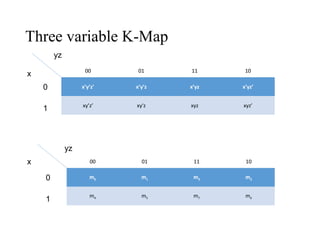
Three variable K-Map
x’y’z’ x’y’z x’yz x’yz’
xy’z’ xy'z xyz xyz’
m0 m1 m3 m2
m4 m5 m7 m6
x
x
yz
yz
0
1
0
1
00 01 11 10
00 01 11 10
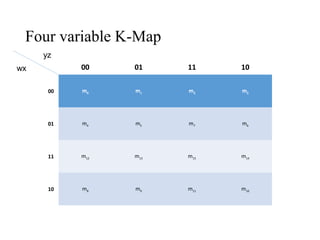
Four variable K-Map
m0 m1 m3 m2
m4 m5 m7 m6
m12 m13 m15 m14
m8 m9 m11 m10
00 01 11 10
00
01
11
10
wx
yz
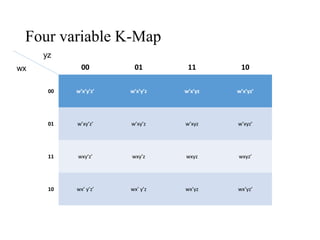
Four variable K-Map
w’x’y’z’ w’x’y’z w’x’yz w’x’yz’
w’xy’z’ w’xy’z w’xyz w’xyz’
wxy’z’ wxy’z wxyz wxyz’
wx’ y’z’ wx’ y’z wx’yz wx’yz’
00 01 11 10
00
01
11
10
wx
yz
Simplification Using the K-Map
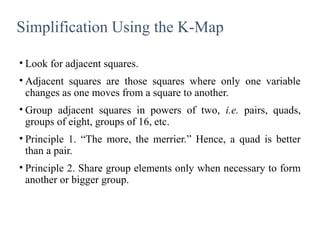
• Look for adjacent squares.
• Adjacent squares are those squares where only one variable
changes as one moves from a square to another.
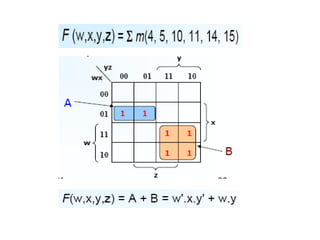
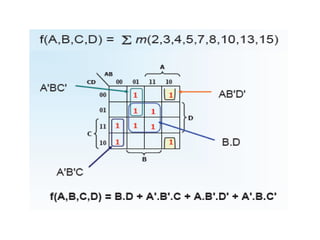
• Group adjacent squares in powers of two, i.e. pairs, quads,
groups of eight, groups of 16, etc.
• Principle 1. “The more, the merrier.” Hence, a quad is better
than a pair.
• Principle 2. Share group elements only when necessary to form
another or bigger group.
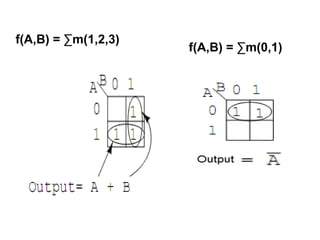
f(A,B) = ∑m(1,2,3)
f(A,B) = ∑m(0,1)
f(x1,x2,x3) = ∑m(0,1,2,3,6)
f(x1,x2,x3) = ∑m(2,3,4,6)
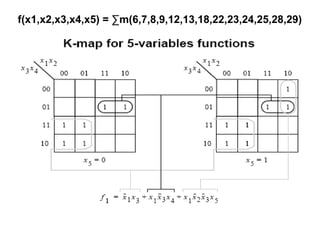
f(x1,x2,x3,x4,x5) = ∑m(6,7,8,9,12,13,18,22,23,24,25,28,29)
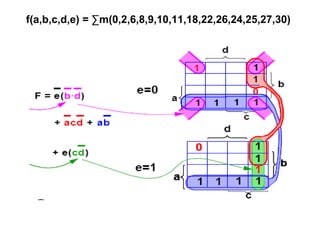
f(a,b,c,d,e) = ∑m(0,2,6,8,9,10,11,18,22,26,24,25,27,30)
POS Simplification
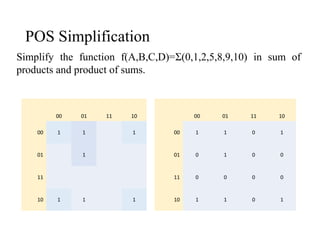
00 01 11 10
00 1 1 0 1
01 0 1 0 0
11 0 0 0 0
10 1 1 0 1
Simplify the function f(A,B,C,D)=Σ(0,1,2,5,8,9,10) in sum of
products and product of sums.
00 01 11 10
00 1 1 1
01 1
11
10 1 1 1
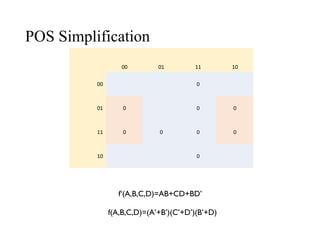
POS Simplification
00 01 11 10
00 0
01 0 0 0
11 0 0 0 0
10 0
f(A,B,C,D)=(A’+B’)(C’+D’)(B’+D)
f‘(A,B,C,D)=AB+CD+BD’
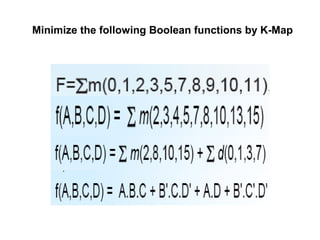
Minimize the following Boolean functions by K-Map
THANK YOU

K Map Simplification

  • 1.
    Simplification of Booleanfunctions by Karnaugh Map and Tabulation Method Presented By C.Ramesh Assistant Professor/ECE KIT-kalaignarkarunanidhi Institute Of Technology, Ciombatore.
  • 2.
    Introduction • Although thetruth table representation of a function is unique, when expressed algebraically, it can appear in many different form. • Boolean functions may be simplified by algebraic means. • How ever, this procedure of minimization is difficult because it takes specific rules to predict each succeeding step in the manipulative process. • The map method provides a simple straight forward procedure for minimizing Boolean functions.
  • 3.
    Karnaugh Map (K-Map) •A K-Map is a graphical representation of a truth table that can be used to reduce a logic circuit to its simplest terms. • The Karnaugh map uses a rectangle divided into rows and columns. • Any product term in the expression to be simplified can be represented as the intersection of a row and a column. • The rows and columns are labeled with each term in the expression and its complement. • The labels must be arranged so that each horizontal or vertical move changes the state of one and only one variable.
  • 4.
    Two variable K-Map x’y’x’y xy’ xy x y 0 0 1 1 m0 m1 m2 m3 x y 0 0 1 1
  • 5.
    Three variable K-Map x’y’z’x’y’z x’yz x’yz’ xy’z’ xy'z xyz xyz’ m0 m1 m3 m2 m4 m5 m7 m6 x x yz yz 0 1 0 1 00 01 11 10 00 01 11 10
  • 6.
    Four variable K-Map m0m1 m3 m2 m4 m5 m7 m6 m12 m13 m15 m14 m8 m9 m11 m10 00 01 11 10 00 01 11 10 wx yz
  • 7.
    Four variable K-Map w’x’y’z’w’x’y’z w’x’yz w’x’yz’ w’xy’z’ w’xy’z w’xyz w’xyz’ wxy’z’ wxy’z wxyz wxyz’ wx’ y’z’ wx’ y’z wx’yz wx’yz’ 00 01 11 10 00 01 11 10 wx yz
  • 8.
    Simplification Using theK-Map • Look for adjacent squares. • Adjacent squares are those squares where only one variable changes as one moves from a square to another. • Group adjacent squares in powers of two, i.e. pairs, quads, groups of eight, groups of 16, etc. • Principle 1. “The more, the merrier.” Hence, a quad is better than a pair. • Principle 2. Share group elements only when necessary to form another or bigger group.
  • 9.
  • 10.
  • 16.
  • 17.
  • 21.
    POS Simplification 00 0111 10 00 1 1 0 1 01 0 1 0 0 11 0 0 0 0 10 1 1 0 1 Simplify the function f(A,B,C,D)=Σ(0,1,2,5,8,9,10) in sum of products and product of sums. 00 01 11 10 00 1 1 1 01 1 11 10 1 1 1
  • 22.
    POS Simplification 00 0111 10 00 0 01 0 0 0 11 0 0 0 0 10 0 f(A,B,C,D)=(A’+B’)(C’+D’)(B’+D) f‘(A,B,C,D)=AB+CD+BD’
  • 26.
    Minimize the followingBoolean functions by K-Map
  • 27.