BARIATRIC SURGERY
DR.SIDDHARTH M
MORBID OBESITY
• Morbid obesity is defined as being either 100 lb above ideal body
weight, twice ideal body weight, or a body mass index of 40kg/m2
OBESITY: THE MAGNITUDE OF THE PROBLEM
• Studies of adolescent obesity have estimated the incidence of
obesity (40% above ideal body weight) as being in the 35% range for
adolescents in the United States but more than 20% in most
European countries.
• After tobacco use, obesity is the second leading cause of
preventable death in the United States
• It is a sobering thought to realize that a 25-year-old morbidly obese
man has a 22% reduction in life expectancy, or 12 years of life lost
PATHOPHYSIOLOGY AND ASSOCIATED
MEDICAL PROBLEMS
• There is a clear familial predisposition
• The rapid increase in obesity from 1980 to 2006 emphasizes the
considerable environmental component
• a severely obese individual has, in general, persistent hunger that is
not satiated by amounts of food that satisfy the nonobese
• Ghrelin plays akey role in satiety
• Morbid obesity is a metabolic disease associated with numerous
medical problems affecting cvs ,pulmonary,metabolic,git and other.
MEDICAL VERSUS SURGICAL THERAPY
• Medical therapy for severe obesity has limited short-term success
and almost nonexistent long-term success
• Once severely obese, the likelihood that a person will lose enough
weight by dietary means alone and remain at a BMI below 35 kg/m2
is estimated at 3% or less
• A 10% weight loss attained over a period of months at a rate of 0.5
to 2 lb/wk is the initial goal of medical therapy
• Pharmacologic therapy focus on two medications sibutramine and
orlistat
PREOPERATIVE EVALUATION AND SELECTION
Eligibility
• BMI >40 kg/m2 or BMI >35 kg/m2 with an associated medical
comorbidity worsened by obesity
▪ Failed dietary therapy
▪ Psychiatrically stable without alcohol dependence or illegal drug
use
▪ Knowledgeable about the operation and its sequelae
▪ Motivated individual
▪ Medical problems not precluding probable survival from surgery
CONTRAINDICATIONS
• Medical contraindications to bariatric surgery are not clear.
• All patients with comorbid conditions are at greater risk.
• nonambulatory status is not an absolute contraindication to surgery,
it does place the patient at increased risk
• Patients who weigh more than 600 lb are at increased risk for
mortality and have more complications.
• Prader-Willi syndrome is an absolute contraindication. No surgical
therapy affects the constant need to eat in these patients.
• Age is a controversial contraindication to bariatric surgery
Preoperative Evaluation
• Preoperative assessment of a bariatric surgical patient involves two
distinct areas.
• One is a specific preoperative assessment of candidacy for bariatric
surgery and evaluation for comorbid conditions.
• The second is a general assessment and preoperative preparation
as for any major abdominal surgery
• It consists of the Bariatric Multidisciplinary Team consisting of
surgeons ,nutritionist,anaesthesist,psychiatrist and nurse care with
allied specialists.
1.Specific preoperative assessment of
candidacy
• a complete history and physical examination at the initial
assessment
• arterial blood gas analysis is performed in selected patients
• upper endoscopy in patients with symptomatic gastroesophageal
reflux disease (GERD) or other upper digestive symptoms
• ultrasound of the gallbladder.
• Proper preoperative patient education is essential
2.Evaluation of Specific Comorbid Conditions
• Patients with a history of recent chest pain or a change in exercise
tolerance need to undergo a formal cardiology assessment,
including stress testing as indicated
• Pulmonary assessment includes a search for obstructive sleep
apnea,reactive asthma,pickwickian syndrome
• Musculoskeletal conditions, especially arthritis and degenerative
joint disease
• hyperlipidemia, hypercholesterolemia, and type 2 diabetes mellitus
• Skin must be examined for fungal infection and venous stasis
changes
• Evaluated for gallstones ,gerd ,nash
Pre op day
• A first-generation cephalosporin, in a dose appropriate for weight, is
given preoperatively, and antibiotics are continued for only 24 hours.
• Three major measures are used for prophylaxis against DVT and
pulmonary embolism:
• 1.ambulation within 4 to 6 hours of surgery,
• 2.SCD stockings or shoe sleeves
• 3.subcutaneous low-molecular-weight heparin on call in the operating
room and then administered twice daily until discharge
• Prophylactic vena cava filters are inserted, if possible on a temporary
basis, in patients at extremely high risk for DVT and pulmonary embolism
SPECIAL EQUIPMENT
• The operating room needs to contain a hydraulically operated operating
room table that can accommodate up to 800 lb.
• Side attachments to widen the table as needed are required,Foam
cushioning, extra large SCD stockings, wide and secure padded straps for
the abdomen and legs
• high-flow insufflators able to maintain pneumoperitoneum are essential.
• a 45-degree telescope, extra long staplers, atraumatic graspers, and
other instruments to be most useful.
• Extra long trocars may be needed.
• A fixed retractor device secured to the operating room table for clamping
and holding the liver retractor is also essential.
OPERATIVE PROCEDURES
1.Restrictive
• Vertical banded gastroplasty (VBG) (historic purposes only)
• Laparoscopic adjustable gastric banding (LAGB)
2.Largely Restrictive/Mildly Malabsorptive
• Roux-en-Y gastric bypass (RYGB)
3.Largely Malabsorptive/Mildly Restrictive
• Biliopancreatic diversion (BPD)
• Duodenal switch (DS)
VERTICAL BANDED GASTROPLASTY
• This procedure has now largely been abandoned in favor of other
operations
• because of poor long-term weight loss.
• a high rate of late stenosis of the gastric outlet.
• a tendency for patients to adopt a high-calorie liquid diet
• thereby leading to regain of weight
ADJUSTABLE GASTRIC BANDING
• The AGB procedure may be performed with any of three types of
adjustable bands.
• The only band approved for use by the FDA in the United States is
the LAP-BAND
• The Swedish Adjustable Gastric Band
• MIDBAND (Medical Innovation Development, Villeurbanne, France)
• Heliogast Band (Helioscopie, Vienna, France)
• The techniques of placement of the bands are similar; only the
locking mechanisms, band shape and configuration, and adjustment
schedules vary somewhat for the different types of bands
PRINCIPLE
• They all work on the principle of restriction of oral intake
• by limiting the volume of the proximal part of the stomach.
• Their advantage over the traditional vertical banded gastroplasty is
adjustability.
TECHNIQUE for placement of the AGB system
• described in detail by Fielding and Allen
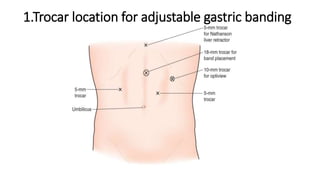
1.Trocar location for adjustable gastric banding
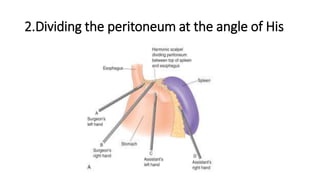
2.Dividing the peritoneum at the angle of His
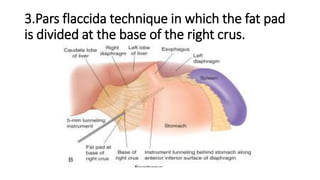
3.Pars flaccida technique in which the fat pad
is divided at the base of the right crus.
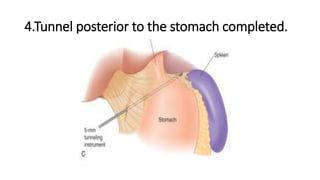
4.Tunnel posterior to the stomach completed.
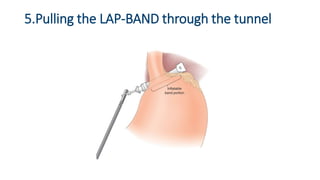
5.Pulling the LAP-BAND through the tunnel
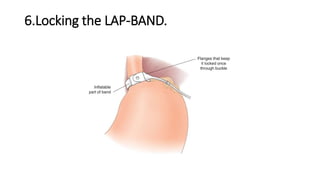
6.Locking the LAP-BAND.
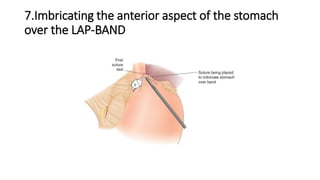
7.Imbricating the anterior aspect of the stomach
over the LAP-BAND
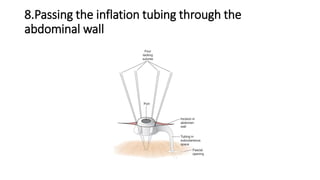
8.Passing the inflation tubing through the
abdominal wall
complications
• Band slippage less with pars flacida technique
• slippage is usually manifested as the sudden development of food
intolerance or occasionally gastroesophageal reflux
• Erosion of the band into the lumen of the stomach is a far less
frequent complication but requires reoperation
• Port access site problems are the most numerous of the
complications that occur after AGB like kinking ,infection
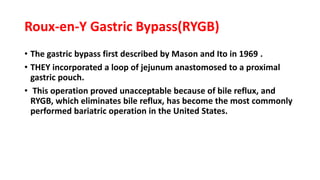
Roux-en-Y Gastric Bypass(RYGB)
• The gastric bypass first described by Mason and Ito in 1969 .
• THEY incorporated a loop of jejunum anastomosed to a proximal
gastric pouch.
• This operation proved unacceptable because of bile reflux, and
RYGB, which eliminates bile reflux, has become the most commonly
performed bariatric operation in the United States.
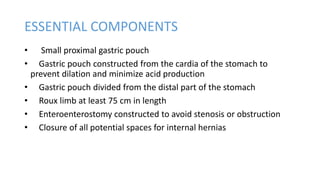
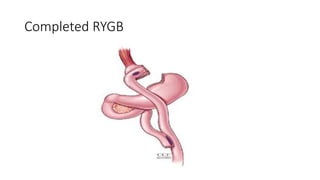
ESSENTIAL COMPONENTS
• Small proximal gastric pouch
• Gastric pouch constructed from the cardia of the stomach to
prevent dilation and minimize acid production
• Gastric pouch divided from the distal part of the stomach
• Roux limb at least 75 cm in length
• Enteroenterostomy constructed to avoid stenosis or obstruction
• Closure of all potential spaces for internal hernias
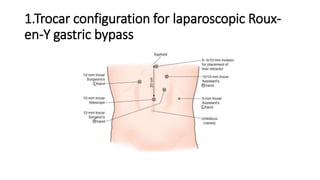
1.Trocar configuration for laparoscopic Roux-
en-Y gastric bypass
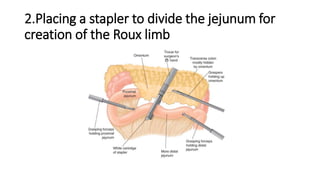
2.Placing a stapler to divide the jejunum for
creation of the Roux limb
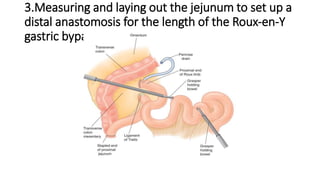
3.Measuring and laying out the jejunum to set up a
distal anastomosis for the length of the Roux-en-Y
gastric bypass
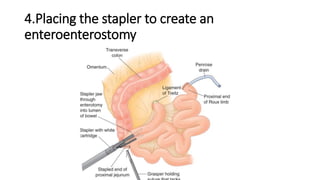
4.Placing the stapler to create an
enteroenterostomy
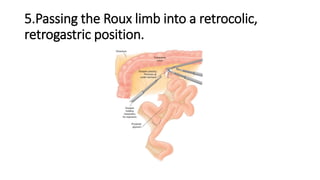
5.Passing the Roux limb into a retrocolic,
retrogastric position.
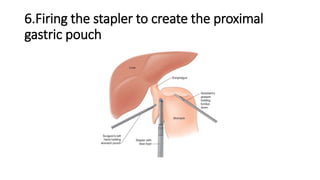
6.Firing the stapler to create the proximal
gastric pouch
Completed RYGB
Biliopancreatic Diversion
1. like most bariatric operations that had been performed through an
open approach, is now performed through a laparoscopic approach.
2.BPD produces weight loss based primarily on malabsorption, but it
does have a mild restrictive component.
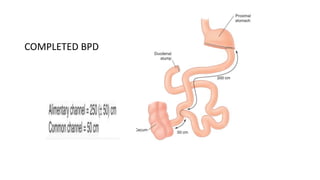
3.The intestinal tract is reconstructed to allow only a short so-called
common channel of the distal 50-cm of terminal ileum for absorption
of fat and protein.
4.The alimentary tract beyond the proximal part of the stomach is
rearranged to include only the distal 200 cm of ileum, including the
common channel.
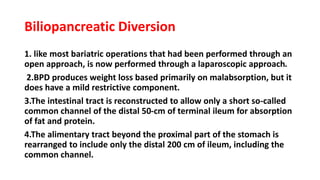
1.Dividing the
ileum at the 200-
cm location
proximal to the
ileocecal valve
after having
already marked the
50-cm location
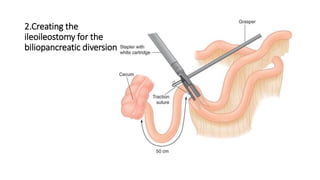
2.Creating the
ileoileostomy for the
biliopancreatic diversion
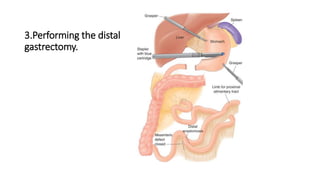
3.Performing the distal
gastrectomy.
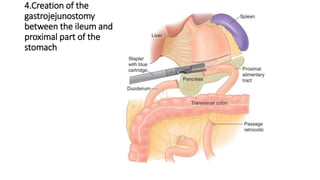
4.Creation of the
gastrojejunostomy
between the ileum and
proximal part of the
stomach
COMPLETED BPD
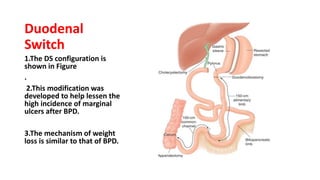
Duodenal
Switch
1.The DS configuration is
shown in Figure
.
2.This modification was
developed to help lessen the
high incidence of marginal
ulcers after BPD.
3.The mechanism of weight
loss is similar to that of BPD.
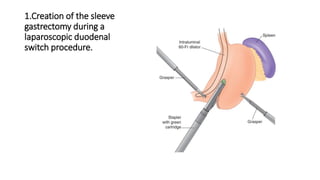
1.Creation of the sleeve
gastrectomy during a
laparoscopic duodenal
switch procedure.
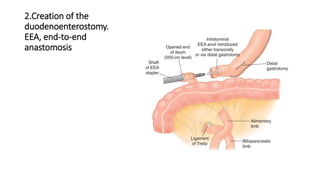
2.Creation of the
duodenoenterostomy.
EEA, end-to-end
anastomosis
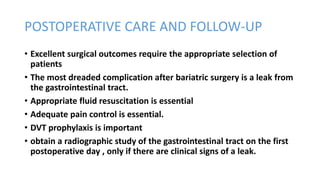
POSTOPERATIVE CARE AND FOLLOW-UP
• Excellent surgical outcomes require the appropriate selection of
patients
• The most dreaded complication after bariatric surgery is a leak from
the gastrointestinal tract.
• Appropriate fluid resuscitation is essential
• Adequate pain control is essential.
• DVT prophylaxis is important
• obtain a radiographic study of the gastrointestinal tract on the first
postoperative day , only if there are clinical signs of a leak.
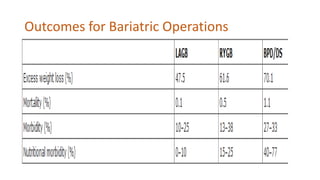
Outcomes for Bariatric Operations
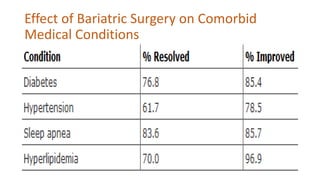
Effect of Bariatric Surgery on Comorbid
Medical Conditions
Plastic Surgery after Weight Loss
• Patients who have undergone bariatric surgery are often left with
large amounts of hanging skin or rolls of skin and subcutaneous tissue
as a result of the weight loss..
• Plastic surgeons who are experienced in abdominoplasty and body
contouring can offer these patients an excellent surgical treatment for
the problems of excessive skin.
• Reconstructive surgery requires careful preoperative planning and is
based on the patient's deformities and priorities.
• Excess tissue of the lower torso is the most common deformity for
which patients undergo surgical intervention.
• A standard abdominoplasty to remove this excessive tissue is
performed.
• More radical body contouring can include a circumferential
abdominoplasty and lower body.
• Circumferential abdominoplasty removes redundant skin of the lower
abdomen, flattens the abdomen, and incorporates the lower body lift
• Medial thighplasty also may be needed for patients with significant
excess medial thigh skin. This is done transversely.
• Mid-back and epigastric rolls, along with sagging breasts, are
corrected with an upper body lift.
• The upper body lift is a reverse abdominoplasty, removal of mid-
torso excessive skin, and reshaping of the breasts.
• For highly selected individuals, and with a well-organized team, a
single-stage total body lift, which includes a circumferential
abdominoplasty, lower body lift, medial thighplasty, upper body lift,
and breast reshaping, can be performed safely in <8 hours
conclusion
• It currently represents the fastest growing area of general surgery.
• Patient demand for the procedure has vastly increased; at present,
surgeons operate annually on only 1% of the eligible patients who
would benefit from bariatric surgery.
• The disease process of morbid obesity is unfortunately both poorly
understood and rapidly increasing.
• Surgical therapy is currently the only effective treatment of morbid
obesity.
bariatric surgery

bariatric surgery

  • 1.
  • 2.
    MORBID OBESITY • Morbidobesity is defined as being either 100 lb above ideal body weight, twice ideal body weight, or a body mass index of 40kg/m2
  • 3.
    OBESITY: THE MAGNITUDEOF THE PROBLEM • Studies of adolescent obesity have estimated the incidence of obesity (40% above ideal body weight) as being in the 35% range for adolescents in the United States but more than 20% in most European countries. • After tobacco use, obesity is the second leading cause of preventable death in the United States • It is a sobering thought to realize that a 25-year-old morbidly obese man has a 22% reduction in life expectancy, or 12 years of life lost
  • 4.
    PATHOPHYSIOLOGY AND ASSOCIATED MEDICALPROBLEMS • There is a clear familial predisposition • The rapid increase in obesity from 1980 to 2006 emphasizes the considerable environmental component • a severely obese individual has, in general, persistent hunger that is not satiated by amounts of food that satisfy the nonobese • Ghrelin plays akey role in satiety • Morbid obesity is a metabolic disease associated with numerous medical problems affecting cvs ,pulmonary,metabolic,git and other.
  • 5.
    MEDICAL VERSUS SURGICALTHERAPY • Medical therapy for severe obesity has limited short-term success and almost nonexistent long-term success • Once severely obese, the likelihood that a person will lose enough weight by dietary means alone and remain at a BMI below 35 kg/m2 is estimated at 3% or less • A 10% weight loss attained over a period of months at a rate of 0.5 to 2 lb/wk is the initial goal of medical therapy • Pharmacologic therapy focus on two medications sibutramine and orlistat
  • 6.
  • 7.
    Eligibility • BMI >40kg/m2 or BMI >35 kg/m2 with an associated medical comorbidity worsened by obesity ▪ Failed dietary therapy ▪ Psychiatrically stable without alcohol dependence or illegal drug use ▪ Knowledgeable about the operation and its sequelae ▪ Motivated individual ▪ Medical problems not precluding probable survival from surgery
  • 9.
    CONTRAINDICATIONS • Medical contraindicationsto bariatric surgery are not clear. • All patients with comorbid conditions are at greater risk. • nonambulatory status is not an absolute contraindication to surgery, it does place the patient at increased risk • Patients who weigh more than 600 lb are at increased risk for mortality and have more complications. • Prader-Willi syndrome is an absolute contraindication. No surgical therapy affects the constant need to eat in these patients. • Age is a controversial contraindication to bariatric surgery
  • 10.
    Preoperative Evaluation • Preoperativeassessment of a bariatric surgical patient involves two distinct areas. • One is a specific preoperative assessment of candidacy for bariatric surgery and evaluation for comorbid conditions. • The second is a general assessment and preoperative preparation as for any major abdominal surgery • It consists of the Bariatric Multidisciplinary Team consisting of surgeons ,nutritionist,anaesthesist,psychiatrist and nurse care with allied specialists.
  • 11.
    1.Specific preoperative assessmentof candidacy • a complete history and physical examination at the initial assessment • arterial blood gas analysis is performed in selected patients • upper endoscopy in patients with symptomatic gastroesophageal reflux disease (GERD) or other upper digestive symptoms • ultrasound of the gallbladder. • Proper preoperative patient education is essential
  • 12.
    2.Evaluation of SpecificComorbid Conditions • Patients with a history of recent chest pain or a change in exercise tolerance need to undergo a formal cardiology assessment, including stress testing as indicated • Pulmonary assessment includes a search for obstructive sleep apnea,reactive asthma,pickwickian syndrome • Musculoskeletal conditions, especially arthritis and degenerative joint disease • hyperlipidemia, hypercholesterolemia, and type 2 diabetes mellitus • Skin must be examined for fungal infection and venous stasis changes • Evaluated for gallstones ,gerd ,nash
  • 13.
    Pre op day •A first-generation cephalosporin, in a dose appropriate for weight, is given preoperatively, and antibiotics are continued for only 24 hours. • Three major measures are used for prophylaxis against DVT and pulmonary embolism: • 1.ambulation within 4 to 6 hours of surgery, • 2.SCD stockings or shoe sleeves • 3.subcutaneous low-molecular-weight heparin on call in the operating room and then administered twice daily until discharge • Prophylactic vena cava filters are inserted, if possible on a temporary basis, in patients at extremely high risk for DVT and pulmonary embolism
  • 15.
    SPECIAL EQUIPMENT • Theoperating room needs to contain a hydraulically operated operating room table that can accommodate up to 800 lb. • Side attachments to widen the table as needed are required,Foam cushioning, extra large SCD stockings, wide and secure padded straps for the abdomen and legs • high-flow insufflators able to maintain pneumoperitoneum are essential. • a 45-degree telescope, extra long staplers, atraumatic graspers, and other instruments to be most useful. • Extra long trocars may be needed. • A fixed retractor device secured to the operating room table for clamping and holding the liver retractor is also essential.
  • 16.
    OPERATIVE PROCEDURES 1.Restrictive • Verticalbanded gastroplasty (VBG) (historic purposes only) • Laparoscopic adjustable gastric banding (LAGB) 2.Largely Restrictive/Mildly Malabsorptive • Roux-en-Y gastric bypass (RYGB) 3.Largely Malabsorptive/Mildly Restrictive • Biliopancreatic diversion (BPD) • Duodenal switch (DS)
  • 17.
    VERTICAL BANDED GASTROPLASTY •This procedure has now largely been abandoned in favor of other operations • because of poor long-term weight loss. • a high rate of late stenosis of the gastric outlet. • a tendency for patients to adopt a high-calorie liquid diet • thereby leading to regain of weight
  • 18.
    ADJUSTABLE GASTRIC BANDING •The AGB procedure may be performed with any of three types of adjustable bands. • The only band approved for use by the FDA in the United States is the LAP-BAND • The Swedish Adjustable Gastric Band • MIDBAND (Medical Innovation Development, Villeurbanne, France) • Heliogast Band (Helioscopie, Vienna, France) • The techniques of placement of the bands are similar; only the locking mechanisms, band shape and configuration, and adjustment schedules vary somewhat for the different types of bands
  • 19.
    PRINCIPLE • They allwork on the principle of restriction of oral intake • by limiting the volume of the proximal part of the stomach. • Their advantage over the traditional vertical banded gastroplasty is adjustability.
  • 20.
    TECHNIQUE for placementof the AGB system • described in detail by Fielding and Allen
  • 21.
    1.Trocar location foradjustable gastric banding
  • 22.
    2.Dividing the peritoneumat the angle of His
  • 23.
    3.Pars flaccida techniquein which the fat pad is divided at the base of the right crus.
  • 24.
    4.Tunnel posterior tothe stomach completed.
  • 25.
    5.Pulling the LAP-BANDthrough the tunnel
  • 26.
  • 27.
    7.Imbricating the anterioraspect of the stomach over the LAP-BAND
  • 28.
    8.Passing the inflationtubing through the abdominal wall
  • 30.
    complications • Band slippageless with pars flacida technique • slippage is usually manifested as the sudden development of food intolerance or occasionally gastroesophageal reflux • Erosion of the band into the lumen of the stomach is a far less frequent complication but requires reoperation • Port access site problems are the most numerous of the complications that occur after AGB like kinking ,infection
  • 31.
    Roux-en-Y Gastric Bypass(RYGB) •The gastric bypass first described by Mason and Ito in 1969 . • THEY incorporated a loop of jejunum anastomosed to a proximal gastric pouch. • This operation proved unacceptable because of bile reflux, and RYGB, which eliminates bile reflux, has become the most commonly performed bariatric operation in the United States.
  • 32.
    ESSENTIAL COMPONENTS • Smallproximal gastric pouch • Gastric pouch constructed from the cardia of the stomach to prevent dilation and minimize acid production • Gastric pouch divided from the distal part of the stomach • Roux limb at least 75 cm in length • Enteroenterostomy constructed to avoid stenosis or obstruction • Closure of all potential spaces for internal hernias
  • 33.
    1.Trocar configuration forlaparoscopic Roux- en-Y gastric bypass
  • 34.
    2.Placing a staplerto divide the jejunum for creation of the Roux limb
  • 35.
    3.Measuring and layingout the jejunum to set up a distal anastomosis for the length of the Roux-en-Y gastric bypass
  • 36.
    4.Placing the staplerto create an enteroenterostomy
  • 37.
    5.Passing the Rouxlimb into a retrocolic, retrogastric position.
  • 38.
    6.Firing the staplerto create the proximal gastric pouch
  • 39.
  • 40.
    Biliopancreatic Diversion 1. likemost bariatric operations that had been performed through an open approach, is now performed through a laparoscopic approach. 2.BPD produces weight loss based primarily on malabsorption, but it does have a mild restrictive component. 3.The intestinal tract is reconstructed to allow only a short so-called common channel of the distal 50-cm of terminal ileum for absorption of fat and protein. 4.The alimentary tract beyond the proximal part of the stomach is rearranged to include only the distal 200 cm of ileum, including the common channel.
  • 41.
    1.Dividing the ileum atthe 200- cm location proximal to the ileocecal valve after having already marked the 50-cm location
  • 42.
    2.Creating the ileoileostomy forthe biliopancreatic diversion
  • 43.
  • 44.
    4.Creation of the gastrojejunostomy betweenthe ileum and proximal part of the stomach
  • 45.
  • 46.
    Duodenal Switch 1.The DS configurationis shown in Figure . 2.This modification was developed to help lessen the high incidence of marginal ulcers after BPD. 3.The mechanism of weight loss is similar to that of BPD.
  • 47.
    1.Creation of thesleeve gastrectomy during a laparoscopic duodenal switch procedure.
  • 48.
  • 49.
    POSTOPERATIVE CARE ANDFOLLOW-UP • Excellent surgical outcomes require the appropriate selection of patients • The most dreaded complication after bariatric surgery is a leak from the gastrointestinal tract. • Appropriate fluid resuscitation is essential • Adequate pain control is essential. • DVT prophylaxis is important • obtain a radiographic study of the gastrointestinal tract on the first postoperative day , only if there are clinical signs of a leak.
  • 50.
  • 51.
    Effect of BariatricSurgery on Comorbid Medical Conditions
  • 52.
    Plastic Surgery afterWeight Loss • Patients who have undergone bariatric surgery are often left with large amounts of hanging skin or rolls of skin and subcutaneous tissue as a result of the weight loss.. • Plastic surgeons who are experienced in abdominoplasty and body contouring can offer these patients an excellent surgical treatment for the problems of excessive skin. • Reconstructive surgery requires careful preoperative planning and is based on the patient's deformities and priorities.
  • 53.
    • Excess tissueof the lower torso is the most common deformity for which patients undergo surgical intervention. • A standard abdominoplasty to remove this excessive tissue is performed. • More radical body contouring can include a circumferential abdominoplasty and lower body. • Circumferential abdominoplasty removes redundant skin of the lower abdomen, flattens the abdomen, and incorporates the lower body lift • Medial thighplasty also may be needed for patients with significant excess medial thigh skin. This is done transversely.
  • 54.
    • Mid-back andepigastric rolls, along with sagging breasts, are corrected with an upper body lift. • The upper body lift is a reverse abdominoplasty, removal of mid- torso excessive skin, and reshaping of the breasts. • For highly selected individuals, and with a well-organized team, a single-stage total body lift, which includes a circumferential abdominoplasty, lower body lift, medial thighplasty, upper body lift, and breast reshaping, can be performed safely in <8 hours
  • 55.
    conclusion • It currentlyrepresents the fastest growing area of general surgery. • Patient demand for the procedure has vastly increased; at present, surgeons operate annually on only 1% of the eligible patients who would benefit from bariatric surgery. • The disease process of morbid obesity is unfortunately both poorly understood and rapidly increasing. • Surgical therapy is currently the only effective treatment of morbid obesity.