George S. Ferzli, MD Joel Ricci, MD
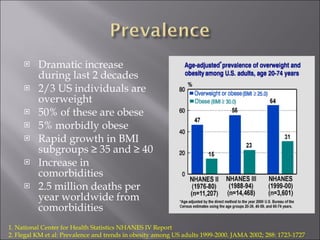
Dramatic increase during last 2 decades 2/3 US individuals are overweight 50% of these are obese 5% morbidly obese Rapid growth in BMI subgroups ≥ 35 and ≥ 40 Increase in comorbidities 2.5 million deaths per year worldwide from comorbidities 1. National Center for Health Statistics NHANES IV Report 2. Flegal KM et al: Prevalence and trends in obesity among US adults 1999-2000. JAMA 2002; 288: 1723-1727
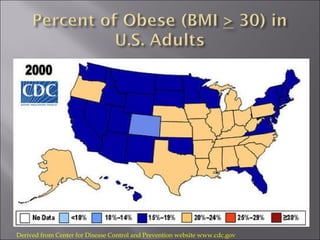
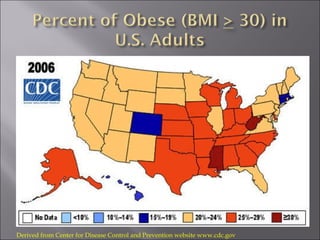
Derived from Center for Disease Control and Prevention website www.cdc.gov
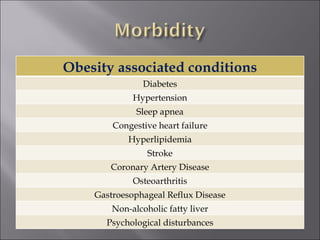
Obesity associated conditions Diabetes Hypertension Sleep apnea Congestive heart failure Hyperlipidemia Stroke Coronary Artery Disease Osteoarthritis Gastroesophageal Reflux Disease Non-alcoholic fatty liver Psychological disturbances
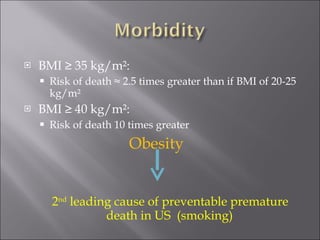
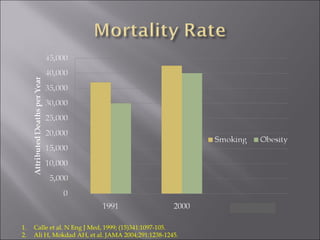
BMI ≥ 35 kg/m²: Risk of death ≈ 2.5 times greater than if BMI of 20-25 kg/m² BMI ≥ 40 kg/m²: Risk of death 10 times greater Obesity 2 nd  leading cause of preventable premature death in US  (smoking)
Calle et al. N Eng J Med, 1999; (15)341:1097-105.  Ali H, Mokdad AH, et al. JAMA 2004;291:1238-1245.
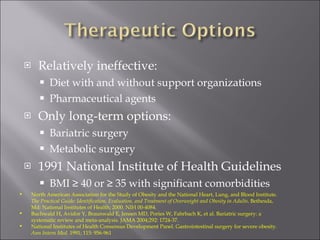
Relatively ineffective: Diet with and without support organizations Pharmaceutical agents Only long-term options: Bariatric surgery Metabolic surgery 1991 National Institute of Health Guidelines BMI ≥ 40 or ≥ 35 with significant comorbidities North American Association for the Study of Obesity and the National Heart, Lung, and Blood Institute.  The Practical Guide: Identification, Evaluation, and Treatment of Overweight and Obesity in Adults . Bethesda, Md: National Institutes of Health; 2000. NIH 00-4084. Buchwald H, Avidor Y, Braunwald E, Jensen MD, Pories W, Fahrbach K, et al. Bariatric surgery: a systematic review and meta-analysis. JAMA 2004;292: 1724-37. National Institutes of Health Consensus Development Panel. Gastrointestinal surgery for severe obesity.  Ann Intern Med . 1991; 115: 956-961
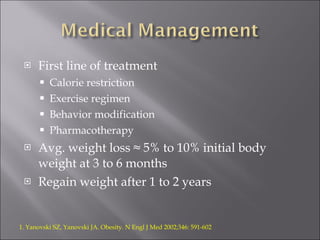
First line of treatment Calorie restriction Exercise regimen Behavior modification Pharmacotherapy Avg. weight loss ≈ 5% to 10% initial body weight at 3 to 6 months Regain weight after 1 to 2 years 1. Yanovski SZ, Yanovski JA. Obesity. N Engl J Med 2002;346: 591-602
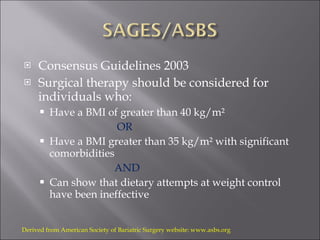
Consensus Guidelines 2003 Surgical therapy should be considered for individuals who: Have a BMI of greater than 40 kg/m² OR Have a BMI greater than 35 kg/m² with significant comorbidities AND Can show that dietary attempts at weight control have been ineffective Derived from American Society of Bariatric Surgery website: www.asbs.org
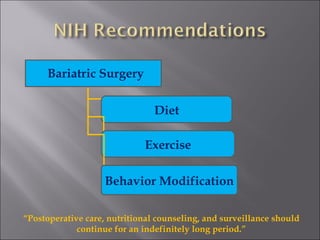
Bariatric Surgery Diet Exercise Behavior Modification “ Postoperative care, nutritional counseling, and surveillance should continue for an indefinitely long period.”
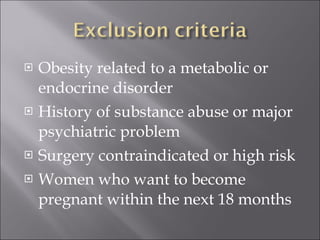
Obesity related to a metabolic or endocrine disorder History of substance abuse or major psychiatric problem Surgery contraindicated or high risk Women who want to become pregnant within the next 18 months
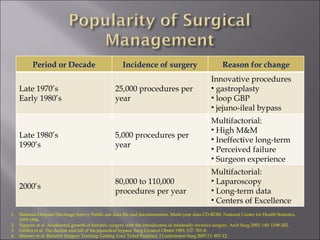
National Hospital Discharge Survey Public-use data file and documentation. Multi-year data CD-ROM. National Center for Health Statistics, 1979-1996. Nguyen et al. Accelerated growth of bariatric surgery with the introduction of minimally invasive surgery. Arch Surg 2005; 140: 1198-202. Griffen et al. The decline and fall of the jejunoileal bypass. Surg Gynecol Obstet 1983; 157: 301-8. Shirmer et al. Bariatric Surgery Training: Getting Your Ticket Punched. J Gastrointest Surg 2007;11: 807-12. Period or Decade Incidence of surgery Reason for change Late 1970’s  Early 1980’s 25,000 procedures per year Innovative procedures gastroplasty loop GBP jejuno-ileal bypass Late 1980’s 1990’s 5,000 procedures per year Multifactorial: High M&M Ineffective long-term Perceived failure Surgeon experience  2000’s 80,000 to 110,000 procedures per year Multifactorial: Laparoscopy Long-term data Centers of Excellence
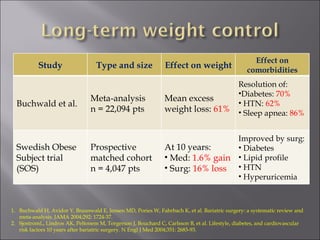
Buchwald H, Avidor Y, Braunwald E, Jensen MD, Pories W, Fahrbach K, et al. Bariatric surgery: a systematic review and meta-analysis. JAMA 2004;292: 1724-37. SjostromL, Lindros AK, Peltonem M, Torgerson J, Bouchard C, Carlsson B, et al. Lifestyle, diabetes, and cardiovascular risk factors 10 years after bariatric surgery. N Engl J Med 2004;351: 2683-93. Study Type and size Effect on weight Effect on comorbidities Buchwald et al. Meta-analysis n = 22,094 pts Mean excess  weight loss:  61% Resolution of:  Diabetes:  70% HTN:  62% Sleep apnea:  86% Swedish Obese Subject trial (SOS) Prospective matched cohort n = 4,047 pts At 10 years: Med:  1.6% gain Surg:  16% loss Improved by surg: Diabetes Lipid profile HTN Hyperuricemia
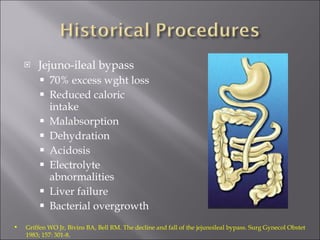
Jejuno-ileal bypass 70% excess wght loss Reduced caloric intake Malabsorption Dehydration Acidosis Electrolyte abnormalities Liver failure Bacterial overgrowth Griffen WO Jr, Bivins BA, Bell RM. The decline and fall of the jejunoileal bypass. Surg Gynecol Obstet 1983; 157: 301-8 .
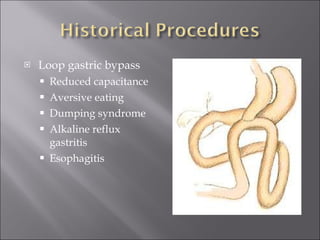
Loop gastric bypass Reduced capacitance Aversive eating Dumping syndrome Alkaline reflux gastritis Esophagitis
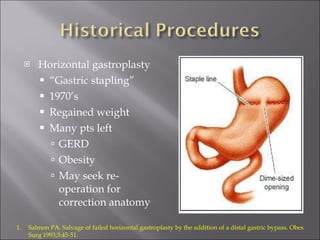
Horizontal gastroplasty “ Gastric stapling” 1970’s Regained weight Many pts left GERD Obesity May seek re-operation for correction anatomy Salmon PA. Salvage of failed horizontal gastroplasty by the addition of a distal gastric bypass. Obes Surg 1993;3:45-51.
 
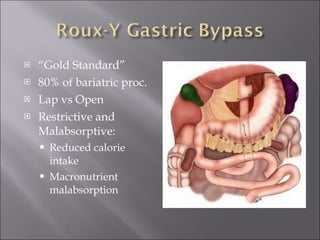
“ Gold Standard” 80% of bariatric proc. Lap vs Open Restrictive and Malabsorptive: Reduced calorie intake Macronutrient malabsorption
Pouch formation: Small gastric pouch 15-30 mL Transect vs Stapling Re-inforcement of staple line  Roux limb creation: 15 to 100 cm distal to Ligament of Treitz Jejuno-jejunostomy 75 to 150 cm down Roux limb Long limb bypass: ↑ weight loss from malabsorption Brolin RE. Long limb Roux en Y gastric bypass revisited. Surg Clin North Am 2005;85:807-17, vii.
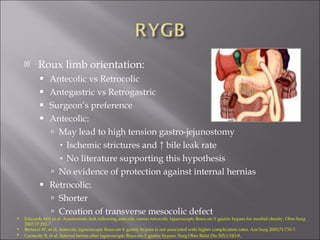
Roux limb orientation: Antecolic vs Retrocolic Antegastric vs Retrogastric Surgeon’s preference Antecolic: May lead to high tension gastro-jejunostomy Ischemic strictures and ↑ bile leak rate No literature supporting this hypothesis No evidence of protection against internal hernias Retrocolic: Shorter Creation of transverse mesocolic defect Edwards MA et al. Anastomotic leak following antecolic versus retrocolic laparoscopic Roux-en-Y gastric bypass for morbid obesity. Obes Surg 2007;17:292-7. Bertucci W, et al. Antecolic laparoscopic Roux-en-Y gastric bypass is not associated with higher complication rates. Am Surg 2005;71:735-7. Carmody B, et al. Internal hernia after laparoscopic Roux-en-Y gastric bypass. Surg Obes Relat Dis 205;1:543-8 .
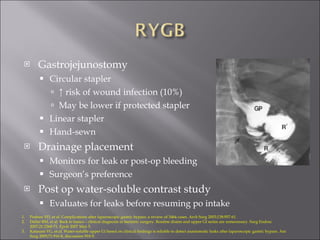
Gastrojejunostomy Circular stapler ↑  risk of wound infection (10%) May be lower if protected stapler Linear stapler Hand-sewn Drainage placement Monitors for leak or post-op bleeding Surgeon’s preference Post op water-soluble contrast study Evaluates for leaks before resuming po intake Podnos YD, et al. Complications after laparoscopic gastric bypass: a review of 3464 cases. Arch Surg 2003;138:957-61. Dallal RM, et al. Back to basics – clinical diagnosis in bariatric surgery. Routine drains and upper GI series are unnecessary. Surg Endosc 2007;21:2268-71. Epub 2007 May 5. Katasani VG, et al. Water-soluble upper Gi based on clinical findings is reliable to detect anastomotic leaks after laparoscopic gastric bypass. Am Surg 2005;71:916-8, discussion 918-9.
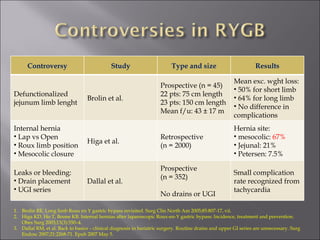
Brolin RE. Long limb Roux en Y gastric bypass revisited. Surg Clin North Am 2005;85:807-17, vii. Higa KD, Ho T, Boone KB. Internal hernias after laparoscopic Roux-en-Y gastric bypass: Incidence, treatment and prevention. Obes Surg 2003;13(3):350–4. Dallal RM, et al. Back to basics – clinical diagnosis in bariatric surgery. Routine drains and upper GI series are unnecessary. Surg Endosc 2007;21:2268-71. Epub 2007 May 5. Controversy Study Type and size Results Defunctionalized jejunum limb lenght Brolin et al. Prospective (n = 45) 22 pts: 75 cm length 23 pts: 150 cm length Mean f/u: 43 ± 17 m Mean exc. wght loss: 50% for short limb 64% for long limb No difference in complications Internal hernia  Lap vs Open Roux limb position Mesocolic closure Higa et al. Retrospective  (n = 2000) Hernia site: mesocolic:  67% Jejunal: 21% Petersen: 7.5% Leaks or bleeding: Drain placement UGI series Dallal et al. Prospective (n = 352) No drains or UGI Small complication rate recognized from tachycardia
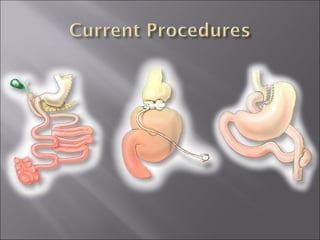
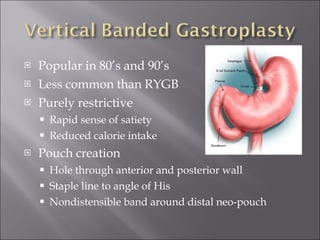
Popular in 80’s and 90’s Less common than RYGB Purely restrictive Rapid sense of satiety Reduced calorie intake Pouch creation Hole through anterior and posterior wall Staple line to angle of His Nondistensible band around distal neo-pouch
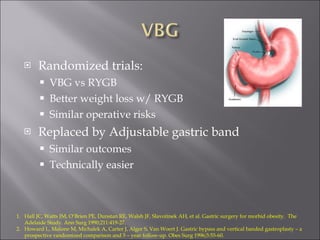
Randomized trials: VBG vs RYGB Better weight loss w/ RYGB Similar operative risks Replaced by Adjustable gastric band Similar outcomes Technically easier Hall JC, Watts JM, O’Brien PE, Dunstan RE, Walsh JF, Slavotinek AH, et al. Gastric surgery for morbid obesity.  The Adelaide Study. Ann Surg 1990;211:419-27. Howard L, Malone M, Michalek A, Carter J, Alger S, Van Woert J. Gastric bypass and vertical banded gastroplasty – a prospective randomized comparison and 5 – year follow-up. Obes Surg 1996;5:55-60.
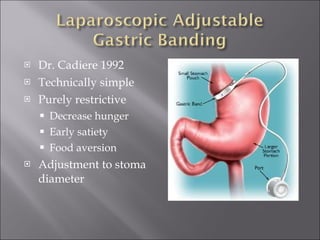
Dr. Cadiere 1992 Technically simple Purely restrictive Decrease hunger Early satiety Food aversion Adjustment to stoma diameter
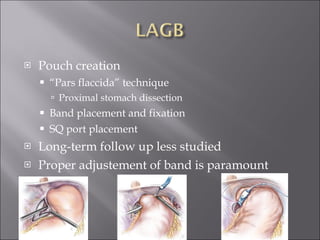
Pouch creation “ Pars flaccida” technique Proximal stomach dissection Band placement and fixation SQ port placement Long-term follow up less studied Proper adjustement of band is paramount
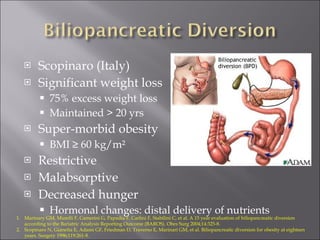
Scopinaro (Italy) Significant weight loss 75% excess weight loss Maintained > 20 yrs Super-morbid obesity BMI ≥ 60 kg/m² Restrictive Malabsorptive Decreased hunger Hormonal changes: distal delivery of nutrients Marinary GM, Murelli F, Camerini G, Papadia F, Carlini F, Stabilini C, et al. A 15 year evaluation of biliopancreatic diversion according to the Bariatric Analysis Reporting Outcome (BAROS). Obes Surg 2004;14:325-8. Scopinaro N, Gianetta E, Adami GF, Friedman D, Traverso E, Marinari GM, et al. Biliopancreatic diversion for obesity at eighteen years. Surgery 1996;119:261-8.
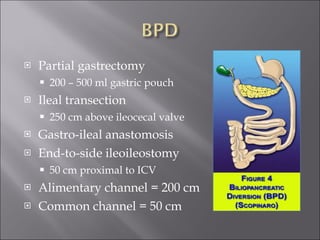
Partial gastrectomy 200 – 500 ml gastric pouch Ileal transection 250 cm above ileocecal valve Gastro-ileal anastomosis End-to-side ileoileostomy 50 cm proximal to ICV Alimentary channel = 200 cm Common channel = 50 cm
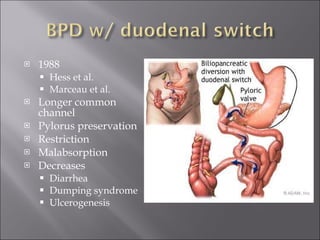
1988 Hess et al. Marceau et al. Longer common channel Pylorus preservation Restriction Malabsorption Decreases  Diarrhea Dumping syndrome Ulcerogenesis
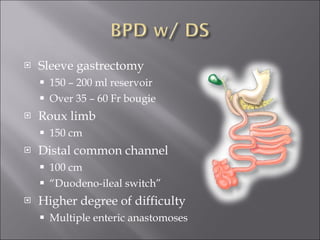
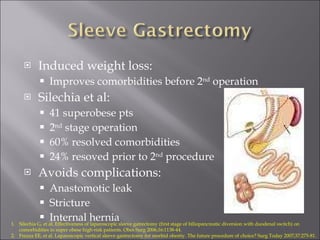
Sleeve gastrectomy 150 – 200 ml reservoir Over 35 – 60 Fr bougie Roux limb 150 cm Distal common channel 100 cm “ Duodeno-ileal switch” Higher degree of difficulty Multiple enteric anastomoses
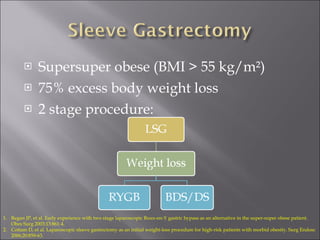
Supersuper obese (BMI > 55 kg/m²) 75% excess body weight loss 2 stage procedure: Regan JP, et al. Early experience with two stage laparoscopic Roux-en-Y gastric bypass as an alternative in the super-super obese patient. Obes Surg 2003;13:861-4. Cottam D, et al. Laparoscopic sleeve gastrectomy as an initial weight-loss procedure for high-risk patients with morbid obesity. Surg Endosc 2006;20:859-63.
Induced weight loss: Improves comorbidities before 2 nd  operation Silechia et al: 41 superobese pts 2 nd  stage operation 60% resolved comorbidities 24% resoved prior to 2 nd  procedure Avoids complications: Anastomotic leak Stricture Internal hernia Silechia G, et al. Effectiveness of laparoscopic sleeve gatrectomy (first stage of biliopancreatic diversion with duodenal switch) on comorbidities in super obese high-risk patients. Obes Surg 2006;16:1138-44. Frezza EE, et al. Laparoscopic vertical sleeve gastrectomy for morbid obestiy. The future procedure of choice? Surg Today 2007;37:275-81.
OPEN   ↑  post op pain Longer hospitalizations ↑  wound complications Infection Hernias Seromas Return to work in 4-8 weeks LAPAROSCOPIC ↓  post op pain Early mobility ↓  Wound complications 2-3 day hospital stay Return to work in 1-3 weeks Nguyen NT, et al. Accelerated growth of bariatric surgery with the introduction of minimally invasive surgery. Arch Surg 2005;140:1198-202.
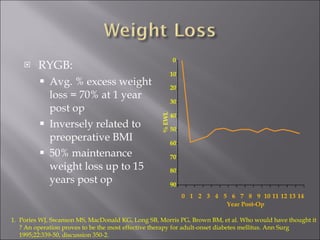
RYGB: Avg. % excess weight loss = 70% at 1 year post op Inversely related to preoperative BMI 50% maintenance weight loss up to 15 years post op Pories WJ, Swanson MS, MacDonald KG, Long SB, Morris PG, Brown BM, et al. Who would have thought it ? An operation proves to be the most effective therapy for adult-onset diabetes mellitus. Ann Surg 1995;22:339-50, discussion 350-2. 0 10 20 30 40 50 60 70 80 90 0 1 2 3 4 5 6 7 8 9 10 11 12 13 14 Year Post-Op % EWL )
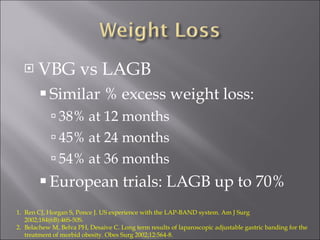
VBG vs LAGB Similar % excess weight loss: 38% at 12 months 45% at 24 months 54% at 36 months European trials: LAGB up to 70% Ren CJ, Horgan S, Ponce J. US experience with the LAP-BAND system. Am J Surg 2002;184(6B):46S-50S. Belachew M, Belva PH, Desaive C. Long term results of laparoscopic adjustable gastric banding for the treatment of morbid obesity. Obes Surg 2002;12:564-8.
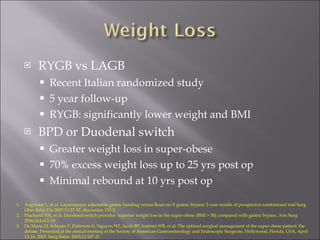
RYGB vs LAGB Recent Italian randomized study 5 year follow-up RYGB: significantly lower weight and BMI BPD or Duodenal switch Greater weight loss in super-obese 70% excess weight loss up to 25 yrs post op Minimal rebound at 10 yrs post op Angrisani L, et al. Laparoscopic adjustable gastric banding versus Roux-en-Y gastric bypass: 5 year results of prospective randomized trial Surg Obes Relat Dis 2007;3:127-32, discussion 132-2. Prachand VN, et al. Duodenal switch provides  superior weight loss in the super-obese (BMI > 50) compared with gastric bypass. Ann Surg 2006;244:611-19. De Maria EJ, Schauer P, Patterson E, Nguyen NT, Jacob BP, Inabnet WB, et al. The optimal surgical management of the super-obese patient: the debate. Presented at the annual meeting of the Society of American Gastroenterology and Endoscopic Surgeons, Hollywood, Florida, USA, April 13-16, 2005. Surg Innov 2005;12:107-21.
Surgical patients vs Control subjects Recent studies: Mortality decreased by 40% in surgical group Long-term death lower in surgical group Multiple studies: Weight loss and improved comorbidities 30% to 85% Reduced Mortality   compared to nonsurgical care
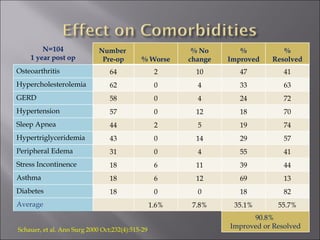
Schauer, et al. Ann Surg 2000 Oct;232(4):515-29 N=104 1 year post op Number  Pre-op % Worse % No change % Improved % Resolved Osteoarthritis 64 2 10 47 41 Hypercholesterolemia 62 0 4 33 63 GERD 58 0 4 24 72 Hypertension 57 0 12 18 70 Sleep Apnea 44 2 5 19 74 Hypertriglyceridemia 43 0 14 29 57 Peripheral Edema 31 0 4 55 41 Stress Incontinence 18 6 11 39 44 Asthma 18 6 12 69 13 Diabetes 18 0 0 18 82 Average 1.6% 7.8% 35.1% 55.7% 90.8%  Improved or Resolved
Rapid decrease in serum blood sugar Decrease in medication requirements 66% to 75% complete resolution Increased insulin sensitivity Inhibits progression of disease Swedish Obese Subject Trial: Reduced relative risk by factor of 30 compared to medically treated population Buchwald H, Avidor Y, Braunwald E, Jensen MD, Pories W, Fahrbach K, et al. Bariatric surgery: a systematic review and meta-analysis. JAMA 2004;292: 1724-37.  Pories WJ, Swanson MS, MacDonald KG, Long SB, Morris PG, Brown BM, et al. Who would have thought it ? An operation proves to be the most effective therapy for adult-onset diabetes mellitus. Ann Surg 1995;22:339-50, discussion 350-2. SjostromL, Lindros AK, Peltonem M, Torgerson J, Bouchard C, Carlsson B, et al. Lifestyle, diabetes, and cardiovascular risk factors 10 years after bariatric surgery. N Engl J Med 2004;351: 2683-93.
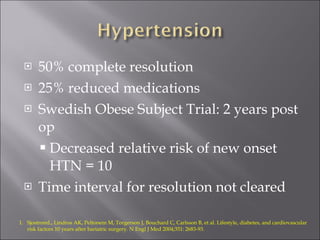
50% complete resolution 25% reduced medications Swedish Obese Subject Trial: 2 years post op Decreased relative risk of new onset HTN = 10 Time interval for resolution not cleared SjostromL, Lindros AK, Peltonem M, Torgerson J, Bouchard C, Carlsson B, et al. Lifestyle, diabetes, and cardiovascular risk factors 10 years after bariatric surgery. N Engl J Med 2004;351: 2683-93.
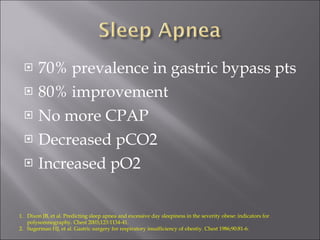
70% prevalence in gastric bypass pts 80% improvement No more CPAP Decreased pCO2 Increased pO2 Dixon JB, et al. Predicting sleep apnea and excessive day sleepiness in the severity obese: indicators for polysomnography. Chest 2003;123:1134-41. Sugerman HJ, et al. Gastric surgery for respiratory insufficiency of obestiy. Chest 1986;90:81-6.
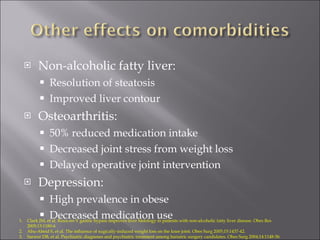
Non-alcoholic fatty liver: Resolution of steatosis Improved liver contour Osteoarthritis: 50% reduced medication intake Decreased joint stress from weight loss Delayed operative joint intervention Depression: High prevalence in obese Decreased medication use Clark JM, et al. Roux-en-Y gastric bypass improves liver histology in patients with non-alcoholic fatty liver disease. Obes Res 2005;13:1180-6 Abu-Abeid S, et al. The influence of sugically-induced weight loss on the knee joint. Obes Surg 2005;15:1437-42. Sarwer DB, et al. Psychiatric diagnoses and psychiatric treatment among bariatric surgery candidates. Obes Surg 2004;14:1148-56.
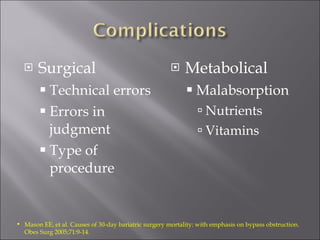
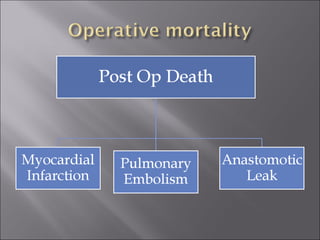
Surgical Technical errors Errors in judgment Type of procedure Metabolical Malabsorption Nutrients Vitamins Mason EE, et al. Causes of 30-day bariatric surgery mortality: with emphasis on bypass obstruction. Obes Surg 2005;71:9-14 .
 
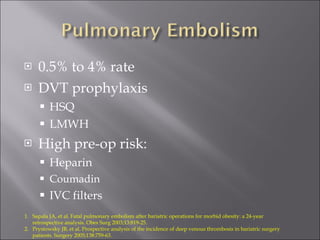
0.5% to 4% rate DVT prophylaxis HSQ LMWH High pre-op risk: Heparin Coumadin IVC filters Sapala JA, et al. Fatal pulmonary embolism after bariatric operations for morbid obesity: a 24-year retrospective analysis. Obes Surg 2003;13:819-25. Prystowsky JB, et al. Prospective analysis of the incidence of deep venous thrombosis in bariatric surgery patients. Surgery 2005;138:759-63.
0.5% to 1% rate Obesity Cardiac comorbidities Pre-op stress testing Long term benefit out-weights slightly increased risk McCullough PA, et al. Cardiorespiratory fitness and short-term complications after bariatric surgery. Chest 2006;130:517-25 .
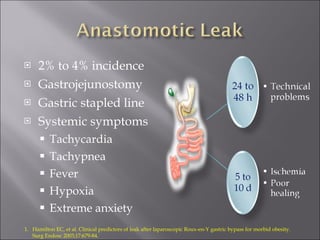
2% to 4% incidence Gastrojejunostomy Gastric stapled line Systemic symptoms Tachycardia Tachypnea Fever Hypoxia Extreme anxiety Hamilton EC, et al. Clinical predictors of leak after laparoscopic Roux-en-Y gastric bypass for morbid obesity. Surg Endosc 2003;17:679-84.
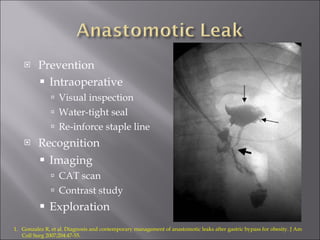
Prevention Intraoperative   Visual inspection Water-tight seal Re-inforce staple line Recognition Imaging  CAT scan Contrast study Exploration Gonzalez R, et al. Diagnosis and contemporary management of anastomotic leaks after gastric bypass for obesity. J Am Coll Surg 2007;204:47-55.
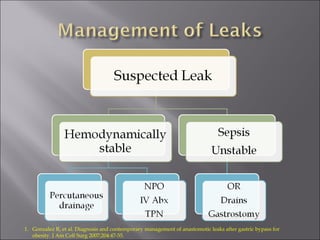
Gonzalez R, et al. Diagnosis and contemporary management of anastomotic leaks after gastric bypass for obesity. J Am Coll Surg 2007;204:47-55.
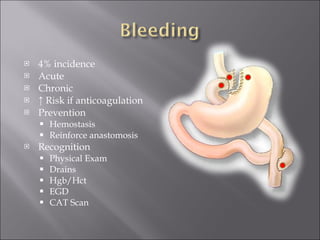
4% incidence Acute Chronic ↑  Risk if anticoagulation Prevention Hemostasis Reinforce anastomosis Recognition Physical Exam Drains Hgb/Hct EGD CAT Scan
5% to 20% incidence Less in laparoscopic vs open Laparoscopic wounds heal faster Risk factors in obese: Thick layer of SQ fat -> liquefaction fat necrosis Lower SQ tissue Oxygen tension 5 to 20 days post op Wound opening & packing Revision of port site in LAGB Rule out band erosion into gastric lumen EGD Podnos YD, et al. Complications after laparoscopic gastric bypass: a review of 3464 case. Arch Surg 2003;138:957-61. Anaya DA, et al. The obese surgical patient: a susceptible host for infection. Surg Infect (Larchmt) 2006;7:473-80. Kabon B, et al. Obesity decreases perioperative tissue oxygenation. Anesthesiology 2004;100:274-80.
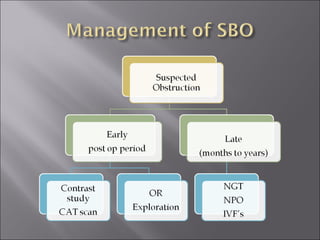
Early and Late Small bowel anastomosis 2% to 8% incidence ↑  with Laparoscopic approach Adhesions: months to years post op Internal hernias through defects: Small bowel mesentery Transverse mesocolon Obstruction Perforation of gastric remnant Blow-out duodenal stump
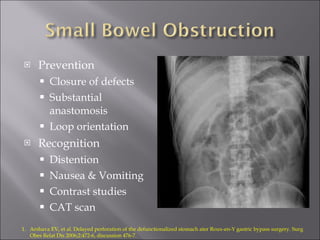
Prevention Closure of defects Substantial anastomosis Loop orientation Recognition Distention Nausea & Vomiting Contrast studies CAT scan Arshava EV, et al. Delayed perforation of the defunctionalized stomach ater Roux-en-Y gastric bypass surgery. Surg Obes Relat Dis 2006;2:472-6, discussion 476-7.
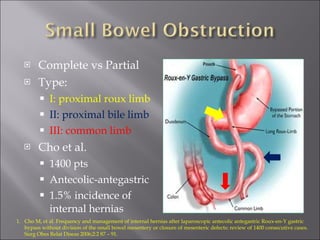
Complete vs Partial Type: I: proximal roux limb II: proximal bile limb III: common limb Cho et al. 1400 pts Antecolic-antegastric 1.5% incidence of internal hernias Cho M, et al. Frequency and management of internal hernias after laparoscopic antecolic antegastric Roux-en-Y gastric bypass without division of the small bowel mesentery or closure of mesenteric defects: review of 1400 consecutive cases. Surg Obes Relat Diseas 2006;2:2 87 – 91. .
 
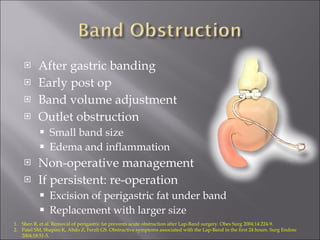
After gastric banding Early post op Band volume adjustment Outlet obstruction Small band size Edema and inflammation Non-operative management If persistent: re-operation Excision of perigastric fat under band Replacement with larger size Shen R, et al. Removal of perigastric fat prevents acute obstruction after Lap-Band surgery. Obes Surg 2004;14:224-9. Patel SM, Shapiro K, Abdo Z, Ferzli GS. Obstructive symptoms associated with the Lap-Band in the first 24 hours. Surg Endosc 2004;18:51-5.
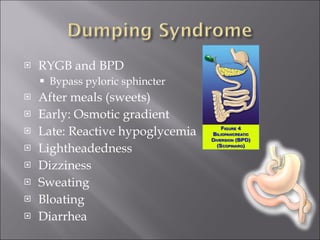
RYGB and BPD Bypass pyloric sphincter After meals (sweets) Early: Osmotic gradient Late: Reactive hypoglycemia Lightheadedness Dizziness Sweating Bloating Diarrhea
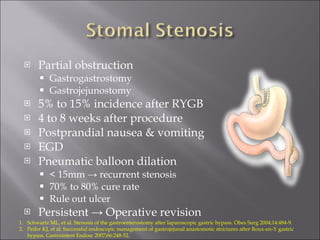
Partial obstruction Gastrogastrostomy Gastrojejunostomy 5% to 15% incidence after RYGB 4 to 8 weeks after procedure Postprandial nausea & vomiting EGD Pneumatic balloon dilation < 15mm -> recurrent stenosis 70% to 80% cure rate Rule out ulcer Persistent -> Operative revision Schwartz ML, et al. Stenosis of the gastroenterostomy after laparoscopic gastric bypass. Obes Surg 2004;14:484-9. Peifer KJ, et al. Successful endoscopic management of gastrojejunal anastomotic strictures after Roux-en-Y gastric bypass. Gastrointest Endosc 2007;66:248-52.
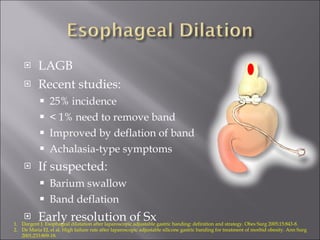
LAGB Recent studies: 25% incidence < 1% need to remove band Improved by deflation of band Achalasia-type symptoms If suspected: Barium swallow Band deflation Early resolution of Sx Dargent J. Esophageal dilatation after laparoscopic adjustable gastric banding: definition and strategy. Obes Surg 2005;15:843-8. De Maria EJ, et al. High failure rate after laparoscopic adjustable silicone gastric banding for treatment of morbid obesity. Ann Surg 2001;233:809-18.
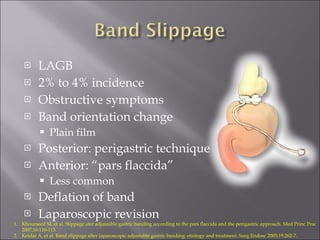
LAGB 2% to 4% incidence Obstructive symptoms Band orientation change Plain film Posterior: perigastric technique Anterior: “pars flaccida” Less common Deflation of band Laparoscopic revision Khourseed M, et al. Slippage ater adjustable gastric banding according to the pars flaccida and the perigastric approach. Med Princ Prac 2007;16:110-113. Keidar A, et al. Band slippage after laparoscopic adjustable gastric banding: etiology and treatment. Surg Endosc 2005;19:262-7.
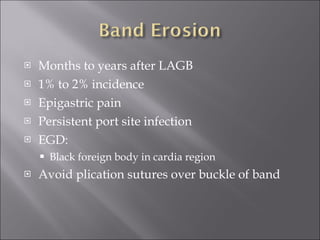
Months to years after LAGB 1% to 2% incidence Epigastric pain Persistent port site infection EGD: Black foreign body in cardia region Avoid plication sutures over buckle of band
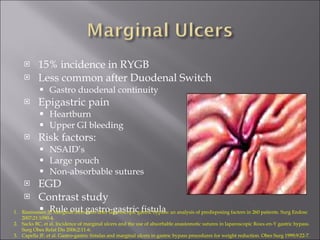
15% incidence in RYGB Less common after Duodenal Switch Gastro duodenal continuity Epigastric pain Heartburn Upper GI bleeding Risk factors: NSAID’s Large pouch Non-absorbable sutures EGD Contrast study Rule out gastro-gastric fistula Rasmussen JJ, Marginal ulceration after laparoscopic gastric bypass: an analysis of predisposing factors in 260 patients. Surg Endosc 2007;21:1090-4. Sacks BC, et al. Incidence of marginal ulcers and the use of absorbable anastomotic sutures in laparoscopic Roux-en-Y gastric bypass. Surg Obes Relat Dis 2006;2:11-6. Capella JF, et al. Gastro-gastric fistulas and marginal ulcers in gastric bypass procedures for weight reduction. Obes Surg 1999;9:22-7.
Rapid weight loss -> Gallstone formation 50% incidence 10% symptomatic Adjunt cholecystectomy  Cholelithiasis or cholecystitis at time or operation Ursodeoxycholic acid: ↓  incidence of gallstones post op by 30% Post op anatomy: Difficult management of pancreatitis, CBD stones Sugerman HJ, et al. A multicenter, placebo-controlled, randomized, double-blind, prospective trial of prophylactic ursodiol for the prevention of gallstone formation following gastric bypass induced rapid weight loss. Am J Surg 1995;169:91-6. Taylor J, et al. Is routine cholecystectomy necessary at the time of Roux-en-Y gastric bypass? Obes Surg 2006;16:759-61. Ceppa FA, et al. Laparoscopic transgastric endoscopy after Roux-en-Y gastric bypass. Surg Obes Relat Dis 2007;3:21-4.
RYGB Transected/Occluded Lumen Recanalization -> Fistula 2% to 25% incidence Risk factors: Anastomotic leak LUQ abscess Long-term consequence: Marginal ulcer Suboptimal weight loss Sudden weight gain Carrodeguas L, et al. Management of gastrogastric fistulas after divided Roux-en-Y gastric bypass surgery for morbid obesity: analysis of 1,292 consecutive patients and review of literature. Surg Obes Relat Dis 2005;1:467-74. Gumbs AA, et al. Incidence and management of marginal ulcerations after laparoscopic Roux-en-Y gastric bypass. Surg Obes Relat Dis 2006;2:460-3.
GI contrast study EGD Indications for Rx: Symptomatic ulcers Suboptimal weight loss PPI’s Sucralfate Surgical revision
Laparoscopic Remnant Gastrectomy Cho et al. 1400 pts w/ RYGB 21 pts w/ GGF (1.5%) 15 underwent LRG No recurrence of GGF No mortality 1. Cho M, et al. Laparoscopic Remnant Gastrectomy: A Novel approach to Gastrogastric fistula after Roux-en-Y gastric bypass for morbid obesity. J Am Coll Surg 2007;4:617-24.
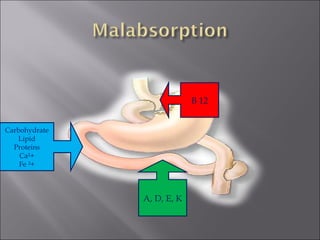
Carbohydrate Lipid Proteins Ca²+ Fe ²+ B 12 A, D, E, K
Restrictive: Intolerance Inadequate weight loss Complications Combined: Enlarged pouch Regained weight Gastro-gastric fistula
Band deflation Replacement size Conversion to RYGB Conversion to Duodenal Switch Multiple Short Studies Short follow up Conversion is safe with significant weight loss and lower BMI
Decrease pouch size Lengthen biliary limb Distal jejuno-ileal anastomosis Increases malabsorption May increase weight loss Mason EE, et al. Optimizing results of gastric bypass. Ann Surg 1975;182(4):405-14. Fobi MA, et al. Revision of failed gastric bypass to distal Roux-en-Y gastric bypass: a review of 65 cases. Obes Surg 2001;11(2):190-5.
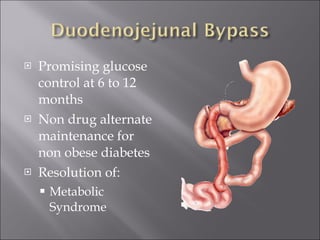
Metabolic Surgery Surgical resolution for Diabetes? Too fast to be accounted to weight loss alone Duodenojejunal Bypass (DJB) Non-obese Rat models Complete resolution of diabetes Intestinal bypass Hormonal regulation Foregut vs Hindgut hypothesis Rubino F. Bariatric Surgery: Effects on Glucose Homeostasis. Curr Opin Clin Nutr Metab Care 9:497-507
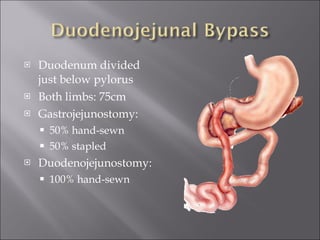
Duodenum divided just below pylorus Both limbs: 75cm Gastrojejunostomy: 50% hand-sewn 50% stapled Duodenojejunostomy: 100% hand-sewn
Promising glucose control at 6 to 12 months Non drug alternate maintenance for non obese diabetes Resolution of: Metabolic Syndrome
Endoscopic plication of the pylorus with laparoscopic gastrojejeunostomy N.O.T.E.S Endoscopic plication of the pylorus Endoscopic transgastric gastric jejeunostomy Human multicenter trials underway Kantsevoy SV, et al. Technical feasibility of endoscopic gatric reduction: a pilot study in a porcine model. Gastrointes Endosc 2007;65:510-3. Deviere J, et al. Safety, feasibility and weight loss after trans-oral gastroplasty (TOGA): first human multicenter study. Surg Endosc 2007;21(suppl 1): S303.
 

Bariatric Surgery: Options, Trends, and Latest Innovations

  • 1.
    George S. Ferzli,MD Joel Ricci, MD
  • 2.
    Dramatic increase duringlast 2 decades 2/3 US individuals are overweight 50% of these are obese 5% morbidly obese Rapid growth in BMI subgroups ≥ 35 and ≥ 40 Increase in comorbidities 2.5 million deaths per year worldwide from comorbidities 1. National Center for Health Statistics NHANES IV Report 2. Flegal KM et al: Prevalence and trends in obesity among US adults 1999-2000. JAMA 2002; 288: 1723-1727
  • 3.
    Derived from Centerfor Disease Control and Prevention website www.cdc.gov
  • 4.
    Derived from Centerfor Disease Control and Prevention website www.cdc.gov
  • 5.
    Obesity associated conditionsDiabetes Hypertension Sleep apnea Congestive heart failure Hyperlipidemia Stroke Coronary Artery Disease Osteoarthritis Gastroesophageal Reflux Disease Non-alcoholic fatty liver Psychological disturbances
  • 6.
    BMI ≥ 35kg/m²: Risk of death ≈ 2.5 times greater than if BMI of 20-25 kg/m² BMI ≥ 40 kg/m²: Risk of death 10 times greater Obesity 2 nd leading cause of preventable premature death in US (smoking)
  • 7.
    Calle et al.N Eng J Med, 1999; (15)341:1097-105. Ali H, Mokdad AH, et al. JAMA 2004;291:1238-1245.
  • 8.
    Relatively ineffective: Dietwith and without support organizations Pharmaceutical agents Only long-term options: Bariatric surgery Metabolic surgery 1991 National Institute of Health Guidelines BMI ≥ 40 or ≥ 35 with significant comorbidities North American Association for the Study of Obesity and the National Heart, Lung, and Blood Institute. The Practical Guide: Identification, Evaluation, and Treatment of Overweight and Obesity in Adults . Bethesda, Md: National Institutes of Health; 2000. NIH 00-4084. Buchwald H, Avidor Y, Braunwald E, Jensen MD, Pories W, Fahrbach K, et al. Bariatric surgery: a systematic review and meta-analysis. JAMA 2004;292: 1724-37. National Institutes of Health Consensus Development Panel. Gastrointestinal surgery for severe obesity. Ann Intern Med . 1991; 115: 956-961
  • 9.
    First line oftreatment Calorie restriction Exercise regimen Behavior modification Pharmacotherapy Avg. weight loss ≈ 5% to 10% initial body weight at 3 to 6 months Regain weight after 1 to 2 years 1. Yanovski SZ, Yanovski JA. Obesity. N Engl J Med 2002;346: 591-602
  • 10.
    Consensus Guidelines 2003Surgical therapy should be considered for individuals who: Have a BMI of greater than 40 kg/m² OR Have a BMI greater than 35 kg/m² with significant comorbidities AND Can show that dietary attempts at weight control have been ineffective Derived from American Society of Bariatric Surgery website: www.asbs.org
  • 11.
    Bariatric Surgery DietExercise Behavior Modification “ Postoperative care, nutritional counseling, and surveillance should continue for an indefinitely long period.”
  • 12.
    Obesity related toa metabolic or endocrine disorder History of substance abuse or major psychiatric problem Surgery contraindicated or high risk Women who want to become pregnant within the next 18 months
  • 13.
    National Hospital DischargeSurvey Public-use data file and documentation. Multi-year data CD-ROM. National Center for Health Statistics, 1979-1996. Nguyen et al. Accelerated growth of bariatric surgery with the introduction of minimally invasive surgery. Arch Surg 2005; 140: 1198-202. Griffen et al. The decline and fall of the jejunoileal bypass. Surg Gynecol Obstet 1983; 157: 301-8. Shirmer et al. Bariatric Surgery Training: Getting Your Ticket Punched. J Gastrointest Surg 2007;11: 807-12. Period or Decade Incidence of surgery Reason for change Late 1970’s Early 1980’s 25,000 procedures per year Innovative procedures gastroplasty loop GBP jejuno-ileal bypass Late 1980’s 1990’s 5,000 procedures per year Multifactorial: High M&M Ineffective long-term Perceived failure Surgeon experience 2000’s 80,000 to 110,000 procedures per year Multifactorial: Laparoscopy Long-term data Centers of Excellence
  • 14.
    Buchwald H, AvidorY, Braunwald E, Jensen MD, Pories W, Fahrbach K, et al. Bariatric surgery: a systematic review and meta-analysis. JAMA 2004;292: 1724-37. SjostromL, Lindros AK, Peltonem M, Torgerson J, Bouchard C, Carlsson B, et al. Lifestyle, diabetes, and cardiovascular risk factors 10 years after bariatric surgery. N Engl J Med 2004;351: 2683-93. Study Type and size Effect on weight Effect on comorbidities Buchwald et al. Meta-analysis n = 22,094 pts Mean excess weight loss: 61% Resolution of: Diabetes: 70% HTN: 62% Sleep apnea: 86% Swedish Obese Subject trial (SOS) Prospective matched cohort n = 4,047 pts At 10 years: Med: 1.6% gain Surg: 16% loss Improved by surg: Diabetes Lipid profile HTN Hyperuricemia
  • 15.
    Jejuno-ileal bypass 70%excess wght loss Reduced caloric intake Malabsorption Dehydration Acidosis Electrolyte abnormalities Liver failure Bacterial overgrowth Griffen WO Jr, Bivins BA, Bell RM. The decline and fall of the jejunoileal bypass. Surg Gynecol Obstet 1983; 157: 301-8 .
  • 16.
    Loop gastric bypassReduced capacitance Aversive eating Dumping syndrome Alkaline reflux gastritis Esophagitis
  • 17.
    Horizontal gastroplasty “Gastric stapling” 1970’s Regained weight Many pts left GERD Obesity May seek re-operation for correction anatomy Salmon PA. Salvage of failed horizontal gastroplasty by the addition of a distal gastric bypass. Obes Surg 1993;3:45-51.
  • 18.
  • 19.
    “ Gold Standard”80% of bariatric proc. Lap vs Open Restrictive and Malabsorptive: Reduced calorie intake Macronutrient malabsorption
  • 20.
    Pouch formation: Smallgastric pouch 15-30 mL Transect vs Stapling Re-inforcement of staple line Roux limb creation: 15 to 100 cm distal to Ligament of Treitz Jejuno-jejunostomy 75 to 150 cm down Roux limb Long limb bypass: ↑ weight loss from malabsorption Brolin RE. Long limb Roux en Y gastric bypass revisited. Surg Clin North Am 2005;85:807-17, vii.
  • 21.
    Roux limb orientation:Antecolic vs Retrocolic Antegastric vs Retrogastric Surgeon’s preference Antecolic: May lead to high tension gastro-jejunostomy Ischemic strictures and ↑ bile leak rate No literature supporting this hypothesis No evidence of protection against internal hernias Retrocolic: Shorter Creation of transverse mesocolic defect Edwards MA et al. Anastomotic leak following antecolic versus retrocolic laparoscopic Roux-en-Y gastric bypass for morbid obesity. Obes Surg 2007;17:292-7. Bertucci W, et al. Antecolic laparoscopic Roux-en-Y gastric bypass is not associated with higher complication rates. Am Surg 2005;71:735-7. Carmody B, et al. Internal hernia after laparoscopic Roux-en-Y gastric bypass. Surg Obes Relat Dis 205;1:543-8 .
  • 22.
    Gastrojejunostomy Circular stapler↑ risk of wound infection (10%) May be lower if protected stapler Linear stapler Hand-sewn Drainage placement Monitors for leak or post-op bleeding Surgeon’s preference Post op water-soluble contrast study Evaluates for leaks before resuming po intake Podnos YD, et al. Complications after laparoscopic gastric bypass: a review of 3464 cases. Arch Surg 2003;138:957-61. Dallal RM, et al. Back to basics – clinical diagnosis in bariatric surgery. Routine drains and upper GI series are unnecessary. Surg Endosc 2007;21:2268-71. Epub 2007 May 5. Katasani VG, et al. Water-soluble upper Gi based on clinical findings is reliable to detect anastomotic leaks after laparoscopic gastric bypass. Am Surg 2005;71:916-8, discussion 918-9.
  • 23.
    Brolin RE. Longlimb Roux en Y gastric bypass revisited. Surg Clin North Am 2005;85:807-17, vii. Higa KD, Ho T, Boone KB. Internal hernias after laparoscopic Roux-en-Y gastric bypass: Incidence, treatment and prevention. Obes Surg 2003;13(3):350–4. Dallal RM, et al. Back to basics – clinical diagnosis in bariatric surgery. Routine drains and upper GI series are unnecessary. Surg Endosc 2007;21:2268-71. Epub 2007 May 5. Controversy Study Type and size Results Defunctionalized jejunum limb lenght Brolin et al. Prospective (n = 45) 22 pts: 75 cm length 23 pts: 150 cm length Mean f/u: 43 ± 17 m Mean exc. wght loss: 50% for short limb 64% for long limb No difference in complications Internal hernia Lap vs Open Roux limb position Mesocolic closure Higa et al. Retrospective (n = 2000) Hernia site: mesocolic: 67% Jejunal: 21% Petersen: 7.5% Leaks or bleeding: Drain placement UGI series Dallal et al. Prospective (n = 352) No drains or UGI Small complication rate recognized from tachycardia
  • 24.
    Popular in 80’sand 90’s Less common than RYGB Purely restrictive Rapid sense of satiety Reduced calorie intake Pouch creation Hole through anterior and posterior wall Staple line to angle of His Nondistensible band around distal neo-pouch
  • 25.
    Randomized trials: VBGvs RYGB Better weight loss w/ RYGB Similar operative risks Replaced by Adjustable gastric band Similar outcomes Technically easier Hall JC, Watts JM, O’Brien PE, Dunstan RE, Walsh JF, Slavotinek AH, et al. Gastric surgery for morbid obesity. The Adelaide Study. Ann Surg 1990;211:419-27. Howard L, Malone M, Michalek A, Carter J, Alger S, Van Woert J. Gastric bypass and vertical banded gastroplasty – a prospective randomized comparison and 5 – year follow-up. Obes Surg 1996;5:55-60.
  • 26.
    Dr. Cadiere 1992Technically simple Purely restrictive Decrease hunger Early satiety Food aversion Adjustment to stoma diameter
  • 27.
    Pouch creation “Pars flaccida” technique Proximal stomach dissection Band placement and fixation SQ port placement Long-term follow up less studied Proper adjustement of band is paramount
  • 28.
    Scopinaro (Italy) Significantweight loss 75% excess weight loss Maintained > 20 yrs Super-morbid obesity BMI ≥ 60 kg/m² Restrictive Malabsorptive Decreased hunger Hormonal changes: distal delivery of nutrients Marinary GM, Murelli F, Camerini G, Papadia F, Carlini F, Stabilini C, et al. A 15 year evaluation of biliopancreatic diversion according to the Bariatric Analysis Reporting Outcome (BAROS). Obes Surg 2004;14:325-8. Scopinaro N, Gianetta E, Adami GF, Friedman D, Traverso E, Marinari GM, et al. Biliopancreatic diversion for obesity at eighteen years. Surgery 1996;119:261-8.
  • 29.
    Partial gastrectomy 200– 500 ml gastric pouch Ileal transection 250 cm above ileocecal valve Gastro-ileal anastomosis End-to-side ileoileostomy 50 cm proximal to ICV Alimentary channel = 200 cm Common channel = 50 cm
  • 30.
    1988 Hess etal. Marceau et al. Longer common channel Pylorus preservation Restriction Malabsorption Decreases Diarrhea Dumping syndrome Ulcerogenesis
  • 31.
    Sleeve gastrectomy 150– 200 ml reservoir Over 35 – 60 Fr bougie Roux limb 150 cm Distal common channel 100 cm “ Duodeno-ileal switch” Higher degree of difficulty Multiple enteric anastomoses
  • 32.
    Supersuper obese (BMI> 55 kg/m²) 75% excess body weight loss 2 stage procedure: Regan JP, et al. Early experience with two stage laparoscopic Roux-en-Y gastric bypass as an alternative in the super-super obese patient. Obes Surg 2003;13:861-4. Cottam D, et al. Laparoscopic sleeve gastrectomy as an initial weight-loss procedure for high-risk patients with morbid obesity. Surg Endosc 2006;20:859-63.
  • 33.
    Induced weight loss:Improves comorbidities before 2 nd operation Silechia et al: 41 superobese pts 2 nd stage operation 60% resolved comorbidities 24% resoved prior to 2 nd procedure Avoids complications: Anastomotic leak Stricture Internal hernia Silechia G, et al. Effectiveness of laparoscopic sleeve gatrectomy (first stage of biliopancreatic diversion with duodenal switch) on comorbidities in super obese high-risk patients. Obes Surg 2006;16:1138-44. Frezza EE, et al. Laparoscopic vertical sleeve gastrectomy for morbid obestiy. The future procedure of choice? Surg Today 2007;37:275-81.
  • 34.
    OPEN ↑ post op pain Longer hospitalizations ↑ wound complications Infection Hernias Seromas Return to work in 4-8 weeks LAPAROSCOPIC ↓ post op pain Early mobility ↓ Wound complications 2-3 day hospital stay Return to work in 1-3 weeks Nguyen NT, et al. Accelerated growth of bariatric surgery with the introduction of minimally invasive surgery. Arch Surg 2005;140:1198-202.
  • 35.
    RYGB: Avg. %excess weight loss = 70% at 1 year post op Inversely related to preoperative BMI 50% maintenance weight loss up to 15 years post op Pories WJ, Swanson MS, MacDonald KG, Long SB, Morris PG, Brown BM, et al. Who would have thought it ? An operation proves to be the most effective therapy for adult-onset diabetes mellitus. Ann Surg 1995;22:339-50, discussion 350-2. 0 10 20 30 40 50 60 70 80 90 0 1 2 3 4 5 6 7 8 9 10 11 12 13 14 Year Post-Op % EWL )
  • 36.
    VBG vs LAGBSimilar % excess weight loss: 38% at 12 months 45% at 24 months 54% at 36 months European trials: LAGB up to 70% Ren CJ, Horgan S, Ponce J. US experience with the LAP-BAND system. Am J Surg 2002;184(6B):46S-50S. Belachew M, Belva PH, Desaive C. Long term results of laparoscopic adjustable gastric banding for the treatment of morbid obesity. Obes Surg 2002;12:564-8.
  • 37.
    RYGB vs LAGBRecent Italian randomized study 5 year follow-up RYGB: significantly lower weight and BMI BPD or Duodenal switch Greater weight loss in super-obese 70% excess weight loss up to 25 yrs post op Minimal rebound at 10 yrs post op Angrisani L, et al. Laparoscopic adjustable gastric banding versus Roux-en-Y gastric bypass: 5 year results of prospective randomized trial Surg Obes Relat Dis 2007;3:127-32, discussion 132-2. Prachand VN, et al. Duodenal switch provides superior weight loss in the super-obese (BMI > 50) compared with gastric bypass. Ann Surg 2006;244:611-19. De Maria EJ, Schauer P, Patterson E, Nguyen NT, Jacob BP, Inabnet WB, et al. The optimal surgical management of the super-obese patient: the debate. Presented at the annual meeting of the Society of American Gastroenterology and Endoscopic Surgeons, Hollywood, Florida, USA, April 13-16, 2005. Surg Innov 2005;12:107-21.
  • 38.
    Surgical patients vsControl subjects Recent studies: Mortality decreased by 40% in surgical group Long-term death lower in surgical group Multiple studies: Weight loss and improved comorbidities 30% to 85% Reduced Mortality compared to nonsurgical care
  • 39.
    Schauer, et al.Ann Surg 2000 Oct;232(4):515-29 N=104 1 year post op Number Pre-op % Worse % No change % Improved % Resolved Osteoarthritis 64 2 10 47 41 Hypercholesterolemia 62 0 4 33 63 GERD 58 0 4 24 72 Hypertension 57 0 12 18 70 Sleep Apnea 44 2 5 19 74 Hypertriglyceridemia 43 0 14 29 57 Peripheral Edema 31 0 4 55 41 Stress Incontinence 18 6 11 39 44 Asthma 18 6 12 69 13 Diabetes 18 0 0 18 82 Average 1.6% 7.8% 35.1% 55.7% 90.8% Improved or Resolved
  • 40.
    Rapid decrease inserum blood sugar Decrease in medication requirements 66% to 75% complete resolution Increased insulin sensitivity Inhibits progression of disease Swedish Obese Subject Trial: Reduced relative risk by factor of 30 compared to medically treated population Buchwald H, Avidor Y, Braunwald E, Jensen MD, Pories W, Fahrbach K, et al. Bariatric surgery: a systematic review and meta-analysis. JAMA 2004;292: 1724-37. Pories WJ, Swanson MS, MacDonald KG, Long SB, Morris PG, Brown BM, et al. Who would have thought it ? An operation proves to be the most effective therapy for adult-onset diabetes mellitus. Ann Surg 1995;22:339-50, discussion 350-2. SjostromL, Lindros AK, Peltonem M, Torgerson J, Bouchard C, Carlsson B, et al. Lifestyle, diabetes, and cardiovascular risk factors 10 years after bariatric surgery. N Engl J Med 2004;351: 2683-93.
  • 41.
    50% complete resolution25% reduced medications Swedish Obese Subject Trial: 2 years post op Decreased relative risk of new onset HTN = 10 Time interval for resolution not cleared SjostromL, Lindros AK, Peltonem M, Torgerson J, Bouchard C, Carlsson B, et al. Lifestyle, diabetes, and cardiovascular risk factors 10 years after bariatric surgery. N Engl J Med 2004;351: 2683-93.
  • 42.
    70% prevalence ingastric bypass pts 80% improvement No more CPAP Decreased pCO2 Increased pO2 Dixon JB, et al. Predicting sleep apnea and excessive day sleepiness in the severity obese: indicators for polysomnography. Chest 2003;123:1134-41. Sugerman HJ, et al. Gastric surgery for respiratory insufficiency of obestiy. Chest 1986;90:81-6.
  • 43.
    Non-alcoholic fatty liver:Resolution of steatosis Improved liver contour Osteoarthritis: 50% reduced medication intake Decreased joint stress from weight loss Delayed operative joint intervention Depression: High prevalence in obese Decreased medication use Clark JM, et al. Roux-en-Y gastric bypass improves liver histology in patients with non-alcoholic fatty liver disease. Obes Res 2005;13:1180-6 Abu-Abeid S, et al. The influence of sugically-induced weight loss on the knee joint. Obes Surg 2005;15:1437-42. Sarwer DB, et al. Psychiatric diagnoses and psychiatric treatment among bariatric surgery candidates. Obes Surg 2004;14:1148-56.
  • 44.
    Surgical Technical errorsErrors in judgment Type of procedure Metabolical Malabsorption Nutrients Vitamins Mason EE, et al. Causes of 30-day bariatric surgery mortality: with emphasis on bypass obstruction. Obes Surg 2005;71:9-14 .
  • 45.
  • 46.
    0.5% to 4%rate DVT prophylaxis HSQ LMWH High pre-op risk: Heparin Coumadin IVC filters Sapala JA, et al. Fatal pulmonary embolism after bariatric operations for morbid obesity: a 24-year retrospective analysis. Obes Surg 2003;13:819-25. Prystowsky JB, et al. Prospective analysis of the incidence of deep venous thrombosis in bariatric surgery patients. Surgery 2005;138:759-63.
  • 47.
    0.5% to 1%rate Obesity Cardiac comorbidities Pre-op stress testing Long term benefit out-weights slightly increased risk McCullough PA, et al. Cardiorespiratory fitness and short-term complications after bariatric surgery. Chest 2006;130:517-25 .
  • 48.
    2% to 4%incidence Gastrojejunostomy Gastric stapled line Systemic symptoms Tachycardia Tachypnea Fever Hypoxia Extreme anxiety Hamilton EC, et al. Clinical predictors of leak after laparoscopic Roux-en-Y gastric bypass for morbid obesity. Surg Endosc 2003;17:679-84.
  • 49.
    Prevention Intraoperative Visual inspection Water-tight seal Re-inforce staple line Recognition Imaging CAT scan Contrast study Exploration Gonzalez R, et al. Diagnosis and contemporary management of anastomotic leaks after gastric bypass for obesity. J Am Coll Surg 2007;204:47-55.
  • 50.
    Gonzalez R, etal. Diagnosis and contemporary management of anastomotic leaks after gastric bypass for obesity. J Am Coll Surg 2007;204:47-55.
  • 51.
    4% incidence AcuteChronic ↑ Risk if anticoagulation Prevention Hemostasis Reinforce anastomosis Recognition Physical Exam Drains Hgb/Hct EGD CAT Scan
  • 52.
    5% to 20%incidence Less in laparoscopic vs open Laparoscopic wounds heal faster Risk factors in obese: Thick layer of SQ fat -> liquefaction fat necrosis Lower SQ tissue Oxygen tension 5 to 20 days post op Wound opening & packing Revision of port site in LAGB Rule out band erosion into gastric lumen EGD Podnos YD, et al. Complications after laparoscopic gastric bypass: a review of 3464 case. Arch Surg 2003;138:957-61. Anaya DA, et al. The obese surgical patient: a susceptible host for infection. Surg Infect (Larchmt) 2006;7:473-80. Kabon B, et al. Obesity decreases perioperative tissue oxygenation. Anesthesiology 2004;100:274-80.
  • 53.
    Early and LateSmall bowel anastomosis 2% to 8% incidence ↑ with Laparoscopic approach Adhesions: months to years post op Internal hernias through defects: Small bowel mesentery Transverse mesocolon Obstruction Perforation of gastric remnant Blow-out duodenal stump
  • 54.
    Prevention Closure ofdefects Substantial anastomosis Loop orientation Recognition Distention Nausea & Vomiting Contrast studies CAT scan Arshava EV, et al. Delayed perforation of the defunctionalized stomach ater Roux-en-Y gastric bypass surgery. Surg Obes Relat Dis 2006;2:472-6, discussion 476-7.
  • 55.
    Complete vs PartialType: I: proximal roux limb II: proximal bile limb III: common limb Cho et al. 1400 pts Antecolic-antegastric 1.5% incidence of internal hernias Cho M, et al. Frequency and management of internal hernias after laparoscopic antecolic antegastric Roux-en-Y gastric bypass without division of the small bowel mesentery or closure of mesenteric defects: review of 1400 consecutive cases. Surg Obes Relat Diseas 2006;2:2 87 – 91. .
  • 56.
  • 57.
    After gastric bandingEarly post op Band volume adjustment Outlet obstruction Small band size Edema and inflammation Non-operative management If persistent: re-operation Excision of perigastric fat under band Replacement with larger size Shen R, et al. Removal of perigastric fat prevents acute obstruction after Lap-Band surgery. Obes Surg 2004;14:224-9. Patel SM, Shapiro K, Abdo Z, Ferzli GS. Obstructive symptoms associated with the Lap-Band in the first 24 hours. Surg Endosc 2004;18:51-5.
  • 58.
    RYGB and BPDBypass pyloric sphincter After meals (sweets) Early: Osmotic gradient Late: Reactive hypoglycemia Lightheadedness Dizziness Sweating Bloating Diarrhea
  • 59.
    Partial obstruction GastrogastrostomyGastrojejunostomy 5% to 15% incidence after RYGB 4 to 8 weeks after procedure Postprandial nausea & vomiting EGD Pneumatic balloon dilation < 15mm -> recurrent stenosis 70% to 80% cure rate Rule out ulcer Persistent -> Operative revision Schwartz ML, et al. Stenosis of the gastroenterostomy after laparoscopic gastric bypass. Obes Surg 2004;14:484-9. Peifer KJ, et al. Successful endoscopic management of gastrojejunal anastomotic strictures after Roux-en-Y gastric bypass. Gastrointest Endosc 2007;66:248-52.
  • 60.
    LAGB Recent studies:25% incidence < 1% need to remove band Improved by deflation of band Achalasia-type symptoms If suspected: Barium swallow Band deflation Early resolution of Sx Dargent J. Esophageal dilatation after laparoscopic adjustable gastric banding: definition and strategy. Obes Surg 2005;15:843-8. De Maria EJ, et al. High failure rate after laparoscopic adjustable silicone gastric banding for treatment of morbid obesity. Ann Surg 2001;233:809-18.
  • 61.
    LAGB 2% to4% incidence Obstructive symptoms Band orientation change Plain film Posterior: perigastric technique Anterior: “pars flaccida” Less common Deflation of band Laparoscopic revision Khourseed M, et al. Slippage ater adjustable gastric banding according to the pars flaccida and the perigastric approach. Med Princ Prac 2007;16:110-113. Keidar A, et al. Band slippage after laparoscopic adjustable gastric banding: etiology and treatment. Surg Endosc 2005;19:262-7.
  • 62.
    Months to yearsafter LAGB 1% to 2% incidence Epigastric pain Persistent port site infection EGD: Black foreign body in cardia region Avoid plication sutures over buckle of band
  • 63.
    15% incidence inRYGB Less common after Duodenal Switch Gastro duodenal continuity Epigastric pain Heartburn Upper GI bleeding Risk factors: NSAID’s Large pouch Non-absorbable sutures EGD Contrast study Rule out gastro-gastric fistula Rasmussen JJ, Marginal ulceration after laparoscopic gastric bypass: an analysis of predisposing factors in 260 patients. Surg Endosc 2007;21:1090-4. Sacks BC, et al. Incidence of marginal ulcers and the use of absorbable anastomotic sutures in laparoscopic Roux-en-Y gastric bypass. Surg Obes Relat Dis 2006;2:11-6. Capella JF, et al. Gastro-gastric fistulas and marginal ulcers in gastric bypass procedures for weight reduction. Obes Surg 1999;9:22-7.
  • 64.
    Rapid weight loss-> Gallstone formation 50% incidence 10% symptomatic Adjunt cholecystectomy Cholelithiasis or cholecystitis at time or operation Ursodeoxycholic acid: ↓ incidence of gallstones post op by 30% Post op anatomy: Difficult management of pancreatitis, CBD stones Sugerman HJ, et al. A multicenter, placebo-controlled, randomized, double-blind, prospective trial of prophylactic ursodiol for the prevention of gallstone formation following gastric bypass induced rapid weight loss. Am J Surg 1995;169:91-6. Taylor J, et al. Is routine cholecystectomy necessary at the time of Roux-en-Y gastric bypass? Obes Surg 2006;16:759-61. Ceppa FA, et al. Laparoscopic transgastric endoscopy after Roux-en-Y gastric bypass. Surg Obes Relat Dis 2007;3:21-4.
  • 65.
    RYGB Transected/Occluded LumenRecanalization -> Fistula 2% to 25% incidence Risk factors: Anastomotic leak LUQ abscess Long-term consequence: Marginal ulcer Suboptimal weight loss Sudden weight gain Carrodeguas L, et al. Management of gastrogastric fistulas after divided Roux-en-Y gastric bypass surgery for morbid obesity: analysis of 1,292 consecutive patients and review of literature. Surg Obes Relat Dis 2005;1:467-74. Gumbs AA, et al. Incidence and management of marginal ulcerations after laparoscopic Roux-en-Y gastric bypass. Surg Obes Relat Dis 2006;2:460-3.
  • 66.
    GI contrast studyEGD Indications for Rx: Symptomatic ulcers Suboptimal weight loss PPI’s Sucralfate Surgical revision
  • 67.
    Laparoscopic Remnant GastrectomyCho et al. 1400 pts w/ RYGB 21 pts w/ GGF (1.5%) 15 underwent LRG No recurrence of GGF No mortality 1. Cho M, et al. Laparoscopic Remnant Gastrectomy: A Novel approach to Gastrogastric fistula after Roux-en-Y gastric bypass for morbid obesity. J Am Coll Surg 2007;4:617-24.
  • 68.
    Carbohydrate Lipid ProteinsCa²+ Fe ²+ B 12 A, D, E, K
  • 69.
    Restrictive: Intolerance Inadequateweight loss Complications Combined: Enlarged pouch Regained weight Gastro-gastric fistula
  • 70.
    Band deflation Replacementsize Conversion to RYGB Conversion to Duodenal Switch Multiple Short Studies Short follow up Conversion is safe with significant weight loss and lower BMI
  • 71.
    Decrease pouch sizeLengthen biliary limb Distal jejuno-ileal anastomosis Increases malabsorption May increase weight loss Mason EE, et al. Optimizing results of gastric bypass. Ann Surg 1975;182(4):405-14. Fobi MA, et al. Revision of failed gastric bypass to distal Roux-en-Y gastric bypass: a review of 65 cases. Obes Surg 2001;11(2):190-5.
  • 72.
    Metabolic Surgery Surgicalresolution for Diabetes? Too fast to be accounted to weight loss alone Duodenojejunal Bypass (DJB) Non-obese Rat models Complete resolution of diabetes Intestinal bypass Hormonal regulation Foregut vs Hindgut hypothesis Rubino F. Bariatric Surgery: Effects on Glucose Homeostasis. Curr Opin Clin Nutr Metab Care 9:497-507
  • 73.
    Duodenum divided justbelow pylorus Both limbs: 75cm Gastrojejunostomy: 50% hand-sewn 50% stapled Duodenojejunostomy: 100% hand-sewn
  • 74.
    Promising glucose controlat 6 to 12 months Non drug alternate maintenance for non obese diabetes Resolution of: Metabolic Syndrome
  • 75.
    Endoscopic plication ofthe pylorus with laparoscopic gastrojejeunostomy N.O.T.E.S Endoscopic plication of the pylorus Endoscopic transgastric gastric jejeunostomy Human multicenter trials underway Kantsevoy SV, et al. Technical feasibility of endoscopic gatric reduction: a pilot study in a porcine model. Gastrointes Endosc 2007;65:510-3. Deviere J, et al. Safety, feasibility and weight loss after trans-oral gastroplasty (TOGA): first human multicenter study. Surg Endosc 2007;21(suppl 1): S303.
  • 76.