APPLYING
PROPERTIES OF A
WELL-WRITTEN
TEXT
The organization of ideas is invariability
one of the aspects in writing which is often
highly valued. A well-written text is built
around effective paragraphing, on coherence
and on established conventions.
A well-organized piece of writing is not
only clear but also logical and aesthetic.
Existence of organizational markers and
coherent flow of ideas are typically the focus
in evaluation of writing.
FOUR FUNDAMENTAL
PROPERTIES OF A
WELL-WRITTEN
TEXT
1. ORGANIZATION
 Strong organization constitutes proper
paragraphing and logical order of
presentation of ideas.
 Ostrom (1978) averred that it is a way of
making visible to the reader the stages in
writer’s thinking.
1. ORGANIZATION
 Paragraphing is dividing a text into
paragraphs.
 The unity and coherence of ideas among
sentences is what makes the paragraph.
 It is essentially a unit of thought not of
length.
1. ORGANIZATION
 Blakesley and Hoogeveen (2008) in the
Thomsom Handbook, shed light on the
nature of rethorical situation.
1. ORGANIZATION
 To them, the form, length, style and
positioning of paragraphs will vary,
depending on the nature and conventions
of the medium (print or digital), the
interface (size and type of paper, screen
resolution and size), and the genre.
1. ORGANIZATION
“In short, the rethorical situation should always
guide your use of paragraphing. When you understand
the paragraph conventions, your audience and purpose,
your rethorical situation, your writing’s subject matter,
you will be in the best position to decide how to use
paragraphs strategically and effectively to teach, delight,
or persuade with your writing.”
THERE ARE BASICS TO A
WELL- ORGANIZED PARAGRAPHS
 First, each paragraph must be built around
a single idea termed as the controlling idea.
 Next, create a topic sentence which is
generally written as opening sentence of
the paragraph.
THERE ARE BASICS TO A
WELL- ORGANIZED PARAGRAPHS
 Then, an appropriate technique from a
variety of ways of developing a paragraph
must be employed to develop the topic
sentence/key idea.
THERE ARE BASICS TO A
WELL- ORGANIZED PARAGRAPHS
 Finally, in order to achieve unity, appropriate
connectives between and within paragraphs
must be used.
 The formula of STTC (single idea, topic
sentence, appropriate technique and
connectives) makes a well-structured paragraph.
2. COHERENCE AND COHESION
 Coherence and cohesion are two basic
features that facilitate textual continuity.
 The two terms are connected but cannot
be used interchangeably.
COHERENCE
Refers to the rhetorical
aspects of your writing,
which include developing
your argument, synthesizing
and integrating readings,
organizing and clarifying
ideas.
It means the overall
understandability of what
you write or say.
COHESION
Cohesion of writing is
focused on the grammatical
aspects of writing.
Refers to the degree to
which sentences (or even
different parts of one
sentence) are connected so
that the flow of ideas is
easily to follow.
COHERENCE
Coherence is based more
on logic of the ideas and
how they are presented
rather than on the language
that is used to express these
ideas.
COHESION
Cohesion has nothing to do
with the content but rather
on whether the paragraph
has well connected or
merely a group of unrelated
sentences. Is serves as the
glue that holds the structure
together. Good cohesion
leads to good coherence.
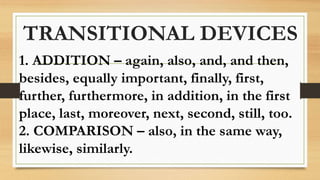
TRANSITIONAL DEVICES
1. ADDITION – again, also, and, and then,
besides, equally important, finally, first,
further, furthermore, in addition, in the first
place, last, moreover, next, second, still, too.
2. COMPARISON – also, in the same way,
likewise, similarly.
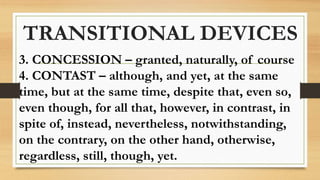
TRANSITIONAL DEVICES
3. CONCESSION – granted, naturally, of course
4. CONTAST – although, and yet, at the same
time, but at the same time, despite that, even so,
even though, for all that, however, in contrast, in
spite of, instead, nevertheless, notwithstanding,
on the contrary, on the other hand, otherwise,
regardless, still, though, yet.
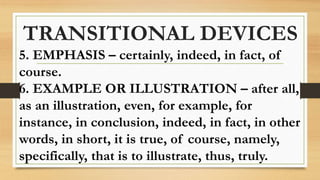
TRANSITIONAL DEVICES
5. EMPHASIS – certainly, indeed, in fact, of
course.
6. EXAMPLE OR ILLUSTRATION – after all,
as an illustration, even, for example, for
instance, in conclusion, indeed, in fact, in other
words, in short, it is true, of course, namely,
specifically, that is to illustrate, thus, truly.
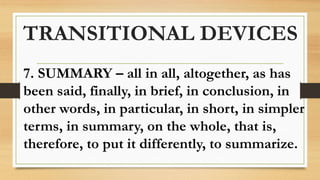
TRANSITIONAL DEVICES
7. SUMMARY – all in all, altogether, as has
been said, finally, in brief, in conclusion, in
other words, in particular, in short, in simpler
terms, in summary, on the whole, that is,
therefore, to put it differently, to summarize.
TRANSITIONAL DEVICES
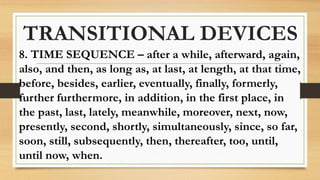
8. TIME SEQUENCE – after a while, afterward, again,
also, and then, as long as, at last, at length, at that time,
before, besides, earlier, eventually, finally, formerly,
further furthermore, in addition, in the first place, in
the past, last, lately, meanwhile, moreover, next, now,
presently, second, shortly, simultaneously, since, so far,
soon, still, subsequently, then, thereafter, too, until,
until now, when.
3. LANGUAGE
 As a writer, it is important not only to think
about what you say, but how you say it. In
order to choose the most effective language,
the writer must consider the objective of
the document, the context in which it is
being written, and who will be reading it.
3. LANGUAGE
 Appropriate language increases one’s
credibility, strengthens his argument and
keeps his audience.
 The overview of the different aspects of
using appropriate language is presented on
the next slides.
1. LEVELS OF FORMALITY
- Writing in a style that your audience expects
and that fits your purpose is key to successful
writing.
2. IN-GROUP JARGON
- Only use in-group jargon when you are
writing for members of that group. You should
never use jargon for a general audience without
first explaining it.
3. SLANG AND IDIOMATIC EXPRESSIONS
- Avoid using slang or idiomatic expressions
in general academic writing.
4. DECEITFUL LANGUAGE AND
EUPHEMISMS
- Avoid using euphemisms (words that veil
the truth, such as ‘collateral damage’) and other
deceitful language.
5. BIASED LANGUAGE
- Avoid using any biased language including
language with a racial, ethnic, group, or gender
bias or language that is stereotypical.
THE SIX
CHARACTERISTICS
OF EFFECTIVE
LANGUAGE
1. CONCRETE AND SPECIFIC
LANGUAGE
- Concrete language includes
descriptions which creates tangible images
with details the reader can visualize. Abstract
Language is vague and obscure, and does
not bring to mind specific visual images.
EXAMPLES:
He is a bad roommate.
He is lazy and discourteous.
He is untidy and unclean.
He doesn’t clean up his own messes.
He leaves his dirty dishes on the kitchen
counter.
2. CONCISE LANGUAGE
- A hallmark of effective writers is the
ability to express the desired message in as
few words as possible. Good writers, in other
words, use language which is straightforward
and to-the-point. Consider the following
examples:
1. It is widely discussed by employees that many of
them will be forced to change jobs and take on new
responsibilities when the merger takes place between
two companies.
2. Before making a decision about whether the person
on trial is guilty or innocent in this case, the members
of the jury should be sure to carefully think about,
ponder and reflect on all of the important and relevant
testimonies in the case.
3. FAMILIAR LANGUAGE
- familiar language is that which the
readers easily recognize and understand
because they use it on a regular basis.
 One of the most important functions of
language is to build homophily or a sense
of commonality with one’s readers.
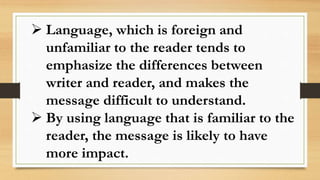
 Language, which is foreign and
unfamiliar to the reader tends to
emphasize the differences between
writer and reader, and makes the
message difficult to understand.
 By using language that is familiar to the
reader, the message is likely to have
more impact.
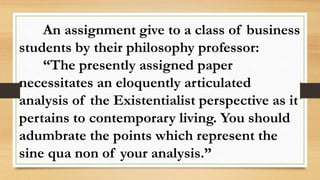
An assignment give to a class of business
students by their philosophy professor:
“The presently assigned paper
necessitates an eloquently articulated
analysis of the Existentialist perspective as it
pertains to contemporary living. You should
adumbrate the points which represent the
sine qua non of your analysis.”
A letter sent to high school students
warning them of the risks of an unhealthy diet:
“Individuals who maintain a diet of high fat
content are exposed to an increased risk of
developing Atherosclerosis, which is a buildup of
fat deposits on the inner walls of the arteries. This
condition can reduce or cut off the flow of blood
in the arteries serving the major organs of the
body. This can lead to poor health.”
4. PRECISE AND CLEAR LANGUAGE
- the use of appropriate language is a
tricky matter because the meaning of words
is relative and situational. The more precise
and clear one’s use if language becomes, the
fewer the number of possible interpretations
for a message. Clarity decreases the potential
misinterpretations.
5. CONSTRUCTIVE LANGUAGE
- constructive language phrases a
potentially negative message in a positive
way, whereas destructive language directs
blame and criticism toward the reader,
creating defensiveness.
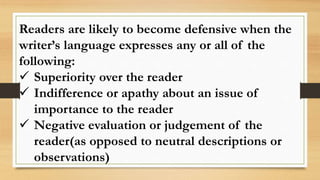
Readers are likely to become defensive when the
writer’s language expresses any or all of the
following:
 Superiority over the reader
 Indifference or apathy about an issue of
importance to the reader
 Negative evaluation or judgement of the
reader(as opposed to neutral descriptions or
observations)
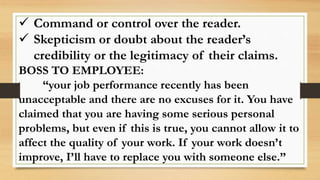
 Command or control over the reader.
 Skepticism or doubt about the reader’s
credibility or the legitimacy of their claims.
BOSS TO EMPLOYEE:
“your job performance recently has been
unacceptable and there are no excuses for it. You have
claimed that you are having some serious personal
problems, but even if this is true, you cannot allow it to
affect the quality of your work. If your work doesn’t
improve, I’ll have to replace you with someone else.”
6. FORMALITY OF LANGUAGE
- The formality of the language one uses
should match the formality of the situation
and the relationship between the writer and
the reader.
VERY FORMAL:
Exceedingly large segments of the
population are expressing their discontent
with medical practitioners who appear to be
more engrossed in amassing financial assets
than in providing efficacious care to people
with health disorders.
FORMAL:
A large number of consumers are
complaining about medical doctors who are
apparently more interested in making money
than I providing effective health care.
INFORMAL:
A lot of people are unhappy with their
doctors who only seem to care about how
much money they make, and not about
giving their patients good care.
4. MECHANICS
Mechanics describe the technical aspects of
writing. It specifies the established conventions
for words that you use – spelling, punctuation,
capitalization etc. A piece if writing must look
worth reading such that it is not hard to figure
out what you are trying to say.
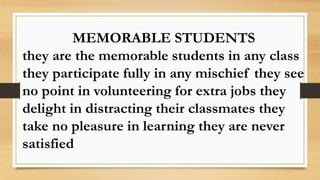
MEMORABLE STUDENTS
they are the memorable students in any class
they participate fully in any mischief they see
no point in volunteering for extra jobs they
delight in distracting their classmates they
take no pleasure in learning they are never
satisfied
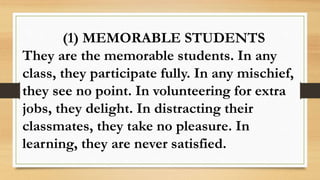
(1) MEMORABLE STUDENTS
They are the memorable students. In any
class, they participate fully. In any mischief,
they see no point. In volunteering for extra
jobs, they delight. In distracting their
classmates, they take no pleasure. In
learning, they are never satisfied.
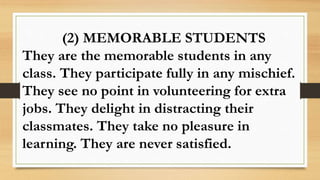
(2) MEMORABLE STUDENTS
They are the memorable students in any
class. They participate fully in any mischief.
They see no point in volunteering for extra
jobs. They delight in distracting their
classmates. They take no pleasure in
learning. They are never satisfied.
USING CRITICAL
READING FOR
THINKING AND
REASONING
We read everyday. From day in to day
out, consciously or unconsciously, we
grab or check any written material, read
it to satisfy our certain needs. But are we
convinced that this act leads us to look
for, analyze and evaluate a text/context?
Deborah Knott 2012 of New College
Writing Centre expressed in writing that
as a reader, you are not a passive
participant, but an active constructor of
meaning.
CRITICAL READING
 is dissecting a reading material.
 It is the art of asking the text, “Why
did it happen? How did it happen?
What should have been done instead,
or be done thereafter?, etc.”
CRITICAL READING
 If this skill is well-developed, nurtured
and enhanced, the reader is obviously
challenged to reason out and justify
for her thoughts, ideas and decisions.
Some authorities share their piece of
knowledge about the significance of
reading and ways how to develop
thinking and reasoning.
Baraceros (2005) expressed that
critical reading is necessary for the
students to know how to examine
critically what they see, feel and read to
be able to make good judgement or
decisions for the welfare of their
countrymen.
Anthony Shadid 2012, a journalist,
articulated that to non-critical readers,
many texts offer the truth, and nothing
but the truth. To the critical reader, any
single text provides but one portrayal of
the facts, on individual’s “take” on the
subject.
Kurland (2010) noted that to non-
critical readers, texts provide facts.
Readers gain knowledge by memorizing
the statements within a text. Critical
readers thus recognize not only what the
text says, but also how that text portrays
the subject matter.
According to him, there are three steps or modes
of analysis which are reflected in three types of
reading and discussion:
What a text says – restatements (talks about the
same topic as the original text)
What a text does – description (discussion
aspects of discussion itself)
What a text means – interpretation (analyzes the
text and asserts a meaning for the text as a whole.
SOME
TECHNIQUES TO
DEVELOP
A. THINKING
It is the act of constructing and
deconstructing ideas in both spoken and written
form based on a given context.
1. Check and analyze the title. Read further how
it is developed and/or argued in the succeeding
statement.
2. Identify the aim of the text. Make initial
arguments about its context.
3. Skim the reading material and give focus on
the entire body. Identify what might have caused
certain issues/situations and offer feasible
solutions.
4. Make some relevant associations of the text to
your life. In the course of making connections,
the reader may either be sympathetic or apathetic
depending on the experiences he/she may have
had which are relevant to the text.
5. Evaluate the reading material. Ascertain if the
entire text calls for a debate and eventually come
up with a sound decision/judgement.
B. REASONING
It is the process of expressing ideas and
opinions as well as justifying a stand based on
prior and existing knowledge and experiences
needed to arrive at a decision.
1. Dare to read everyday. Citing relevant ideas of
experts and authorities in reading materials
definitely help strengthen one’s stance of an
issue.
2. Learn to focus to the main ideas (explicit or
implied) and supporting details mentioned in the
argument.
3. Examine the pros and cons of your
argument/resolution. This will help you weave
the flow of your thoughts presented.
4. Organize your thoughts. Arrange ideas either in
chronological order or by emphasis (general to
specific or vice versa). Once organized, oral or
written expression becomes meaningful.
5. Note points for improvement. After having
justified an issue, recheck your stand based on your
power to convince the reader/audience. Moreover,
practice, practice so that you become conscious of
becoming better every time you reason out.
EVALUATION GUIDE
FOR CRITICAL
READING
ELEMENTS
FOR
EVALUATION
EXPLANATION GUIDE
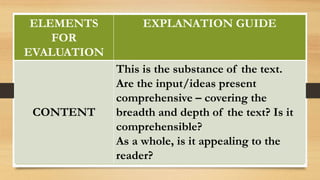
CONTENT
This is the substance of the text.
Are the input/ideas present
comprehensive – covering the
breadth and depth of the text? Is it
comprehensible?
As a whole, is it appealing to the
reader?
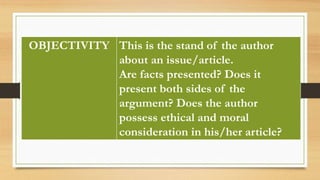
OBJECTIVITY This is the stand of the author
about an issue/article.
Are facts presented? Does it
present both sides of the
argument? Does the author
possess ethical and moral
consideration in his/her article?
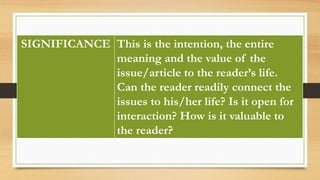
SIGNIFICANCE This is the intention, the entire
meaning and the value of the
issue/article to the reader’s life.
Can the reader readily connect the
issues to his/her life? Is it open for
interaction? How is it valuable to
the reader?
IDENTIFYING
EXPLICIT AND
IMPLICIT CLAIM
IN A TEXT
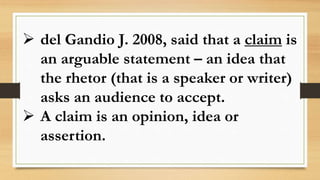
 del Gandio J. 2008, said that a claim is
an arguable statement – an idea that
the rhetor (that is a speaker or writer)
asks an audience to accept.
 A claim is an opinion, idea or
assertion.
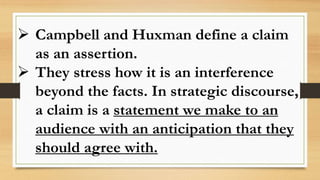
 Campbell and Huxman define a claim
as an assertion.
 They stress how it is an interference
beyond the facts. In strategic discourse,
a claim is a statement we make to an
audience with an anticipation that they
should agree with.
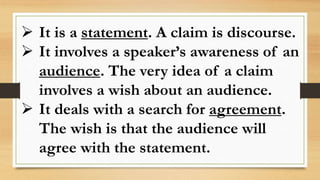
 It is a statement. A claim is discourse.
 It involves a speaker’s awareness of an
audience. The very idea of a claim
involves a wish about an audience.
 It deals with a search for agreement.
The wish is that the audience will
agree with the statement.
 It involves anticipation. To anticipate
the audience’s agreement means we
look hopefully to it, but we are anxious
that they may not give it.
 A claim thus forwards a statement that
we worry the audience will not agree
to, but wish them to agree to.
TYPES OF
CLAIMS
A. CLAIM OF FACT: A claim asserts
some empirical truth.
• Something that can be determined by careful
observation of past, present or future.
• Generally, the truth of the assertion will be
determined by events. But the speaker will
offer information or explanation that predicts
or characterizes the events.
• Claims of facts are those we think about rightly
as being true or false. Of course, sometimes
we cannot prove something true or false but we
have to say “How likely is it that it is true?”
But the reasons we give are the reasons we
believe the statement is true or false.
• Argument usually turns on strength of
evidence presented as reason for arguer’s
belief in the claim.
CLAIM OF FACT
Examples:
1. Research studies are conducted to
improve human condition.
2. Climate Change has already become
an issue in the country.
3. Success of teaching depends upon the
creativity of the teacher.
B. CLAIM OF JUDGEMENT OR
VALUE: A claim asserts a judgement of
some sort.
• Look for keywords that are matter of
judgement rather than fact: good, well, kind,
useful, desirable, etc.
• A claim is based on things we like or dislike.
Thus it deals with goals, with things we find
attractive.
• Speakers provide the reasoning for their
judgement, but ultimately, it is assent to the
reasons rather than comparison to fact that
determines the agreement to the claim.
• argument usually turns on whether the
underlying value of the claim is accepted as a
public good.
• Your feel for the argument by judgement or
value has to be different than that of fact.
Disagreements over values are not “wrong” I
the sense that they are inaccurate. Rather, they
turn on what is important to us and how the
things that are important to us to bear on a
situation.
Examples:
1. Musical comedy is the best form of
entertainment.
2. Staying with the family with a limited
income is more valuable than being away
earning a lot.
3. Communication is better than
computation.
A. ACTION OR POLICY: A claim
asserts that an action should be taken.
• Be sensitive to calls that some action be
taken.
• Look for keywords “should” or “ought”.
These words may not always be present, but
if they are, actions are usually called for.
• Decisions about whether we should take an
action or not are the most complex of
arguments. They turn on many claims about
what happens if we do take an action or what
happens if we fail to act.
• Arguments usually turns on whether the
reasons for taking the action outweigh the
possible costs of taking the action.
Examples:
1. fetal tissue should be banned in any
research undertaking.
2. the government should continue to
offer scholarship program especially to the
poor but bright students.
3. gender equality needs to be
strengthened in the academe.
USING
CONTEXT IN
TEXT
DEVELOPMENT
INTERTEXTUALITY
•Depends on a system of limitations in our freedom
of choice, of exclusions, since it is by renouncing
incompatible associations within the text that we
come to identify in the intertext their compatible
counterparts.
•- Michael Riffaterre (2010)
• He further states that this intertextuality is
the complete opposite of hypertextuality
because the former builds a “structured
network” of limits that will keep the
reader on track (towards the “correct”
interpretation), the latter is a “loose web
of free association”.
• Intertextuality is a literary device that
creates an ‘interrelationship between texts’
and generates related understanding in
separate works. These references are made
to influence that reader and add layers of
depth to a text, based on the reader’s prior
knowledge and understanding.
• Intertextuality is a literary discourse
strategy utilized in writers in novels,
poetry, theatre and even in non-written
texts.
• For example an author’s borrowing and
transformation of a prior text, and a
reader’s referencing of one text in reading
another.
HYPERTEXTUALITY
•Is simply a non-linear way of presenting
information. Rather than reading or learning about
things in the order that an author, or editor, or
publisher sets out for us, readers of hypertext may
follow their own path, create their own order—
their own meaning out the material.
•- K. Amaral, 2010
• This is accomplished by creating “links”
between information. These links are
provided so that readers may ‘jump’ to
further information about a specific topic
being discussed.
• Hypertext is particularly useful as a way to
introduce computer-mediated dialogic
interaction in any writing class because it
can be applied in much the same way in
non-networked classes and non-
networked classes alike.
FORMULATING
EVALUATIVE
STATEMENTS
• Evaluation refers to the making of a
value judgement.
• Making value judgement involves the use
of certain criteria against which we
determine whether something is good or
bad, strong or weak, beautiful or ugly etc..
• Bunnin and Yu (2004) disclosed that n
philosophy of language and ethics, some
philosophers suggest that we distinguish
between two kinds of meaning of
expressions.
• Descriptive meaning contributes to a
bare presentation of facts, as in the claim
“This strawberry is sweet.”
• Evaluative meaning functions in a
different way by offering an assessment, as
in the claim “This strawberry is good.”
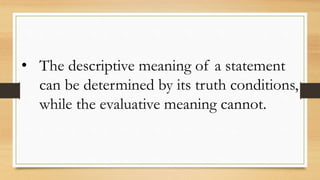
• The descriptive meaning of a statement
can be determined by its truth conditions,
while the evaluative meaning cannot.
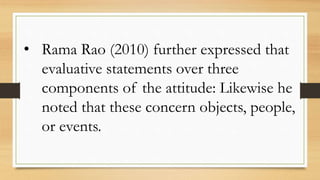
• Rama Rao (2010) further expressed that
evaluative statements over three
components of the attitude: Likewise he
noted that these concern objects, people,
or events.
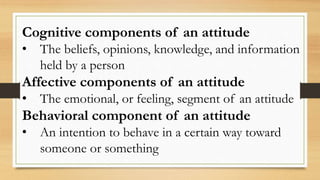
Cognitive components of an attitude
• The beliefs, opinions, knowledge, and information
held by a person
Affective components of an attitude
• The emotional, or feeling, segment of an attitude
Behavioral component of an attitude
• An intention to behave in a certain way toward
someone or something
The following will help you formulate
evaluative statements:
1. Examine the entire text. Scan the part you
find significant. Jot down notes/reasons what
made it significant.
2. Trace reliable evidence to support your
views and feelings.
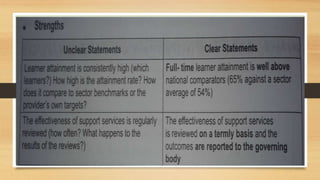
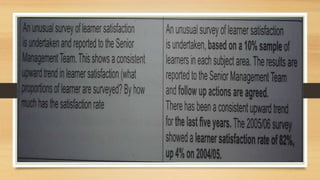
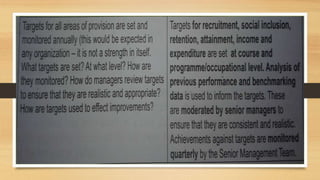
3. Have a copy of the strengths and
weaknesses. Once organized, counter check
the statements.
4. Evaluate whether or not your output
covers the essential elements and it worthy
for sharing with the other readers.
5. Look back and reflect on the activity you
have just accomplished.
DETERMINING
TEXTUAL
EVIDENCE
• In the process of evaluating statements,
the reader tends to assert his/her point for
emphasis or simply put, his/her claims.
Well-thought-of assertions lead to a
meaningful engagement of a reader to a
written text.
Assertion is a stylistic approach or technique
involving a strong declaration, a forceful or
confident and positive statement regarding a
belief or a fact. Often, it is without a proof
or any support. Its purpose is to express
ideas or feelings directly.
TYPES OF
ASSERTION
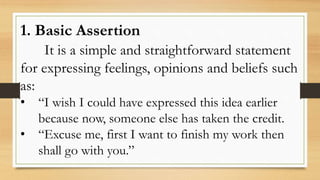
1. Basic Assertion
It is a simple and straightforward statement
for expressing feelings, opinions and beliefs such
as:
• “I wish I could have expressed this idea earlier
because now, someone else has taken the credit.
• “Excuse me, first I want to finish my work then
shall go with you.”
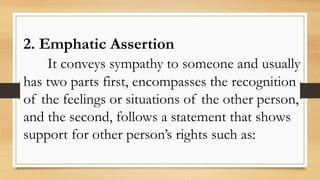
2. Emphatic Assertion
It conveys sympathy to someone and usually
has two parts first, encompasses the recognition
of the feelings or situations of the other person,
and the second, follows a statement that shows
support for other person’s rights such as:
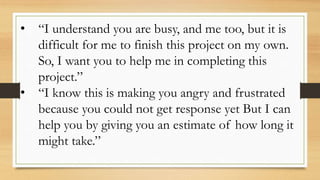
• “I understand you are busy, and me too, but it is
difficult for me to finish this project on my own.
So, I want you to help me in completing this
project.”
• “I know this is making you angry and frustrated
because you could not get response yet But I can
help you by giving you an estimate of how long it
might take.”
3. Escalating Assertion
It occurs when someone is not able to give
response to basic assertions of a person and,
therefore, that person becomes form about him/her
such as:
• “If you do not finish this work at 6:00 tonight, I
would better take the services of another worker.”
• “I really want to finish this point before you start
yours.”
4. Language Assertion
It involves “I” language and is useful for
expressing negative feelings. Nevertheless, it
constructively lays emphasis on a person’s
feelings of anger such as:
• “When you speak harshly, I cannot work with
you because I feel annoyed. Therefore, I want
you to speak gently and then assign me task.
• “When I cannot take proper sleep, it affects my
nerves and I feel irritation. Therefore I like to go
to bed earlier.”
CLAIM
AND
COUNTERCLAIM
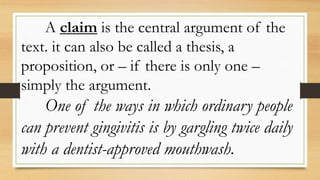
A claim is the central argument of the
text. it can also be called a thesis, a
proposition, or – if there is only one –
simply the argument.
One of the ways in which ordinary people
can prevent gingivitis is by gargling twice daily
with a dentist-approved mouthwash.
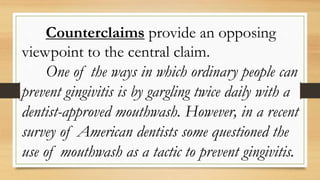
Counterclaims provide an opposing
viewpoint to the central claim.
One of the ways in which ordinary people can
prevent gingivitis is by gargling twice daily with a
dentist-approved mouthwash. However, in a recent
survey of American dentists some questioned the
use of mouthwash as a tactic to prevent gingivitis.

Applying-Properties-of-a-Well-Written-Text.pptx

  • 1.
  • 2.
    The organization ofideas is invariability one of the aspects in writing which is often highly valued. A well-written text is built around effective paragraphing, on coherence and on established conventions.
  • 3.
    A well-organized pieceof writing is not only clear but also logical and aesthetic. Existence of organizational markers and coherent flow of ideas are typically the focus in evaluation of writing.
  • 4.
    FOUR FUNDAMENTAL PROPERTIES OFA WELL-WRITTEN TEXT
  • 5.
    1. ORGANIZATION  Strongorganization constitutes proper paragraphing and logical order of presentation of ideas.  Ostrom (1978) averred that it is a way of making visible to the reader the stages in writer’s thinking.
  • 6.
    1. ORGANIZATION  Paragraphingis dividing a text into paragraphs.  The unity and coherence of ideas among sentences is what makes the paragraph.  It is essentially a unit of thought not of length.
  • 7.
    1. ORGANIZATION  Blakesleyand Hoogeveen (2008) in the Thomsom Handbook, shed light on the nature of rethorical situation.
  • 8.
    1. ORGANIZATION  Tothem, the form, length, style and positioning of paragraphs will vary, depending on the nature and conventions of the medium (print or digital), the interface (size and type of paper, screen resolution and size), and the genre.
  • 9.
    1. ORGANIZATION “In short,the rethorical situation should always guide your use of paragraphing. When you understand the paragraph conventions, your audience and purpose, your rethorical situation, your writing’s subject matter, you will be in the best position to decide how to use paragraphs strategically and effectively to teach, delight, or persuade with your writing.”
  • 10.
    THERE ARE BASICSTO A WELL- ORGANIZED PARAGRAPHS  First, each paragraph must be built around a single idea termed as the controlling idea.  Next, create a topic sentence which is generally written as opening sentence of the paragraph.
  • 11.
    THERE ARE BASICSTO A WELL- ORGANIZED PARAGRAPHS  Then, an appropriate technique from a variety of ways of developing a paragraph must be employed to develop the topic sentence/key idea.
  • 12.
    THERE ARE BASICSTO A WELL- ORGANIZED PARAGRAPHS  Finally, in order to achieve unity, appropriate connectives between and within paragraphs must be used.  The formula of STTC (single idea, topic sentence, appropriate technique and connectives) makes a well-structured paragraph.
  • 13.
    2. COHERENCE ANDCOHESION  Coherence and cohesion are two basic features that facilitate textual continuity.  The two terms are connected but cannot be used interchangeably.
  • 14.
    COHERENCE Refers to therhetorical aspects of your writing, which include developing your argument, synthesizing and integrating readings, organizing and clarifying ideas. It means the overall understandability of what you write or say. COHESION Cohesion of writing is focused on the grammatical aspects of writing. Refers to the degree to which sentences (or even different parts of one sentence) are connected so that the flow of ideas is easily to follow.
  • 15.
    COHERENCE Coherence is basedmore on logic of the ideas and how they are presented rather than on the language that is used to express these ideas. COHESION Cohesion has nothing to do with the content but rather on whether the paragraph has well connected or merely a group of unrelated sentences. Is serves as the glue that holds the structure together. Good cohesion leads to good coherence.
  • 16.
    TRANSITIONAL DEVICES 1. ADDITION– again, also, and, and then, besides, equally important, finally, first, further, furthermore, in addition, in the first place, last, moreover, next, second, still, too. 2. COMPARISON – also, in the same way, likewise, similarly.
  • 17.
    TRANSITIONAL DEVICES 3. CONCESSION– granted, naturally, of course 4. CONTAST – although, and yet, at the same time, but at the same time, despite that, even so, even though, for all that, however, in contrast, in spite of, instead, nevertheless, notwithstanding, on the contrary, on the other hand, otherwise, regardless, still, though, yet.
  • 18.
    TRANSITIONAL DEVICES 5. EMPHASIS– certainly, indeed, in fact, of course. 6. EXAMPLE OR ILLUSTRATION – after all, as an illustration, even, for example, for instance, in conclusion, indeed, in fact, in other words, in short, it is true, of course, namely, specifically, that is to illustrate, thus, truly.
  • 19.
    TRANSITIONAL DEVICES 7. SUMMARY– all in all, altogether, as has been said, finally, in brief, in conclusion, in other words, in particular, in short, in simpler terms, in summary, on the whole, that is, therefore, to put it differently, to summarize.
  • 20.
    TRANSITIONAL DEVICES 8. TIMESEQUENCE – after a while, afterward, again, also, and then, as long as, at last, at length, at that time, before, besides, earlier, eventually, finally, formerly, further furthermore, in addition, in the first place, in the past, last, lately, meanwhile, moreover, next, now, presently, second, shortly, simultaneously, since, so far, soon, still, subsequently, then, thereafter, too, until, until now, when.
  • 21.
    3. LANGUAGE  Asa writer, it is important not only to think about what you say, but how you say it. In order to choose the most effective language, the writer must consider the objective of the document, the context in which it is being written, and who will be reading it.
  • 22.
    3. LANGUAGE  Appropriatelanguage increases one’s credibility, strengthens his argument and keeps his audience.  The overview of the different aspects of using appropriate language is presented on the next slides.
  • 23.
    1. LEVELS OFFORMALITY - Writing in a style that your audience expects and that fits your purpose is key to successful writing. 2. IN-GROUP JARGON - Only use in-group jargon when you are writing for members of that group. You should never use jargon for a general audience without first explaining it.
  • 24.
    3. SLANG ANDIDIOMATIC EXPRESSIONS - Avoid using slang or idiomatic expressions in general academic writing. 4. DECEITFUL LANGUAGE AND EUPHEMISMS - Avoid using euphemisms (words that veil the truth, such as ‘collateral damage’) and other deceitful language.
  • 25.
    5. BIASED LANGUAGE -Avoid using any biased language including language with a racial, ethnic, group, or gender bias or language that is stereotypical.
  • 26.
  • 27.
    1. CONCRETE ANDSPECIFIC LANGUAGE - Concrete language includes descriptions which creates tangible images with details the reader can visualize. Abstract Language is vague and obscure, and does not bring to mind specific visual images.
  • 28.
    EXAMPLES: He is abad roommate. He is lazy and discourteous. He is untidy and unclean. He doesn’t clean up his own messes. He leaves his dirty dishes on the kitchen counter.
  • 29.
    2. CONCISE LANGUAGE -A hallmark of effective writers is the ability to express the desired message in as few words as possible. Good writers, in other words, use language which is straightforward and to-the-point. Consider the following examples:
  • 30.
    1. It iswidely discussed by employees that many of them will be forced to change jobs and take on new responsibilities when the merger takes place between two companies. 2. Before making a decision about whether the person on trial is guilty or innocent in this case, the members of the jury should be sure to carefully think about, ponder and reflect on all of the important and relevant testimonies in the case.
  • 31.
    3. FAMILIAR LANGUAGE -familiar language is that which the readers easily recognize and understand because they use it on a regular basis.  One of the most important functions of language is to build homophily or a sense of commonality with one’s readers.
  • 32.
     Language, whichis foreign and unfamiliar to the reader tends to emphasize the differences between writer and reader, and makes the message difficult to understand.  By using language that is familiar to the reader, the message is likely to have more impact.
  • 33.
    An assignment giveto a class of business students by their philosophy professor: “The presently assigned paper necessitates an eloquently articulated analysis of the Existentialist perspective as it pertains to contemporary living. You should adumbrate the points which represent the sine qua non of your analysis.”
  • 34.
    A letter sentto high school students warning them of the risks of an unhealthy diet: “Individuals who maintain a diet of high fat content are exposed to an increased risk of developing Atherosclerosis, which is a buildup of fat deposits on the inner walls of the arteries. This condition can reduce or cut off the flow of blood in the arteries serving the major organs of the body. This can lead to poor health.”
  • 35.
    4. PRECISE ANDCLEAR LANGUAGE - the use of appropriate language is a tricky matter because the meaning of words is relative and situational. The more precise and clear one’s use if language becomes, the fewer the number of possible interpretations for a message. Clarity decreases the potential misinterpretations.
  • 36.
    5. CONSTRUCTIVE LANGUAGE -constructive language phrases a potentially negative message in a positive way, whereas destructive language directs blame and criticism toward the reader, creating defensiveness.
  • 37.
    Readers are likelyto become defensive when the writer’s language expresses any or all of the following:  Superiority over the reader  Indifference or apathy about an issue of importance to the reader  Negative evaluation or judgement of the reader(as opposed to neutral descriptions or observations)
  • 38.
     Command orcontrol over the reader.  Skepticism or doubt about the reader’s credibility or the legitimacy of their claims. BOSS TO EMPLOYEE: “your job performance recently has been unacceptable and there are no excuses for it. You have claimed that you are having some serious personal problems, but even if this is true, you cannot allow it to affect the quality of your work. If your work doesn’t improve, I’ll have to replace you with someone else.”
  • 39.
    6. FORMALITY OFLANGUAGE - The formality of the language one uses should match the formality of the situation and the relationship between the writer and the reader.
  • 40.
    VERY FORMAL: Exceedingly largesegments of the population are expressing their discontent with medical practitioners who appear to be more engrossed in amassing financial assets than in providing efficacious care to people with health disorders.
  • 41.
    FORMAL: A large numberof consumers are complaining about medical doctors who are apparently more interested in making money than I providing effective health care.
  • 42.
    INFORMAL: A lot ofpeople are unhappy with their doctors who only seem to care about how much money they make, and not about giving their patients good care.
  • 43.
    4. MECHANICS Mechanics describethe technical aspects of writing. It specifies the established conventions for words that you use – spelling, punctuation, capitalization etc. A piece if writing must look worth reading such that it is not hard to figure out what you are trying to say.
  • 44.
    MEMORABLE STUDENTS they arethe memorable students in any class they participate fully in any mischief they see no point in volunteering for extra jobs they delight in distracting their classmates they take no pleasure in learning they are never satisfied
  • 45.
    (1) MEMORABLE STUDENTS Theyare the memorable students. In any class, they participate fully. In any mischief, they see no point. In volunteering for extra jobs, they delight. In distracting their classmates, they take no pleasure. In learning, they are never satisfied.
  • 46.
    (2) MEMORABLE STUDENTS Theyare the memorable students in any class. They participate fully in any mischief. They see no point in volunteering for extra jobs. They delight in distracting their classmates. They take no pleasure in learning. They are never satisfied.
  • 47.
  • 48.
    We read everyday.From day in to day out, consciously or unconsciously, we grab or check any written material, read it to satisfy our certain needs. But are we convinced that this act leads us to look for, analyze and evaluate a text/context?
  • 49.
    Deborah Knott 2012of New College Writing Centre expressed in writing that as a reader, you are not a passive participant, but an active constructor of meaning.
  • 50.
    CRITICAL READING  isdissecting a reading material.  It is the art of asking the text, “Why did it happen? How did it happen? What should have been done instead, or be done thereafter?, etc.”
  • 51.
    CRITICAL READING  Ifthis skill is well-developed, nurtured and enhanced, the reader is obviously challenged to reason out and justify for her thoughts, ideas and decisions.
  • 52.
    Some authorities sharetheir piece of knowledge about the significance of reading and ways how to develop thinking and reasoning.
  • 53.
    Baraceros (2005) expressedthat critical reading is necessary for the students to know how to examine critically what they see, feel and read to be able to make good judgement or decisions for the welfare of their countrymen.
  • 54.
    Anthony Shadid 2012,a journalist, articulated that to non-critical readers, many texts offer the truth, and nothing but the truth. To the critical reader, any single text provides but one portrayal of the facts, on individual’s “take” on the subject.
  • 55.
    Kurland (2010) notedthat to non- critical readers, texts provide facts. Readers gain knowledge by memorizing the statements within a text. Critical readers thus recognize not only what the text says, but also how that text portrays the subject matter.
  • 56.
    According to him,there are three steps or modes of analysis which are reflected in three types of reading and discussion: What a text says – restatements (talks about the same topic as the original text) What a text does – description (discussion aspects of discussion itself) What a text means – interpretation (analyzes the text and asserts a meaning for the text as a whole.
  • 57.
  • 58.
    A. THINKING It isthe act of constructing and deconstructing ideas in both spoken and written form based on a given context. 1. Check and analyze the title. Read further how it is developed and/or argued in the succeeding statement. 2. Identify the aim of the text. Make initial arguments about its context.
  • 59.
    3. Skim thereading material and give focus on the entire body. Identify what might have caused certain issues/situations and offer feasible solutions. 4. Make some relevant associations of the text to your life. In the course of making connections, the reader may either be sympathetic or apathetic depending on the experiences he/she may have had which are relevant to the text.
  • 60.
    5. Evaluate thereading material. Ascertain if the entire text calls for a debate and eventually come up with a sound decision/judgement.
  • 61.
    B. REASONING It isthe process of expressing ideas and opinions as well as justifying a stand based on prior and existing knowledge and experiences needed to arrive at a decision. 1. Dare to read everyday. Citing relevant ideas of experts and authorities in reading materials definitely help strengthen one’s stance of an issue.
  • 62.
    2. Learn tofocus to the main ideas (explicit or implied) and supporting details mentioned in the argument. 3. Examine the pros and cons of your argument/resolution. This will help you weave the flow of your thoughts presented.
  • 63.
    4. Organize yourthoughts. Arrange ideas either in chronological order or by emphasis (general to specific or vice versa). Once organized, oral or written expression becomes meaningful. 5. Note points for improvement. After having justified an issue, recheck your stand based on your power to convince the reader/audience. Moreover, practice, practice so that you become conscious of becoming better every time you reason out.
  • 64.
  • 65.
    ELEMENTS FOR EVALUATION EXPLANATION GUIDE CONTENT This isthe substance of the text. Are the input/ideas present comprehensive – covering the breadth and depth of the text? Is it comprehensible? As a whole, is it appealing to the reader?
  • 66.
    OBJECTIVITY This isthe stand of the author about an issue/article. Are facts presented? Does it present both sides of the argument? Does the author possess ethical and moral consideration in his/her article?
  • 67.
    SIGNIFICANCE This isthe intention, the entire meaning and the value of the issue/article to the reader’s life. Can the reader readily connect the issues to his/her life? Is it open for interaction? How is it valuable to the reader?
  • 68.
  • 69.
     del GandioJ. 2008, said that a claim is an arguable statement – an idea that the rhetor (that is a speaker or writer) asks an audience to accept.  A claim is an opinion, idea or assertion.
  • 70.
     Campbell andHuxman define a claim as an assertion.  They stress how it is an interference beyond the facts. In strategic discourse, a claim is a statement we make to an audience with an anticipation that they should agree with.
  • 71.
     It isa statement. A claim is discourse.  It involves a speaker’s awareness of an audience. The very idea of a claim involves a wish about an audience.  It deals with a search for agreement. The wish is that the audience will agree with the statement.
  • 72.
     It involvesanticipation. To anticipate the audience’s agreement means we look hopefully to it, but we are anxious that they may not give it.  A claim thus forwards a statement that we worry the audience will not agree to, but wish them to agree to.
  • 73.
  • 74.
    A. CLAIM OFFACT: A claim asserts some empirical truth. • Something that can be determined by careful observation of past, present or future. • Generally, the truth of the assertion will be determined by events. But the speaker will offer information or explanation that predicts or characterizes the events.
  • 75.
    • Claims offacts are those we think about rightly as being true or false. Of course, sometimes we cannot prove something true or false but we have to say “How likely is it that it is true?” But the reasons we give are the reasons we believe the statement is true or false. • Argument usually turns on strength of evidence presented as reason for arguer’s belief in the claim.
  • 76.
    CLAIM OF FACT Examples: 1.Research studies are conducted to improve human condition. 2. Climate Change has already become an issue in the country. 3. Success of teaching depends upon the creativity of the teacher.
  • 77.
    B. CLAIM OFJUDGEMENT OR VALUE: A claim asserts a judgement of some sort. • Look for keywords that are matter of judgement rather than fact: good, well, kind, useful, desirable, etc. • A claim is based on things we like or dislike. Thus it deals with goals, with things we find attractive.
  • 78.
    • Speakers providethe reasoning for their judgement, but ultimately, it is assent to the reasons rather than comparison to fact that determines the agreement to the claim. • argument usually turns on whether the underlying value of the claim is accepted as a public good.
  • 79.
    • Your feelfor the argument by judgement or value has to be different than that of fact. Disagreements over values are not “wrong” I the sense that they are inaccurate. Rather, they turn on what is important to us and how the things that are important to us to bear on a situation.
  • 80.
    Examples: 1. Musical comedyis the best form of entertainment. 2. Staying with the family with a limited income is more valuable than being away earning a lot. 3. Communication is better than computation.
  • 81.
    A. ACTION ORPOLICY: A claim asserts that an action should be taken. • Be sensitive to calls that some action be taken. • Look for keywords “should” or “ought”. These words may not always be present, but if they are, actions are usually called for.
  • 82.
    • Decisions aboutwhether we should take an action or not are the most complex of arguments. They turn on many claims about what happens if we do take an action or what happens if we fail to act. • Arguments usually turns on whether the reasons for taking the action outweigh the possible costs of taking the action.
  • 83.
    Examples: 1. fetal tissueshould be banned in any research undertaking. 2. the government should continue to offer scholarship program especially to the poor but bright students. 3. gender equality needs to be strengthened in the academe.
  • 84.
  • 85.
    INTERTEXTUALITY •Depends on asystem of limitations in our freedom of choice, of exclusions, since it is by renouncing incompatible associations within the text that we come to identify in the intertext their compatible counterparts. •- Michael Riffaterre (2010)
  • 86.
    • He furtherstates that this intertextuality is the complete opposite of hypertextuality because the former builds a “structured network” of limits that will keep the reader on track (towards the “correct” interpretation), the latter is a “loose web of free association”.
  • 87.
    • Intertextuality isa literary device that creates an ‘interrelationship between texts’ and generates related understanding in separate works. These references are made to influence that reader and add layers of depth to a text, based on the reader’s prior knowledge and understanding.
  • 88.
    • Intertextuality isa literary discourse strategy utilized in writers in novels, poetry, theatre and even in non-written texts. • For example an author’s borrowing and transformation of a prior text, and a reader’s referencing of one text in reading another.
  • 89.
    HYPERTEXTUALITY •Is simply anon-linear way of presenting information. Rather than reading or learning about things in the order that an author, or editor, or publisher sets out for us, readers of hypertext may follow their own path, create their own order— their own meaning out the material. •- K. Amaral, 2010
  • 90.
    • This isaccomplished by creating “links” between information. These links are provided so that readers may ‘jump’ to further information about a specific topic being discussed.
  • 91.
    • Hypertext isparticularly useful as a way to introduce computer-mediated dialogic interaction in any writing class because it can be applied in much the same way in non-networked classes and non- networked classes alike.
  • 92.
  • 93.
    • Evaluation refersto the making of a value judgement. • Making value judgement involves the use of certain criteria against which we determine whether something is good or bad, strong or weak, beautiful or ugly etc..
  • 94.
    • Bunnin andYu (2004) disclosed that n philosophy of language and ethics, some philosophers suggest that we distinguish between two kinds of meaning of expressions.
  • 95.
    • Descriptive meaningcontributes to a bare presentation of facts, as in the claim “This strawberry is sweet.” • Evaluative meaning functions in a different way by offering an assessment, as in the claim “This strawberry is good.”
  • 96.
    • The descriptivemeaning of a statement can be determined by its truth conditions, while the evaluative meaning cannot.
  • 97.
    • Rama Rao(2010) further expressed that evaluative statements over three components of the attitude: Likewise he noted that these concern objects, people, or events.
  • 98.
    Cognitive components ofan attitude • The beliefs, opinions, knowledge, and information held by a person Affective components of an attitude • The emotional, or feeling, segment of an attitude Behavioral component of an attitude • An intention to behave in a certain way toward someone or something
  • 104.
    The following willhelp you formulate evaluative statements: 1. Examine the entire text. Scan the part you find significant. Jot down notes/reasons what made it significant. 2. Trace reliable evidence to support your views and feelings.
  • 105.
    3. Have acopy of the strengths and weaknesses. Once organized, counter check the statements. 4. Evaluate whether or not your output covers the essential elements and it worthy for sharing with the other readers. 5. Look back and reflect on the activity you have just accomplished.
  • 107.
  • 108.
    • In theprocess of evaluating statements, the reader tends to assert his/her point for emphasis or simply put, his/her claims. Well-thought-of assertions lead to a meaningful engagement of a reader to a written text.
  • 109.
    Assertion is astylistic approach or technique involving a strong declaration, a forceful or confident and positive statement regarding a belief or a fact. Often, it is without a proof or any support. Its purpose is to express ideas or feelings directly.
  • 110.
  • 111.
    1. Basic Assertion Itis a simple and straightforward statement for expressing feelings, opinions and beliefs such as: • “I wish I could have expressed this idea earlier because now, someone else has taken the credit. • “Excuse me, first I want to finish my work then shall go with you.”
  • 112.
    2. Emphatic Assertion Itconveys sympathy to someone and usually has two parts first, encompasses the recognition of the feelings or situations of the other person, and the second, follows a statement that shows support for other person’s rights such as:
  • 113.
    • “I understandyou are busy, and me too, but it is difficult for me to finish this project on my own. So, I want you to help me in completing this project.” • “I know this is making you angry and frustrated because you could not get response yet But I can help you by giving you an estimate of how long it might take.”
  • 114.
    3. Escalating Assertion Itoccurs when someone is not able to give response to basic assertions of a person and, therefore, that person becomes form about him/her such as: • “If you do not finish this work at 6:00 tonight, I would better take the services of another worker.” • “I really want to finish this point before you start yours.”
  • 115.
    4. Language Assertion Itinvolves “I” language and is useful for expressing negative feelings. Nevertheless, it constructively lays emphasis on a person’s feelings of anger such as:
  • 116.
    • “When youspeak harshly, I cannot work with you because I feel annoyed. Therefore, I want you to speak gently and then assign me task. • “When I cannot take proper sleep, it affects my nerves and I feel irritation. Therefore I like to go to bed earlier.”
  • 117.
  • 118.
    A claim isthe central argument of the text. it can also be called a thesis, a proposition, or – if there is only one – simply the argument. One of the ways in which ordinary people can prevent gingivitis is by gargling twice daily with a dentist-approved mouthwash.
  • 119.
    Counterclaims provide anopposing viewpoint to the central claim. One of the ways in which ordinary people can prevent gingivitis is by gargling twice daily with a dentist-approved mouthwash. However, in a recent survey of American dentists some questioned the use of mouthwash as a tactic to prevent gingivitis.