International Research Journal of Engineering and Technology (IRJET) e-ISSN: 2395-0056
Volume: 09 Issue: 10 | Oct 2022 www.irjet.net p-ISSN: 2395-0072
© 2022, IRJET | Impact Factor value: 7.529 | ISO 9001:2008 Certified Journal | Page 1066
LANGUAGE TRANSLATOR APP
BALA HARSHITHAA B
Student, Department of Information Technology, Bannari Amman Institute of technology, Erode, Tamil Nadu,
India
---------------------------------------------------------------------***---------------------------------------------------------------------
Abstract - A language translator is an android application
that can be utilized for translating from one dialect to any
other dialect. There have been difficulties in information
communication between countries over the years. In modern
times, language interpreters must understand and speakboth
the language that is being translated and translated to. The
aim is to develop an android language converter app in order
to make learning and language translation easy andfacilitate
stress-free communication, which can work more efficiently
than other existing applicationswithanoptimizedcodefor the
process of translation. The motto is to implement a lens for
scanning the images instantly and convert them to text and
translate them. Making the app work even in offline mode is
the main objective.
Key Words: Language, Translation, Communication,
Lens, Offline
1. INTRODUCTION
A Translator app is an assistance for translation
which helps people survive in places where the language is
unknown. They can easily input their messageeithervia text
or via speech and can translate it easily into any language.
This can also assist people with difficulty in writing with the
help of speech recognition features. The text in an image can
be captured with a lens and it can be translated into any
language as per the user's choice. I have used a specificset of
codes which process two or more combined user input
modes, such as speech, image. Even for detecting the voice
and for scanning images we used java code to perform the
actions unlike other systems. In our proposed model it
works in both online and offline mode. The proposed model
is the structure of the Next-Generation of voice Assistants.
2. LITERATURE SURVEY
This chapter will discuss article review of our project. The
article review is important because it is used to help the
developer to build the system, so that the developer gets
more knowledge of the pros and cons of the system, which
helps the developer to choose the best way to develop the
system. Research and analysis of an existing system or
current system have to be done in order to build a good
system. Good system always comes after enhancement of
existing systems.
A Practical Guide for Translators, 5th edn, Bristol,
Multilingual Matters by Samuelsson-Brown G in 2020 briefs
about translators and its applications which helped to build
the flow of developing the app effectively
Building a translation competence model by
Amsterdam, John Benjamins in 2021 gave guidance on
building the model
Triangulating Translation: Perspectives in Process
Oriented Research by Amsterdam, John Benjamins in 2021
says about translation and its applications which helped in
implementation of translation more efficiently
Approaches to Translation by Newmark P in 1981
tells how translation works efficiently and guided to
complete the app successfully
The researchhelpedincompletionoftheapplication
and served as a stepping stone for achieving efficiency in
translation of text to text, speech to text, image to text
translation.
3. PROBLEM STATEMENT
Communicating with people at one time when the
user doesn't understand the language spoken by the other
user. By using this app, the user can easily understand what
he/she (other user) is speaking and translating it to the user
who uses the app. They are completely useful for the one
who travels from country to country or from state
to state i.e the one who travels the world. There are many
apps like this but the app which has been developed can
work completely in offline mode. Moreover it can recognise
the text in an image accurately and translate it to the
language as per the user’s choicewhichreducestheeffortsof
the user in typing the text present in anything again in a
translator app.
International Research Journal of Engineering and Technology (IRJET) e-ISSN: 2395-0056
Volume: 09 Issue: 10 | Oct 2022 www.irjet.net p-ISSN: 2395-0072
© 2022, IRJET | Impact Factor value: 7.529 | ISO 9001:2008 Certified Journal | Page 1067
4. REQUIREMENTS
4.1 SOFTWARE REQUIREMENTS
4.2 HARDWARE REQUIREMENTS
4.3 FUNCTIONAL REQUIREMENTS
1. System Admin: Installs translations in the
application.
2. Translator: Updates translations that can then be
used in the application.
3. Developer: Creates windows and customizations
that use a translation
framework to enable a language specific version of the
customization.
4. User: Works with the functionality in the
application and specifies the language
they would like to view the user interface in. Chooses a
language from those that
are active within the application.
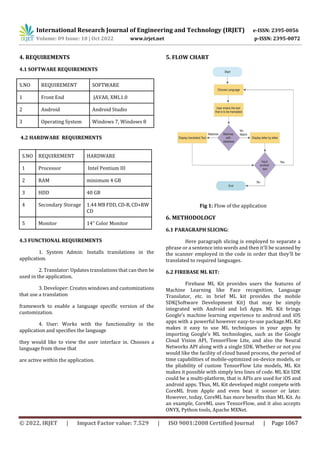
5. FLOW CHART
Fig 1: Flow of the application
6. METHODOLOGY
6.1 PARAGRAPH SLICING:
Here paragraph slicing is employed to separate a
phrase or a sentence into words and then it'll be scanned by
the scanner employed in the code in order that they'll be
translated to required languages.
6.2 FIREBASE ML KIT:
Firebase ML Kit provides users the features of
Machine Learning like Face recognition, Language
Translator, etc. in brief ML kit provides the mobile
SDK(Software Development Kit) that may be simply
integrated with Android and IoS Apps. ML Kit brings
Google’s machine learning experience to android and iOS
apps with a powerful however easy-to-use package.ML Kit
makes it easy to use ML techniques in your apps by
importing Google's ML technologies, such as the Google
Cloud Vision API, TensorFlow Lite, and also the Neural
Networks API along with a single SDK. Whether or not you
would like the facility of cloud based process, the period of
time capabilities of mobile-optimized on-device models, or
the pliability of custom TensorFlow Lite models, ML Kit
makes it possible with simply less lines of code. ML Kit SDK
could be a multi-platform, that is APIs are used for iOS and
android apps. Thus, ML Kit developed might compete with
CoreML from Apple and even beat it sooner or later.
However, today, CoreML has more benefits than ML Kit. As
an example, CoreML uses TensorFlow, and it also accepts
ONYX, Python tools, Apache MXNet.
S.NO REQUIREMENT SOFTWARE
1 Front End JAVA8, XML1.0
2 Android Android Studio
3 Operating System Windows 7, Windows 8
S.NO REQUIREMENT HARDWARE
1 Processor Intel Pentium III
2 RAM minimum 4 GB
3 HDD 40 GB
4 Secondary Storage 1.44 MB FDD,CD-R,CD+RW
CD
5 Monitor 14” Color Monitor
International Research Journal of Engineering and Technology (IRJET) e-ISSN: 2395-0056
Volume: 09 Issue: 10 | Oct 2022 www.irjet.net p-ISSN: 2395-0072
© 2022, IRJET | Impact Factor value: 7.529 | ISO 9001:2008 Certified Journal | Page 1068
7. OUTPUT SCREENSHOTS
7.1 LANGUAGE SELECTION
Fig 3: Language selection Fig 4: Language selection
7.2 TEXT TO TEXT TRANSLATION
Fig 5: Text to text translation
Fig 6: Speech recognition Fig 7: Speech to text
translation
Fig 2: Homepage 7.3 SPEECH TO TEXT TRANSLATION
International Research Journal of Engineering and Technology (IRJET) e-ISSN: 2395-0056
Volume: 09 Issue: 10 | Oct 2022 www.irjet.net p-ISSN: 2395-0072
© 2022, IRJET | Impact Factor value: 7.529 | ISO 9001:2008 Certified Journal | Page 1069
7.4 IMAGE TO TEXT TRANSLATION
Fig 8: Image recognition Fig 9: Image to text
translation
8. CONCLUSIONS
The development of the app comes up with the following
conclusions
 Deliver information in multiple languages
 Improve communication in multiple languages
 Increase human translation productivity
 Create, manage enterprise language as a Corporate
asset
 Integrate with enterprise applications
 Assist people with disability in speech
 Capture image and translate easily
 No requirement of internet connectivity
Further the future work can be taken up on image
recognition for text which are handwritten and also
including an optionforuploadinga documentfortranslation.
REFERENCES
[1] Sim Liew Fong Faculty of Information Sciences and
Engineering, Management and Science University, Shah
Alam, Selangor Darul Ehsan, Malaysia(chapter-8)
[2] Scientific World Journal Volume 2014 (2020), Article ID
267872
[3] Md Gapar bin Md JoharFaculty of Information Sciences
and Engineering, Management and Science University, Shah
Alam, Selangor Darul Ehsan, Malaysia(chapter-8)
[4] Baker, M. (ed.) (2020) Routledge Encyclopedia of
Translation Studies, London, Routledge.
[5] Language Policy Unit, Council of Europe (2019) Common
European Framework of Reference for Languages:Learning,
Teaching, Assessment [Online]. Available at
http://www.coe.int/ t/dg4/ linguistic/source/framework_
en.pdf (Accessed 29 March 2019).
[6] Newmark, P. (1981) Approaches to Translation, Oxford,
Pergamon.
[7] Routes into languages (2019) What is Translating?
[Online]. Available at
http://www.nationalnetworkfortranslation.ac.uk/(Accessed
29 March 2017).
[8] Encyclopedia of Literary Translation into English by
Olive Classe (Editor).

LANGUAGE TRANSLATOR APP

  • 1.
    International Research Journalof Engineering and Technology (IRJET) e-ISSN: 2395-0056 Volume: 09 Issue: 10 | Oct 2022 www.irjet.net p-ISSN: 2395-0072 © 2022, IRJET | Impact Factor value: 7.529 | ISO 9001:2008 Certified Journal | Page 1066 LANGUAGE TRANSLATOR APP BALA HARSHITHAA B Student, Department of Information Technology, Bannari Amman Institute of technology, Erode, Tamil Nadu, India ---------------------------------------------------------------------***--------------------------------------------------------------------- Abstract - A language translator is an android application that can be utilized for translating from one dialect to any other dialect. There have been difficulties in information communication between countries over the years. In modern times, language interpreters must understand and speakboth the language that is being translated and translated to. The aim is to develop an android language converter app in order to make learning and language translation easy andfacilitate stress-free communication, which can work more efficiently than other existing applicationswithanoptimizedcodefor the process of translation. The motto is to implement a lens for scanning the images instantly and convert them to text and translate them. Making the app work even in offline mode is the main objective. Key Words: Language, Translation, Communication, Lens, Offline 1. INTRODUCTION A Translator app is an assistance for translation which helps people survive in places where the language is unknown. They can easily input their messageeithervia text or via speech and can translate it easily into any language. This can also assist people with difficulty in writing with the help of speech recognition features. The text in an image can be captured with a lens and it can be translated into any language as per the user's choice. I have used a specificset of codes which process two or more combined user input modes, such as speech, image. Even for detecting the voice and for scanning images we used java code to perform the actions unlike other systems. In our proposed model it works in both online and offline mode. The proposed model is the structure of the Next-Generation of voice Assistants. 2. LITERATURE SURVEY This chapter will discuss article review of our project. The article review is important because it is used to help the developer to build the system, so that the developer gets more knowledge of the pros and cons of the system, which helps the developer to choose the best way to develop the system. Research and analysis of an existing system or current system have to be done in order to build a good system. Good system always comes after enhancement of existing systems. A Practical Guide for Translators, 5th edn, Bristol, Multilingual Matters by Samuelsson-Brown G in 2020 briefs about translators and its applications which helped to build the flow of developing the app effectively Building a translation competence model by Amsterdam, John Benjamins in 2021 gave guidance on building the model Triangulating Translation: Perspectives in Process Oriented Research by Amsterdam, John Benjamins in 2021 says about translation and its applications which helped in implementation of translation more efficiently Approaches to Translation by Newmark P in 1981 tells how translation works efficiently and guided to complete the app successfully The researchhelpedincompletionoftheapplication and served as a stepping stone for achieving efficiency in translation of text to text, speech to text, image to text translation. 3. PROBLEM STATEMENT Communicating with people at one time when the user doesn't understand the language spoken by the other user. By using this app, the user can easily understand what he/she (other user) is speaking and translating it to the user who uses the app. They are completely useful for the one who travels from country to country or from state to state i.e the one who travels the world. There are many apps like this but the app which has been developed can work completely in offline mode. Moreover it can recognise the text in an image accurately and translate it to the language as per the user’s choicewhichreducestheeffortsof the user in typing the text present in anything again in a translator app.
  • 2.
    International Research Journalof Engineering and Technology (IRJET) e-ISSN: 2395-0056 Volume: 09 Issue: 10 | Oct 2022 www.irjet.net p-ISSN: 2395-0072 © 2022, IRJET | Impact Factor value: 7.529 | ISO 9001:2008 Certified Journal | Page 1067 4. REQUIREMENTS 4.1 SOFTWARE REQUIREMENTS 4.2 HARDWARE REQUIREMENTS 4.3 FUNCTIONAL REQUIREMENTS 1. System Admin: Installs translations in the application. 2. Translator: Updates translations that can then be used in the application. 3. Developer: Creates windows and customizations that use a translation framework to enable a language specific version of the customization. 4. User: Works with the functionality in the application and specifies the language they would like to view the user interface in. Chooses a language from those that are active within the application. 5. FLOW CHART Fig 1: Flow of the application 6. METHODOLOGY 6.1 PARAGRAPH SLICING: Here paragraph slicing is employed to separate a phrase or a sentence into words and then it'll be scanned by the scanner employed in the code in order that they'll be translated to required languages. 6.2 FIREBASE ML KIT: Firebase ML Kit provides users the features of Machine Learning like Face recognition, Language Translator, etc. in brief ML kit provides the mobile SDK(Software Development Kit) that may be simply integrated with Android and IoS Apps. ML Kit brings Google’s machine learning experience to android and iOS apps with a powerful however easy-to-use package.ML Kit makes it easy to use ML techniques in your apps by importing Google's ML technologies, such as the Google Cloud Vision API, TensorFlow Lite, and also the Neural Networks API along with a single SDK. Whether or not you would like the facility of cloud based process, the period of time capabilities of mobile-optimized on-device models, or the pliability of custom TensorFlow Lite models, ML Kit makes it possible with simply less lines of code. ML Kit SDK could be a multi-platform, that is APIs are used for iOS and android apps. Thus, ML Kit developed might compete with CoreML from Apple and even beat it sooner or later. However, today, CoreML has more benefits than ML Kit. As an example, CoreML uses TensorFlow, and it also accepts ONYX, Python tools, Apache MXNet. S.NO REQUIREMENT SOFTWARE 1 Front End JAVA8, XML1.0 2 Android Android Studio 3 Operating System Windows 7, Windows 8 S.NO REQUIREMENT HARDWARE 1 Processor Intel Pentium III 2 RAM minimum 4 GB 3 HDD 40 GB 4 Secondary Storage 1.44 MB FDD,CD-R,CD+RW CD 5 Monitor 14” Color Monitor
  • 3.
    International Research Journalof Engineering and Technology (IRJET) e-ISSN: 2395-0056 Volume: 09 Issue: 10 | Oct 2022 www.irjet.net p-ISSN: 2395-0072 © 2022, IRJET | Impact Factor value: 7.529 | ISO 9001:2008 Certified Journal | Page 1068 7. OUTPUT SCREENSHOTS 7.1 LANGUAGE SELECTION Fig 3: Language selection Fig 4: Language selection 7.2 TEXT TO TEXT TRANSLATION Fig 5: Text to text translation Fig 6: Speech recognition Fig 7: Speech to text translation Fig 2: Homepage 7.3 SPEECH TO TEXT TRANSLATION
  • 4.
    International Research Journalof Engineering and Technology (IRJET) e-ISSN: 2395-0056 Volume: 09 Issue: 10 | Oct 2022 www.irjet.net p-ISSN: 2395-0072 © 2022, IRJET | Impact Factor value: 7.529 | ISO 9001:2008 Certified Journal | Page 1069 7.4 IMAGE TO TEXT TRANSLATION Fig 8: Image recognition Fig 9: Image to text translation 8. CONCLUSIONS The development of the app comes up with the following conclusions  Deliver information in multiple languages  Improve communication in multiple languages  Increase human translation productivity  Create, manage enterprise language as a Corporate asset  Integrate with enterprise applications  Assist people with disability in speech  Capture image and translate easily  No requirement of internet connectivity Further the future work can be taken up on image recognition for text which are handwritten and also including an optionforuploadinga documentfortranslation. REFERENCES [1] Sim Liew Fong Faculty of Information Sciences and Engineering, Management and Science University, Shah Alam, Selangor Darul Ehsan, Malaysia(chapter-8) [2] Scientific World Journal Volume 2014 (2020), Article ID 267872 [3] Md Gapar bin Md JoharFaculty of Information Sciences and Engineering, Management and Science University, Shah Alam, Selangor Darul Ehsan, Malaysia(chapter-8) [4] Baker, M. (ed.) (2020) Routledge Encyclopedia of Translation Studies, London, Routledge. [5] Language Policy Unit, Council of Europe (2019) Common European Framework of Reference for Languages:Learning, Teaching, Assessment [Online]. Available at http://www.coe.int/ t/dg4/ linguistic/source/framework_ en.pdf (Accessed 29 March 2019). [6] Newmark, P. (1981) Approaches to Translation, Oxford, Pergamon. [7] Routes into languages (2019) What is Translating? [Online]. Available at http://www.nationalnetworkfortranslation.ac.uk/(Accessed 29 March 2017). [8] Encyclopedia of Literary Translation into English by Olive Classe (Editor).