Language Teaching Methodology  Alejandro Garcia Daniela Montes
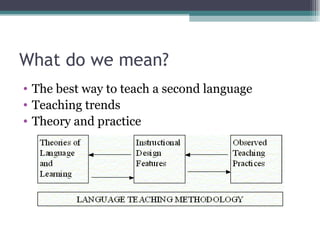
What do we mean? The best way to teach a second language  Teaching trends  Theory and practice
“ Shifting sands” Albert Marckwardt saw these changes as a cyclical pattern in which a new paradigm of LTM emerged every quarter of a century  Each one taking positive elements of the other ALM is the most significant Borrowing elements from: Direct method Breaking away completely from Grammar-Translation Method
“ Shifting sands” Psychologists also found an increase in the interest of interpersonal relationships within the value of group work  The same way happened with linguists who looked for the nature of communication and communicative competence
New trends Communicative competence Collaborative learning Looking to break away from “teaching of rules, patterns, definitions and other knowledge ‘about’  language”  Making students communicate genuinely and spontaneously
Conclusions  Language Teaching Methodologies always change  The new trends invite us to give the student more space to communicate freely  Nowadays many opt for an eclectic approach to teaching
Ready?
1. What do we mean by Language Teaching Methodology? The best way to teach a second language  Teaching trends  Theory and practice
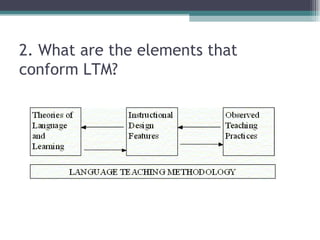
2. What are the elements that conform LTM?
3. How is LTM compared to? Who compared it?  As shifting sands Albert Marckwardt
4. Which method made a significant difference in these “shifting sands”? ALM
5. What are the new trends in teaching?  Communicative competence Collaborative learning Looking to break away from “teaching of rules, patterns, definitions and other knowledge ‘about’  language”  Making students communicate genuinely and spontaneously
References  Principles of Language Learning and Teaching , Brown D., Fourth edition, Longman.  http://www.cal.org/resources/Digest/rodgers.html

Language Teaching Methodology

  • 1.
    Language Teaching Methodology Alejandro Garcia Daniela Montes
  • 2.
    What do wemean? The best way to teach a second language Teaching trends Theory and practice
  • 3.
    “ Shifting sands”Albert Marckwardt saw these changes as a cyclical pattern in which a new paradigm of LTM emerged every quarter of a century Each one taking positive elements of the other ALM is the most significant Borrowing elements from: Direct method Breaking away completely from Grammar-Translation Method
  • 4.
    “ Shifting sands”Psychologists also found an increase in the interest of interpersonal relationships within the value of group work The same way happened with linguists who looked for the nature of communication and communicative competence
  • 5.
    New trends Communicativecompetence Collaborative learning Looking to break away from “teaching of rules, patterns, definitions and other knowledge ‘about’ language” Making students communicate genuinely and spontaneously
  • 6.
    Conclusions LanguageTeaching Methodologies always change The new trends invite us to give the student more space to communicate freely Nowadays many opt for an eclectic approach to teaching
  • 7.
  • 8.
    1. What dowe mean by Language Teaching Methodology? The best way to teach a second language Teaching trends Theory and practice
  • 9.
    2. What arethe elements that conform LTM?
  • 10.
    3. How isLTM compared to? Who compared it? As shifting sands Albert Marckwardt
  • 11.
    4. Which methodmade a significant difference in these “shifting sands”? ALM
  • 12.
    5. What arethe new trends in teaching? Communicative competence Collaborative learning Looking to break away from “teaching of rules, patterns, definitions and other knowledge ‘about’ language” Making students communicate genuinely and spontaneously
  • 13.
    References Principlesof Language Learning and Teaching , Brown D., Fourth edition, Longman. http://www.cal.org/resources/Digest/rodgers.html