New approaches to teaching EnglishKey Concepts in ELT
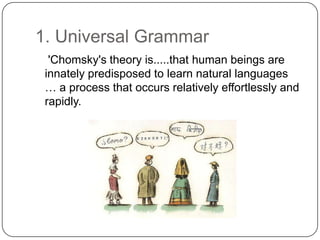
1. Universal Grammar    'Chomsky's theory is.....that human beings are innately predisposed to learn natural languages … a process that occurs relatively effortlessly and rapidly.
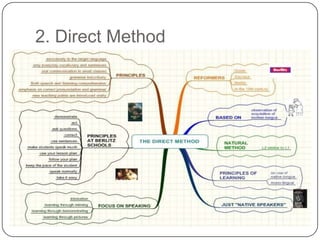
2. Direct Method
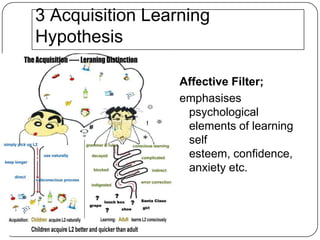
3.Acquisition Learning HypothesisAffective Filter;emphasises psychological elements of learning self esteem, confidence, anxiety etc.
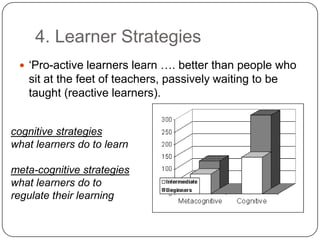
4. Learner Strategies‘Pro-active learners learn …. better than people who sit at the feet of teachers, passively waiting to be taught (reactive learners).cognitive strategies what learners do to learnmeta-cognitive strategies what learners do to regulate their learning
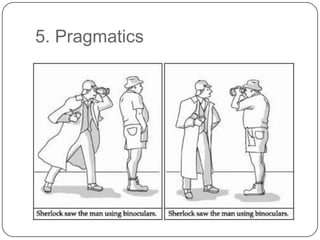
5. Pragmatics
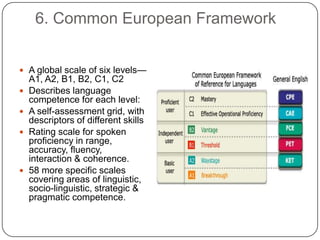
6. Common European FrameworkA global scale of six levels—A1, A2, B1, B2, C1, C2Describes language competence for each level:A self-assessment grid, with descriptors of different skills   Rating scale for spoken proficiency in range, accuracy, fluency, interaction & coherence.58 more specific scales covering areas of linguistic, socio-linguistic, strategic & pragmatic competence.
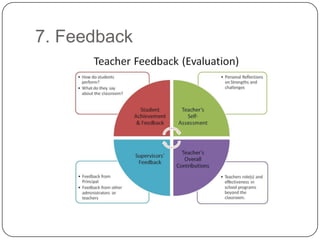
7. Feedback
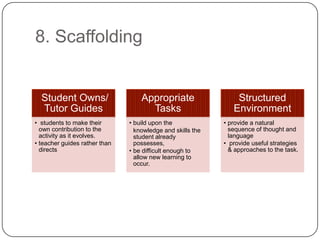
8. Scaffolding
9. Lingua Franca/Globish
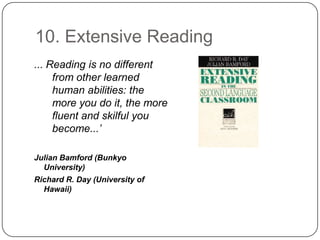
10. Extensive Reading... Reading is no different from other learned human abilities: the more you do it, the more fluent and skilful you become...’Julian Bamford (Bunkyo University) Richard R. Day (University of Hawaii)
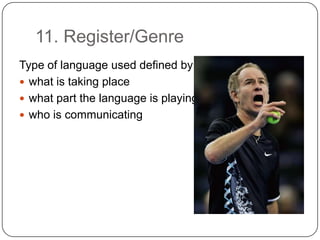
11. Register/GenreType of language used defined by:what is taking placewhat part the language is playing who is communicating
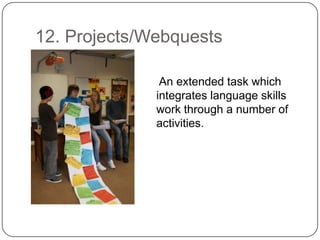
12. Projects/Webquests    An extended task which integrates language skills work through a number of activities.
For more ELT resourceshttp://www.eslreading.org/http://esolebooks.com/http://younglearners.eslreading.org/http://www.englishlanguagefaqs.com/Created by Kieran McGovern (MA)http://esolebooks.com/Editor/kieranmcgovern.html

Key Concepts in ELT

  • 1.
    New approaches toteaching EnglishKey Concepts in ELT
  • 2.
    1. Universal Grammar 'Chomsky's theory is.....that human beings are innately predisposed to learn natural languages … a process that occurs relatively effortlessly and rapidly.
  • 3.
  • 4.
    3.Acquisition Learning HypothesisAffectiveFilter;emphasises psychological elements of learning self esteem, confidence, anxiety etc.
  • 5.
    4. Learner Strategies‘Pro-activelearners learn …. better than people who sit at the feet of teachers, passively waiting to be taught (reactive learners).cognitive strategies what learners do to learnmeta-cognitive strategies what learners do to regulate their learning
  • 6.
  • 7.
    6. Common EuropeanFrameworkA global scale of six levels—A1, A2, B1, B2, C1, C2Describes language competence for each level:A self-assessment grid, with descriptors of different skills Rating scale for spoken proficiency in range, accuracy, fluency, interaction & coherence.58 more specific scales covering areas of linguistic, socio-linguistic, strategic & pragmatic competence.
  • 8.
  • 9.
  • 10.
  • 11.
    10. Extensive Reading...Reading is no different from other learned human abilities: the more you do it, the more fluent and skilful you become...’Julian Bamford (Bunkyo University) Richard R. Day (University of Hawaii)
  • 12.
    11. Register/GenreType oflanguage used defined by:what is taking placewhat part the language is playing who is communicating
  • 13.
    12. Projects/Webquests An extended task which integrates language skills work through a number of activities.
  • 14.
    For more ELTresourceshttp://www.eslreading.org/http://esolebooks.com/http://younglearners.eslreading.org/http://www.englishlanguagefaqs.com/Created by Kieran McGovern (MA)http://esolebooks.com/Editor/kieranmcgovern.html

Editor's Notes

  • #3 http://tiny.cc/0l7w7
  • #4 Reaction to the Grammar-Translation Attempts to recreate L1 learning conditionsAll teaching in the target languageGrammar taught inductivelyFocus on speaking and listeningOnly useful ‘everyday' language is taught.Teacher explains new vocabulary using visual aids or demonstrations. WeaknessConditions under which L2 learned very different.Classroom legacy: 
Emphasis on listening & speakingUse of the target language for all class instructionsUse of visuals to illustrate meaning
  • #5 Description of Krashen's Theory of Second Language AcquisitionKrashen's theory of second language acquisition consists of five main hypotheses: the Acquisition-Learning hypothesis,the Monitor hypothesis,the Natural Order hypothesis,the Input hypothesis,and the Affective Filter hypothesis.
  • #6 Emphasis on 'what learners do to learn and do to regulate their learning'. Distinction between cognitive strategies (what learners do to learn) and meta-cognitive strategies (what learners do to regulate their learning).http://eltj.oxfordjournals.org/content/47/1/92.full.pdf+html
  • #7 Importance of adjusting language to context.The Co-operative Principle Quality (speak the truth, and what you have evidence for),QuantityManner (avoid verbosity, obscurity, etc.)Relation (talk relevantly).Politeness/banter/irony principle.
  • #8 ‘a communicative, action-based, learner centred view of language learning ... promoting pluri-lingualism as a means to facilitate mobility in Europe and encouraging linguistic tolerance and respect.’Collections of ‘can do’ statements provided by the Association of Language Testers in Europe (ALTE) (www.alte.org) & the DIALANG project (www.dialang.org)
  • #11 ‘contact language’ between persons who share neither a common native tongue nor a common (national) culture, and for whom English is the chosen foreign language of communication’ (Firth, 1996)
  • #12  Extensive Reading/Listening  1. Students read as much as possible    3. A variety of materials on a wide range of topics is available so as to encourage reading for different reasons and in different ways.  4.  5. Students select what they want to read and have the freedom to stop reading material that fails to interest them.  6.  7. Emphasis on pleasure, information and general understanding.  8. Reading is its own reward.  9.  10. Reading materials are well within the linguistic competence of the students  11.  12. Reading is individual and silent, at the student's own pace, and, outside class, done when and where the student chooses.    14. Reading speed is usually faster rather than slower as students read books and other material they find easily understandable.  15.  16. Teachers guide & record students in getting the most out of the program.    18. The teacher is a role model of a reader
  • #14 activities combine in working towards an agreed goal and may include planning, the gathering of information through reading, listening, interviewing, etc., discussion of the information, problem solving, oral or written reporting, and display