Stanford University at California  Teaching Methodology By: Mostafa Ewees (PhD)  Educational ,Social Psychologists  May 2010
Course: Teaching Methodology Book: Techniques and Principles in Language Teaching Author: Diana Larsen-Freeman Second Edition, 12 chapters Slide production: Dr. Mus Ewees Stanford  University  Number of slides: 345
Language Teaching Ten factors in each chapter Teacher’s goals Teacher’s role vs. students’ role Features of teaching & learning  The nature of interaction
Language Teaching Dealing with students’ feelings Language vs. culture Language areas and skills to emphasize The role of the native language
Language Teaching Dealing with evaluation Dealing with students’ errors Two types of exercises: checking your understanding and applying what you studied
Language Teaching:GT Grammar Translation  (GT) is the first method we discuss. GT  appeared in the first half of the 19 th  century and was one of the  nonscientific  methods.
Language Teaching:GT Why is GT a classical method?  GT was to help students appreciate L2 literature. L2 grammar helps them learn Ll grammar & grow mentally.
Language Teaching:GT Thinking about the experience GT - a teacher proof method- in Iran. It is the output of German scholarship.
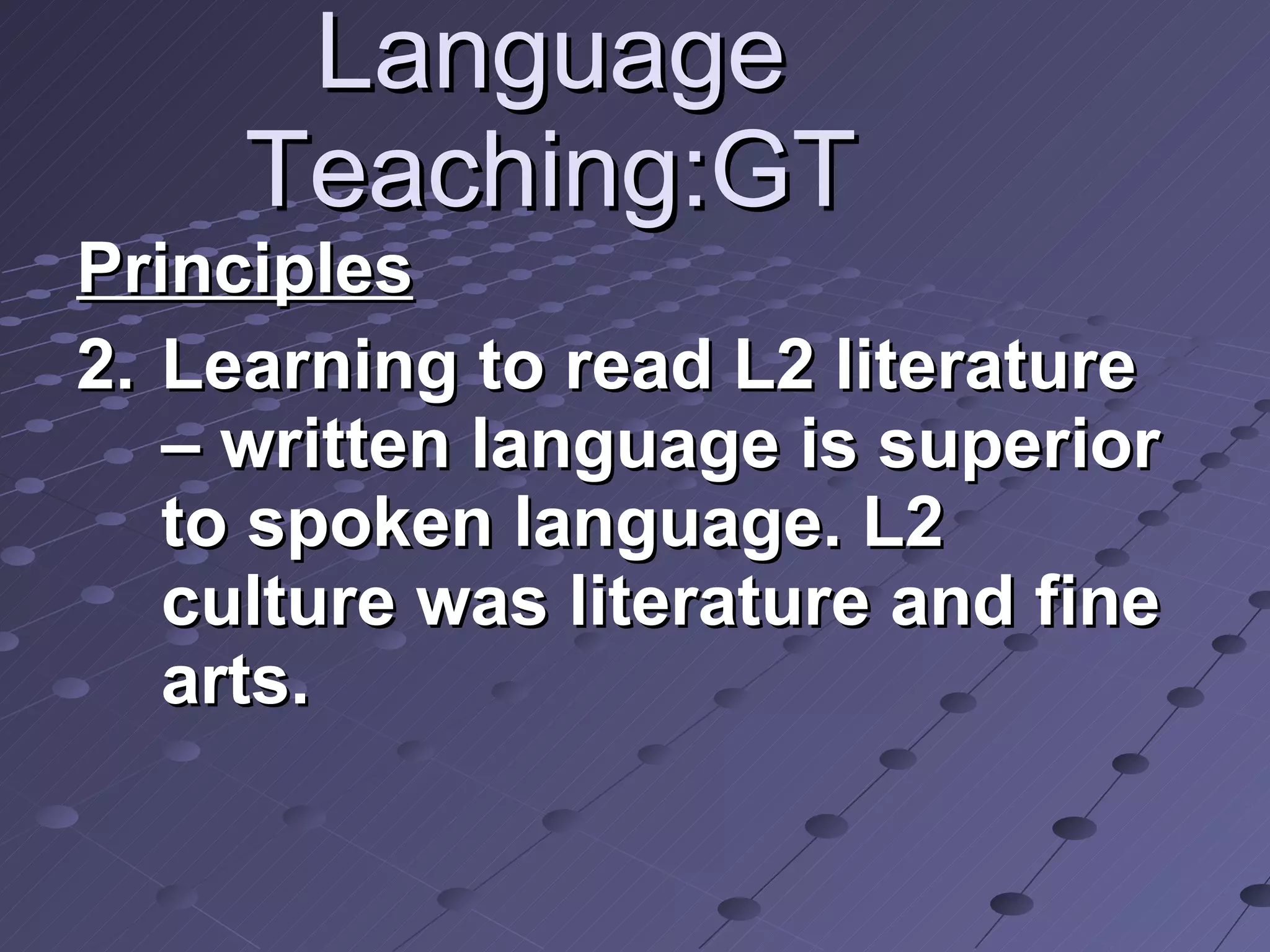
Language Teaching:GT Principles Learning to read L2 literature – written language is superior to spoken language. L2 culture was literature and fine arts.
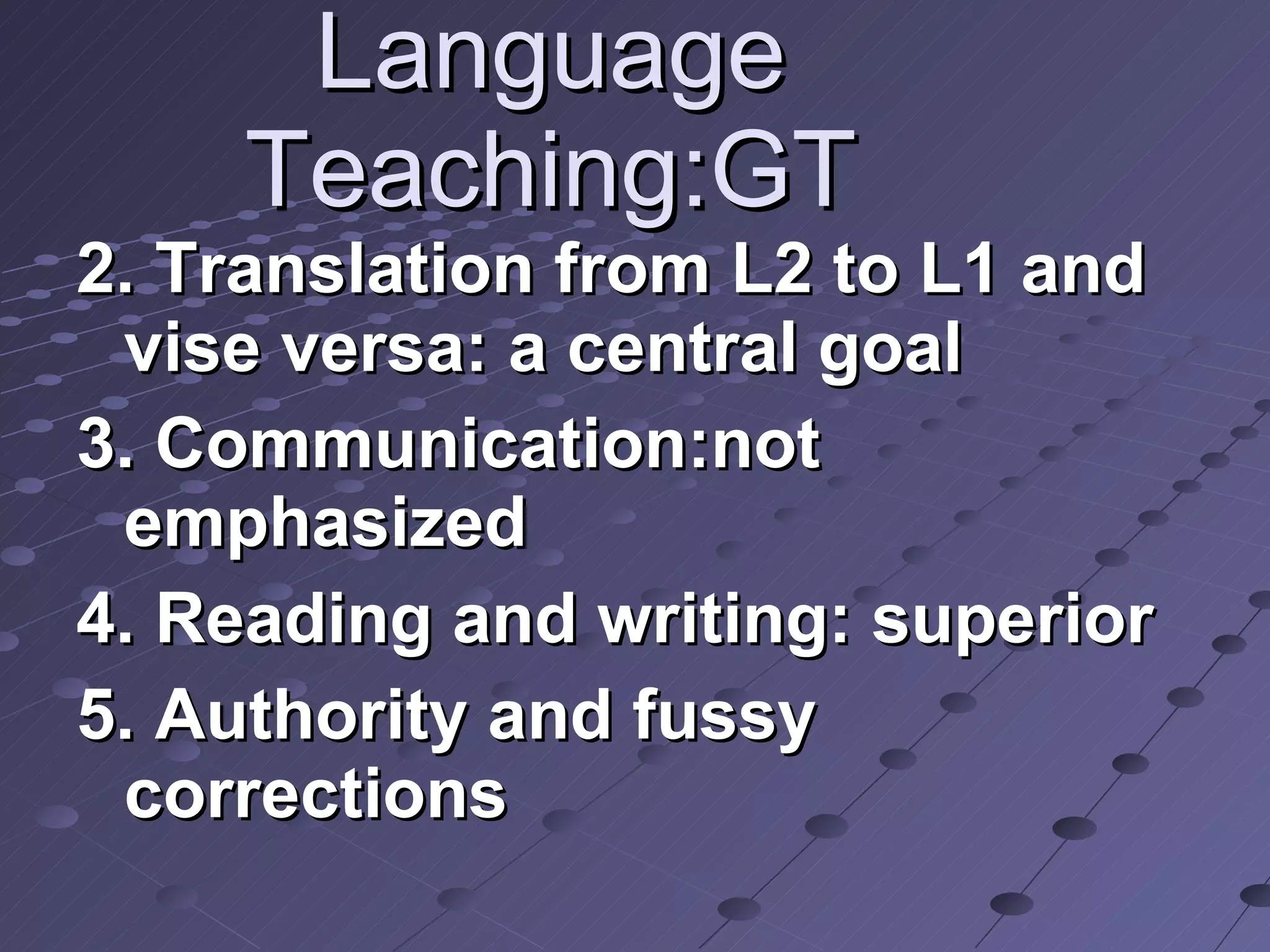
Language Teaching:GT 2. Translation from L2 to L1 and vise versa: a central goal 3. Communication:not emphasized 4. Reading and writing: superior 5. Authority and fussy corrections
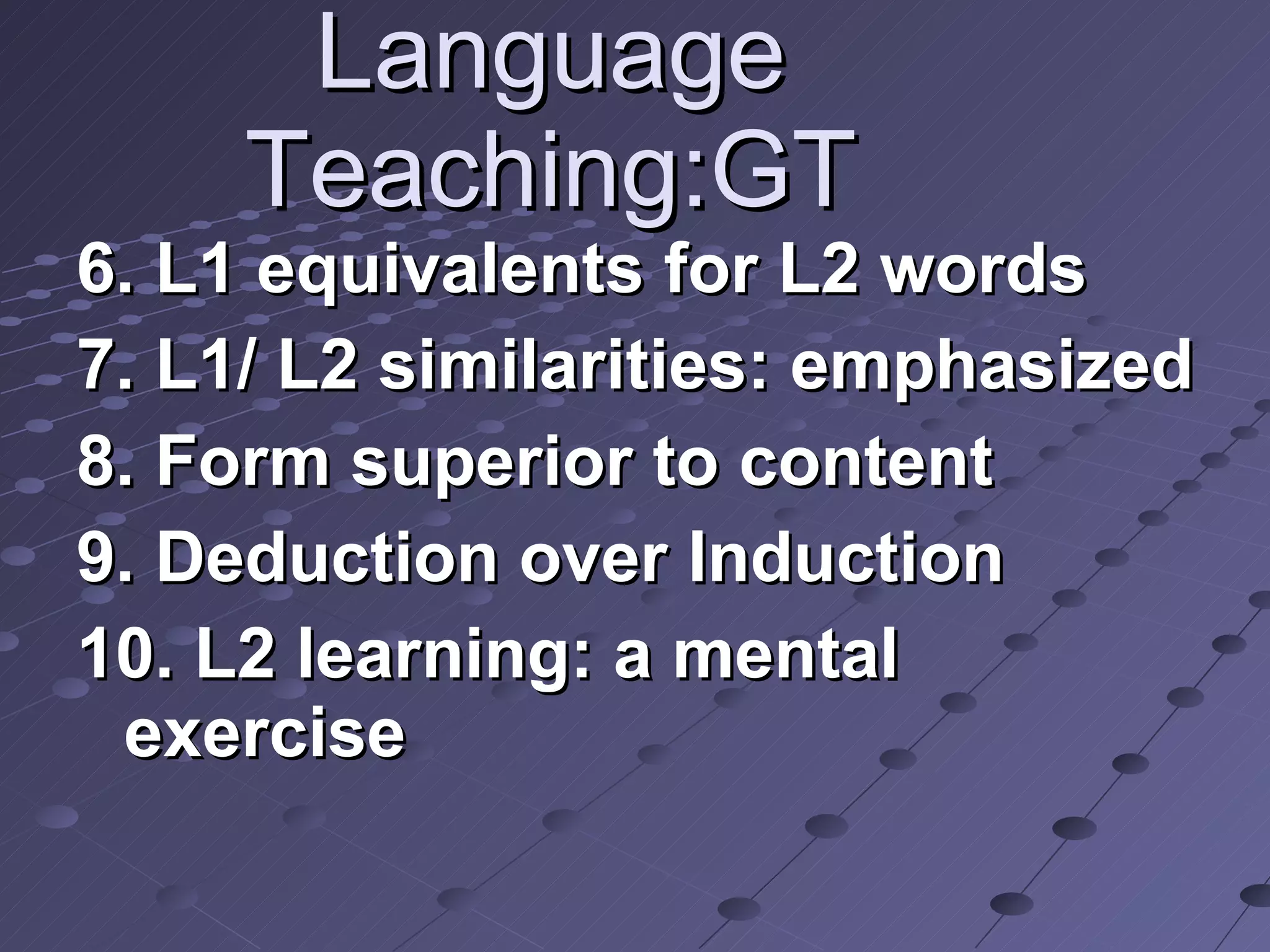
Language Teaching:GT 6. L1 equivalents for L2 words 7. L1/ L2 similarities: emphasized 8. Form superior to content 9. Deduction over Induction 10. L2 learning: a mental exercise
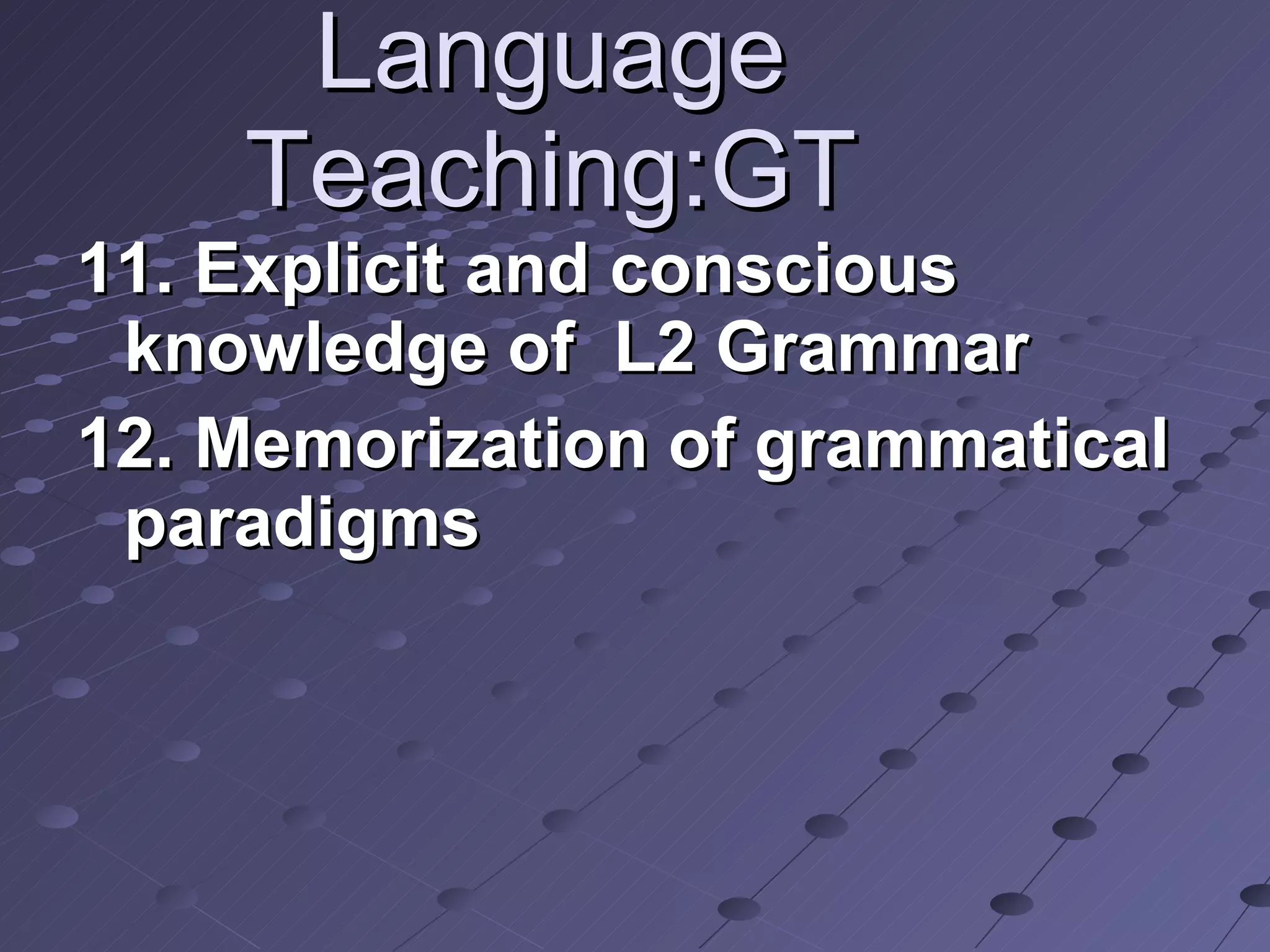
Language Teaching:GT 11. Explicit and conscious knowledge of  L2 Grammar  12. Memorization of grammatical paradigms
Language Teaching:GT Summary Reviewing the principles Reviewing the techniques
Language Teaching:GT Activity: Explain the differences between learning about L2 and learning to use L2.
Language Teaching:GT GT was challenged by: Natural methodologists Linguists interested in phonetics The reform movement
Language Teaching:GT Natural method gave rise to the Direct method – the next chapter. However, GT still has its own proponents and is used in some parts of the world. Why?
Language Teaching:DM The Direct Method (DM) rose to prominence at the beginning of the 20 th  century and it is one of the nonscientific methods, similar to Grammar Translation.
Language Teaching:DM DM is a movement toward a scientific method. Gouin started a method based on child language acquisition.
Language Teaching:DM Franke wrote on the direct association between form and meaning. Saussure made a distinction between language and substance.
Language Teaching:DM To Saussure language is form not substance. In addition, Sauveur banned translation and use of mother tongue in the classroom.
Language Teaching:DM The weaknesses of GT made DM very popular. Basic principle:The use of L1 is sin and the connection between L2 and meaning should be direct.
Language Teaching:DM Principles   1. Language is mainly speech. Culture includes more than fine arts. Reading is taught from the beginning.
Language Teaching:DM 2. Concrete objects are used to make the direct link between form (language) and meaning. 3. Mother tongue has almost no role.
Language Teaching:DM 4. Demonstration is preferred to explanation and translation. 5. Vocabulary in use is emphasized to boost thinking in English. (Real use in real sentences)
Language Teaching:DM 6. Oral communication is the goal.  7. Pronunciation receives primary attention - focus on form. 8. Self correction is preferred to teacher’s correction.
Language Teaching:DM 9. Lessons should provide the chances for real life  conversation.   10. Grammar is taught inductively or implicitly.
Language Teaching:DM 11. Like reading,writing is practiced from beginning.Four language skills are together. 12. Lessons are topic based and not structurally designed.
Language Teaching:DM 13. Language and culture are interwoven. Notes on Direct Method: Fluency over accuracy (unlike GT)
Language Teaching:DM Immediate correction  by self correction or teacher’s indirect correction. An error is like a sin. Students’ knowledge  about  L2 is not evaluated (as it was in GT).
Language Teaching:DM The weaknesses of Direct Method Overemphasized natural language acquisition usage for classroom learning situation.
Language Teaching:DM Lacking a firm basis in Applied Linguistics and psychology of learning. Placing so much emphasis on the teacher rather than textbook.
Language Teaching:DM By 1920s, Direct Method (Berlitz Method in the U. S.) started to decline. DM led to Audio-lingual Method (ALM) in the United States.
Language Teaching:DM At the same time Situational Language Teaching (Oral Approach) was popular in Europe and Contrastive Analysis gained importance.
Language Teaching:DM About the same time Eclecticism – the idea that language teaching should undergo ongoing reform – was also proposed and supported.
Language Teaching:ALM GT and Direct Method were popular until World War II. The Audio-lingual Method (ALM) was developed in the U. S. during World War II. Why?
Language Teaching:ALM Audio-Lingual Method (ALM) is the  first scientific method  since it has roots in both psychology and linguistics.
Language Teaching:ALM Psychology: Skinner (1930s-50s) Behaviorism Linguistics: Bloomfield (1930s-50s) Structuralism
Language Teaching:ALM Principle:  Form appears inside the context, not in isolation. For example, a dialogue is used to introduce a new structure.
Language Teaching:ALM L1 and L2 have two systems and they are treated differently  to avoid interference . The teacher is the model. His native-like accent does matter.
Language Teaching:ALM Language learning is habit formation and habits should be repeated to get fixed in mind. Errors are barriers for habit  formation (inhibition).
Language Teaching:ALM Communication is the prior goal. A sentence includes several slots and each slot needs a special part of speech.
Language Teaching:ALM A. John is satisfied with the ------.  (a noun is needed after preposition) B. John is satisfied with the ------ concert. ( a noun or an adjective)
Language Teaching:ALM 8. Positive reinforcement is preferred to no/negative reinforcement. Note: Behaviorism: stimulus, response and reinforcement.
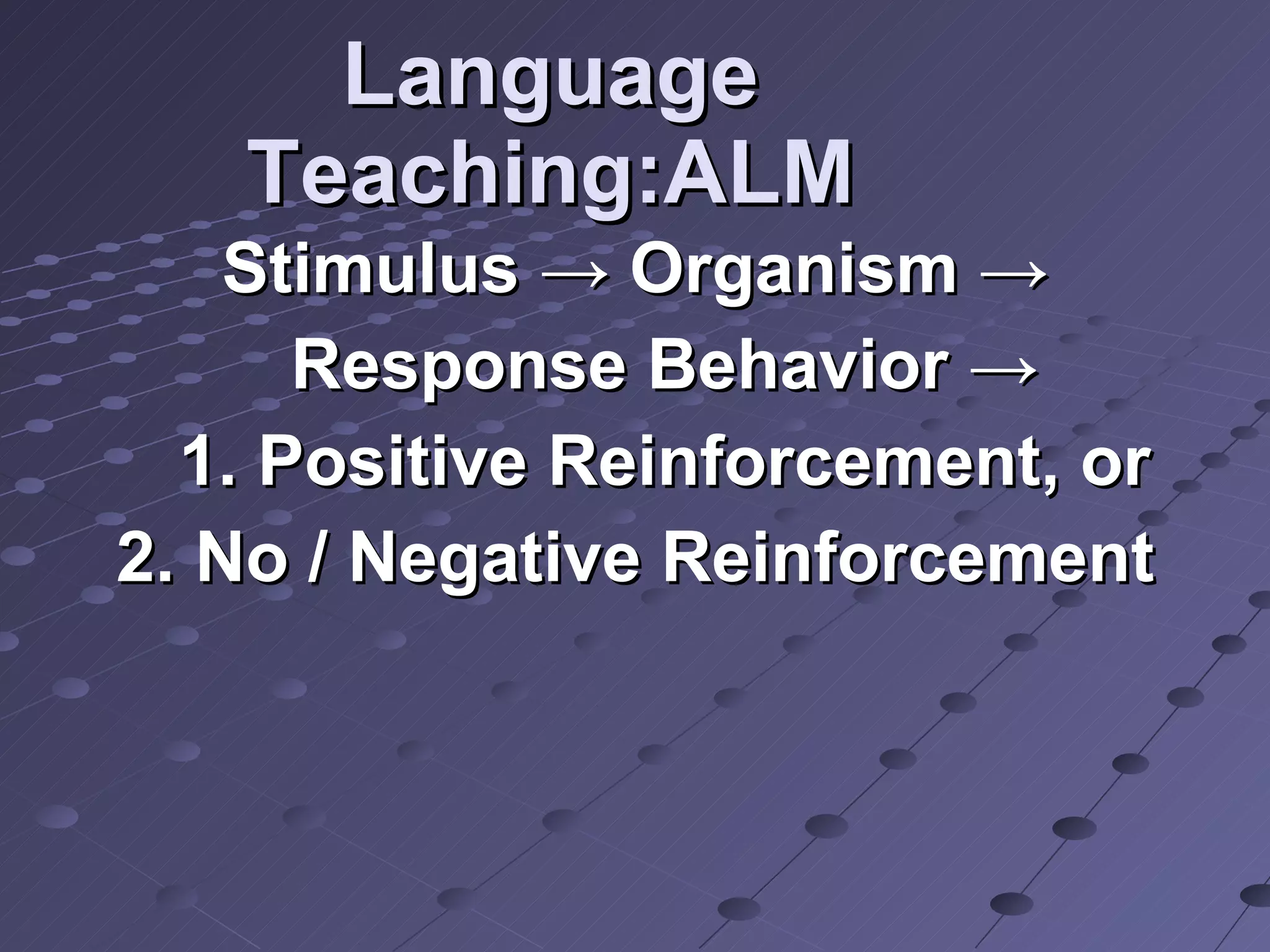
Language Teaching:ALM Stimulus -> Organism -> Response Behavior ->  1. Positive Reinforcement, or 2. No / Negative Reinforcement
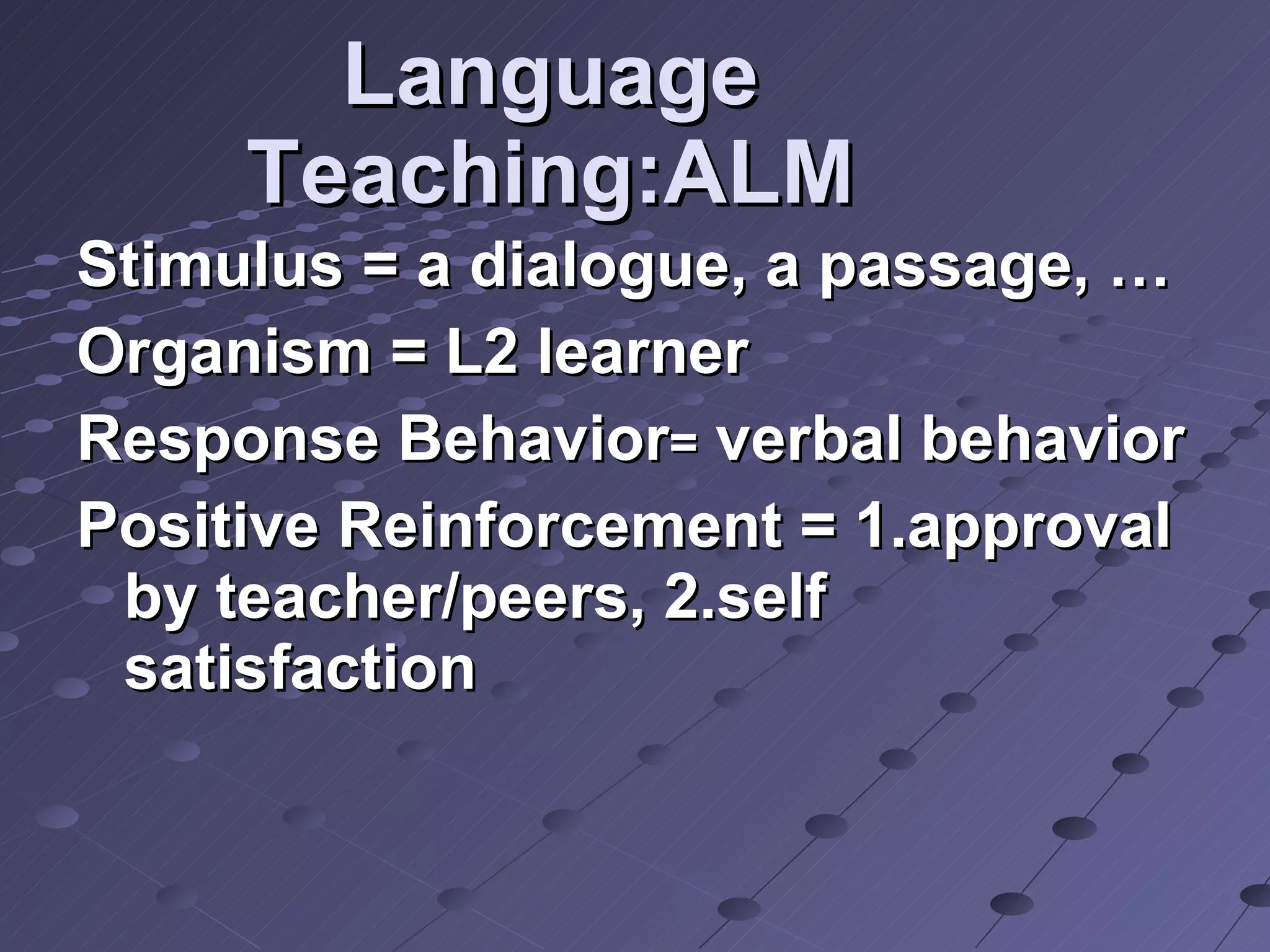
Language Teaching:ALM Stimulus = a dialogue, a passage, …  Organism = L2 learner Response Behavior =  verbal behavior Positive Reinforcement = 1.approval by teacher/peers, 2.self satisfaction
Language Teaching:ALM 9. Stimuli can be verbal/nonverbal Note: Behaviorism, like linguistic Structuralism, is an  anti-mentalist ,  empirically based  approach.
Language Teaching:ALM 10. Language is a set of patterns or structures. Pattern practice leads to the over-learning of a desired verbal behavior (habit formation).
Language Teaching:ALM Linguistic Structuralism  : A. Language is a system of forms, from smaller units such as sounds to bigger units such as sentences.
Language Teaching:ALM B. Structuralism studies the distribution of units within the system (e.g., phoneme vs. allophone).
Language Teaching:ALM C. Structuralism is a reaction to  mentalist and traditional approach to grammar. D. In Structuralism all languages are equally developed.
Language Teaching:ALM E. Language is equal to speech. F. Language can be learned by mastering the building blocks (elements) of the Form system.
Language Teaching:ALM G. Rule-ordered processes involve  addition ,  deletion , and  transposition  of grammatical elements.
Language Teaching:ALM 11. Automatic repetition is the result of overlearning - Drilling and mechanical repetition.  12.The teacher is an orchestra leader.
Language Teaching:ALM From the three language learning activities – 1. Mechanical drills, 2. meaningful exercises, and 3. communicative activities – the first one is practiced.
Language Teaching:ALM 13. Learning the structural patterns comes before vocabulary. Students sometimes repeat unknown or meaningless words (Form is more important).
Language Teaching:ALM 14. L2 learning is equal to L1 acquisition. Rules are induced (implicit) from examples. 15. Contrastive analysis of L1 and L2 shows the areas of difficulty.
Language Teaching:ALM 16. The “Natural Order” is to be adopted for L2 acquisition. Note: In ALM acquisition is preferred to learning. The former is implicit.
Language Teaching:ALM 17. Culture is discussed within the context of language.
Language Teaching:ALM Techniques: Dialogue memorization Backward build up drills Repetition drills Chain drills
Language Teaching:ALM Single-slot substitution drills Multiple slot substitution drills Transformation drills Question and answer drills Use of minimal pairs
Language Teaching:ALM Completing the dialogue Grammar game
Language Teaching:SW The Silent Way: Although Audiolingualism is widely used all over the world, it was heavily criticized in the early 1960s.
Language Teaching:SW Both Behaviorism (psychological foundation) and Structuralism (linguistic foundation) were attacked by linguists and psychologists.
Language Teaching:SW Behaviorism was followed by  Cognitive Psychology . Structuralism was followed by  Transformational-generative linguistics .
Language Teaching:SW Basic concepts:  1. Human is creative, so mimicry, memorization, repetition and parrot learning (Behaviorism)  do not lead to real learning .
Language Teaching:SW 2. Language is not confined to a limited number of structures (as opposed to Structuralism). Best evidence: new sentences that children make in early life.
Language Teaching:SW 3. Language learning is not the outcome of habit formation (Behaviorism). It is the process of creative rule formation (Cognitive Psychology).
Language Teaching:SW 4.  Cognitive psychology  puts more emphasis on thoughtful, mentalist and creative processes. Learners form hypothesis to discover the rules of L2
Language Teaching:SW 5. Language learning is not the passive process of stimulus -> response -> behavior. Learners are actively involved in discovering L2 rules.
Language Teaching:SW Note: In general, Cognitive science deals with the scientific study of thinking, reasoning and the intellectual processes of the mind.
Language Teaching:SW 6.a. Generative Transformational theory (proposed by Chomsky in 1957) is a model for the description of all languages.
Language Teaching:SW 6.b. GT theory, with a system of rules, shows the knowledge that a native speaker uses in forming grammatical sentences.
Language Teaching:SW 6.c. In GT theory internalized grammar of a language – Competence – enables one to create and understand totally new sentences.
Language Teaching:SW 6.d. Competence enables us to tell what are and what are not possible sentences in a language (implicit knowledge).
Language Teaching:SW 6.e.  Competence  is different from  Performance  which is the actual use of the language by individuals.
Language Teaching:SW 7. Errors are inevitable, natural signs of learning/acquisition. They show the learner is testing his hypotheses.The progress is gradual and step by step.
Language Teaching:SW 8. All four skills are worked on from the beginning. In addition. Form and meaning are both important.
Language Teaching:SW Gattegno’s “Silent Way”  was not  the outcome of Cognitive Psychology, but in line with the theory. That is, both assign an active role to the learner.
Language Teaching:SW In both Silent way and Cognitive Psychology,  teaching is subordinate to learning: Both of them are learning and learner centered , not teaching centered.
Language Teaching:SW Principles: 1. The teacher goes  from familiar to unfamiliar . For example, he starts with L2 sounds which are similar to L1 sounds.
Language Teaching:SW 2. The teacher speaks very little, only when needed. His silence motivates the learners to participate more and be active.
Language Teaching:SW 3. The teacher is not the model. His gestures work.Student’s “self criteria”  for correctness are emphasized. The student takes the responsibility of learning.
Language Teaching:SW 4. Students’ actions show if they have learned. 5. Students help each other. 6. The teacher uses gestures and L1 to help them learn.
Language Teaching:SW 7. & 8. Students’ familiar knowledge (old context) helps them learn the unfamiliar (new context). The teacher’s interference is very little.
Language Teaching:SW 9. Reading is worked on from the beginning but after speaking. 10. The teacher's silence leads to the student's autonomy: learner centeredness.
Language Teaching:SW 11. Meaning is achieved through perceptions (senses), not translation. 12.Group cooperation is the norm. 13. Little praise and punishment.
Language Teaching:SW 14. Errors are important. They are the road signs. 15. Self correction over teacher’s correction. 16. Students listen to each other.
Language Teaching:SW 17. Learning rates are different. Perfection is not the target. 18. The teacher frees his time by his silence.  19. Students are attentive.
Language Teaching:SW 20. Meaningful practice is preferred to repetition. 21. Logical presentation of language elements from familiar to unfamiliar.
Language Teaching:SW 22. & 23. Autonomy is gained by exploring and making choices. 24. Feedback from students informs the teacher. 25.No homework:sleeping practice
Language Teaching:SW 26. Syllabus is structure based.  27. Structures are not presented in a linear way. 28. Skills (speaking, reading and writing) reinforce one another.
Language Teaching:SUG Suggestopedia (Superlearning): psychological barriers are the main causes of failure in language learning. These barriers should be removed.
Language Teaching:SUG These barriers are fear of bad performance, limited ability to learn, and failure, so our full mental powers are not revealed.
Language Teaching:SUG Suggestology: how to harness and redirect mental capacity foe maximum learning. It is based on Desuggestion and Suggestion
Language Teaching:SUG Desuggestion: unloading mental reserves of unwanted memories. Suggestion: loading the reserves with facilitating memories.
Language Teaching:SUG Basics of Suggestology: 1. Authority: the teacher’s C. V., his belief in the method and his manner are valued (the placebo effect).
Language Teaching:SUG 2. Infantalization: students take the role of a child (games, songs, gymnastic exercises, … ).
Language Teaching:SUG Principles: Learning is facilitated in comfort. Peripheral learning is valued.
Language Teaching:SUG 3. Students must respect and trust the teacher’s authority. 4. The teacher “desuggests” the barriers: L2 learning is fun.
Language Teaching:SUG 5. Students’ imagination is activated (Suggestion). 6. Students’ confidence is raised (Suggestion).
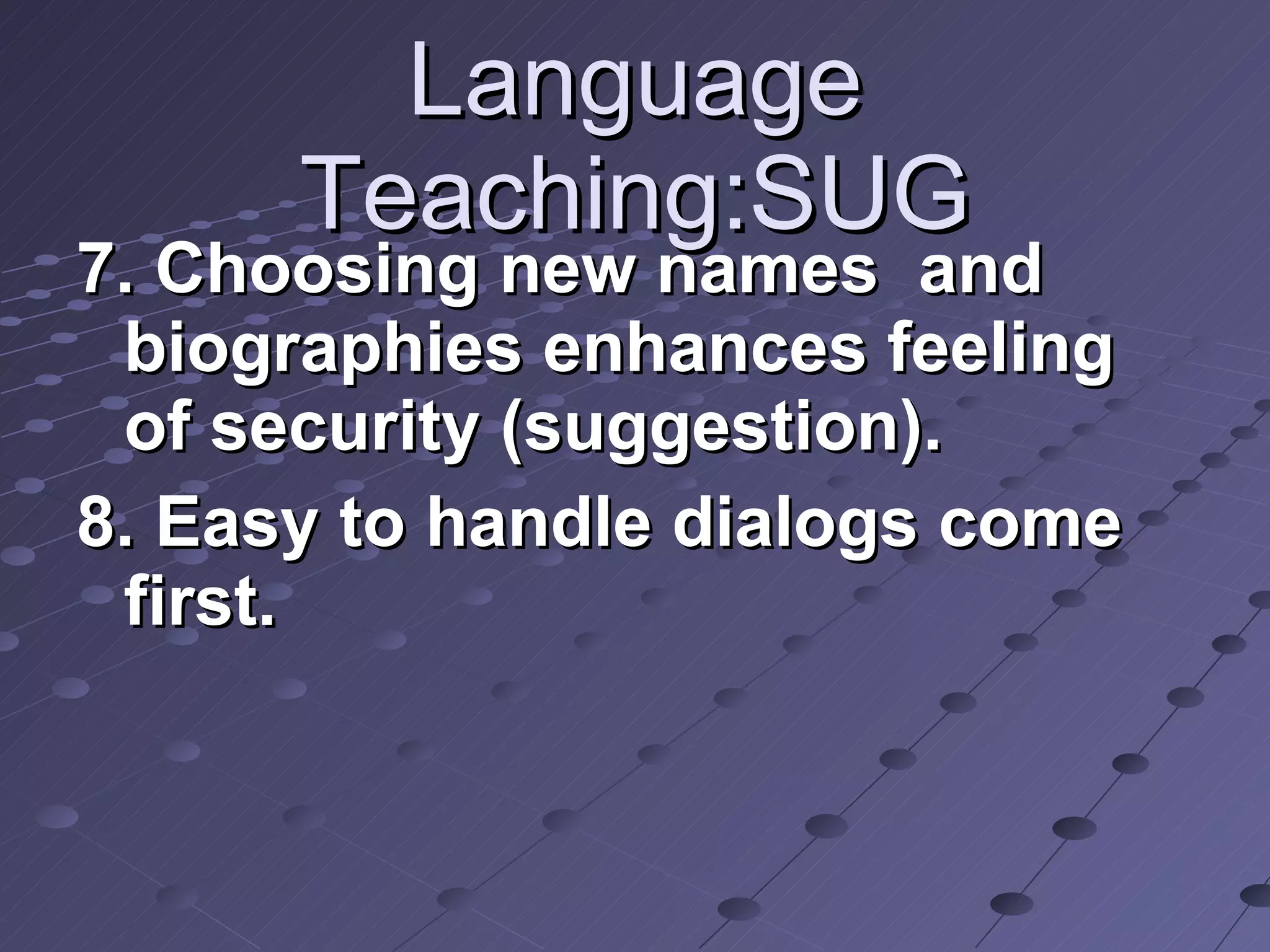
Language Teaching:SUG 7. Choosing new names  and biographies enhances feeling of security (suggestion). 8. Easy to handle dialogs come first.
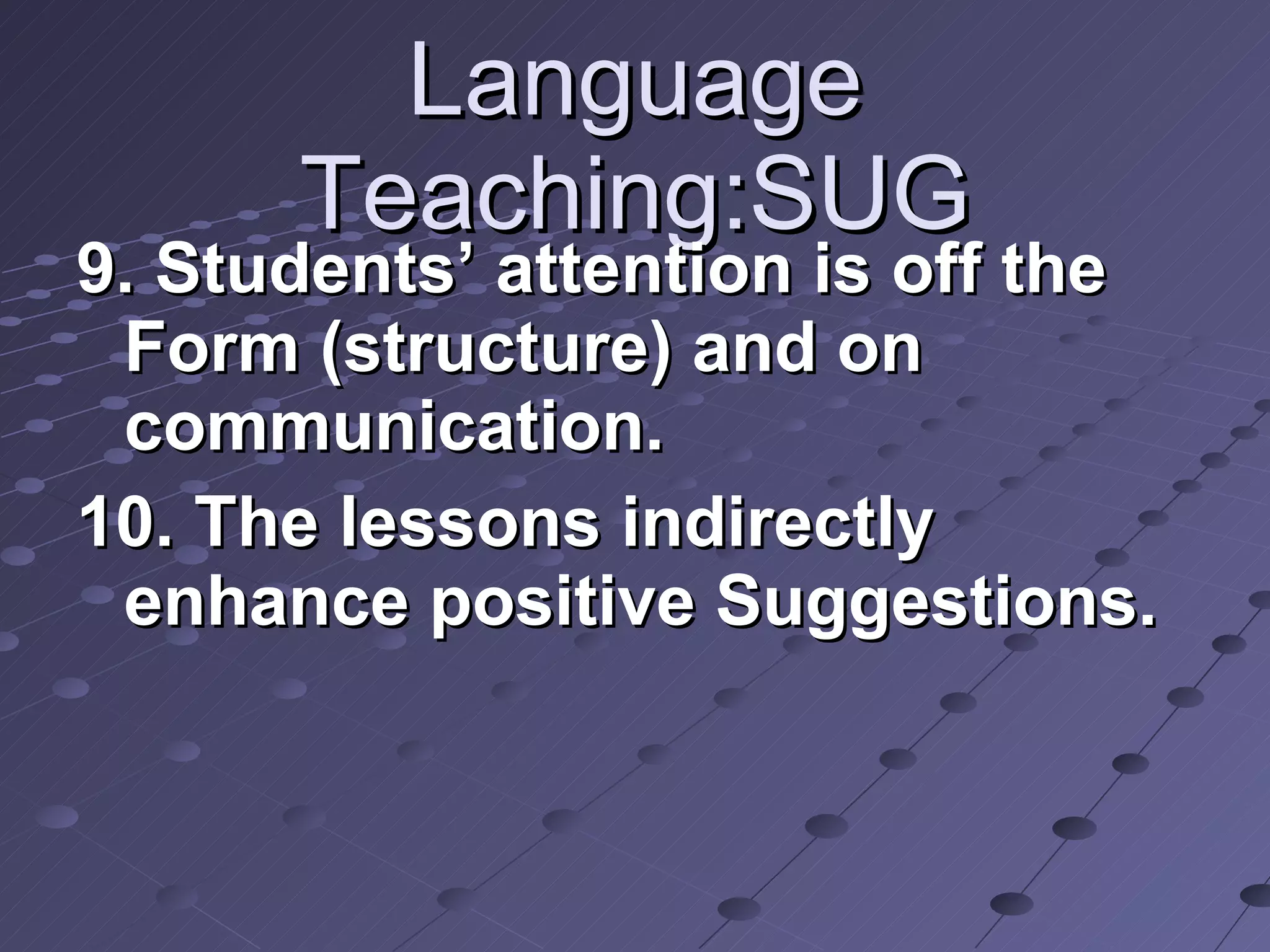
Language Teaching:SUG 9. Students’ attention is off the Form (structure) and on communication. 10. The lessons indirectly enhance positive Suggestions.
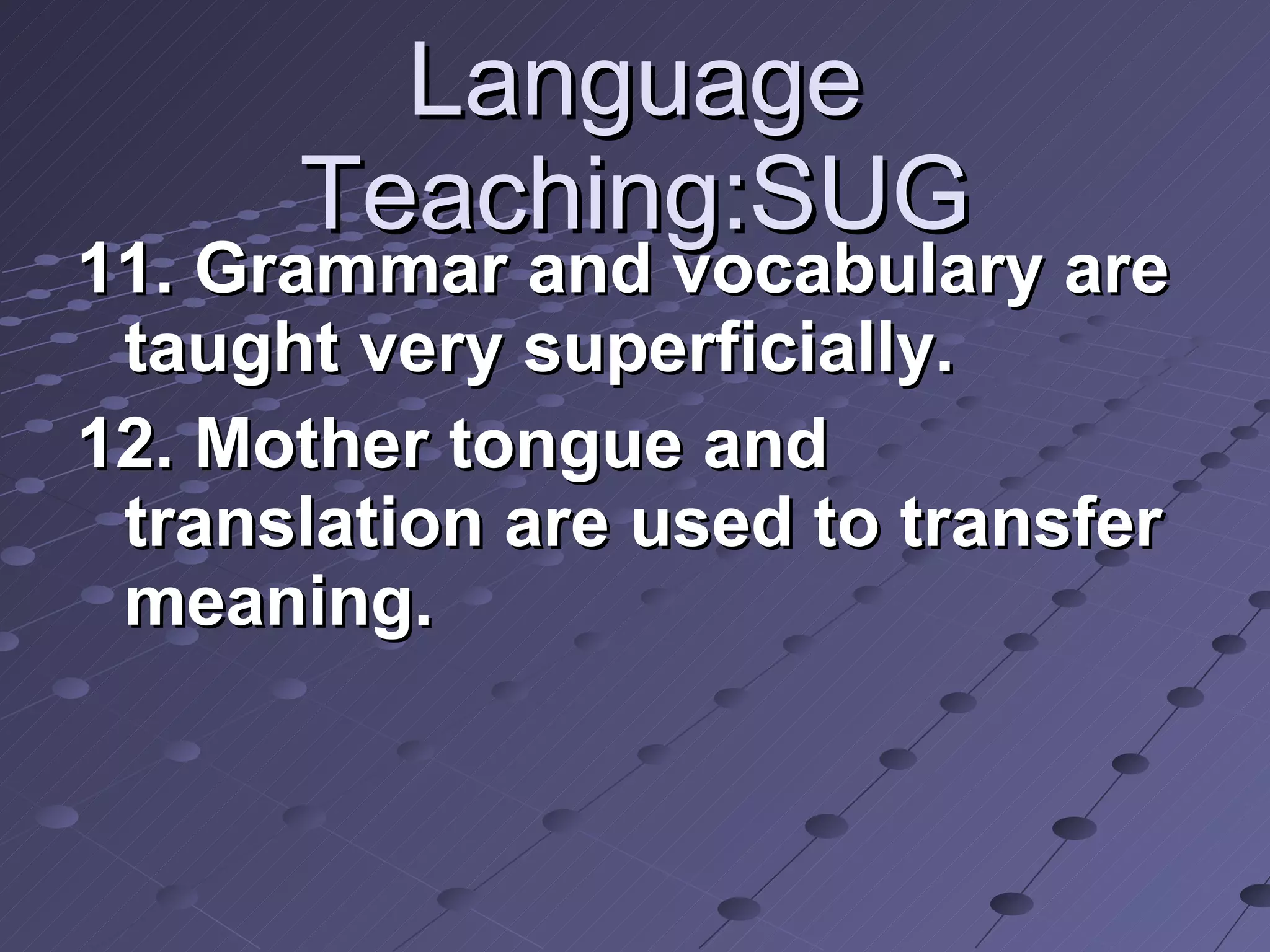
Language Teaching:SUG 11. Grammar and vocabulary are taught very superficially.  12. Mother tongue and translation are used to transfer meaning.
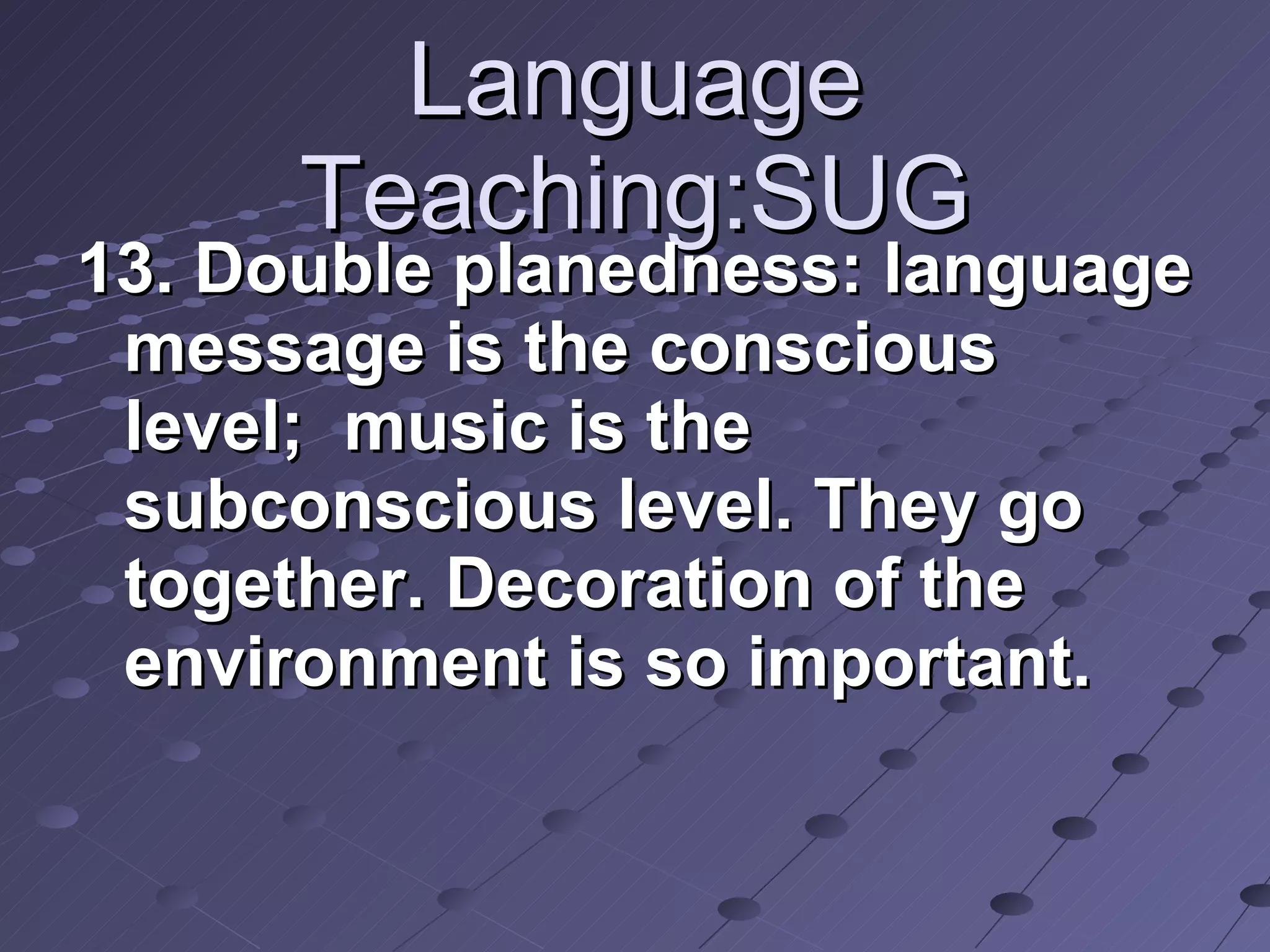
Language Teaching:SUG 13. Double planedness: language message is the conscious level;  music is the subconscious level. They go together. Decoration of the environment is so important.
Language Teaching:SUG 14. To overcome the barriers, a pseudo-passive state is needed. 15. Homework is done at night and in the morning.
Language Teaching:SUG 16. Dramatization and fantasy reduce the barriers to learning. 17. The arts (music, drama, … ) should be part of the process of learning.
Language Teaching:SUG 18. Novelty is the to motivation (learning activities are varied). 19. Infantalization is the key factor. A childlike attitude to learning helps a lot.
Language Teaching:SUG 20. In some activities the conscious attention focuses on using L2, not on the structure and form.  21.Errors are tolerated and corrected indirectly later.
Language Teaching:SUG Two kinds of materials: 1. Direct support: texts and tapes 2. Indirect support: classroom decoration and music
Language Teaching:SUG Zero beginners are different from false beginners. Students are required to talk ex tempore (not from memorized lines).
Language Teaching:SUG Students are immersed in the method and forget their past (new names). Words are taught in word pairs.
Language Teaching:SUG The texts should be emotionally and motivationally powerful. They have literary value. Musical background leads to relaxed body and alert mind.
Language Teaching:CLL Community Language Learning: Students as “whole persons” feelings + intellect + physical  reactions + instinctive protective reactions + desire to learn
Language Teaching:CLL Counseling Learning  ->  Community Language Learning (By: Charles A. Curran) His theory is based on adult learning .
Language Teaching:CLL Adults feel frightened in a new learning situation: the inherent change and chances of making mistakes frightens them. So the  teacher should play a counselor .
Language Teaching:CLL CLL is a humanistic approach taken from Carl Rodger’s approach (1950): the focus is on  Affective (emotional) Domain ; it is client (learner) centered.
Language Teaching:CLL Factors of Affective Domain: Empathy, self-esteem, attitude extroversion, inhibition, imitation, anxiety, and so on.
Language Teaching:CLL Language process is not just :  sender -> message -> receiver It is interactional and communicative. It is a social process .
Language Teaching:CLL CLL is a holistic approach: Cognitive + Affective factors Classroom interaction is between peers (symmetrical) or learner-knower (asymmetrical)
Language Teaching:CLL Principles: The teacher starts a friendly relationship. The teacher’s explanation of the activities brings security.
Language Teaching:CLL 3. Language is for communication. 4. The teacher’s standing position can be effective in reducing tension and fostering interaction.
Language Teaching:CLL 5. The teacher is caring about the students limitations and fears. They learn with different paces. 6. Time limits are revealed; security follows!
Language Teaching:CLL 7. The teacher and students are whole persons (Affective + Cognitive factors).
Language Teaching:CLL 8. Learners have different strategies, paces and styles of learning. The teacher makes them feel relaxed (Affective factors).
Language Teaching:CLL 9. The teacher is a counselor. Negative feelings block learning. 10. L1 is part of the process of learning. Understanding should be guaranteed.
Language Teaching:CLL 11. Activities should be clear /clarified (Affective factors). 12. The tasks are given one by one to reduce the barriers.
Language Teaching:CLL 13. Students go from total dependence on the teacher to independence and initiative. 14. Relaxed reflection and thinking fosters the process.
Language Teaching:CLL 15. Having a choice results in developing an inner wisdom.  16. Careful listening is needed to learn to discriminate and see the similarities and differences.
Language Teaching:CLL 17. Group work and cooperation is preferred to competition. 18. Indirect correction reduces tension.
Language Teaching:CLL 19. Interaction among the peers (students) leads to trust and less threat. 20. Learning takes place if the task neither too new nor too familiar.
Language Teaching:CLL 21. Thinking about learning experiences is as positive as reflecting on L2. 22. In early stages, the syllabus is learner dependent (oriented).
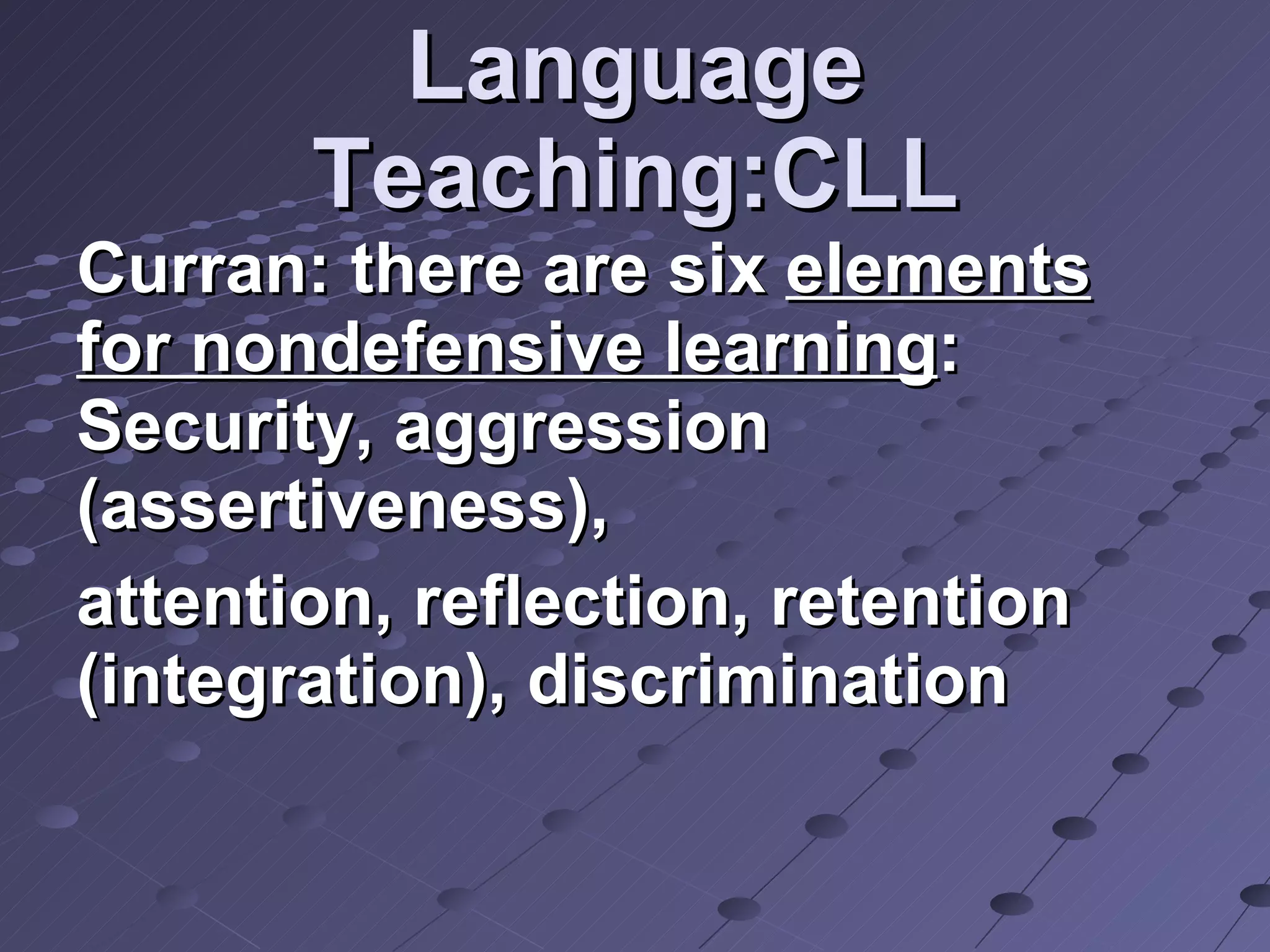
Language Teaching:CLL Curran: there are six  elements for nondefensive learning : Security, aggression (assertiveness), attention, reflection, retention (integration), discrimination
Language Teaching:CLL Evaluation in CLL is not fixed, but it should be in line with the principles. The test is mainly integrative, not discrete point. Self evaluation is also valued.
Language Teaching:CLL In CLL culture and language are inseparable. The teacher and students form a community (learning is persons). They trust each other and the process.
Language Teaching:TPR Total Physical Response is an example of “Comprehension Approach”. The importance is given to Listening Comprehension.
Language Teaching:TPR The idea of Comprehension Approach comes from child language acquisition. Speaking is a natural product of listening.
Language Teaching:TPR Many methods are based on L1 acquisition. Krashen and Terrell’s “natural Approach”:
Language Teaching:TPR communication through pictures and words is fostered, but L1 is also used. Natural Approach is similar to Direct Method, but in former L1 is allowed.
Language Teaching:TPR In Winitz and Reed’s  self instructional program  and in Winitz’  The Learnables , students listen and look at relevant pictures.
Language Teaching:TPR In Asher’s TPR students listen and respond in actions.
Language Teaching:TPR TP is based on “Trace Theory”: the more a memory connection is traced, the storage of memory associations is easier (Heb’s Law).
Language Teaching:TPR Tracing and retracing can be both verbal (language) and motor (actions). The combination of the two fosters the recall.
Language Teaching:TPR TPR is humanistic in saying that gamelike movements reduce stress. TPR is basically structuralist (imperative verbs at the center).
Language Teaching:TPR TPR claims that nonabstractions (verbs and concrete nouns) help us learn abstractions.
Language Teaching:TPR Language chunks are practiced rather than single items.  No grammar explanation is given
Language Teaching:TPR The theory of psychology is Bahaviorist : Verbal Stimulus -> Response
Language Teaching:TPR The learning hypotheses: 1. Innate bio program: listening before speaking (Natural Approach) and synchronized with body.
Language Teaching:TPR 2. Affective Filter: meaning through movements 3. Brain Lateralization: motor activities are right brain centered (following Piaget).
Language Teaching:TPR Students master L2 through right hemisphere motor activities while the left one (language center!) is watching and learning.
Language Teaching:TPR Principles: 1. Meaning is transferred through actions. Right brain  (nonverbal center) is involved. Chunks are preferred to single words.
Language Teaching:TPR 2. Listening before speaking. 3. Actions accompany the language. The teacher acts first. 4. The basic structure is imperative (only volunteers act).
Language Teaching:TPR 5. Students first observe and then perform the actions.  6. Feeling of success and little anxiety facilitate learning.
Language Teaching:TPR 7.Changing order of commands blocks sheer memorization. 8. Correction should be indirect and through actions.
Language Teaching:TPR 9. Novelty of commands can be motivating. 10. Language learning should be fun (funny commands).
Language Teaching:TPR 11. Spoken language comes first. 12. Speaking emerges very naturally. They choose to speake.
Language Teaching:TPR 13. The teacher is tolerant of the errors. Delicate points and details are put off for later and higher levels.
Language Teaching: CLT The Communicative Language Teaching UNIT 9
Language Teaching:CLT This is a British Approach that followed Oral Approach or Situational Language Teaching (simultaneous with Direct Method).
Language Teaching:CLT The decline of SLT – similar to Direct Method –  was due to Chomsky’s influence.In Britain functional and communicative aspects gained prominence.
Language Teaching:CLT While in the U.S. innateness and Generativity of language were important (under Chomsky’s influence), in Britain communication was important
Language Teaching:CLT Many methods claim to be communicative. They also say that structure and vocabulary are important.
Language Teaching:CLT Communicative Approach:these are good but not enough. We can not get ready for communication if just vocabulary and structure are worked on.
Language Teaching:CLT Communication includes functions. Functions are what we do with the language: arguing, persuading, promising, rejection or accepting an invitation, …
Language Teaching:CLT All these functions happen inside a social context. Wilkin’s Functional Notional Approach formed the basis of Communicative Approach.
Language Teaching:CLT Functions are what we do with the language, but Notional categories are: time, sequence, quantity, location, frequency.
Language Teaching:CLT Communicative Approach, Communicative Language Teaching, functional Approach and Notional Functional Approach have almost the same goals.
Language Teaching:CLT Knowledge of forms, meanings and functions can be positive if they help the learner in the process of  meaning exchange  .
Language Teaching:CLT There are two versions of Communicative Approach:  1. Weak Version (standard): the goal is to provide chances to use English for communication.
Language Teaching:CLT This is called ‘learning to use’ or ‘language for communication’. 2. Strong Version: language as communication – using language to learn.
Language Teaching:CLT The linguistic theory behind Communicative Approach is Dell Hymes’ communicative competence (1972).
Language Teaching:CLT He believed that Chomsky’s ‘linguistic competence’ was too limited. Linguistic competence doesn't justify social and functional rules of the language.
Language Teaching:CLT Hymes’ competence deals with both knowledge ( usage ) and  use .
Language Teaching:CLT Principles: 1. Authentic language in real context:sports columns from a recent newspaper
Language Teaching:CLT 2. Ability to figure out someone’s intentions:communicative competence
Language Teaching:CLT 3.Language: a vehicle for communication, not the object of study (language for communication).
Language Teaching:CLT 4. One function in different linguistic forms (the goal is to convey meaning with a ny possible and suitable form).
Language Teaching:CLT 5. Language use at higher levels (supra sentential, text or discourse level).
Language Teaching:CLT Note: Discourse or communication has three elements: 1. Real communication (information gap), 2. Task based activities, 3. Meaningfulness (authenticity).
Language Teaching:CLT In discourse analysis: cohesion (physical connectedness) and coherence (connectedness in meaning)
Language Teaching:CLT 6. The importance of games as real communication (task based activities) Note: Immediate feedback ensures the learner of the result.
Language Teaching:CLT 7. Opportunities for self expression 8. Errors as natural outcome of development of communication skills.
Language Teaching:CLT 9. Establishment of situations to promote communication (strip story).
Language Teaching:CLT 10. Cooperation and team work as a chance to negotiate meaning. 11. Role play as an example of social context (language for communication)
Language Teaching:CLT 12. Language forms with respect to social communicative norms (talking to your boss vs. talking to your colleague)
Language Teaching:CLT 13. The teacher as an advisor giving guidelines to groups 14. A choice about what to say (linguistic competence) and how to say (communicative one).
15. Grammar and vocabulary from functions, situational context and roles.  Language Teaching:CLT
Language Teaching:CLT 16. Listening to authentic language as homework.
Language Teaching:CLT What is the goal of the teacher? To develop communicative competence in the learners. Form, meaning and function are all critical.
Language Teaching:CLT What are the roles of the teacher? 1. Facilitator of learning process, 2. Manager of classroom activities, 3. Advisor, 4. Co-communicator
Language Teaching:CLT What is the role of the student? The learner is a communicator, actively engaged in transferring meaning and a responsible manager of the social activities.
Language Teaching:CLT Characteristics of the process? Usage and use are both important. Activities – role play, problem solving tasks, games – are communication oriented.
Language Teaching:CLT Note: information gap is a critical issue: a real interaction is made to exchange meaning – to reveal make unknown information.
Language Teaching:CLT The nature of student-teacher interaction? The teacher is the initiator of activities. The interaction is basically student-student.
Language Teaching:CLT How about the student’s feelings? The students are more motivated if they do something real and purposeful with the language.
Language Teaching:CLT Note: Team work and cooperation also fosters the feeling of security. They integrate L2 with their personality.
Language Teaching:CLT How are language/culture viewed? Language: form, meaning and function. Culture is part of real communication (e.g., the use of nonverbal behavior).
Language Teaching:CLT The important areas of language? Functions over forms. The syllabus is functional and a variety of form are introduced in each function.
Language Teaching:CLT Note: at first easier functions are used to introduce easier forms. In general function determines form not the other way round.
Language Teaching:CLT Note: the students learn about cohesion and coherence in real communication, not in an explicit way (by scrambling and unscrambling the text).
Language Teaching:CLT What is the role of L1? L1 has almost no role. Communication happens in L2 context.
Language Teaching:CLT How is evaluation accomplished? Both accuracy and fluency are evaluated. The ideal learner is a the best communicator. The use of forms is not valuable by itself.
Language Teaching:CLT Note: Evaluation here is informal and happens in the process of acting communicatively. But the test is a communicative test which deals with functions.
Language Teaching:CLT Note: the tests are integrative such as writing a letter to a friend which is a function and conveys meaning. It si also a social activity.
Language Teaching:CLT How are the errors treated? Errors of form are tolerated as a natural outcome. Linguistic knowledge is not very critical for communicative ability.
Language Teaching:CLT Techniques and materials: 1. Authentic materials (real world) 2, scrambled sentences (cohesion and coherence)
Language Teaching:CLT 3. Language games (information gap, choice and feedback) 4. Picture strip story (information gap, team work,  problem solving and negotiating meaning)
Language Teaching:CLT 5. Role play (different social contexts lead to different roles and each role uses certain forms for each function).
Language Teaching:CLT The goals of the teacher? To accelerate the process of learning for communication. The learner’s mental powers must be trapped by dessuggesting.
Language Teaching:CLT The role of the teacher? He is the authority. He should be trusted and respected (placebo effect).
Language Teaching:CLT Features of teaching/learning? A. Students are comfortable. Furniture and decoration are important. Music accompanies.
Language Teaching:CLT B. Posters displaying grammatical information are on the wall (peripheral learning). New names and biographies (new identities)
Language Teaching:CLT C. lengthy dialogs in L2 with L1 translation and notes on vocabulary and grammar. In the first major phase (receptive) the teacher reads the dialog along the music.
Language Teaching:CLT D.  Now the whole brain (left and right) is involved (similar to TPR). The students also see he translation.
Language Teaching:CLT In the second major phase (activation) the students engage in various activities: dramatization, games, songs, question and answer exercises.
Language Teaching:CLT The nature of interaction? The teacher initiates. The when they feel relaxed the students also initiate interaction.
Language Teaching:CLT How are the feelings dealt with? They have to be relaxed and confident. Learning comes naturally not by force (suggestion and desuggestion).
Language Teaching:CLT How is language/culture viewed? A. Communication is a two plane activity. In the first plane language happens. In the second nonverbal factors affect.
Language Teaching:CLT B. culture includes the life of L2 speakers and the fine arts.
Language Teaching:CLT What areas/skills are emphasized? Vocabulary is emphasized. Grammar is dealt with explicitly (conscious attention) but minimally. Speaking is valued.
Language Teaching:CLT The role of L1? L1 makes the dialog clear and easy so the students get relaxed.
Language Teaching:CLT How is evaluation done? It is done on the class activities not through formal tests (Suggestology).
Language Teaching:CLT How are the errors treated? At the early stages no direct correction happens. Later they receive indirect correction on form.
Language Teaching:CLT The goals of the teacher? Natural communication, learning about their own learning and taking responsibility for it, acting nondefensively:as whole persons.
Language Teaching:CLT The teacher’s role? He is a counselor first. He is caring and supportive.
Language Teaching:CLT The student’s role? At first they are totally dependent like a client to a counselor. Five stages to move from dependence to independence.
Language Teaching:CLT Features of teaching and learning? A. At first they speak in L1 and the teacher gives L2 translation in chunks.
Language Teaching:CLT B. Later a transcript is made of the dialog and L1 words are written under that. Activities follow: grammar points, making new sentences, pronunciation.
Language Teaching:CLT The nature of interaction? A. The nature changes over time. Sometimes the teacher removes himself from the circle to encourage them to interact.
Language Teaching:CLT B. Sometimes he gives L1 translation.At later time students take more responsibility. Both are decision makers (student-teacher centeredness).
Language Teaching:CLT How are the feelings treated? Precise instructions,L1 equivalents, establishing time limits,easy to handle lessons, and taking responsibility bring security .
Language Teaching:CLT How is language/culture viewed? Language is for communication. Culture is integrated with language.
Language Teaching:CLT What areas are emphasized? In early stages the students design the syllabus. The most important skills are understanding and speaking the language.
Language Teaching:CLT What is the role of L1? Security is initially enhanced by having L1 equivalents.
Language Teaching:CLT How is evaluation accomplished? There is no particular mode of evaluation. But teacher made integrative tests is more common than discrete point tests.
Language Teaching:CLT How are the errors responded? Without calling everyone’s attention to error, the teacher corrects it indirectly.
Language Teaching:Content based... Chapter 10 Content-based, task-based, and Participatory Approaches
Language Teaching:Content based... Three approaches that make communication central Content based instruction Task-based approach Participatory approach
Language Teaching:Content based... These approaches do not focus on form or function.  They give more importance to  process of learning  over linguistic content.
Language Teaching:Content based... Here instead of ‘learning to use English’ we try to ‘use English to learn’. Here instead of ‘English for communication’ we try to gain ‘English as communication’.
Language Teaching:Content based... ESP (English for special purposes) is content oriented or content based. English for pilots, nurses, businessmen are some examples.
Language Teaching:Content based... What is the special contribution of ESP? It integrates language and content.
Language Teaching:Content based... What was the purpose of ‘language across the curriculum’ movement? It was for native speakers in England (1970s) to integrate reading and writing into all other subjects.
Language Teaching:Content based... In ESP, the selection and sequence of language items arise from communicative needs, not predetermined syllabi (plural of syllabus).
Language Teaching:Content based... OBSERVATIONS AND PRINCIPLES
Language Teaching:Content based... The subject matter (content) is the platform for language learning. Language learning is not happening in general English text and discourse.
Language Teaching:Content based... Previous knowledge is the basis. It helps them learn better. So if the text is about geography we begin with Iran.
Language Teaching:Content based... Relevance of language to the students’ academic needs motivates them. For example, nurses like to know the terminology of their major. This is a means to an end, not an end in iteself.
Language Teaching:Content based... In other words, here the language is the medium of instruction and not the purpose (end) of that.
Language Teaching:Content based... If the content of communication is interesting to the students, learning happens with greater speed and depth.
Language Teaching:Content based... With the presence of contextual clues, vocabulary learning is easier. (cloze test and fill in the blanks)
Language Teaching:Content based... Authenticity means content + use. Even with authentic texts, the learners need support by providing examples.
Language Teaching:Content based... Learners work with meaningful, cognitively demanding, and authentic  texts and tasks (learning by doing) .
Language Teaching:Content based... They work within the framework of all language skills, not just conversationally. This is what real communication is. This is an example of an  immersion program .
Language Teaching:Content based... ADJUNCT MODEL: In adjunct model, the students take a normal academic course and a language course related to that academic course. Content teacher and language teacher teach their courses in a way to help the other course too.
Language Teaching:Content based... Sheltered language instruction (content based): Both native and non native speakers of a language take academic courses but for non native speakers ‘sheltered’ instruction is provided to help them through the difficult process of studying content in a foreign language.
Language Teaching:Content based... All what we said is also applicable if we combine language and vocational/job purposes.
Language Teaching:Content based... Whole Language Approach: Language is taught holistically not in pieces like grammar and vocabulary (it comes from Gestalt psychology where the whole is emphasized rather than the pieces and segments).
Language Teaching:Content based... Holistic approaches are ‘top down’ in the sense that they work from meaning to linguistic form.
Language Teaching:Content based... In ‘bottom up’ methods, the students start with pieces and then try to put the pieces together to make a whole (audiolingualism).
Language Teaching:Content based... In ‘whole language learning’ errors are natural parts of learning process. Here Vygotsky’s idea about social nature of learning is encouraged.
Language Teaching:Content based... In ‘language experience approach’, which is an example of ‘holistic learning’, students read texts about their own life experience. Students mention their stories in the first language and the teacher converts them into L2. This is done to facilitate learning.
Language Teaching:Content based... Process writing and journal keeping are also examples of Whole Learning. In the former, writing is seen as a process in which the teacher and students collaborate to build up ideas. It is not just an assignment to be done by students.
Language Teaching:Content based... The latter is like keeping a diary in which students write their feelings and anything else they want to communicate with the teacher. The teacher ‘dialogues’ with the writings and writes responses on them but does not correct the form.
Language Teaching:Content based... Task-Based Instruction
Language Teaching:Content based... Task based approach also uses natural context. ‘Do to Learn’ is the basic concept. You learn better while you perform and interact with other students. ‘problem solving’ is the key concept. In problem solving you develop new knowledge by focusing on the old.
Language Teaching:Content based... Observations and experiences
Language Teaching:Content based... The tasks in the class are clear and purposeful. The task needs to be challenging. The task develops by teacher-learner interaction.
Language Teaching:Content based... The teacher uses normal language with normal speed. The teacher helps them find correct answers. Language is used to perform a task, not just for linguistic development.
Language Teaching:Content based... Authentic activity through authentic language use is encouraged. The focus is on meaning. They receive feedback for what they did.
Language Teaching:Content based... Three types of tasks (Probhu) 1. Information gap activity: exchanging information to perform a task (students exchange information about their weekly schedules)
Language Teaching:Content based... 2. Opinion gap activity: students give their feelings to perform (finding solutions for unemployment)
Language Teaching:Content based... 3. Reasoning gap activity: students derive new information from the data they were given (finding he best way to a city by looking at and discussing a map)
Language Teaching:Content based... The last type - reasoning gap – involves more engagement and is more challenging.
Language Teaching:Content based... Long and Crooks (1993): three other types of tasks (syllabi) 1. Procedural: the example is the lesson given in the book
Language Teaching:Content based... 2. Communication interaction: the students along with the teacher decide upon the task to do. 3. Meaningful interaction: working on meaning while drawing attention to form.
Language Teaching:Content based... What is ‘Project Work Approach’? Here the students elect a project to do, for example they decide to publish a school news paper.
Language Teaching:Content based... The first step is planning through collaboration. The second step is collecting information. The final step is reviewing their report.
Language Teaching:Content based... In all stages, the teacher acts as a counselor and consultant not as a project director.
Language Teaching:Content based... Participatory Approach By: Paula Freire
Language Teaching:Content based... It begins with meaningful content. Form emerges from content. The content is not about subject matter, but about issues of interest.
Language Teaching:Content based... Freire engaged the students with immediate social problems (unemployment, low income, addiction).
Language Teaching:Content based... The purpose is not just linguistic development, but for taking actions and thinking about the problems.  Education is not value free (it is value loaded where feelings are involved)
Language Teaching:Content based... As an example: compare discussing addiction with talking about the use of elevators in carrying things.
Language Teaching:Content based... Observations and Principles
Language Teaching:Content based... The class activity is tuned to outside world events.  The syllabus is not predetermined or apriori. It is a posteriori, determined through discussion.
Language Teaching:Content based... For example, the first session they tak and read about addiction and they find out that the main reason is unemployment, so the next session they discuss unemployment.
Language Teaching:Content based... Education is very effective if it is experience oriented. This also motivates them. Students see themselves as active participants in the social life.
Language Teaching:Content based... Language form follows  and is geared to content. Form is not dealt with in isolation. Students can create materials to be used in the following session.
Language Teaching:Content based... Self evaluation is encouraged. The students see the outcome and evaluate the process of learning.
Language Teaching:Learning Strategy... Chapter 11
Language Teaching:Learning Strategy... Learning Strategy Training, Cooperative Learning, and Multiple Intelligences
Language Teaching:Learning Strategy... These are three methodological innovations. The focus of all is on the learner; they are learner oriented (opposite of teacher oriented methods such as Grammar translation).
Language Teaching:Learning Strategy... Learning Strategy Training
Language Teaching:Learning Strategy... What is a learning strategy? The techniques or devices a learner may use to acquire knowledge. (Rubin 1975)
Language Teaching:Learning Strategy... What are the features of good language learners? They are willing and accurate guessers. They have great desire to communicate although they may look foolish.
Language Teaching:Learning Strategy... They pay attention to both meaning and form. They practice and monitor their own and others’ speech.
Language Teaching:Learning Strategy... These strategies should be taught. Learning strategies training is as important as language training. (Wenden 1985)
Language Teaching:Learning Strategy... Observations and Principles
Language Teaching:Learning Strategy... Prior knowledge and experiences are used to build up new knowledge. Studying strategies of learning leads to academic success. Learning should be taught, as well as language.
Language Teaching:Learning Strategy... Autonomy is encouraged: students should become independent and self regulated learners. Self assessment-evaluating one’s own progress- also helps autonomy.
Language Teaching:Learning Strategy... Learners should be capable of transferring strategies to new learning situations. If they are trained to use prefixes to understand meaning, they need to practice it at home.
Language Teaching:Learning Strategy... Remember that the methodological trends in chapter 11 complement the ones presented in chapter 10.
Language Teaching:Learning Strategy... For example, strategies should be taught within the framework of content area texts.
Language Teaching:Learning Strategy... The strategies we practiced in chapter 11 are ‘metacognitive strategies’ according to Chamot and O’Malley (1994).
Language Teaching:Learning Strategy... Metacognitive strategies are used to plan, monitor, and evaluate a learning task. They also include: arranging the conditions that boost learning; setting long and short term goals; checking one’s comprehension during listening or reading.
Language Teaching:Learning Strategy... Chamot and O’Malley also identify two other categories: cognitive strategies which involve learners’ interaction and manipulation of materials, and ...
Language Teaching:Learning Strategy... Social / affective strategies where learners interact with other persons. Affective factors include feelings and attitudes.
Language Teaching:Learning Strategy... Cooperative Learning
Language Teaching:Learning Strategy... Cooperative learning means learning in group (an affective/social strategy). The  way  they cooperate is important.
Language Teaching:Learning Strategy... Observations and Principles
Language Teaching:Learning Strategy... ‘ positive interdependence’ is encouraged. Each students helps the other to learn vocabulary items. Cooperation instead of competition and individualistic learning.
Language Teaching:Learning Strategy... Groups are fixed for some time and include people of different ethnic, religious, social background and mixed gender.
Language Teaching:Learning Strategy... By working in groups they take different roles and learn to cooperate in different circumstances.
Language Teaching:Learning Strategy... Self evaluation and assessment and judgment about others’ work is urged. Social skills-asking for apology, repetition, help, ...- are taught.
Language Teaching:Learning Strategy... They take the test individually to learn to accept the outcome of cooperative effort. Teachers teach language  and cooperation .
Language Teaching:Learning Strategy... Multiple Intelligences
Language Teaching:Learning Strategy... In addition to different strategies of learning, students have different strengths and weaknesses. In other words, they have  different learning or cognitive styles .
Language Teaching:Learning Strategy... For instance, visual learners vs. aural learners. Data gatherers vs. rule formers ( the former have fluency with little accuracy; the latter have the reverse)
Language Teaching:Learning Strategy... Students have seven different intelligences that can be developed: Logical/mathematical (ability to use numbers and reasoning) Visual/spatial (awareness of size, dsitance, color, movement, ...)
Language Teaching:Learning Strategy... Body/kinesthetic (the ability to use one’s body to express oneself and solve problems). Musical/rhythmic (the ability to cope with melody and rhythm). Interpersonal (cooperation and mutual understanding).
Language Teaching:Learning Strategy... Intrapersonal (understanding oneself and practicing self discipline. Verbal/linguistic (using language effectively and creatively).
Language Teaching:Learning Strategy... It is assumed that everyone has all these abilities but at different levels. Each activity may be built up by using one or more of these intelligences and teachers should be aware of them.
Language Teaching:Learning Strategy... Christison (1996) and Armstrong (1994) provide examples that fit each type of intelligence: Logical/mathematical (puzzles and games, logical, sequential presentations, classifications and categorizations
Language Teaching:Learning Strategy... Visual/spatial (charts and grids, videos, drawing) Body/kinesthetic (hands-on activities, field trips, pantomime) Musical/rhythmic (singing, playing music, jazz chants)
Language Teaching:Learning Strategy... Interpersonal (pair work, project work, group problem solving) Intrapersonal (self evaluation, journal keeping, options for homework) Verbal/linguistic (note-taking, story telling, debates)
Language Teaching:Learning Strategy... A teacher may develop special lessons to develop each intelligence. For example, providing vocabulary lessons in the form of puzzles and games to develop logical/mathematical intelligence.
Language Teaching:Learning Strategy... Gardner (1999) has added the 8 th  intelligence-the naturalist- someone knowledgeable about and comfortable in the natural world.
Language Teaching:Learning Strategy... In conclusion, teachers should be aware of the unique qualities of each student.
Language Teaching: Conclusion Chapter 12 Conclusion
Language Teaching: Conclusion After discussing methods individually, we try to deal with the m collectively.  Each method and approach is summarized according to three aspects of language/culture, language learning and language teaching (page 178) which were fully discussed in the related chapters.
Language Teaching: Conclusion All these methods and approaches are practiced today but with different weights and distributions.
Language Teaching: Conclusion In the present century the use of technology , strategies, styles, innovations, interaction, cooperation, and affective factors are given primary attention.
Language Teaching: Conclusion The greatest similarity among methods is the goal to communicate in the second language. All methods have been practiced in classes; in future virtual education and technology based instruction will gain importance.
Language Teaching: Conclusion Most methods deal with the issue of culture very implicitly. It is sometimes referred to as  the fifth skill  plus reading, writing, listening and speaking.
Language Teaching: Conclusion Differences among the methods: (two types) Complementary differences: the differences that do not contradict each other. Being a drill conductor and a counselor as teacher roles do not contradict but complement each other.
Language Teaching: Conclusion Contradictory differences: For example, in Grammar translation the use of L1 is prescribed while in Comprehension Approach and Direct Method it is proscribed (forbidden).
Language Teaching: Conclusion What is the best method ad how does  a teacher choose one? A teacher should consider the values, experiences, goals, fundamental views about teaching, learning, learners and teachers, use of technology and similar factors to decide.
Language Teaching: Conclusion The best method is  eclectic method.  Eclectic method is not a method by itself. It means using different methods and different techniques of different methods depending on the age, gender, goal (short term and long term), ....
Language Teaching: Conclusion ... available audio visual devices, available materials, learners’ needs, defined objectives of the course, views about learning and teaching, and views about dealing with strategies and styles.
Language Teaching: Conclusion For example, although Grammar Translation looks outdated, a teacher may decide to work on translation as an integrative skill. Repetition and drill work from audio lingual method is very useful for children.
Language Teaching: Conclusion Rule description in brief works best for adults since adults are rule formers. Some methods work better at a special level f language proficiency.  Relativism: for each situation one method should be applied.
Language Teaching: Conclusion Pluralism (eclecticism): there is some value to each method. Different methods or parts of methods should be practiced in the same context. Principled eclecticism happens when a teacher makes  method of his own by combining different parts of methods.
Language Teaching: Conclusion Teachers as managers of classroom should know that a number of methodological options exist which are guided by a number of factors such as values, experience and commitment to a set of learning outcomes.
Language Teaching: Conclusion If they are asked, ‘Do you use, for example, translation or mechanical drilling?, they say: IT DEPENDS. It depends on many factors.
Language Teaching: Conclusion The main point here is that teaching as a profession is not a product but a process;  we learn to teach and also we teach to learn. It might be a lifelong process.
Language Teaching The End

Stanford University At California Teaching Methodology

  • 1.
    Stanford University atCalifornia Teaching Methodology By: Mostafa Ewees (PhD) Educational ,Social Psychologists May 2010
  • 2.
    Course: Teaching MethodologyBook: Techniques and Principles in Language Teaching Author: Diana Larsen-Freeman Second Edition, 12 chapters Slide production: Dr. Mus Ewees Stanford University Number of slides: 345
  • 3.
    Language Teaching Tenfactors in each chapter Teacher’s goals Teacher’s role vs. students’ role Features of teaching & learning The nature of interaction
  • 4.
    Language Teaching Dealingwith students’ feelings Language vs. culture Language areas and skills to emphasize The role of the native language
  • 5.
    Language Teaching Dealingwith evaluation Dealing with students’ errors Two types of exercises: checking your understanding and applying what you studied
  • 6.
    Language Teaching:GT GrammarTranslation (GT) is the first method we discuss. GT appeared in the first half of the 19 th century and was one of the nonscientific methods.
  • 7.
    Language Teaching:GT Whyis GT a classical method? GT was to help students appreciate L2 literature. L2 grammar helps them learn Ll grammar & grow mentally.
  • 8.
    Language Teaching:GT Thinkingabout the experience GT - a teacher proof method- in Iran. It is the output of German scholarship.
  • 9.
    Language Teaching:GT PrinciplesLearning to read L2 literature – written language is superior to spoken language. L2 culture was literature and fine arts.
  • 10.
    Language Teaching:GT 2.Translation from L2 to L1 and vise versa: a central goal 3. Communication:not emphasized 4. Reading and writing: superior 5. Authority and fussy corrections
  • 11.
    Language Teaching:GT 6.L1 equivalents for L2 words 7. L1/ L2 similarities: emphasized 8. Form superior to content 9. Deduction over Induction 10. L2 learning: a mental exercise
  • 12.
    Language Teaching:GT 11.Explicit and conscious knowledge of L2 Grammar 12. Memorization of grammatical paradigms
  • 13.
    Language Teaching:GT SummaryReviewing the principles Reviewing the techniques
  • 14.
    Language Teaching:GT Activity:Explain the differences between learning about L2 and learning to use L2.
  • 15.
    Language Teaching:GT GTwas challenged by: Natural methodologists Linguists interested in phonetics The reform movement
  • 16.
    Language Teaching:GT Naturalmethod gave rise to the Direct method – the next chapter. However, GT still has its own proponents and is used in some parts of the world. Why?
  • 17.
    Language Teaching:DM TheDirect Method (DM) rose to prominence at the beginning of the 20 th century and it is one of the nonscientific methods, similar to Grammar Translation.
  • 18.
    Language Teaching:DM DMis a movement toward a scientific method. Gouin started a method based on child language acquisition.
  • 19.
    Language Teaching:DM Frankewrote on the direct association between form and meaning. Saussure made a distinction between language and substance.
  • 20.
    Language Teaching:DM ToSaussure language is form not substance. In addition, Sauveur banned translation and use of mother tongue in the classroom.
  • 21.
    Language Teaching:DM Theweaknesses of GT made DM very popular. Basic principle:The use of L1 is sin and the connection between L2 and meaning should be direct.
  • 22.
    Language Teaching:DM Principles 1. Language is mainly speech. Culture includes more than fine arts. Reading is taught from the beginning.
  • 23.
    Language Teaching:DM 2.Concrete objects are used to make the direct link between form (language) and meaning. 3. Mother tongue has almost no role.
  • 24.
    Language Teaching:DM 4.Demonstration is preferred to explanation and translation. 5. Vocabulary in use is emphasized to boost thinking in English. (Real use in real sentences)
  • 25.
    Language Teaching:DM 6.Oral communication is the goal. 7. Pronunciation receives primary attention - focus on form. 8. Self correction is preferred to teacher’s correction.
  • 26.
    Language Teaching:DM 9.Lessons should provide the chances for real life conversation. 10. Grammar is taught inductively or implicitly.
  • 27.
    Language Teaching:DM 11.Like reading,writing is practiced from beginning.Four language skills are together. 12. Lessons are topic based and not structurally designed.
  • 28.
    Language Teaching:DM 13.Language and culture are interwoven. Notes on Direct Method: Fluency over accuracy (unlike GT)
  • 29.
    Language Teaching:DM Immediatecorrection by self correction or teacher’s indirect correction. An error is like a sin. Students’ knowledge about L2 is not evaluated (as it was in GT).
  • 30.
    Language Teaching:DM Theweaknesses of Direct Method Overemphasized natural language acquisition usage for classroom learning situation.
  • 31.
    Language Teaching:DM Lackinga firm basis in Applied Linguistics and psychology of learning. Placing so much emphasis on the teacher rather than textbook.
  • 32.
    Language Teaching:DM By1920s, Direct Method (Berlitz Method in the U. S.) started to decline. DM led to Audio-lingual Method (ALM) in the United States.
  • 33.
    Language Teaching:DM Atthe same time Situational Language Teaching (Oral Approach) was popular in Europe and Contrastive Analysis gained importance.
  • 34.
    Language Teaching:DM Aboutthe same time Eclecticism – the idea that language teaching should undergo ongoing reform – was also proposed and supported.
  • 35.
    Language Teaching:ALM GTand Direct Method were popular until World War II. The Audio-lingual Method (ALM) was developed in the U. S. during World War II. Why?
  • 36.
    Language Teaching:ALM Audio-LingualMethod (ALM) is the first scientific method since it has roots in both psychology and linguistics.
  • 37.
    Language Teaching:ALM Psychology:Skinner (1930s-50s) Behaviorism Linguistics: Bloomfield (1930s-50s) Structuralism
  • 38.
    Language Teaching:ALM Principle: Form appears inside the context, not in isolation. For example, a dialogue is used to introduce a new structure.
  • 39.
    Language Teaching:ALM L1and L2 have two systems and they are treated differently to avoid interference . The teacher is the model. His native-like accent does matter.
  • 40.
    Language Teaching:ALM Languagelearning is habit formation and habits should be repeated to get fixed in mind. Errors are barriers for habit formation (inhibition).
  • 41.
    Language Teaching:ALM Communicationis the prior goal. A sentence includes several slots and each slot needs a special part of speech.
  • 42.
    Language Teaching:ALM A.John is satisfied with the ------. (a noun is needed after preposition) B. John is satisfied with the ------ concert. ( a noun or an adjective)
  • 43.
    Language Teaching:ALM 8.Positive reinforcement is preferred to no/negative reinforcement. Note: Behaviorism: stimulus, response and reinforcement.
  • 44.
    Language Teaching:ALM Stimulus-> Organism -> Response Behavior -> 1. Positive Reinforcement, or 2. No / Negative Reinforcement
  • 45.
    Language Teaching:ALM Stimulus= a dialogue, a passage, … Organism = L2 learner Response Behavior = verbal behavior Positive Reinforcement = 1.approval by teacher/peers, 2.self satisfaction
  • 46.
    Language Teaching:ALM 9.Stimuli can be verbal/nonverbal Note: Behaviorism, like linguistic Structuralism, is an anti-mentalist , empirically based approach.
  • 47.
    Language Teaching:ALM 10.Language is a set of patterns or structures. Pattern practice leads to the over-learning of a desired verbal behavior (habit formation).
  • 48.
    Language Teaching:ALM LinguisticStructuralism : A. Language is a system of forms, from smaller units such as sounds to bigger units such as sentences.
  • 49.
    Language Teaching:ALM B.Structuralism studies the distribution of units within the system (e.g., phoneme vs. allophone).
  • 50.
    Language Teaching:ALM C.Structuralism is a reaction to mentalist and traditional approach to grammar. D. In Structuralism all languages are equally developed.
  • 51.
    Language Teaching:ALM E.Language is equal to speech. F. Language can be learned by mastering the building blocks (elements) of the Form system.
  • 52.
    Language Teaching:ALM G.Rule-ordered processes involve addition , deletion , and transposition of grammatical elements.
  • 53.
    Language Teaching:ALM 11.Automatic repetition is the result of overlearning - Drilling and mechanical repetition. 12.The teacher is an orchestra leader.
  • 54.
    Language Teaching:ALM Fromthe three language learning activities – 1. Mechanical drills, 2. meaningful exercises, and 3. communicative activities – the first one is practiced.
  • 55.
    Language Teaching:ALM 13.Learning the structural patterns comes before vocabulary. Students sometimes repeat unknown or meaningless words (Form is more important).
  • 56.
    Language Teaching:ALM 14.L2 learning is equal to L1 acquisition. Rules are induced (implicit) from examples. 15. Contrastive analysis of L1 and L2 shows the areas of difficulty.
  • 57.
    Language Teaching:ALM 16.The “Natural Order” is to be adopted for L2 acquisition. Note: In ALM acquisition is preferred to learning. The former is implicit.
  • 58.
    Language Teaching:ALM 17.Culture is discussed within the context of language.
  • 59.
    Language Teaching:ALM Techniques:Dialogue memorization Backward build up drills Repetition drills Chain drills
  • 60.
    Language Teaching:ALM Single-slotsubstitution drills Multiple slot substitution drills Transformation drills Question and answer drills Use of minimal pairs
  • 61.
    Language Teaching:ALM Completingthe dialogue Grammar game
  • 62.
    Language Teaching:SW TheSilent Way: Although Audiolingualism is widely used all over the world, it was heavily criticized in the early 1960s.
  • 63.
    Language Teaching:SW BothBehaviorism (psychological foundation) and Structuralism (linguistic foundation) were attacked by linguists and psychologists.
  • 64.
    Language Teaching:SW Behaviorismwas followed by Cognitive Psychology . Structuralism was followed by Transformational-generative linguistics .
  • 65.
    Language Teaching:SW Basicconcepts: 1. Human is creative, so mimicry, memorization, repetition and parrot learning (Behaviorism) do not lead to real learning .
  • 66.
    Language Teaching:SW 2.Language is not confined to a limited number of structures (as opposed to Structuralism). Best evidence: new sentences that children make in early life.
  • 67.
    Language Teaching:SW 3.Language learning is not the outcome of habit formation (Behaviorism). It is the process of creative rule formation (Cognitive Psychology).
  • 68.
    Language Teaching:SW 4. Cognitive psychology puts more emphasis on thoughtful, mentalist and creative processes. Learners form hypothesis to discover the rules of L2
  • 69.
    Language Teaching:SW 5.Language learning is not the passive process of stimulus -> response -> behavior. Learners are actively involved in discovering L2 rules.
  • 70.
    Language Teaching:SW Note:In general, Cognitive science deals with the scientific study of thinking, reasoning and the intellectual processes of the mind.
  • 71.
    Language Teaching:SW 6.a.Generative Transformational theory (proposed by Chomsky in 1957) is a model for the description of all languages.
  • 72.
    Language Teaching:SW 6.b.GT theory, with a system of rules, shows the knowledge that a native speaker uses in forming grammatical sentences.
  • 73.
    Language Teaching:SW 6.c.In GT theory internalized grammar of a language – Competence – enables one to create and understand totally new sentences.
  • 74.
    Language Teaching:SW 6.d.Competence enables us to tell what are and what are not possible sentences in a language (implicit knowledge).
  • 75.
    Language Teaching:SW 6.e. Competence is different from Performance which is the actual use of the language by individuals.
  • 76.
    Language Teaching:SW 7.Errors are inevitable, natural signs of learning/acquisition. They show the learner is testing his hypotheses.The progress is gradual and step by step.
  • 77.
    Language Teaching:SW 8.All four skills are worked on from the beginning. In addition. Form and meaning are both important.
  • 78.
    Language Teaching:SW Gattegno’s“Silent Way” was not the outcome of Cognitive Psychology, but in line with the theory. That is, both assign an active role to the learner.
  • 79.
    Language Teaching:SW Inboth Silent way and Cognitive Psychology, teaching is subordinate to learning: Both of them are learning and learner centered , not teaching centered.
  • 80.
    Language Teaching:SW Principles:1. The teacher goes from familiar to unfamiliar . For example, he starts with L2 sounds which are similar to L1 sounds.
  • 81.
    Language Teaching:SW 2.The teacher speaks very little, only when needed. His silence motivates the learners to participate more and be active.
  • 82.
    Language Teaching:SW 3.The teacher is not the model. His gestures work.Student’s “self criteria” for correctness are emphasized. The student takes the responsibility of learning.
  • 83.
    Language Teaching:SW 4.Students’ actions show if they have learned. 5. Students help each other. 6. The teacher uses gestures and L1 to help them learn.
  • 84.
    Language Teaching:SW 7.& 8. Students’ familiar knowledge (old context) helps them learn the unfamiliar (new context). The teacher’s interference is very little.
  • 85.
    Language Teaching:SW 9.Reading is worked on from the beginning but after speaking. 10. The teacher's silence leads to the student's autonomy: learner centeredness.
  • 86.
    Language Teaching:SW 11.Meaning is achieved through perceptions (senses), not translation. 12.Group cooperation is the norm. 13. Little praise and punishment.
  • 87.
    Language Teaching:SW 14.Errors are important. They are the road signs. 15. Self correction over teacher’s correction. 16. Students listen to each other.
  • 88.
    Language Teaching:SW 17.Learning rates are different. Perfection is not the target. 18. The teacher frees his time by his silence. 19. Students are attentive.
  • 89.
    Language Teaching:SW 20.Meaningful practice is preferred to repetition. 21. Logical presentation of language elements from familiar to unfamiliar.
  • 90.
    Language Teaching:SW 22.& 23. Autonomy is gained by exploring and making choices. 24. Feedback from students informs the teacher. 25.No homework:sleeping practice
  • 91.
    Language Teaching:SW 26.Syllabus is structure based. 27. Structures are not presented in a linear way. 28. Skills (speaking, reading and writing) reinforce one another.
  • 92.
    Language Teaching:SUG Suggestopedia(Superlearning): psychological barriers are the main causes of failure in language learning. These barriers should be removed.
  • 93.
    Language Teaching:SUG Thesebarriers are fear of bad performance, limited ability to learn, and failure, so our full mental powers are not revealed.
  • 94.
    Language Teaching:SUG Suggestology:how to harness and redirect mental capacity foe maximum learning. It is based on Desuggestion and Suggestion
  • 95.
    Language Teaching:SUG Desuggestion:unloading mental reserves of unwanted memories. Suggestion: loading the reserves with facilitating memories.
  • 96.
    Language Teaching:SUG Basicsof Suggestology: 1. Authority: the teacher’s C. V., his belief in the method and his manner are valued (the placebo effect).
  • 97.
    Language Teaching:SUG 2.Infantalization: students take the role of a child (games, songs, gymnastic exercises, … ).
  • 98.
    Language Teaching:SUG Principles:Learning is facilitated in comfort. Peripheral learning is valued.
  • 99.
    Language Teaching:SUG 3.Students must respect and trust the teacher’s authority. 4. The teacher “desuggests” the barriers: L2 learning is fun.
  • 100.
    Language Teaching:SUG 5.Students’ imagination is activated (Suggestion). 6. Students’ confidence is raised (Suggestion).
  • 101.
    Language Teaching:SUG 7.Choosing new names and biographies enhances feeling of security (suggestion). 8. Easy to handle dialogs come first.
  • 102.
    Language Teaching:SUG 9.Students’ attention is off the Form (structure) and on communication. 10. The lessons indirectly enhance positive Suggestions.
  • 103.
    Language Teaching:SUG 11.Grammar and vocabulary are taught very superficially. 12. Mother tongue and translation are used to transfer meaning.
  • 104.
    Language Teaching:SUG 13.Double planedness: language message is the conscious level; music is the subconscious level. They go together. Decoration of the environment is so important.
  • 105.
    Language Teaching:SUG 14.To overcome the barriers, a pseudo-passive state is needed. 15. Homework is done at night and in the morning.
  • 106.
    Language Teaching:SUG 16.Dramatization and fantasy reduce the barriers to learning. 17. The arts (music, drama, … ) should be part of the process of learning.
  • 107.
    Language Teaching:SUG 18.Novelty is the to motivation (learning activities are varied). 19. Infantalization is the key factor. A childlike attitude to learning helps a lot.
  • 108.
    Language Teaching:SUG 20.In some activities the conscious attention focuses on using L2, not on the structure and form. 21.Errors are tolerated and corrected indirectly later.
  • 109.
    Language Teaching:SUG Twokinds of materials: 1. Direct support: texts and tapes 2. Indirect support: classroom decoration and music
  • 110.
    Language Teaching:SUG Zerobeginners are different from false beginners. Students are required to talk ex tempore (not from memorized lines).
  • 111.
    Language Teaching:SUG Studentsare immersed in the method and forget their past (new names). Words are taught in word pairs.
  • 112.
    Language Teaching:SUG Thetexts should be emotionally and motivationally powerful. They have literary value. Musical background leads to relaxed body and alert mind.
  • 113.
    Language Teaching:CLL CommunityLanguage Learning: Students as “whole persons” feelings + intellect + physical reactions + instinctive protective reactions + desire to learn
  • 114.
    Language Teaching:CLL CounselingLearning -> Community Language Learning (By: Charles A. Curran) His theory is based on adult learning .
  • 115.
    Language Teaching:CLL Adultsfeel frightened in a new learning situation: the inherent change and chances of making mistakes frightens them. So the teacher should play a counselor .
  • 116.
    Language Teaching:CLL CLLis a humanistic approach taken from Carl Rodger’s approach (1950): the focus is on Affective (emotional) Domain ; it is client (learner) centered.
  • 117.
    Language Teaching:CLL Factorsof Affective Domain: Empathy, self-esteem, attitude extroversion, inhibition, imitation, anxiety, and so on.
  • 118.
    Language Teaching:CLL Languageprocess is not just : sender -> message -> receiver It is interactional and communicative. It is a social process .
  • 119.
    Language Teaching:CLL CLLis a holistic approach: Cognitive + Affective factors Classroom interaction is between peers (symmetrical) or learner-knower (asymmetrical)
  • 120.
    Language Teaching:CLL Principles:The teacher starts a friendly relationship. The teacher’s explanation of the activities brings security.
  • 121.
    Language Teaching:CLL 3.Language is for communication. 4. The teacher’s standing position can be effective in reducing tension and fostering interaction.
  • 122.
    Language Teaching:CLL 5.The teacher is caring about the students limitations and fears. They learn with different paces. 6. Time limits are revealed; security follows!
  • 123.
    Language Teaching:CLL 7.The teacher and students are whole persons (Affective + Cognitive factors).
  • 124.
    Language Teaching:CLL 8.Learners have different strategies, paces and styles of learning. The teacher makes them feel relaxed (Affective factors).
  • 125.
    Language Teaching:CLL 9.The teacher is a counselor. Negative feelings block learning. 10. L1 is part of the process of learning. Understanding should be guaranteed.
  • 126.
    Language Teaching:CLL 11.Activities should be clear /clarified (Affective factors). 12. The tasks are given one by one to reduce the barriers.
  • 127.
    Language Teaching:CLL 13.Students go from total dependence on the teacher to independence and initiative. 14. Relaxed reflection and thinking fosters the process.
  • 128.
    Language Teaching:CLL 15.Having a choice results in developing an inner wisdom. 16. Careful listening is needed to learn to discriminate and see the similarities and differences.
  • 129.
    Language Teaching:CLL 17.Group work and cooperation is preferred to competition. 18. Indirect correction reduces tension.
  • 130.
    Language Teaching:CLL 19.Interaction among the peers (students) leads to trust and less threat. 20. Learning takes place if the task neither too new nor too familiar.
  • 131.
    Language Teaching:CLL 21.Thinking about learning experiences is as positive as reflecting on L2. 22. In early stages, the syllabus is learner dependent (oriented).
  • 132.
    Language Teaching:CLL Curran:there are six elements for nondefensive learning : Security, aggression (assertiveness), attention, reflection, retention (integration), discrimination
  • 133.
    Language Teaching:CLL Evaluationin CLL is not fixed, but it should be in line with the principles. The test is mainly integrative, not discrete point. Self evaluation is also valued.
  • 134.
    Language Teaching:CLL InCLL culture and language are inseparable. The teacher and students form a community (learning is persons). They trust each other and the process.
  • 135.
    Language Teaching:TPR TotalPhysical Response is an example of “Comprehension Approach”. The importance is given to Listening Comprehension.
  • 136.
    Language Teaching:TPR Theidea of Comprehension Approach comes from child language acquisition. Speaking is a natural product of listening.
  • 137.
    Language Teaching:TPR Manymethods are based on L1 acquisition. Krashen and Terrell’s “natural Approach”:
  • 138.
    Language Teaching:TPR communicationthrough pictures and words is fostered, but L1 is also used. Natural Approach is similar to Direct Method, but in former L1 is allowed.
  • 139.
    Language Teaching:TPR InWinitz and Reed’s self instructional program and in Winitz’ The Learnables , students listen and look at relevant pictures.
  • 140.
    Language Teaching:TPR InAsher’s TPR students listen and respond in actions.
  • 141.
    Language Teaching:TPR TPis based on “Trace Theory”: the more a memory connection is traced, the storage of memory associations is easier (Heb’s Law).
  • 142.
    Language Teaching:TPR Tracingand retracing can be both verbal (language) and motor (actions). The combination of the two fosters the recall.
  • 143.
    Language Teaching:TPR TPRis humanistic in saying that gamelike movements reduce stress. TPR is basically structuralist (imperative verbs at the center).
  • 144.
    Language Teaching:TPR TPRclaims that nonabstractions (verbs and concrete nouns) help us learn abstractions.
  • 145.
    Language Teaching:TPR Languagechunks are practiced rather than single items. No grammar explanation is given
  • 146.
    Language Teaching:TPR Thetheory of psychology is Bahaviorist : Verbal Stimulus -> Response
  • 147.
    Language Teaching:TPR Thelearning hypotheses: 1. Innate bio program: listening before speaking (Natural Approach) and synchronized with body.
  • 148.
    Language Teaching:TPR 2.Affective Filter: meaning through movements 3. Brain Lateralization: motor activities are right brain centered (following Piaget).
  • 149.
    Language Teaching:TPR Studentsmaster L2 through right hemisphere motor activities while the left one (language center!) is watching and learning.
  • 150.
    Language Teaching:TPR Principles:1. Meaning is transferred through actions. Right brain (nonverbal center) is involved. Chunks are preferred to single words.
  • 151.
    Language Teaching:TPR 2.Listening before speaking. 3. Actions accompany the language. The teacher acts first. 4. The basic structure is imperative (only volunteers act).
  • 152.
    Language Teaching:TPR 5.Students first observe and then perform the actions. 6. Feeling of success and little anxiety facilitate learning.
  • 153.
    Language Teaching:TPR 7.Changingorder of commands blocks sheer memorization. 8. Correction should be indirect and through actions.
  • 154.
    Language Teaching:TPR 9.Novelty of commands can be motivating. 10. Language learning should be fun (funny commands).
  • 155.
    Language Teaching:TPR 11.Spoken language comes first. 12. Speaking emerges very naturally. They choose to speake.
  • 156.
    Language Teaching:TPR 13.The teacher is tolerant of the errors. Delicate points and details are put off for later and higher levels.
  • 157.
    Language Teaching: CLTThe Communicative Language Teaching UNIT 9
  • 158.
    Language Teaching:CLT Thisis a British Approach that followed Oral Approach or Situational Language Teaching (simultaneous with Direct Method).
  • 159.
    Language Teaching:CLT Thedecline of SLT – similar to Direct Method – was due to Chomsky’s influence.In Britain functional and communicative aspects gained prominence.
  • 160.
    Language Teaching:CLT Whilein the U.S. innateness and Generativity of language were important (under Chomsky’s influence), in Britain communication was important
  • 161.
    Language Teaching:CLT Manymethods claim to be communicative. They also say that structure and vocabulary are important.
  • 162.
    Language Teaching:CLT CommunicativeApproach:these are good but not enough. We can not get ready for communication if just vocabulary and structure are worked on.
  • 163.
    Language Teaching:CLT Communicationincludes functions. Functions are what we do with the language: arguing, persuading, promising, rejection or accepting an invitation, …
  • 164.
    Language Teaching:CLT Allthese functions happen inside a social context. Wilkin’s Functional Notional Approach formed the basis of Communicative Approach.
  • 165.
    Language Teaching:CLT Functionsare what we do with the language, but Notional categories are: time, sequence, quantity, location, frequency.
  • 166.
    Language Teaching:CLT CommunicativeApproach, Communicative Language Teaching, functional Approach and Notional Functional Approach have almost the same goals.
  • 167.
    Language Teaching:CLT Knowledgeof forms, meanings and functions can be positive if they help the learner in the process of meaning exchange .
  • 168.
    Language Teaching:CLT Thereare two versions of Communicative Approach: 1. Weak Version (standard): the goal is to provide chances to use English for communication.
  • 169.
    Language Teaching:CLT Thisis called ‘learning to use’ or ‘language for communication’. 2. Strong Version: language as communication – using language to learn.
  • 170.
    Language Teaching:CLT Thelinguistic theory behind Communicative Approach is Dell Hymes’ communicative competence (1972).
  • 171.
    Language Teaching:CLT Hebelieved that Chomsky’s ‘linguistic competence’ was too limited. Linguistic competence doesn't justify social and functional rules of the language.
  • 172.
    Language Teaching:CLT Hymes’competence deals with both knowledge ( usage ) and use .
  • 173.
    Language Teaching:CLT Principles:1. Authentic language in real context:sports columns from a recent newspaper
  • 174.
    Language Teaching:CLT 2.Ability to figure out someone’s intentions:communicative competence
  • 175.
    Language Teaching:CLT 3.Language:a vehicle for communication, not the object of study (language for communication).
  • 176.
    Language Teaching:CLT 4.One function in different linguistic forms (the goal is to convey meaning with a ny possible and suitable form).
  • 177.
    Language Teaching:CLT 5.Language use at higher levels (supra sentential, text or discourse level).
  • 178.
    Language Teaching:CLT Note:Discourse or communication has three elements: 1. Real communication (information gap), 2. Task based activities, 3. Meaningfulness (authenticity).
  • 179.
    Language Teaching:CLT Indiscourse analysis: cohesion (physical connectedness) and coherence (connectedness in meaning)
  • 180.
    Language Teaching:CLT 6.The importance of games as real communication (task based activities) Note: Immediate feedback ensures the learner of the result.
  • 181.
    Language Teaching:CLT 7.Opportunities for self expression 8. Errors as natural outcome of development of communication skills.
  • 182.
    Language Teaching:CLT 9.Establishment of situations to promote communication (strip story).
  • 183.
    Language Teaching:CLT 10.Cooperation and team work as a chance to negotiate meaning. 11. Role play as an example of social context (language for communication)
  • 184.
    Language Teaching:CLT 12.Language forms with respect to social communicative norms (talking to your boss vs. talking to your colleague)
  • 185.
    Language Teaching:CLT 13.The teacher as an advisor giving guidelines to groups 14. A choice about what to say (linguistic competence) and how to say (communicative one).
  • 186.
    15. Grammar andvocabulary from functions, situational context and roles. Language Teaching:CLT
  • 187.
    Language Teaching:CLT 16.Listening to authentic language as homework.
  • 188.
    Language Teaching:CLT Whatis the goal of the teacher? To develop communicative competence in the learners. Form, meaning and function are all critical.
  • 189.
    Language Teaching:CLT Whatare the roles of the teacher? 1. Facilitator of learning process, 2. Manager of classroom activities, 3. Advisor, 4. Co-communicator
  • 190.
    Language Teaching:CLT Whatis the role of the student? The learner is a communicator, actively engaged in transferring meaning and a responsible manager of the social activities.
  • 191.
    Language Teaching:CLT Characteristicsof the process? Usage and use are both important. Activities – role play, problem solving tasks, games – are communication oriented.
  • 192.
    Language Teaching:CLT Note:information gap is a critical issue: a real interaction is made to exchange meaning – to reveal make unknown information.
  • 193.
    Language Teaching:CLT Thenature of student-teacher interaction? The teacher is the initiator of activities. The interaction is basically student-student.
  • 194.
    Language Teaching:CLT Howabout the student’s feelings? The students are more motivated if they do something real and purposeful with the language.
  • 195.
    Language Teaching:CLT Note:Team work and cooperation also fosters the feeling of security. They integrate L2 with their personality.
  • 196.
    Language Teaching:CLT Howare language/culture viewed? Language: form, meaning and function. Culture is part of real communication (e.g., the use of nonverbal behavior).
  • 197.
    Language Teaching:CLT Theimportant areas of language? Functions over forms. The syllabus is functional and a variety of form are introduced in each function.
  • 198.
    Language Teaching:CLT Note:at first easier functions are used to introduce easier forms. In general function determines form not the other way round.
  • 199.
    Language Teaching:CLT Note:the students learn about cohesion and coherence in real communication, not in an explicit way (by scrambling and unscrambling the text).
  • 200.
    Language Teaching:CLT Whatis the role of L1? L1 has almost no role. Communication happens in L2 context.
  • 201.
    Language Teaching:CLT Howis evaluation accomplished? Both accuracy and fluency are evaluated. The ideal learner is a the best communicator. The use of forms is not valuable by itself.
  • 202.
    Language Teaching:CLT Note:Evaluation here is informal and happens in the process of acting communicatively. But the test is a communicative test which deals with functions.
  • 203.
    Language Teaching:CLT Note:the tests are integrative such as writing a letter to a friend which is a function and conveys meaning. It si also a social activity.
  • 204.
    Language Teaching:CLT Howare the errors treated? Errors of form are tolerated as a natural outcome. Linguistic knowledge is not very critical for communicative ability.
  • 205.
    Language Teaching:CLT Techniquesand materials: 1. Authentic materials (real world) 2, scrambled sentences (cohesion and coherence)
  • 206.
    Language Teaching:CLT 3.Language games (information gap, choice and feedback) 4. Picture strip story (information gap, team work, problem solving and negotiating meaning)
  • 207.
    Language Teaching:CLT 5.Role play (different social contexts lead to different roles and each role uses certain forms for each function).
  • 208.
    Language Teaching:CLT Thegoals of the teacher? To accelerate the process of learning for communication. The learner’s mental powers must be trapped by dessuggesting.
  • 209.
    Language Teaching:CLT Therole of the teacher? He is the authority. He should be trusted and respected (placebo effect).
  • 210.
    Language Teaching:CLT Featuresof teaching/learning? A. Students are comfortable. Furniture and decoration are important. Music accompanies.
  • 211.
    Language Teaching:CLT B.Posters displaying grammatical information are on the wall (peripheral learning). New names and biographies (new identities)
  • 212.
    Language Teaching:CLT C.lengthy dialogs in L2 with L1 translation and notes on vocabulary and grammar. In the first major phase (receptive) the teacher reads the dialog along the music.
  • 213.
    Language Teaching:CLT D. Now the whole brain (left and right) is involved (similar to TPR). The students also see he translation.
  • 214.
    Language Teaching:CLT Inthe second major phase (activation) the students engage in various activities: dramatization, games, songs, question and answer exercises.
  • 215.
    Language Teaching:CLT Thenature of interaction? The teacher initiates. The when they feel relaxed the students also initiate interaction.
  • 216.
    Language Teaching:CLT Howare the feelings dealt with? They have to be relaxed and confident. Learning comes naturally not by force (suggestion and desuggestion).
  • 217.
    Language Teaching:CLT Howis language/culture viewed? A. Communication is a two plane activity. In the first plane language happens. In the second nonverbal factors affect.
  • 218.
    Language Teaching:CLT B.culture includes the life of L2 speakers and the fine arts.
  • 219.
    Language Teaching:CLT Whatareas/skills are emphasized? Vocabulary is emphasized. Grammar is dealt with explicitly (conscious attention) but minimally. Speaking is valued.
  • 220.
    Language Teaching:CLT Therole of L1? L1 makes the dialog clear and easy so the students get relaxed.
  • 221.
    Language Teaching:CLT Howis evaluation done? It is done on the class activities not through formal tests (Suggestology).
  • 222.
    Language Teaching:CLT Howare the errors treated? At the early stages no direct correction happens. Later they receive indirect correction on form.
  • 223.
    Language Teaching:CLT Thegoals of the teacher? Natural communication, learning about their own learning and taking responsibility for it, acting nondefensively:as whole persons.
  • 224.
    Language Teaching:CLT Theteacher’s role? He is a counselor first. He is caring and supportive.
  • 225.
    Language Teaching:CLT Thestudent’s role? At first they are totally dependent like a client to a counselor. Five stages to move from dependence to independence.
  • 226.
    Language Teaching:CLT Featuresof teaching and learning? A. At first they speak in L1 and the teacher gives L2 translation in chunks.
  • 227.
    Language Teaching:CLT B.Later a transcript is made of the dialog and L1 words are written under that. Activities follow: grammar points, making new sentences, pronunciation.
  • 228.
    Language Teaching:CLT Thenature of interaction? A. The nature changes over time. Sometimes the teacher removes himself from the circle to encourage them to interact.
  • 229.
    Language Teaching:CLT B.Sometimes he gives L1 translation.At later time students take more responsibility. Both are decision makers (student-teacher centeredness).
  • 230.
    Language Teaching:CLT Howare the feelings treated? Precise instructions,L1 equivalents, establishing time limits,easy to handle lessons, and taking responsibility bring security .
  • 231.
    Language Teaching:CLT Howis language/culture viewed? Language is for communication. Culture is integrated with language.
  • 232.
    Language Teaching:CLT Whatareas are emphasized? In early stages the students design the syllabus. The most important skills are understanding and speaking the language.
  • 233.
    Language Teaching:CLT Whatis the role of L1? Security is initially enhanced by having L1 equivalents.
  • 234.
    Language Teaching:CLT Howis evaluation accomplished? There is no particular mode of evaluation. But teacher made integrative tests is more common than discrete point tests.
  • 235.
    Language Teaching:CLT Howare the errors responded? Without calling everyone’s attention to error, the teacher corrects it indirectly.
  • 236.
    Language Teaching:Content based...Chapter 10 Content-based, task-based, and Participatory Approaches
  • 237.
    Language Teaching:Content based...Three approaches that make communication central Content based instruction Task-based approach Participatory approach
  • 238.
    Language Teaching:Content based...These approaches do not focus on form or function. They give more importance to process of learning over linguistic content.
  • 239.
    Language Teaching:Content based...Here instead of ‘learning to use English’ we try to ‘use English to learn’. Here instead of ‘English for communication’ we try to gain ‘English as communication’.
  • 240.
    Language Teaching:Content based...ESP (English for special purposes) is content oriented or content based. English for pilots, nurses, businessmen are some examples.
  • 241.
    Language Teaching:Content based...What is the special contribution of ESP? It integrates language and content.
  • 242.
    Language Teaching:Content based...What was the purpose of ‘language across the curriculum’ movement? It was for native speakers in England (1970s) to integrate reading and writing into all other subjects.
  • 243.
    Language Teaching:Content based...In ESP, the selection and sequence of language items arise from communicative needs, not predetermined syllabi (plural of syllabus).
  • 244.
    Language Teaching:Content based...OBSERVATIONS AND PRINCIPLES
  • 245.
    Language Teaching:Content based...The subject matter (content) is the platform for language learning. Language learning is not happening in general English text and discourse.
  • 246.
    Language Teaching:Content based...Previous knowledge is the basis. It helps them learn better. So if the text is about geography we begin with Iran.
  • 247.
    Language Teaching:Content based...Relevance of language to the students’ academic needs motivates them. For example, nurses like to know the terminology of their major. This is a means to an end, not an end in iteself.
  • 248.
    Language Teaching:Content based...In other words, here the language is the medium of instruction and not the purpose (end) of that.
  • 249.
    Language Teaching:Content based...If the content of communication is interesting to the students, learning happens with greater speed and depth.
  • 250.
    Language Teaching:Content based...With the presence of contextual clues, vocabulary learning is easier. (cloze test and fill in the blanks)
  • 251.
    Language Teaching:Content based...Authenticity means content + use. Even with authentic texts, the learners need support by providing examples.
  • 252.
    Language Teaching:Content based...Learners work with meaningful, cognitively demanding, and authentic texts and tasks (learning by doing) .
  • 253.
    Language Teaching:Content based...They work within the framework of all language skills, not just conversationally. This is what real communication is. This is an example of an immersion program .
  • 254.
    Language Teaching:Content based...ADJUNCT MODEL: In adjunct model, the students take a normal academic course and a language course related to that academic course. Content teacher and language teacher teach their courses in a way to help the other course too.
  • 255.
    Language Teaching:Content based...Sheltered language instruction (content based): Both native and non native speakers of a language take academic courses but for non native speakers ‘sheltered’ instruction is provided to help them through the difficult process of studying content in a foreign language.
  • 256.
    Language Teaching:Content based...All what we said is also applicable if we combine language and vocational/job purposes.
  • 257.
    Language Teaching:Content based...Whole Language Approach: Language is taught holistically not in pieces like grammar and vocabulary (it comes from Gestalt psychology where the whole is emphasized rather than the pieces and segments).
  • 258.
    Language Teaching:Content based...Holistic approaches are ‘top down’ in the sense that they work from meaning to linguistic form.
  • 259.
    Language Teaching:Content based...In ‘bottom up’ methods, the students start with pieces and then try to put the pieces together to make a whole (audiolingualism).
  • 260.
    Language Teaching:Content based...In ‘whole language learning’ errors are natural parts of learning process. Here Vygotsky’s idea about social nature of learning is encouraged.
  • 261.
    Language Teaching:Content based...In ‘language experience approach’, which is an example of ‘holistic learning’, students read texts about their own life experience. Students mention their stories in the first language and the teacher converts them into L2. This is done to facilitate learning.
  • 262.
    Language Teaching:Content based...Process writing and journal keeping are also examples of Whole Learning. In the former, writing is seen as a process in which the teacher and students collaborate to build up ideas. It is not just an assignment to be done by students.
  • 263.
    Language Teaching:Content based...The latter is like keeping a diary in which students write their feelings and anything else they want to communicate with the teacher. The teacher ‘dialogues’ with the writings and writes responses on them but does not correct the form.
  • 264.
    Language Teaching:Content based...Task-Based Instruction
  • 265.
    Language Teaching:Content based...Task based approach also uses natural context. ‘Do to Learn’ is the basic concept. You learn better while you perform and interact with other students. ‘problem solving’ is the key concept. In problem solving you develop new knowledge by focusing on the old.
  • 266.
    Language Teaching:Content based...Observations and experiences
  • 267.
    Language Teaching:Content based...The tasks in the class are clear and purposeful. The task needs to be challenging. The task develops by teacher-learner interaction.
  • 268.
    Language Teaching:Content based...The teacher uses normal language with normal speed. The teacher helps them find correct answers. Language is used to perform a task, not just for linguistic development.
  • 269.
    Language Teaching:Content based...Authentic activity through authentic language use is encouraged. The focus is on meaning. They receive feedback for what they did.
  • 270.
    Language Teaching:Content based...Three types of tasks (Probhu) 1. Information gap activity: exchanging information to perform a task (students exchange information about their weekly schedules)
  • 271.
    Language Teaching:Content based...2. Opinion gap activity: students give their feelings to perform (finding solutions for unemployment)
  • 272.
    Language Teaching:Content based...3. Reasoning gap activity: students derive new information from the data they were given (finding he best way to a city by looking at and discussing a map)
  • 273.
    Language Teaching:Content based...The last type - reasoning gap – involves more engagement and is more challenging.
  • 274.
    Language Teaching:Content based...Long and Crooks (1993): three other types of tasks (syllabi) 1. Procedural: the example is the lesson given in the book
  • 275.
    Language Teaching:Content based...2. Communication interaction: the students along with the teacher decide upon the task to do. 3. Meaningful interaction: working on meaning while drawing attention to form.
  • 276.
    Language Teaching:Content based...What is ‘Project Work Approach’? Here the students elect a project to do, for example they decide to publish a school news paper.
  • 277.
    Language Teaching:Content based...The first step is planning through collaboration. The second step is collecting information. The final step is reviewing their report.
  • 278.
    Language Teaching:Content based...In all stages, the teacher acts as a counselor and consultant not as a project director.
  • 279.
    Language Teaching:Content based...Participatory Approach By: Paula Freire
  • 280.
    Language Teaching:Content based...It begins with meaningful content. Form emerges from content. The content is not about subject matter, but about issues of interest.
  • 281.
    Language Teaching:Content based...Freire engaged the students with immediate social problems (unemployment, low income, addiction).
  • 282.
    Language Teaching:Content based...The purpose is not just linguistic development, but for taking actions and thinking about the problems. Education is not value free (it is value loaded where feelings are involved)
  • 283.
    Language Teaching:Content based...As an example: compare discussing addiction with talking about the use of elevators in carrying things.
  • 284.
    Language Teaching:Content based...Observations and Principles
  • 285.
    Language Teaching:Content based...The class activity is tuned to outside world events. The syllabus is not predetermined or apriori. It is a posteriori, determined through discussion.
  • 286.
    Language Teaching:Content based...For example, the first session they tak and read about addiction and they find out that the main reason is unemployment, so the next session they discuss unemployment.
  • 287.
    Language Teaching:Content based...Education is very effective if it is experience oriented. This also motivates them. Students see themselves as active participants in the social life.
  • 288.
    Language Teaching:Content based...Language form follows and is geared to content. Form is not dealt with in isolation. Students can create materials to be used in the following session.
  • 289.
    Language Teaching:Content based...Self evaluation is encouraged. The students see the outcome and evaluate the process of learning.
  • 290.
  • 291.
    Language Teaching:Learning Strategy...Learning Strategy Training, Cooperative Learning, and Multiple Intelligences
  • 292.
    Language Teaching:Learning Strategy...These are three methodological innovations. The focus of all is on the learner; they are learner oriented (opposite of teacher oriented methods such as Grammar translation).
  • 293.
    Language Teaching:Learning Strategy...Learning Strategy Training
  • 294.
    Language Teaching:Learning Strategy...What is a learning strategy? The techniques or devices a learner may use to acquire knowledge. (Rubin 1975)
  • 295.
    Language Teaching:Learning Strategy...What are the features of good language learners? They are willing and accurate guessers. They have great desire to communicate although they may look foolish.
  • 296.
    Language Teaching:Learning Strategy...They pay attention to both meaning and form. They practice and monitor their own and others’ speech.
  • 297.
    Language Teaching:Learning Strategy...These strategies should be taught. Learning strategies training is as important as language training. (Wenden 1985)
  • 298.
    Language Teaching:Learning Strategy...Observations and Principles
  • 299.
    Language Teaching:Learning Strategy...Prior knowledge and experiences are used to build up new knowledge. Studying strategies of learning leads to academic success. Learning should be taught, as well as language.
  • 300.
    Language Teaching:Learning Strategy...Autonomy is encouraged: students should become independent and self regulated learners. Self assessment-evaluating one’s own progress- also helps autonomy.
  • 301.
    Language Teaching:Learning Strategy...Learners should be capable of transferring strategies to new learning situations. If they are trained to use prefixes to understand meaning, they need to practice it at home.
  • 302.
    Language Teaching:Learning Strategy...Remember that the methodological trends in chapter 11 complement the ones presented in chapter 10.
  • 303.
    Language Teaching:Learning Strategy...For example, strategies should be taught within the framework of content area texts.
  • 304.
    Language Teaching:Learning Strategy...The strategies we practiced in chapter 11 are ‘metacognitive strategies’ according to Chamot and O’Malley (1994).
  • 305.
    Language Teaching:Learning Strategy...Metacognitive strategies are used to plan, monitor, and evaluate a learning task. They also include: arranging the conditions that boost learning; setting long and short term goals; checking one’s comprehension during listening or reading.
  • 306.
    Language Teaching:Learning Strategy...Chamot and O’Malley also identify two other categories: cognitive strategies which involve learners’ interaction and manipulation of materials, and ...
  • 307.
    Language Teaching:Learning Strategy...Social / affective strategies where learners interact with other persons. Affective factors include feelings and attitudes.
  • 308.
  • 309.
    Language Teaching:Learning Strategy...Cooperative learning means learning in group (an affective/social strategy). The way they cooperate is important.
  • 310.
    Language Teaching:Learning Strategy...Observations and Principles
  • 311.
    Language Teaching:Learning Strategy...‘ positive interdependence’ is encouraged. Each students helps the other to learn vocabulary items. Cooperation instead of competition and individualistic learning.
  • 312.
    Language Teaching:Learning Strategy...Groups are fixed for some time and include people of different ethnic, religious, social background and mixed gender.
  • 313.
    Language Teaching:Learning Strategy...By working in groups they take different roles and learn to cooperate in different circumstances.
  • 314.
    Language Teaching:Learning Strategy...Self evaluation and assessment and judgment about others’ work is urged. Social skills-asking for apology, repetition, help, ...- are taught.
  • 315.
    Language Teaching:Learning Strategy...They take the test individually to learn to accept the outcome of cooperative effort. Teachers teach language and cooperation .
  • 316.
  • 317.
    Language Teaching:Learning Strategy...In addition to different strategies of learning, students have different strengths and weaknesses. In other words, they have different learning or cognitive styles .
  • 318.
    Language Teaching:Learning Strategy...For instance, visual learners vs. aural learners. Data gatherers vs. rule formers ( the former have fluency with little accuracy; the latter have the reverse)
  • 319.
    Language Teaching:Learning Strategy...Students have seven different intelligences that can be developed: Logical/mathematical (ability to use numbers and reasoning) Visual/spatial (awareness of size, dsitance, color, movement, ...)
  • 320.
    Language Teaching:Learning Strategy...Body/kinesthetic (the ability to use one’s body to express oneself and solve problems). Musical/rhythmic (the ability to cope with melody and rhythm). Interpersonal (cooperation and mutual understanding).
  • 321.
    Language Teaching:Learning Strategy...Intrapersonal (understanding oneself and practicing self discipline. Verbal/linguistic (using language effectively and creatively).
  • 322.
    Language Teaching:Learning Strategy...It is assumed that everyone has all these abilities but at different levels. Each activity may be built up by using one or more of these intelligences and teachers should be aware of them.
  • 323.
    Language Teaching:Learning Strategy...Christison (1996) and Armstrong (1994) provide examples that fit each type of intelligence: Logical/mathematical (puzzles and games, logical, sequential presentations, classifications and categorizations
  • 324.
    Language Teaching:Learning Strategy...Visual/spatial (charts and grids, videos, drawing) Body/kinesthetic (hands-on activities, field trips, pantomime) Musical/rhythmic (singing, playing music, jazz chants)
  • 325.
    Language Teaching:Learning Strategy...Interpersonal (pair work, project work, group problem solving) Intrapersonal (self evaluation, journal keeping, options for homework) Verbal/linguistic (note-taking, story telling, debates)
  • 326.
    Language Teaching:Learning Strategy...A teacher may develop special lessons to develop each intelligence. For example, providing vocabulary lessons in the form of puzzles and games to develop logical/mathematical intelligence.
  • 327.
    Language Teaching:Learning Strategy...Gardner (1999) has added the 8 th intelligence-the naturalist- someone knowledgeable about and comfortable in the natural world.
  • 328.
    Language Teaching:Learning Strategy...In conclusion, teachers should be aware of the unique qualities of each student.
  • 329.
    Language Teaching: ConclusionChapter 12 Conclusion
  • 330.
    Language Teaching: ConclusionAfter discussing methods individually, we try to deal with the m collectively. Each method and approach is summarized according to three aspects of language/culture, language learning and language teaching (page 178) which were fully discussed in the related chapters.
  • 331.
    Language Teaching: ConclusionAll these methods and approaches are practiced today but with different weights and distributions.
  • 332.
    Language Teaching: ConclusionIn the present century the use of technology , strategies, styles, innovations, interaction, cooperation, and affective factors are given primary attention.
  • 333.
    Language Teaching: ConclusionThe greatest similarity among methods is the goal to communicate in the second language. All methods have been practiced in classes; in future virtual education and technology based instruction will gain importance.
  • 334.
    Language Teaching: ConclusionMost methods deal with the issue of culture very implicitly. It is sometimes referred to as the fifth skill plus reading, writing, listening and speaking.
  • 335.
    Language Teaching: ConclusionDifferences among the methods: (two types) Complementary differences: the differences that do not contradict each other. Being a drill conductor and a counselor as teacher roles do not contradict but complement each other.
  • 336.
    Language Teaching: ConclusionContradictory differences: For example, in Grammar translation the use of L1 is prescribed while in Comprehension Approach and Direct Method it is proscribed (forbidden).
  • 337.
    Language Teaching: ConclusionWhat is the best method ad how does a teacher choose one? A teacher should consider the values, experiences, goals, fundamental views about teaching, learning, learners and teachers, use of technology and similar factors to decide.
  • 338.
    Language Teaching: ConclusionThe best method is eclectic method. Eclectic method is not a method by itself. It means using different methods and different techniques of different methods depending on the age, gender, goal (short term and long term), ....
  • 339.
    Language Teaching: Conclusion... available audio visual devices, available materials, learners’ needs, defined objectives of the course, views about learning and teaching, and views about dealing with strategies and styles.
  • 340.
    Language Teaching: ConclusionFor example, although Grammar Translation looks outdated, a teacher may decide to work on translation as an integrative skill. Repetition and drill work from audio lingual method is very useful for children.
  • 341.
    Language Teaching: ConclusionRule description in brief works best for adults since adults are rule formers. Some methods work better at a special level f language proficiency. Relativism: for each situation one method should be applied.
  • 342.
    Language Teaching: ConclusionPluralism (eclecticism): there is some value to each method. Different methods or parts of methods should be practiced in the same context. Principled eclecticism happens when a teacher makes method of his own by combining different parts of methods.
  • 343.
    Language Teaching: ConclusionTeachers as managers of classroom should know that a number of methodological options exist which are guided by a number of factors such as values, experience and commitment to a set of learning outcomes.
  • 344.
    Language Teaching: ConclusionIf they are asked, ‘Do you use, for example, translation or mechanical drilling?, they say: IT DEPENDS. It depends on many factors.
  • 345.
    Language Teaching: ConclusionThe main point here is that teaching as a profession is not a product but a process; we learn to teach and also we teach to learn. It might be a lifelong process.
  • 346.