Overview of Programming
Programming language
 The set of instruction written in a programming
language is called program.
 Two types:
1) Application Program: Program which direct the
computer to solve the problem of user.
eg. Word, excel, games etc
2) System Program: Program which direct the
computer to solve the problem of computer itself.
eg. OS, antivirus software etc
 To communicate with a computer it has to be instructed
to carry out various tasks like: what operations to
perform, how to present results, when and how to make
certain decisions and so on.
 These set of instructions have to be communicated to
the computer through a language called ‘programming
language’.
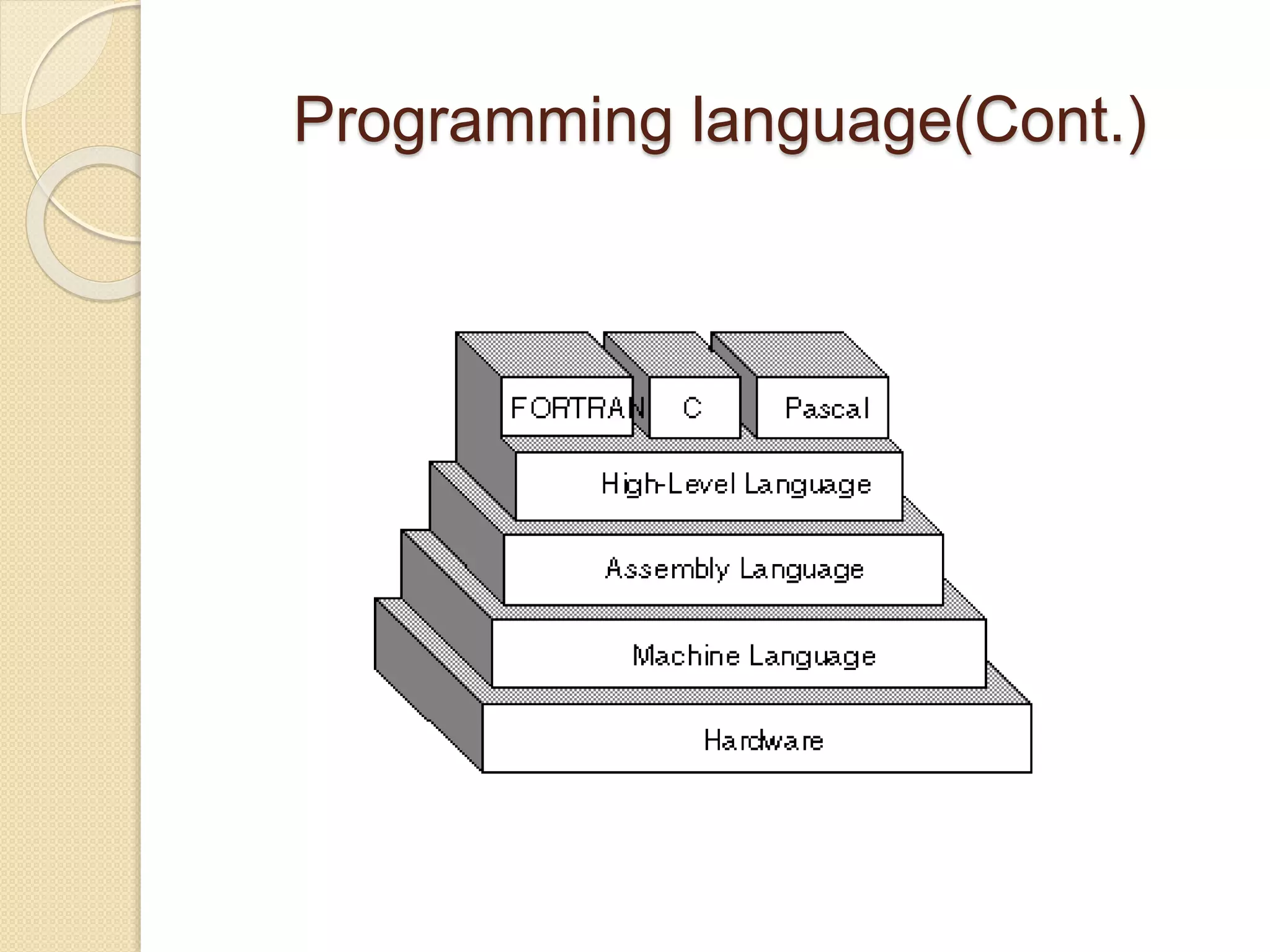
 Levels of programming language:
1)Machine language(low level)
2)Assembly language
3)Procedure oriented language(high level)
4)Fourth generation language(4GLs)
Programming language(Cont.)
1)Machine level language
 Computers are made of two-state electronic
components which can understand only pulse and no-
pulse (1 and 0) conditions.
 It consist of string of binary numbers(0 and 1).
 faster program execution
 It is very tedious to understand and remember the
various combinations of 1’s and 0’s representing data
and instructions.
 Every computer has its own machine language, the
programmer can not communicate with other computers
if he does not know its machine language.
2)Assembly language
 It uses mnemonic codes such as ADD for addition, SUB
for subtraction etc.
 Memory locations containing data are given names
such as TOTAL, MARKS, TIME etc.
 Thus, instead of referring a location using its number, it
can be referred using the name given to it.
 A program written in assembly language must be
translated into machine language before it can be
executed. This translation is done by another program
called assembler.
Programming language(Cont.)
 Advantages of assembly language over machine
language:
 It saves programmer’s time.
 Fewer errors are made.
 They are easier to modify than machine language
programs.
Programming language(Cont.)
3) Procedure oriented language (High level)
 This language consists of a set of words and symbols
and one can write programs using these in conjunction
with certain pre-specified rules of the language.
 A programming language such as C, FORTRAN,
or Pascal that enables a programmer to
write programs that are independent of a particular type
of computer.
 It is machine independent and a program written in high
level language can be run on different computers with
little or no modification.
 The main advantage of high-level languages over low-
level languages is that they are easier to read, write,
and maintain.
 Ultimately, programs written in a high-level language
must be translated into machine language by a
compiler or interpreter.
 faster program development
 It takes extra time for conversion and thus are less
efficient as compared to machine language programs.
Programming language(Cont.)
4) Fourth generation language
 A non-procedural programming language that requires
less coding than lower-level languages.
 Eg. Command-line languages, database management
systems (DBMSs). Prolog, an artificial
intelligence language that applies rules to data to
arrive at solutions
Language translators
 Compiler: It checks the entire program and if error free,
produces a complete program in machine
language(object code).Then object code is loaded in
memory for execution.
 Interpreter: which analyzes and executes each line of
source code without looking at the entire program.
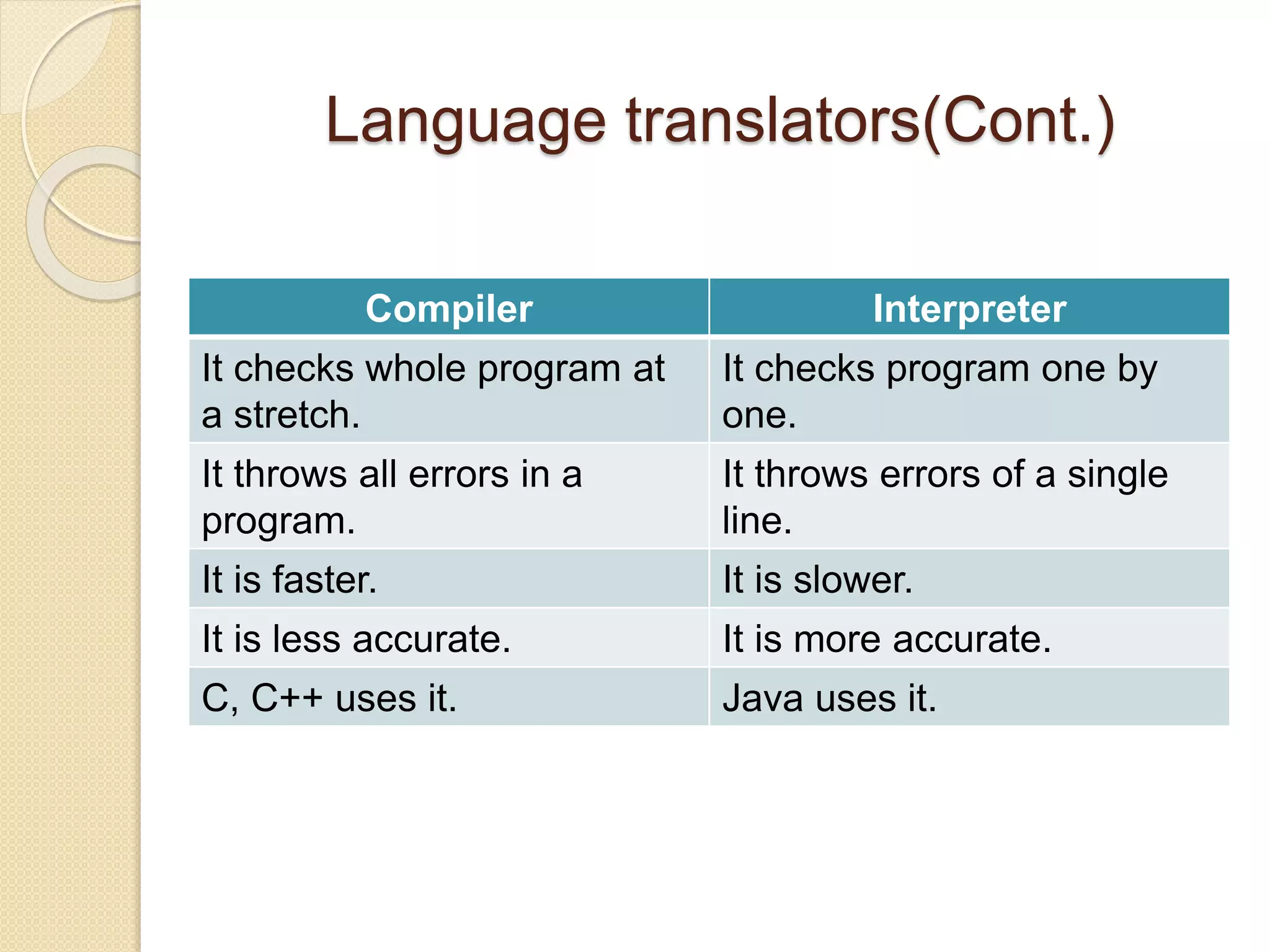
Compiler Interpreter
It checks whole program at
a stretch.
It checks program one by
one.
It throws all errors in a
program.
It throws errors of a single
line.
It is faster. It is slower.
It is less accurate. It is more accurate.
C, C++ uses it. Java uses it.
Language translators(Cont.)
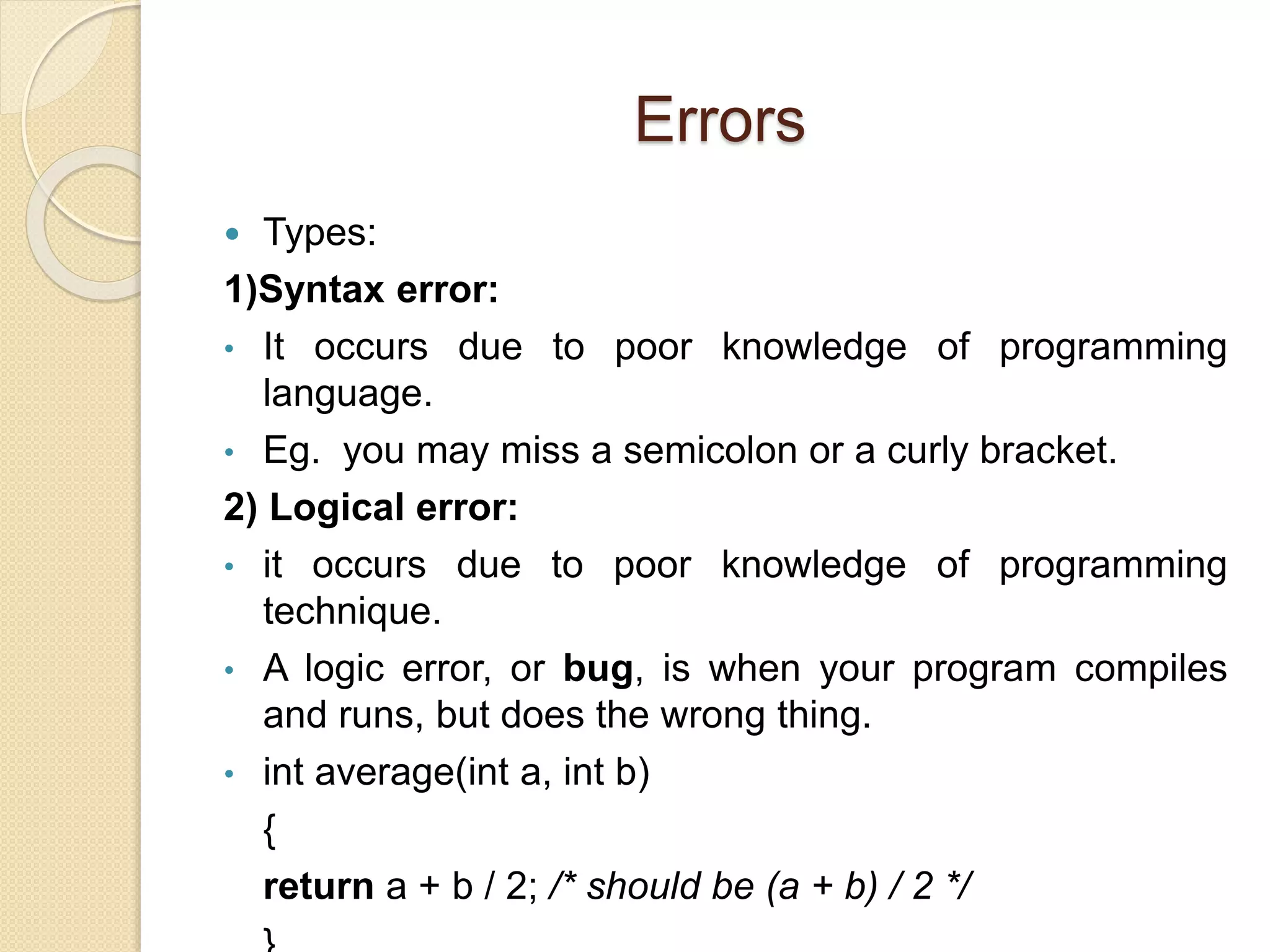
Errors
 Types:
1)Syntax error:
• It occurs due to poor knowledge of programming
language.
• Eg. you may miss a semicolon or a curly bracket.
2) Logical error:
• it occurs due to poor knowledge of programming
technique.
• A logic error, or bug, is when your program compiles
and runs, but does the wrong thing.
• int average(int a, int b)
{
return a + b / 2; /* should be (a + b) / 2 */
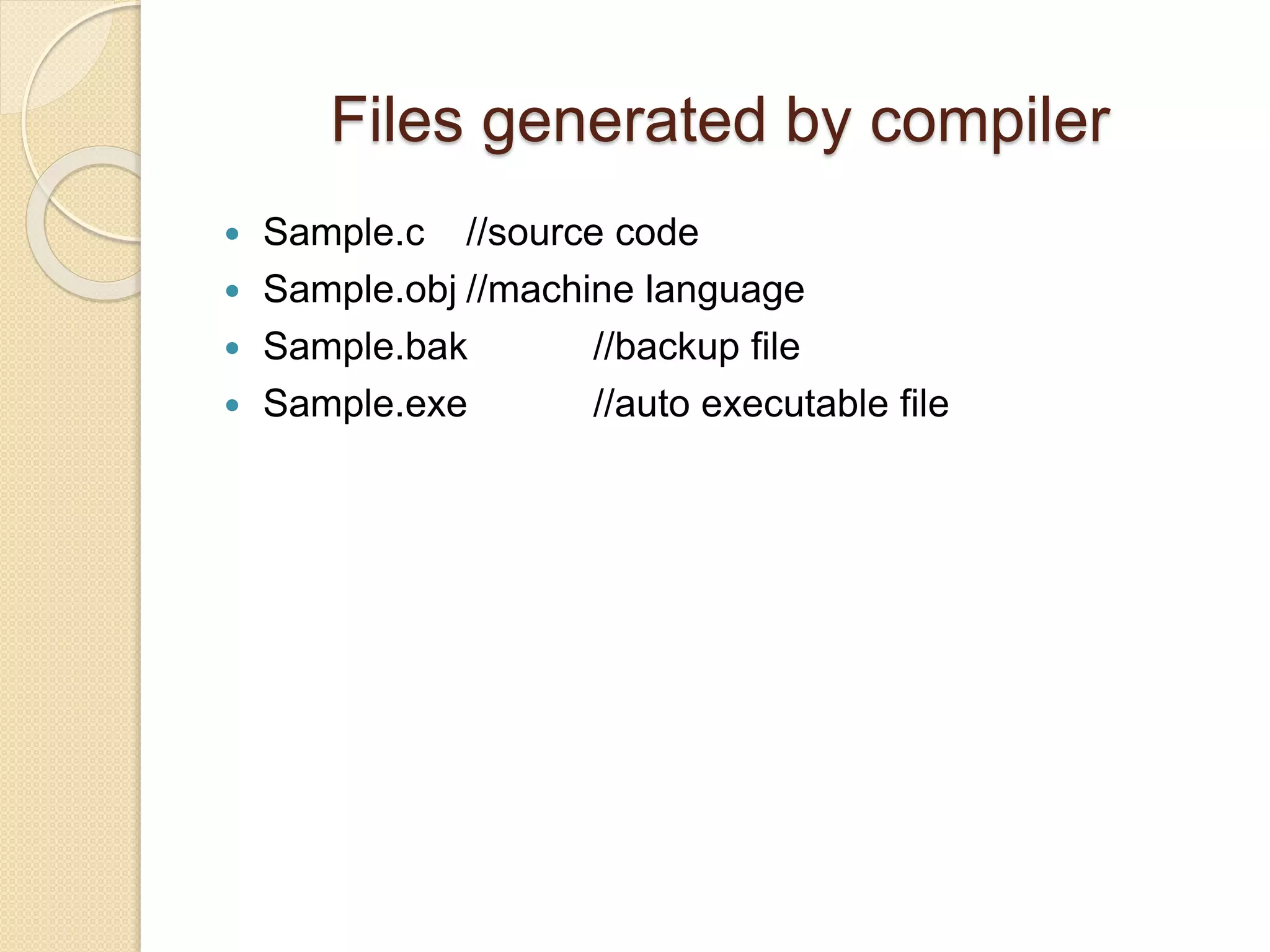
Files generated by compiler
 Sample.c //source code
 Sample.obj //machine language
 Sample.bak //backup file
 Sample.exe //auto executable file
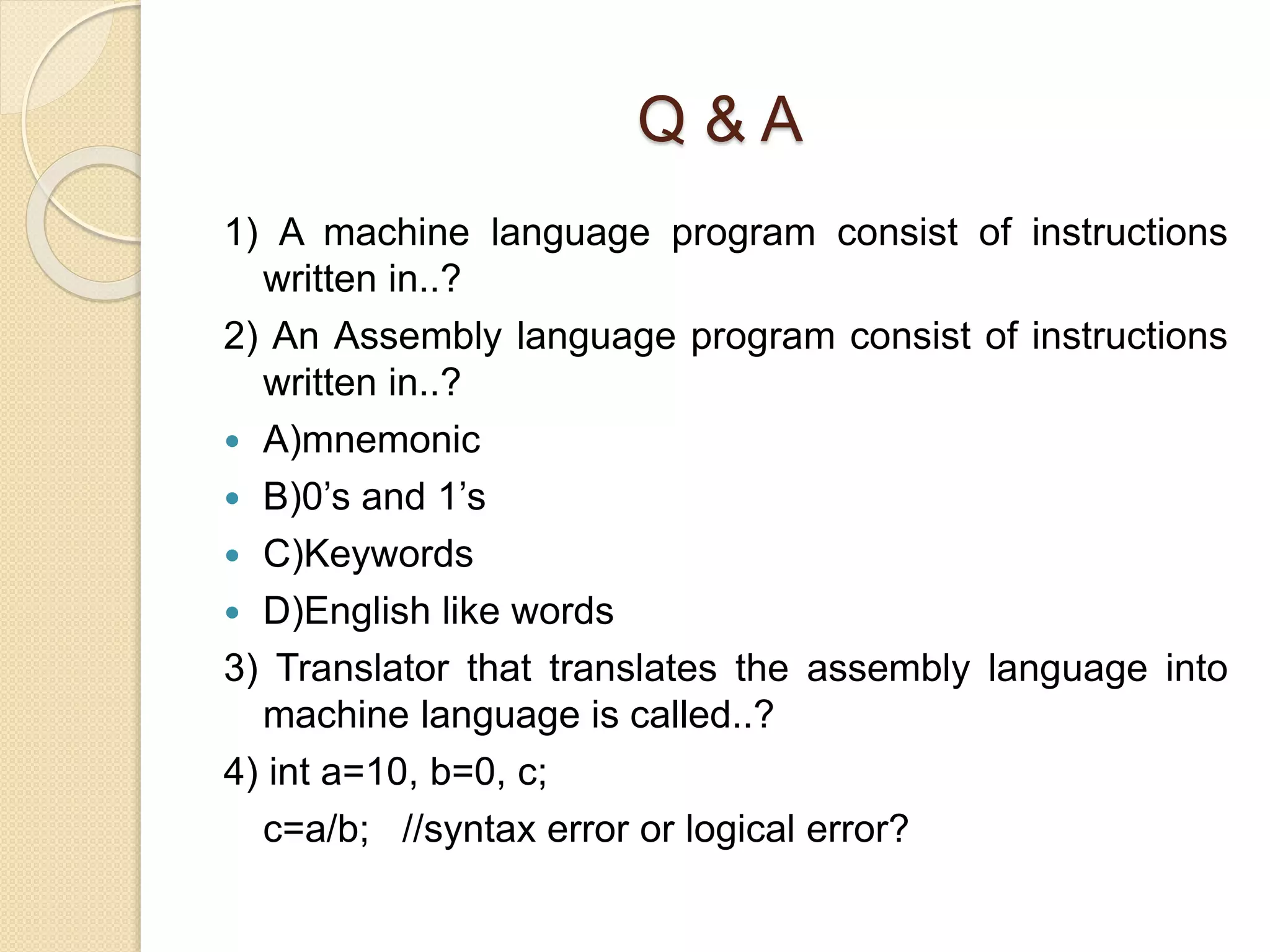
Q & A
1) A machine language program consist of instructions
written in..?
2) An Assembly language program consist of instructions
written in..?
 A)mnemonic
 B)0’s and 1’s
 C)Keywords
 D)English like words
3) Translator that translates the assembly language into
machine language is called..?
4) int a=10, b=0, c;
c=a/b; //syntax error or logical error?

1.Overview of Programming.pptx

  • 1.
  • 2.
    Programming language  Theset of instruction written in a programming language is called program.  Two types: 1) Application Program: Program which direct the computer to solve the problem of user. eg. Word, excel, games etc 2) System Program: Program which direct the computer to solve the problem of computer itself. eg. OS, antivirus software etc
  • 3.
     To communicatewith a computer it has to be instructed to carry out various tasks like: what operations to perform, how to present results, when and how to make certain decisions and so on.  These set of instructions have to be communicated to the computer through a language called ‘programming language’.  Levels of programming language: 1)Machine language(low level) 2)Assembly language 3)Procedure oriented language(high level) 4)Fourth generation language(4GLs) Programming language(Cont.)
  • 4.
  • 5.
    Programming language(Cont.) 1)Machine levellanguage  Computers are made of two-state electronic components which can understand only pulse and no- pulse (1 and 0) conditions.  It consist of string of binary numbers(0 and 1).  faster program execution  It is very tedious to understand and remember the various combinations of 1’s and 0’s representing data and instructions.  Every computer has its own machine language, the programmer can not communicate with other computers if he does not know its machine language.
  • 6.
    2)Assembly language  Ituses mnemonic codes such as ADD for addition, SUB for subtraction etc.  Memory locations containing data are given names such as TOTAL, MARKS, TIME etc.  Thus, instead of referring a location using its number, it can be referred using the name given to it.  A program written in assembly language must be translated into machine language before it can be executed. This translation is done by another program called assembler. Programming language(Cont.)
  • 7.
     Advantages ofassembly language over machine language:  It saves programmer’s time.  Fewer errors are made.  They are easier to modify than machine language programs. Programming language(Cont.)
  • 8.
    Programming language(Cont.) 3) Procedureoriented language (High level)  This language consists of a set of words and symbols and one can write programs using these in conjunction with certain pre-specified rules of the language.  A programming language such as C, FORTRAN, or Pascal that enables a programmer to write programs that are independent of a particular type of computer.  It is machine independent and a program written in high level language can be run on different computers with little or no modification.  The main advantage of high-level languages over low- level languages is that they are easier to read, write, and maintain.
  • 9.
     Ultimately, programswritten in a high-level language must be translated into machine language by a compiler or interpreter.  faster program development  It takes extra time for conversion and thus are less efficient as compared to machine language programs. Programming language(Cont.)
  • 10.
    Programming language(Cont.) 4) Fourthgeneration language  A non-procedural programming language that requires less coding than lower-level languages.  Eg. Command-line languages, database management systems (DBMSs). Prolog, an artificial intelligence language that applies rules to data to arrive at solutions
  • 11.
    Language translators  Compiler:It checks the entire program and if error free, produces a complete program in machine language(object code).Then object code is loaded in memory for execution.  Interpreter: which analyzes and executes each line of source code without looking at the entire program.
  • 12.
    Compiler Interpreter It checkswhole program at a stretch. It checks program one by one. It throws all errors in a program. It throws errors of a single line. It is faster. It is slower. It is less accurate. It is more accurate. C, C++ uses it. Java uses it. Language translators(Cont.)
  • 13.
    Errors  Types: 1)Syntax error: •It occurs due to poor knowledge of programming language. • Eg. you may miss a semicolon or a curly bracket. 2) Logical error: • it occurs due to poor knowledge of programming technique. • A logic error, or bug, is when your program compiles and runs, but does the wrong thing. • int average(int a, int b) { return a + b / 2; /* should be (a + b) / 2 */
  • 14.
    Files generated bycompiler  Sample.c //source code  Sample.obj //machine language  Sample.bak //backup file  Sample.exe //auto executable file
  • 15.
    Q & A 1)A machine language program consist of instructions written in..? 2) An Assembly language program consist of instructions written in..?  A)mnemonic  B)0’s and 1’s  C)Keywords  D)English like words 3) Translator that translates the assembly language into machine language is called..? 4) int a=10, b=0, c; c=a/b; //syntax error or logical error?