Free DELTA Webinar 18/09/2011


LANGUAGE DEVELOPMENT
                                           LDT
FOR TEACHERS

 PRESENTER: MARISA CONSTANTINIDES,
 CELT ATHENS
Language Needs

 Preparation   Instruction   Feedback
Lesson Preparation &
Materials Design


Evaluate, Select, Adapt, Design, Create, Supplement, Research
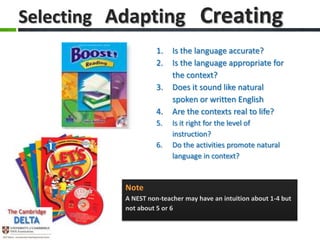
Selecting Adapting                 Creating
                     1.   Is the language accurate?
                     2.   Is the language appropriate for
                          the context?
                     3.   Does it sound like natural
                          spoken or written English
                     4.   Are the contexts real to life?
                     5.   Is it right for the level of
                          instruction?
                     6.   Do the activities promote natural
                          language in context?


           Note
           A NEST non-teacher may have an intuition about 1-4 but
           not about 5 or 6
Classroom Instruction


Instruct, Initiate, Elicit, Comment, Model, Evaluate, Correct, Nominate, Accept
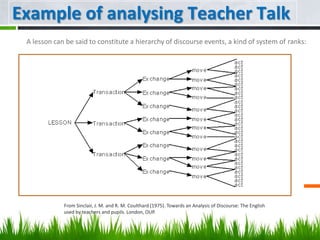
Example of analysing Teacher Talk
 A lesson can be said to constitute a hierarchy of discourse events, a kind of system of ranks:


             From Sinclair, J. M. and R. M. Coulthard (1975). Towards an Analysis of Discourse: The English
             used by teachers and pupils. London, OUP.
Classroom Discourse Task 1
   Look at the transcript of a transaction on the next page [from Papaefthymiou-
   Lytra S (1990), Explorations in Foreign Language Classroom Discourse] and decide
   how you would divide it into exchanges, moves, and acts.

   T:       Can you guess/think of one reason why doesn’t he like city-life?
   L:       Because the city is with many θορύβους
   T:       There is too much noise or too many noise?
   Ls:      Much noise.
   T:       Much noise.
   L:       City have a lot of buildings.
   T:       Cities have a lot of buildings.
            Big buildings.
   L:       There are much cars/many cars.
            They are ugly.
   T:       There are many cars.
   L:       And they must work.
   T:       They must work.
            People in villages work even more.
   L:       All the city people are in a hurry.
   T:       Yes.
Classroom Discourse Task 2
   Look at the definitions below [from Sinclair and Coulthard (1975), Towards an
   Analysis of Discourse] and label the transcript in the previous task
   accordingly.

   A transaction typically consists of an initial boundary exchange followed by a series of
   teaching exchanges.
   A boundary exchange consists of a move which marks a boundary between larger stages
   in the discourse (frame) and a move which indicates which direction the lesson is likely to
   proceed in (focus).
   A teaching exchange characteristically consists of an initiating move followed by a
   responding move or moves. the typical teaching exchange consists of Initiation (by the
   teacher), Response (by the learner) and Feedback (by the teacher).

   More specifically, teaching exchanges may belong to one of the following categories:
   teacher elicit [IRF], teacher direct [IR(F), where R is a nonverbal action], teacher inform
   [I(R)], checking [IR(F), where I represents a genuine teacher question, ie, one to which
   the teacher does not know the answer], pupil elicit [IR, where I is performed by the
   pupil] and pupil inform [IF, where I is performed by the pupil]
Feedback Correction


Identify Errors, Indicate, Recast, Explain, Present. Check Understanding
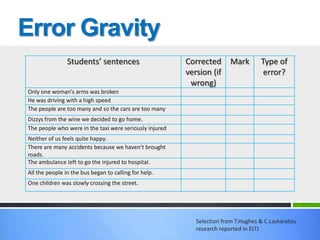
Error Gravity
                Students’ sentences                      Corrected      Mark        Type of
                                                         version (if                 error?
                                                          wrong)
Only one woman’s arms was broken
He was driving with a high speed
The people are too many and so the cars are too many
Dizzys from the wine we decided to go home.
The people who were in the taxi were seriously injured
Neither of us feels quite happy.
There are many accidents because we haven’t brought
roads.
The ambulance left to go the injured to hospital.
All the people in the bus began to calling for help.
One children was slowly crossing the street.


                                                            Selection from T.Hughes & C.Laskaratou
                                                            research reported in ELTJ
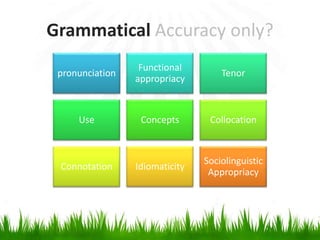
Grammatical Accuracy only?
                  Functional
 pronunciation                      Tenor
                 appropriacy


     Use          Concepts       Collocation


                                Sociolinguistic
 Connotation     Idiomaticity
                                 Appropriacy
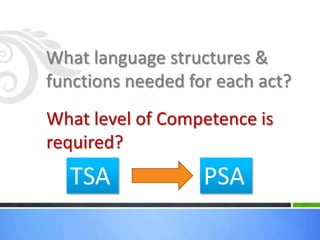
What language structures &
functions needed for each act?
What level of Competence is
required?
  TSA              PSA
Assessment?

•   Validity
•   Reliability
•   Clarity
•   Practicality
•   Discrimination
How can you assess Language Teachers?


                         By using an exam from an official
                         examining body?

                         By creating your own test?

                         By recording a T during a lesson?


                          All this will depend on your TSA and
                          what level the Ts are required to
                          reach.
Develop Professionally


  Research     Connect   Develop


                               What
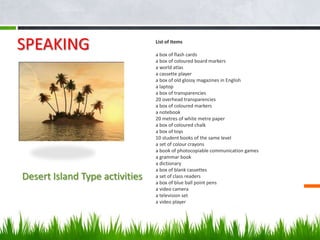
SPEAKING                        List of Items

                                a box of flash cards
                                a box of coloured board markers
                                a world atlas
                                a cassette player
                                a box of old glossy magazines in English
                                a laptop
                                a box of transparencies
                                20 overhead transparencies
                                a box of coloured markers
                                a notebook
                                20 metres of white metre paper
                                a box of coloured chalk
                                a box of toys
                                10 student books of the same level
                                a set of colour crayons
                                a book of photocopiable communication games
                                a grammar book
                                a dictionary
                                a box of blank cassettes
Desert Island Type activities   a set of class readers
                                a box of blue ball point pens
                                a video camera
                                a television set
                                a video player
WRITING           -----Original Message-----
                  From: Khalid Shammad
                  [mailto:kshammad@hotmail.com]
                  Sent: Thursday, May 17, 2001 11:08 PM
                  To: celt@celt.edu.gr
                  Subject: drama disertations

                  I'm interested in applying dramatic
                  techniques in teaching English in my
                  country, so I want you to provide me
                  with some abstracts of studies related to
                  this subject in order to conduct a study
                  about using drama in
                  our schools.
                                                 Thank You

          I did not reply to this letter as I felt it was too
          demanding/aggressive. Can you rewrite it so it
          becomes more likely the writer will get a response?
PRONUNCIATION – HUMOUR – PLAYING
WITH LANGUAGE
             I Read /listen to the original one...

              - My wife's gone to the West Indies
              - Jamaica?
              - No, she went of her own accord.

              Where is the misunderstanding?
             What is funny about it?


              Write some punch lines on the next page
PRONUNCIATION
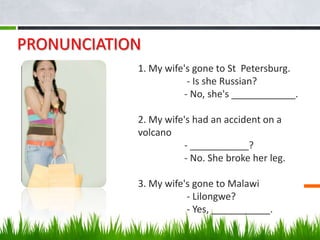
            1. My wife's gone to St Petersburg.
                        - Is she Russian?
                       - No, she's ____________.

            2. My wife's had an accident on a
            volcano
                       - ___________?
                       - No. She broke her leg.

            3. My wife's gone to Malawi
                       - Lilongwe?
                       - Yes, ___________.
PRONUNCIATION - CHUNKING


Task 2: Read these sentences in two different ways
so as to make two different interpretations possible.

I'm eating Mummy
We stopped wondering where to go
As a matter of fact she said I was too tall for my age


      Teachers need to read aloud to their students a lot
PRONUNCIATION
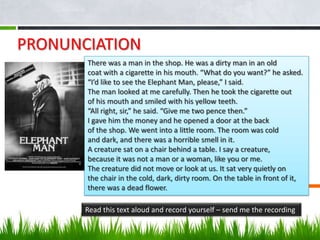
       There was a man in the shop. He was a dirty man in an old
       coat with a cigarette in his mouth. “What do you want?” he asked.
       “I’d like to see the Elephant Man, please,” I said.
       The man looked at me carefully. Then he took the cigarette out
       of his mouth and smiled with his yellow teeth.
       “All right, sir,” he said. “Give me two pence then.”
       I gave him the money and he opened a door at the back
       of the shop. We went into a little room. The room was cold
       and dark, and there was a horrible smell in it.
       A creature sat on a chair behind a table. I say a creature,
       because it was not a man or a woman, like you or me.
       The creature did not move or look at us. It sat very quietly on
       the chair in the cold, dark, dirty room. On the table in front of it,
       there was a dead flower.

       Read this text aloud and record yourself – send me the recording
LANGUAGE VARIATION

  TASK A:
  Which of these statements is: a) formal, b) casual, c) impersonal, d)
  informal.

  All candidates shall proceed to the examination room.

  Those taking part should go to the examination room.

  Could you please go to the exam room?

  Go to the exam room.
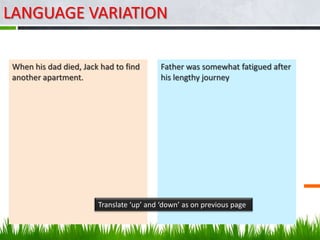
LANGUAGE VARIATION

When his dad died, Jack had to find       Father was somewhat fatigued after
another apartment.                        his lengthy journey


                       Translate ‘up’ and ‘down’ as on previous page
Course & Syllabus Design
should follow similar steps
                              .
EXAMPLES YOU CAN USE IN MODULE 3


 Use the CELT Athens English for Teachers Course
 webpage to explore syllabus elements you could
 include on such a course for your Module 3
 Assignment. Look for Syllabus ideas on the Cambridge
 ESOL website and especially the language awareness
 elements in ICELT & TKT KAL
Spread the Message!


That’s all
good folks!
CELT ATHENS
                   http://www.celt.edu.gr/

                  TEFL MATTERS BLOG
             marisaconstantinides.edublogs.org/

                            CELT SN
               http://celt-athens.grou.ps/home


Marisa Constantinides
@Marisa_C
What’s Your Message?
@info@celt.edu.gr

LANGUAGE DEVELOPMENT FOR TEACHERS (LDT)

  • 1.
    Free DELTA Webinar18/09/2011 LANGUAGE DEVELOPMENT LDT FOR TEACHERS PRESENTER: MARISA CONSTANTINIDES, CELT ATHENS
  • 2.
    Language Needs Preparation Instruction Feedback
  • 3.
    Lesson Preparation & MaterialsDesign Evaluate, Select, Adapt, Design, Create, Supplement, Research
  • 4.
    Selecting Adapting Creating 1. Is the language accurate? 2. Is the language appropriate for the context? 3. Does it sound like natural spoken or written English 4. Are the contexts real to life? 5. Is it right for the level of instruction? 6. Do the activities promote natural language in context? Note A NEST non-teacher may have an intuition about 1-4 but not about 5 or 6
  • 5.
    Classroom Instruction Instruct, Initiate,Elicit, Comment, Model, Evaluate, Correct, Nominate, Accept
  • 6.
    Example of analysingTeacher Talk A lesson can be said to constitute a hierarchy of discourse events, a kind of system of ranks: From Sinclair, J. M. and R. M. Coulthard (1975). Towards an Analysis of Discourse: The English used by teachers and pupils. London, OUP.
  • 7.
    Classroom Discourse Task1 Look at the transcript of a transaction on the next page [from Papaefthymiou- Lytra S (1990), Explorations in Foreign Language Classroom Discourse] and decide how you would divide it into exchanges, moves, and acts. T: Can you guess/think of one reason why doesn’t he like city-life? L: Because the city is with many θορύβους T: There is too much noise or too many noise? Ls: Much noise. T: Much noise. L: City have a lot of buildings. T: Cities have a lot of buildings. Big buildings. L: There are much cars/many cars. They are ugly. T: There are many cars. L: And they must work. T: They must work. People in villages work even more. L: All the city people are in a hurry. T: Yes.
  • 8.
    Classroom Discourse Task2 Look at the definitions below [from Sinclair and Coulthard (1975), Towards an Analysis of Discourse] and label the transcript in the previous task accordingly. A transaction typically consists of an initial boundary exchange followed by a series of teaching exchanges. A boundary exchange consists of a move which marks a boundary between larger stages in the discourse (frame) and a move which indicates which direction the lesson is likely to proceed in (focus). A teaching exchange characteristically consists of an initiating move followed by a responding move or moves. the typical teaching exchange consists of Initiation (by the teacher), Response (by the learner) and Feedback (by the teacher). More specifically, teaching exchanges may belong to one of the following categories: teacher elicit [IRF], teacher direct [IR(F), where R is a nonverbal action], teacher inform [I(R)], checking [IR(F), where I represents a genuine teacher question, ie, one to which the teacher does not know the answer], pupil elicit [IR, where I is performed by the pupil] and pupil inform [IF, where I is performed by the pupil]
  • 9.
    Feedback Correction Identify Errors,Indicate, Recast, Explain, Present. Check Understanding
  • 10.
    Error Gravity Students’ sentences Corrected Mark Type of version (if error? wrong) Only one woman’s arms was broken He was driving with a high speed The people are too many and so the cars are too many Dizzys from the wine we decided to go home. The people who were in the taxi were seriously injured Neither of us feels quite happy. There are many accidents because we haven’t brought roads. The ambulance left to go the injured to hospital. All the people in the bus began to calling for help. One children was slowly crossing the street. Selection from T.Hughes & C.Laskaratou research reported in ELTJ
  • 11.
    Grammatical Accuracy only? Functional pronunciation Tenor appropriacy Use Concepts Collocation Sociolinguistic Connotation Idiomaticity Appropriacy
  • 12.
    What language structures& functions needed for each act? What level of Competence is required? TSA PSA
  • 13.
    Assessment? • Validity • Reliability • Clarity • Practicality • Discrimination
  • 14.
    How can youassess Language Teachers? By using an exam from an official examining body? By creating your own test? By recording a T during a lesson? All this will depend on your TSA and what level the Ts are required to reach.
  • 15.
    Develop Professionally Research Connect Develop What
  • 17.
    SPEAKING List of Items a box of flash cards a box of coloured board markers a world atlas a cassette player a box of old glossy magazines in English a laptop a box of transparencies 20 overhead transparencies a box of coloured markers a notebook 20 metres of white metre paper a box of coloured chalk a box of toys 10 student books of the same level a set of colour crayons a book of photocopiable communication games a grammar book a dictionary a box of blank cassettes Desert Island Type activities a set of class readers a box of blue ball point pens a video camera a television set a video player
  • 18.
    WRITING -----Original Message----- From: Khalid Shammad [mailto:kshammad@hotmail.com] Sent: Thursday, May 17, 2001 11:08 PM To: celt@celt.edu.gr Subject: drama disertations I'm interested in applying dramatic techniques in teaching English in my country, so I want you to provide me with some abstracts of studies related to this subject in order to conduct a study about using drama in our schools. Thank You I did not reply to this letter as I felt it was too demanding/aggressive. Can you rewrite it so it becomes more likely the writer will get a response?
  • 19.
    PRONUNCIATION – HUMOUR– PLAYING WITH LANGUAGE I Read /listen to the original one... - My wife's gone to the West Indies - Jamaica? - No, she went of her own accord. Where is the misunderstanding? What is funny about it? Write some punch lines on the next page
  • 20.
    PRONUNCIATION 1. My wife's gone to St Petersburg. - Is she Russian? - No, she's ____________. 2. My wife's had an accident on a volcano - ___________? - No. She broke her leg. 3. My wife's gone to Malawi - Lilongwe? - Yes, ___________.
  • 21.
    PRONUNCIATION - CHUNKING Task2: Read these sentences in two different ways so as to make two different interpretations possible. I'm eating Mummy We stopped wondering where to go As a matter of fact she said I was too tall for my age Teachers need to read aloud to their students a lot
  • 22.
    PRONUNCIATION There was a man in the shop. He was a dirty man in an old coat with a cigarette in his mouth. “What do you want?” he asked. “I’d like to see the Elephant Man, please,” I said. The man looked at me carefully. Then he took the cigarette out of his mouth and smiled with his yellow teeth. “All right, sir,” he said. “Give me two pence then.” I gave him the money and he opened a door at the back of the shop. We went into a little room. The room was cold and dark, and there was a horrible smell in it. A creature sat on a chair behind a table. I say a creature, because it was not a man or a woman, like you or me. The creature did not move or look at us. It sat very quietly on the chair in the cold, dark, dirty room. On the table in front of it, there was a dead flower. Read this text aloud and record yourself – send me the recording
  • 23.
    LANGUAGE VARIATION TASK A: Which of these statements is: a) formal, b) casual, c) impersonal, d) informal. All candidates shall proceed to the examination room. Those taking part should go to the examination room. Could you please go to the exam room? Go to the exam room.
  • 24.
    LANGUAGE VARIATION When hisdad died, Jack had to find Father was somewhat fatigued after another apartment. his lengthy journey Translate ‘up’ and ‘down’ as on previous page
  • 26.
    Course & SyllabusDesign should follow similar steps .
  • 27.
    EXAMPLES YOU CANUSE IN MODULE 3 Use the CELT Athens English for Teachers Course webpage to explore syllabus elements you could include on such a course for your Module 3 Assignment. Look for Syllabus ideas on the Cambridge ESOL website and especially the language awareness elements in ICELT & TKT KAL
  • 28.
  • 29.
    CELT ATHENS http://www.celt.edu.gr/ TEFL MATTERS BLOG marisaconstantinides.edublogs.org/ CELT SN http://celt-athens.grou.ps/home Marisa Constantinides @Marisa_C What’s Your Message? @info@celt.edu.gr

Editor's Notes

  • #2 This presentation demonstrates the new capabilities of PowerPoint and it is best viewed in Slide Show. These slides are designed to give you great ideas for the presentations you’ll create in PowerPoint 2010!For more sample templates, click the File tab, and then on the New tab, click Sample Templates.
  • #13 TSA+Target Situation Analysis PSA= Present Situation Analysis