Language Change Overview








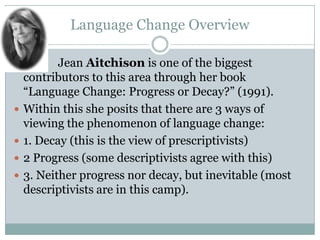
Jean Aitchison is one of the biggest
contributors to this area through her book
“Language Change: Progress or Decay?” (1991).
Within this she posits that there are 3 ways of
viewing the phenomenon of language change:
1. Decay (this is the view of prescriptivists)
2 Progress (some descriptivists agree with this)
3. Neither progress nor decay, but inevitable (most
descriptivists are in this camp).
Types of change
 Aitchison felt that changes could be both conscious

and unconscious.
 In Labov‟s New York study, his elicitation of
spontaneous versus careful speech highlighted that
New Yorkers were consciously moving towards the
use of a rhotic /r/, as this occurred more in careful
speech. This can therefore be associated with overt
prestige, moving towards the most
desirable(standard) variety.
Types of change
 However his Martha‟s vineyard study highlighted a

different trend. The vowel changes in the community
highlighted a trend towards imitating the
conservative speech patterns of the older fishermen
of the island as tourist rates increased and the
islanders needed to establish themselves as a
separate group. This change was however
subconscious and the islanders were not at all
aware of exaggerating the vowel changes. This is an
example of covert prestige.
Why: Causes Versus Catalysts
 Language change comes about through a variety of

causes. Some are natural and some are social.
 An example of a natural cause is the phenomenon of
Ease of articulation whereby language changes
because people try to make combinations of sounds
easier to say. E.g. the word „thumb‟ lost the /b/
sound due to omission/elision by dropping the
final consonant (compare thimble).
Why: Causes Versus Catalysts
 Although change usually comes about through the

ways mentioned there are also some catalysts which
help speed up the process. These are usually social
triggers such as prestige. The reactions to this, as
discussed, can be conscious or unconscious.
Other Language change theories that try to explain
why
 Functional theory proposed by M.A.K.







Halliday, posits that language changes according to
the needs of its users. This mainly covers lexical
change. This tends to take the form of:
1. new discoveries/learning/inventions.
2. Technological words
3. Slang.
Eval: this theory makes a lot of sense but cannot
account for all language change as it focusses only on
lexical change.
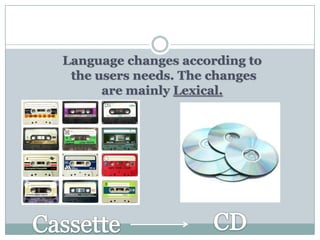
Language changes according to
the users needs. The changes
are mainly Lexical.
EXAMPLES:
Going out of use:
• Vinyl?
• LP
• Cassette
• Betamax
• Floppy Disk
• Video

Words disappear over
time as things change,
e.g. Technology and
Science.

Coming into use:
• USB
• MP3
• DVD
• Flash drive
• Blu-ray
• iPod
• Laptop
Other Language change theories that try to explain
why.

 Random fluctuation theory was supported by 2

linguists. Paul Postal said that language is as
unpredictable as fashion and therefore changes in
language are totally random.
 Charles Hockett proposed a different angle, that
random „mistakes‟ lead to language changing.
 Eval: 1. This would lead to linguistic chaos; 2.
Changes that occur in different languages are too
similar to be random; Not all elements change (e.g.
grammar)
Other Language change theories that try to explain
why.

 Substratum theory explains changes in language

coming about through language contact. In the past
this happened mainly through trade and invasion.
Nowadays it might happen through social
networking and immigration
 Eval: 1. Again this theory accounts for some aspects
of language change but cannot be the sole reason for
it.
How?
 We looked at many possible changes in language and






many reasons why language changes and we now
need to look at HOW these take place.
JA says that there are 3 aspects to the way a change
takes place:
1. Potential for change: a speaker makes a linguistic
choice.
2. Implementation: the choice becomes selected as
part of a linguistic system
Diffusion: the change is imitated beyond the site of
origin.
How?
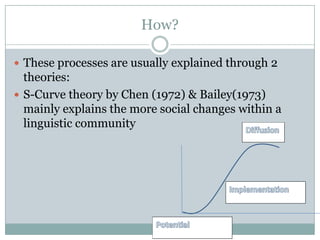
 These processes are usually explained through 2

theories:
 S-Curve theory by Chen (1972) & Bailey(1973)
mainly explains the more social changes within a
linguistic community
How?
 The wave theory by Chen & Wang
 Explains the geographical
 Spread of language changes.
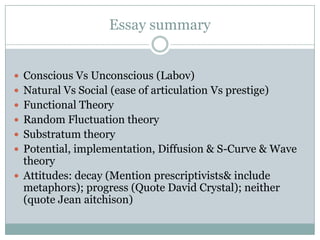
Essay summary
 Conscious Vs Unconscious (Labov)
 Natural Vs Social (ease of articulation Vs prestige)
 Functional Theory
 Random Fluctuation theory
 Substratum theory
 Potential, implementation, Diffusion & S-Curve & Wave

theory
 Attitudes: decay (Mention prescriptivists& include
metaphors); progress (Quote David Crystal); neither
(quote Jean aitchison)
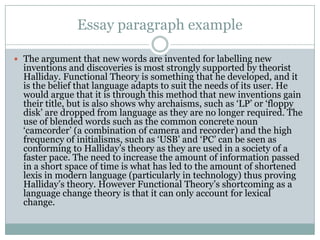
Essay paragraph example
 The argument that new words are invented for labelling new

inventions and discoveries is most strongly supported by theorist
Halliday. Functional Theory is something that he developed, and it
is the belief that language adapts to suit the needs of its user. He
would argue that it is through this method that new inventions gain
their title, but is also shows why archaisms, such as „LP‟ or „floppy
disk‟ are dropped from language as they are no longer required. The
use of blended words such as the common concrete noun
„camcorder‟ (a combination of camera and recorder) and the high
frequency of initialisms, such as „USB‟ and „PC‟ can be seen as
conforming to Halliday‟s theory as they are used in a society of a
faster pace. The need to increase the amount of information passed
in a short space of time is what has led to the amount of shortened
lexis in modern language (particularly in technology) thus proving
Halliday‟s theory. However Functional Theory‟s shortcoming as a
language change theory is that it can only account for lexical
change.
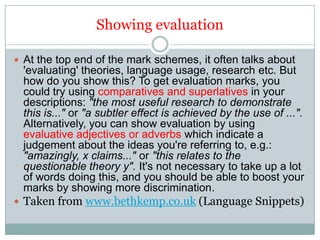
Showing evaluation
 At the top end of the mark schemes, it often talks about

'evaluating' theories, language usage, research etc. But
how do you show this? To get evaluation marks, you
could try using comparatives and superlatives in your
descriptions: "the most useful research to demonstrate
this is..." or "a subtler effect is achieved by the use of ...".
Alternatively, you can show evaluation by using
evaluative adjectives or adverbs which indicate a
judgement about the ideas you're referring to, e.g.:
"amazingly, x claims..." or "this relates to the
questionable theory y". It's not necessary to take up a lot
of words doing this, and you should be able to boost your
marks by showing more discrimination.
 Taken from www.bethkemp.co.uk (Language Snippets)

Language change theories

  • 1.
    Language Change Overview      JeanAitchison is one of the biggest contributors to this area through her book “Language Change: Progress or Decay?” (1991). Within this she posits that there are 3 ways of viewing the phenomenon of language change: 1. Decay (this is the view of prescriptivists) 2 Progress (some descriptivists agree with this) 3. Neither progress nor decay, but inevitable (most descriptivists are in this camp).
  • 2.
    Types of change Aitchison felt that changes could be both conscious and unconscious.  In Labov‟s New York study, his elicitation of spontaneous versus careful speech highlighted that New Yorkers were consciously moving towards the use of a rhotic /r/, as this occurred more in careful speech. This can therefore be associated with overt prestige, moving towards the most desirable(standard) variety.
  • 3.
    Types of change However his Martha‟s vineyard study highlighted a different trend. The vowel changes in the community highlighted a trend towards imitating the conservative speech patterns of the older fishermen of the island as tourist rates increased and the islanders needed to establish themselves as a separate group. This change was however subconscious and the islanders were not at all aware of exaggerating the vowel changes. This is an example of covert prestige.
  • 4.
    Why: Causes VersusCatalysts  Language change comes about through a variety of causes. Some are natural and some are social.  An example of a natural cause is the phenomenon of Ease of articulation whereby language changes because people try to make combinations of sounds easier to say. E.g. the word „thumb‟ lost the /b/ sound due to omission/elision by dropping the final consonant (compare thimble).
  • 5.
    Why: Causes VersusCatalysts  Although change usually comes about through the ways mentioned there are also some catalysts which help speed up the process. These are usually social triggers such as prestige. The reactions to this, as discussed, can be conscious or unconscious.
  • 6.
    Other Language changetheories that try to explain why  Functional theory proposed by M.A.K.     Halliday, posits that language changes according to the needs of its users. This mainly covers lexical change. This tends to take the form of: 1. new discoveries/learning/inventions. 2. Technological words 3. Slang. Eval: this theory makes a lot of sense but cannot account for all language change as it focusses only on lexical change.
  • 7.
    Language changes accordingto the users needs. The changes are mainly Lexical.
  • 8.
    EXAMPLES: Going out ofuse: • Vinyl? • LP • Cassette • Betamax • Floppy Disk • Video Words disappear over time as things change, e.g. Technology and Science. Coming into use: • USB • MP3 • DVD • Flash drive • Blu-ray • iPod • Laptop
  • 10.
    Other Language changetheories that try to explain why.  Random fluctuation theory was supported by 2 linguists. Paul Postal said that language is as unpredictable as fashion and therefore changes in language are totally random.  Charles Hockett proposed a different angle, that random „mistakes‟ lead to language changing.  Eval: 1. This would lead to linguistic chaos; 2. Changes that occur in different languages are too similar to be random; Not all elements change (e.g. grammar)
  • 11.
    Other Language changetheories that try to explain why.  Substratum theory explains changes in language coming about through language contact. In the past this happened mainly through trade and invasion. Nowadays it might happen through social networking and immigration  Eval: 1. Again this theory accounts for some aspects of language change but cannot be the sole reason for it.
  • 12.
    How?  We lookedat many possible changes in language and     many reasons why language changes and we now need to look at HOW these take place. JA says that there are 3 aspects to the way a change takes place: 1. Potential for change: a speaker makes a linguistic choice. 2. Implementation: the choice becomes selected as part of a linguistic system Diffusion: the change is imitated beyond the site of origin.
  • 13.
    How?  These processesare usually explained through 2 theories:  S-Curve theory by Chen (1972) & Bailey(1973) mainly explains the more social changes within a linguistic community
  • 14.
    How?  The wavetheory by Chen & Wang  Explains the geographical  Spread of language changes.
  • 15.
    Essay summary  ConsciousVs Unconscious (Labov)  Natural Vs Social (ease of articulation Vs prestige)  Functional Theory  Random Fluctuation theory  Substratum theory  Potential, implementation, Diffusion & S-Curve & Wave theory  Attitudes: decay (Mention prescriptivists& include metaphors); progress (Quote David Crystal); neither (quote Jean aitchison)
  • 16.
    Essay paragraph example The argument that new words are invented for labelling new inventions and discoveries is most strongly supported by theorist Halliday. Functional Theory is something that he developed, and it is the belief that language adapts to suit the needs of its user. He would argue that it is through this method that new inventions gain their title, but is also shows why archaisms, such as „LP‟ or „floppy disk‟ are dropped from language as they are no longer required. The use of blended words such as the common concrete noun „camcorder‟ (a combination of camera and recorder) and the high frequency of initialisms, such as „USB‟ and „PC‟ can be seen as conforming to Halliday‟s theory as they are used in a society of a faster pace. The need to increase the amount of information passed in a short space of time is what has led to the amount of shortened lexis in modern language (particularly in technology) thus proving Halliday‟s theory. However Functional Theory‟s shortcoming as a language change theory is that it can only account for lexical change.
  • 17.
    Showing evaluation  Atthe top end of the mark schemes, it often talks about 'evaluating' theories, language usage, research etc. But how do you show this? To get evaluation marks, you could try using comparatives and superlatives in your descriptions: "the most useful research to demonstrate this is..." or "a subtler effect is achieved by the use of ...". Alternatively, you can show evaluation by using evaluative adjectives or adverbs which indicate a judgement about the ideas you're referring to, e.g.: "amazingly, x claims..." or "this relates to the questionable theory y". It's not necessary to take up a lot of words doing this, and you should be able to boost your marks by showing more discrimination.  Taken from www.bethkemp.co.uk (Language Snippets)