A VISION-BASED LANE TRACKING
SYSTEM FOR AUTONOMOUS DRIVING
USING KALMAN FILTER
Department of Information Engineering
University of Pisa
A. Biondi – .
F. Corucci – .
2011
Project for Digital Control class
Prof. A. Balestrino, Prof. A. Landi
Aim of the project
 Build a vision-based lane tracking system using
Kalman filter
 Test Kalman filter effectiveness in a practical noisy
scenario
 Experience with some computer vision algorithms
and techniques
Project for Digital Control class - University of Pisa 2
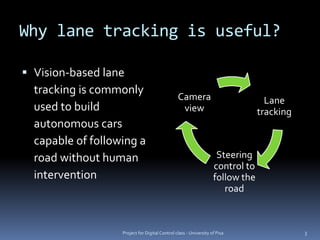
Why lane tracking is useful?
Lane
tracking
Steering
control to
follow the
road
Camera
view
 Vision-based lane
tracking is commonly
used to build
autonomous cars
capable of following a
road without human
intervention
Project for Digital Control class - University of Pisa 3
Video acquisition
 In order to collect a
dataset to work with, we
placed a netbook on an
hand-cart and recorded
a video from the
webcam while following
a realistic circuit as best
as possible
Project for Digital Control class - University of Pisa 4
Video acquisition
Project for Digital Control class - University of Pisa 5
RGB video frame grabbed from the webcam
Image preprocessing - Overview
Project for Digital Control class - University of Pisa 6
 Some preprocessing is needed on the RGB video frame
in order to perform feature discrimination:
RGB frame
Grayscale
Equalization Filtering
Binarization
Edge detection
Grayscale conversion
Project for Digital Control class - University of Pisa 7
Grayscale video frame
Color distribution
Floor
Lane
markers
Enhancing color separation
Project for Digital Control class - University of Pisa 8
Enhanced color
separation
Resulting color distribution
Floor
Lane
markers
This was achieved using the
decorrelation stretch method,
commonly used for feature
discrimination in images.
(Correlated images does not
usually have sharp contours)
Filtering floor components
Project for Digital Control class - University of Pisa 9
Image after filtering
Resulting color distribution
Floor
Lane
markers
FILTER
This was achieved enhancing the
image contrast through color
saturation (with appropriate
thresholds).
Floor is saturated to black
Image binarization
Project for Digital Control class - University of Pisa 10
Binarized image
 The image is now a matrix of 0 and 1
Edge detection
 Once the interesting features (i.e. lane marks) are
enhanced, we detect edges in the video frame, in
order to identify lane-marks contours to be
followed
 The Canny algorithm (a derivative filter) was used
for this purpose
Project for Digital Control class - University of Pisa 11
Edge detection - Canny
Project for Digital Control class - University of Pisa 12
Frame after Canny application
The linear contours are now clearly identifiable
Line detection
 We are now able to extrapolate the analytic
equations of the lane-mark borders
 At the first frame, we have no idea of where lane
marks could be, so we need to perform a global
scan
 We used the Hough Transformation in order to
detect lines in this situation
Project for Digital Control class - University of Pisa 13
Outline on Hough transformation
Project for Digital Control class - University of Pisa 14
θ
 Allows to discriminate features
described by an analytical
equation
 It has been generalized in order
to detect arbitrarily complex
shapes
 The problem of searching for a
feature is translated in a max
problem
Example of Hough
detection on a complex
shape
More on Hough transformation
Project for Digital Control class - University of Pisa 15
θ
 The equation that ties the curve parameters 𝑎𝑖 to the
coordinates 𝑥, 𝑦 looks like:
𝑓 𝑥, 𝑦 , 𝑎1, … , 𝑎 𝑛 = 0
 Every point 𝑥𝑖, 𝑦𝑖 of the image space generates a
hyper-curve in the parametric space
 A point in the parametric space identifies uniquely a
curve in the image space
 N points of the image space generate N curves in the
parametric space with a common intersection that is the
curve on which they possibly lie on
More on Hough transformation
Project for Digital Control class - University of Pisa 16
θ
 In our case the curves in the parametric space are still
lines
𝑦 = 𝑚𝑥 + 𝑞 → 𝑓 𝑥, 𝑦 , 𝑚, 𝑞 = 0
 Given a point 𝑥𝑖, 𝑦𝑖 , the parametric equation is
𝑞 = 𝑦𝑖 − 𝑚 ∗ 𝑥𝑖
 Every intersection in the parameter space is interpreted
as a vote for the corresponding curve
 A curve that has lot of votes identifies (with a certain
confidence) a relevant feature
Line detection
Project for Digital Control class - University of Pisa 17
Hough transform parameters space
Peaks identifiyng lines
Detected lines,
superimposed on the
original RGB frame
θ
Inverse perspective transform
 Work in perspective space is not convenient
 A common way to avoid it is performing an inverse
perspective transformation (→ Bird’s Eye view)
 The achieved «virtual» top view is much more
convenient in order to measure the distances and
the angles we need
 Various auxiliary operation in our application are
performed in this space
Project for Digital Control class - University of Pisa 18
Inverse perspective transform
Project for Digital Control class - University of Pisa 19
I → W map
Inverse perspective transform
Project for Digital Control class - University of Pisa 20
Bird’s eye view («virtual» top view)
I space
W space
Perspective view
So, where’s Kalman?
 The problem with this approach is that performing a
HoughTransformation on the whole image is
computationally heavy: with a reasonable video frame
rate for a driving application, there is no time to
perform Hough between two subsequent frames
We can exploit Kalman to drastically reduce the search
area in every frame and subsequently detect lane-markers
in a computationally efficient way
Project for Digital Control class - University of Pisa 21
Kalman – the intuition
 Once we have an idea of where the lane marks are at the
first frame, a Kalman filter is used in order to predict where
the lane marks will be in the next video frame
 The system then evolves step-by-step, frame after frame,
through Kalman predictions, until this is possible (i.e.
Kalman is able to lock-on the lane mark)
 Every Kalman prediction identifies a very thin region of the
next frame, in which we can perform a local search in a very
efficient way (preprocessing, binarization, pixels fit)
 If something goes wrong and we are not able to identify the
lane mark in the predicted band, a global Hough scan is
performed
Project for Digital Control class - University of Pisa 22
Algorithm overview
Project for Digital Control class - University of Pisa 23
1-st frame
• Hough detection
• Kalman initialization
• Kalman prediction for frame no. 2
k-th frame
• Fit inside Kalman predicted band
• If fit fails -> Perform Hough Detection and init. Kalman
• Kalman prediction for frame no. K+1
…
…
…
…
Model details
𝐴 𝑘+1= 𝐹𝐴 𝑘 + 𝐺𝑢 𝑘+ 𝑤 𝑘
𝑦 𝑘 = 𝐻𝐴 𝑘+ 𝑣 𝑘
Project for Digital Control class - University of Pisa 24
 𝑨 = state vector =
𝒎
𝒒
Where 𝑚 and 𝑞 are coefficients of a line expressed as: 𝑦 = 𝑚𝑥 + 𝑞
A linear model was sufficient for our short-range view
 𝑭 = autonomous dynamic
Models the evolution of the state when no input is applied. In order to simplify the
model, considered the low velocity and the high frame rate, we have taken 𝐹 = 𝐼
 𝒖 = input vector, models the vehicle steering (here simulated)
 𝑮 = maps the input on the state
 𝒘 𝒌 = process noise ~ 𝑵(𝟎, 𝑷)
 𝒗 𝒌 = measure noise (fit error due to pixel discretization) ~ 𝑵(𝟎, 𝑸)
 𝒚 𝒌 = output (for us, output = state)
 𝑯 = maps state on the output (for us, 𝐻 = 𝐼)
Kalman algorithm
Project for Digital Control class - University of Pisa 25
 𝑃𝑘 = covariance matrix of the process noise 𝒘
 𝑄 𝑘 = covariance matrix of the measurement noise 𝒗
 𝐾𝑘 = Kalman gain
Predicted state Estimated state
Kalman-based detection
Project for Digital Control class - University of Pisa 26
Left lane-mark Right lane-mark Legend:
- Green region:
Kalman predicted
band
- Blue line:
Fitted line
- White line:
Lane-mark
contour (real
pixels)
Experimental results
Project for Digital Control class - University of Pisa 27
<video simulation>
 As shown in the simulation, Kalman is able to track
lane-marks without problems, even:
 in presence of sudden anomalous car movements
 with a simplified linear model (the curve is well tracked!)
 with a simplified model that does not consider the autonomous
dynamic of the system
 Hough recalculation is triggered only when the left lane-
mark disappears from the camera-field: a polling mode
is triggered in this situation, and the lane-mark is
locked-on again when it returns in the camera-field
Future work
Project for Digital Control class - University of Pisa 28
 Use the tracking information in order to make a
vehicle autonomously follow the circuit (a simple
PID can be used to control the steering)
 Simulation
 Implementation
 Mounting a netbook running MATLAB on a toy car equipped with a
camera
 DSP + μcontroller based implementation
Bibliography
Project for Digital Control class - University of Pisa 29
 «A massively parallel approach to real-time
vision-based road markings detection»
Alberto Broggi – University of Parma
http://www.ce.unipr.it/people/broggi/publications/detroit.pdf
 «Lane detection and Kalman-based
linear-parabolic lane tracking»
Lim, Seng,Ang, Chin -The University of Nottingham Malaysia campus
Published at IHMSC’09 - Intelligent Human-Machine Systems and Cybernetics
 «La trasformata di Hough»
Padova University, Computer vision course 07/08
http://vision.unipv.it/corsi/VisioneArtificiale-ls/lucidi/VA-06.pdf
Thank you!
Project for Digital Control class - University of Pisa 30

Implementation of a lane-tracking system for autonomous driving using Kalman filter

  • 1.
    A VISION-BASED LANETRACKING SYSTEM FOR AUTONOMOUS DRIVING USING KALMAN FILTER Department of Information Engineering University of Pisa A. Biondi – . F. Corucci – . 2011 Project for Digital Control class Prof. A. Balestrino, Prof. A. Landi
  • 2.
    Aim of theproject  Build a vision-based lane tracking system using Kalman filter  Test Kalman filter effectiveness in a practical noisy scenario  Experience with some computer vision algorithms and techniques Project for Digital Control class - University of Pisa 2
  • 3.
    Why lane trackingis useful? Lane tracking Steering control to follow the road Camera view  Vision-based lane tracking is commonly used to build autonomous cars capable of following a road without human intervention Project for Digital Control class - University of Pisa 3
  • 4.
    Video acquisition  Inorder to collect a dataset to work with, we placed a netbook on an hand-cart and recorded a video from the webcam while following a realistic circuit as best as possible Project for Digital Control class - University of Pisa 4
  • 5.
    Video acquisition Project forDigital Control class - University of Pisa 5 RGB video frame grabbed from the webcam
  • 6.
    Image preprocessing -Overview Project for Digital Control class - University of Pisa 6  Some preprocessing is needed on the RGB video frame in order to perform feature discrimination: RGB frame Grayscale Equalization Filtering Binarization Edge detection
  • 7.
    Grayscale conversion Project forDigital Control class - University of Pisa 7 Grayscale video frame Color distribution Floor Lane markers
  • 8.
    Enhancing color separation Projectfor Digital Control class - University of Pisa 8 Enhanced color separation Resulting color distribution Floor Lane markers This was achieved using the decorrelation stretch method, commonly used for feature discrimination in images. (Correlated images does not usually have sharp contours)
  • 9.
    Filtering floor components Projectfor Digital Control class - University of Pisa 9 Image after filtering Resulting color distribution Floor Lane markers FILTER This was achieved enhancing the image contrast through color saturation (with appropriate thresholds). Floor is saturated to black
  • 10.
    Image binarization Project forDigital Control class - University of Pisa 10 Binarized image  The image is now a matrix of 0 and 1
  • 11.
    Edge detection  Oncethe interesting features (i.e. lane marks) are enhanced, we detect edges in the video frame, in order to identify lane-marks contours to be followed  The Canny algorithm (a derivative filter) was used for this purpose Project for Digital Control class - University of Pisa 11
  • 12.
    Edge detection -Canny Project for Digital Control class - University of Pisa 12 Frame after Canny application The linear contours are now clearly identifiable
  • 13.
    Line detection  Weare now able to extrapolate the analytic equations of the lane-mark borders  At the first frame, we have no idea of where lane marks could be, so we need to perform a global scan  We used the Hough Transformation in order to detect lines in this situation Project for Digital Control class - University of Pisa 13
  • 14.
    Outline on Houghtransformation Project for Digital Control class - University of Pisa 14 θ  Allows to discriminate features described by an analytical equation  It has been generalized in order to detect arbitrarily complex shapes  The problem of searching for a feature is translated in a max problem Example of Hough detection on a complex shape
  • 15.
    More on Houghtransformation Project for Digital Control class - University of Pisa 15 θ  The equation that ties the curve parameters 𝑎𝑖 to the coordinates 𝑥, 𝑦 looks like: 𝑓 𝑥, 𝑦 , 𝑎1, … , 𝑎 𝑛 = 0  Every point 𝑥𝑖, 𝑦𝑖 of the image space generates a hyper-curve in the parametric space  A point in the parametric space identifies uniquely a curve in the image space  N points of the image space generate N curves in the parametric space with a common intersection that is the curve on which they possibly lie on
  • 16.
    More on Houghtransformation Project for Digital Control class - University of Pisa 16 θ  In our case the curves in the parametric space are still lines 𝑦 = 𝑚𝑥 + 𝑞 → 𝑓 𝑥, 𝑦 , 𝑚, 𝑞 = 0  Given a point 𝑥𝑖, 𝑦𝑖 , the parametric equation is 𝑞 = 𝑦𝑖 − 𝑚 ∗ 𝑥𝑖  Every intersection in the parameter space is interpreted as a vote for the corresponding curve  A curve that has lot of votes identifies (with a certain confidence) a relevant feature
  • 17.
    Line detection Project forDigital Control class - University of Pisa 17 Hough transform parameters space Peaks identifiyng lines Detected lines, superimposed on the original RGB frame θ
  • 18.
    Inverse perspective transform Work in perspective space is not convenient  A common way to avoid it is performing an inverse perspective transformation (→ Bird’s Eye view)  The achieved «virtual» top view is much more convenient in order to measure the distances and the angles we need  Various auxiliary operation in our application are performed in this space Project for Digital Control class - University of Pisa 18
  • 19.
    Inverse perspective transform Projectfor Digital Control class - University of Pisa 19 I → W map
  • 20.
    Inverse perspective transform Projectfor Digital Control class - University of Pisa 20 Bird’s eye view («virtual» top view) I space W space Perspective view
  • 21.
    So, where’s Kalman? The problem with this approach is that performing a HoughTransformation on the whole image is computationally heavy: with a reasonable video frame rate for a driving application, there is no time to perform Hough between two subsequent frames We can exploit Kalman to drastically reduce the search area in every frame and subsequently detect lane-markers in a computationally efficient way Project for Digital Control class - University of Pisa 21
  • 22.
    Kalman – theintuition  Once we have an idea of where the lane marks are at the first frame, a Kalman filter is used in order to predict where the lane marks will be in the next video frame  The system then evolves step-by-step, frame after frame, through Kalman predictions, until this is possible (i.e. Kalman is able to lock-on the lane mark)  Every Kalman prediction identifies a very thin region of the next frame, in which we can perform a local search in a very efficient way (preprocessing, binarization, pixels fit)  If something goes wrong and we are not able to identify the lane mark in the predicted band, a global Hough scan is performed Project for Digital Control class - University of Pisa 22
  • 23.
    Algorithm overview Project forDigital Control class - University of Pisa 23 1-st frame • Hough detection • Kalman initialization • Kalman prediction for frame no. 2 k-th frame • Fit inside Kalman predicted band • If fit fails -> Perform Hough Detection and init. Kalman • Kalman prediction for frame no. K+1 … … … …
  • 24.
    Model details 𝐴 𝑘+1=𝐹𝐴 𝑘 + 𝐺𝑢 𝑘+ 𝑤 𝑘 𝑦 𝑘 = 𝐻𝐴 𝑘+ 𝑣 𝑘 Project for Digital Control class - University of Pisa 24  𝑨 = state vector = 𝒎 𝒒 Where 𝑚 and 𝑞 are coefficients of a line expressed as: 𝑦 = 𝑚𝑥 + 𝑞 A linear model was sufficient for our short-range view  𝑭 = autonomous dynamic Models the evolution of the state when no input is applied. In order to simplify the model, considered the low velocity and the high frame rate, we have taken 𝐹 = 𝐼  𝒖 = input vector, models the vehicle steering (here simulated)  𝑮 = maps the input on the state  𝒘 𝒌 = process noise ~ 𝑵(𝟎, 𝑷)  𝒗 𝒌 = measure noise (fit error due to pixel discretization) ~ 𝑵(𝟎, 𝑸)  𝒚 𝒌 = output (for us, output = state)  𝑯 = maps state on the output (for us, 𝐻 = 𝐼)
  • 25.
    Kalman algorithm Project forDigital Control class - University of Pisa 25  𝑃𝑘 = covariance matrix of the process noise 𝒘  𝑄 𝑘 = covariance matrix of the measurement noise 𝒗  𝐾𝑘 = Kalman gain Predicted state Estimated state
  • 26.
    Kalman-based detection Project forDigital Control class - University of Pisa 26 Left lane-mark Right lane-mark Legend: - Green region: Kalman predicted band - Blue line: Fitted line - White line: Lane-mark contour (real pixels)
  • 27.
    Experimental results Project forDigital Control class - University of Pisa 27 <video simulation>  As shown in the simulation, Kalman is able to track lane-marks without problems, even:  in presence of sudden anomalous car movements  with a simplified linear model (the curve is well tracked!)  with a simplified model that does not consider the autonomous dynamic of the system  Hough recalculation is triggered only when the left lane- mark disappears from the camera-field: a polling mode is triggered in this situation, and the lane-mark is locked-on again when it returns in the camera-field
  • 28.
    Future work Project forDigital Control class - University of Pisa 28  Use the tracking information in order to make a vehicle autonomously follow the circuit (a simple PID can be used to control the steering)  Simulation  Implementation  Mounting a netbook running MATLAB on a toy car equipped with a camera  DSP + μcontroller based implementation
  • 29.
    Bibliography Project for DigitalControl class - University of Pisa 29  «A massively parallel approach to real-time vision-based road markings detection» Alberto Broggi – University of Parma http://www.ce.unipr.it/people/broggi/publications/detroit.pdf  «Lane detection and Kalman-based linear-parabolic lane tracking» Lim, Seng,Ang, Chin -The University of Nottingham Malaysia campus Published at IHMSC’09 - Intelligent Human-Machine Systems and Cybernetics  «La trasformata di Hough» Padova University, Computer vision course 07/08 http://vision.unipv.it/corsi/VisioneArtificiale-ls/lucidi/VA-06.pdf
  • 30.
    Thank you! Project forDigital Control class - University of Pisa 30