Technische Universität München
Master thesis : Mono- and stereo-camera
SLAM with ranging aid
Chiraz Nafouki Supervisors: Dr. Gabriele Giorgi
chiraz.nafouki@tum.de gabriele.giorgi@tum.de
M.Sc. Chen Zhu
chen.zhu@tum.de
Mid-term presentation
26/07/2016
Technische Universität München
Outline
1. Motivation
2. Problem Formulation
3. Method: Bundle Adjustment (BA)
4. Related work: Monocular SLAM with ranging aid
5. BA for stereo SLAM with ranging aid
6. Work flow
7. Experimental results
Technische Universität München
3
Motivation
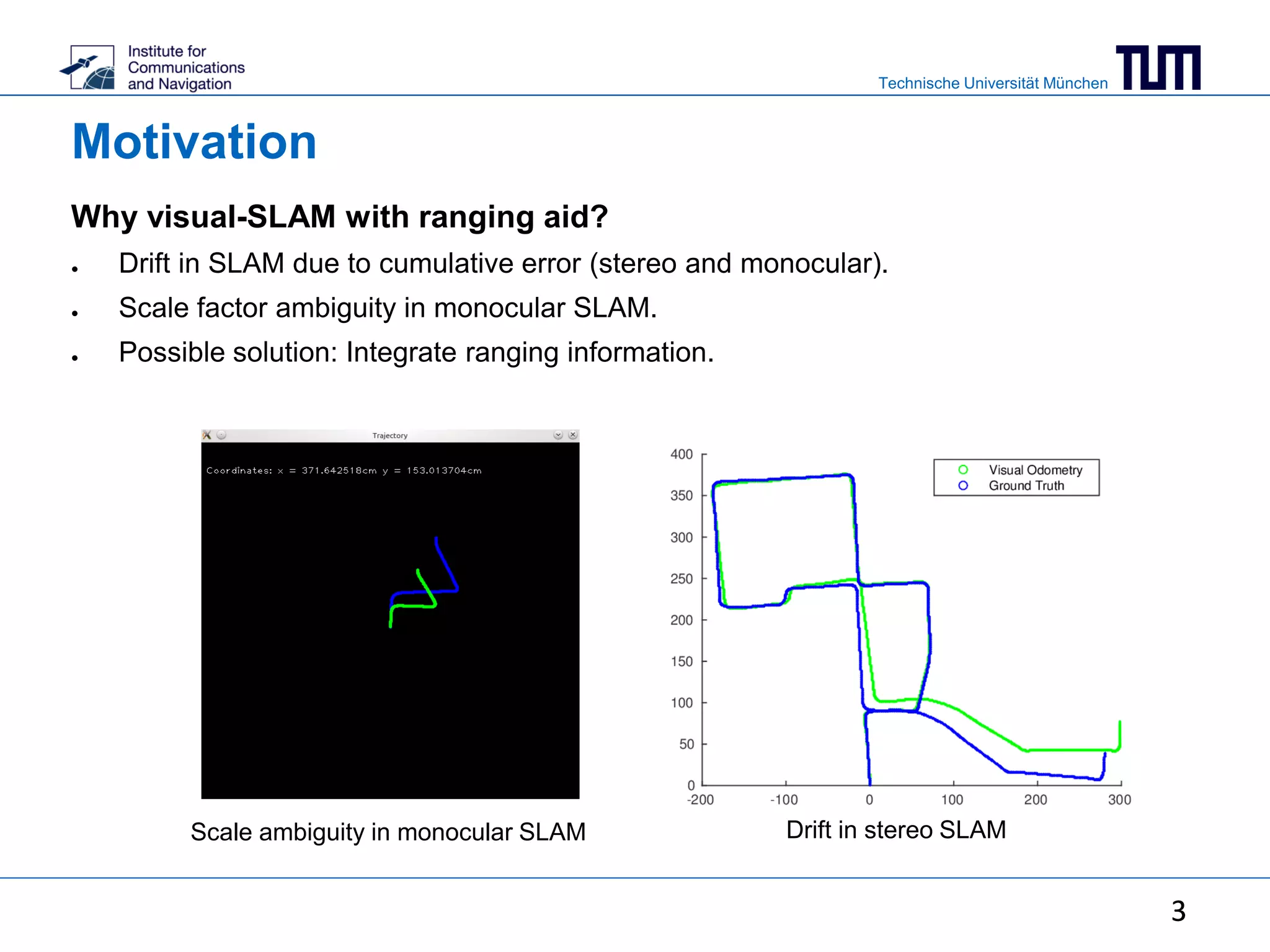
Why visual-SLAM with ranging aid?
● Drift in SLAM due to cumulative error (stereo and monocular).
● Scale factor ambiguity in monocular SLAM.
● Possible solution: Integrate ranging information.
Scale ambiguity in monocular SLAM Drift in stereo SLAM
3
Technische Universität München
Problem Formulation
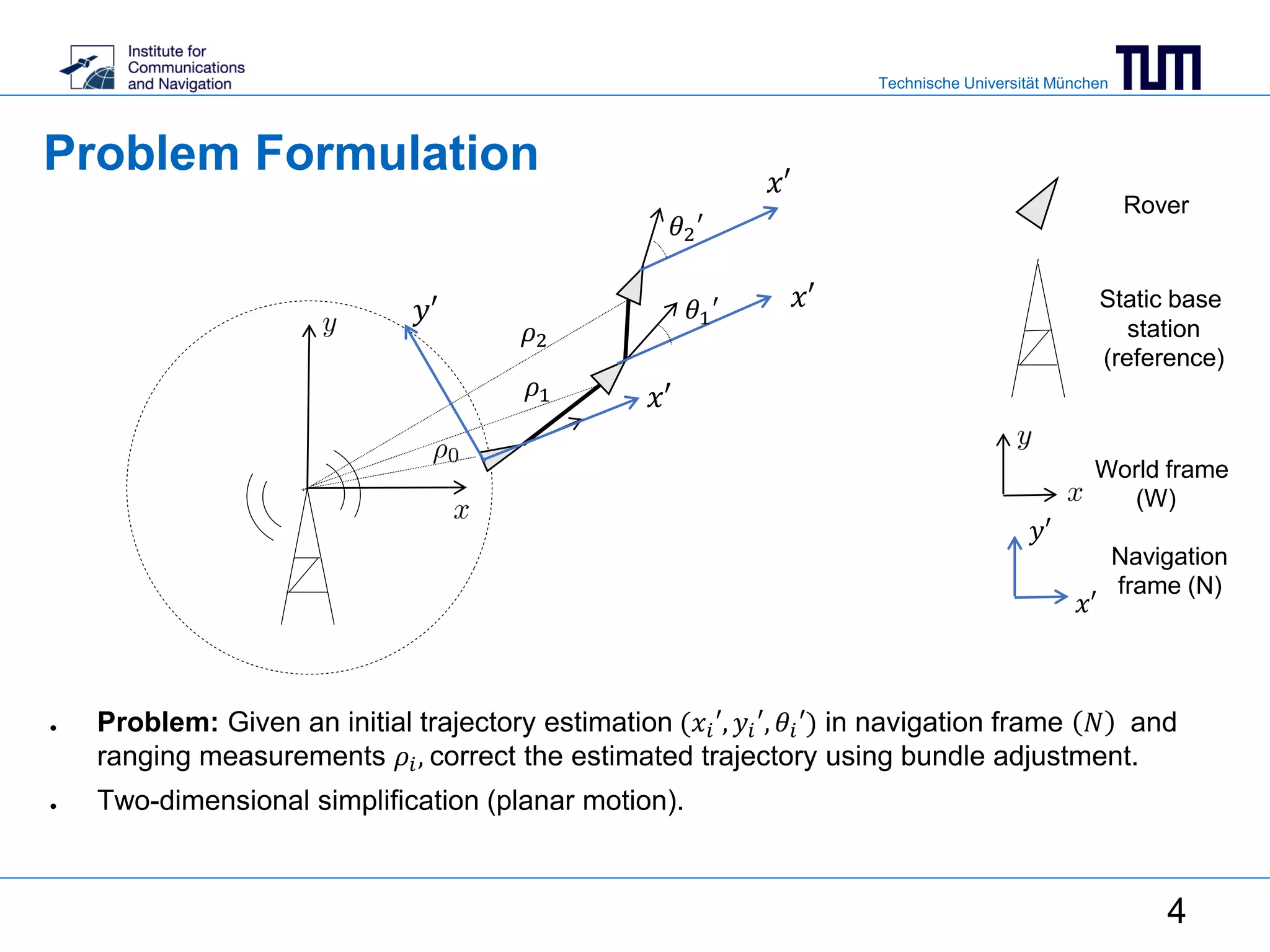
Static base
station
(reference)
Rover
● Problem: Given an initial trajectory estimation (𝑥𝑖′, 𝑦𝑖′, 𝜃𝑖′) in navigation frame 𝑁 and
ranging measurements 𝜌𝑖, correct the estimated trajectory using bundle adjustment.
● Two-dimensional simplification (planar motion).
𝜌1
𝜌2
𝜃1′
𝑥′
𝑦′
𝑥′
𝑦′
World frame
(W)
Navigation
frame (N)
𝜃2′
𝑥′
𝑥′
4
Technische Universität München
Problem Formulation
Static base
station
(reference)
Rover
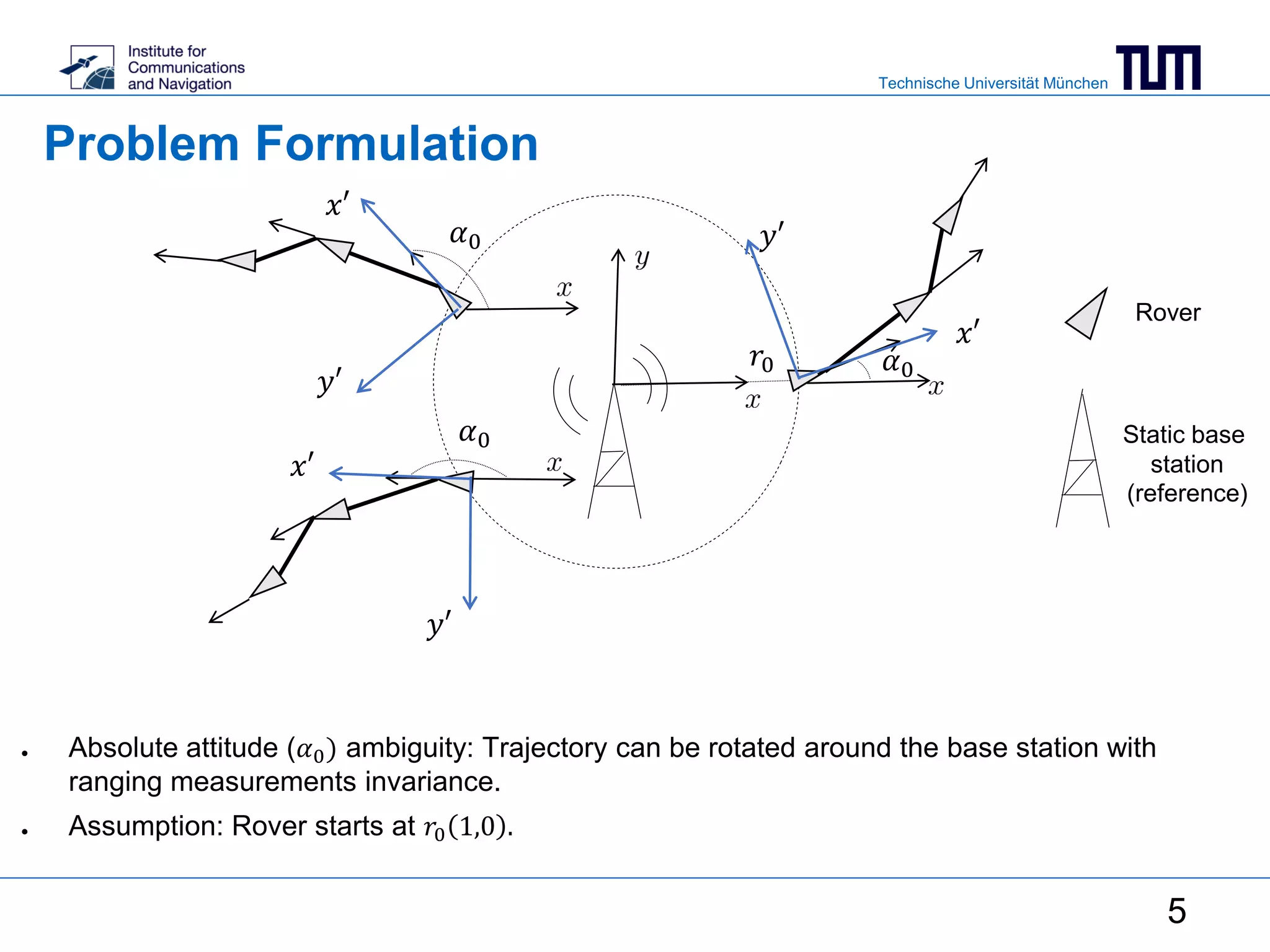
● Absolute attitude (𝛼0) ambiguity: Trajectory can be rotated around the base station with
ranging measurements invariance.
● Assumption: Rover starts at 𝑟0 1,0 .
𝛼0
𝛼0
𝛼0
𝑥′
𝑥′
𝑥′
𝑦′
𝑦′
𝑦′
5
𝑟0
Technische Universität München
Projection of world coordinates into image
coordinates
𝑢 =
𝑥
𝑦
1
= 𝜋 𝑿, R, 𝐭 = P𝐗 = K[R 𝒕]𝐗 =
−𝑓 0 𝑃𝑥
0 −𝑓 𝑃𝑦
0 0 1
[R 𝒕]
𝑋
𝑌
𝑍
1
𝑢: ℎ𝑜𝑚𝑜𝑔𝑒𝑛𝑒𝑜𝑢𝑠 𝑖𝑚𝑎𝑔𝑒 𝑐𝑜𝑜𝑟𝑑𝑖𝑛𝑎𝑡𝑒𝑠
𝑿: 3𝐷 𝑝𝑜𝑖𝑛𝑡 𝑐𝑜𝑜𝑟𝑑𝑖𝑛𝑎𝑡𝑒𝑠
𝑅, 𝒕 ∶ 𝑟𝑜𝑡𝑎𝑡𝑖𝑜𝑛 𝑎𝑛𝑑 𝑡𝑟𝑎𝑛𝑠𝑙𝑎𝑡𝑖𝑜𝑛
𝜋: 𝑝𝑟𝑜𝑗𝑒𝑐𝑡𝑖𝑜𝑛 𝑓𝑢𝑛𝑐𝑡𝑖𝑜𝑛
𝑃: 𝑝𝑟𝑜𝑗𝑒𝑐𝑡𝑖𝑜𝑛 𝑚𝑎𝑡𝑟𝑖𝑥
𝐾: 𝑐𝑎𝑚𝑒𝑟𝑎 𝑚𝑎𝑡𝑟𝑖𝑥
𝑓: 𝑓𝑜𝑐𝑎𝑙 𝑙𝑒𝑛𝑔𝑡ℎ
(𝑃𝑥 , 𝑃𝑦): 𝑝𝑟𝑖𝑛𝑐𝑖𝑝𝑎𝑙 𝑝𝑜𝑖𝑛𝑡 𝑐𝑜𝑜𝑟𝑑𝑖𝑛𝑎𝑡𝑒𝑠
6
Technische Universität München
7
Method : Bundle Adjustment (BA)
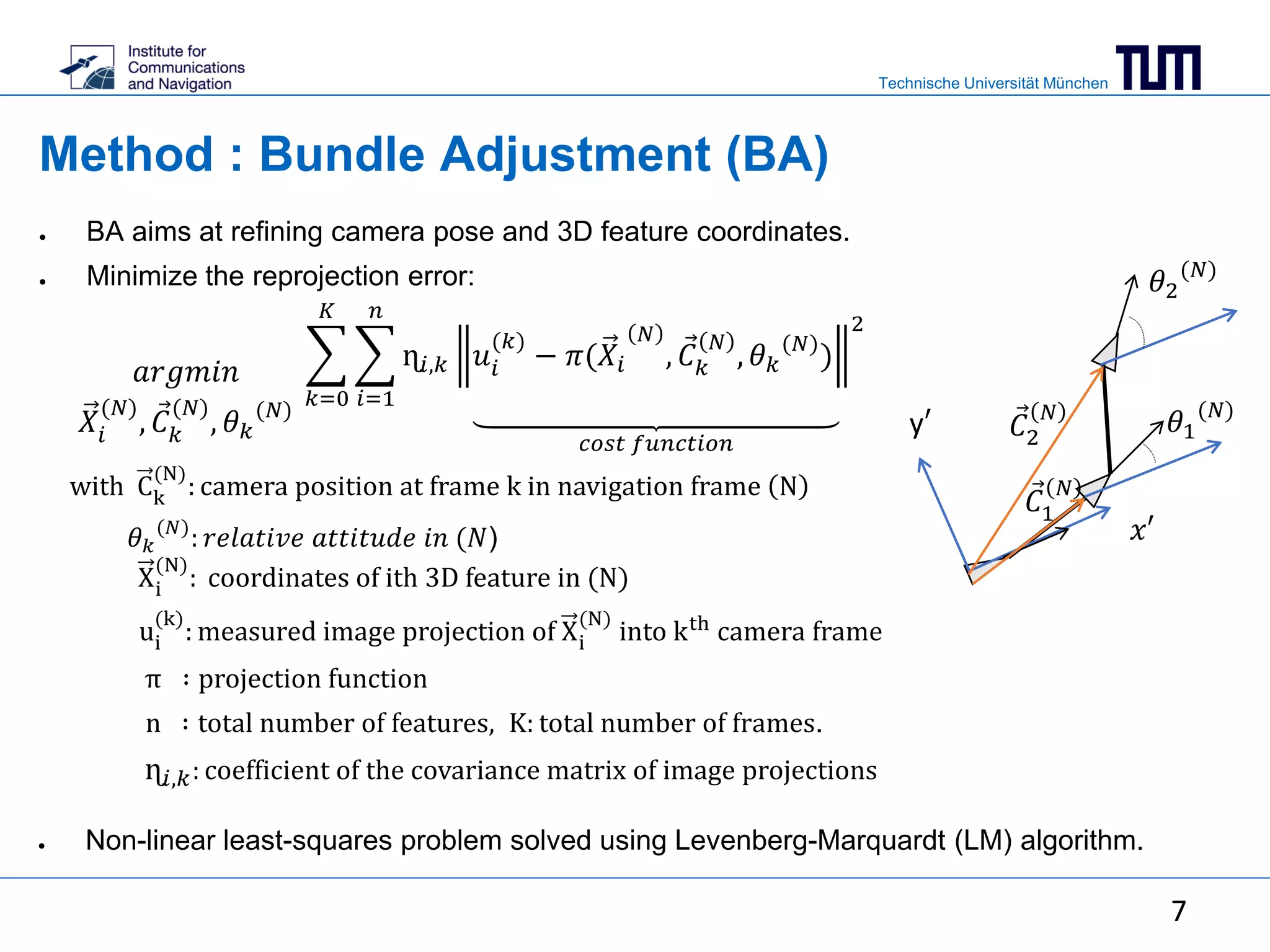
with Ck
(N)
: camera position at frame k in navigation frame N
𝜃 𝑘
(𝑁)
: 𝑟𝑒𝑙𝑎𝑡𝑖𝑣𝑒 𝑎𝑡𝑡𝑖𝑡𝑢𝑑𝑒 𝑖𝑛 (𝑁)
Xi
(N)
: coordinates of ith 3D feature in (N)
ui
(k)
: measured image projection of Xi
(N)
into kth
camera frame
π ∶ projection function
n ∶ total number of features, K: total number of frames.
ɳ𝑖,𝑘: coefficient of the covariance matrix of image projections
𝑎𝑟𝑔𝑚𝑖𝑛
𝑋𝑖
(𝑁)
, 𝐶 𝑘
(𝑁)
, 𝜃 𝑘
(𝑁)
𝑐𝑜𝑠𝑡 𝑓𝑢𝑛𝑐𝑡𝑖𝑜𝑛
𝑘=0
𝐾
𝑖=1
𝑛
ɳ𝑖,𝑘 𝑢𝑖
(𝑘)
− 𝜋(𝑋𝑖
𝑁
, 𝐶 𝑘
𝑁
, 𝜃 𝑘
(𝑁)
)
2
𝑥′
● BA aims at refining camera pose and 3D feature coordinates.
● Minimize the reprojection error:
● Non-linear least-squares problem solved using Levenberg-Marquardt (LM) algorithm.
𝐶1
𝑁
𝐶2
𝑁
y′
7
𝜃1
(𝑁)
𝜃2
(𝑁)
Technische Universität München
8
Related Work : Scale estimation in monocular
SLAM with ranging measurements
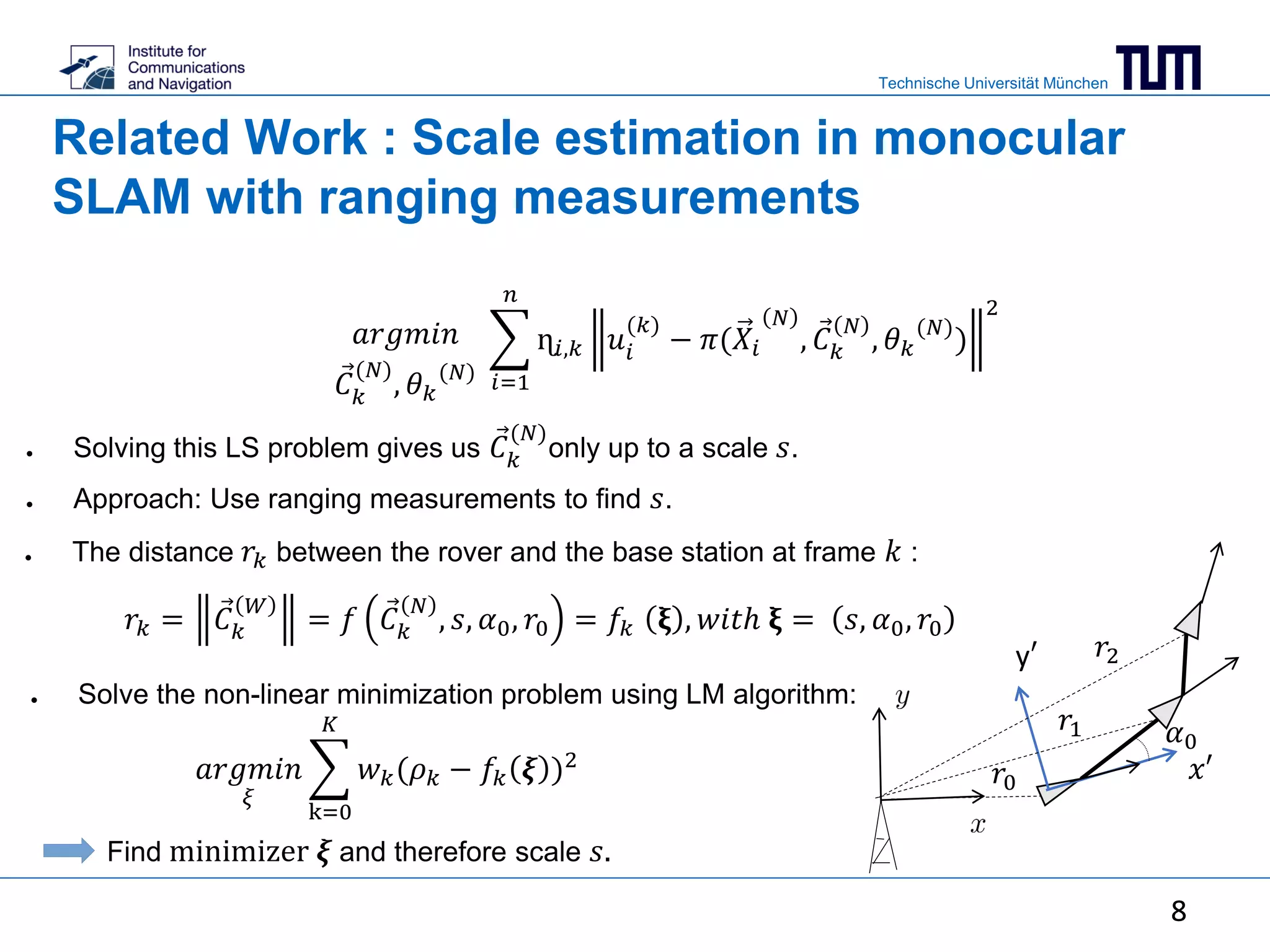
𝑟𝑘 = 𝐶 𝑘
𝑊
= 𝑓 𝐶 𝑘
𝑁
, 𝑠, 𝛼0, 𝑟0 = 𝑓𝑘 𝛏 , 𝑤𝑖𝑡ℎ 𝛏 = 𝑠, 𝛼0, 𝑟0
● Solving this LS problem gives us 𝐶 𝑘
(𝑁)
only up to a scale 𝑠.
● Approach: Use ranging measurements to find 𝑠.
● The distance 𝑟𝑘 between the rover and the base station at frame 𝑘 :
● Solve the non-linear minimization problem using LM algorithm:
𝑎𝑟𝑔𝑚𝑖𝑛
𝜉
k=0
𝐾
𝑤 𝑘(𝜌 𝑘 − 𝑓𝑘 𝝃 )2
Find minimizer 𝝃 and therefore scale 𝑠.
𝑖=1
𝑛
ɳ𝑖,𝑘 𝑢𝑖
(𝑘)
− 𝜋(𝑋𝑖
𝑁
, 𝐶 𝑘
𝑁
, 𝜃 𝑘
(𝑁)
)
2
𝑎𝑟𝑔𝑚𝑖𝑛
𝐶 𝑘
(𝑁)
, 𝜃 𝑘
(𝑁)
𝑟1
𝑟2
𝛼0
𝑟0 𝑥′
y′
8
Technische Universität München
9
𝑎𝑟𝑔𝑚𝑖𝑛
𝜉
k=0
𝐾
𝑤 𝑘(𝜌 𝑘 − 𝑓𝑘 𝝃 )2
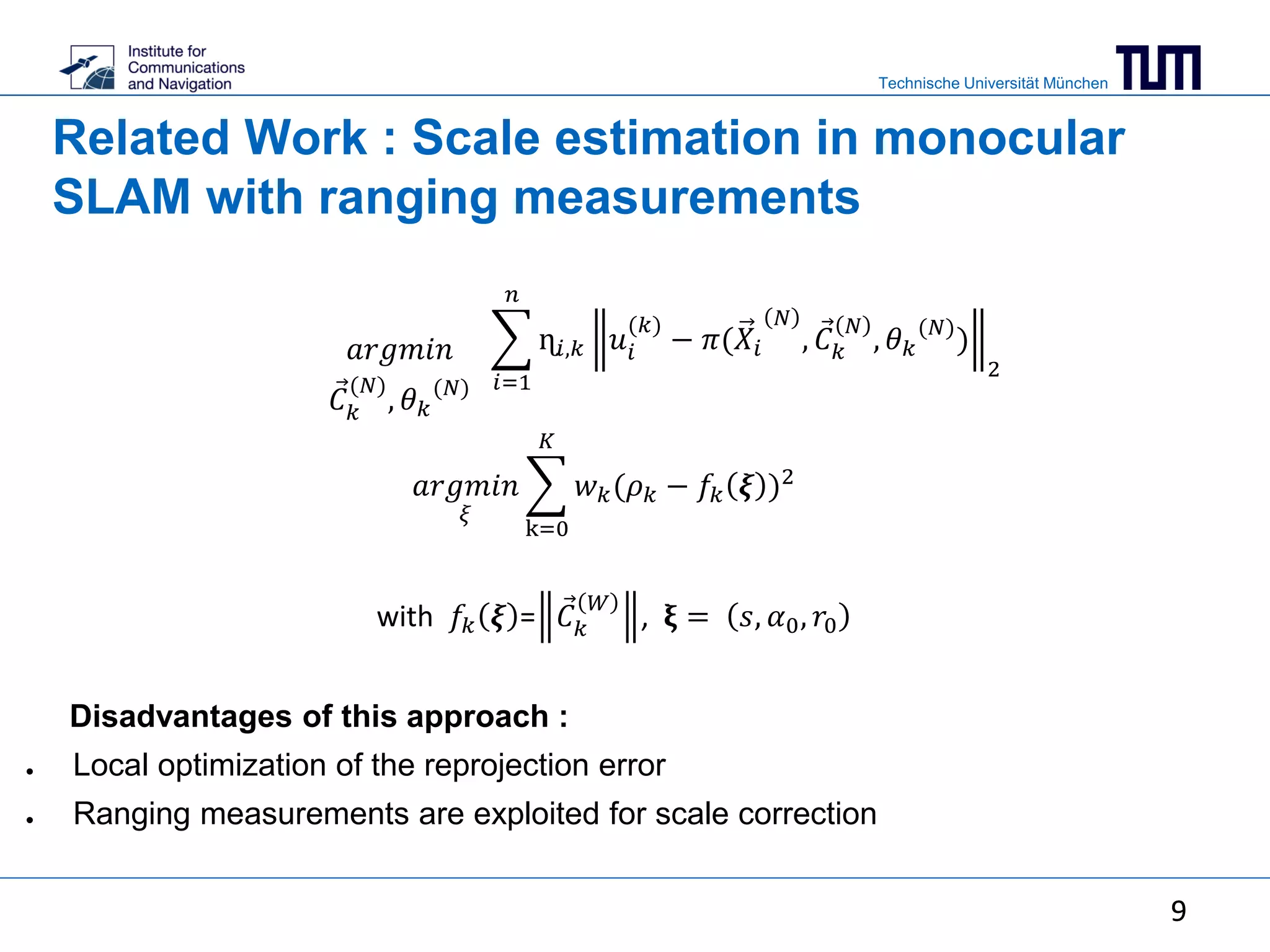
Disadvantages of this approach :
● Local optimization of the reprojection error
● Ranging measurements are exploited for scale correction
𝑎𝑟𝑔𝑚𝑖𝑛
𝐶 𝑘
(𝑁)
, 𝜃 𝑘
(𝑁) 𝑖=1
𝑛
ɳ𝑖,𝑘 𝑢𝑖
(𝑘)
− 𝜋(𝑋𝑖
𝑁
, 𝐶 𝑘
𝑁
, 𝜃 𝑘
(𝑁)
)
2
9
Related Work : Scale estimation in monocular
SLAM with ranging measurements
with 𝑓𝑘 𝝃 = 𝐶 𝑘
𝑊
, 𝛏 = 𝑠, 𝛼0, 𝑟0
Technische Universität München
Stereo case: BA with ranging measuremets
● No scale ambiguity.
● Ranging measurements can be used to reduce the trajectory drift.
● Approach: include the ranging measurements into the cost function of BA.
𝑘=0
𝐾
𝑖=1
𝑛
ɳ𝑖,𝑘 𝑢𝑖
(𝑘)
− 𝜋(𝑋𝑖
𝑊
, 𝐶 𝑘
𝑊
, 𝜃 𝑘
(𝑊)
)
2
+ 𝑤 𝑘(𝜌 𝑘 − 𝐶 𝑘
𝑊
)2
𝑐𝑜𝑠𝑡 𝑓𝑢𝑛𝑐𝑡𝑖𝑜𝑛
𝑎𝑟𝑔𝑚𝑖𝑛
𝑋𝑖
(w)
, 𝐶 𝑘
(W)
, 𝜃 𝑘
(𝑊)
10
𝐶1
𝑊
𝐶2
𝑊
𝑥′
y′
𝐶0
𝑊
Technische Universität München
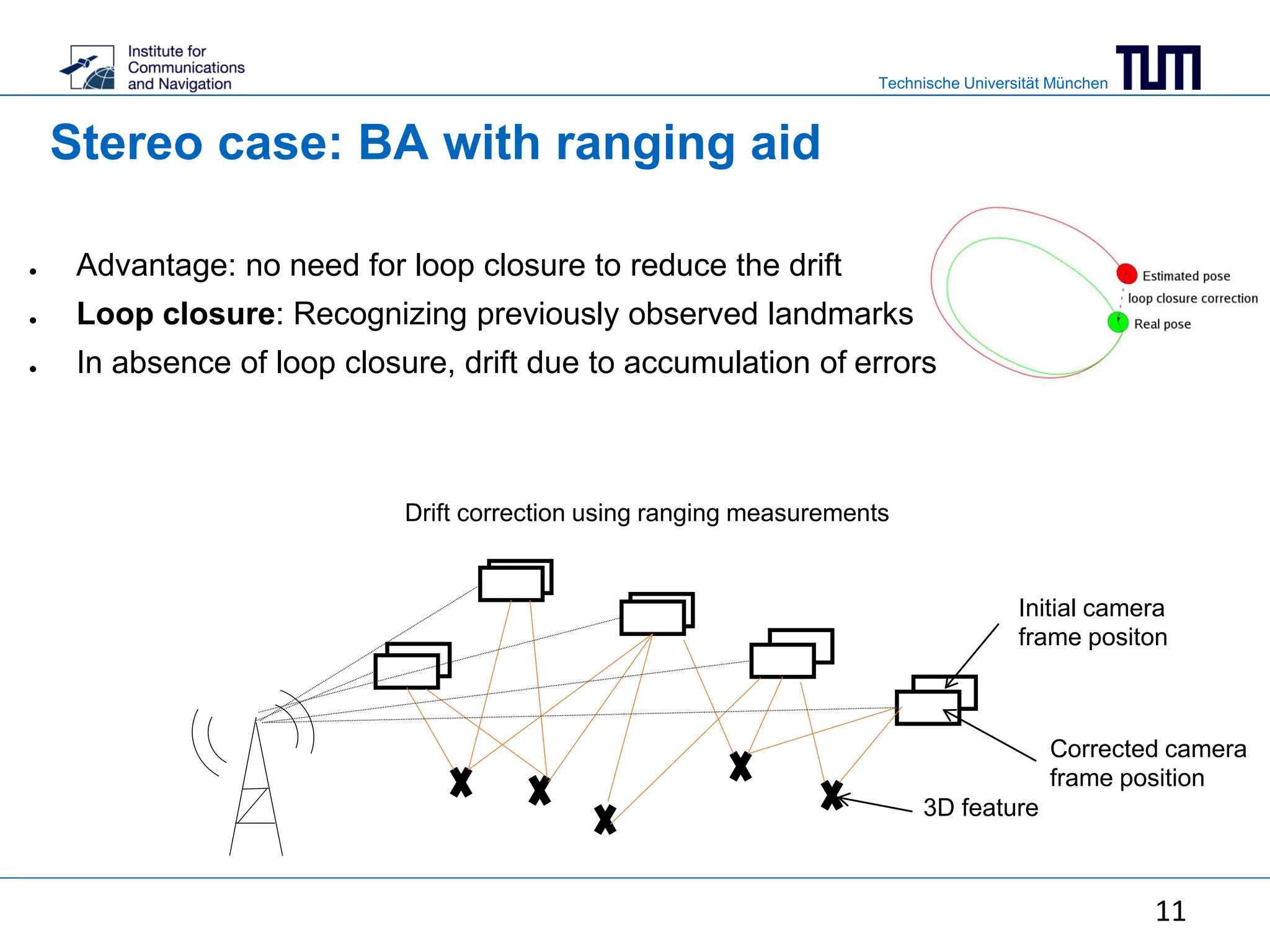
Initial camera
frame positon
3D feature
Corrected camera
frame position
Drift correction using ranging measurements
● Advantage: no need for loop closure to reduce the drift
● Loop closure: Recognizing previously observed landmarks
● In absence of loop closure, drift due to accumulation of errors
Stereo case: BA with ranging aid
11
Technische Universität München
12
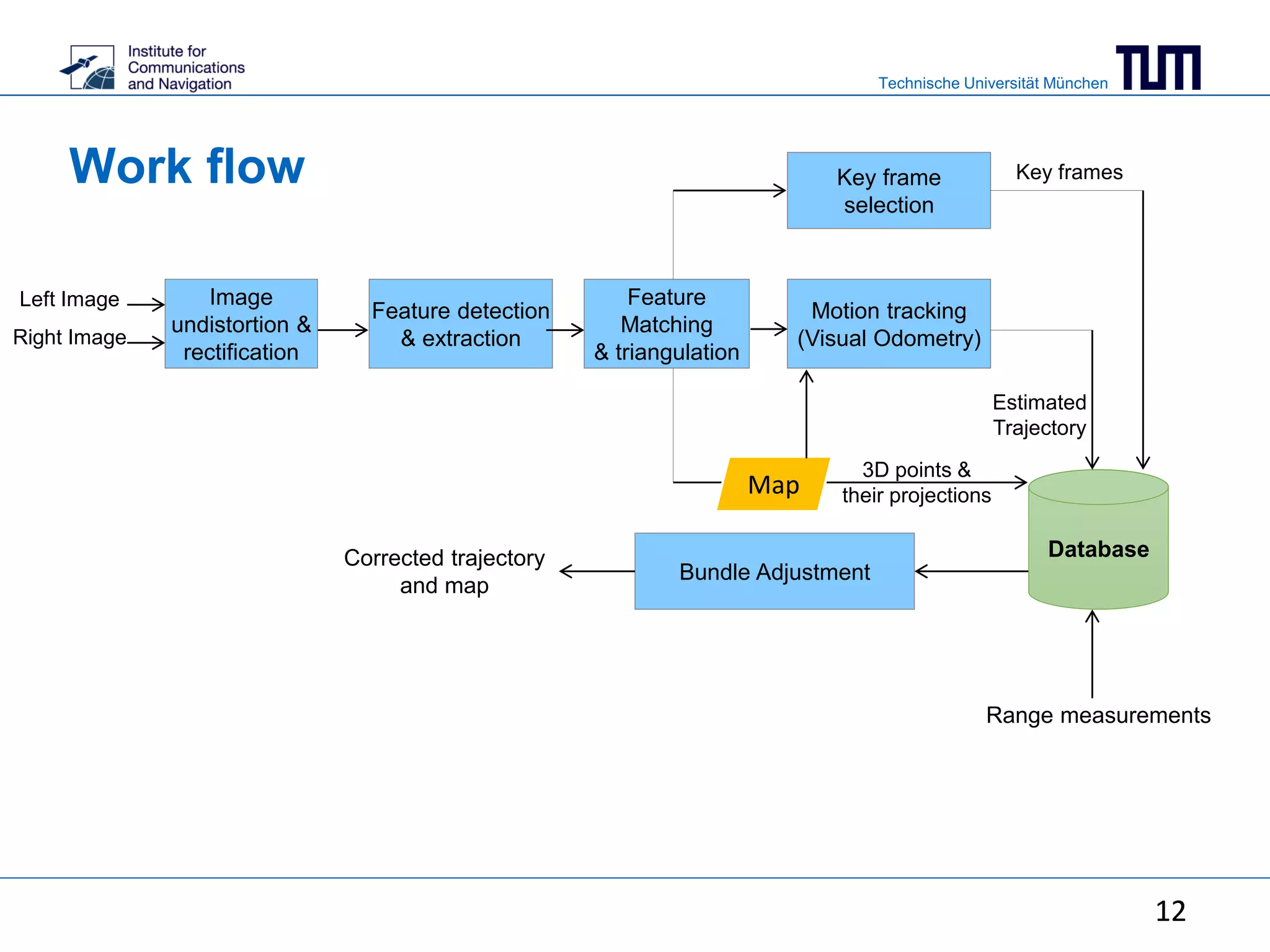
Work flow
Feature detection
& extraction
Motion tracking
(Visual Odometry)
Bundle Adjustment
Feature
Matching
& triangulation
Key frame
selection
Database
Left Image
Range measurements
Right Image
Image
undistortion &
rectification
Key frames
Estimated
Trajectory
3D points &
their projectionsMap
Corrected trajectory
and map
12
Technische Universität München
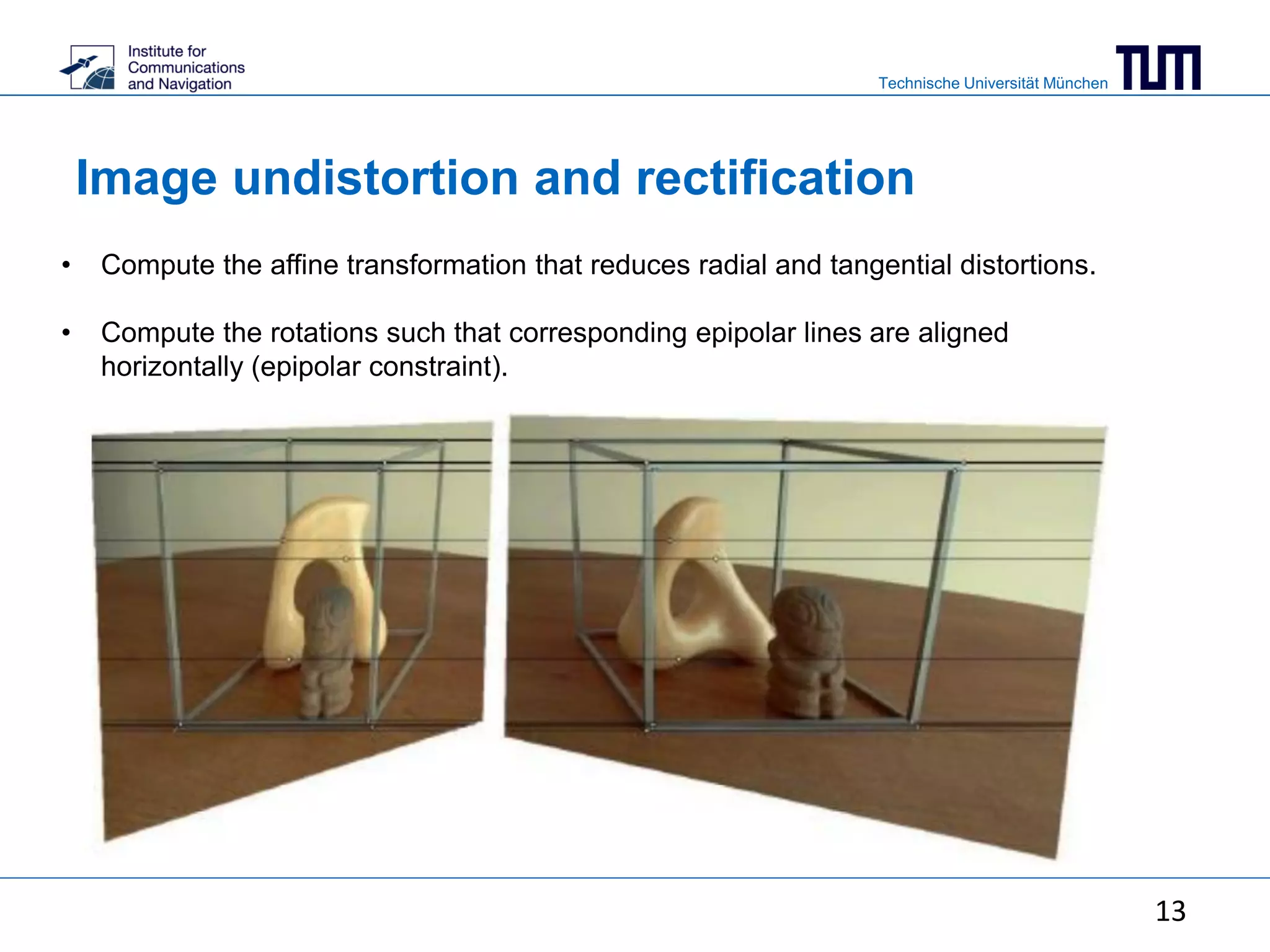
Image undistortion and rectification
• Compute the affine transformation that reduces radial and tangential distortions.
• Compute the rotations such that corresponding epipolar lines are aligned
horizontally (epipolar constraint).
13
Technische Universität München
14
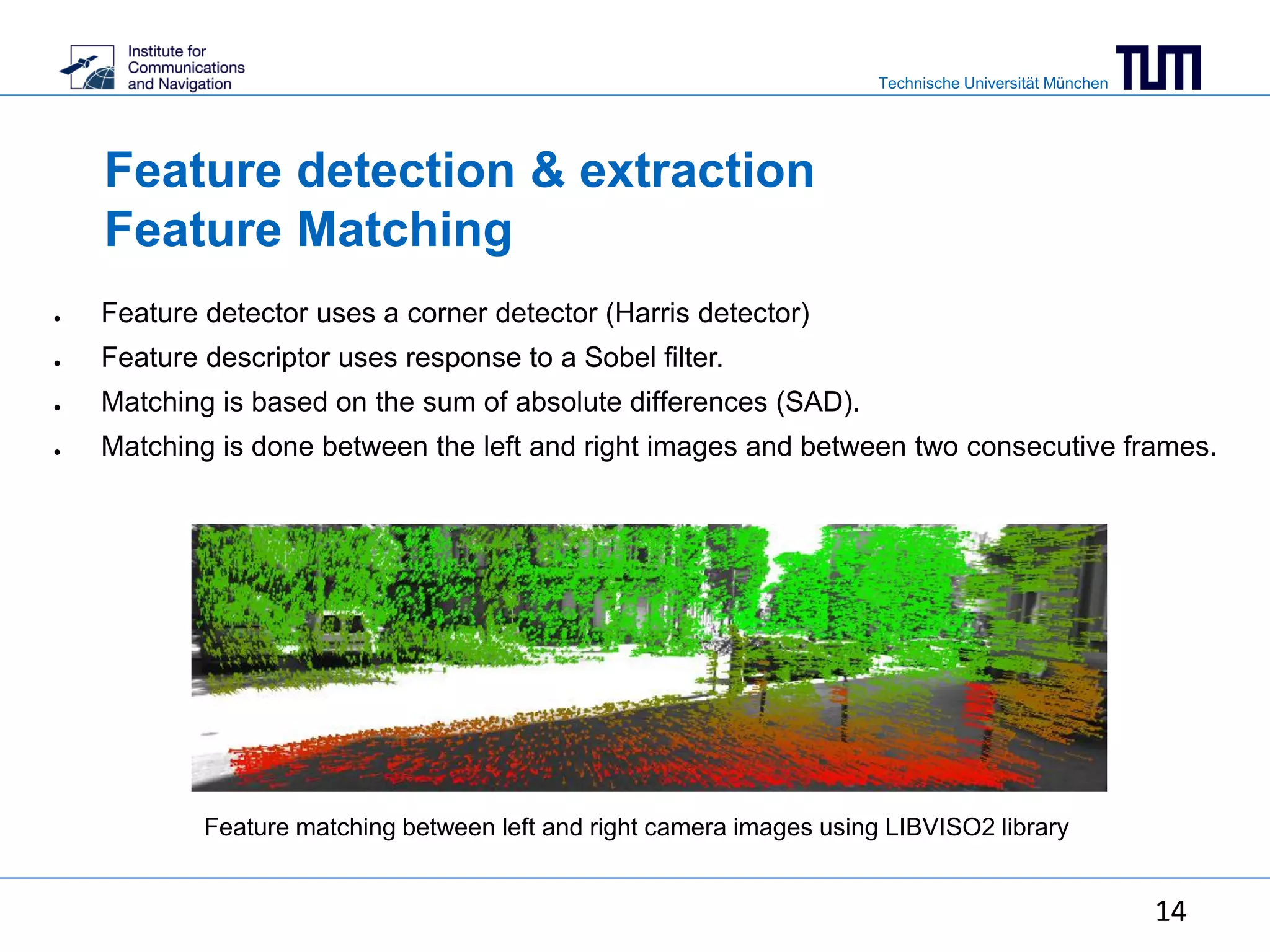
Feature detection & extraction
Feature Matching
● Feature detector uses a corner detector (Harris detector)
● Feature descriptor uses response to a Sobel filter.
● Matching is based on the sum of absolute differences (SAD).
● Matching is done between the left and right images and between two consecutive frames.
Feature matching between left and right camera images using LIBVISO2 library
14
Technische Universität München
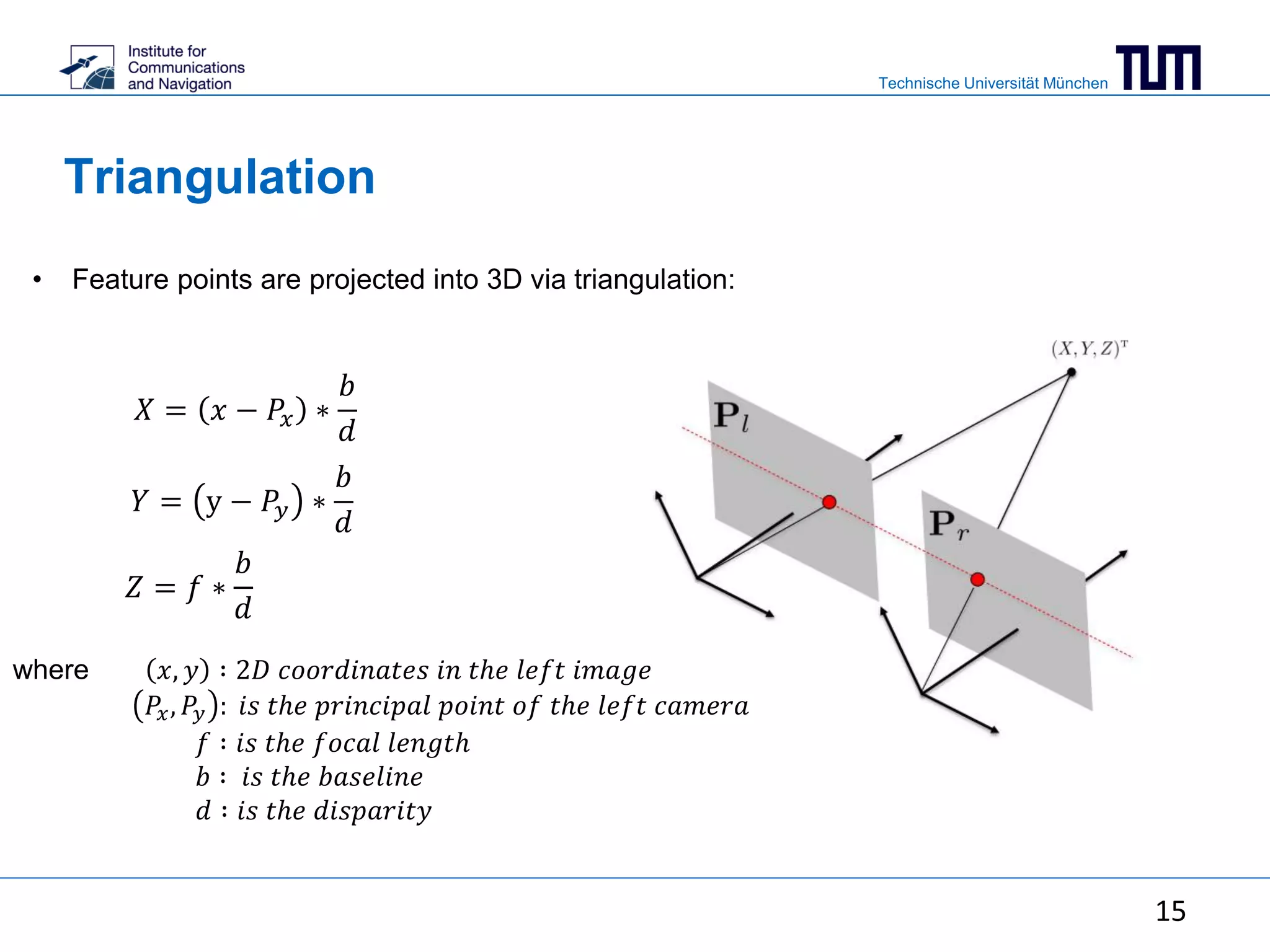
Triangulation
• Feature points are projected into 3D via triangulation:
15
𝑋 = 𝑥 − 𝑃𝑥 ∗
𝑏
𝑑
𝑌 = y − 𝑃𝑦 ∗
𝑏
𝑑
𝑍 = 𝑓 ∗
𝑏
𝑑
where 𝑥, 𝑦 ∶ 2𝐷 𝑐𝑜𝑜𝑟𝑑𝑖𝑛𝑎𝑡𝑒𝑠 𝑖𝑛 𝑡ℎ𝑒 𝑙𝑒𝑓𝑡 𝑖𝑚𝑎𝑔𝑒
𝑃𝑥, 𝑃𝑦 : 𝑖𝑠 𝑡ℎ𝑒 𝑝𝑟𝑖𝑛𝑐𝑖𝑝𝑎𝑙 𝑝𝑜𝑖𝑛𝑡 𝑜𝑓 𝑡ℎ𝑒 𝑙𝑒𝑓𝑡 𝑐𝑎𝑚𝑒𝑟𝑎
𝑓 ∶ 𝑖𝑠 𝑡ℎ𝑒 𝑓𝑜𝑐𝑎𝑙 𝑙𝑒𝑛𝑔𝑡ℎ
𝑏 ∶ 𝑖𝑠 𝑡ℎ𝑒 𝑏𝑎𝑠𝑒𝑙𝑖𝑛𝑒
𝑑 ∶ 𝑖𝑠 𝑡ℎ𝑒 𝑑𝑖𝑠𝑝𝑎𝑟𝑖𝑡𝑦
Technische Universität München
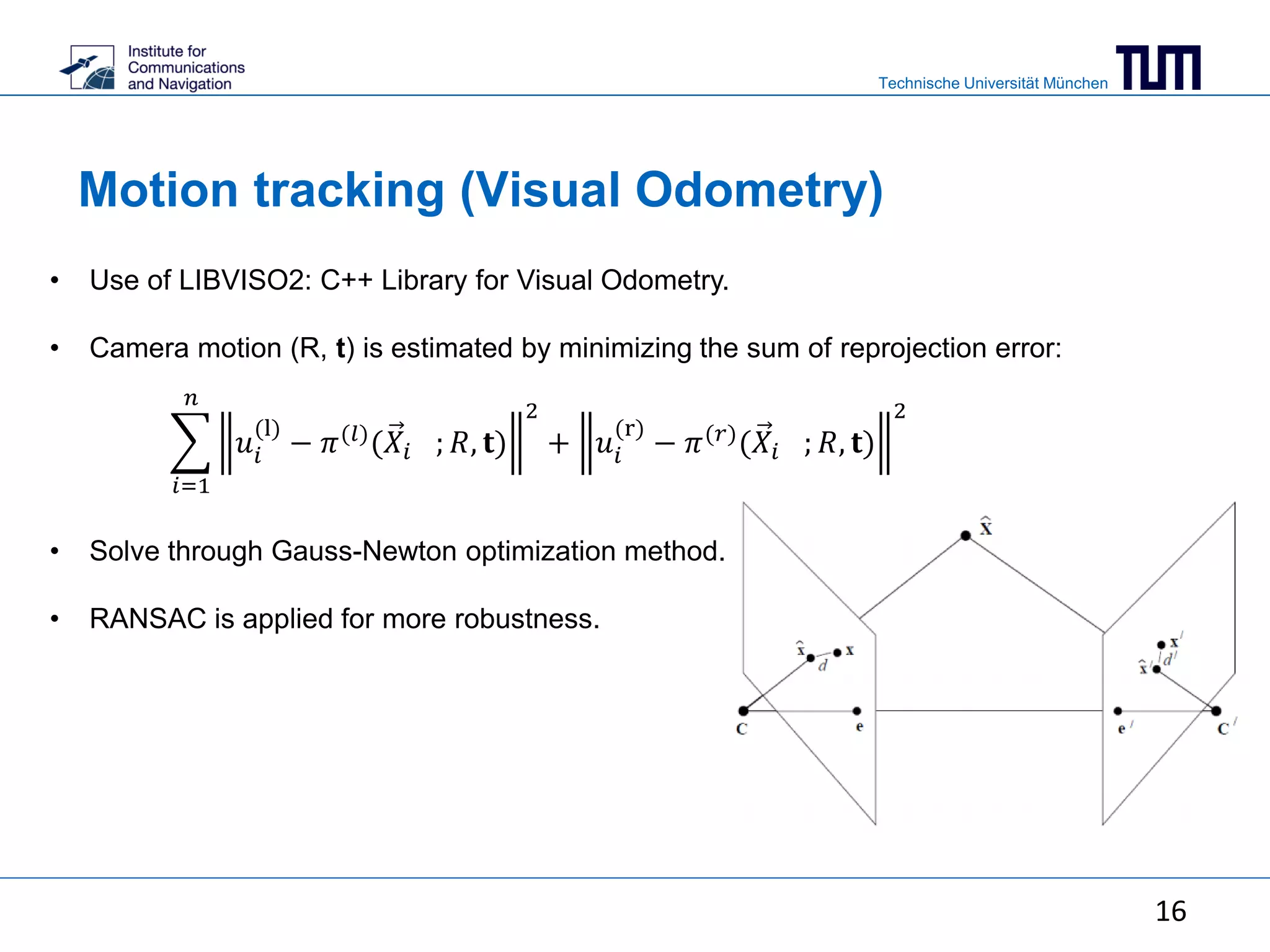
Motion tracking (Visual Odometry)
• Use of LIBVISO2: C++ Library for Visual Odometry.
• Camera motion (R, t) is estimated by minimizing the sum of reprojection error:
• Solve through Gauss-Newton optimization method.
• RANSAC is applied for more robustness.
𝑖=1
𝑛
𝑢𝑖
(l)
− 𝜋(𝑙)(𝑋𝑖 ; 𝑅, 𝐭)
2
+ 𝑢𝑖
(r)
− 𝜋(𝑟)(𝑋𝑖 ; 𝑅, 𝐭)
2
16
Technische Universität München
17
Ranging measurements
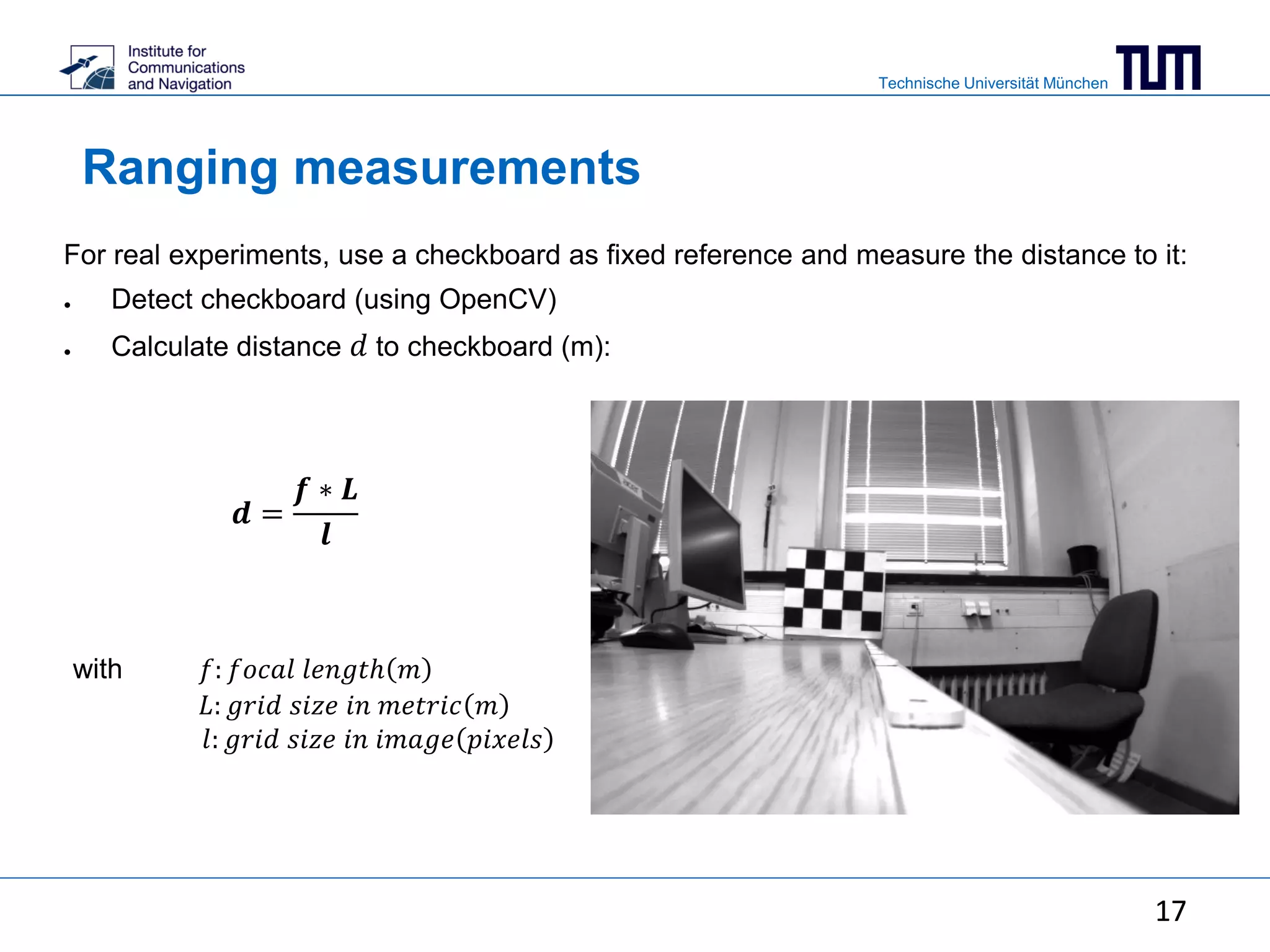
For real experiments, use a checkboard as fixed reference and measure the distance to it:
● Detect checkboard (using OpenCV)
● Calculate distance 𝑑 to checkboard (m):
17
with 𝑓: 𝑓𝑜𝑐𝑎𝑙 𝑙𝑒𝑛𝑔𝑡ℎ 𝑚
𝐿: 𝑔𝑟𝑖𝑑 𝑠𝑖𝑧𝑒 𝑖𝑛 𝑚𝑒𝑡𝑟𝑖𝑐 𝑚
𝑙: 𝑔𝑟𝑖𝑑 𝑠𝑖𝑧𝑒 𝑖𝑛 𝑖𝑚𝑎𝑔𝑒 𝑝𝑖𝑥𝑒𝑙𝑠
𝒅 =
𝒇 ∗ 𝑳
𝒍
Technische Universität München
18
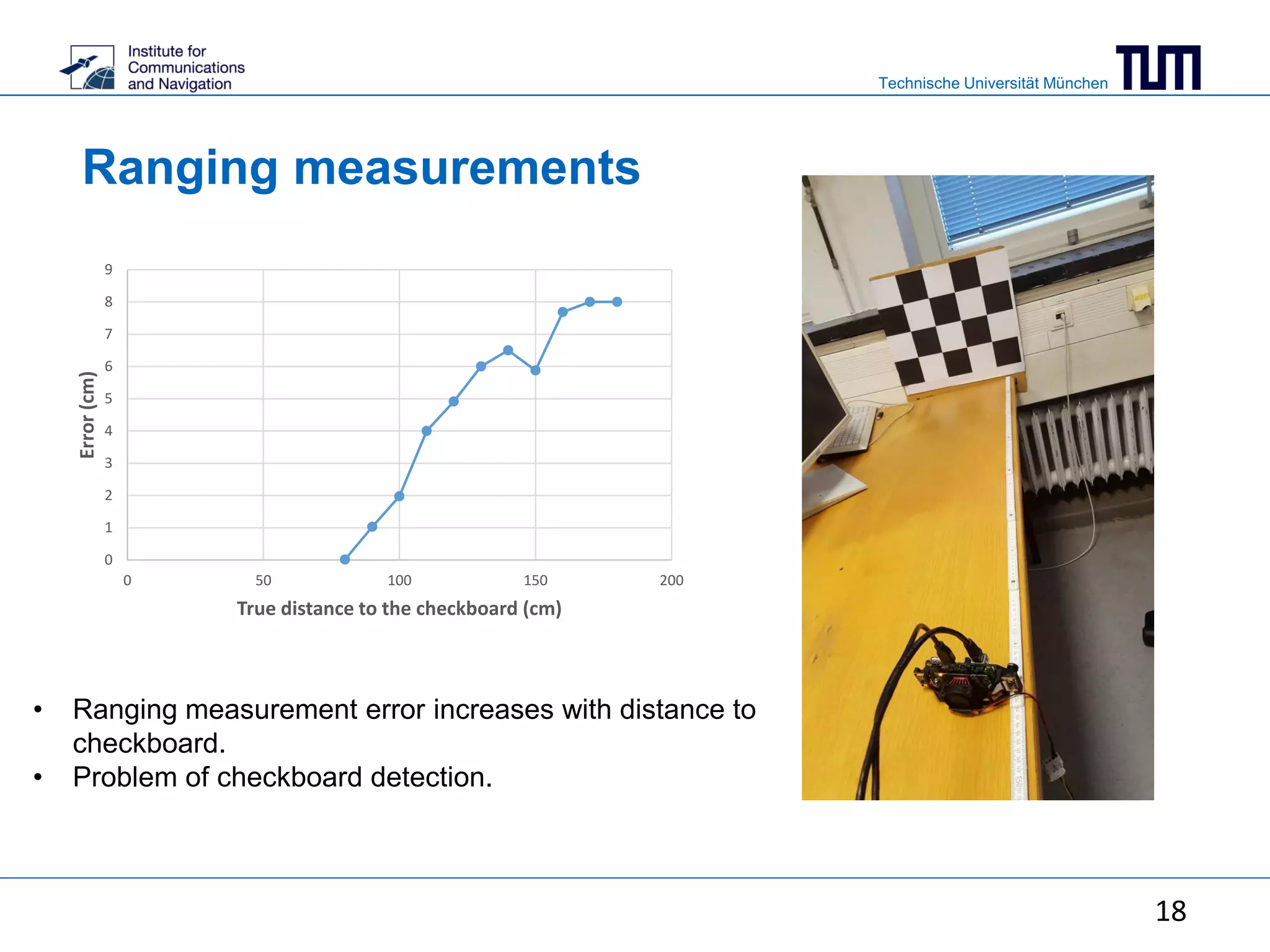
Ranging measurements
0
1
2
3
4
5
6
7
8
9
0 50 100 150 200
Error(cm)
True distance to the checkboard (cm)
• Ranging measurement error increases with distance to
checkboard.
• Problem of checkboard detection.
Technische Universität München
19
Experimental Set up
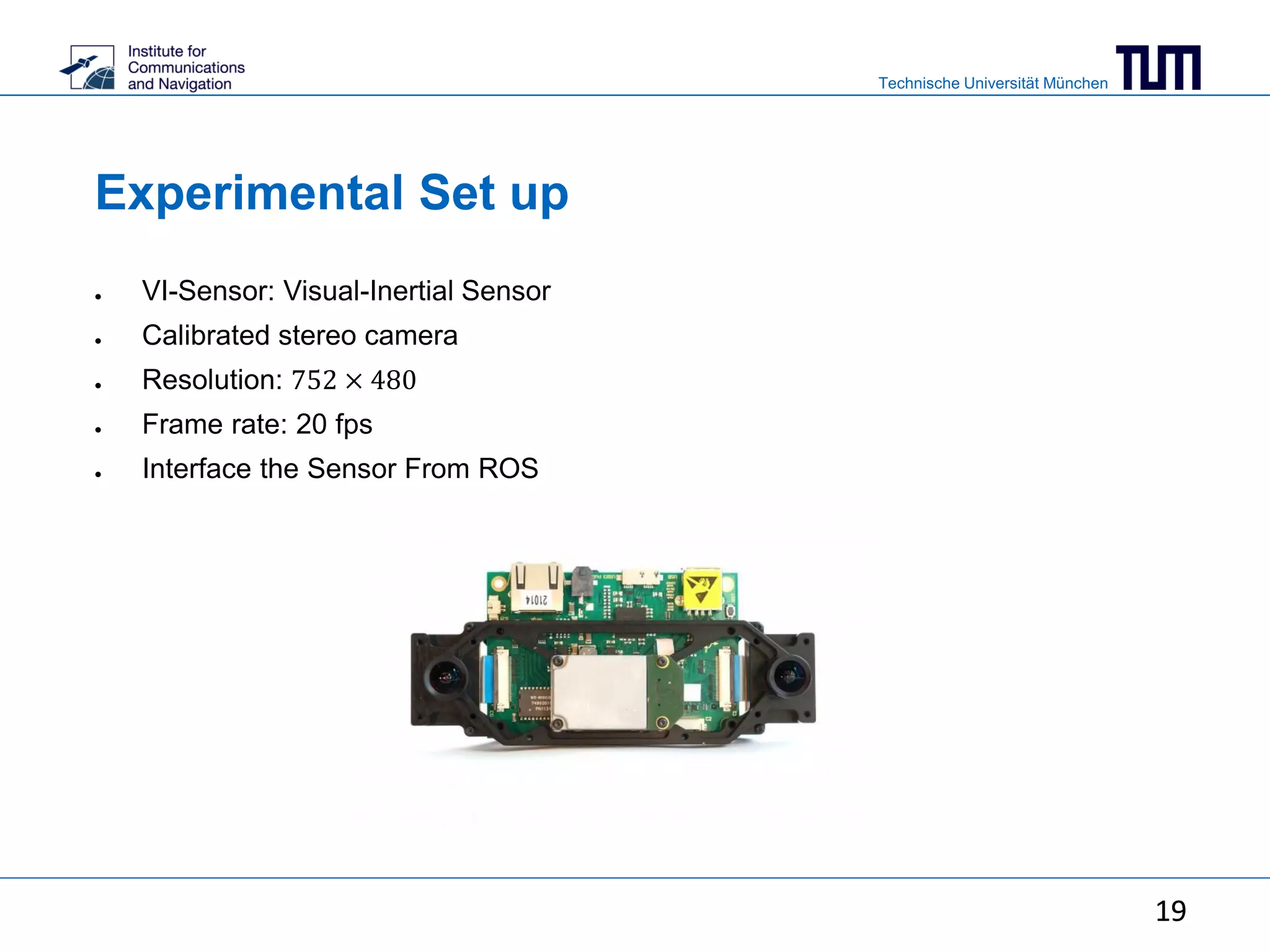
● VI-Sensor: Visual-Inertial Sensor
● Calibrated stereo camera
● Resolution: 752 × 480
● Frame rate: 20 fps
● Interface the Sensor From ROS
19
Technische Universität München
Experimental Results
Results using VI-Sensor
• BA for 3168 3D points and 100 frames
• Computation time 43 seconds
• 50 iterations for LM algorithm
• Reduction of the reprojection error from 6007,84 to 192,894
• Implementation of work flow (without ranging measurement and without keyframes
selection)
• Implementation of Bundle adjustment using the Sparse Bundle Adjustment (sba)
C++ package
• Estimation of the initial and final total reprojection error
Technische Universität München
21
Experimental Results
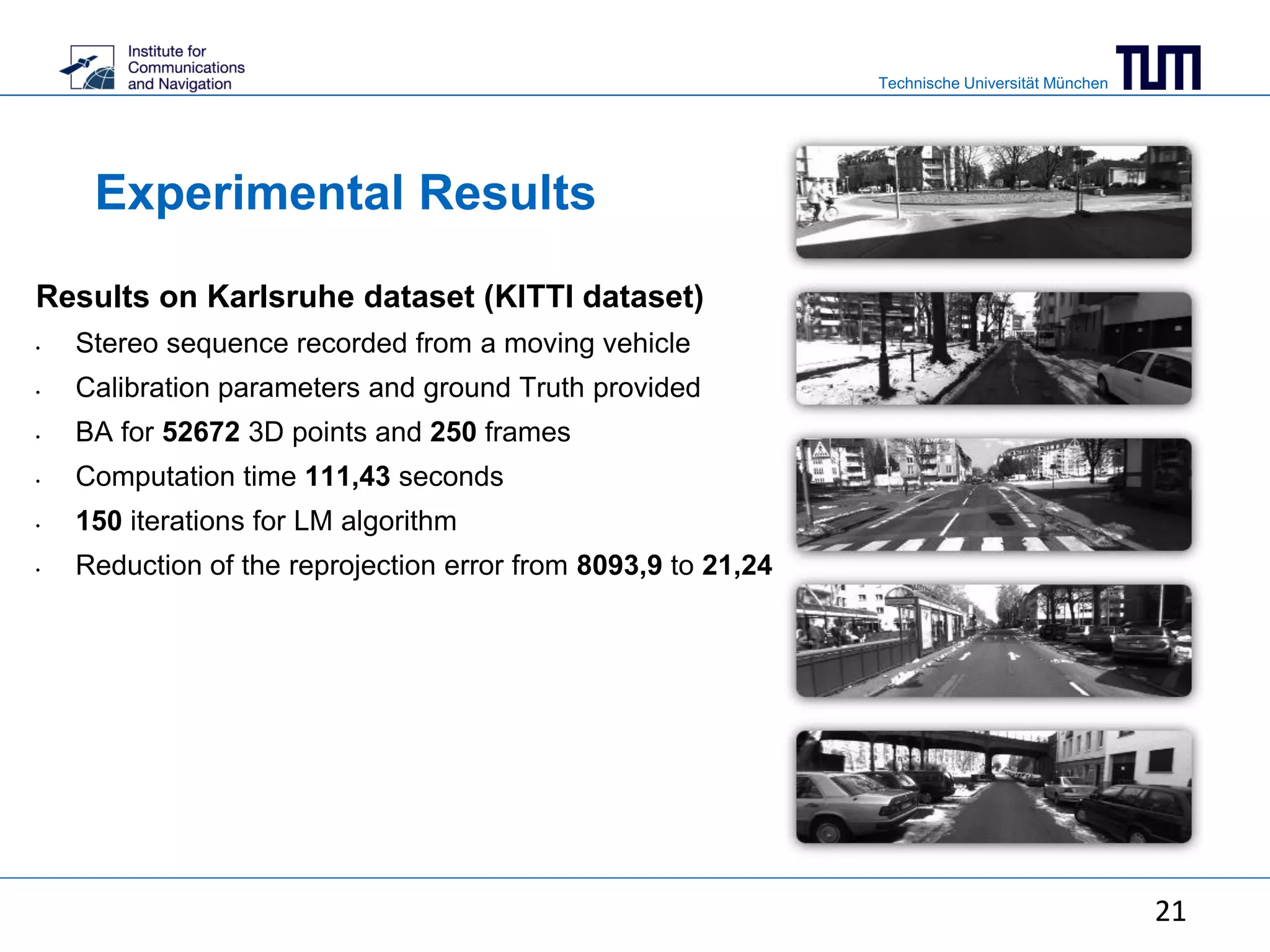
Results on Karlsruhe dataset (KITTI dataset)
• Stereo sequence recorded from a moving vehicle
• Calibration parameters and ground Truth provided
• BA for 52672 3D points and 250 frames
• Computation time 111,43 seconds
• 150 iterations for LM algorithm
• Reduction of the reprojection error from 8093,9 to 21,24
21
Technische Universität München
22
Next?
● Integration of ranging measurements and keyframes selection in BA
● Mapping
● Compare with ground truth and other approaches
Optional:
● Try other feature detectors/descriptors
● Loop closure detection
● Report and final presentation: end of October
22
Technische Universität München
23
References
23
The Design and Implementation of a Generic Sparse Bundle Adjustment Software
Package Based on the Levenberg-Marquardt Algorithm
M.I. A. Lourakis and A.A. Argyros
StereoScan: Dense 3d Reconstruction in Real-time
Andreas Geiger, Julius Ziegler and Christoph Stiller
Visual Odometry Part I: The First 30 Years and Fundamentals
Davide Scaramuzza and Friedrich Fraundorfer
Real-time Monocular SLAM: Why Filter?
Hauke Strasdat, J. M. M. Montiel and Andrew J. Davison

mid_presentation

  • 1.
    Technische Universität München Masterthesis : Mono- and stereo-camera SLAM with ranging aid Chiraz Nafouki Supervisors: Dr. Gabriele Giorgi chiraz.nafouki@tum.de gabriele.giorgi@tum.de M.Sc. Chen Zhu chen.zhu@tum.de Mid-term presentation 26/07/2016
  • 2.
    Technische Universität München Outline 1.Motivation 2. Problem Formulation 3. Method: Bundle Adjustment (BA) 4. Related work: Monocular SLAM with ranging aid 5. BA for stereo SLAM with ranging aid 6. Work flow 7. Experimental results
  • 3.
    Technische Universität München 3 Motivation Whyvisual-SLAM with ranging aid? ● Drift in SLAM due to cumulative error (stereo and monocular). ● Scale factor ambiguity in monocular SLAM. ● Possible solution: Integrate ranging information. Scale ambiguity in monocular SLAM Drift in stereo SLAM 3
  • 4.
    Technische Universität München ProblemFormulation Static base station (reference) Rover ● Problem: Given an initial trajectory estimation (𝑥𝑖′, 𝑦𝑖′, 𝜃𝑖′) in navigation frame 𝑁 and ranging measurements 𝜌𝑖, correct the estimated trajectory using bundle adjustment. ● Two-dimensional simplification (planar motion). 𝜌1 𝜌2 𝜃1′ 𝑥′ 𝑦′ 𝑥′ 𝑦′ World frame (W) Navigation frame (N) 𝜃2′ 𝑥′ 𝑥′ 4
  • 5.
    Technische Universität München ProblemFormulation Static base station (reference) Rover ● Absolute attitude (𝛼0) ambiguity: Trajectory can be rotated around the base station with ranging measurements invariance. ● Assumption: Rover starts at 𝑟0 1,0 . 𝛼0 𝛼0 𝛼0 𝑥′ 𝑥′ 𝑥′ 𝑦′ 𝑦′ 𝑦′ 5 𝑟0
  • 6.
    Technische Universität München Projectionof world coordinates into image coordinates 𝑢 = 𝑥 𝑦 1 = 𝜋 𝑿, R, 𝐭 = P𝐗 = K[R 𝒕]𝐗 = −𝑓 0 𝑃𝑥 0 −𝑓 𝑃𝑦 0 0 1 [R 𝒕] 𝑋 𝑌 𝑍 1 𝑢: ℎ𝑜𝑚𝑜𝑔𝑒𝑛𝑒𝑜𝑢𝑠 𝑖𝑚𝑎𝑔𝑒 𝑐𝑜𝑜𝑟𝑑𝑖𝑛𝑎𝑡𝑒𝑠 𝑿: 3𝐷 𝑝𝑜𝑖𝑛𝑡 𝑐𝑜𝑜𝑟𝑑𝑖𝑛𝑎𝑡𝑒𝑠 𝑅, 𝒕 ∶ 𝑟𝑜𝑡𝑎𝑡𝑖𝑜𝑛 𝑎𝑛𝑑 𝑡𝑟𝑎𝑛𝑠𝑙𝑎𝑡𝑖𝑜𝑛 𝜋: 𝑝𝑟𝑜𝑗𝑒𝑐𝑡𝑖𝑜𝑛 𝑓𝑢𝑛𝑐𝑡𝑖𝑜𝑛 𝑃: 𝑝𝑟𝑜𝑗𝑒𝑐𝑡𝑖𝑜𝑛 𝑚𝑎𝑡𝑟𝑖𝑥 𝐾: 𝑐𝑎𝑚𝑒𝑟𝑎 𝑚𝑎𝑡𝑟𝑖𝑥 𝑓: 𝑓𝑜𝑐𝑎𝑙 𝑙𝑒𝑛𝑔𝑡ℎ (𝑃𝑥 , 𝑃𝑦): 𝑝𝑟𝑖𝑛𝑐𝑖𝑝𝑎𝑙 𝑝𝑜𝑖𝑛𝑡 𝑐𝑜𝑜𝑟𝑑𝑖𝑛𝑎𝑡𝑒𝑠 6
  • 7.
    Technische Universität München 7 Method: Bundle Adjustment (BA) with Ck (N) : camera position at frame k in navigation frame N 𝜃 𝑘 (𝑁) : 𝑟𝑒𝑙𝑎𝑡𝑖𝑣𝑒 𝑎𝑡𝑡𝑖𝑡𝑢𝑑𝑒 𝑖𝑛 (𝑁) Xi (N) : coordinates of ith 3D feature in (N) ui (k) : measured image projection of Xi (N) into kth camera frame π ∶ projection function n ∶ total number of features, K: total number of frames. ɳ𝑖,𝑘: coefficient of the covariance matrix of image projections 𝑎𝑟𝑔𝑚𝑖𝑛 𝑋𝑖 (𝑁) , 𝐶 𝑘 (𝑁) , 𝜃 𝑘 (𝑁) 𝑐𝑜𝑠𝑡 𝑓𝑢𝑛𝑐𝑡𝑖𝑜𝑛 𝑘=0 𝐾 𝑖=1 𝑛 ɳ𝑖,𝑘 𝑢𝑖 (𝑘) − 𝜋(𝑋𝑖 𝑁 , 𝐶 𝑘 𝑁 , 𝜃 𝑘 (𝑁) ) 2 𝑥′ ● BA aims at refining camera pose and 3D feature coordinates. ● Minimize the reprojection error: ● Non-linear least-squares problem solved using Levenberg-Marquardt (LM) algorithm. 𝐶1 𝑁 𝐶2 𝑁 y′ 7 𝜃1 (𝑁) 𝜃2 (𝑁)
  • 8.
    Technische Universität München 8 RelatedWork : Scale estimation in monocular SLAM with ranging measurements 𝑟𝑘 = 𝐶 𝑘 𝑊 = 𝑓 𝐶 𝑘 𝑁 , 𝑠, 𝛼0, 𝑟0 = 𝑓𝑘 𝛏 , 𝑤𝑖𝑡ℎ 𝛏 = 𝑠, 𝛼0, 𝑟0 ● Solving this LS problem gives us 𝐶 𝑘 (𝑁) only up to a scale 𝑠. ● Approach: Use ranging measurements to find 𝑠. ● The distance 𝑟𝑘 between the rover and the base station at frame 𝑘 : ● Solve the non-linear minimization problem using LM algorithm: 𝑎𝑟𝑔𝑚𝑖𝑛 𝜉 k=0 𝐾 𝑤 𝑘(𝜌 𝑘 − 𝑓𝑘 𝝃 )2 Find minimizer 𝝃 and therefore scale 𝑠. 𝑖=1 𝑛 ɳ𝑖,𝑘 𝑢𝑖 (𝑘) − 𝜋(𝑋𝑖 𝑁 , 𝐶 𝑘 𝑁 , 𝜃 𝑘 (𝑁) ) 2 𝑎𝑟𝑔𝑚𝑖𝑛 𝐶 𝑘 (𝑁) , 𝜃 𝑘 (𝑁) 𝑟1 𝑟2 𝛼0 𝑟0 𝑥′ y′ 8
  • 9.
    Technische Universität München 9 𝑎𝑟𝑔𝑚𝑖𝑛 𝜉 k=0 𝐾 𝑤𝑘(𝜌 𝑘 − 𝑓𝑘 𝝃 )2 Disadvantages of this approach : ● Local optimization of the reprojection error ● Ranging measurements are exploited for scale correction 𝑎𝑟𝑔𝑚𝑖𝑛 𝐶 𝑘 (𝑁) , 𝜃 𝑘 (𝑁) 𝑖=1 𝑛 ɳ𝑖,𝑘 𝑢𝑖 (𝑘) − 𝜋(𝑋𝑖 𝑁 , 𝐶 𝑘 𝑁 , 𝜃 𝑘 (𝑁) ) 2 9 Related Work : Scale estimation in monocular SLAM with ranging measurements with 𝑓𝑘 𝝃 = 𝐶 𝑘 𝑊 , 𝛏 = 𝑠, 𝛼0, 𝑟0
  • 10.
    Technische Universität München Stereocase: BA with ranging measuremets ● No scale ambiguity. ● Ranging measurements can be used to reduce the trajectory drift. ● Approach: include the ranging measurements into the cost function of BA. 𝑘=0 𝐾 𝑖=1 𝑛 ɳ𝑖,𝑘 𝑢𝑖 (𝑘) − 𝜋(𝑋𝑖 𝑊 , 𝐶 𝑘 𝑊 , 𝜃 𝑘 (𝑊) ) 2 + 𝑤 𝑘(𝜌 𝑘 − 𝐶 𝑘 𝑊 )2 𝑐𝑜𝑠𝑡 𝑓𝑢𝑛𝑐𝑡𝑖𝑜𝑛 𝑎𝑟𝑔𝑚𝑖𝑛 𝑋𝑖 (w) , 𝐶 𝑘 (W) , 𝜃 𝑘 (𝑊) 10 𝐶1 𝑊 𝐶2 𝑊 𝑥′ y′ 𝐶0 𝑊
  • 11.
    Technische Universität München Initialcamera frame positon 3D feature Corrected camera frame position Drift correction using ranging measurements ● Advantage: no need for loop closure to reduce the drift ● Loop closure: Recognizing previously observed landmarks ● In absence of loop closure, drift due to accumulation of errors Stereo case: BA with ranging aid 11
  • 12.
    Technische Universität München 12 Workflow Feature detection & extraction Motion tracking (Visual Odometry) Bundle Adjustment Feature Matching & triangulation Key frame selection Database Left Image Range measurements Right Image Image undistortion & rectification Key frames Estimated Trajectory 3D points & their projectionsMap Corrected trajectory and map 12
  • 13.
    Technische Universität München Imageundistortion and rectification • Compute the affine transformation that reduces radial and tangential distortions. • Compute the rotations such that corresponding epipolar lines are aligned horizontally (epipolar constraint). 13
  • 14.
    Technische Universität München 14 Featuredetection & extraction Feature Matching ● Feature detector uses a corner detector (Harris detector) ● Feature descriptor uses response to a Sobel filter. ● Matching is based on the sum of absolute differences (SAD). ● Matching is done between the left and right images and between two consecutive frames. Feature matching between left and right camera images using LIBVISO2 library 14
  • 15.
    Technische Universität München Triangulation •Feature points are projected into 3D via triangulation: 15 𝑋 = 𝑥 − 𝑃𝑥 ∗ 𝑏 𝑑 𝑌 = y − 𝑃𝑦 ∗ 𝑏 𝑑 𝑍 = 𝑓 ∗ 𝑏 𝑑 where 𝑥, 𝑦 ∶ 2𝐷 𝑐𝑜𝑜𝑟𝑑𝑖𝑛𝑎𝑡𝑒𝑠 𝑖𝑛 𝑡ℎ𝑒 𝑙𝑒𝑓𝑡 𝑖𝑚𝑎𝑔𝑒 𝑃𝑥, 𝑃𝑦 : 𝑖𝑠 𝑡ℎ𝑒 𝑝𝑟𝑖𝑛𝑐𝑖𝑝𝑎𝑙 𝑝𝑜𝑖𝑛𝑡 𝑜𝑓 𝑡ℎ𝑒 𝑙𝑒𝑓𝑡 𝑐𝑎𝑚𝑒𝑟𝑎 𝑓 ∶ 𝑖𝑠 𝑡ℎ𝑒 𝑓𝑜𝑐𝑎𝑙 𝑙𝑒𝑛𝑔𝑡ℎ 𝑏 ∶ 𝑖𝑠 𝑡ℎ𝑒 𝑏𝑎𝑠𝑒𝑙𝑖𝑛𝑒 𝑑 ∶ 𝑖𝑠 𝑡ℎ𝑒 𝑑𝑖𝑠𝑝𝑎𝑟𝑖𝑡𝑦
  • 16.
    Technische Universität München Motiontracking (Visual Odometry) • Use of LIBVISO2: C++ Library for Visual Odometry. • Camera motion (R, t) is estimated by minimizing the sum of reprojection error: • Solve through Gauss-Newton optimization method. • RANSAC is applied for more robustness. 𝑖=1 𝑛 𝑢𝑖 (l) − 𝜋(𝑙)(𝑋𝑖 ; 𝑅, 𝐭) 2 + 𝑢𝑖 (r) − 𝜋(𝑟)(𝑋𝑖 ; 𝑅, 𝐭) 2 16
  • 17.
    Technische Universität München 17 Rangingmeasurements For real experiments, use a checkboard as fixed reference and measure the distance to it: ● Detect checkboard (using OpenCV) ● Calculate distance 𝑑 to checkboard (m): 17 with 𝑓: 𝑓𝑜𝑐𝑎𝑙 𝑙𝑒𝑛𝑔𝑡ℎ 𝑚 𝐿: 𝑔𝑟𝑖𝑑 𝑠𝑖𝑧𝑒 𝑖𝑛 𝑚𝑒𝑡𝑟𝑖𝑐 𝑚 𝑙: 𝑔𝑟𝑖𝑑 𝑠𝑖𝑧𝑒 𝑖𝑛 𝑖𝑚𝑎𝑔𝑒 𝑝𝑖𝑥𝑒𝑙𝑠 𝒅 = 𝒇 ∗ 𝑳 𝒍
  • 18.
    Technische Universität München 18 Rangingmeasurements 0 1 2 3 4 5 6 7 8 9 0 50 100 150 200 Error(cm) True distance to the checkboard (cm) • Ranging measurement error increases with distance to checkboard. • Problem of checkboard detection.
  • 19.
    Technische Universität München 19 ExperimentalSet up ● VI-Sensor: Visual-Inertial Sensor ● Calibrated stereo camera ● Resolution: 752 × 480 ● Frame rate: 20 fps ● Interface the Sensor From ROS 19
  • 20.
    Technische Universität München ExperimentalResults Results using VI-Sensor • BA for 3168 3D points and 100 frames • Computation time 43 seconds • 50 iterations for LM algorithm • Reduction of the reprojection error from 6007,84 to 192,894 • Implementation of work flow (without ranging measurement and without keyframes selection) • Implementation of Bundle adjustment using the Sparse Bundle Adjustment (sba) C++ package • Estimation of the initial and final total reprojection error
  • 21.
    Technische Universität München 21 ExperimentalResults Results on Karlsruhe dataset (KITTI dataset) • Stereo sequence recorded from a moving vehicle • Calibration parameters and ground Truth provided • BA for 52672 3D points and 250 frames • Computation time 111,43 seconds • 150 iterations for LM algorithm • Reduction of the reprojection error from 8093,9 to 21,24 21
  • 22.
    Technische Universität München 22 Next? ●Integration of ranging measurements and keyframes selection in BA ● Mapping ● Compare with ground truth and other approaches Optional: ● Try other feature detectors/descriptors ● Loop closure detection ● Report and final presentation: end of October 22
  • 23.
    Technische Universität München 23 References 23 TheDesign and Implementation of a Generic Sparse Bundle Adjustment Software Package Based on the Levenberg-Marquardt Algorithm M.I. A. Lourakis and A.A. Argyros StereoScan: Dense 3d Reconstruction in Real-time Andreas Geiger, Julius Ziegler and Christoph Stiller Visual Odometry Part I: The First 30 Years and Fundamentals Davide Scaramuzza and Friedrich Fraundorfer Real-time Monocular SLAM: Why Filter? Hauke Strasdat, J. M. M. Montiel and Andrew J. Davison