Landforms and Changes in the Earth's Surface
               Vocabulary Guide
Weathering is the wearing away of earth materials. It is a constant
process. Weathering is caused by many things including wind, ice, water
and chemicals.

Erosion is when weathered earth materials move from one place to
another.

Deposition is when eroded earth materials stop moving and settle in a
new place. One way to remember this is to think DEPOSIT.

Key Point: often times "erosion" is used to describe all 3 process above.
However on your assessment, you will need to be able to understand all 3
terms independently.
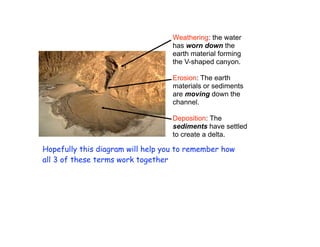
Weathering: the water
                                   has worn down the
                                   earth material forming
                                   the V-shaped canyon.

                                   Erosion: The earth
                                   materials or sediments
                                   are moving down the
                                   channel.

                                   Deposition: The
                                   sediments have settled
                                   to create a delta.

Hopefully this diagram will help you to remember how
all 3 of these terms work together
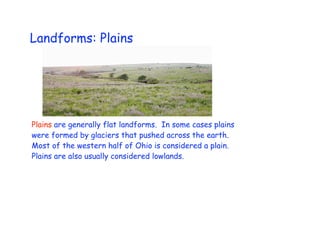
Landforms: Plains


Plains are generally flat landforms. In some cases plains
were formed by glaciers that pushed across the earth.
Most of the western half of Ohio is considered a plain.
Plains are also usually considered lowlands.
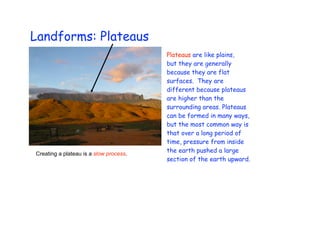
Landforms: Plateaus
                                        Plateaus are like plains,
                                        but they are generally
                                        because they are flat
                                        surfaces. They are
                                        different because plateaus
                                        are higher than the
                                        surrounding areas. Plateaus
                                        can be formed in many ways,
                                        but the most common way is
                                        that over a long period of
                                        time, pressure from inside
Creating a plateau is a slow process.
                                        the earth pushed a large
                                        section of the earth upward.
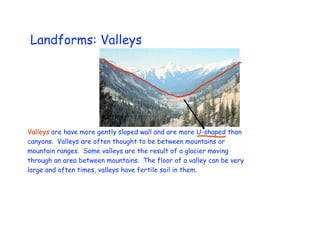
Landforms: Valleys


Valleys are have more gently sloped wall and are more U-shaped than
canyons. Valleys are often thought to be between mountains or
mountain ranges. Some valleys are the result of a glacier moving
through an area between mountains. The floor of a valley can be very
large and often times, valleys have fertile soil in them.
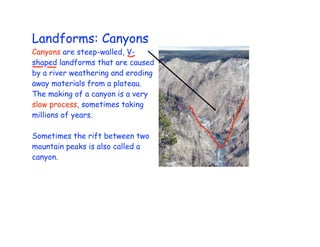
Landforms: Canyons
Canyons are steep-walled, V-
shaped landforms that are caused
by a river weathering and eroding
away materials from a plateau.
The making of a canyon is a very
slow process, sometimes taking
millions of years.

Sometimes the rift between two
mountain peaks is also called a
canyon.
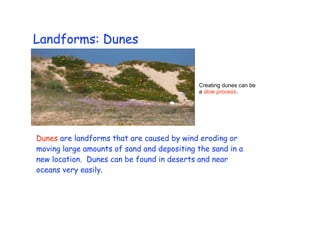
Landforms: Dunes


                                            Creating dunes can be
                                            a slow process.


Dunes are landforms that are caused by wind eroding or
moving large amounts of sand and depositing the sand in a
new location. Dunes can be found in deserts and near
oceans very easily.
Landforms: Deltas
                         Deltas are "fan-shaped"
                         landforms that are caused
                         by the erosion or movement
                         of sand, rock and other
                         earth materials by a river.
                         When a river moves these
                         material down river, the
                         deposition of the materials
                         into the ocean or sea is the
                         delta.
            Nile River Delta as seen from a satellite.
            Creating deltas is a slow process.
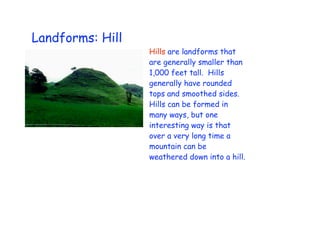
Landforms: Hill
                  Hills are landforms that
                  are generally smaller than
                  1,000 feet tall. Hills
                  generally have rounded
                  tops and smoothed sides.
                  Hills can be formed in
                  many ways, but one
                  interesting way is that
                  over a very long time a
                  mountain can be
                  weathered down into a hill.
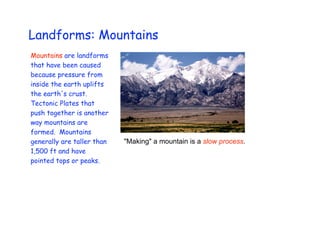
Landforms: Mountains
Mountains are landforms
that have been caused
because pressure from
inside the earth uplifts
the earth's crust.
Tectonic Plates that
push together is another
way mountains are
formed. Mountains
generally are taller than   "Making" a mountain is a slow process.
1,500 ft and have
pointed tops or peaks.
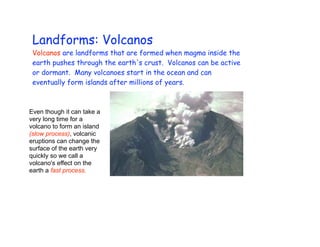
Landforms: Volcanos
 Volcanos are landforms that are formed when magma inside the
 earth pushes through the earth's crust. Volcanos can be active
 or dormant. Many volcanoes start in the ocean and can
 eventually form islands after millions of years.


Even though it can take a
very long time for a
volcano to form an island
(slow process), volcanic
eruptions can change the
surface of the earth very
quickly so we call a
volcano's effect on the
earth a fast process.
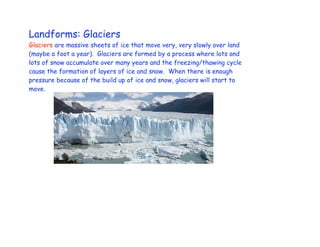
Landforms: Glaciers
Glaciers are massive sheets of ice that move very, very slowly over land
(maybe a foot a year). Glaciers are formed by a process where lots and
lots of snow accumulate over many years and the freezing/thawing cycle
cause the formation of layers of ice and snow. When there is enough
pressure because of the build up of ice and snow, glaciers will start to
move.
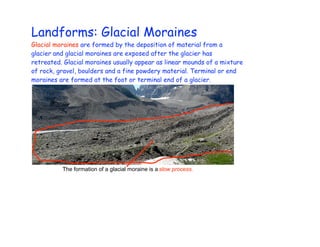
Landforms: Glacial Moraines
Glacial moraines are formed by the deposition of material from a
glacier and glacial moraines are exposed after the glacier has
retreated. Glacial moraines usually appear as linear mounds of a mixture
of rock, gravel, boulders and a fine powdery material. Terminal or end
moraines are formed at the foot or terminal end of a glacier.


          The formation of a glacial moraine is a slow process.
Earthquakes
Earthquakes are not landforms, but they do change the earth's
surface a great deal. We would classify an earthquake as a fast
process for changing the earth's surface. Earthquakes happen
when there is a sudden release of energy in the earth's crust
that creates waves of energy. These waves of energy cause the
earth's crust to shake and crack.


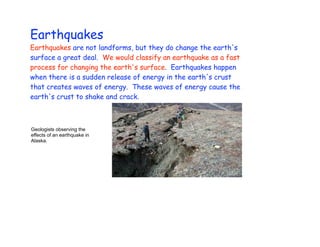
Geologists observing the
effects of an earthquake in
Alaska.
Rapid (Fast) Earth Changing Processes:
1) Volcanic Eruptions ( page 12 of "earthquakes and
volcanoes")
2) Earthquakes ( page 83 in science text book)
3) Landslides and Mudslides (page 24 of "earth's
changing crust")

Slow Earth Changing Processes:
1) Formation of Mountains (page 12 of How
Mountains Are Made)
2) Glaciers ( Ice page 10)
3) Volcanoes forming islands ( from "earthquakes
and volcanoes')
4) Weathering and erosion of rock due to water
and/or wind (Science text and other resources)

Landforms vocab guide

  • 1.
    Landforms and Changesin the Earth's Surface Vocabulary Guide Weathering is the wearing away of earth materials. It is a constant process. Weathering is caused by many things including wind, ice, water and chemicals. Erosion is when weathered earth materials move from one place to another. Deposition is when eroded earth materials stop moving and settle in a new place. One way to remember this is to think DEPOSIT. Key Point: often times "erosion" is used to describe all 3 process above. However on your assessment, you will need to be able to understand all 3 terms independently.
  • 2.
    Weathering: the water has worn down the earth material forming the V-shaped canyon. Erosion: The earth materials or sediments are moving down the channel. Deposition: The sediments have settled to create a delta. Hopefully this diagram will help you to remember how all 3 of these terms work together
  • 3.
    Landforms: Plains Plains aregenerally flat landforms. In some cases plains were formed by glaciers that pushed across the earth. Most of the western half of Ohio is considered a plain. Plains are also usually considered lowlands.
  • 4.
    Landforms: Plateaus Plateaus are like plains, but they are generally because they are flat surfaces. They are different because plateaus are higher than the surrounding areas. Plateaus can be formed in many ways, but the most common way is that over a long period of time, pressure from inside Creating a plateau is a slow process. the earth pushed a large section of the earth upward.
  • 5.
    Landforms: Valleys Valleys arehave more gently sloped wall and are more U-shaped than canyons. Valleys are often thought to be between mountains or mountain ranges. Some valleys are the result of a glacier moving through an area between mountains. The floor of a valley can be very large and often times, valleys have fertile soil in them.
  • 6.
    Landforms: Canyons Canyons aresteep-walled, V- shaped landforms that are caused by a river weathering and eroding away materials from a plateau. The making of a canyon is a very slow process, sometimes taking millions of years. Sometimes the rift between two mountain peaks is also called a canyon.
  • 7.
    Landforms: Dunes Creating dunes can be a slow process. Dunes are landforms that are caused by wind eroding or moving large amounts of sand and depositing the sand in a new location. Dunes can be found in deserts and near oceans very easily.
  • 8.
    Landforms: Deltas Deltas are "fan-shaped" landforms that are caused by the erosion or movement of sand, rock and other earth materials by a river. When a river moves these material down river, the deposition of the materials into the ocean or sea is the delta. Nile River Delta as seen from a satellite. Creating deltas is a slow process.
  • 9.
    Landforms: Hill Hills are landforms that are generally smaller than 1,000 feet tall. Hills generally have rounded tops and smoothed sides. Hills can be formed in many ways, but one interesting way is that over a very long time a mountain can be weathered down into a hill.
  • 10.
    Landforms: Mountains Mountains arelandforms that have been caused because pressure from inside the earth uplifts the earth's crust. Tectonic Plates that push together is another way mountains are formed. Mountains generally are taller than "Making" a mountain is a slow process. 1,500 ft and have pointed tops or peaks.
  • 11.
    Landforms: Volcanos Volcanosare landforms that are formed when magma inside the earth pushes through the earth's crust. Volcanos can be active or dormant. Many volcanoes start in the ocean and can eventually form islands after millions of years. Even though it can take a very long time for a volcano to form an island (slow process), volcanic eruptions can change the surface of the earth very quickly so we call a volcano's effect on the earth a fast process.
  • 12.
    Landforms: Glaciers Glaciers aremassive sheets of ice that move very, very slowly over land (maybe a foot a year). Glaciers are formed by a process where lots and lots of snow accumulate over many years and the freezing/thawing cycle cause the formation of layers of ice and snow. When there is enough pressure because of the build up of ice and snow, glaciers will start to move.
  • 13.
    Landforms: Glacial Moraines Glacialmoraines are formed by the deposition of material from a glacier and glacial moraines are exposed after the glacier has retreated. Glacial moraines usually appear as linear mounds of a mixture of rock, gravel, boulders and a fine powdery material. Terminal or end moraines are formed at the foot or terminal end of a glacier. The formation of a glacial moraine is a slow process.
  • 14.
    Earthquakes Earthquakes are notlandforms, but they do change the earth's surface a great deal. We would classify an earthquake as a fast process for changing the earth's surface. Earthquakes happen when there is a sudden release of energy in the earth's crust that creates waves of energy. These waves of energy cause the earth's crust to shake and crack. Geologists observing the effects of an earthquake in Alaska.
  • 15.
    Rapid (Fast) EarthChanging Processes: 1) Volcanic Eruptions ( page 12 of "earthquakes and volcanoes") 2) Earthquakes ( page 83 in science text book) 3) Landslides and Mudslides (page 24 of "earth's changing crust") Slow Earth Changing Processes: 1) Formation of Mountains (page 12 of How Mountains Are Made) 2) Glaciers ( Ice page 10) 3) Volcanoes forming islands ( from "earthquakes and volcanoes') 4) Weathering and erosion of rock due to water and/or wind (Science text and other resources)