LAND ECONOMICS By: Tesfaye K. (MSc.)
November, 2021
CHAPTER TWO :
LAND USE AND COMPATIBILITY
OF ALTERNATIVE USES
Supply & Demand of Land
Demand is the quantity of a product buyers are
willing and able (if demand is effective) to purchase at
a particular price at which the good is being sold.
 The supply of a good (or service) is the quantity that
producers are willing and able to supply on the
market at a particular price
The price of a commodity, service, or product is
created by the interaction of supply and demand
CONT……
Market analysis investigates supply and demand as
economic forces that establish the price of real estate
product
Supply and demand are the forces that form the
foundation for the allocation of resources in a
market.
Land markets work in cycles, which respond to
various factors– interest rates, inflation or deflation,
economic growth or slump, effective demand,
political stability or instability, and people’s general
optimism or pessimism.
CONT……..
If the economy is doing well, people find work and
wages increase, and they are generally optimistic
which may prompt people to invest in property.
The increase in demand for property pushes its price
up and sends a signal to property developers to build
more stock.
But real estate takes time and a lag occurs between
the time when the demand is high and when the real
estate finally come onto the market
CONT…
In the time that it takes to build more stock in the market,
inflation could increase, and the economy could slow down,
reducing people’s ability to spend.
Demand for real estate may drop because people do not
have enough spending money, but it is at this time that the
construction industry has finally completed the building of
extra stock which now enters the market during a downturn,
causing a surplus in supply and the lowering of prices
The inability of the property market to respond quickly to
forces of demand and supply is one of the causes of its
inefficiency
CONT…
Generally in the land market, if the demand curve shifts out
from D1 to D2 consumers demand more land to be
available to utilize but the supply side often cannot respond
to the increased demand that rapidly the result will be a
shortage at the new market price, quantity demanded will
exceed quantity supplied.
Economic equilibrium will therefore not be reached.
THE PRICE ELASTICITY OF
DEMAND AND SUPPLY
The price elasticity of demand is the change in how much
people will buy if the price changes.
Demand for luxury items may slow dramatically if prices are
raised, because these purchases are not essential, and can
be postponed it is highly elastic.
On the other hand, demand for necessities such as food,
medicine and shelter are inelastic their demand remains
about the same despite price changes because buyers
cannot postpone their purchases it is highly inelastic
CONT…
On the supply side, supply is elastic if a small rise in price
results in a large increase in the amount supplied.
It is inelastic if the supply is disproportional (small) to the
increased price
The price elasticity of supply and demand of land is a
central concept in the land market.
This is because land is a finite resource, its supply is
relatively inelastic: no matter how high the price of land,
one cannot increase its physical acreage
CONT…
This has significant consequences for urban development.
Increasing demand for urban land can rarely be met by increasing
supply, as land is relatively inelastic.
As a result, prices are bound to increase disproportionately to
supply in ways that negatively affect poorer people in urban areas.
With price inelasticity of supply – as witnessed in the land market
– the quantity of land that can be supplied is limited.
As a result, when the demand curve shifts out, from D to D1,
representing an increase in demand at all prices, the quantity that
can be supplied increases very little (from Q to Q1) while the price
increases disproportionately (from P to P1) compared to the
increase in the quantity of land supplied.
DERIVED DEMAND
Demand for some products is indirect, because they are
means to an end: it is not the thing itself that is desired, but
what that thing makes possible.
Derived demand is an important concept for land, since
people need land for what the land makes possible what it
yields and not for the land in itself
But there are exceptions, particularly in the African context,
where there is a desire for the land itself because of its
symbolic value.
CONT…
If land is fertile, there is of course greater demand for it than for
infertile land. Similarly, in an urban context it is what you can do on
the land which is important.
The demand for land is ‘derived’ from that potential use. Land is
used for various activities
Demand for types of land varies depending on what the land is
used for and the kinds of activities that will take place on the land.
What people are prepared to pay for land is linked to what they are
allowed to use that land for, and therefore what income they are
able to derive from that land.
THE CONCEPT OF LAND
RENT
Land Rent and Productivity
Early classical economists regarded rent as a
a landlord by a tenant for the use of land in its
‘unimproved’ state (land with no buildings on it)
for farming.
Rent on most productive land is based on its
over the least productive and competition between
farmers ensures the value of the ‘difference in
of land’ is paid as rent (Alonso, 1964).
CONT……
Rent is therefore dependent on the demand (and hence
the price paid) for the output from the land or a derived
demand.
The first concept of rent is that it is an income arising from
the land i.e. The income derived from the ownership of land
and other free gifts of nature is called rent (by Marshall).
Did you agree by the idea that rent is collected only from
naturally gifted land? What about improvements?
Especially in urban areas?
CONT….
Rent collected is for the land (natural gift) and for
improvements made by man labor and so it is not only for
the natural gift of land and the other concept of rent (the
extension or space relation) was rise
The extension concept of rent states that the fundamental
attribute of land is its extension
The right to use a piece of land gives command over a
certain space (part of the earth's surface).
CONT……
In this concept of rent, in the rent of land, there is an
element due to the environment, or to a situation, which is
separable from the elements due to the "value of the soil
as it was made by nature," and that due "to
improvements made in it by man.“
The increased value and income of the land is attributed to
a new element, the situation.
In considering time, place, form, and elemental value, it
may be assumed for logical and practical purposes that any
three of the four features of value are given, and then the
change in the value may be attributed to the fourth Feature.
CONT……
The value is equally dependent on the substance, form
and time, place, and the presence of wants that can be
satisfied.
It does not seem legitimate, in viewing the subjects
statically, to speak of two classes of income from natural
resources, one due to the free gifts of nature and the other
to the increase in value of those gifts with social progress
and leads to the other concept of rent( the time or long
period concept)
CONT……
The fourth concept of rent is as general surplus.
The word rent (consumers surplus) is frequently used of
late in reference to any surplus gain.
Rent is here not connected with any particular kind of
agents, nor is it any regular form of income, but it is merely
a margin of advantage in an exchange.
It is also defined as a surplus of pleasure to the workers
above the sacrifice involved in their work.
The rent concept has become one of the surpluses found
throughout the whole range of industry.
CONT…..
The fifth concept of rent is no cost concept.
In this concept, rent is the thought that it is a share of the
product (or an income, or the yield of a factor) which "does
not enter into the cost of production.
 This definition also raises an issue which impractical in a
real world and the more comprehensive concept
In general, in context of economics Rent is a part of
payment made by tenant to landlords for the use land
CONCEPT OF RENT IN
DIFFERENT THEORIES
DAVID RICARDO THEORY OF RENT
Ricardo rent theory is also called classical rent theory
 After 1st world war the price of land and corn were
highly raised and Ricardo was want find the reason.
According to Ricardo Rent is defined as
“Rent is the Portion of the produce of the earth
is paid for landlord for the use of original and
indestructible power of the earth.”
CONT……
Assumption of Ricardo Rent Theory
Land differ in fertility
The law diminishing returns operating in agriculture
Rent depends upon fertility and location of land
Theory assumes perfect competition
It is based on the assumption of long period
There is existence of marginal land or no rent land
Land has certain original and indestructible power
Land is used for cultivation only
Most fertile land are cultivated first
CONT……..
Illustration of the theory
Assume that some people go to a newly discovered
island and settle down there
There are three grade of land namely A, B, and C in
island.
A being most fertile, B less fertile and C the least
need to pay rents as long as such best lands are
available.
CONT….
Since the land is abundant and idle, there is no need to pay
rent as long as such best lands are freely available
Given a certain amount of labor and capital the yield per
hectare on A grade land is 40 quintals
Suppose another group of people goes and settle down in
same land after some time
Hence the demand for agricultural produce will increase
The most fertile land (A grade) alone cannot produce all the
food grains that needed on account of the operation of law
diminishing returns
CONT……
 So the less fertile lands ( B grade) will have to be brought
under cultivation in order to meet the growing population/
demand
For the same amount of labor and capital employed in A
grade land, the yield per hectare on grade B land is 30
quintals
The Surplus of 10 quintals (40-30) per hectare appears on
grade A land
This is the Economic Rent of A grade land
CONT…..
Suppose yet another group of people goes and settle
down in the same island
So the least fertile land (C grade) will have to be brought
under cultivation
For the same amount of capital and labor, the yield per
hectare on C grade land is 20 quintals
 This Surplus of A grade land is raised to 20 quintals (40-
20) and it is the economic rent of A grade land
CONT.……
The Surplus of B grade land is10 quintals (30-20)
This is the Economic rent of B grade land
In the above illustration in c grade land cost of production
is just equal the price of its produce and therefore does not
yield any rent (20-20)
Hence C grade land is called no rent land or Marginal
land.
Therefore no rent land or marginal land is the land in
which cost of production is just equal to the price of its
production.
CRITICISM OF RICARDIAN
THEORY OF RENT
Criticisms raised for the theory of Ricardo are:
1. No Original and Indestructible Power:
Ricardo is of the opinion that rent is paid due to the
original and indestructible powers of the soil but there
are no powers of the soil which are indestructible.
As we go on cultivating a piece of land time and again,
its fertility gradually diminishes.
CONT….
2. Wrong Assumption of 'No Rent Land‘ or Marginal Land
Ricardo assumes the existence of no-rent land for a land
meets the cost of cultivation.
The modern economists are of the opinion that if a plot of
be put to several uses, then it does yield rent
3. Rent Enters Into Price:
According to Ricardo, rent does not enter into price.
 The modern economists are of the opinion that it does enter
price.
CONT……..
4. Wrong Assumption of Perfect Competition:
Ricardo is of the opinion that perfect competition
between the landlord and the tenant, but in the
world, it is imperfect competition which is the order
day
5. Neglect of Scarcity Principle:
It is pointed out by the modem economists that the
concept of rent can be easily explained with the help
scarcity principle and so there is no need to have a
separate theory of rent
CONT………
6. Neglect the alternative Use of land
Land had alternative uses and it followed that, like
other factor of production, it must receive its due
remuneration.
Further, since each piece of land had an opportunity
the rent that could be obtained in the most profitable
alternative use, it followed that the rent of land did
into the cost of production
CONT……
7. Assumption on Relation to rent and price of
produce
The increase in the rent of land is not caused
increase in the price of the produce.
Rather the price of the produce has risen
the rent of land has risen.
Thus, the price of produce is high because the
of land is high, and not vice versa.
CONT…..
8. Effect Land Tax
Any form of land tax which differentiates between
uses would not be neutral in its effect,
But would result in a shift in the use of land from the
to the lower taxed use with the tax being passed on
form of a higher price for the product of the land
the higher rate
VON THUNEN'S RENT
THEORY
Modern location economics began with Von Thunen (1826)
He was the first to develop a basic analytical model of the
relationships between markets, production, and distance
based upon the agricultural landscape
The relative costs of transporting different agricultural
commodities to the central market determined the agricultural
land use around a city
 The most productive activities will thus compete for the
closest land to the market and activities not productive
enough will locate further away
ASSUMPTIONS OF VON THUNEN
I. Market Isolation
There is one isolated market in an isolated state having
no interactions (trade) with the outside
There is a central market (CBD)
II. Ubiquitous land characteristics
The land surrounding the market is entirely flat and its
fertility uniform.
CONT…..
III. Transportation
It is assumed there are no transport infrastructures
as roads or rivers and that farmers are transporting
production to the market using horses and carts
Transportation costs are dependent of the type of
commodity being transported to the market as well
distance involved.
Or assumed there is a uniform horse- and - cart
facilities to the central market
CONT……..
Different foods can be grown but since this differ in bulk
the cost of transporting them to the market differs
For each type of product transport cost vary with directly
and proportionally to the central market
All agricultural land uses are maximizing their productivity
(rent), which in this case is dependent upon their location
from the market (Central City).
CONT…………
The role of farmer is to maximize his profit which is simply
the market price minus the transport and production costs.
The most productive activities (gardening or milk
production) or activities having high transport costs
(firewood) locate nearby the market
Von Thunen assumed that land use zones will emerge and
that the types and quantities of products demanded in the
city and the consequent prices that commodities generated
would influence the total volume of production of each type
of land use.
RESULTS DEDUCED BY VON
THUNEN
Land rent for a particular product varies reversely with
distance from the city, reaching zero where marginal costs
and marginal revenue for a product are equal
The product with the highest yield per acre is produced
closest to the market
Intensity of cultivation decreases with distance from the
market,
Perishability of products decreases with increasing
distance from market,
CONT……..
Price of land varies directly with its rent yielding capability
Crops which have a considerable weight or bulk proportion
to their value or crops which require high transportation
costs, will be produced close to the market
The greater the distance from the city the more likely that
land users occupying those locations will require lower
transportation costs per unit per mile
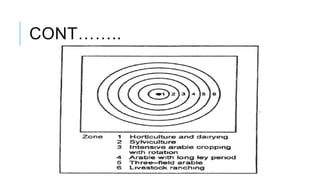
CONT………….
Recognizable zones of different types of land use will
develop around the city
Because of the different lifestyles associated with different
forms of production, the nature of economic life will also
vary distinctly with increasing distance from the city
Because of the initial environmental uniformity
assumptions in the isolated state, land users will be
arranged in concentric circles around the central city
CONT……..
WILLIAM ALONSO RENT
THEORY
William Alonso Extended the von Thunen model to urban
land uses.
His model gives land use, rent, intensity of land use,
population and employment as a function of distance to
the CBD of the city as a solution of an economic
equilibrium for the market for space
In his analyses the central business district of the urban
area replaces the urban area in the Von Thunen analysis
as the destination of all travel.
CONT…..
Instead of the transport of agricultural produce to the city,
however, the concern is with the daily movement of people
to their workplace in the city center affect the rent
Both the Ricardian and the Von Thunen approaches have
as a feature in common that it is the demand for land which
determines the rent to be charged.
The supply of land is unimportant (fixed)
In Ricardos case this is because he assumes that there is
a fixed supply of land which cannot be altered.
CONT…….
In Von Thunens case it is because he assumes that the
land surrounding the city is all available for agricultural use
so that, if the demand is high enough, the land will be
used by the owner or rented by a tenant.
In each case the owners of the land have no particular
role other than to maximize the income that they obtain
from the land which they own, either using it themselves
or renting it to a tenant.
EDGAR STREETER DUNN THE
LOCATION OF AGRICULTURAL
PRODUCTION THEORY
E S Dunn Operationalize the Von Thunen concept in the
form of a mathematical model in 1954.
Dunn concurred with Von Thunen’s basic ideas when
considering product type and isolation.
He formalized the Von Thunen model an a functional
relationship expressed as follows.
CONT……
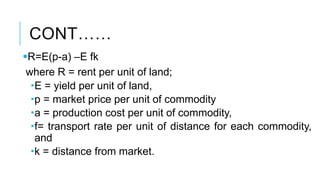
R=E(p-a) –E fk
where R = rent per unit of land;
E = yield per unit of land,
p = market price per unit of commodity
a = production cost per unit of commodity,
f= transport rate per unit of distance for each commodity,
and
k = distance from market.
CONT…….
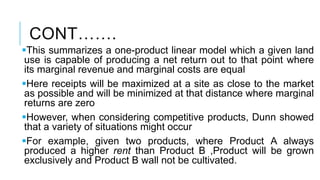
This summarizes a one-product linear model which a given land
use is capable of producing a net return out to that point where
its marginal revenue and marginal costs are equal
Here receipts will be maximized at a site as close to the market
as possible and will be minimized at that distance where marginal
returns are zero
However, when considering competitive products, Dunn showed
that a variety of situations might occur
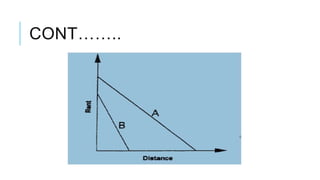
For example, given two products, where Product A always
produced a higher rent than Product B ,Product will be grown
exclusively and Product B wall not be cultivated.
CONT……..
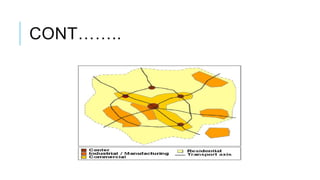
WALTER ISARD (1955)
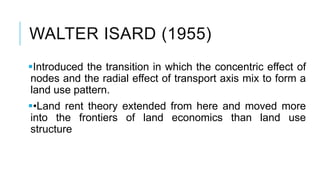
Introduced the transition in which the concentric effect of
nodes and the radial effect of transport axis mix to form a
land use pattern.
•Land rent theory extended from here and moved more
into the frontiers of land economics than land use
structure
CONT……..

land Economics 2.pptx

  • 1.
    LAND ECONOMICS By:Tesfaye K. (MSc.) November, 2021
  • 2.
    CHAPTER TWO : LANDUSE AND COMPATIBILITY OF ALTERNATIVE USES Supply & Demand of Land Demand is the quantity of a product buyers are willing and able (if demand is effective) to purchase at a particular price at which the good is being sold.  The supply of a good (or service) is the quantity that producers are willing and able to supply on the market at a particular price The price of a commodity, service, or product is created by the interaction of supply and demand
  • 3.
    CONT…… Market analysis investigatessupply and demand as economic forces that establish the price of real estate product Supply and demand are the forces that form the foundation for the allocation of resources in a market. Land markets work in cycles, which respond to various factors– interest rates, inflation or deflation, economic growth or slump, effective demand, political stability or instability, and people’s general optimism or pessimism.
  • 4.
    CONT…….. If the economyis doing well, people find work and wages increase, and they are generally optimistic which may prompt people to invest in property. The increase in demand for property pushes its price up and sends a signal to property developers to build more stock. But real estate takes time and a lag occurs between the time when the demand is high and when the real estate finally come onto the market
  • 5.
    CONT… In the timethat it takes to build more stock in the market, inflation could increase, and the economy could slow down, reducing people’s ability to spend. Demand for real estate may drop because people do not have enough spending money, but it is at this time that the construction industry has finally completed the building of extra stock which now enters the market during a downturn, causing a surplus in supply and the lowering of prices The inability of the property market to respond quickly to forces of demand and supply is one of the causes of its inefficiency
  • 6.
    CONT… Generally in theland market, if the demand curve shifts out from D1 to D2 consumers demand more land to be available to utilize but the supply side often cannot respond to the increased demand that rapidly the result will be a shortage at the new market price, quantity demanded will exceed quantity supplied. Economic equilibrium will therefore not be reached.
  • 7.
    THE PRICE ELASTICITYOF DEMAND AND SUPPLY The price elasticity of demand is the change in how much people will buy if the price changes. Demand for luxury items may slow dramatically if prices are raised, because these purchases are not essential, and can be postponed it is highly elastic. On the other hand, demand for necessities such as food, medicine and shelter are inelastic their demand remains about the same despite price changes because buyers cannot postpone their purchases it is highly inelastic
  • 8.
    CONT… On the supplyside, supply is elastic if a small rise in price results in a large increase in the amount supplied. It is inelastic if the supply is disproportional (small) to the increased price The price elasticity of supply and demand of land is a central concept in the land market. This is because land is a finite resource, its supply is relatively inelastic: no matter how high the price of land, one cannot increase its physical acreage
  • 9.
    CONT… This has significantconsequences for urban development. Increasing demand for urban land can rarely be met by increasing supply, as land is relatively inelastic. As a result, prices are bound to increase disproportionately to supply in ways that negatively affect poorer people in urban areas. With price inelasticity of supply – as witnessed in the land market – the quantity of land that can be supplied is limited. As a result, when the demand curve shifts out, from D to D1, representing an increase in demand at all prices, the quantity that can be supplied increases very little (from Q to Q1) while the price increases disproportionately (from P to P1) compared to the increase in the quantity of land supplied.
  • 10.
    DERIVED DEMAND Demand forsome products is indirect, because they are means to an end: it is not the thing itself that is desired, but what that thing makes possible. Derived demand is an important concept for land, since people need land for what the land makes possible what it yields and not for the land in itself But there are exceptions, particularly in the African context, where there is a desire for the land itself because of its symbolic value.
  • 11.
    CONT… If land isfertile, there is of course greater demand for it than for infertile land. Similarly, in an urban context it is what you can do on the land which is important. The demand for land is ‘derived’ from that potential use. Land is used for various activities Demand for types of land varies depending on what the land is used for and the kinds of activities that will take place on the land. What people are prepared to pay for land is linked to what they are allowed to use that land for, and therefore what income they are able to derive from that land.
  • 12.
    THE CONCEPT OFLAND RENT Land Rent and Productivity Early classical economists regarded rent as a a landlord by a tenant for the use of land in its ‘unimproved’ state (land with no buildings on it) for farming. Rent on most productive land is based on its over the least productive and competition between farmers ensures the value of the ‘difference in of land’ is paid as rent (Alonso, 1964).
  • 13.
    CONT…… Rent is thereforedependent on the demand (and hence the price paid) for the output from the land or a derived demand. The first concept of rent is that it is an income arising from the land i.e. The income derived from the ownership of land and other free gifts of nature is called rent (by Marshall). Did you agree by the idea that rent is collected only from naturally gifted land? What about improvements? Especially in urban areas?
  • 14.
    CONT…. Rent collected isfor the land (natural gift) and for improvements made by man labor and so it is not only for the natural gift of land and the other concept of rent (the extension or space relation) was rise The extension concept of rent states that the fundamental attribute of land is its extension The right to use a piece of land gives command over a certain space (part of the earth's surface).
  • 15.
    CONT…… In this conceptof rent, in the rent of land, there is an element due to the environment, or to a situation, which is separable from the elements due to the "value of the soil as it was made by nature," and that due "to improvements made in it by man.“ The increased value and income of the land is attributed to a new element, the situation. In considering time, place, form, and elemental value, it may be assumed for logical and practical purposes that any three of the four features of value are given, and then the change in the value may be attributed to the fourth Feature.
  • 16.
    CONT…… The value isequally dependent on the substance, form and time, place, and the presence of wants that can be satisfied. It does not seem legitimate, in viewing the subjects statically, to speak of two classes of income from natural resources, one due to the free gifts of nature and the other to the increase in value of those gifts with social progress and leads to the other concept of rent( the time or long period concept)
  • 17.
    CONT…… The fourth conceptof rent is as general surplus. The word rent (consumers surplus) is frequently used of late in reference to any surplus gain. Rent is here not connected with any particular kind of agents, nor is it any regular form of income, but it is merely a margin of advantage in an exchange. It is also defined as a surplus of pleasure to the workers above the sacrifice involved in their work. The rent concept has become one of the surpluses found throughout the whole range of industry.
  • 18.
    CONT….. The fifth conceptof rent is no cost concept. In this concept, rent is the thought that it is a share of the product (or an income, or the yield of a factor) which "does not enter into the cost of production.  This definition also raises an issue which impractical in a real world and the more comprehensive concept In general, in context of economics Rent is a part of payment made by tenant to landlords for the use land
  • 19.
    CONCEPT OF RENTIN DIFFERENT THEORIES DAVID RICARDO THEORY OF RENT Ricardo rent theory is also called classical rent theory  After 1st world war the price of land and corn were highly raised and Ricardo was want find the reason. According to Ricardo Rent is defined as “Rent is the Portion of the produce of the earth is paid for landlord for the use of original and indestructible power of the earth.”
  • 20.
    CONT…… Assumption of RicardoRent Theory Land differ in fertility The law diminishing returns operating in agriculture Rent depends upon fertility and location of land Theory assumes perfect competition It is based on the assumption of long period There is existence of marginal land or no rent land Land has certain original and indestructible power Land is used for cultivation only Most fertile land are cultivated first
  • 21.
    CONT…….. Illustration of thetheory Assume that some people go to a newly discovered island and settle down there There are three grade of land namely A, B, and C in island. A being most fertile, B less fertile and C the least need to pay rents as long as such best lands are available.
  • 22.
    CONT…. Since the landis abundant and idle, there is no need to pay rent as long as such best lands are freely available Given a certain amount of labor and capital the yield per hectare on A grade land is 40 quintals Suppose another group of people goes and settle down in same land after some time Hence the demand for agricultural produce will increase The most fertile land (A grade) alone cannot produce all the food grains that needed on account of the operation of law diminishing returns
  • 23.
    CONT……  So theless fertile lands ( B grade) will have to be brought under cultivation in order to meet the growing population/ demand For the same amount of labor and capital employed in A grade land, the yield per hectare on grade B land is 30 quintals The Surplus of 10 quintals (40-30) per hectare appears on grade A land This is the Economic Rent of A grade land
  • 24.
    CONT….. Suppose yet anothergroup of people goes and settle down in the same island So the least fertile land (C grade) will have to be brought under cultivation For the same amount of capital and labor, the yield per hectare on C grade land is 20 quintals  This Surplus of A grade land is raised to 20 quintals (40- 20) and it is the economic rent of A grade land
  • 25.
    CONT.…… The Surplus ofB grade land is10 quintals (30-20) This is the Economic rent of B grade land In the above illustration in c grade land cost of production is just equal the price of its produce and therefore does not yield any rent (20-20) Hence C grade land is called no rent land or Marginal land. Therefore no rent land or marginal land is the land in which cost of production is just equal to the price of its production.
  • 26.
    CRITICISM OF RICARDIAN THEORYOF RENT Criticisms raised for the theory of Ricardo are: 1. No Original and Indestructible Power: Ricardo is of the opinion that rent is paid due to the original and indestructible powers of the soil but there are no powers of the soil which are indestructible. As we go on cultivating a piece of land time and again, its fertility gradually diminishes.
  • 27.
    CONT…. 2. Wrong Assumptionof 'No Rent Land‘ or Marginal Land Ricardo assumes the existence of no-rent land for a land meets the cost of cultivation. The modern economists are of the opinion that if a plot of be put to several uses, then it does yield rent 3. Rent Enters Into Price: According to Ricardo, rent does not enter into price.  The modern economists are of the opinion that it does enter price.
  • 28.
    CONT…….. 4. Wrong Assumptionof Perfect Competition: Ricardo is of the opinion that perfect competition between the landlord and the tenant, but in the world, it is imperfect competition which is the order day 5. Neglect of Scarcity Principle: It is pointed out by the modem economists that the concept of rent can be easily explained with the help scarcity principle and so there is no need to have a separate theory of rent
  • 29.
    CONT……… 6. Neglect thealternative Use of land Land had alternative uses and it followed that, like other factor of production, it must receive its due remuneration. Further, since each piece of land had an opportunity the rent that could be obtained in the most profitable alternative use, it followed that the rent of land did into the cost of production
  • 30.
    CONT…… 7. Assumption onRelation to rent and price of produce The increase in the rent of land is not caused increase in the price of the produce. Rather the price of the produce has risen the rent of land has risen. Thus, the price of produce is high because the of land is high, and not vice versa.
  • 31.
    CONT….. 8. Effect LandTax Any form of land tax which differentiates between uses would not be neutral in its effect, But would result in a shift in the use of land from the to the lower taxed use with the tax being passed on form of a higher price for the product of the land the higher rate
  • 32.
    VON THUNEN'S RENT THEORY Modernlocation economics began with Von Thunen (1826) He was the first to develop a basic analytical model of the relationships between markets, production, and distance based upon the agricultural landscape The relative costs of transporting different agricultural commodities to the central market determined the agricultural land use around a city  The most productive activities will thus compete for the closest land to the market and activities not productive enough will locate further away
  • 33.
    ASSUMPTIONS OF VONTHUNEN I. Market Isolation There is one isolated market in an isolated state having no interactions (trade) with the outside There is a central market (CBD) II. Ubiquitous land characteristics The land surrounding the market is entirely flat and its fertility uniform.
  • 34.
    CONT….. III. Transportation It isassumed there are no transport infrastructures as roads or rivers and that farmers are transporting production to the market using horses and carts Transportation costs are dependent of the type of commodity being transported to the market as well distance involved. Or assumed there is a uniform horse- and - cart facilities to the central market
  • 35.
    CONT…….. Different foods canbe grown but since this differ in bulk the cost of transporting them to the market differs For each type of product transport cost vary with directly and proportionally to the central market All agricultural land uses are maximizing their productivity (rent), which in this case is dependent upon their location from the market (Central City).
  • 36.
    CONT………… The role offarmer is to maximize his profit which is simply the market price minus the transport and production costs. The most productive activities (gardening or milk production) or activities having high transport costs (firewood) locate nearby the market Von Thunen assumed that land use zones will emerge and that the types and quantities of products demanded in the city and the consequent prices that commodities generated would influence the total volume of production of each type of land use.
  • 37.
    RESULTS DEDUCED BYVON THUNEN Land rent for a particular product varies reversely with distance from the city, reaching zero where marginal costs and marginal revenue for a product are equal The product with the highest yield per acre is produced closest to the market Intensity of cultivation decreases with distance from the market, Perishability of products decreases with increasing distance from market,
  • 38.
    CONT…….. Price of landvaries directly with its rent yielding capability Crops which have a considerable weight or bulk proportion to their value or crops which require high transportation costs, will be produced close to the market The greater the distance from the city the more likely that land users occupying those locations will require lower transportation costs per unit per mile
  • 39.
    CONT…………. Recognizable zones ofdifferent types of land use will develop around the city Because of the different lifestyles associated with different forms of production, the nature of economic life will also vary distinctly with increasing distance from the city Because of the initial environmental uniformity assumptions in the isolated state, land users will be arranged in concentric circles around the central city
  • 40.
  • 41.
    WILLIAM ALONSO RENT THEORY WilliamAlonso Extended the von Thunen model to urban land uses. His model gives land use, rent, intensity of land use, population and employment as a function of distance to the CBD of the city as a solution of an economic equilibrium for the market for space In his analyses the central business district of the urban area replaces the urban area in the Von Thunen analysis as the destination of all travel.
  • 42.
    CONT….. Instead of thetransport of agricultural produce to the city, however, the concern is with the daily movement of people to their workplace in the city center affect the rent Both the Ricardian and the Von Thunen approaches have as a feature in common that it is the demand for land which determines the rent to be charged. The supply of land is unimportant (fixed) In Ricardos case this is because he assumes that there is a fixed supply of land which cannot be altered.
  • 43.
    CONT……. In Von Thunenscase it is because he assumes that the land surrounding the city is all available for agricultural use so that, if the demand is high enough, the land will be used by the owner or rented by a tenant. In each case the owners of the land have no particular role other than to maximize the income that they obtain from the land which they own, either using it themselves or renting it to a tenant.
  • 44.
    EDGAR STREETER DUNNTHE LOCATION OF AGRICULTURAL PRODUCTION THEORY E S Dunn Operationalize the Von Thunen concept in the form of a mathematical model in 1954. Dunn concurred with Von Thunen’s basic ideas when considering product type and isolation. He formalized the Von Thunen model an a functional relationship expressed as follows.
  • 45.
    CONT…… R=E(p-a) –E fk whereR = rent per unit of land; E = yield per unit of land, p = market price per unit of commodity a = production cost per unit of commodity, f= transport rate per unit of distance for each commodity, and k = distance from market.
  • 46.
    CONT……. This summarizes aone-product linear model which a given land use is capable of producing a net return out to that point where its marginal revenue and marginal costs are equal Here receipts will be maximized at a site as close to the market as possible and will be minimized at that distance where marginal returns are zero However, when considering competitive products, Dunn showed that a variety of situations might occur For example, given two products, where Product A always produced a higher rent than Product B ,Product will be grown exclusively and Product B wall not be cultivated.
  • 47.
  • 48.
    WALTER ISARD (1955) Introducedthe transition in which the concentric effect of nodes and the radial effect of transport axis mix to form a land use pattern. •Land rent theory extended from here and moved more into the frontiers of land economics than land use structure
  • 49.