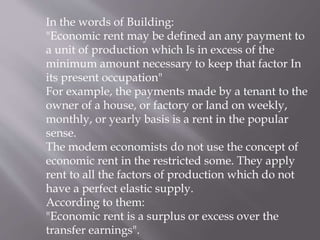
In the words of Building:
"Economic rent may be defined an any payment to
a unit of production which Is in excess of the
minimum amount necessary to keep that factor In
its present occupation"
For example, the payments made by a tenant to the
owner of a house, or factory or land on weekly,
monthly, or yearly basis is a rent in the popular
sense.
The modem economists do not use the concept of
economic rent in the restricted some. They apply
rent to all the factors of production which do not
have a perfect elastic supply.
According to them:
"Economic rent is a surplus or excess over the
transfer earnings".
1. Ricardian Theory of Rent
2. Modern Theory of Factor
Pricing Under Perfect
Competition
3. Quasi Rent
Ricardian Theory of Rent
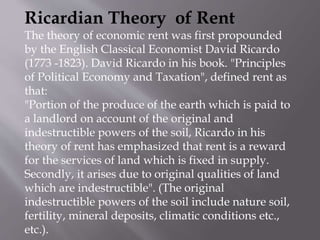
The theory of economic rent was first propounded
by the English Classical Economist David Ricardo
(1773 -1823). David Ricardo in his book. "Principles
of Political Economy and Taxation", defined rent as
that:
"Portion of the produce of the earth which is paid to
a landlord on account of the original and
indestructible powers of the soil, Ricardo in his
theory of rent has emphasized that rent is a reward
for the services of land which is fixed in supply.
Secondly, it arises due to original qualities of land
which are indestructible". (The original
indestructible powers of the soil include nature soil,
fertility, mineral deposits, climatic conditions etc.,
etc.).
Assumptions:
(i) Rent Under Extensive Cultivation.
(ii) Rent Under Intensive Cultivation.
A
25
20
B
20
15 15
C
15
10 10 10
D
10
5 5 5 5
E
5
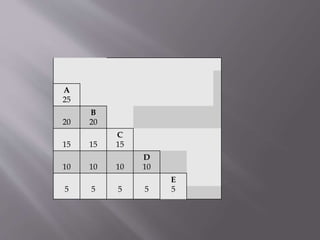
You can see in the above table that there are
five kinds of land .
First one is very fertile land so it having
highest rent
2nd is inferior land hence having less rent
3rd one inferior than 1st and 2nd land so it has
less rent than previous two.
4th Land is more inferior than previous but
still acquiring rent
The last land is most inferior land so it is
earning no rent.
Rent Under Intensive Cultivation:
The theory of rent which has been discussed
above applies to Intensive margin of cultivation.
The surplus or economic rent also arises to the
land cultivated intensively. This occurs due to
the operation of the famous law of diminishing
returns.
When the land is cultivated intensively, the
application of additional doses of labor and
capital brings in less and less of yield. The dose
whose cost just equates the value of marginal
return is regarded marginal or no rent dose. The
rent arises on all the infra-marginal doses.
Limitation of Ricardian Theory of Rent:
(i) Original and Indestructible Power
(ii) Wrong Assumption of 'No Rent
Land’
(iii) Rent Enters Into Price
(iv) Wrong Assumption of Perfect
Competition
(v) All Lands are Equally Fertile
(vi) Historically Wrong
(vii) Neglect of Scarcity Principle
Quasi Rent
The concept of quasi-rent owes its origin to Dr. Alfred
Marshall. Dr. Marshal is of the opinion that:
"It is not possible for human beings to increase the supply of
land. It is fixed by Nature. If price of a produce rises, the
surface of earth cannot be increased and if price falls, it
cannot be decreased. But by appliance of machine which are
the product of human efforts, the supply can be increased or
decreased if a fairly long period of time is allowed".
"Marshall is of the view that a differential surplus which
arises from a factor of production, whose supply is fixed for
all times to come should be named as rent but a temporary
gain which a factor or production earns due to temporary
limitation of its supply should be called quasi-rent".
Modern Theory of Rent:
Modern theory of rent is an amplified and modified
version of Ricardian theory of Rent. It was first of all
discussed by J.S. Mill and after that developed by
economists like Jevons, Pareto, Marshall, Joan
Robinson etc.
According to modern theory, economic rent is a
surplus which is not peculiar to land alone. It can be
a part of income of labour, capital, entrepreneur.
According to modern version rent is a surplus which
arises due to difference between actual earning and
transfer earning.
Rent = Actual Earning-Transfer Earning.
What is Transfer Earning?
When we transfer one factor from one
use to another, we have to sacrifice the
income earned by it from its earlier
use. Sacrifice of earning is called
transfer earning.
In short what a person, piece of land
or capital can earn in the next best
alternative use is known as transfer
earnings.
Features of Modern Theory of Rent:
The major features of the modern
theory of rent are as under:
1. Rent can be a part of the income of all
factors of production.
2. Amount of rent depends upon the
difference between actual earning and
transfer earning.
3. Rent arises when supply of the factor
is either perfectly inelastic or less elastic.
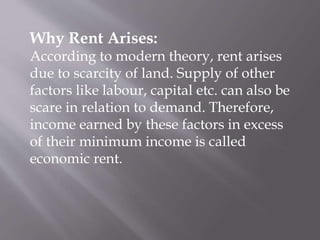
Why Rent Arises:
According to modern theory, rent arises
due to scarcity of land. Supply of other
factors like labour, capital etc. can also be
scare in relation to demand. Therefore,
income earned by these factors in excess
of their minimum income is called
economic rent.
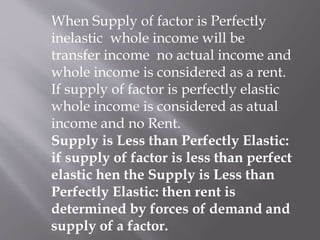
When Supply of factor is Perfectly
inelastic whole income will be
transfer income no actual income and
whole income is considered as a rent.
If supply of factor is perfectly elastic
whole income is considered as atual
income and no Rent.
Supply is Less than Perfectly Elastic:
if supply of factor is less than perfect
elastic hen the Supply is Less than
Perfectly Elastic: then rent is
determined by forces of demand and
supply of a factor.

Rent

  • 2.
    In the wordsof Building: "Economic rent may be defined an any payment to a unit of production which Is in excess of the minimum amount necessary to keep that factor In its present occupation" For example, the payments made by a tenant to the owner of a house, or factory or land on weekly, monthly, or yearly basis is a rent in the popular sense. The modem economists do not use the concept of economic rent in the restricted some. They apply rent to all the factors of production which do not have a perfect elastic supply. According to them: "Economic rent is a surplus or excess over the transfer earnings".
  • 3.
    1. Ricardian Theoryof Rent 2. Modern Theory of Factor Pricing Under Perfect Competition 3. Quasi Rent
  • 4.
    Ricardian Theory ofRent The theory of economic rent was first propounded by the English Classical Economist David Ricardo (1773 -1823). David Ricardo in his book. "Principles of Political Economy and Taxation", defined rent as that: "Portion of the produce of the earth which is paid to a landlord on account of the original and indestructible powers of the soil, Ricardo in his theory of rent has emphasized that rent is a reward for the services of land which is fixed in supply. Secondly, it arises due to original qualities of land which are indestructible". (The original indestructible powers of the soil include nature soil, fertility, mineral deposits, climatic conditions etc., etc.).
  • 5.
    Assumptions: (i) Rent UnderExtensive Cultivation. (ii) Rent Under Intensive Cultivation.
  • 6.
    A 25 20 B 20 15 15 C 15 10 1010 D 10 5 5 5 5 E 5
  • 7.
    You can seein the above table that there are five kinds of land . First one is very fertile land so it having highest rent 2nd is inferior land hence having less rent 3rd one inferior than 1st and 2nd land so it has less rent than previous two. 4th Land is more inferior than previous but still acquiring rent The last land is most inferior land so it is earning no rent.
  • 8.
    Rent Under IntensiveCultivation: The theory of rent which has been discussed above applies to Intensive margin of cultivation. The surplus or economic rent also arises to the land cultivated intensively. This occurs due to the operation of the famous law of diminishing returns. When the land is cultivated intensively, the application of additional doses of labor and capital brings in less and less of yield. The dose whose cost just equates the value of marginal return is regarded marginal or no rent dose. The rent arises on all the infra-marginal doses.
  • 9.
    Limitation of RicardianTheory of Rent: (i) Original and Indestructible Power (ii) Wrong Assumption of 'No Rent Land’ (iii) Rent Enters Into Price (iv) Wrong Assumption of Perfect Competition (v) All Lands are Equally Fertile (vi) Historically Wrong (vii) Neglect of Scarcity Principle
  • 10.
    Quasi Rent The conceptof quasi-rent owes its origin to Dr. Alfred Marshall. Dr. Marshal is of the opinion that: "It is not possible for human beings to increase the supply of land. It is fixed by Nature. If price of a produce rises, the surface of earth cannot be increased and if price falls, it cannot be decreased. But by appliance of machine which are the product of human efforts, the supply can be increased or decreased if a fairly long period of time is allowed". "Marshall is of the view that a differential surplus which arises from a factor of production, whose supply is fixed for all times to come should be named as rent but a temporary gain which a factor or production earns due to temporary limitation of its supply should be called quasi-rent".
  • 11.
    Modern Theory ofRent: Modern theory of rent is an amplified and modified version of Ricardian theory of Rent. It was first of all discussed by J.S. Mill and after that developed by economists like Jevons, Pareto, Marshall, Joan Robinson etc. According to modern theory, economic rent is a surplus which is not peculiar to land alone. It can be a part of income of labour, capital, entrepreneur. According to modern version rent is a surplus which arises due to difference between actual earning and transfer earning. Rent = Actual Earning-Transfer Earning.
  • 12.
    What is TransferEarning? When we transfer one factor from one use to another, we have to sacrifice the income earned by it from its earlier use. Sacrifice of earning is called transfer earning. In short what a person, piece of land or capital can earn in the next best alternative use is known as transfer earnings.
  • 13.
    Features of ModernTheory of Rent: The major features of the modern theory of rent are as under: 1. Rent can be a part of the income of all factors of production. 2. Amount of rent depends upon the difference between actual earning and transfer earning. 3. Rent arises when supply of the factor is either perfectly inelastic or less elastic.
  • 14.
    Why Rent Arises: Accordingto modern theory, rent arises due to scarcity of land. Supply of other factors like labour, capital etc. can also be scare in relation to demand. Therefore, income earned by these factors in excess of their minimum income is called economic rent.
  • 15.
    When Supply offactor is Perfectly inelastic whole income will be transfer income no actual income and whole income is considered as a rent. If supply of factor is perfectly elastic whole income is considered as atual income and no Rent. Supply is Less than Perfectly Elastic: if supply of factor is less than perfect elastic hen the Supply is Less than Perfectly Elastic: then rent is determined by forces of demand and supply of a factor.