LACTATION FAILURE- URBAN &
RURAL MOTHERS
DR.K.Sivakumar
INTRODUCTION
• Infant and young child feeding practices
directly affect the nutritional status of
children under two years, impacting child
survival
• Child feeding practices are linked with
knowledge of mother and socio-economic and
cultural dimensions of the community
INFANT FEEDING PRACTICES IN INDIA
NFHS-3
• Although breast feeding after birth is
nearly universal practice in India, very
few children are put on breast feeding
practice immediately after birth.
• Only 23.4 % of newborn babies were put
on breast feeding within 1 hr.
• 37%- day one
• 63%-squeezed the first milk from breast
discarded (colostrum) before they started
breast feeding.
• Initiation of breast feeding is delayed and
newborn is deprived of most nutritious feed
and energy.
Optimal Infant Feeding practices includes
• Initiation of breastfeeding within one hour of birth.
• Exclusive breastfeeding up to six months of life.
• Continued breastfeeding for two years of life or
beyond.
• Introduction of appropriate complementary feeding
after 6 months of age.
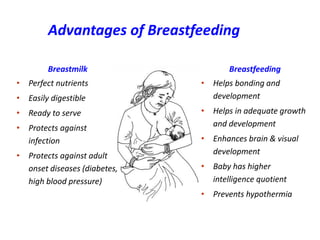
Advantages of Breastfeeding
Breastmilk
• Perfect nutrients
• Easily digestible
• Ready to serve
• Protects against
infection
• Protects against adult
onset diseases (diabetes,
high blood pressure)
Breastfeeding
• Helps bonding and
development
• Helps in adequate growth
and development
• Enhances brain & visual
development
• Baby has higher
intelligence quotient
• Prevents hypothermia
Advantages of Breastfeeding (contd.)
Mother
• Reduces post delivery
bleeding and anemia
• Delays next pregnancy
• Protects breast and
ovarian cancer
• Protects obesity and
shapes body
• Convenient
Society
• Eco-friendly
• Human resource
development
• Economic
development
Family
 Economic benefits
 Less illnesses
 Family bonding
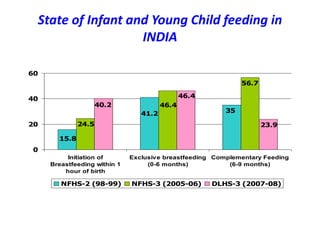
State of Infant and Young Child feeding in
INDIA
3541.2
15.8
56.7
46.4
24.5 23.9
46.4
40.2
0
20
40
60
Initiation of
Breastfeeding within 1
hour of birth
Exclusive breastfeeding
(0-6 months)
Complementary Feeding
(6-9 months)
NFHS-2 (98-99) NFHS-3 (2005-06) DLHS-3 (2007-08)
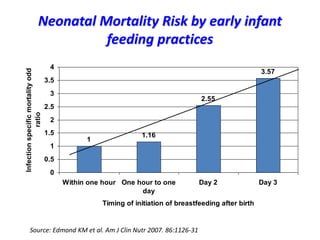
Neonatal Mortality Risk by early infant
feeding practices
1
1.16
2.55
3.57
0
0.5
1
1.5
2
2.5
3
3.5
4
Within one hour One hour to one
day
Day 2 Day 3
Timing of initiation of breastfeeding after birth
Infectionspecificmortalityodd
ratio
Source: Edmond KM et al. Am J Clin Nutr 2007. 86:1126-31
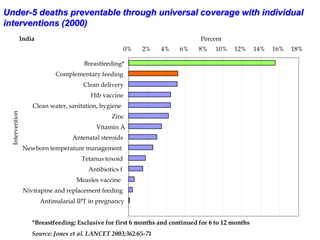
Under-5 deaths preventable through universal coverage with individual
interventions (2000)
India
*Breastfeeding: Exclusive for first 6 months and continued for 6 to 12 months
Source: Jones et al. LANCET 2003;362:65-71
0% 2% 4% 6% 8% 10% 12% 14% 16% 18%
Breastfeeding*
Complementary feeding
Clean delivery
Hib vaccine
Clean water, sanitation, hygiene
Zinc
Vitamin A
Antenatal steroids
Newborn temperature management
Tetanus toxoid
Antibiotics f
Measles vaccine
Nivirapine and replacement feeding
Antimalarial IPT in pregnancy
Intervention
Percent
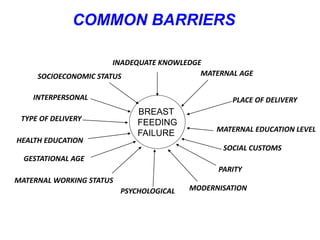
COMMON BARRIERS
BREAST
FEEDING
FAILURE
INTERPERSONAL
INADEQUATE KNOWLEDGE
SOCIOECONOMIC STATUS MATERNAL AGE
MATERNAL EDUCATION LEVEL
MATERNAL WORKING STATUS
PARITY
GESTATIONAL AGE
PLACE OF DELIVERY
TYPE OF DELIVERY
SOCIAL CUSTOMS
MODERNISATIONPSYCHOLOGICAL
HEALTH EDUCATION
SOCIOECONOMIC STATUS
• Socio economic status of the mothers had a
significant association with duration of breast
feeding
• Shorter duration was observed among the
mothers with higher socioeconomic status
• prolonged duration among the lower
socioeconomic class
• economically deprived mothers tended to
breastfeed their babies for a longer period as
compared to economically well-off mothers.
Source: breast feeding-practices,problems&prospects Ms. Sunita Reddy et al (6*)
INADEQUATE KNOWLEDGE
• All mothers knew that they had to breast feed
their babies, but they did not have adequate
knowledge about the appropriate way of
breastfeeding.
• 10% knew that they have to initiate breast
feeding within ½ hour of birth
• 10% had idea on hazards of prelacteal feed
Source: RN Chaudhary et al(2*)
• 25% had idea on importance of colostrum
• 15% knew the meaning of exclusive breast
feeding
• The impact of knowledge about breastfeeding
practice, i.e., (duration of breastfeeding,
proper techniques, proper time of weaning) is
poorly understood.
Source: RN Chaudhary et al(2*)
INTERPERSONAL
• Mother, Mother-in-law, Husband, Peer group
are the most influential persons in decision-
making about breast-feeding
• Misguidance & lack of support is one of the
major contribution to breast-feeding failure
• Family relationships can play a significant role
particularly in sustaining breastfeeding
Source : R.Haider et al(7*) "International Breastfeeding Journal."
MATERNAL AGE
• Age of the mother had a significant positive
effect on the duration of breast feeding
• Mothers above 30 years had lower exclusive
breastfeeding rates compared to younger
mothers, similarly teen mothers had lower
rates
• mothers in twenties were more likely to
breast feed for 6 months than their older
counterparts
Source: al-Nasser AN et al (5*)
MATERNAL EDUCATION LEVEL
• Educational status of the mothers was
inversely associated with duration of breast
feeding
• As educational status increased the duration
of breast feeding decreased
• 25% of mothers who had studied up to college
level & more had not practiced exclusive
breast feeding
Source : Mrs. Rama ram et al & Kar et al (3*,4*) Ms. Sunita Reddy (6*)
• Prolonged duration was observed among
illiterate mothers
• educated mothers tend to discontinue
breastfeeding earlier than their illiterate
counterparts
• Literacy status had little effect on continuation
of breast feeding for more than six months
Source : Mrs. Rama ram et al & Kar et al (3*,4*) Ms. Sunita Reddy (6*)
MATERNAL WORKING STATUS
• Working mothers have been observed to find
it difficult to breastfeed their infants and wean
them quite early
• Mother's work status played a significant role
in the early termination of breastfeeding.
• Returning to work has been identified as a
factor that influences breastfeeding duration
and was cited as the most common reason for
breastfeeding cessation by mothers
• Mothers working more than 20 hours per
week post-partum was associated with a
shorter duration of breastfeeding
• lack of workplace facilities
PARITY
• Parity also significantly affected duration of
breast feeding in a positive manner
• Primigravidas mothers did not breast feed
exclusively compared to of the Multiparous
• Second & third born babies had higher rates than
first borns.
• Mothers with previous breastfeeding experience
had a greater duration of breastfeeding than
mothers with no previous breastfeeding
experience.
PLACE OF DELIVERY
• Place of delivery was found to influence
initiation of breastfeeding practices
• Mothers who delivered their babies at health
facilities were found to initiate breastfeeding
on time & feed exclusively compared to home
deliveries.
• This might be due to proper counseling and
guidance of health workers for breastfeeding
initiation and continuation.
TYPE OF DELIVERY
• Type of delivery also significantly affected
duration of breast feeding.
• It is found that mothers having cesarean
deliveries were less likely to breastfeed at
6 months compared to mothers with normal
vaginal deliveries
• The reason may be due to mothers having
cesarean section experience more complication,
pain, prolonged recovery, fatigue, discomfort,
stress and anxiety.
TABOO’s
• Social custom of rural India is that the early breast
milk is the witch's milk
• There is no secretion of milk in first three days
• Colostrum as something indigestible and not good for
baby’s health
• Size of the breast influences the amount of the milk
production
• Believed that breastfeeding affects a woman's
posture and makes them lose their charm and figure
• Consider it indecent and embarrassing to use their
breast as a source of nutrients to their babies.
HEALTH EDUCATION
• Mothers who received breast-feeding
counseling and support from the time of their
babies' birth had significantly greater rates of
breast-feeding initiation, exclusivity, and
duration of total breastfeeding than those
who did not
• Attending prenatal counseling appears to be
associated with breastfeeding initiation &
continuation
PSYCHOLOGICAL
• Women who were under stress and anxiety
failed to breastfeed for long.
• Postpartum depression begin as soon as three
to four days after delivery and can affect
decision and ability to breastfeed
• Insufficient milk syndrome
• Mother’s intention to breastfeed can influence
breastfeeding duration
• Mothers who intend to breastfeed for greater
lengths of time tend to breastfeed for longer
than mothers who intend to breastfeed for less
time
• It was found that mothers with intention to
breastfeed for less than 4 months was a risk
factor for early discontinuation of
breastfeeding.
28
BREAST FEEDING PROBLEMS
Retracted nipple
Cracked nipple
Engorged breast
Mastitis
Insufficient breast milk
Maternal medications
How to overcome this problems
Breastfeeding Initiatives
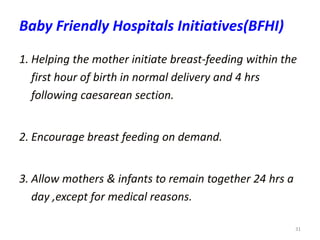
31
Baby Friendly Hospitals Initiatives(BFHI)
1. Helping the mother initiate breast-feeding within the
first hour of birth in normal delivery and 4 hrs
following caesarean section.
2. Encourage breast feeding on demand.
3. Allow mothers & infants to remain together 24 hrs a
day ,except for medical reasons.
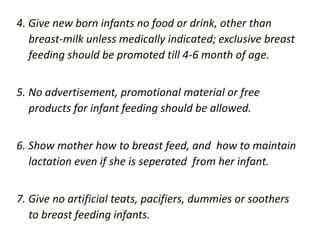
4. Give new born infants no food or drink, other than
breast-milk unless medically indicated; exclusive breast
feeding should be promoted till 4-6 month of age.
5. No advertisement, promotional material or free
products for infant feeding should be allowed.
6. Show mother how to breast feed, and how to maintain
lactation even if she is seperated from her infant.
7. Give no artificial teats, pacifiers, dummies or soothers
to breast feeding infants.
33
8. Encourage mothers to assist each other and
to develop breast feeding supporting groups.
9. Inform all pregnant women about benefits
and management of breastfeeding
10. Train all the health care staffs in the skills
necessory to implement this policy.
34
National guidelines on infant & young child
feeding(2004)
• Intensify nutrition &health education to improve
infant & child feeding and caring practices so as to:
(a) bring down the prevalence of under-weight
children under 3yrs from current level of 47%-40% ;
(b) reduce prevalence of severe under nutrition in
children in the 0-6yrs age group by 50%
• Enhance early institution of breast feeding (colostrum
feeding) from the current level of 15.8%-50%.
• Enhance the breast feeding rate for the first 6 month
from the current rate of 55.2%( for 0-3 months) to
80% .
• Enhance the complementary feeding rate at 6
months from the current level of 33.5% -75%.
Breastfeeding Promotion Network Of
India ( BPNI)
• Registered, independent, non-profit, national
organization located at New Delhi
• Working towards protecting, promoting and
supporting breastfeeding
• BPNI believes “ Breast feeding is the right of all
mothers and children”
• Main goal is to empower all lactating mother to
practice exclusive breastfeeding up to six months
and continued breastfeeding upto two years and
along with introduction of appropriate
complementary feeding after 6 months of age.
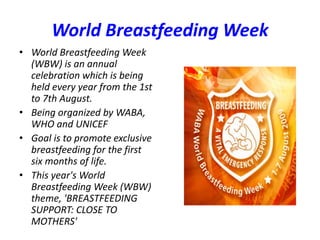
World Breastfeeding Week
• World Breastfeeding Week
(WBW) is an annual
celebration which is being
held every year from the 1st
to 7th August.
• Being organized by WABA,
WHO and UNICEF
• Goal is to promote exclusive
breastfeeding for the first
six months of life.
• This year's World
Breastfeeding Week (WBW)
theme, 'BREASTFEEDING
SUPPORT: CLOSE TO
MOTHERS'
REFERENCES
1. NFHS-2 AND 3
2. Knowledge and practice of mothers regarding
breast feeding: a hospital based study, RN
Chaudhary et al
3. Mrs Rama Ram et al: Breast feeding practices in
rural Darjeeling.IJCM, 2000; 25 (2);79 – 82
4. Kar M, De R: Breast feeding practices – impression
from an Urban Community ,Indian Jour. Of Public
Health, 1991; 35 (4): 93 -5
5. A retrospective study of factors affecting breast
feeding practices in a rural community of Saudi
Arabia, al-Nasser AN, Bamgboye EA, Alburno MK.
6. Breast feeding-practices ,problems & prospects Ms.
Sunita Reddy
7. Reasons for failure of breast-feeding counselling:
mother’s perspectives in Bangladesh,R.Haider et al
8. Worldbreastfeedingweek.org
THANK U

Lactation failure

  • 1.
    LACTATION FAILURE- URBAN& RURAL MOTHERS DR.K.Sivakumar
  • 2.
    INTRODUCTION • Infant andyoung child feeding practices directly affect the nutritional status of children under two years, impacting child survival • Child feeding practices are linked with knowledge of mother and socio-economic and cultural dimensions of the community
  • 3.
    INFANT FEEDING PRACTICESIN INDIA NFHS-3 • Although breast feeding after birth is nearly universal practice in India, very few children are put on breast feeding practice immediately after birth. • Only 23.4 % of newborn babies were put on breast feeding within 1 hr.
  • 4.
    • 37%- dayone • 63%-squeezed the first milk from breast discarded (colostrum) before they started breast feeding. • Initiation of breast feeding is delayed and newborn is deprived of most nutritious feed and energy.
  • 5.
    Optimal Infant Feedingpractices includes • Initiation of breastfeeding within one hour of birth. • Exclusive breastfeeding up to six months of life. • Continued breastfeeding for two years of life or beyond. • Introduction of appropriate complementary feeding after 6 months of age.
  • 6.
    Advantages of Breastfeeding Breastmilk •Perfect nutrients • Easily digestible • Ready to serve • Protects against infection • Protects against adult onset diseases (diabetes, high blood pressure) Breastfeeding • Helps bonding and development • Helps in adequate growth and development • Enhances brain & visual development • Baby has higher intelligence quotient • Prevents hypothermia
  • 7.
    Advantages of Breastfeeding(contd.) Mother • Reduces post delivery bleeding and anemia • Delays next pregnancy • Protects breast and ovarian cancer • Protects obesity and shapes body • Convenient Society • Eco-friendly • Human resource development • Economic development Family  Economic benefits  Less illnesses  Family bonding
  • 8.
    State of Infantand Young Child feeding in INDIA 3541.2 15.8 56.7 46.4 24.5 23.9 46.4 40.2 0 20 40 60 Initiation of Breastfeeding within 1 hour of birth Exclusive breastfeeding (0-6 months) Complementary Feeding (6-9 months) NFHS-2 (98-99) NFHS-3 (2005-06) DLHS-3 (2007-08)
  • 9.
    Neonatal Mortality Riskby early infant feeding practices 1 1.16 2.55 3.57 0 0.5 1 1.5 2 2.5 3 3.5 4 Within one hour One hour to one day Day 2 Day 3 Timing of initiation of breastfeeding after birth Infectionspecificmortalityodd ratio Source: Edmond KM et al. Am J Clin Nutr 2007. 86:1126-31
  • 10.
    Under-5 deaths preventablethrough universal coverage with individual interventions (2000) India *Breastfeeding: Exclusive for first 6 months and continued for 6 to 12 months Source: Jones et al. LANCET 2003;362:65-71 0% 2% 4% 6% 8% 10% 12% 14% 16% 18% Breastfeeding* Complementary feeding Clean delivery Hib vaccine Clean water, sanitation, hygiene Zinc Vitamin A Antenatal steroids Newborn temperature management Tetanus toxoid Antibiotics f Measles vaccine Nivirapine and replacement feeding Antimalarial IPT in pregnancy Intervention Percent
  • 11.
    COMMON BARRIERS BREAST FEEDING FAILURE INTERPERSONAL INADEQUATE KNOWLEDGE SOCIOECONOMICSTATUS MATERNAL AGE MATERNAL EDUCATION LEVEL MATERNAL WORKING STATUS PARITY GESTATIONAL AGE PLACE OF DELIVERY TYPE OF DELIVERY SOCIAL CUSTOMS MODERNISATIONPSYCHOLOGICAL HEALTH EDUCATION
  • 12.
    SOCIOECONOMIC STATUS • Socioeconomic status of the mothers had a significant association with duration of breast feeding • Shorter duration was observed among the mothers with higher socioeconomic status • prolonged duration among the lower socioeconomic class • economically deprived mothers tended to breastfeed their babies for a longer period as compared to economically well-off mothers. Source: breast feeding-practices,problems&prospects Ms. Sunita Reddy et al (6*)
  • 13.
    INADEQUATE KNOWLEDGE • Allmothers knew that they had to breast feed their babies, but they did not have adequate knowledge about the appropriate way of breastfeeding. • 10% knew that they have to initiate breast feeding within ½ hour of birth • 10% had idea on hazards of prelacteal feed Source: RN Chaudhary et al(2*)
  • 14.
    • 25% hadidea on importance of colostrum • 15% knew the meaning of exclusive breast feeding • The impact of knowledge about breastfeeding practice, i.e., (duration of breastfeeding, proper techniques, proper time of weaning) is poorly understood. Source: RN Chaudhary et al(2*)
  • 15.
    INTERPERSONAL • Mother, Mother-in-law,Husband, Peer group are the most influential persons in decision- making about breast-feeding • Misguidance & lack of support is one of the major contribution to breast-feeding failure • Family relationships can play a significant role particularly in sustaining breastfeeding Source : R.Haider et al(7*) "International Breastfeeding Journal."
  • 16.
    MATERNAL AGE • Ageof the mother had a significant positive effect on the duration of breast feeding • Mothers above 30 years had lower exclusive breastfeeding rates compared to younger mothers, similarly teen mothers had lower rates • mothers in twenties were more likely to breast feed for 6 months than their older counterparts Source: al-Nasser AN et al (5*)
  • 17.
    MATERNAL EDUCATION LEVEL •Educational status of the mothers was inversely associated with duration of breast feeding • As educational status increased the duration of breast feeding decreased • 25% of mothers who had studied up to college level & more had not practiced exclusive breast feeding Source : Mrs. Rama ram et al & Kar et al (3*,4*) Ms. Sunita Reddy (6*)
  • 18.
    • Prolonged durationwas observed among illiterate mothers • educated mothers tend to discontinue breastfeeding earlier than their illiterate counterparts • Literacy status had little effect on continuation of breast feeding for more than six months Source : Mrs. Rama ram et al & Kar et al (3*,4*) Ms. Sunita Reddy (6*)
  • 19.
    MATERNAL WORKING STATUS •Working mothers have been observed to find it difficult to breastfeed their infants and wean them quite early • Mother's work status played a significant role in the early termination of breastfeeding. • Returning to work has been identified as a factor that influences breastfeeding duration and was cited as the most common reason for breastfeeding cessation by mothers
  • 20.
    • Mothers workingmore than 20 hours per week post-partum was associated with a shorter duration of breastfeeding • lack of workplace facilities
  • 21.
    PARITY • Parity alsosignificantly affected duration of breast feeding in a positive manner • Primigravidas mothers did not breast feed exclusively compared to of the Multiparous • Second & third born babies had higher rates than first borns. • Mothers with previous breastfeeding experience had a greater duration of breastfeeding than mothers with no previous breastfeeding experience.
  • 22.
    PLACE OF DELIVERY •Place of delivery was found to influence initiation of breastfeeding practices • Mothers who delivered their babies at health facilities were found to initiate breastfeeding on time & feed exclusively compared to home deliveries. • This might be due to proper counseling and guidance of health workers for breastfeeding initiation and continuation.
  • 23.
    TYPE OF DELIVERY •Type of delivery also significantly affected duration of breast feeding. • It is found that mothers having cesarean deliveries were less likely to breastfeed at 6 months compared to mothers with normal vaginal deliveries • The reason may be due to mothers having cesarean section experience more complication, pain, prolonged recovery, fatigue, discomfort, stress and anxiety.
  • 24.
    TABOO’s • Social customof rural India is that the early breast milk is the witch's milk • There is no secretion of milk in first three days • Colostrum as something indigestible and not good for baby’s health • Size of the breast influences the amount of the milk production • Believed that breastfeeding affects a woman's posture and makes them lose their charm and figure • Consider it indecent and embarrassing to use their breast as a source of nutrients to their babies.
  • 25.
    HEALTH EDUCATION • Motherswho received breast-feeding counseling and support from the time of their babies' birth had significantly greater rates of breast-feeding initiation, exclusivity, and duration of total breastfeeding than those who did not • Attending prenatal counseling appears to be associated with breastfeeding initiation & continuation
  • 26.
    PSYCHOLOGICAL • Women whowere under stress and anxiety failed to breastfeed for long. • Postpartum depression begin as soon as three to four days after delivery and can affect decision and ability to breastfeed • Insufficient milk syndrome • Mother’s intention to breastfeed can influence breastfeeding duration
  • 27.
    • Mothers whointend to breastfeed for greater lengths of time tend to breastfeed for longer than mothers who intend to breastfeed for less time • It was found that mothers with intention to breastfeed for less than 4 months was a risk factor for early discontinuation of breastfeeding.
  • 28.
    28 BREAST FEEDING PROBLEMS Retractednipple Cracked nipple Engorged breast Mastitis Insufficient breast milk Maternal medications
  • 29.
    How to overcomethis problems
  • 30.
  • 31.
    31 Baby Friendly HospitalsInitiatives(BFHI) 1. Helping the mother initiate breast-feeding within the first hour of birth in normal delivery and 4 hrs following caesarean section. 2. Encourage breast feeding on demand. 3. Allow mothers & infants to remain together 24 hrs a day ,except for medical reasons.
  • 32.
    4. Give newborn infants no food or drink, other than breast-milk unless medically indicated; exclusive breast feeding should be promoted till 4-6 month of age. 5. No advertisement, promotional material or free products for infant feeding should be allowed. 6. Show mother how to breast feed, and how to maintain lactation even if she is seperated from her infant. 7. Give no artificial teats, pacifiers, dummies or soothers to breast feeding infants.
  • 33.
    33 8. Encourage mothersto assist each other and to develop breast feeding supporting groups. 9. Inform all pregnant women about benefits and management of breastfeeding 10. Train all the health care staffs in the skills necessory to implement this policy.
  • 34.
    34 National guidelines oninfant & young child feeding(2004) • Intensify nutrition &health education to improve infant & child feeding and caring practices so as to: (a) bring down the prevalence of under-weight children under 3yrs from current level of 47%-40% ; (b) reduce prevalence of severe under nutrition in children in the 0-6yrs age group by 50% • Enhance early institution of breast feeding (colostrum feeding) from the current level of 15.8%-50%.
  • 35.
    • Enhance thebreast feeding rate for the first 6 month from the current rate of 55.2%( for 0-3 months) to 80% . • Enhance the complementary feeding rate at 6 months from the current level of 33.5% -75%.
  • 36.
    Breastfeeding Promotion NetworkOf India ( BPNI) • Registered, independent, non-profit, national organization located at New Delhi • Working towards protecting, promoting and supporting breastfeeding • BPNI believes “ Breast feeding is the right of all mothers and children” • Main goal is to empower all lactating mother to practice exclusive breastfeeding up to six months and continued breastfeeding upto two years and along with introduction of appropriate complementary feeding after 6 months of age.
  • 37.
    World Breastfeeding Week •World Breastfeeding Week (WBW) is an annual celebration which is being held every year from the 1st to 7th August. • Being organized by WABA, WHO and UNICEF • Goal is to promote exclusive breastfeeding for the first six months of life. • This year's World Breastfeeding Week (WBW) theme, 'BREASTFEEDING SUPPORT: CLOSE TO MOTHERS'
  • 38.
    REFERENCES 1. NFHS-2 AND3 2. Knowledge and practice of mothers regarding breast feeding: a hospital based study, RN Chaudhary et al 3. Mrs Rama Ram et al: Breast feeding practices in rural Darjeeling.IJCM, 2000; 25 (2);79 – 82 4. Kar M, De R: Breast feeding practices – impression from an Urban Community ,Indian Jour. Of Public Health, 1991; 35 (4): 93 -5
  • 39.
    5. A retrospectivestudy of factors affecting breast feeding practices in a rural community of Saudi Arabia, al-Nasser AN, Bamgboye EA, Alburno MK. 6. Breast feeding-practices ,problems & prospects Ms. Sunita Reddy 7. Reasons for failure of breast-feeding counselling: mother’s perspectives in Bangladesh,R.Haider et al 8. Worldbreastfeedingweek.org
  • 40.

Editor's Notes

  • #10 Initiation of breastfeeding and risk of neonatal death - Strong evidence showed that risk of death as a result of infection increased as the delay in initiating breastfeeding increased.Overall, late initiation of breastfeeding (after day 1) was associated with a 2.6-fold increased risk of infection-specific neonatal mortality.Delaying the initiation of breastfeeding till day 3 increased the risk of infection-specific neonatal mortality by 3.6 fold.