Working in the laboratory


     Dr Varsha Shahane
Objectives

•   To ensure and assure quality
•   Ethical practices
•   Waste management
•   Care of lab equipments
Contents

•   Good lab practices
•   Ethics in lab medicine
•   BMW
•   Equipments
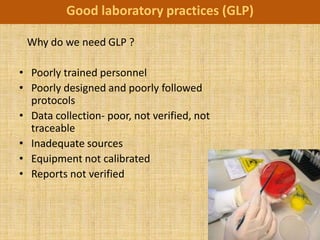
Good laboratory practices (GLP)

 Why do we need GLP ?

• Poorly trained personnel
• Poorly designed and poorly followed
  protocols
• Data collection- poor, not verified, not
  traceable
• Inadequate sources
• Equipment not calibrated
• Reports not verified
Principles of GLP

• To implement clear organisation structures
• To help scientists obtain results which are – reliable,
  repeatable, auditable, recognised by scientists all
  over the world
• Helps in standardization of tests – avoid false
  positives and false negatives
GLP ensures that studies are :

•   Planned
•   Performed ( SOPM)
•   Recorded
•   Reported
•   Archived- stored/ preserved
•   Monitored
Laboratory Accreditation

• Third party certification of competence of medical
  laboratory
• It is a formal recognition of the labs where people
  are reassured of the reliability of the lab services
• National Accreditation Board for Testing and
  Calibration laboratories – NABL- to perform tests in
  accordance with ISO guidelines
Benefits of Accreditation

• Enhances customer confidence- potential increase in
  business
• International level of competence achieved
• Time, money, effort saved – repetition of tests and re
  testing of reagents avoided
• Better control of lab operations
• Lab personnel more confident about their reports
• Better networking and access to remote patients
To summarize :

•   Limits wastage and resources
•   Ensures high quality
•   Ensures comparability of results
•   Promotes mutual recognition of results

    IT IS THE QUALITY SYSTEM FOR
     MANAGEMENT OF WORK 
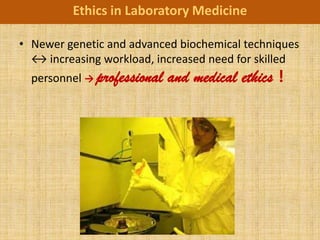
Ethics in Laboratory Medicine

• Newer genetic and advanced biochemical techniques
  ↔ increasing workload, increased need for skilled
  personnel → professional   and medical ethics !
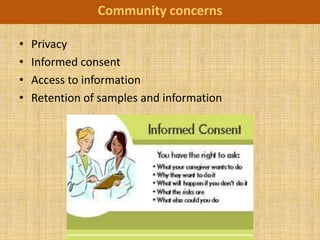
Community concerns

•   Privacy
•   Informed consent
•   Access to information
•   Retention of samples and information
Main aim :

• Uphold the reputation of their profession
• Benefit the health and well being of patients and
  community → welfare and interest of patients
• Treat all patients equally, no discrimination
• Collect only relevant and necessary information of
  patient required to carry out the test/tests. Explain
  the purpose to patient
• In case of communicable diseases, safety of staff and
  other patients should be given priority
Ethics in pre-examination

• Informed consent- for invasive or risky procedures
• In cases of diseases with serious implications, like,
  genetic diseases, HIV etc, adequate counselling is
  important prior to collection of sample
• During reception and sample collection adequate
  privacy for the patient should be ensured
• If the sample received is unacceptable for testing, it
  should be discarded and the concerned physician be
  notified.
Ethics in examination

• Examination of the sample be performed by the
  skilled personnel only
• Only standard procedures should be followed for
  collection, transport, testing and reporting of results
  – all documented in SOPM (standard operating
  manual)
• Tampering with results / fabrication of results.... X
• If an in house procedure is used, it must be validated
  and documented
• Use adequate controls during test. External and
  internal QC has an important role
Ethics in post examination

• Results should be documented and verified by the
  chief of the lab
• Undue delay in reporting should be avoided and if it
  is inevitable, the concerned physician should be
  informed about the delay with reasons
• Confidentiality of report is of utmost importance-
  inform only the physician
• Results if used for epidemiology or statistical data,
  should be done without disclosing the patient’s
  identity
• Accurate interpretation of results is crucial in the
  interests of the patient
Lab records

• Record section –identification, collection , indexing,
  access, storage, maintainence and safe disposal of
  records
• Safety (loss, unauthorised access, tampering,
  damage, misuse)
• Legibility and readability
• Retrievable
• Duration of retention of records to be defined
• Accessibility to lab records- Develop protocols to
  handle requests that deal with gaining access to
  record section
• Access should be through requesting physician, lab
  staff, duty of other individuals ( police, scientists etc)
Biomedical waste management (BMW)

• It is defined as any waste which is generated during
  diagnosis, treatment or immunization of human
  beings or animals or in research activities or in
  testing or production of biological specimens
• Dangers – infections (Tb, pneumonia, diarrhoeal
  diseases), re sale and re use (Hepatitis B and C, HIV),
  injuries, toxic effects
  AIR, WATER and LAND POLLUTION
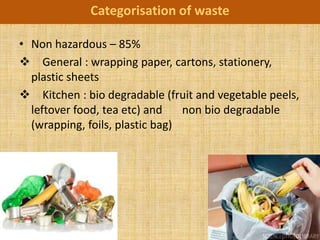
Categorisation of waste

• Non hazardous – 85%
 General : wrapping paper, cartons, stationery,
  plastic sheets
 Kitchen : bio degradable (fruit and vegetable peels,
  leftover food, tea etc) and    non bio degradable
  (wrapping, foils, plastic bag)
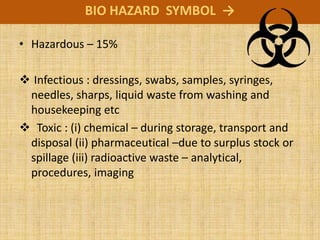
BIO HAZARD SYMBOL →

• Hazardous – 15%

 Infectious : dressings, swabs, samples, syringes,
 needles, sharps, liquid waste from washing and
 housekeeping etc
 Toxic : (i) chemical – during storage, transport and
 disposal (ii) pharmaceutical –due to surplus stock or
 spillage (iii) radioactive waste – analytical,
 procedures, imaging
Waste audit

• Type and quantity of waste generated, planning of
  policy
• Daily inspection of kitchen, OT, pharmacy, wards, pre
  op rooms, emergency wards, OPDs, injection and
  dressing rooms
BMW management

• Segregation at point of generation
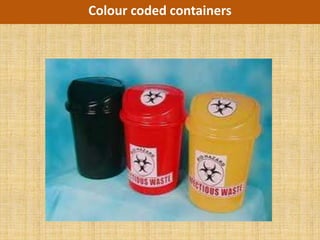
• All the segregated waste should be placed in a
  puncture proof plastic bag which should go in the
  correct colour coded container with a lid
• The workers should use all personal protective
  measures while cleaning, collecting and segregation
  of BMW, including getting vaccinated
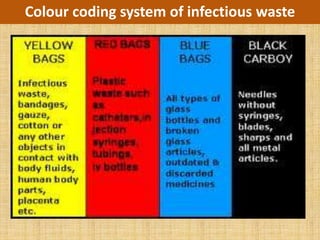
Colour coding system of infectious waste
Colour coded containers
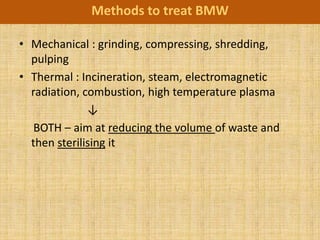
Methods to treat BMW

• Mechanical : grinding, compressing, shredding,
  pulping
• Thermal : Incineration, steam, electromagnetic
  radiation, combustion, high temperature plasma
              ↓
   BOTH – aim at reducing the volume of waste and
  then sterilising it
• Important things to remember :
• Needle re capping must be strictly prohibited.
  Needle sterlisers and cutters used
• Segregate waste at the point of production. Every
  room must have colour coded bags for disposal
• Strictly adhere to colour coding
• NEVER allow infectious and non infectious waste to
  mix
• NEVER transport infectious waste with the general
  municipal waste. Arrange separate transport for
  biohazard waste
• The containers should not be filled upto the brim.
  Only 3/4th of it should occupy the waste
• The plastic bags should be tied tightly before placing
  in container
• Use chemical disinfectants for pre treatment of BMW
  before placing in container– sodium hypochlorite
  (0.5-5%)
• Strictly follow personal protective measures
  guidelines and the hospital policies

• REDUCE, RE USE , RECYCLE
• Care and Use of instruments
  Laboratory testing needs to be –
   fast, reliable, accurate, cost effective
  So good quality instruments are required and they
  should be properly used and taken care of

• Microscope, pH meter, autoclaves, hot air ovens,
  centrifuges, pipettes, analytical balance, automatic
  dispensers and diluters, thermometers, glassware,
  plastic ware, bilogical safety cabinets, refrigerators,
  incubators, freezers,ELISA readers, waterbaths,
  spectrophotometers, auto analyser, distilled water
  plants, diagnostic kits, reagents
General Do s and Don’t s

• Keep all equipment away from heat, strong light,
  powerful electrical connections, water prone areas.
  Keep in cool dry places
• Daily / periodic cleaning and calibration. Also, daily
  checking of the working part of each instrument
• Use of correct cleaning agents, solvents etc
• Proper storage of every part of the equipment
• Maintainence – Annual maintainence contract (AMC)
contd

• Proper procedures of switching on , switching off and
  placing the instruments
• Gentle and careful use
• STRICT ADHERENCE TO THE INSTRUCTIONS GIVEN
  IN THE MANUAL FOR EVERY EQUIPMENT AND
  INSTRUMENT IN THE LAB.
Be alert. Love your lab and take care of it.

Laboratory work practices

  • 1.
    Working in thelaboratory Dr Varsha Shahane
  • 2.
    Objectives • To ensure and assure quality • Ethical practices • Waste management • Care of lab equipments
  • 3.
    Contents • Good lab practices • Ethics in lab medicine • BMW • Equipments
  • 4.
    Good laboratory practices(GLP) Why do we need GLP ? • Poorly trained personnel • Poorly designed and poorly followed protocols • Data collection- poor, not verified, not traceable • Inadequate sources • Equipment not calibrated • Reports not verified
  • 5.
    Principles of GLP •To implement clear organisation structures • To help scientists obtain results which are – reliable, repeatable, auditable, recognised by scientists all over the world • Helps in standardization of tests – avoid false positives and false negatives
  • 6.
    GLP ensures thatstudies are : • Planned • Performed ( SOPM) • Recorded • Reported • Archived- stored/ preserved • Monitored
  • 7.
    Laboratory Accreditation • Thirdparty certification of competence of medical laboratory • It is a formal recognition of the labs where people are reassured of the reliability of the lab services • National Accreditation Board for Testing and Calibration laboratories – NABL- to perform tests in accordance with ISO guidelines
  • 8.
    Benefits of Accreditation •Enhances customer confidence- potential increase in business • International level of competence achieved • Time, money, effort saved – repetition of tests and re testing of reagents avoided • Better control of lab operations • Lab personnel more confident about their reports • Better networking and access to remote patients
  • 9.
    To summarize : • Limits wastage and resources • Ensures high quality • Ensures comparability of results • Promotes mutual recognition of results IT IS THE QUALITY SYSTEM FOR MANAGEMENT OF WORK 
  • 10.
    Ethics in LaboratoryMedicine • Newer genetic and advanced biochemical techniques ↔ increasing workload, increased need for skilled personnel → professional and medical ethics !
  • 11.
    Community concerns • Privacy • Informed consent • Access to information • Retention of samples and information
  • 12.
    Main aim : •Uphold the reputation of their profession • Benefit the health and well being of patients and community → welfare and interest of patients • Treat all patients equally, no discrimination • Collect only relevant and necessary information of patient required to carry out the test/tests. Explain the purpose to patient • In case of communicable diseases, safety of staff and other patients should be given priority
  • 13.
    Ethics in pre-examination •Informed consent- for invasive or risky procedures • In cases of diseases with serious implications, like, genetic diseases, HIV etc, adequate counselling is important prior to collection of sample • During reception and sample collection adequate privacy for the patient should be ensured • If the sample received is unacceptable for testing, it should be discarded and the concerned physician be notified.
  • 14.
    Ethics in examination •Examination of the sample be performed by the skilled personnel only • Only standard procedures should be followed for collection, transport, testing and reporting of results – all documented in SOPM (standard operating manual) • Tampering with results / fabrication of results.... X • If an in house procedure is used, it must be validated and documented • Use adequate controls during test. External and internal QC has an important role
  • 15.
    Ethics in postexamination • Results should be documented and verified by the chief of the lab • Undue delay in reporting should be avoided and if it is inevitable, the concerned physician should be informed about the delay with reasons • Confidentiality of report is of utmost importance- inform only the physician • Results if used for epidemiology or statistical data, should be done without disclosing the patient’s identity • Accurate interpretation of results is crucial in the interests of the patient
  • 16.
    Lab records • Recordsection –identification, collection , indexing, access, storage, maintainence and safe disposal of records • Safety (loss, unauthorised access, tampering, damage, misuse) • Legibility and readability • Retrievable • Duration of retention of records to be defined
  • 17.
    • Accessibility tolab records- Develop protocols to handle requests that deal with gaining access to record section • Access should be through requesting physician, lab staff, duty of other individuals ( police, scientists etc)
  • 18.
    Biomedical waste management(BMW) • It is defined as any waste which is generated during diagnosis, treatment or immunization of human beings or animals or in research activities or in testing or production of biological specimens • Dangers – infections (Tb, pneumonia, diarrhoeal diseases), re sale and re use (Hepatitis B and C, HIV), injuries, toxic effects AIR, WATER and LAND POLLUTION
  • 19.
    Categorisation of waste •Non hazardous – 85%  General : wrapping paper, cartons, stationery, plastic sheets  Kitchen : bio degradable (fruit and vegetable peels, leftover food, tea etc) and non bio degradable (wrapping, foils, plastic bag)
  • 20.
    BIO HAZARD SYMBOL→ • Hazardous – 15%  Infectious : dressings, swabs, samples, syringes, needles, sharps, liquid waste from washing and housekeeping etc  Toxic : (i) chemical – during storage, transport and disposal (ii) pharmaceutical –due to surplus stock or spillage (iii) radioactive waste – analytical, procedures, imaging
  • 21.
    Waste audit • Typeand quantity of waste generated, planning of policy • Daily inspection of kitchen, OT, pharmacy, wards, pre op rooms, emergency wards, OPDs, injection and dressing rooms
  • 22.
    BMW management • Segregationat point of generation • All the segregated waste should be placed in a puncture proof plastic bag which should go in the correct colour coded container with a lid • The workers should use all personal protective measures while cleaning, collecting and segregation of BMW, including getting vaccinated
  • 23.
    Colour coding systemof infectious waste
  • 24.
  • 25.
    Methods to treatBMW • Mechanical : grinding, compressing, shredding, pulping • Thermal : Incineration, steam, electromagnetic radiation, combustion, high temperature plasma ↓ BOTH – aim at reducing the volume of waste and then sterilising it
  • 26.
    • Important thingsto remember : • Needle re capping must be strictly prohibited. Needle sterlisers and cutters used • Segregate waste at the point of production. Every room must have colour coded bags for disposal • Strictly adhere to colour coding • NEVER allow infectious and non infectious waste to mix • NEVER transport infectious waste with the general municipal waste. Arrange separate transport for biohazard waste
  • 27.
    • The containersshould not be filled upto the brim. Only 3/4th of it should occupy the waste • The plastic bags should be tied tightly before placing in container • Use chemical disinfectants for pre treatment of BMW before placing in container– sodium hypochlorite (0.5-5%) • Strictly follow personal protective measures guidelines and the hospital policies • REDUCE, RE USE , RECYCLE
  • 28.
    • Care andUse of instruments Laboratory testing needs to be – fast, reliable, accurate, cost effective So good quality instruments are required and they should be properly used and taken care of • Microscope, pH meter, autoclaves, hot air ovens, centrifuges, pipettes, analytical balance, automatic dispensers and diluters, thermometers, glassware, plastic ware, bilogical safety cabinets, refrigerators, incubators, freezers,ELISA readers, waterbaths, spectrophotometers, auto analyser, distilled water plants, diagnostic kits, reagents
  • 29.
    General Do sand Don’t s • Keep all equipment away from heat, strong light, powerful electrical connections, water prone areas. Keep in cool dry places • Daily / periodic cleaning and calibration. Also, daily checking of the working part of each instrument • Use of correct cleaning agents, solvents etc • Proper storage of every part of the equipment • Maintainence – Annual maintainence contract (AMC)
  • 30.
    contd • Proper proceduresof switching on , switching off and placing the instruments • Gentle and careful use • STRICT ADHERENCE TO THE INSTRUCTIONS GIVEN IN THE MANUAL FOR EVERY EQUIPMENT AND INSTRUMENT IN THE LAB.
  • 31.
    Be alert. Loveyour lab and take care of it.