Labour relations and Labour
Regulations in Nepal
Presentation on Labour relations and Labour
Regulations in Nepal
BY
• Nikesh Pradhan 61
• Sonika Shakya 62
• Nitesh Dubedi 63
• Rina Manandhar 64
Labour relations and Labour
Regulations in Nepal
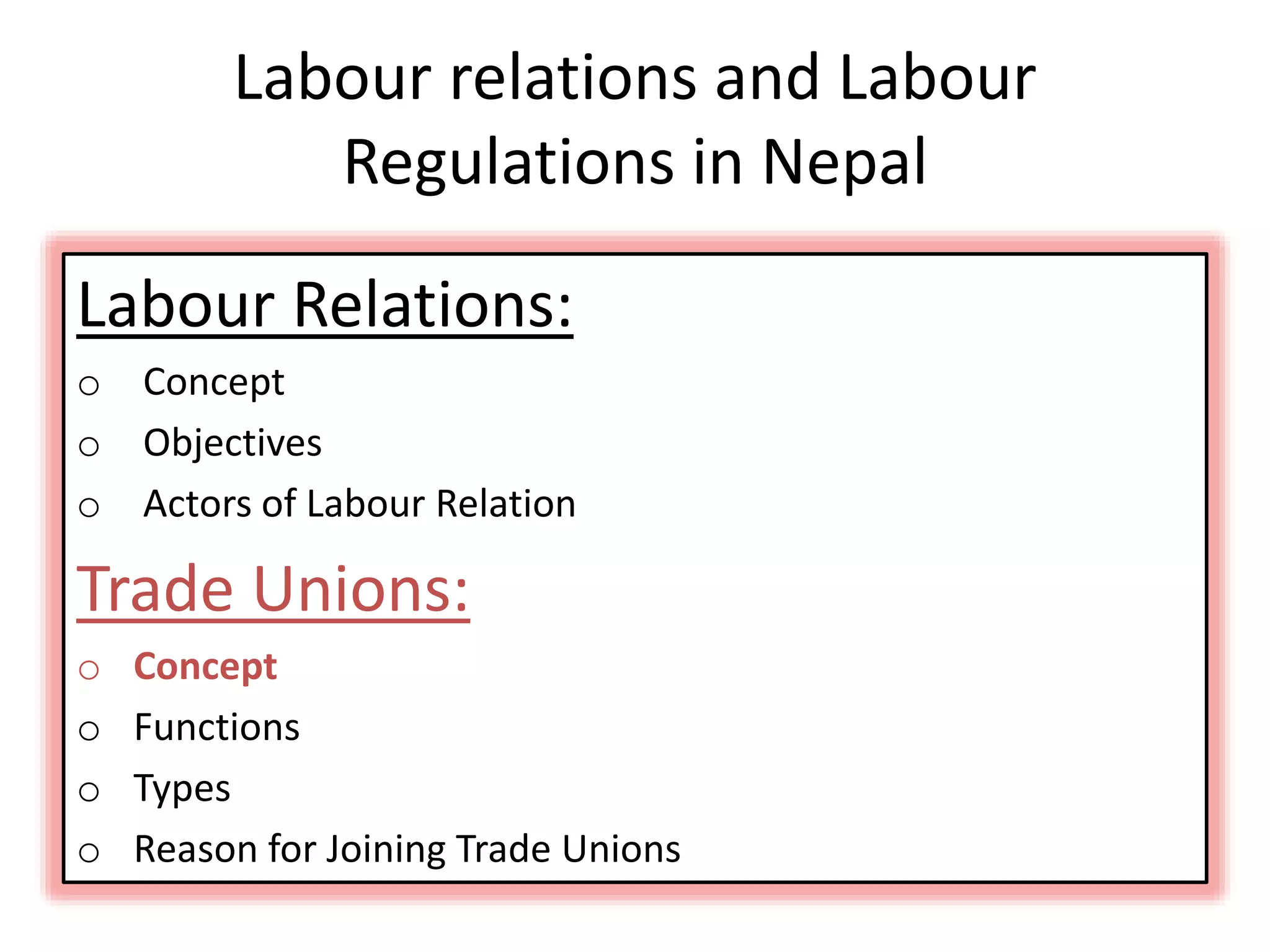
Labour Relations:
o Concept
o Objectives
o Actors of Labour Relation
Trade Unions:
o Concept
o Functions
o Types
o Reason for Joining Trade Unions
Labour relations
• Concept:
Labour relations encompasses a set of phenomena, both inside
and outside the workplace, concerned with determining and
regulating employment relationship between management and
employees or among employees and their organization that
characterize and grow out of employment.
Labour relation refers to a system that makes a social dialogue
possible among employees, employers and government
representative.
Labour relations and Labour
Regulations in Nepal
Labour Relations:
o Concept
o Objectives
o Actors of Labour Relation
Trade Unions:
o Concept
o Functions
o Types
o Reason for Joining Trade Unions
Labour relations
Objectives:
1. To enhance economic status of worker.
2. To avoid industrial conflicts and their consequences.
3. To extend and maintain industrial democracy.
4. To provide an opportunity to the worker to have a say in the
management decision making.
5. To regulate production by minimizing conflicts.
6. To provide forum to the workers to solve their problems through
mutual negotiations and consultations with management.
7. To encourage and develop trade union in order to develop workers
collective strength etc.
Labour relations and Labour
Regulations in Nepal
Labour Relations:
o Concept
o Objectives
o Actors of Labour Relation
Trade Unions:
o Concept
o Functions
o Types
o Reason for Joining Trade Unions
Labour relations
• Actors of Labour Relation:
Labour relations
• Actors of Labour Relation:
 Employees/Trade Union :
It includes employees, trade union, which is concerned with
 Employers and their Organization:
 Government:
The Government keeps an eye on. Both the trade unions and
employers' organizations to regulate their behaviors in the
interest of the nation.
Labour relations and Labour
Regulations in Nepal
Labour Relations:
o Concept
o Objectives
o Actors of Labour Relation
Trade Unions:
o Concept
o Functions
o Types
o Reason for Joining Trade Unions
Trade Union
Concept:
It is an organization of workers or employees formed mainly
→ to negotiate with the employers on various employment related issues
→ to improve the terms and conditions at their workplace
→ to enhance their status in society.
An organization that represents employees’ interests to
management on issues such as wages, work hours, and working
conditions
An organisation formed by workers to protect the interests of their
members.
Labour relations and Labour
Regulations in Nepal
Labour Relations:
o Concept
o Objectives
o Actors of Labour Relation
Trade Unions:
o Concept
o Functions
o Types
o Reason for Joining Trade Unions
Trade Union
Functions:
• Collective bargaining
→Represent members to negotiate with employers, for better wages
and conditions of employment.
• Safeguard jobs
→Protect jobs of members
• Cooperate with employers
→For the benefits of members, resolve disputes in a mutually
acceptable manner
• Political function
→Support pro-union political parties
Trade Union
Functions:
Social function
→ Support members with recreation facilities and benefits for
unemployment, illness, retirement, death
Labour relations and Labour
Regulations in Nepal
Labour Relations:
o Concept
o Objectives
o Actors of Labour Relation
Trade Unions:
o Concept
o Functions
o Types
o Reason for Joining Trade Unions
Trade Union
• Types of Trade Union:
1. Industrial Unions or Employers’ Unions:
Members work in the same industry, e.g. banking (IBOA), PABSON etc.
2. Craft Unions:
Members belong to a particular trade and have served an apprenticeship
e.g. Brick and Stone layers Trade union, Barber’s union etc.
3. White Collar Unions:
Members are usually professional e.g. teachers unions, NELTA etc.
4. House union (company or enterprise union)
Members are from the same company regardless of occupation or job.
Labour relations and Labour
Regulations in Nepal
Labour Relations:
o Concept
o Objectives
o Actors of Labour Relation
Trade Unions:
o Concept
o Functions
o Types
o Reason for Joining Trade Unions
Trade Union
• Reason for joining Trade Union:
1. Greater Bargaining Power.
The individual employee possesses very little bargaining power as
compared to that of his employer. If he is not satisfied with the wage and
other conditions of employment, he may join union to have greater
bargaining power.
2. Make their Voices Heard
The desire for self-expression is a fundamental human drive for most
people. All of us wish to share our feelings, ideas and opinions with
others. Similarly the workers also want the management to listen to
them and it is possible through Trade Unions.
Trade Union
• Reason for joining Trade Union:
3. Minimize Discrimination
4. Sense of Security
The employees may join the unions to secure adequate protection from
various types of hazards and income insecurity such as accident, injury,
illness, unemployment, etc. The trade union secure retirement benefits
of the workers and compel the management to invest in welfare services
for the benefit of the workers.
5. Sense of Participation.
The employees can participate in management of matters affecting their
interests only if they join trade unions. They can influence the decisions
that are taken as a result of collective bargaining between the union and
the management.
Trade Union
• Reason for joining Trade Union:
6. Sense of Belongingness
Many employees join a union because their co-workers are the members
of the union.
7. Other Reasons
At times, an employee joins a union under group pressure; if he does not,
he often has a very difficult time at work.
On the other hand, those who are members of a union feel that they gain
respect in the eyes of their fellow workers. They can also discuss their
problem with’ the trade union leaders.
Collective Bargaining
• Concept
• Process
Collective Bargaining
• Concept:
Collective Bargaining is a process in which the representatives of a
Labour organization & the representatives of business organization
meet and attempt to negotiate a contract or agreement, which
specifies the nature of employee-employer union relationship”.
It is the process of negotiation between firm’s and workers’
representatives for the purpose of establishing mutually agreeable
conditions of employment
It is a technique adopted by two parties to reach an understanding
acceptable to both through the process of discussion and
negotiation
Collective Bargaining
• Concept
• Process
Collective Bargaining
• Process:
1. Prepare
This phase involves composition of a negotiation team
The first thing to be done is to determine whether there is
actually any reason to negotiate at all
2. Discuss
Here, the parties decide the ground rules that will guide the
negotiations
Collective Bargaining
• Process:
3. Propose
This phase involves the initial opening statements and the
possible options that exist to resolve them. In a word, this
phase could be described as ‘brainstorming’
4. Bargain
This stage comprises the time when ‘what ifs’ and ‘supposals’
are set forth and the drafting of agreements take place
Collective Bargaining
• Process:
5. Settlement
Once the parties are through with the bargaining process, a
consensual agreement is reached upon wherein both the
parties agree to a common decision regarding the problem or
the issue
Collective Bargaining
Process of Collective Bargaining
Labour Disputes
• Causes
• Settlement Provisions
Labour Disputes
• Causes
 Wages and Salaries
→ when employees disagree with the process of
determination of wage and salary, dispute begins.
 Bonus
→ employees consider bonus as a part of payment due to
them and thus bonus distribution leads to dispute.
 Personal Cause
→ fines, dismissal, suspension are causes of personal
disputes
Labour Disputes
• Causes
 Violence and Indiscipline
→violence and undisciplined action of workers create
disputes between workers and management, e.g. fighting,
failure to obey rules, use of drug etc.
 Union affiliated with different parties
→there may be multiple unions in same organization
affiliated with different parties, they all have different ways of
handling issues which often result in dispute.
Labour Disputes
• Causes
• Settlement Provisions
Labour Disputes
Filing complaint to the employer
Bilateral discussion
Involvement of Labour office
Appointment of mediator or Constituting
Dispute settlement Committee
Right to appeal
According to Labour Act of Nepal 1991, the dispute settlement in Nepal
includes following steps:
Provisions and Features of Labour Act
Labour Act,1992 (as amended in 1998)
Main Features and Provisions
a) Job security: This provision relate to
● Position classification of workers
● Appointment letter to workers
● Generally no employment to foreign workers
● No termination of service of permanent
employees
Provisions and Features of Labour Act
Labour Act,1992 (as amended in 1998)
b) Working Hours
● 8 hours per day or 48 hours per week; one day
holiday per week.
● Overtime for extra hours of at one and half times
of normal wage.
● Attendance register for workers e.t.c.
Provisions and Features of Labour Act
Labour Act,1992 (as amended in 1998)
c) Wages
● Minimum wages must be paid as specified by the
government.
● Annual increment to permanent workers.
● No unauthorized deduction from salary.
d) Health and Safety
●Proper cleanliness of workplace.
● Safety equipments and fire fighting equipment
Provisions and Features of Labour Act
Labour Act,1992 (as amended in 1998)
e) Welfare
● Welfare fund for workers
● Compensation for injury
● Housing, canteen and rest room
Conclusion
To conclude we can say that labour is lifeblood
of any organization; if we are able to maintain
a good industrial labour relation the
prosperity of both employer(industry) and
employees wil be at extremity.
Refrences
Agrawal, Dr. GR. (2004). Foundation of Human
Resource Management in Nepal. Bhotahity,
Kathmandu, Nepal: M.K. Publishers & Distributers
Adhikari, D. R. (2002). Fundamentals of Human
Resource Management Text and Cases. Kathmandu:
Manakamna Books.
Labour Act of Nepal 2048
Google

Labor relations and labor regulations in nepal

  • 1.
    Labour relations andLabour Regulations in Nepal Presentation on Labour relations and Labour Regulations in Nepal BY • Nikesh Pradhan 61 • Sonika Shakya 62 • Nitesh Dubedi 63 • Rina Manandhar 64
  • 2.
    Labour relations andLabour Regulations in Nepal Labour Relations: o Concept o Objectives o Actors of Labour Relation Trade Unions: o Concept o Functions o Types o Reason for Joining Trade Unions
  • 3.
    Labour relations • Concept: Labourrelations encompasses a set of phenomena, both inside and outside the workplace, concerned with determining and regulating employment relationship between management and employees or among employees and their organization that characterize and grow out of employment. Labour relation refers to a system that makes a social dialogue possible among employees, employers and government representative.
  • 4.
    Labour relations andLabour Regulations in Nepal Labour Relations: o Concept o Objectives o Actors of Labour Relation Trade Unions: o Concept o Functions o Types o Reason for Joining Trade Unions
  • 5.
    Labour relations Objectives: 1. Toenhance economic status of worker. 2. To avoid industrial conflicts and their consequences. 3. To extend and maintain industrial democracy. 4. To provide an opportunity to the worker to have a say in the management decision making. 5. To regulate production by minimizing conflicts. 6. To provide forum to the workers to solve their problems through mutual negotiations and consultations with management. 7. To encourage and develop trade union in order to develop workers collective strength etc.
  • 6.
    Labour relations andLabour Regulations in Nepal Labour Relations: o Concept o Objectives o Actors of Labour Relation Trade Unions: o Concept o Functions o Types o Reason for Joining Trade Unions
  • 7.
    Labour relations • Actorsof Labour Relation:
  • 8.
    Labour relations • Actorsof Labour Relation:  Employees/Trade Union : It includes employees, trade union, which is concerned with  Employers and their Organization:  Government: The Government keeps an eye on. Both the trade unions and employers' organizations to regulate their behaviors in the interest of the nation.
  • 9.
    Labour relations andLabour Regulations in Nepal Labour Relations: o Concept o Objectives o Actors of Labour Relation Trade Unions: o Concept o Functions o Types o Reason for Joining Trade Unions
  • 10.
    Trade Union Concept: It isan organization of workers or employees formed mainly → to negotiate with the employers on various employment related issues → to improve the terms and conditions at their workplace → to enhance their status in society. An organization that represents employees’ interests to management on issues such as wages, work hours, and working conditions An organisation formed by workers to protect the interests of their members.
  • 11.
    Labour relations andLabour Regulations in Nepal Labour Relations: o Concept o Objectives o Actors of Labour Relation Trade Unions: o Concept o Functions o Types o Reason for Joining Trade Unions
  • 12.
    Trade Union Functions: • Collectivebargaining →Represent members to negotiate with employers, for better wages and conditions of employment. • Safeguard jobs →Protect jobs of members • Cooperate with employers →For the benefits of members, resolve disputes in a mutually acceptable manner • Political function →Support pro-union political parties
  • 13.
    Trade Union Functions: Social function →Support members with recreation facilities and benefits for unemployment, illness, retirement, death
  • 14.
    Labour relations andLabour Regulations in Nepal Labour Relations: o Concept o Objectives o Actors of Labour Relation Trade Unions: o Concept o Functions o Types o Reason for Joining Trade Unions
  • 15.
    Trade Union • Typesof Trade Union: 1. Industrial Unions or Employers’ Unions: Members work in the same industry, e.g. banking (IBOA), PABSON etc. 2. Craft Unions: Members belong to a particular trade and have served an apprenticeship e.g. Brick and Stone layers Trade union, Barber’s union etc. 3. White Collar Unions: Members are usually professional e.g. teachers unions, NELTA etc. 4. House union (company or enterprise union) Members are from the same company regardless of occupation or job.
  • 16.
    Labour relations andLabour Regulations in Nepal Labour Relations: o Concept o Objectives o Actors of Labour Relation Trade Unions: o Concept o Functions o Types o Reason for Joining Trade Unions
  • 17.
    Trade Union • Reasonfor joining Trade Union: 1. Greater Bargaining Power. The individual employee possesses very little bargaining power as compared to that of his employer. If he is not satisfied with the wage and other conditions of employment, he may join union to have greater bargaining power. 2. Make their Voices Heard The desire for self-expression is a fundamental human drive for most people. All of us wish to share our feelings, ideas and opinions with others. Similarly the workers also want the management to listen to them and it is possible through Trade Unions.
  • 18.
    Trade Union • Reasonfor joining Trade Union: 3. Minimize Discrimination 4. Sense of Security The employees may join the unions to secure adequate protection from various types of hazards and income insecurity such as accident, injury, illness, unemployment, etc. The trade union secure retirement benefits of the workers and compel the management to invest in welfare services for the benefit of the workers. 5. Sense of Participation. The employees can participate in management of matters affecting their interests only if they join trade unions. They can influence the decisions that are taken as a result of collective bargaining between the union and the management.
  • 19.
    Trade Union • Reasonfor joining Trade Union: 6. Sense of Belongingness Many employees join a union because their co-workers are the members of the union. 7. Other Reasons At times, an employee joins a union under group pressure; if he does not, he often has a very difficult time at work. On the other hand, those who are members of a union feel that they gain respect in the eyes of their fellow workers. They can also discuss their problem with’ the trade union leaders.
  • 20.
  • 21.
    Collective Bargaining • Concept: CollectiveBargaining is a process in which the representatives of a Labour organization & the representatives of business organization meet and attempt to negotiate a contract or agreement, which specifies the nature of employee-employer union relationship”. It is the process of negotiation between firm’s and workers’ representatives for the purpose of establishing mutually agreeable conditions of employment It is a technique adopted by two parties to reach an understanding acceptable to both through the process of discussion and negotiation
  • 22.
  • 23.
    Collective Bargaining • Process: 1.Prepare This phase involves composition of a negotiation team The first thing to be done is to determine whether there is actually any reason to negotiate at all 2. Discuss Here, the parties decide the ground rules that will guide the negotiations
  • 24.
    Collective Bargaining • Process: 3.Propose This phase involves the initial opening statements and the possible options that exist to resolve them. In a word, this phase could be described as ‘brainstorming’ 4. Bargain This stage comprises the time when ‘what ifs’ and ‘supposals’ are set forth and the drafting of agreements take place
  • 25.
    Collective Bargaining • Process: 5.Settlement Once the parties are through with the bargaining process, a consensual agreement is reached upon wherein both the parties agree to a common decision regarding the problem or the issue
  • 26.
    Collective Bargaining Process ofCollective Bargaining
  • 27.
    Labour Disputes • Causes •Settlement Provisions
  • 28.
    Labour Disputes • Causes Wages and Salaries → when employees disagree with the process of determination of wage and salary, dispute begins.  Bonus → employees consider bonus as a part of payment due to them and thus bonus distribution leads to dispute.  Personal Cause → fines, dismissal, suspension are causes of personal disputes
  • 29.
    Labour Disputes • Causes Violence and Indiscipline →violence and undisciplined action of workers create disputes between workers and management, e.g. fighting, failure to obey rules, use of drug etc.  Union affiliated with different parties →there may be multiple unions in same organization affiliated with different parties, they all have different ways of handling issues which often result in dispute.
  • 30.
    Labour Disputes • Causes •Settlement Provisions
  • 31.
    Labour Disputes Filing complaintto the employer Bilateral discussion Involvement of Labour office Appointment of mediator or Constituting Dispute settlement Committee Right to appeal According to Labour Act of Nepal 1991, the dispute settlement in Nepal includes following steps:
  • 32.
  • 33.
    Provisions and Featuresof Labour Act Labour Act,1992 (as amended in 1998) Main Features and Provisions a) Job security: This provision relate to ● Position classification of workers ● Appointment letter to workers ● Generally no employment to foreign workers ● No termination of service of permanent employees
  • 34.
    Provisions and Featuresof Labour Act Labour Act,1992 (as amended in 1998) b) Working Hours ● 8 hours per day or 48 hours per week; one day holiday per week. ● Overtime for extra hours of at one and half times of normal wage. ● Attendance register for workers e.t.c.
  • 35.
    Provisions and Featuresof Labour Act Labour Act,1992 (as amended in 1998) c) Wages ● Minimum wages must be paid as specified by the government. ● Annual increment to permanent workers. ● No unauthorized deduction from salary. d) Health and Safety ●Proper cleanliness of workplace. ● Safety equipments and fire fighting equipment
  • 36.
    Provisions and Featuresof Labour Act Labour Act,1992 (as amended in 1998) e) Welfare ● Welfare fund for workers ● Compensation for injury ● Housing, canteen and rest room
  • 37.
    Conclusion To conclude wecan say that labour is lifeblood of any organization; if we are able to maintain a good industrial labour relation the prosperity of both employer(industry) and employees wil be at extremity.
  • 38.
    Refrences Agrawal, Dr. GR.(2004). Foundation of Human Resource Management in Nepal. Bhotahity, Kathmandu, Nepal: M.K. Publishers & Distributers Adhikari, D. R. (2002). Fundamentals of Human Resource Management Text and Cases. Kathmandu: Manakamna Books. Labour Act of Nepal 2048 Google

Editor's Notes