Trade Unions
Concept & Role in Industrial Relations


          Onkar R Satam
          Kantilal Kamble
             Anit Nair
Trade Unions: What?
The Trade Union Act 1926 defines a trade
 union as a combination, whether
 temporary or permanent, formed
 primarily for the purpose of regulating
 the relations between workmen and
 employers or between workmen and
 workmen, or between employers and
 employers, or for imposing restrictive
 condition on the conduct of any trade or
 business, and includes any federation of
Objectives of Trade
Unions
 Representation
 Negotiation
 Voice in decisions affecting workers
 Member Services
    Education and training
    Legal assistance
    Financial discounts
    Welfare benefits
Functions of Trade
     Unions
1) Militant Functions
 To achieve higher wages and better working conditions
 To raise the status of workers as a part of industry
 To protect laborers against victimization and injustice


2) Fraternal    Functions
 To take up welfare measures for improving the morale of
    workers
   To generate self confidence among worker
   To encourage sincerity and discipline among worker
   To provide opportunities for promotion and growth
   To protect women workers against discrimination
Importance of Trade
  Unions
Trade unions proved being of great importance :

-By helping in the recruitment and selection of
  workers.
-By inculcating discipline among the workforce
-By enabling settlement of industrial disputes in a
  rational manner
-By helping social adjustments. (Workers have to
  adjust themselves to the new working
  conditions, the new rules and policies. Workers
  coming from different backgrounds may become
Social Responsibilities of
Trade Unions
 Promoting and maintaining national
 integration by reducing the number of
 industrial disputes

 Incorporating a sense of corporate
 social responsibility in workers

 Achieving industrial peace
Reasons for joining
Trade Unions
1. Greater Bargaining Power
2. Minimize Discrimination
3. Sense of Security
4. Sense of Participation
5. Sense of Belongingness
6. Platform for self expression
7. Betterment of relationships
Current Stagnation of Trade
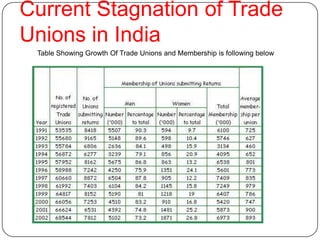
Unions in India
 Table Showing Growth Of Trade Unions and Membership is following below
The Code of Discipline 1958
The Management and Union(s) agree -

 That no unilateral action will be taken with any
  company matter and that disputes will be settled at
  appropriate level;
 That the existing machinery for settlement of
  disputes would be utilized with the utmost
  expedition;
 That there would be no strike or lockout without
  notice;
 That affirming their faith in democratic principles,
 That neither party will have recourse to (a) coercion,
  (b) intimidation, (c) victimization or (d) go-slow;
 That they will avoid, (a) litigation, (b) sit down and
  stay in strikes and (c) lock outs;
 That they will promote constructive co-operation
  between their representatives at all levels and as
  between workers themselves and abide by the spirit
  of agreements mutually entered into;
 That they will establish upon a mutually agreed
  basis, a grievance procedure which will ensure a
  speedy and full investigation leading to settlement;
 That they will abide by various stages in the
  grievance procedure and to take no arbitrary action
  which would bypass this procedure; and
 That they will educate the management personnel
The Management agree-
 Not to increase work loads unless agreed upon or
 settled otherwise;
 Not to support or encourage any unfair labour
 practice such as (a) interference with the right of
 employees to enroll or continue as union
 members, (b) discrimination restraint or coercion
 against any employee because of recognised activity
 or trade unions and (c) vcictimisation of any
 employee and abuse of authority in any form;
 To take prompt action for (a) settlement of
 grievances and (b) implementation of
 settlements, awards, decisions and orders;
 To distinguish between actions justifying immediate
 discharge and those where discharge must be
 preceded by warning, reprimand, suspension or
 some other form of disciplinary action and to
 arrange that all such disciplinary action should be
 subject to an appeal through normal grievance
 procedure;

 To take appropriate disciplinary action against its
 officers and members in cases where enquiries
 reveal that they were responsible for precipitated
 action by workers leading to indiscipline; and

 To recognise the union in accordance with the
The Union(s) agree:

 Not to engage in any form of physical duress;

 Not to permit demonstrations which are not peaceful
 and not to permit rowdyism in demonstrations;
 That their member will not engage or cause other
 employees to engage in any union activity during
 working hours, unless as provided by law,
 agreement of practice;
 To discourage unfair labour practices such as (a)
 negligence of duty (b) careless operation, (c)
 damage to the property, (d) interference with or
 disturbance to normal work and (e) insubordination;
 To take prompt action to implement awards,
 agreements, settlements and decisions;
 To display in conspicuous places in the union
 offices, the provisions of this code in the local
 language (s); and
 To express disapproval and to take appropriate
 action against office-bearers and members for
 indulging in action against the spirit of this code.
REGISTRATION OF THE
TRADE UNIONS
 Minimum of 7 members required to register a
 Trade Union
 Application is sent to the Registrar for
 registration the particular state.
 Application contains names and other details of
 the employees who wish to be members of the
 trade union
 Application should also contain suggestions for
 the Name of the Trade Union (3)
 On registration the union becomes a body
 corporate and enjoys privileges such as Raising
RECOGNITION OF TRADE
UNION
Recognition is of two types

 DEFACTO -: Those trade unions who do not
 bother about recognition and commands
 attendance and knows that whether the
 employer recognize or not it can dictate terms
 are known as defacto recognition.

 DE JURE -: A trade union is said to be dejure
 when it is duly and officially recognized by the
 management. As employer may on his on
 volition grant recognition or he may act with
 the unions as if it is recognized.
CRITERIA FOR RECOGNITION OF
 UNIONS
1. Where there is more than one union, a union
  claiming recognition should have been functioning
  for at least one year after registration. Where there is
  only one union, this condition would not apply.
2. The membership of the union should cover at least
  15% of the workers in the establishment concerned.
  Membership would be counted only to those who
  had paid their subscription for at least three months
  during the period of six months immediately
  proceeding the reckoning.
3. A union may claim to be recognised as a
  representative union for an industry in a local area if
  it has a membership of atleast 25% of the workers of
  that industry in that area.
5. Where there are several unions in an industry or
  establishment, the one with the largest membership should
  be recognised
6. A representative union for an industry in an area should
  have the right to represent the workers in all the
  establishments in the industry, but if a union of workers in a
  particular establishment has a membership of 50% or
  more of the workers of that establishment, it should have
  the right to deal with matters of purely local interest such
  as, for instance, the handling of grievances pertaining to its
  own members. All workers who are not members of that
  union might either operate through representative union for
  the industry or seek redress directly.
7. In the case of trade union federations, which are not
  affiliated to any of the four central organisations of labour,
Collective Bargaining: Role of
trade Unions
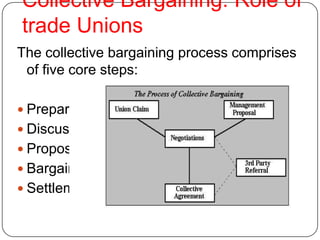
The collective bargaining process comprises
 of five core steps:

 Prepare
 Discuss
 Propose
 Bargain
 Settlement
Case Study of Hotel
 Oberoi
 The employees of the hotel used to get 65 days
 holiday per year, but the management wanted
 to reduce it by 15 days due to some managerial
 issues.

 The workers readily and strongly opposed this
 proposal  and   approached     Maharashtra
 Samarth Kamgar Sanghatna to solve this issue.

 MSKS understood the workers dilemma and
 went to the management to reach             an
 understanding via collective bargaining.
Collective Bargaining
   Process
1.    MSKS agreed to convince the workers but in
  return asked the management to pay 20 days extra
  salary in the month of December.

2.     The management and workers debated over
  the issue.
  The management found that they had the workers
  working for 15 extra days and the workers found
  that they were being paid for 20 days just for 15
  days of extra work.
Case Study of Hotel
  Leela
 The 9/11 Twin towers blasts in America, had its
 adverse effects on the hotel industry as well.

 Hotel Leela decided to eliminate 280 of its
 employees because of low salary availability. This
 280 employees included 200 workers and 80
 supervisors.

 The employees approached Maharashtra Samarth
 Kamgar Sanghatna and a meeting was held
 between the management and the secretary of
 MSKS.
Collective Bargaining
    Process
 The reason behind this decision was asked and the
 reason given by the management was that they
 were unable to pay heavy remunerations to this
 large amount of employees.

 After some calculations it was found that if 10% of
 the remuneration of the workers was cut then it
 would be able to provide remuneration to the 200
 workers.

 The management agreed and 200 workers were
Collective Bargaining Process
 Further it was found that if 2.5% reduction from the
 existing salary could be done along with the
 reduction of 10%, then even the remaining 80 could
 be employed.

 MSKS wanted the reduction to be done right from
 the upper level managers to the lower level
 employees which the management accepted.

 This reduction continued only for 3 months and
 after that everything was back to normal.
Thank You

Trade unions

  • 1.
    Trade Unions Concept &Role in Industrial Relations Onkar R Satam Kantilal Kamble Anit Nair
  • 2.
    Trade Unions: What? TheTrade Union Act 1926 defines a trade union as a combination, whether temporary or permanent, formed primarily for the purpose of regulating the relations between workmen and employers or between workmen and workmen, or between employers and employers, or for imposing restrictive condition on the conduct of any trade or business, and includes any federation of
  • 3.
    Objectives of Trade Unions Representation  Negotiation  Voice in decisions affecting workers  Member Services  Education and training  Legal assistance  Financial discounts  Welfare benefits
  • 4.
    Functions of Trade Unions 1) Militant Functions  To achieve higher wages and better working conditions  To raise the status of workers as a part of industry  To protect laborers against victimization and injustice 2) Fraternal Functions  To take up welfare measures for improving the morale of workers  To generate self confidence among worker  To encourage sincerity and discipline among worker  To provide opportunities for promotion and growth  To protect women workers against discrimination
  • 5.
    Importance of Trade Unions Trade unions proved being of great importance : -By helping in the recruitment and selection of workers. -By inculcating discipline among the workforce -By enabling settlement of industrial disputes in a rational manner -By helping social adjustments. (Workers have to adjust themselves to the new working conditions, the new rules and policies. Workers coming from different backgrounds may become
  • 6.
    Social Responsibilities of TradeUnions  Promoting and maintaining national integration by reducing the number of industrial disputes  Incorporating a sense of corporate social responsibility in workers  Achieving industrial peace
  • 7.
    Reasons for joining TradeUnions 1. Greater Bargaining Power 2. Minimize Discrimination 3. Sense of Security 4. Sense of Participation 5. Sense of Belongingness 6. Platform for self expression 7. Betterment of relationships
  • 8.
    Current Stagnation ofTrade Unions in India Table Showing Growth Of Trade Unions and Membership is following below
  • 9.
    The Code ofDiscipline 1958 The Management and Union(s) agree -  That no unilateral action will be taken with any company matter and that disputes will be settled at appropriate level;  That the existing machinery for settlement of disputes would be utilized with the utmost expedition;  That there would be no strike or lockout without notice;  That affirming their faith in democratic principles,
  • 10.
     That neitherparty will have recourse to (a) coercion, (b) intimidation, (c) victimization or (d) go-slow;  That they will avoid, (a) litigation, (b) sit down and stay in strikes and (c) lock outs;  That they will promote constructive co-operation between their representatives at all levels and as between workers themselves and abide by the spirit of agreements mutually entered into;  That they will establish upon a mutually agreed basis, a grievance procedure which will ensure a speedy and full investigation leading to settlement;  That they will abide by various stages in the grievance procedure and to take no arbitrary action which would bypass this procedure; and  That they will educate the management personnel
  • 11.
    The Management agree- Not to increase work loads unless agreed upon or settled otherwise;  Not to support or encourage any unfair labour practice such as (a) interference with the right of employees to enroll or continue as union members, (b) discrimination restraint or coercion against any employee because of recognised activity or trade unions and (c) vcictimisation of any employee and abuse of authority in any form;  To take prompt action for (a) settlement of grievances and (b) implementation of settlements, awards, decisions and orders;
  • 12.
     To distinguishbetween actions justifying immediate discharge and those where discharge must be preceded by warning, reprimand, suspension or some other form of disciplinary action and to arrange that all such disciplinary action should be subject to an appeal through normal grievance procedure;  To take appropriate disciplinary action against its officers and members in cases where enquiries reveal that they were responsible for precipitated action by workers leading to indiscipline; and  To recognise the union in accordance with the
  • 13.
    The Union(s) agree: Not to engage in any form of physical duress;  Not to permit demonstrations which are not peaceful and not to permit rowdyism in demonstrations;  That their member will not engage or cause other employees to engage in any union activity during working hours, unless as provided by law, agreement of practice;  To discourage unfair labour practices such as (a) negligence of duty (b) careless operation, (c) damage to the property, (d) interference with or disturbance to normal work and (e) insubordination;
  • 14.
     To takeprompt action to implement awards, agreements, settlements and decisions;  To display in conspicuous places in the union offices, the provisions of this code in the local language (s); and  To express disapproval and to take appropriate action against office-bearers and members for indulging in action against the spirit of this code.
  • 15.
    REGISTRATION OF THE TRADEUNIONS  Minimum of 7 members required to register a Trade Union  Application is sent to the Registrar for registration the particular state.  Application contains names and other details of the employees who wish to be members of the trade union  Application should also contain suggestions for the Name of the Trade Union (3)  On registration the union becomes a body corporate and enjoys privileges such as Raising
  • 16.
    RECOGNITION OF TRADE UNION Recognitionis of two types  DEFACTO -: Those trade unions who do not bother about recognition and commands attendance and knows that whether the employer recognize or not it can dictate terms are known as defacto recognition.  DE JURE -: A trade union is said to be dejure when it is duly and officially recognized by the management. As employer may on his on volition grant recognition or he may act with the unions as if it is recognized.
  • 17.
    CRITERIA FOR RECOGNITIONOF UNIONS 1. Where there is more than one union, a union claiming recognition should have been functioning for at least one year after registration. Where there is only one union, this condition would not apply. 2. The membership of the union should cover at least 15% of the workers in the establishment concerned. Membership would be counted only to those who had paid their subscription for at least three months during the period of six months immediately proceeding the reckoning. 3. A union may claim to be recognised as a representative union for an industry in a local area if it has a membership of atleast 25% of the workers of that industry in that area.
  • 18.
    5. Where thereare several unions in an industry or establishment, the one with the largest membership should be recognised 6. A representative union for an industry in an area should have the right to represent the workers in all the establishments in the industry, but if a union of workers in a particular establishment has a membership of 50% or more of the workers of that establishment, it should have the right to deal with matters of purely local interest such as, for instance, the handling of grievances pertaining to its own members. All workers who are not members of that union might either operate through representative union for the industry or seek redress directly. 7. In the case of trade union federations, which are not affiliated to any of the four central organisations of labour,
  • 19.
    Collective Bargaining: Roleof trade Unions The collective bargaining process comprises of five core steps:  Prepare  Discuss  Propose  Bargain  Settlement
  • 20.
    Case Study ofHotel Oberoi  The employees of the hotel used to get 65 days holiday per year, but the management wanted to reduce it by 15 days due to some managerial issues.  The workers readily and strongly opposed this proposal and approached Maharashtra Samarth Kamgar Sanghatna to solve this issue.  MSKS understood the workers dilemma and went to the management to reach an understanding via collective bargaining.
  • 21.
    Collective Bargaining Process 1. MSKS agreed to convince the workers but in return asked the management to pay 20 days extra salary in the month of December. 2. The management and workers debated over the issue. The management found that they had the workers working for 15 extra days and the workers found that they were being paid for 20 days just for 15 days of extra work.
  • 22.
    Case Study ofHotel Leela  The 9/11 Twin towers blasts in America, had its adverse effects on the hotel industry as well.  Hotel Leela decided to eliminate 280 of its employees because of low salary availability. This 280 employees included 200 workers and 80 supervisors.  The employees approached Maharashtra Samarth Kamgar Sanghatna and a meeting was held between the management and the secretary of MSKS.
  • 23.
    Collective Bargaining Process  The reason behind this decision was asked and the reason given by the management was that they were unable to pay heavy remunerations to this large amount of employees.  After some calculations it was found that if 10% of the remuneration of the workers was cut then it would be able to provide remuneration to the 200 workers.  The management agreed and 200 workers were
  • 24.
    Collective Bargaining Process Further it was found that if 2.5% reduction from the existing salary could be done along with the reduction of 10%, then even the remaining 80 could be employed.  MSKS wanted the reduction to be done right from the upper level managers to the lower level employees which the management accepted.  This reduction continued only for 3 months and after that everything was back to normal.
  • 25.