PATHOLOGY
LABORATORY RISK
MANAGEMENT
REMEDIOS TRINIDAD ROMUALDEZ MEDICAL FOUNDATION
Rose Ann B. Lego
BMLS 1-B
• Risk
Identification
• Risk Evaluation
and Analysis
• Audit
• Risk Funding
Risk
Management
Pathology
Laboratory
Risk
MAnagement
Risk Management
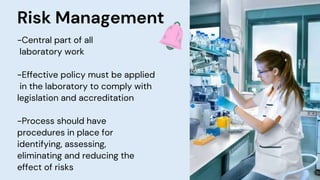
-Central part of all
laboratory work
-Effective policy must be applied
in the laboratory to comply with
legislation and accreditation
-Process should have
procedures in place for
identifying, assessing,
eliminating and reducing the
effect of risks
Larissa
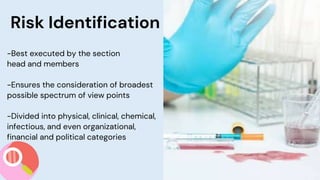
-Best executed by the section
head and members
-Ensures the consideration of broadest
possible spectrum of view points
-Divided into physical, clinical, chemical,
infectious, and even organizational,
financial and political categories
Risk Identification
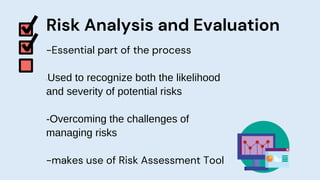
-Essential part of the process
-Used to recognize both the likelihood
and severity of potential risks
-Overcoming the challenges of
managing risks
-makes use of Risk Assessment Tool
Risk Analysis and Evaluation
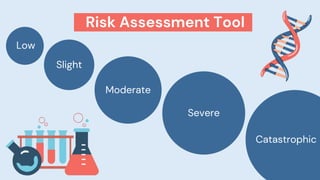
Risk Assessment Tool
Low
Slight
Moderate
Severe
Catastrophic
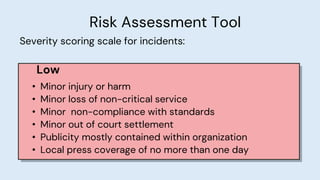
Risk Assessment Tool
Severity scoring scale for incidents:
Low
• Minor injury or harm
• Minor loss of non-critical service
• Minor non-compliance with standards
• Minor out of court settlement
• Publicity mostly contained within organization
• Local press coverage of no more than one day
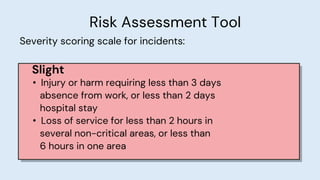
Risk Assessment Tool
Severity scoring scale for incidents:
Slight
• Injury or harm requiring less than 3 days
absence from work, or less than 2 days
hospital stay
• Loss of service for less than 2 hours in
several non-critical areas, or less than
6 hours in one area
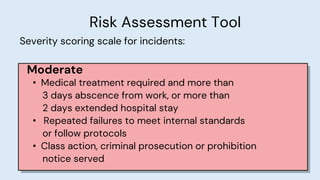
Risk Assessment Tool
Severity scoring scale for incidents:
Moderate
• Medical treatment required and more than
3 days abscence from work, or more than
2 days extended hospital stay
• Repeated failures to meet internal standards
or follow protocols
• Class action, criminal prosecution or prohibition
notice served
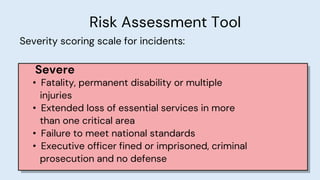
Risk Assessment Tool
Severity scoring scale for incidents:
Severe
• Fatality, permanent disability or multiple
injuries
• Extended loss of essential services in more
than one critical area
• Failure to meet national standards
• Executive officer fined or imprisoned, criminal
prosecution and no defense
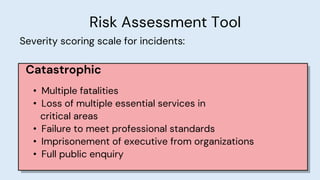
Risk Assessment Tool
Severity scoring scale for incidents:
Catastrophic
• Multiple fatalities
• Loss of multiple essential services in
critical areas
• Failure to meet professional standards
• Imprisonement of executive from organizations
• Full public enquiry
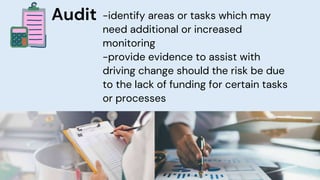
-identify areas or tasks which may
need additional or increased
monitoring
-provide evidence to assist with
driving change should the risk be due
to the lack of funding for certain tasks
or processes
Audit
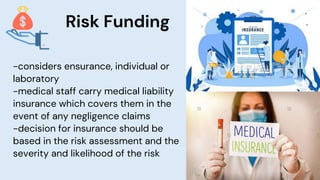
Risk Funding
-considers ensurance, individual or
laboratory
-medical staff carry medical liability
insurance which covers them in the
event of any negligence claims
-decision for insurance should be
based in the risk assessment and the
severity and likelihood of the risk
• Procedures include
identifying, assessing,
eliminating, and reducing of
risks.
• Risk management is an
essential and central part of
all laboratory work.
• To function effectively and
safely, all laboratory and
activities must be subjected
to risk management process.
Key Points to
Remember
Pathology
Laboratory
Risk
Management
Reference(s):
Suvana et. al. (2018).
Bancroft's Theory and
Practice of Histological
Techniques. Retrieved
from
https://books.google.com
.ph/books?id=CERPDwAA
QBAJ&printsec=frontcov
er#v=onepage&q&f=fals
e
Pathology
Laboratory
Risk
MAnagement
THANK YOU!

Pathology Laboratory Risk Management

  • 1.
    PATHOLOGY LABORATORY RISK MANAGEMENT REMEDIOS TRINIDADROMUALDEZ MEDICAL FOUNDATION Rose Ann B. Lego BMLS 1-B
  • 2.
    • Risk Identification • RiskEvaluation and Analysis • Audit • Risk Funding Risk Management Pathology Laboratory Risk MAnagement
  • 3.
    Risk Management -Central partof all laboratory work -Effective policy must be applied in the laboratory to comply with legislation and accreditation -Process should have procedures in place for identifying, assessing, eliminating and reducing the effect of risks Larissa
  • 4.
    -Best executed bythe section head and members -Ensures the consideration of broadest possible spectrum of view points -Divided into physical, clinical, chemical, infectious, and even organizational, financial and political categories Risk Identification
  • 5.
    -Essential part ofthe process -Used to recognize both the likelihood and severity of potential risks -Overcoming the challenges of managing risks -makes use of Risk Assessment Tool Risk Analysis and Evaluation
  • 6.
  • 7.
    Risk Assessment Tool Severityscoring scale for incidents: Low • Minor injury or harm • Minor loss of non-critical service • Minor non-compliance with standards • Minor out of court settlement • Publicity mostly contained within organization • Local press coverage of no more than one day
  • 8.
    Risk Assessment Tool Severityscoring scale for incidents: Slight • Injury or harm requiring less than 3 days absence from work, or less than 2 days hospital stay • Loss of service for less than 2 hours in several non-critical areas, or less than 6 hours in one area
  • 9.
    Risk Assessment Tool Severityscoring scale for incidents: Moderate • Medical treatment required and more than 3 days abscence from work, or more than 2 days extended hospital stay • Repeated failures to meet internal standards or follow protocols • Class action, criminal prosecution or prohibition notice served
  • 10.
    Risk Assessment Tool Severityscoring scale for incidents: Severe • Fatality, permanent disability or multiple injuries • Extended loss of essential services in more than one critical area • Failure to meet national standards • Executive officer fined or imprisoned, criminal prosecution and no defense
  • 11.
    Risk Assessment Tool Severityscoring scale for incidents: Catastrophic • Multiple fatalities • Loss of multiple essential services in critical areas • Failure to meet professional standards • Imprisonement of executive from organizations • Full public enquiry
  • 12.
    -identify areas ortasks which may need additional or increased monitoring -provide evidence to assist with driving change should the risk be due to the lack of funding for certain tasks or processes Audit
  • 13.
    Risk Funding -considers ensurance,individual or laboratory -medical staff carry medical liability insurance which covers them in the event of any negligence claims -decision for insurance should be based in the risk assessment and the severity and likelihood of the risk
  • 14.
    • Procedures include identifying,assessing, eliminating, and reducing of risks. • Risk management is an essential and central part of all laboratory work. • To function effectively and safely, all laboratory and activities must be subjected to risk management process. Key Points to Remember Pathology Laboratory Risk Management
  • 15.
    Reference(s): Suvana et. al.(2018). Bancroft's Theory and Practice of Histological Techniques. Retrieved from https://books.google.com .ph/books?id=CERPDwAA QBAJ&printsec=frontcov er#v=onepage&q&f=fals e Pathology Laboratory Risk MAnagement
  • 16.