Pathology laboratory
management
GROUP B PRESENTATION
Introduction
Management of the histopathology laboratory in today’s environment
requires a balancing act of technical knowledge, business skills, fiscal
responsibility, understanding of the workforce and a quality focus.
Many of today’s managers have ‘risen through the ranks’ and have a
solid foundation of technical skills on which to build, but may need to
hone their leadership and management skills.
The objective of this chapter is not to be a comprehensive guide to the
subject, but discuss and concentrate on specific areas which are unique
and significant to the operation of the laboratory, namely:
• Regulation and Accreditation.
• Quality Management in the laboratory setting.
• Safety concerns specific to Pathology
Accreditation
Accreditation in the American pathology laboratory is a voluntary
process to confirm that the department meets specific standards for
testing, staffing and quality services. Accrediting agencies often have
more stringent requirements than the minimal governmental regulations,
so laboratories may choose accreditation to identify themselves as a
higher quality organization.
Cont.
• CAP is a leading organization which serves patients, pathologists and the public
by promoting excellence in the practice of pathology and laboratory medicine
worldwide. It provides peer conducted inspections on a bi-annual basis. Along
with accreditation, CAP also offers educational and proficiency testing programs
to promote quality practice.
• The International Organization for Standardization (ISO) standards are being
adopted by many as the standards they wish to work to and be accredited by. ISO
is the world’s largest developer and publisher of international standards which
cover many areas of activity
Quality management
A robust quality management system is essential to provide the best possible service
for the patient and clinicians. Quality is defined as a measure of how well a product or
service does the job for which it is designed, i.e. conformity to specification. Internal
quality control (QC) of work processes is an important part of quality management and
has been the traditional way that bench work has been checked for many years.
External quality assurance (EQA) schemes provide benchmarking against other
laboratories and often provide access to best practice methods and expert advice on
improving techniques/specific tests.
Quality control
These systems check that the work process is functioning properly. It includes
processes utilized in the laboratory to recognize and eliminate errors ensuring that the
quality of work produced by the laboratory conforms to specified requirements prior
to its release for diagnosis. Errors and/or deviations from expected results must be
documented and include the corrective action taken, if required. In the laboratory,
quality control has long been a component of accreditation requirements and should
be ingrained in scientists as a daily practice.
External quality assurance (EQA)
In addition to local data collection and monitoring for internal quality
control, external mechanisms provide valuable information regarding
quality and peer comparisons and also serve as an educational tool.
Process improvement
This is the system which is used proactively to approach and identify
opportunities to improve quality before problems occur. It operates through
evaluation and audit of all systems and processes in the laboratory. The goal
is to improve care and safety for patients and staff through recognition of
potential problems and errors before they can occur. Good managers realize
that failures, errors and problems are often due to the system processes, and
not necessarily the fault of the employee(s).
Risk management
Risk management is an essential and central part of all laboratory work. To comply with
legislation and maintain accreditation a laboratory must have an effective risk management
policy. Any chance of something going wrong should be either negated or minimized and
therefore a laboratory’s risk management process should have procedures in place for:
• Identifying all risks which exist within the environment.
• Assessing those risks for likelihood and severity.
• Eliminating those risks which can be removed.
• Reducing the effect of risks which cannot be eliminated.
The pathology laboratory should have close links with, and feed into, the host
organization’s risk management process
Risk identification
Risk identification in laboratory sections is most effectively conducted
by the section lead and team members, in collaboration with the
laboratory’s Health and Safety lead. This approach ensures diverse
viewpoints are considered.
Risks can be categorized into several types, including:
• Clinical Risks: Related to patient care.
• Physical Risks: Associated with equipment and environment.
• Chemical Risks: Involving hazardous materials.
• Infectious Risks: Potential exposure to pathogens.
• Organizational Risks: Related to management processes.
• Financial and Political Risks: Affecting compliance and economic
stability.
Risk analysis and evaluation
• Analysis and evaluation of potential risks is an
essential part of the process and one that is used to
identify both the likelihood and severity of these
risks.
Safety
Safety arrangement: Ensure and maintain personal as well as environmental
health and safety in the laboratory.
- The first step is to identify all electrical, mechanical and biological hazards
that can potentially cause harm in the laboratory.
- Standard operating procedures (SOP) must be detailed to include control of
hazardous substances, risk assessments, and other health and safety
information relevant to handling of specimens.
General rules
• • General safety precautions that must be observed when working in
the laboratory:
• Protect the hands and forearms by wearing either gloves and a
laboratory coat or suitable long gloves to avoid contact of the toxic
material with the skin.
• - Wash hands frequently throughout the day and before leaving the
lab .
• - The laboratory workplace should be well-ventilated, clean and
organized.
• - Smoking, sleeping, eating and drinking are prohibited in the
laboratory.
• - Do not store food and drinks in laboratory refrigerators.
• - Do not wear shorts, sandals, or open-toed shoes in laboratory.
• Minors or personal pets are not permitted in the laboratory.
• Eye wash station, safety shower and first aid kits should be standard facilities in a laboratory.
• Fire extinguishers, first aid, emergency blankets, and hoods must be checked monthly.
• Chemical material should be stored and safely secured where there is sufficient ventilation.
• • Acids and bases must be separately stored.
• All chemical material must be labeled with the name,
• characteristics, danger level, and precautionary
• measures.
• Laboratories must have available appropriate
• protective gears for all individuals: safety devices, goggles, gloves, lab coats, and face-shields.
• • The laboratory must have a method for disposal of hazardous wastes
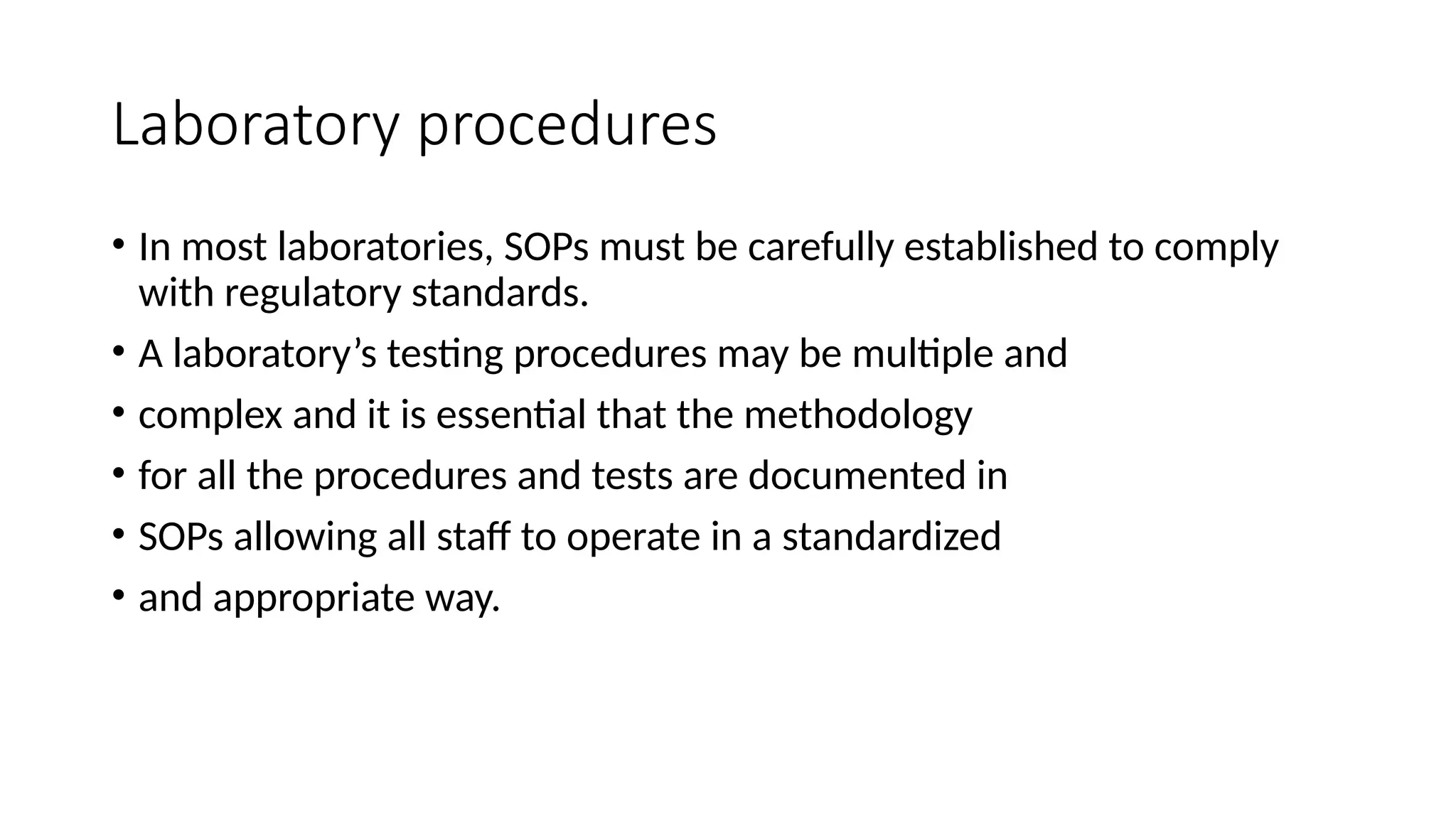
Laboratory procedures
• In most laboratories, SOPs must be carefully established to comply
with regulatory standards.
• A laboratory’s testing procedures may be multiple and
• complex and it is essential that the methodology
• for all the procedures and tests are documented in
• SOPs allowing all staff to operate in a standardized
• and appropriate way.
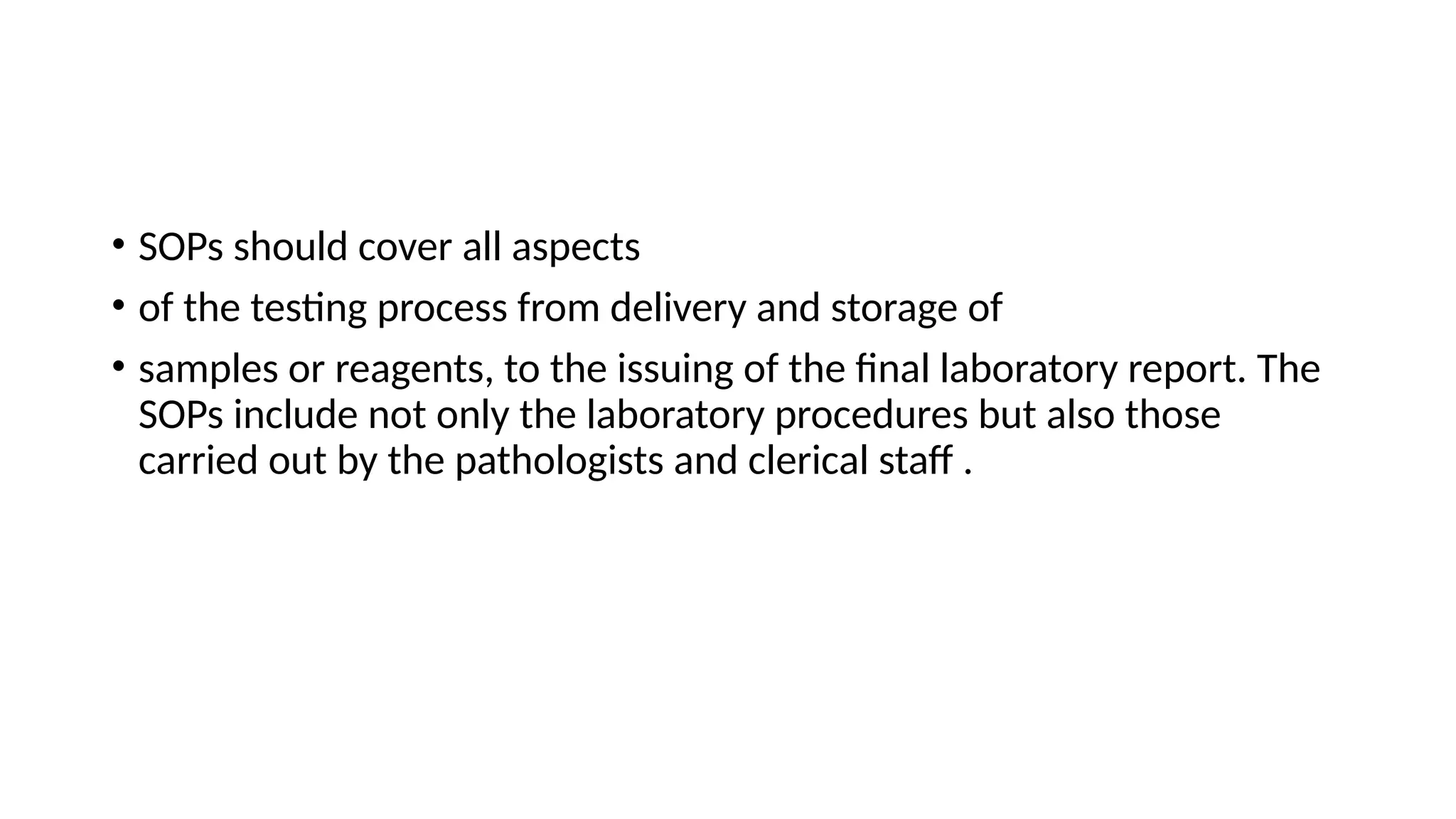
• SOPs should cover all aspects
• of the testing process from delivery and storage of
• samples or reagents, to the issuing of the final laboratory report. The
SOPs include not only the laboratory procedures but also those
carried out by the pathologists and clerical staff .
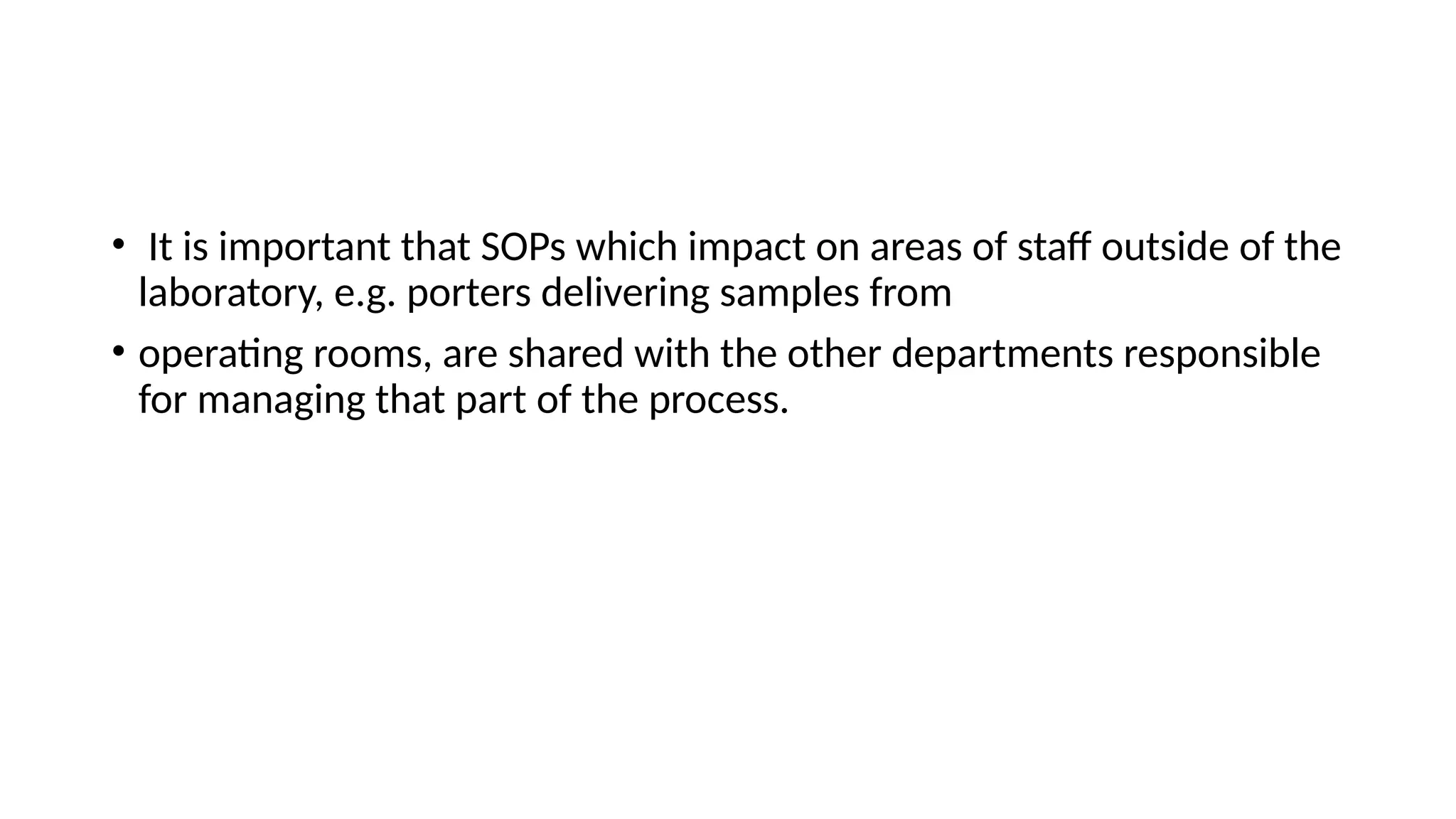
• It is important that SOPs which impact on areas of staff outside of the
laboratory, e.g. porters delivering samples from
• operating rooms, are shared with the other departments responsible
for managing that part of the process.
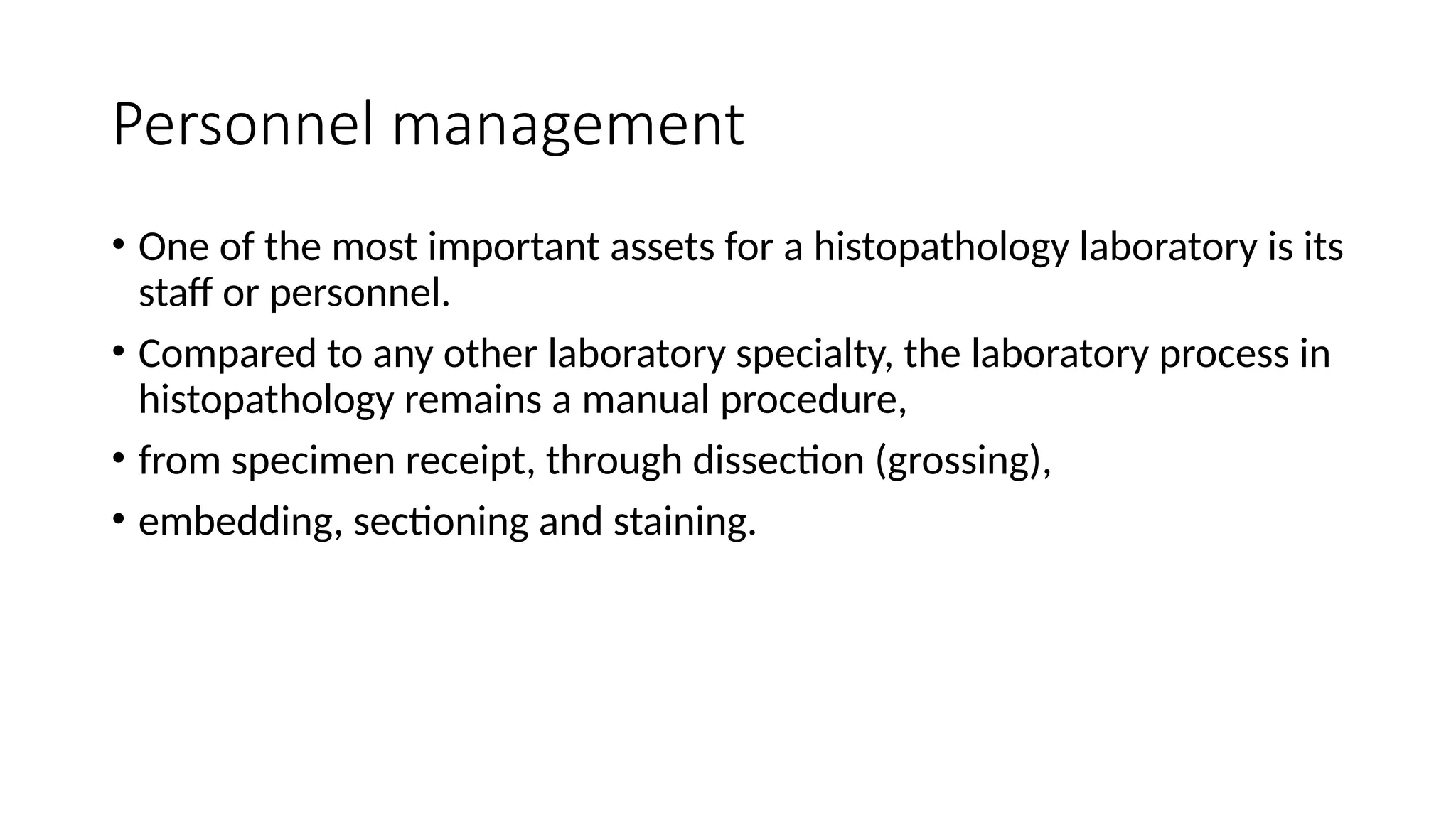
Personnel management
• One of the most important assets for a histopathology laboratory is its
staff or personnel.
• Compared to any other laboratory specialty, the laboratory process in
histopathology remains a manual procedure,
• from specimen receipt, through dissection (grossing),
• embedding, sectioning and staining.
• Many techniques are still reliant on skilled personnel rather than
automation, and the laboratory manager must ensure that
• the department is staffed by an appropriate number
• of employees with the right level of skills to ensure
• that the process is robust, safe and cost-effective.

introduction of light microscope gpp.pptx

  • 1.
  • 2.
    Introduction Management of thehistopathology laboratory in today’s environment requires a balancing act of technical knowledge, business skills, fiscal responsibility, understanding of the workforce and a quality focus. Many of today’s managers have ‘risen through the ranks’ and have a solid foundation of technical skills on which to build, but may need to hone their leadership and management skills.
  • 3.
    The objective ofthis chapter is not to be a comprehensive guide to the subject, but discuss and concentrate on specific areas which are unique and significant to the operation of the laboratory, namely: • Regulation and Accreditation. • Quality Management in the laboratory setting. • Safety concerns specific to Pathology
  • 4.
    Accreditation Accreditation in theAmerican pathology laboratory is a voluntary process to confirm that the department meets specific standards for testing, staffing and quality services. Accrediting agencies often have more stringent requirements than the minimal governmental regulations, so laboratories may choose accreditation to identify themselves as a higher quality organization.
  • 5.
    Cont. • CAP isa leading organization which serves patients, pathologists and the public by promoting excellence in the practice of pathology and laboratory medicine worldwide. It provides peer conducted inspections on a bi-annual basis. Along with accreditation, CAP also offers educational and proficiency testing programs to promote quality practice. • The International Organization for Standardization (ISO) standards are being adopted by many as the standards they wish to work to and be accredited by. ISO is the world’s largest developer and publisher of international standards which cover many areas of activity
  • 6.
    Quality management A robustquality management system is essential to provide the best possible service for the patient and clinicians. Quality is defined as a measure of how well a product or service does the job for which it is designed, i.e. conformity to specification. Internal quality control (QC) of work processes is an important part of quality management and has been the traditional way that bench work has been checked for many years. External quality assurance (EQA) schemes provide benchmarking against other laboratories and often provide access to best practice methods and expert advice on improving techniques/specific tests.
  • 7.
    Quality control These systemscheck that the work process is functioning properly. It includes processes utilized in the laboratory to recognize and eliminate errors ensuring that the quality of work produced by the laboratory conforms to specified requirements prior to its release for diagnosis. Errors and/or deviations from expected results must be documented and include the corrective action taken, if required. In the laboratory, quality control has long been a component of accreditation requirements and should be ingrained in scientists as a daily practice.
  • 8.
    External quality assurance(EQA) In addition to local data collection and monitoring for internal quality control, external mechanisms provide valuable information regarding quality and peer comparisons and also serve as an educational tool.
  • 9.
    Process improvement This isthe system which is used proactively to approach and identify opportunities to improve quality before problems occur. It operates through evaluation and audit of all systems and processes in the laboratory. The goal is to improve care and safety for patients and staff through recognition of potential problems and errors before they can occur. Good managers realize that failures, errors and problems are often due to the system processes, and not necessarily the fault of the employee(s).
  • 10.
    Risk management Risk managementis an essential and central part of all laboratory work. To comply with legislation and maintain accreditation a laboratory must have an effective risk management policy. Any chance of something going wrong should be either negated or minimized and therefore a laboratory’s risk management process should have procedures in place for: • Identifying all risks which exist within the environment. • Assessing those risks for likelihood and severity. • Eliminating those risks which can be removed. • Reducing the effect of risks which cannot be eliminated. The pathology laboratory should have close links with, and feed into, the host organization’s risk management process
  • 11.
    Risk identification Risk identificationin laboratory sections is most effectively conducted by the section lead and team members, in collaboration with the laboratory’s Health and Safety lead. This approach ensures diverse viewpoints are considered. Risks can be categorized into several types, including: • Clinical Risks: Related to patient care. • Physical Risks: Associated with equipment and environment. • Chemical Risks: Involving hazardous materials. • Infectious Risks: Potential exposure to pathogens. • Organizational Risks: Related to management processes. • Financial and Political Risks: Affecting compliance and economic stability.
  • 12.
    Risk analysis andevaluation • Analysis and evaluation of potential risks is an essential part of the process and one that is used to identify both the likelihood and severity of these risks.
  • 13.
    Safety Safety arrangement: Ensureand maintain personal as well as environmental health and safety in the laboratory. - The first step is to identify all electrical, mechanical and biological hazards that can potentially cause harm in the laboratory. - Standard operating procedures (SOP) must be detailed to include control of hazardous substances, risk assessments, and other health and safety information relevant to handling of specimens.
  • 14.
    General rules • •General safety precautions that must be observed when working in the laboratory: • Protect the hands and forearms by wearing either gloves and a laboratory coat or suitable long gloves to avoid contact of the toxic material with the skin. • - Wash hands frequently throughout the day and before leaving the lab .
  • 15.
    • - Thelaboratory workplace should be well-ventilated, clean and organized. • - Smoking, sleeping, eating and drinking are prohibited in the laboratory. • - Do not store food and drinks in laboratory refrigerators. • - Do not wear shorts, sandals, or open-toed shoes in laboratory. • Minors or personal pets are not permitted in the laboratory.
  • 16.
    • Eye washstation, safety shower and first aid kits should be standard facilities in a laboratory. • Fire extinguishers, first aid, emergency blankets, and hoods must be checked monthly. • Chemical material should be stored and safely secured where there is sufficient ventilation. • • Acids and bases must be separately stored. • All chemical material must be labeled with the name, • characteristics, danger level, and precautionary • measures. • Laboratories must have available appropriate • protective gears for all individuals: safety devices, goggles, gloves, lab coats, and face-shields. • • The laboratory must have a method for disposal of hazardous wastes
  • 17.
    Laboratory procedures • Inmost laboratories, SOPs must be carefully established to comply with regulatory standards. • A laboratory’s testing procedures may be multiple and • complex and it is essential that the methodology • for all the procedures and tests are documented in • SOPs allowing all staff to operate in a standardized • and appropriate way.
  • 18.
    • SOPs shouldcover all aspects • of the testing process from delivery and storage of • samples or reagents, to the issuing of the final laboratory report. The SOPs include not only the laboratory procedures but also those carried out by the pathologists and clerical staff .
  • 19.
    • It isimportant that SOPs which impact on areas of staff outside of the laboratory, e.g. porters delivering samples from • operating rooms, are shared with the other departments responsible for managing that part of the process.
  • 20.
    Personnel management • Oneof the most important assets for a histopathology laboratory is its staff or personnel. • Compared to any other laboratory specialty, the laboratory process in histopathology remains a manual procedure, • from specimen receipt, through dissection (grossing), • embedding, sectioning and staining.
  • 21.
    • Many techniquesare still reliant on skilled personnel rather than automation, and the laboratory manager must ensure that • the department is staffed by an appropriate number • of employees with the right level of skills to ensure • that the process is robust, safe and cost-effective.

Editor's Notes

  • #16 Click to edit Master text styles Second level Third level Fourth level Fifth level