UNIVERSITI TUN HUSSEIN ONN MALAYSIA
          FACULTY OF MECHANICAL AND MANUFACTURING ENGINEERING
          BTI 10202: COMPUTER PROGRAMMING


                                          LAB 9 : Functions

 NAME : _____________________________________
 MATRICS NO.: _______________ DATE : ____________                                              MARK


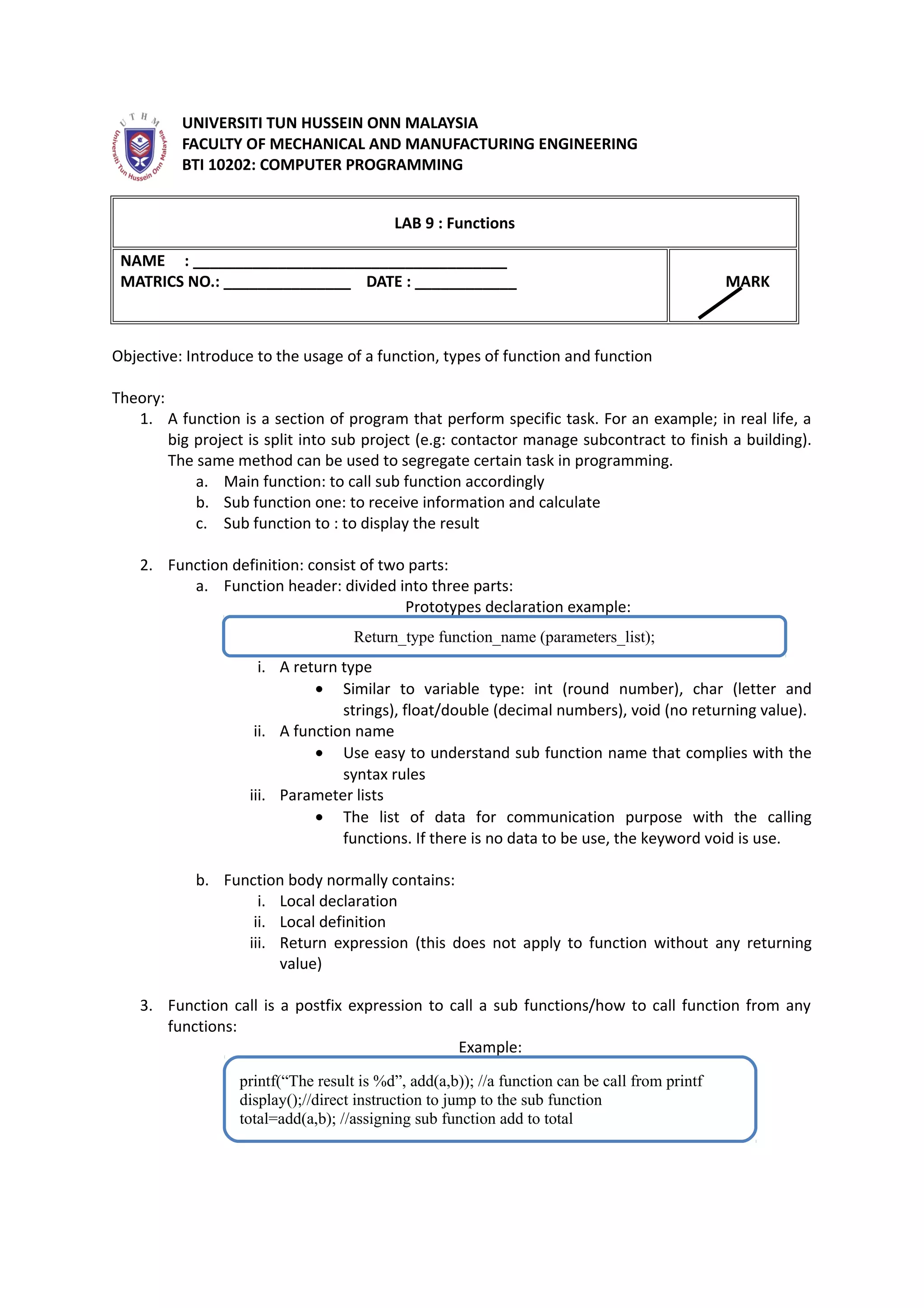
Objective: Introduce to the usage of a function, types of function and function

Theory:
   1. A function is a section of program that perform specific task. For an example; in real life, a
        big project is split into sub project (e.g: contactor manage subcontract to finish a building).
        The same method can be used to segregate certain task in programming.
            a. Main function: to call sub function accordingly
            b. Sub function one: to receive information and calculate
            c. Sub function to : to display the result

    2. Function definition: consist of two parts:
          a. Function header: divided into three parts:
                                          Prototypes declaration example:
                                    Return_type function_name (parameters_list);
                      i. A return type
                              • Similar to variable type: int (round number), char (letter and
                                  strings), float/double (decimal numbers), void (no returning value).
                     ii. A function name
                              • Use easy to understand sub function name that complies with the
                                  syntax rules
                    iii. Parameter lists
                              • The list of data for communication purpose with the calling
                                  functions. If there is no data to be use, the keyword void is use.

            b. Function body normally contains:
                    i. Local declaration
                   ii. Local definition
                  iii. Return expression (this does not apply to function without any returning
                       value)

    3. Function call is a postfix expression to call a sub functions/how to call function from any
       functions:
                                                 Example:
                  printf(“The result is %d”, add(a,b)); //a function can be call from printf
                  display();//direct instruction to jump to the sub function
                  total=add(a,b); //assigning sub function add to total
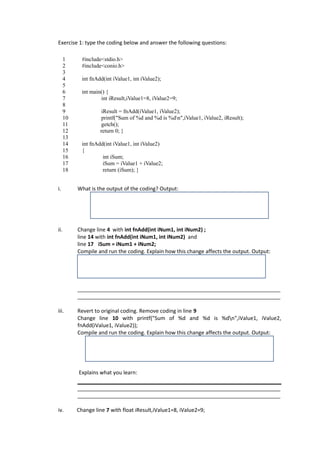
Exercise 1: type the coding below and answer the following questions:

      1      #include<stdio.h>
      2      #include<conio.h>
      3
      4      int fnAdd(int iValue1, int iValue2);
      5
      6      int main() {
      7              int iResult,iValue1=8, iValue2=9;
      8
      9               iResult = fnAdd(iValue1, iValue2);
      10              printf("Sum of %d and %d is %dn",iValue1, iValue2, iResult);
      11              getch();
      12             return 0; }
      13
      14     int fnAdd(int iValue1, int iValue2)
      15     {
      16              int iSum;
      17              iSum = iValue1 + iValue2;
      18              return (iSum); }


i.         What is the output of the coding? Output:


ii.        Change line 4 with int fnAdd(int iNum1, int iNum2) ;
           line 14 with int fnAdd(int iNum1, int iNum2) and
           line 17 iSum = iNum1 + iNum2;
           Compile and run the coding. Explain how this change affects the output. Output:


           _____________________________________________________________________
           _____________________________________________________________________

iii.       Revert to original coding. Remove coding in line 9
           Change line 10 with printf("Sum of %d and %d is %dn",iValue1, iValue2,
           fnAdd(iValue1, iValue2));
           Compile and run the coding. Explain how this change affects the output. Output:


           Explains what you learn:

           _____________________________________________________________________
           _____________________________________________________________________

iv.        Change line 7 with float iResult,iValue1=8, iValue2=9;
List the error and explains:
     _____________________________________________________________________
     _____________________________________________________________________
     _____________________________________________________________________


v.   Revert to original coding. Change line 14 with   int fnAdd(inum1, inum2)
     List the error and explains:

Lab 9 sem ii_12_13

  • 1.
    UNIVERSITI TUN HUSSEINONN MALAYSIA FACULTY OF MECHANICAL AND MANUFACTURING ENGINEERING BTI 10202: COMPUTER PROGRAMMING LAB 9 : Functions NAME : _____________________________________ MATRICS NO.: _______________ DATE : ____________ MARK Objective: Introduce to the usage of a function, types of function and function Theory: 1. A function is a section of program that perform specific task. For an example; in real life, a big project is split into sub project (e.g: contactor manage subcontract to finish a building). The same method can be used to segregate certain task in programming. a. Main function: to call sub function accordingly b. Sub function one: to receive information and calculate c. Sub function to : to display the result 2. Function definition: consist of two parts: a. Function header: divided into three parts: Prototypes declaration example: Return_type function_name (parameters_list); i. A return type • Similar to variable type: int (round number), char (letter and strings), float/double (decimal numbers), void (no returning value). ii. A function name • Use easy to understand sub function name that complies with the syntax rules iii. Parameter lists • The list of data for communication purpose with the calling functions. If there is no data to be use, the keyword void is use. b. Function body normally contains: i. Local declaration ii. Local definition iii. Return expression (this does not apply to function without any returning value) 3. Function call is a postfix expression to call a sub functions/how to call function from any functions: Example: printf(“The result is %d”, add(a,b)); //a function can be call from printf display();//direct instruction to jump to the sub function total=add(a,b); //assigning sub function add to total
  • 2.
    Exercise 1: typethe coding below and answer the following questions: 1 #include<stdio.h> 2 #include<conio.h> 3 4 int fnAdd(int iValue1, int iValue2); 5 6 int main() { 7 int iResult,iValue1=8, iValue2=9; 8 9 iResult = fnAdd(iValue1, iValue2); 10 printf("Sum of %d and %d is %dn",iValue1, iValue2, iResult); 11 getch(); 12 return 0; } 13 14 int fnAdd(int iValue1, int iValue2) 15 { 16 int iSum; 17 iSum = iValue1 + iValue2; 18 return (iSum); } i. What is the output of the coding? Output: ii. Change line 4 with int fnAdd(int iNum1, int iNum2) ; line 14 with int fnAdd(int iNum1, int iNum2) and line 17 iSum = iNum1 + iNum2; Compile and run the coding. Explain how this change affects the output. Output: _____________________________________________________________________ _____________________________________________________________________ iii. Revert to original coding. Remove coding in line 9 Change line 10 with printf("Sum of %d and %d is %dn",iValue1, iValue2, fnAdd(iValue1, iValue2)); Compile and run the coding. Explain how this change affects the output. Output: Explains what you learn: _____________________________________________________________________ _____________________________________________________________________ iv. Change line 7 with float iResult,iValue1=8, iValue2=9;
  • 3.
    List the errorand explains: _____________________________________________________________________ _____________________________________________________________________ _____________________________________________________________________ v. Revert to original coding. Change line 14 with int fnAdd(inum1, inum2) List the error and explains: