Introduction to Computers and
Programming (CSC103)
Lecture 04
2
void main (void)
{
printf("Testing...n..1n...2n....3n")
}
Compilation Result?
#include <stdio.h>
void main (void)
{
value1 = 50;
value2 = 25;
int value1, value2, sum;
sum = value1 + value2;
printf("The sum of %d and %d is %dn", value1, value2, sum);
}
Compilation Result?
1
2
3
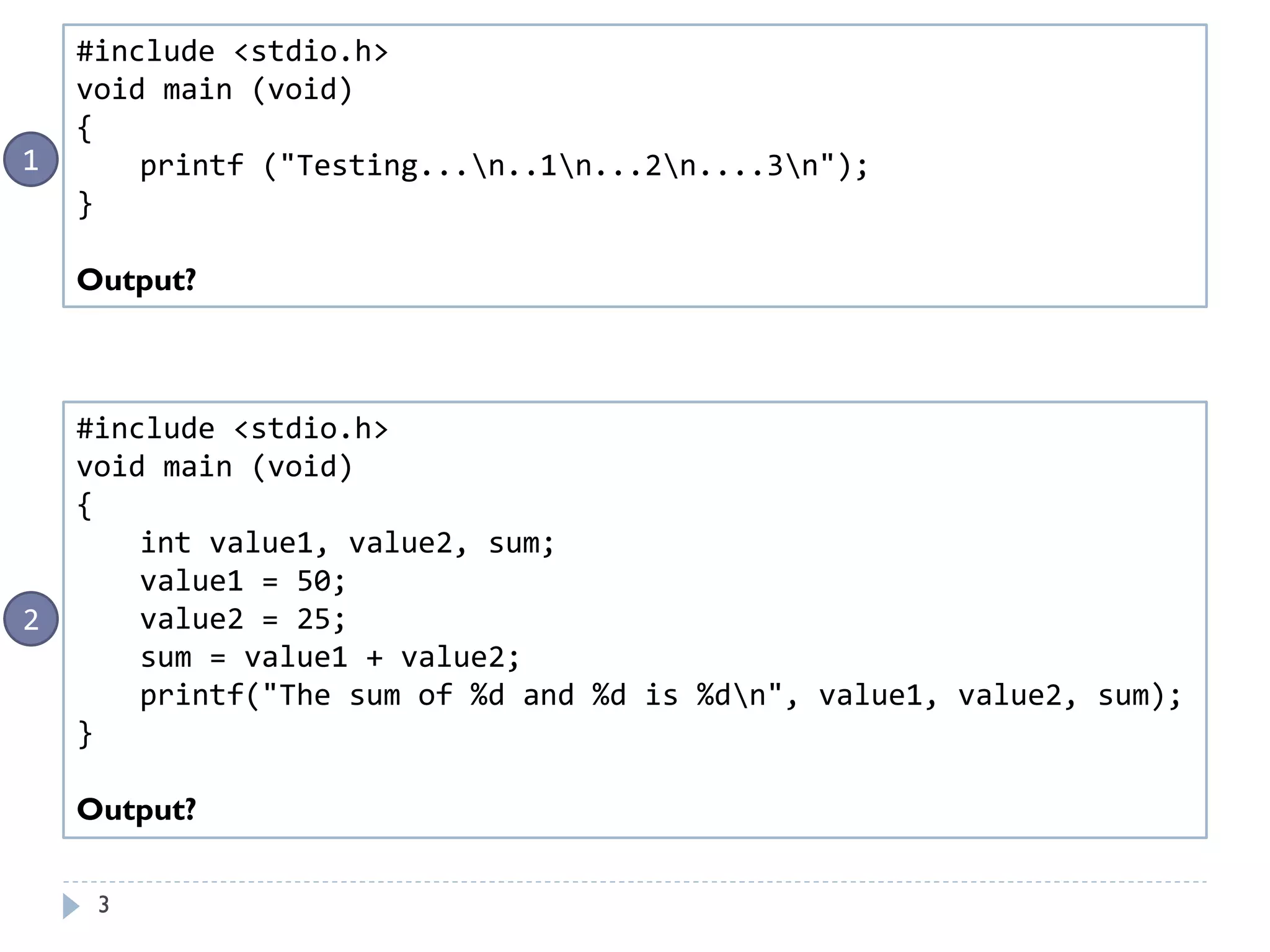
#include <stdio.h>
void main (void)
{
printf ("Testing...n..1n...2n....3n");
}
Output?
#include <stdio.h>
void main (void)
{
int value1, value2, sum;
value1 = 50;
value2 = 25;
sum = value1 + value2;
printf("The sum of %d and %d is %dn", value1, value2, sum);
}
Output?
1
2
Arithmetic Instructions in C
4
int ad ;
float kot, deta, alpha, beta, gamma;
ad = 3200 ;
kot = 0.0056 ;
deta = alpha * beta / gamma + 3.2 * 2 / 5 ;
---------------------------------------------------------------------------------
Here,
*, /, -, + are the arithmetic operators.
= is the assignment operator.
2, 5 and 3200 are integer constants.
3.2 and 0.0056 are real constants.
ad is an integer variable.
kot, deta, alpha, beta, gamma are real variables.
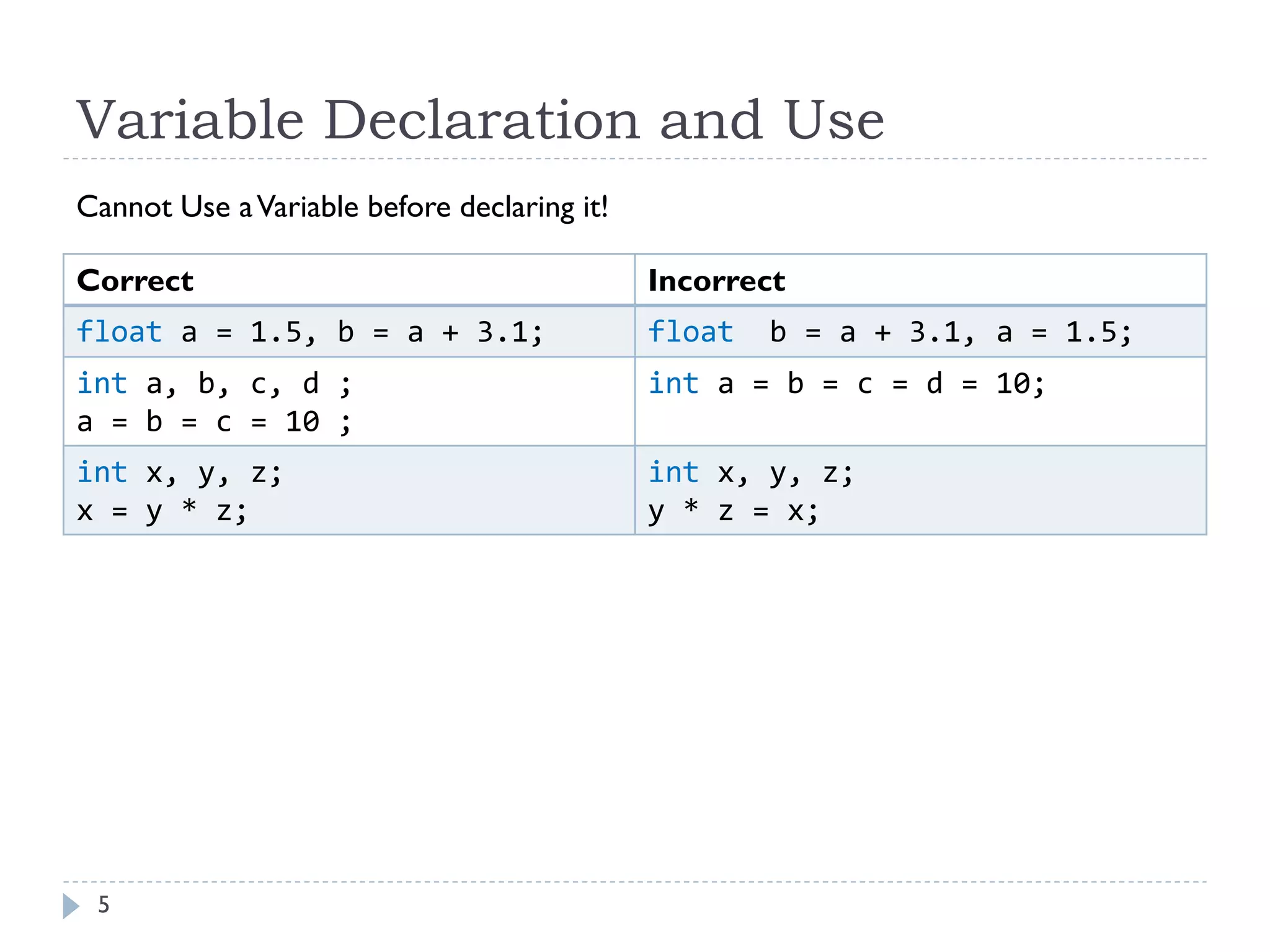
Variable Declaration and Use
5
Correct Incorrect
float a = 1.5, b = a + 3.1; float b = a + 3.1, a = 1.5;
int a, b, c, d ;
a = b = c = 10 ;
int a = b = c = d = 10;
int x, y, z;
x = y * z;
int x, y, z;
y * z = x;
Cannot Use aVariable before declaring it!
Integer and Float Conversion
6
 Implicit and Explicit Conversions
 An arithmetic operation between an integer and integer
always yields an integer result.
 An operation between a real and real always yields a real
result.
 An operation between an integer and real always yields a real
result. In this operation the integer is first promoted to a real
and then the operation is performed. Hence the result is real.
7
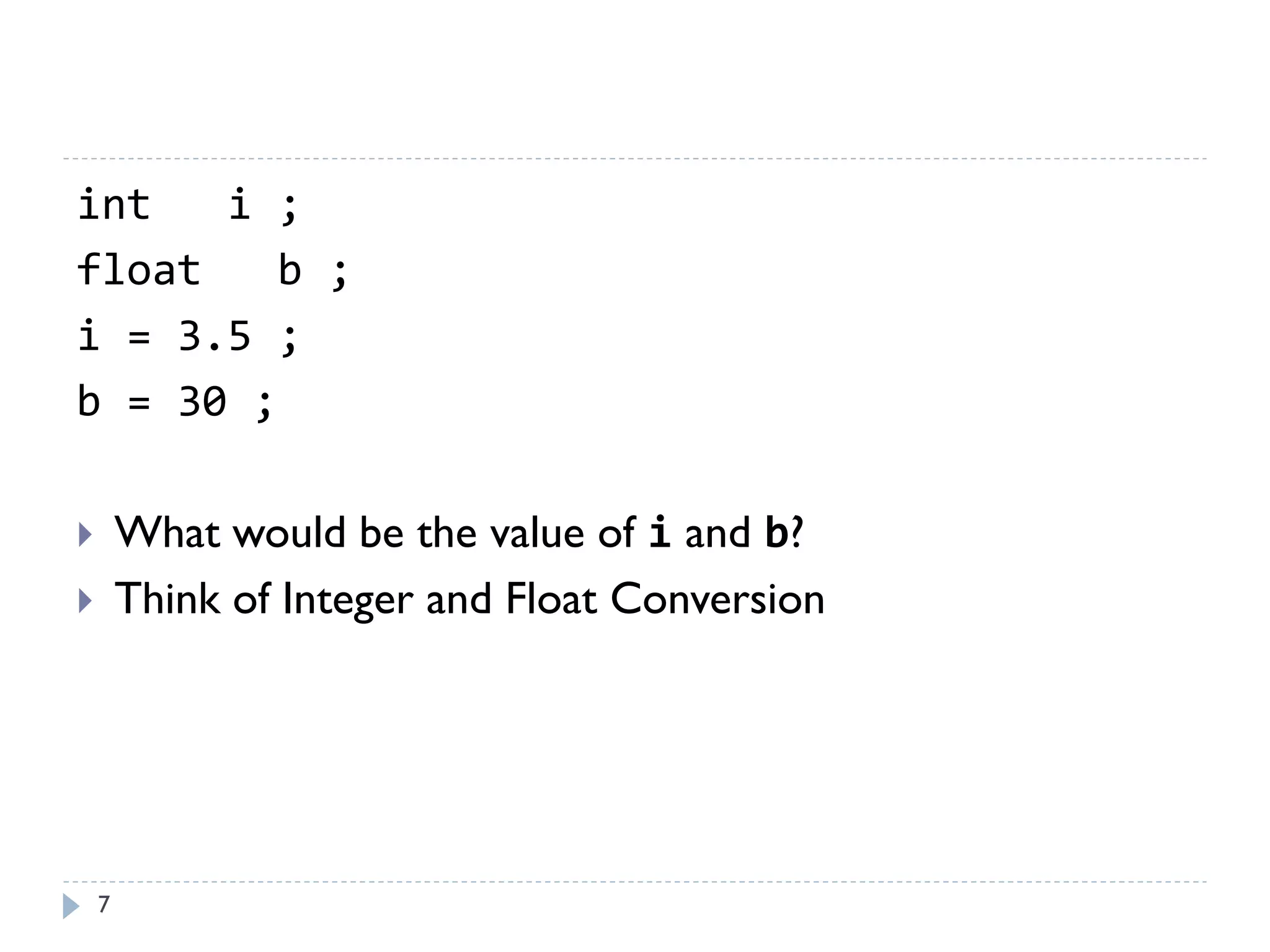
int i ;
float b ;
i = 3.5 ;
b = 30 ;
 What would be the value of i and b?
 Think of Integer and Float Conversion
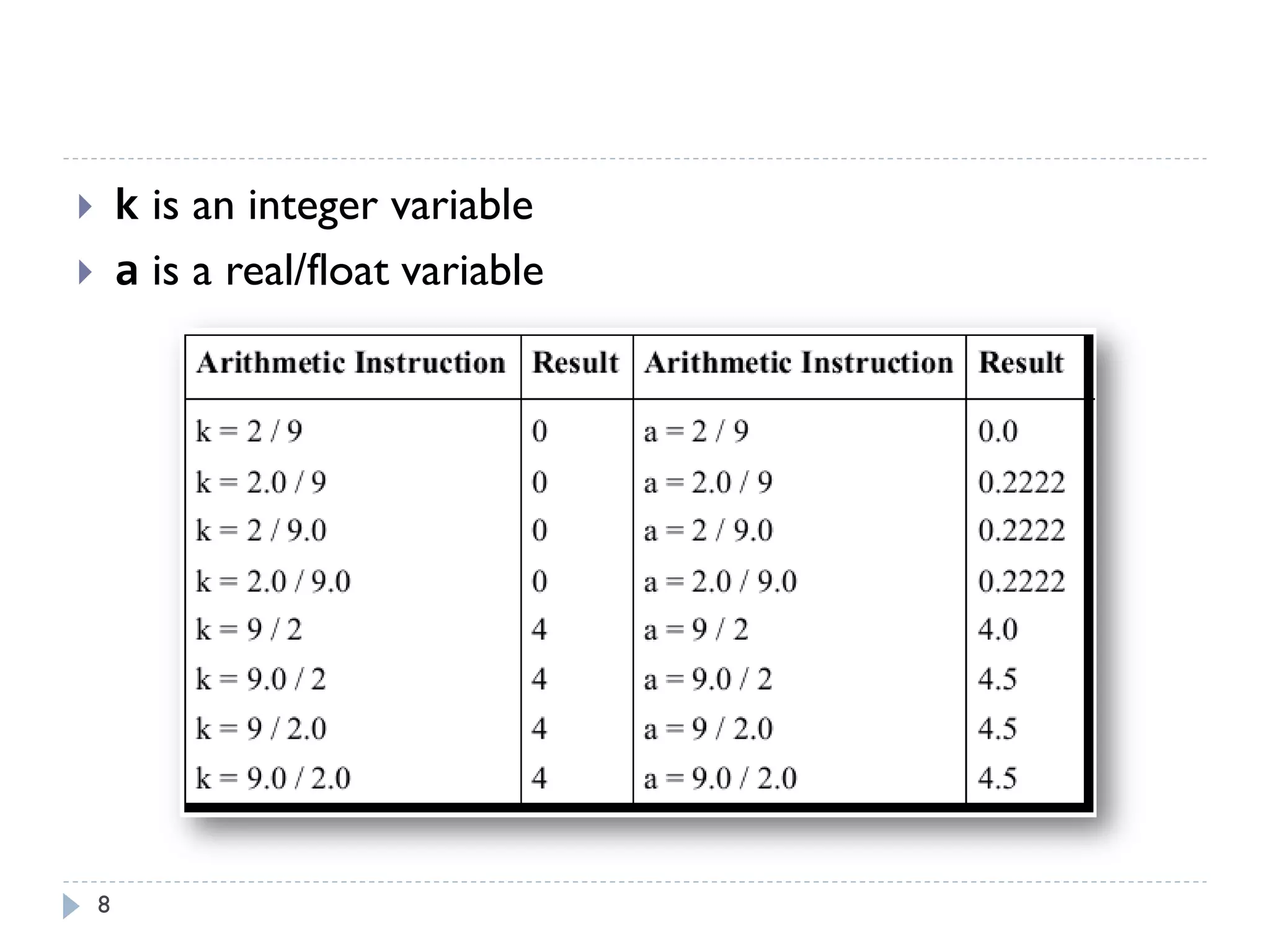
8
 k is an integer variable
 a is a real/float variable
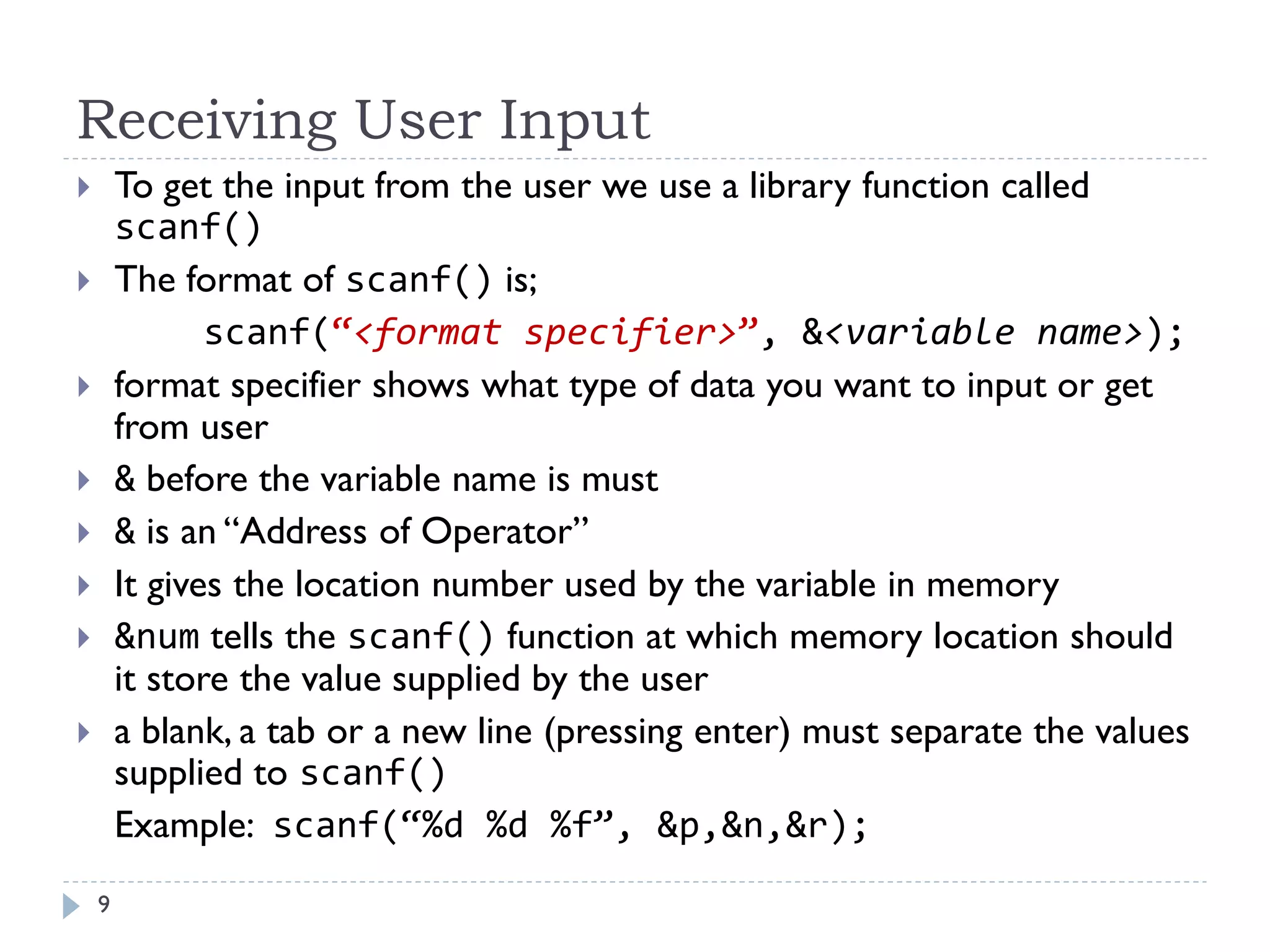
Receiving User Input
 To get the input from the user we use a library function called
scanf()
 The format of scanf() is;
scanf(“<format specifier>”, &<variable name>);
 format specifier shows what type of data you want to input or get
from user
 & before the variable name is must
 & is an “Address of Operator”
 It gives the location number used by the variable in memory
 &num tells the scanf() function at which memory location should
it store the value supplied by the user
 a blank, a tab or a new line (pressing enter) must separate the values
supplied to scanf()
Example: scanf(“%d %d %f”, &p,&n,&r);
9
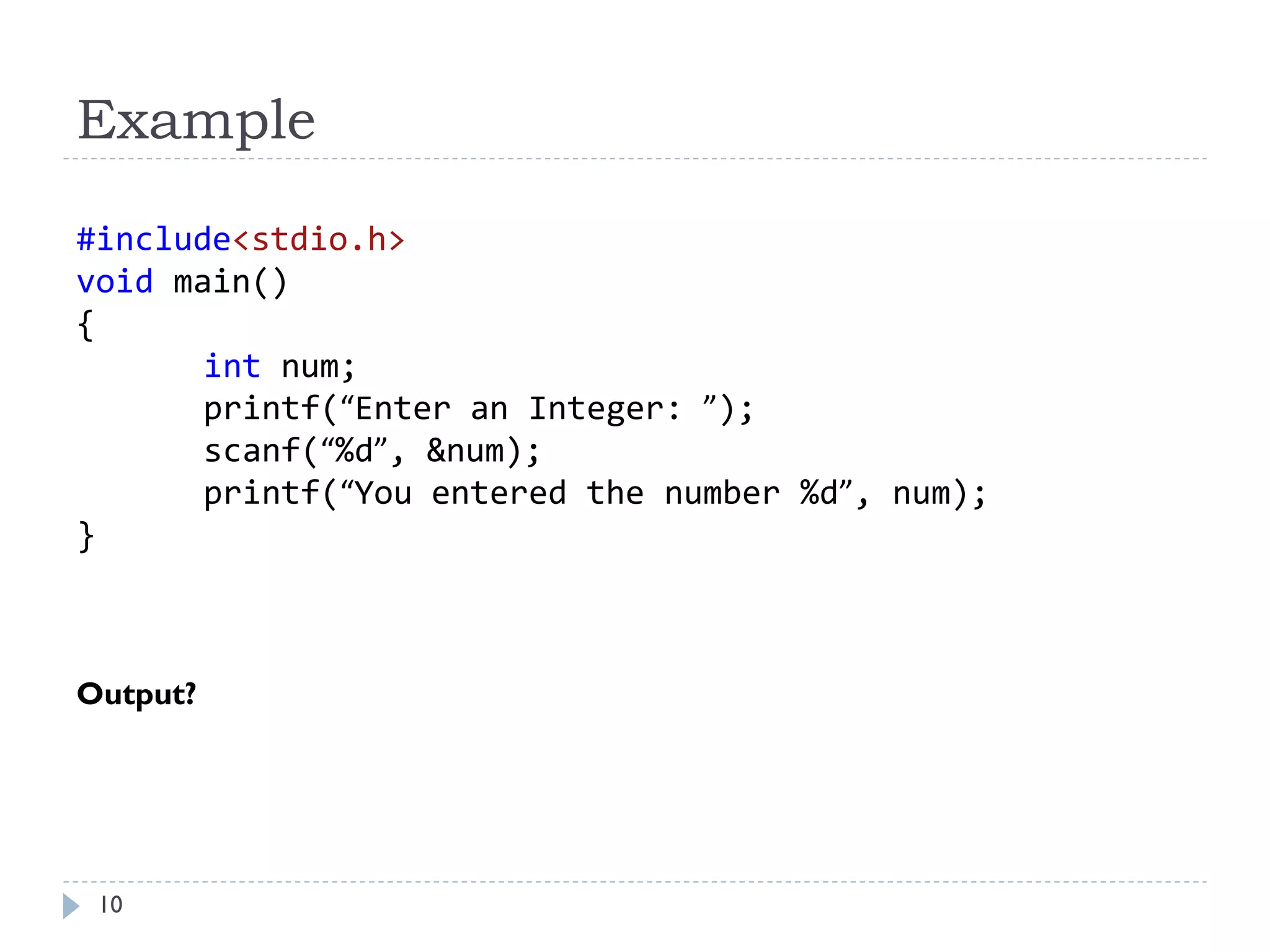
Example
#include<stdio.h>
void main()
{
int num;
printf(“Enter an Integer: ”);
scanf(“%d”, &num);
printf(“You entered the number %d”, num);
}
Output?
10
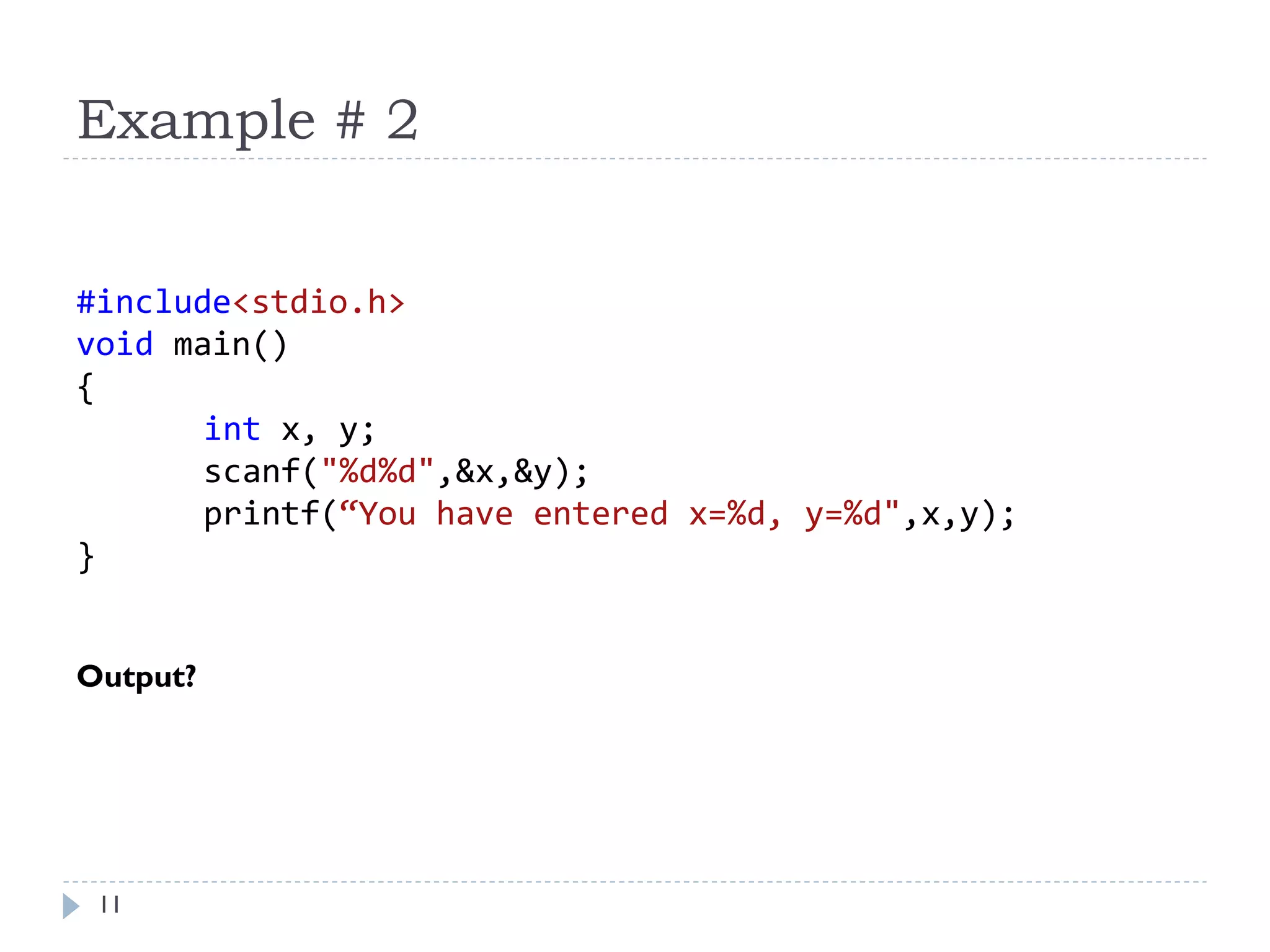
Example # 2
11
#include<stdio.h>
void main()
{
int x, y;
scanf("%d%d",&x,&y);
printf(“You have entered x=%d, y=%d",x,y);
}
Output?
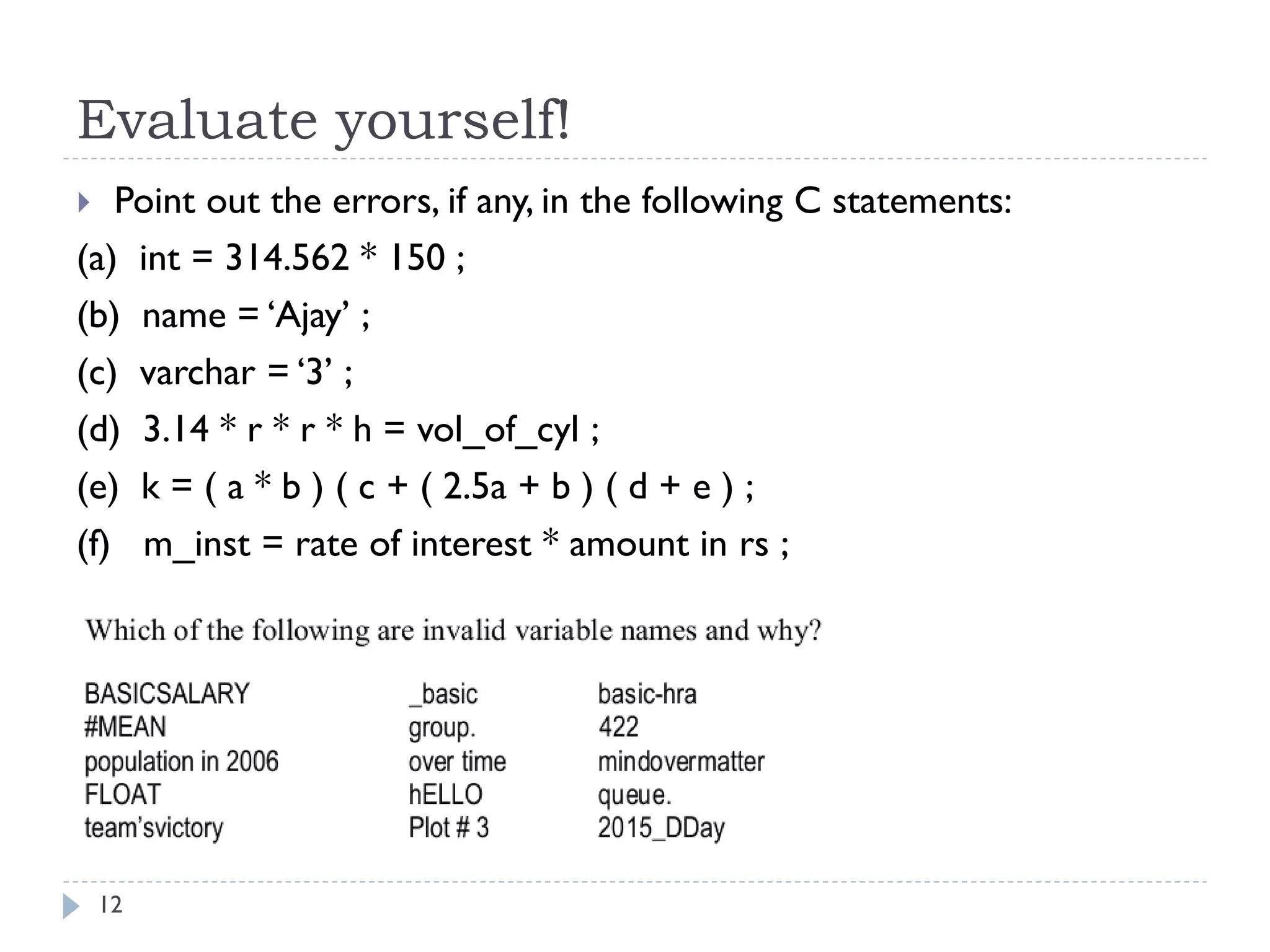
Evaluate yourself!
12
 Point out the errors, if any, in the following C statements:
(a) int = 314.562 * 150 ;
(b) name = ‘Ajay’ ;
(c) varchar = ‘3’ ;
(d) 3.14 * r * r * h = vol_of_cyl ;
(e) k = ( a * b ) ( c + ( 2.5a + b ) ( d + e ) ;
(f) m_inst = rate of interest * amount in rs ;

Introduction to Computer and Programing - Lecture 04

  • 1.
    Introduction to Computersand Programming (CSC103) Lecture 04
  • 2.
    2 void main (void) { printf("Testing...n..1n...2n....3n") } CompilationResult? #include <stdio.h> void main (void) { value1 = 50; value2 = 25; int value1, value2, sum; sum = value1 + value2; printf("The sum of %d and %d is %dn", value1, value2, sum); } Compilation Result? 1 2
  • 3.
    3 #include <stdio.h> void main(void) { printf ("Testing...n..1n...2n....3n"); } Output? #include <stdio.h> void main (void) { int value1, value2, sum; value1 = 50; value2 = 25; sum = value1 + value2; printf("The sum of %d and %d is %dn", value1, value2, sum); } Output? 1 2
  • 4.
    Arithmetic Instructions inC 4 int ad ; float kot, deta, alpha, beta, gamma; ad = 3200 ; kot = 0.0056 ; deta = alpha * beta / gamma + 3.2 * 2 / 5 ; --------------------------------------------------------------------------------- Here, *, /, -, + are the arithmetic operators. = is the assignment operator. 2, 5 and 3200 are integer constants. 3.2 and 0.0056 are real constants. ad is an integer variable. kot, deta, alpha, beta, gamma are real variables.
  • 5.
    Variable Declaration andUse 5 Correct Incorrect float a = 1.5, b = a + 3.1; float b = a + 3.1, a = 1.5; int a, b, c, d ; a = b = c = 10 ; int a = b = c = d = 10; int x, y, z; x = y * z; int x, y, z; y * z = x; Cannot Use aVariable before declaring it!
  • 6.
    Integer and FloatConversion 6  Implicit and Explicit Conversions  An arithmetic operation between an integer and integer always yields an integer result.  An operation between a real and real always yields a real result.  An operation between an integer and real always yields a real result. In this operation the integer is first promoted to a real and then the operation is performed. Hence the result is real.
  • 7.
    7 int i ; floatb ; i = 3.5 ; b = 30 ;  What would be the value of i and b?  Think of Integer and Float Conversion
  • 8.
    8  k isan integer variable  a is a real/float variable
  • 9.
    Receiving User Input To get the input from the user we use a library function called scanf()  The format of scanf() is; scanf(“<format specifier>”, &<variable name>);  format specifier shows what type of data you want to input or get from user  & before the variable name is must  & is an “Address of Operator”  It gives the location number used by the variable in memory  &num tells the scanf() function at which memory location should it store the value supplied by the user  a blank, a tab or a new line (pressing enter) must separate the values supplied to scanf() Example: scanf(“%d %d %f”, &p,&n,&r); 9
  • 10.
    Example #include<stdio.h> void main() { int num; printf(“Enteran Integer: ”); scanf(“%d”, &num); printf(“You entered the number %d”, num); } Output? 10
  • 11.
    Example # 2 11 #include<stdio.h> voidmain() { int x, y; scanf("%d%d",&x,&y); printf(“You have entered x=%d, y=%d",x,y); } Output?
  • 12.
    Evaluate yourself! 12  Pointout the errors, if any, in the following C statements: (a) int = 314.562 * 150 ; (b) name = ‘Ajay’ ; (c) varchar = ‘3’ ; (d) 3.14 * r * r * h = vol_of_cyl ; (e) k = ( a * b ) ( c + ( 2.5a + b ) ( d + e ) ; (f) m_inst = rate of interest * amount in rs ;