Hepatocellular Carcinoma
Lecture 27
HCC
Hepatoma
HCC,,,.2,28,28
Epidemiology
• The fifth most common cancer worldwide and the
third most common cause of cancer mortality.
• Because of its high fatality rates, the
incidence and mortality rates are almost equal..
HCC
About 82% of HCC cases occur in developing
countries with high rates of chronic HBV infection
(& HCV), such as in southeast Asian and
African countries;
52% of all HCC cases occur in
China.
• There is a clear predominance of males with a
ratio of 2.4 : 1.
HCC
Risk factors
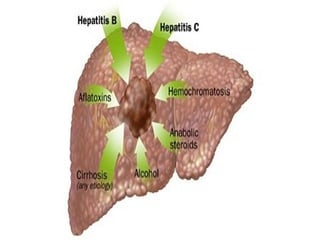
The main risk factors for hepatocellular carcinoma
are;
• Alcoholism
• Hepatitis B
• Hepatitis C (25% of causes globally)
• Aflatoxin (Mycotoxin) B1 produced by Aspergillus
flavus
• Cirrhosis of the liver
• Hemochromatosis
• Wilson's disease
• Type 2 Diabetes (probably aided by obesity)HCC
• Alpha 1 antitrypsin deficiency
• Chemical carcinogens: butter yellow,
nitrosamines
• Prolonged immunosuppressive therapy
• Other types of viral hepatitis
• Tobacco smoking
• Parasitic infestations: clonorchiasis,
schistosomiasis
HCC
HCC
Pathogenesis
• Hepatocellular carcinoma develops when
there is a mutation to the
cellular machinery that causes the cell to
replicate at a higher rate and/or results in
the cell avoiding apoptosis.
HCC
UNCERTAIN
Pathogenesis
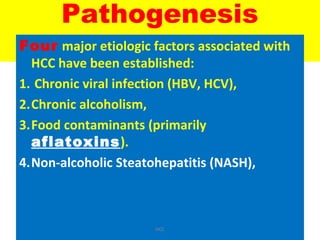
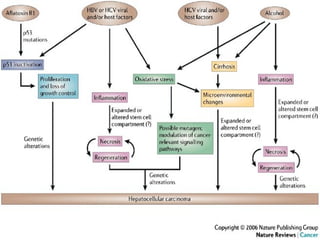
Four major etiologic factors associated with
HCC have been established:
1. Chronic viral infection (HBV, HCV),
2.Chronic alcoholism,
3.Food contaminants (primarily
aflatoxins).
4.Non-alcoholic Steatohepatitis (NASH),
HCC
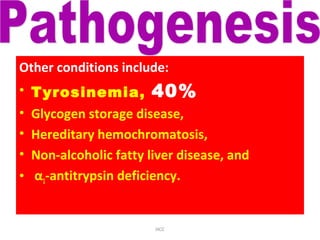
Other conditions include:
• Tyrosinemia, 40%
• Glycogen storage disease,
• Hereditary hemochromatosis,
• Non-alcoholic fatty liver disease, and
• α1-antitrypsin deficiency.
HCC
Many factors interact in the development
of HCC, including:
• Genetic factors,
• Age,
• Gender,
• Chemicals,
• Hormones, and
• Nutrition,
HCC
Cirrhosis seems to be a prerequisite
contributor to the emergence of HCC in
Western countries.
HCC
Pathogenesis
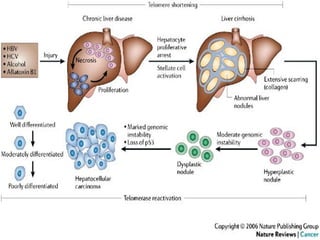
• Repeated cycles of cell death
and regeneration, in chronic
hepatitis damage DNA repair
mechanisms and eventually transform
hepatocytes &
HCC develops.
HCC
Developing countries (endemic areas)
•Aflatoxincan bind covalently with
cellular DNA and cause a specific mutation in
p53.
HCC
HCC
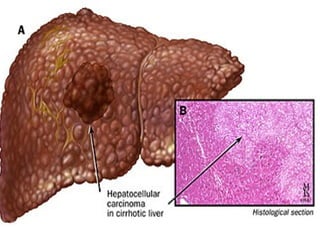
HCC may appear grossly as
(1) unifocal
(2) multifocal,
(3) diffusely
infiltrative/spreading cancer,
HCC
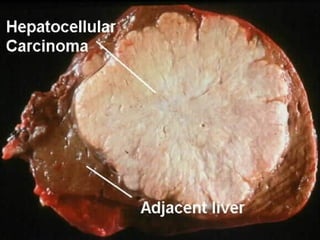
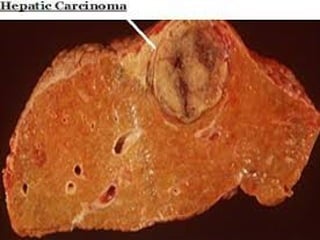
1.Unifocal tumor
AKA Expanding type, most frequently, it forms a
single, yellow-brown, large mass, most often in the
right lobe of the liver with central necrosis,
hemorrhage and occasional bile-staining. It may be
deceptively encapsulated.
HCC
2.Multifocal type
• Less often, multifocal, multiple masses, 3-5 cm in
diameter, scattered throughout the liver are seen.
HCC
3. Infiltrating (Spreading) type
• Rarely, the HCC forms diffusely infiltrating
tumor mass.
HCC
• All three patterns may cause liver
enlargement, particularly the large
unifocal and multinodular patterns.
• The diffusely infiltrative tumor may blend
imperceptibly into a cirrhotic liver
background.
HCC
HCC
HCC
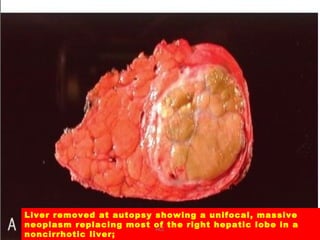
Liver removed at autopsy showing a unifocal, massive
neoplasm replacing most of the right hepatic lobe in a
noncirrhotic liver;
HCC
•Lymph node metastases to
the perihilar, peripancreatic, and para-aortic
nodes above and below the diaphragm are
found in fewer than half of HCCs that spread
beyond the liver.
HCC
• HCC spreads extensively withinthe
liver by obvious contiguous
growth and by the development of
satellite (outpost) nodules, which can be
shown by molecular methods to be
derived from the parent tumor.
HCC
•Metastasis outside the liver
is primarily via vascular invasion, especially
into the hepatic vein system, but
hematogenous metastases, especially to the
lung, tend to occur late in the disease.
HCC
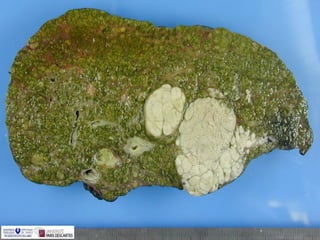
• HCCs are usually PALER than the surrounding
liver, and sometimes take on a GREEN hue when

composed of well-differentiated hepatocytes
capable of secreting BILE.
HCC
HCC
• All patterns of HCCs have a strong propensity for
invasion of vascular structures.
Extensive intrahepatic metastases ensue
(develop), and occasionally, long, snakelike masses
of tumor invade the portal vein (with occlusion of
the portal circulation) or inferior vena cava,
extending even into the right side of the
heart.
HCC
• If HCC with venous invasion is identified in
explanted livers at the time of liver
transplantation, tumor recurrence is likely to occur
in the transplanted donor liver.
HCC
• HCCs range from well-differentiated to highly
anaplastic undifferentiated lesions.
I. In well-differentiated and moderately
differentiated tumors, cells that are
recognizable as hepatocytic in origin are
disposed either in a trabecular
pattern or in an acinar, pseudoglandular
pattern.
HCC
Microscopy
• In the better differentiated variants,
globules of bile may be found
within the cytoplasm of cells and in
pseudocanliculi between cells.
HCC
Microscopy
• Acidophilic hyaline inclusions
within the cytoplasm may be present,
resembling Mallory bodies. There is
surprisingly scant stroma in most HCCs,
explaining the soft consistency of
these tumors.
HCC
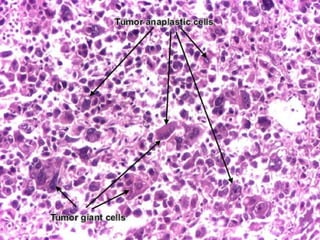
II. In poorly differentiated
forms, tumor cells can take on a
pleomorphic appearance with numerous
anaplastic giant cells, can be small
and completely undifferentiated, or may
even resemble a spindle cell sarcoma.
HCC
Important diagnostic features are:
1.Histologic patterns
2.Cytologic features
HCC
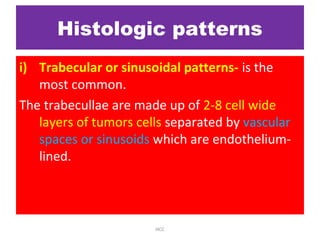
Histologic patterns
i) Trabecular or sinusoidal patterns- is the
most common.
The trabecullae are made up of 2-8 cell wide
layers of tumors cells separated by vascular
spaces or sinusoids which are endothelium-
lined.
HCC
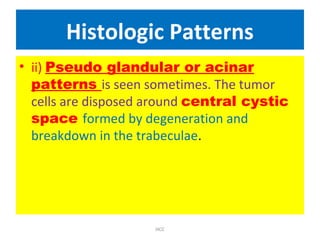
Histologic Patterns
• ii) Pseudo glandular or acinar
patterns is seen sometimes. The tumor
cells are disposed around central cystic
space formed by degeneration and
breakdown in the trabeculae.
HCC
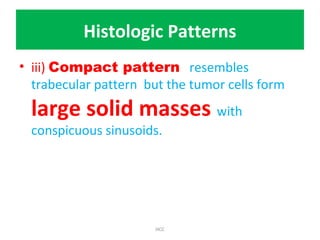
Histologic Patterns
• iii) Compact pattern resembles
trabecular pattern but the tumor cells form
large solid masses with
conspicuous sinusoids.
HCC
• iv) Scirrhous pattern is characterised by
more abundant fibrous stroma.
HCC
2. Cytologic features:
• The typical cytologic features in the HCC
consist of
cells resembling hepatocytes having
vesicular nuclei with prominent
nucleoli.
HCC
• The cytoplasm is granular and
eosinophilic
but becomes increasingly basophilic
with increasing malignancy.
HCC
Aside from these features, a few others
cytologic variants are:
• Pleomorphism,
• Bizarre giant cell formation,
• Spindle-shaped cells,
• Tumor cells with clear cytoplasm,
• Presence of bile within dilated canaliculi, and
• Inracytoplasmic mallory’s hyline.
HCC
HCC
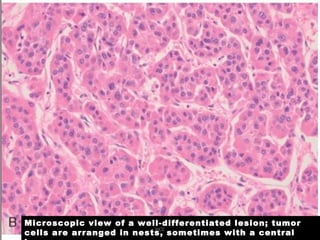
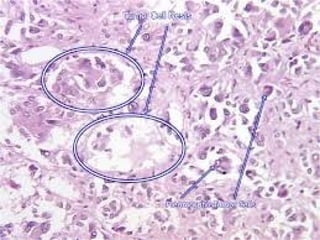
Microscopic view of a well-differentiated lesion; tumor
cells are arranged in nests, sometimes with a central
HCC
HCC
HCC
HCC
Fibrolamellar Carcinoma
• This variant constitutes 5% of HCCs. It
occurs in young male and female adults
(20 to 40 years of age) with equal
incidence.
HCC
• Patients usually do not have underlying
chronic liver diseases, and so the
prognosis is better than the
conventional HCC.
HCC
• The etiology of fibrolamellar carcinoma is
unknown.
• It usually presents as
• single large, hard “scirrhous” tumor with
fibrous bands coursing through it.
HCC
On microscopic examination it is composed of
well-differentiated polygonal cells growing in
nests or cords, and separated by parallel
lamellae of dense collagen bundles. The
tumor cells have abundant eosinophilic
cytoplasm and prominent nucleoli .
HCC
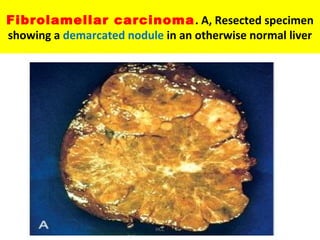
Fibrolamellar carcinoma. A, Resected specimen
showing a demarcated nodule in an otherwise normal liver
HCC
HCC
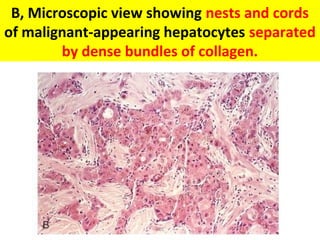
B, Microscopic view showing nests and cords
of malignant-appearing hepatocytes separated
by dense bundles of collagen.
HCC
•Part II,• Lecture 28
HCC
Recap
• The main primary tumor is HCC
• More common (82%) in Asia & Africa.
• The main etiologic agents for HCC are
hepatitis B, C, alcoholic cirrhosis,
hemochromatosis, and more rarely,
tyrosinemia.
HCC
• In the western population about 90% of HCC
develop in cirrhotic livers;
• In Asia almost 50% of cases develop in
noncirrhotic livers.
HCC
• The chronic inflammation and cellular
regeneration associated with viral hepatitis
may be predisposing factors for development
of carcinomas.
HCC
• Hepatocellular carcinomas may be unifocal or
multifocal, tend to invade blood vessels, and
recapitulate normal liver architecture to
varying degrees.
HCC
Clinical Features
• The clinical manifestations of HCC are
seldom characteristic and,
• in the Western population, often are
masked by those related to the
underlying cirrhosis or chronic hepatitis.
HCC
• In areas of high incidence such as tropical
Africa, patients usually have no clinical
history of liver disease, although cirrhosis
may be detected at autopsy.
HCC
• In both populations most patients have
• ill-defined upper abdominal pain,
• malaise,
• fatigue,
• weight loss, and
• sometimes awareness of an abdominal mass
or abdominal fullness.
HCC
• In many cases the enlarged liver
can be felt on palpation, with sufficient
irregularity or nodularity to
permit differentiation from cirrhosis.
HCC
• Jaundice,
• fever, and
• gastrointestinal or esophageal variceal
bleeding
are inconstant findings.
HCC
DiagnosisLab Study
• Elevated levels of serum α-
fetoprotein are found in 50% of
persons with HCC
HCC
• Recently, staining for Glypican-3 has
been used to distinguish early HCC
from dysplastic nodules.
HCC
Imaging studies
• Most valuable for detection of small tumors
are imaging studies:
• Ultrasonography,
• Hepatic angiography,
• Computed tomography, and
• Magnetic resonance imaging.
HCC
Prognosis
Overall, death usually occurs from
(1) cachexia,
(2) gastrointestinal or esophageal variceal
bleeding,
(3) liver failure with hepatic coma, or, rarely,
(4) rupture of the tumor with fatal
hemorrhage.
HCC
• The 5-year survival of
large tumors is dismal,
with the majority of
patients dying within the
first 2 years.
HCC
• With implementation of screening
procedures and advances in imaging, the
detection of HCCs less than 2 cm in diameter
has increased in countries where such
facilities are available. These small tumors
can be removed surgically with good
prognostic outcomes.
HCC
Treatment
• Radiofrequency ablation is used
for local control of large tumors, and
chemoembolization can also be
used, according to a clinical algorithm that
has been widely adopted.
HCC
• Recent findings show that the kinase
inhibitor sorafenib can
prolong the life of individuals with advanced-
stage HCC.
HCC
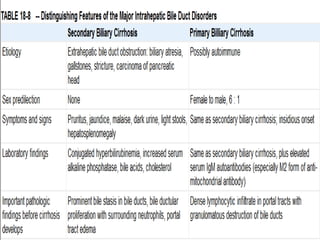
Primary billiary cirrhosis
Secondary billiary cirrhosis
HCC
Primary Billiary Cirrhosis
• PBC is an inflammatory autoimmune disease
mainly affecting the intrahepatic bile ducts.
The primary feature of this disease is a
nonsuppurative, inflammatory destruction of
medium-sized intrahepatic bile ducts. It is
accompanied by portal inflammation,
scarring, and eventual development of
cirrhosis and liver failure
HCC
Secondary billiary cirrhosis
• Secondary biliary cirrhosis is a condition
resulting most often from uncorrected
obstruction of the extrahepatic biliary tree.
HCC
HCC
HCC

L29 hepatocellular carcinoma

  • 1.
  • 2.
    Epidemiology • The fifthmost common cancer worldwide and the third most common cause of cancer mortality. • Because of its high fatality rates, the incidence and mortality rates are almost equal.. HCC
  • 3.
    About 82% ofHCC cases occur in developing countries with high rates of chronic HBV infection (& HCV), such as in southeast Asian and African countries; 52% of all HCC cases occur in China. • There is a clear predominance of males with a ratio of 2.4 : 1. HCC
  • 4.
    Risk factors The mainrisk factors for hepatocellular carcinoma are; • Alcoholism • Hepatitis B • Hepatitis C (25% of causes globally) • Aflatoxin (Mycotoxin) B1 produced by Aspergillus flavus • Cirrhosis of the liver • Hemochromatosis • Wilson's disease • Type 2 Diabetes (probably aided by obesity)HCC
  • 5.
    • Alpha 1antitrypsin deficiency • Chemical carcinogens: butter yellow, nitrosamines • Prolonged immunosuppressive therapy • Other types of viral hepatitis • Tobacco smoking • Parasitic infestations: clonorchiasis, schistosomiasis HCC
  • 6.
  • 7.
    Pathogenesis • Hepatocellular carcinomadevelops when there is a mutation to the cellular machinery that causes the cell to replicate at a higher rate and/or results in the cell avoiding apoptosis. HCC UNCERTAIN
  • 8.
    Pathogenesis Four major etiologicfactors associated with HCC have been established: 1. Chronic viral infection (HBV, HCV), 2.Chronic alcoholism, 3.Food contaminants (primarily aflatoxins). 4.Non-alcoholic Steatohepatitis (NASH), HCC
  • 9.
    Other conditions include: •Tyrosinemia, 40% • Glycogen storage disease, • Hereditary hemochromatosis, • Non-alcoholic fatty liver disease, and • α1-antitrypsin deficiency. HCC
  • 10.
    Many factors interactin the development of HCC, including: • Genetic factors, • Age, • Gender, • Chemicals, • Hormones, and • Nutrition, HCC
  • 11.
    Cirrhosis seems tobe a prerequisite contributor to the emergence of HCC in Western countries. HCC
  • 12.
    Pathogenesis • Repeated cyclesof cell death and regeneration, in chronic hepatitis damage DNA repair mechanisms and eventually transform hepatocytes & HCC develops. HCC Developing countries (endemic areas)
  • 13.
    •Aflatoxincan bind covalentlywith cellular DNA and cause a specific mutation in p53. HCC
  • 14.
  • 15.
    HCC may appeargrossly as (1) unifocal (2) multifocal, (3) diffusely infiltrative/spreading cancer, HCC
  • 16.
    1.Unifocal tumor AKA Expandingtype, most frequently, it forms a single, yellow-brown, large mass, most often in the right lobe of the liver with central necrosis, hemorrhage and occasional bile-staining. It may be deceptively encapsulated. HCC
  • 17.
    2.Multifocal type • Lessoften, multifocal, multiple masses, 3-5 cm in diameter, scattered throughout the liver are seen. HCC
  • 18.
    3. Infiltrating (Spreading)type • Rarely, the HCC forms diffusely infiltrating tumor mass. HCC
  • 19.
    • All threepatterns may cause liver enlargement, particularly the large unifocal and multinodular patterns. • The diffusely infiltrative tumor may blend imperceptibly into a cirrhotic liver background. HCC
  • 20.
  • 21.
  • 22.
    Liver removed atautopsy showing a unifocal, massive neoplasm replacing most of the right hepatic lobe in a noncirrhotic liver; HCC
  • 23.
    •Lymph node metastasesto the perihilar, peripancreatic, and para-aortic nodes above and below the diaphragm are found in fewer than half of HCCs that spread beyond the liver. HCC
  • 24.
    • HCC spreadsextensively withinthe liver by obvious contiguous growth and by the development of satellite (outpost) nodules, which can be shown by molecular methods to be derived from the parent tumor. HCC
  • 25.
    •Metastasis outside theliver is primarily via vascular invasion, especially into the hepatic vein system, but hematogenous metastases, especially to the lung, tend to occur late in the disease. HCC
  • 26.
    • HCCs areusually PALER than the surrounding liver, and sometimes take on a GREEN hue when composed of well-differentiated hepatocytes capable of secreting BILE. HCC
  • 27.
  • 28.
    • All patternsof HCCs have a strong propensity for invasion of vascular structures. Extensive intrahepatic metastases ensue (develop), and occasionally, long, snakelike masses of tumor invade the portal vein (with occlusion of the portal circulation) or inferior vena cava, extending even into the right side of the heart. HCC
  • 29.
    • If HCCwith venous invasion is identified in explanted livers at the time of liver transplantation, tumor recurrence is likely to occur in the transplanted donor liver. HCC
  • 30.
    • HCCs rangefrom well-differentiated to highly anaplastic undifferentiated lesions. I. In well-differentiated and moderately differentiated tumors, cells that are recognizable as hepatocytic in origin are disposed either in a trabecular pattern or in an acinar, pseudoglandular pattern. HCC
  • 31.
    Microscopy • In thebetter differentiated variants, globules of bile may be found within the cytoplasm of cells and in pseudocanliculi between cells. HCC
  • 32.
    Microscopy • Acidophilic hyalineinclusions within the cytoplasm may be present, resembling Mallory bodies. There is surprisingly scant stroma in most HCCs, explaining the soft consistency of these tumors. HCC
  • 33.
    II. In poorlydifferentiated forms, tumor cells can take on a pleomorphic appearance with numerous anaplastic giant cells, can be small and completely undifferentiated, or may even resemble a spindle cell sarcoma. HCC
  • 34.
    Important diagnostic featuresare: 1.Histologic patterns 2.Cytologic features HCC
  • 35.
    Histologic patterns i) Trabecularor sinusoidal patterns- is the most common. The trabecullae are made up of 2-8 cell wide layers of tumors cells separated by vascular spaces or sinusoids which are endothelium- lined. HCC
  • 36.
    Histologic Patterns • ii)Pseudo glandular or acinar patterns is seen sometimes. The tumor cells are disposed around central cystic space formed by degeneration and breakdown in the trabeculae. HCC
  • 37.
    Histologic Patterns • iii)Compact pattern resembles trabecular pattern but the tumor cells form large solid masses with conspicuous sinusoids. HCC
  • 38.
    • iv) Scirrhouspattern is characterised by more abundant fibrous stroma. HCC
  • 39.
    2. Cytologic features: •The typical cytologic features in the HCC consist of cells resembling hepatocytes having vesicular nuclei with prominent nucleoli. HCC
  • 40.
    • The cytoplasmis granular and eosinophilic but becomes increasingly basophilic with increasing malignancy. HCC
  • 41.
    Aside from thesefeatures, a few others cytologic variants are: • Pleomorphism, • Bizarre giant cell formation, • Spindle-shaped cells, • Tumor cells with clear cytoplasm, • Presence of bile within dilated canaliculi, and • Inracytoplasmic mallory’s hyline. HCC
  • 42.
  • 43.
    Microscopic view ofa well-differentiated lesion; tumor cells are arranged in nests, sometimes with a central HCC
  • 44.
  • 45.
  • 46.
  • 47.
    Fibrolamellar Carcinoma • Thisvariant constitutes 5% of HCCs. It occurs in young male and female adults (20 to 40 years of age) with equal incidence. HCC
  • 48.
    • Patients usuallydo not have underlying chronic liver diseases, and so the prognosis is better than the conventional HCC. HCC
  • 49.
    • The etiologyof fibrolamellar carcinoma is unknown. • It usually presents as • single large, hard “scirrhous” tumor with fibrous bands coursing through it. HCC
  • 50.
    On microscopic examinationit is composed of well-differentiated polygonal cells growing in nests or cords, and separated by parallel lamellae of dense collagen bundles. The tumor cells have abundant eosinophilic cytoplasm and prominent nucleoli . HCC
  • 51.
    Fibrolamellar carcinoma. A,Resected specimen showing a demarcated nodule in an otherwise normal liver HCC
  • 52.
  • 53.
    B, Microscopic viewshowing nests and cords of malignant-appearing hepatocytes separated by dense bundles of collagen. HCC
  • 54.
  • 55.
    Recap • The mainprimary tumor is HCC • More common (82%) in Asia & Africa. • The main etiologic agents for HCC are hepatitis B, C, alcoholic cirrhosis, hemochromatosis, and more rarely, tyrosinemia. HCC
  • 56.
    • In thewestern population about 90% of HCC develop in cirrhotic livers; • In Asia almost 50% of cases develop in noncirrhotic livers. HCC
  • 57.
    • The chronicinflammation and cellular regeneration associated with viral hepatitis may be predisposing factors for development of carcinomas. HCC
  • 58.
    • Hepatocellular carcinomasmay be unifocal or multifocal, tend to invade blood vessels, and recapitulate normal liver architecture to varying degrees. HCC
  • 59.
    Clinical Features • Theclinical manifestations of HCC are seldom characteristic and, • in the Western population, often are masked by those related to the underlying cirrhosis or chronic hepatitis. HCC
  • 60.
    • In areasof high incidence such as tropical Africa, patients usually have no clinical history of liver disease, although cirrhosis may be detected at autopsy. HCC
  • 61.
    • In bothpopulations most patients have • ill-defined upper abdominal pain, • malaise, • fatigue, • weight loss, and • sometimes awareness of an abdominal mass or abdominal fullness. HCC
  • 62.
    • In manycases the enlarged liver can be felt on palpation, with sufficient irregularity or nodularity to permit differentiation from cirrhosis. HCC
  • 63.
    • Jaundice, • fever,and • gastrointestinal or esophageal variceal bleeding are inconstant findings. HCC
  • 64.
    DiagnosisLab Study • Elevatedlevels of serum α- fetoprotein are found in 50% of persons with HCC HCC
  • 65.
    • Recently, stainingfor Glypican-3 has been used to distinguish early HCC from dysplastic nodules. HCC
  • 66.
    Imaging studies • Mostvaluable for detection of small tumors are imaging studies: • Ultrasonography, • Hepatic angiography, • Computed tomography, and • Magnetic resonance imaging. HCC
  • 67.
    Prognosis Overall, death usuallyoccurs from (1) cachexia, (2) gastrointestinal or esophageal variceal bleeding, (3) liver failure with hepatic coma, or, rarely, (4) rupture of the tumor with fatal hemorrhage. HCC
  • 68.
    • The 5-yearsurvival of large tumors is dismal, with the majority of patients dying within the first 2 years. HCC
  • 69.
    • With implementationof screening procedures and advances in imaging, the detection of HCCs less than 2 cm in diameter has increased in countries where such facilities are available. These small tumors can be removed surgically with good prognostic outcomes. HCC
  • 70.
    Treatment • Radiofrequency ablationis used for local control of large tumors, and chemoembolization can also be used, according to a clinical algorithm that has been widely adopted. HCC
  • 71.
    • Recent findingsshow that the kinase inhibitor sorafenib can prolong the life of individuals with advanced- stage HCC. HCC
  • 72.
  • 73.
    Primary Billiary Cirrhosis •PBC is an inflammatory autoimmune disease mainly affecting the intrahepatic bile ducts. The primary feature of this disease is a nonsuppurative, inflammatory destruction of medium-sized intrahepatic bile ducts. It is accompanied by portal inflammation, scarring, and eventual development of cirrhosis and liver failure HCC
  • 74.
    Secondary billiary cirrhosis •Secondary biliary cirrhosis is a condition resulting most often from uncorrected obstruction of the extrahepatic biliary tree. HCC
  • 75.
  • 76.