HEPATOCELLULAR
CARCINOMA
Presented by
Suman Raj Baral
Introduction
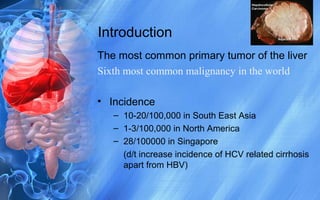
The most common primary tumor of the liver
Sixth most common malignancy in the world
• Incidence
– 10-20/100,000 in South East Asia
– 1-3/100,000 in North America
– 28/100000 in Singapore
(d/t increase incidence of HCV related cirrhosis
apart from HBV)
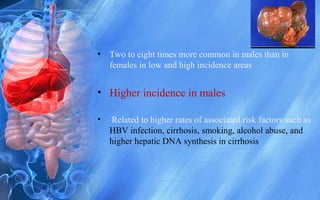
• Two to eight times more common in males than in
females in low and high incidence areas
• Higher incidence in males
• Related to higher rates of associated risk factors such as
HBV infection, cirrhosis, smoking, alcohol abuse, and
higher hepatic DNA synthesis in cirrhosis
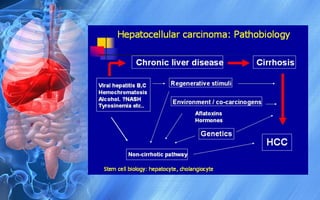
Pathogenesis
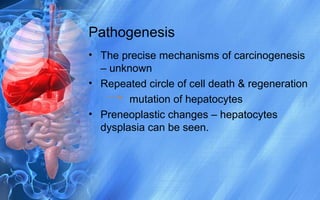
• The precise mechanisms of carcinogenesis
– unknown
• Repeated circle of cell death & regeneration
mutation of hepatocytes
• Preneoplastic changes – hepatocytes
dysplasia can be seen.
• Associations between hepatic viral infections,
environmental exposures, alcohol use, smoking, genetic
metabolic diseases, cirrhosis, OCPs, and the
development of HCC recognized.
• 75% to 80% of HCC related to HBV (50%-55%) or
HCV (25%-30%) infection.
• The development of HCC is a complex and
multistep process that involves any number of these
risk factors.
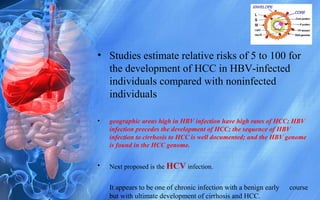
• Studies estimate relative risks of 5 to 100 for
the development of HCC in HBV-infected
individuals compared with noninfected
individuals
• geographic areas high in HBV infection have high rates of HCC; HBV
infection precedes the development of HCC; the sequence of HBV
infection to cirrhosis to HCC is well documented; and the HBV genome
is found in the HCC genome.
• Next proposed is the HCV infection.
It appears to be one of chronic infection with a benign early course
but with ultimate development of cirrhosis and HCC.
• Proposed mechanism is related to cirrhosis and chronic
hepatic inflammation, which is present in 60% to 90%
of patients with HBV infection and HCC.
• Cirrhosis, however, is not a prerequisite for the
development of HBV-related HCC.
• Note that the risk for HCC is not simply related to HBV
exposure but requires chronic infection.
Noted…!!!!
• HBV and HCV infection are both
independent risk factors for the
development of HCC
However,
Act synergistically when an individual is
infected with both viruses.
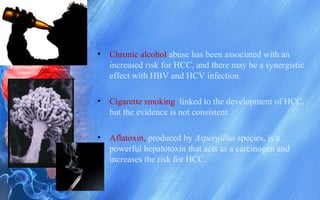
• Chronic alcohol abuse has been associated with an
increased risk for HCC, and there may be a synergistic
effect with HBV and HCV infection.
• Cigarette smoking linked to the development of HCC,
but the evidence is not consistent
• Aflatoxin, produced by Aspergillus species, is a
powerful hepatotoxin that acts as a carcinogen and
increases the risk for HCC.
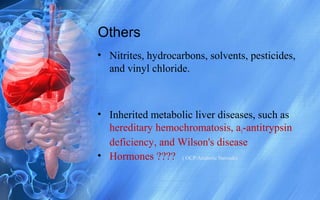
Others
• Nitrites, hydrocarbons, solvents, pesticides,
and vinyl chloride.
• Inherited metabolic liver diseases, such as
hereditary hemochromatosis, a1-antitrypsin
deficiency, and Wilson's disease
• Hormones ???? ( OCP/Anabolic Steroids)
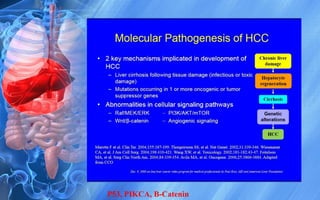
P53, PIKCA, B-Catenin
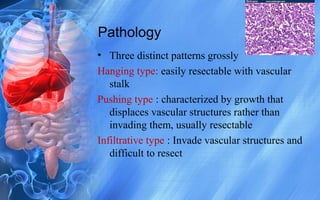
Pathology
• Three distinct patterns grossly
Hanging type: easily resectable with vascular
stalk
Pushing type : characterized by growth that
displaces vascular structures rather than
invading them, usually resectable
Infiltrative type : Invade vascular structures and
difficult to resect
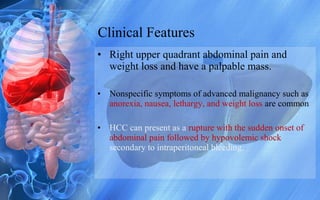
• Right upper quadrant abdominal pain and
weight loss and have a palpable mass.
• Nonspecific symptoms of advanced malignancy such as
anorexia, nausea, lethargy, and weight loss are common
• HCC can present as a rupture with the sudden onset of
abdominal pain followed by hypovolemic shock
secondary to intraperitoneal bleeding.
Clinical Features
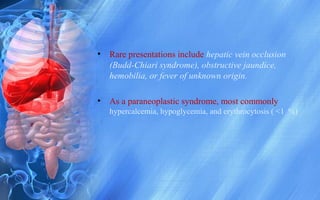
• Rare presentations include hepatic vein occlusion
(Budd-Chiari syndrome), obstructive jaundice,
hemobilia, or fever of unknown origin.
• As a paraneoplastic syndrome, most commonly
hypercalcemia, hypoglycemia, and erythrocytosis ( <1 %)
Laboratory
• Laboratory studies should include a
Complete blood count, electrolytes, liver
function tests, coagulation studies ( INR, PTT),
and alpha-fetoprotein determination.
Determining disease severity
• Anemia: Low hemoglobin may be related to bleeding
from varices or other sources.
• Thrombocytopenia: A platelet count below 100,000/mL
is highly suggestive of significant portal
hypertension/splenomegaly.
• Hyponatremia is commonly found in patients with
cirrhosis and ascites and may be a marker of advanced
liver disease.
• Increased serum creatinine level may reflect intrinsic
renal disease or hepatorenal syndrome.
• Prolonged PT/INR reflects significant impairment of
hepatic function that may preclude resection.
• Elevated liver enzymes (AST/ALT) reflect active
hepatitis due to viral infection, current alcohol use, or
other causes.
• Increased Bilirubin level usually indicates advanced
liver disease.
• Hypoglycemia may represent end-stage liver disease (no
glycogen stores).
Determining Etiology
• HBsAg/anti-HBc, anti-HCV - Viral hepatitis
(current/past)
• Increased iron saturation (>50%) - Underlying
hemochromatosis
• Low alpha-1-antitrypsin levels - Alpha-1-
antitrypsine deficiency
• Increased alpha fetoprotein - Levels greater
than 400 ng/mL considered diagnostic with
appropriate imaging studies
• Hypercalcemia - Ectopic parathyroid hormone
production possible in 5-10% of patients with
hepatocellular carcinoma
• Thrombocytosis (normal/rapid increase in
platelet count in patients with a history of
thrombocytopenia)
Diagnosis
Ultrasound Abdomen
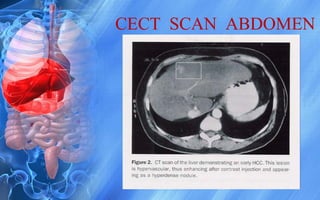
CECT SCAN ABDOMEN
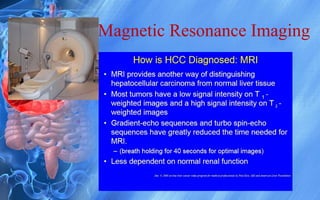
Magnetic Resonance Imaging
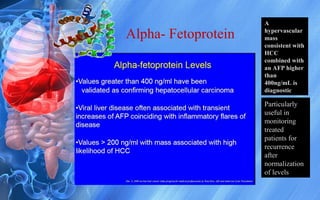
Alpha- Fetoprotein
A
hypervascular
mass
consistent with
HCC
combined with
an AFP higher
than
400ng/mL is
diagnostic
Particularly
useful in
monitoring
treated
patients for
recurrence
after
normalization
of levels
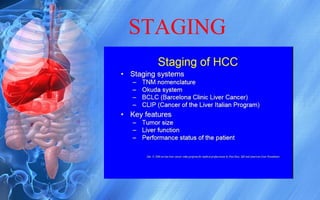
STAGING
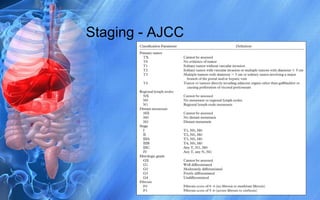
Staging - AJCC
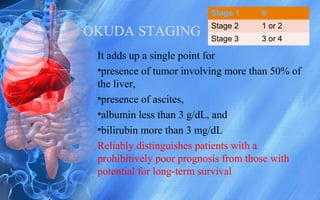
OKUDA STAGING
It adds up a single point for
•presence of tumor involving more than 50% of
the liver,
•presence of ascites,
•albumin less than 3 g/dL, and
•bilirubin more than 3 mg/dL
Reliably distinguishes patients with a
prohibitively poor prognosis from those with
potential for long-term survival
Stage 1 0
Stage 2 1 or 2
Stage 3 3 or 4
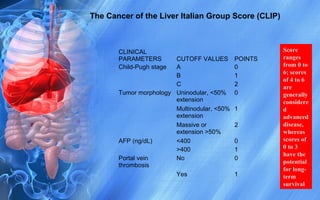
CLINICAL
PARAMETERS CUTOFF VALUES POINTS
Child-Pugh stage A 0
B 1
C 2
Tumor morphology Uninodular, <50%
extension
0
Multinodular, <50%
extension
1
Massive or
extension >50%
2
AFP (ng/dL) <400 0
>400 1
Portal vein
thrombosis
No 0
Yes 1
The Cancer of the Liver Italian Group Score (CLIP)
Score
ranges
from 0 to
6; scores
of 4 to 6
are
generally
considere
d
advanced
disease,
whereas
scores of
0 to 3
have the
potential
for long-
term
survival
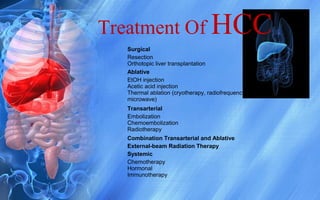
Treatment Of HCC
Surgical
Resection
Orthotopic liver transplantation
Ablative
EtOH injection
Acetic acid injection
Thermal ablation (cryotherapy, radiofrequency ablation,
microwave)
Transarterial
Embolization
Chemoembolization
Radiotherapy
Combination Transarterial and Ablative
External-beam Radiation Therapy
Systemic
Chemotherapy
Hormonal
Immunotherapy
Surgical Modality ( Resection VS
Transplantation)
• Depends upon Child Pugh score (A)
• Only 10% to 20% of patients are considered to
have resectable disease
• The overall postresection survival rates for
HCC are 58% to 100% at 1 year, 28% to 88%
at 3 years, 11% to 75% at 5 years, and 19% to
26% at 10 years.
• commonly cited negative prognostic factors are tumor
size, cirrhosis, infiltrative growth pattern, vascular invasion,
intrahepatic metastases, multifocal tumors, lymph node
metastases, margin less than 1 cm, and lack of a capsule.
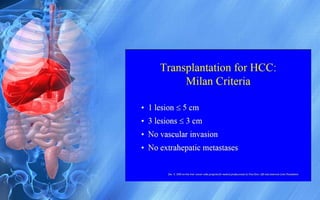
• Ideal treatment is LIVER
TRANSPLANTATION
• Patients with advanced cirrhosis (Child's B and
C) and early-stage HCC are considered for
transplantation.
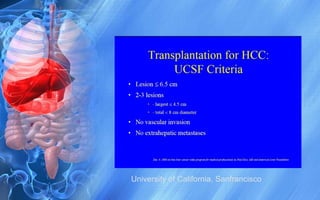
University of California, Sanfrancisco
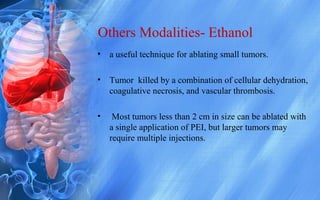
Others Modalities- Ethanol
• a useful technique for ablating small tumors.
• Tumor killed by a combination of cellular dehydration,
coagulative necrosis, and vascular thrombosis.
• Most tumors less than 2 cm in size can be ablated with
a single application of PEI, but larger tumors may
require multiple injections.
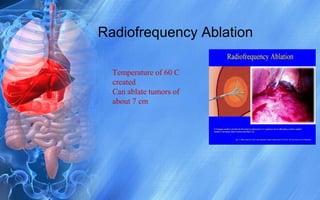
Radiofrequency Ablation
Temperature of 60 C
created
Can ablate tumors of
about 7 cm
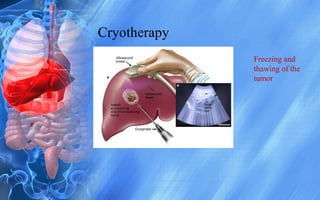
Cryotherapy
Freezing and
thawing of the
tumor
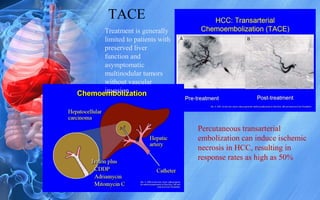
TACE
Percutaneous transarterial
embolization can induce ischemic
necrosis in HCC, resulting in
response rates as high as 50%
Treatment is generally
limited to patients with
preserved liver
function and
asymptomatic
multinodular tumors
without vascular
invasion
New approach :
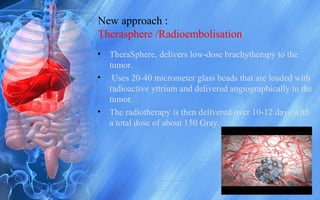
Therasphere /Radioembolisation
• TheraSphere, delivers low-dose brachytherapy to the
tumor.
• Uses 20-40 micrometer glass beads that are loaded with
radioactive yttrium and delivered angiographically in the
tumor.
• The radiotherapy is then delivered over 10-12 days with
a total dose of about 150 Gray.
Systemic Chemotherapy
• Systemic chemotherapy with a variety of
agents has been ineffective for the treatment of
HCC and has a minimal role in the treatment of
HCC. Response rates are generally less than
20% and of short duration.
• doxorubicin-based regimens appear to have the greatest efficacy with
response rates of 20-30% and a minimal impact on survival.
• Immunotherapy and hormonal therapy results
not promising. (tamoxifen, antiandrogens (eg, cyproterone, ketoconazole),
interferon, interleukin 2 (IL-2), and octreotide.)
SORAFENIB
• Sorafenib is a small molecular inhibitor of several tyrosine
protein kinases (VEGFR and PDGFR) (tyrosine kinase
inhibitor or TKI) and Raf kinases (more avidly C-Raf than B-
Raf).
• Sorafenib also inhibits some intracellular serine/threonine
kinases (e.g. C-Raf, wild-type B-Raf and mutant B-Raf).
• Improvement in median survival and time of progression.
• However, various studies under trial
Follow UP
• Follow-ups should be scheduled
– Once monthly up to 6 months,
– then once every 3 months up to 1 year,
– than twice a year up to 2 years and
– once a year every year thereafter
The follow-up is aimed
- at drug dosage adjustment,
- early diagnosis of eventual immunosupression-
related infection,
- early detection of rejection or transplant
dysfunction, and
- later also at detection of immunosupression-related
neoplasia
T
H
A
N
K
Y
O
U

Hepatocellular Carcinoma- At a Glance

  • 1.
  • 4.
    Introduction The most commonprimary tumor of the liver Sixth most common malignancy in the world • Incidence – 10-20/100,000 in South East Asia – 1-3/100,000 in North America – 28/100000 in Singapore (d/t increase incidence of HCV related cirrhosis apart from HBV)
  • 5.
    • Two toeight times more common in males than in females in low and high incidence areas • Higher incidence in males • Related to higher rates of associated risk factors such as HBV infection, cirrhosis, smoking, alcohol abuse, and higher hepatic DNA synthesis in cirrhosis
  • 6.
    Pathogenesis • The precisemechanisms of carcinogenesis – unknown • Repeated circle of cell death & regeneration mutation of hepatocytes • Preneoplastic changes – hepatocytes dysplasia can be seen.
  • 7.
    • Associations betweenhepatic viral infections, environmental exposures, alcohol use, smoking, genetic metabolic diseases, cirrhosis, OCPs, and the development of HCC recognized. • 75% to 80% of HCC related to HBV (50%-55%) or HCV (25%-30%) infection. • The development of HCC is a complex and multistep process that involves any number of these risk factors.
  • 8.
    • Studies estimaterelative risks of 5 to 100 for the development of HCC in HBV-infected individuals compared with noninfected individuals • geographic areas high in HBV infection have high rates of HCC; HBV infection precedes the development of HCC; the sequence of HBV infection to cirrhosis to HCC is well documented; and the HBV genome is found in the HCC genome. • Next proposed is the HCV infection. It appears to be one of chronic infection with a benign early course but with ultimate development of cirrhosis and HCC.
  • 9.
    • Proposed mechanismis related to cirrhosis and chronic hepatic inflammation, which is present in 60% to 90% of patients with HBV infection and HCC. • Cirrhosis, however, is not a prerequisite for the development of HBV-related HCC. • Note that the risk for HCC is not simply related to HBV exposure but requires chronic infection.
  • 10.
    Noted…!!!! • HBV andHCV infection are both independent risk factors for the development of HCC However, Act synergistically when an individual is infected with both viruses.
  • 11.
    • Chronic alcoholabuse has been associated with an increased risk for HCC, and there may be a synergistic effect with HBV and HCV infection. • Cigarette smoking linked to the development of HCC, but the evidence is not consistent • Aflatoxin, produced by Aspergillus species, is a powerful hepatotoxin that acts as a carcinogen and increases the risk for HCC.
  • 12.
    Others • Nitrites, hydrocarbons,solvents, pesticides, and vinyl chloride. • Inherited metabolic liver diseases, such as hereditary hemochromatosis, a1-antitrypsin deficiency, and Wilson's disease • Hormones ???? ( OCP/Anabolic Steroids)
  • 13.
  • 15.
    Pathology • Three distinctpatterns grossly Hanging type: easily resectable with vascular stalk Pushing type : characterized by growth that displaces vascular structures rather than invading them, usually resectable Infiltrative type : Invade vascular structures and difficult to resect
  • 16.
    • Right upperquadrant abdominal pain and weight loss and have a palpable mass. • Nonspecific symptoms of advanced malignancy such as anorexia, nausea, lethargy, and weight loss are common • HCC can present as a rupture with the sudden onset of abdominal pain followed by hypovolemic shock secondary to intraperitoneal bleeding. Clinical Features
  • 17.
    • Rare presentationsinclude hepatic vein occlusion (Budd-Chiari syndrome), obstructive jaundice, hemobilia, or fever of unknown origin. • As a paraneoplastic syndrome, most commonly hypercalcemia, hypoglycemia, and erythrocytosis ( <1 %)
  • 18.
    Laboratory • Laboratory studiesshould include a Complete blood count, electrolytes, liver function tests, coagulation studies ( INR, PTT), and alpha-fetoprotein determination.
  • 19.
    Determining disease severity •Anemia: Low hemoglobin may be related to bleeding from varices or other sources. • Thrombocytopenia: A platelet count below 100,000/mL is highly suggestive of significant portal hypertension/splenomegaly. • Hyponatremia is commonly found in patients with cirrhosis and ascites and may be a marker of advanced liver disease. • Increased serum creatinine level may reflect intrinsic renal disease or hepatorenal syndrome.
  • 20.
    • Prolonged PT/INRreflects significant impairment of hepatic function that may preclude resection. • Elevated liver enzymes (AST/ALT) reflect active hepatitis due to viral infection, current alcohol use, or other causes. • Increased Bilirubin level usually indicates advanced liver disease. • Hypoglycemia may represent end-stage liver disease (no glycogen stores).
  • 21.
    Determining Etiology • HBsAg/anti-HBc,anti-HCV - Viral hepatitis (current/past) • Increased iron saturation (>50%) - Underlying hemochromatosis • Low alpha-1-antitrypsin levels - Alpha-1- antitrypsine deficiency
  • 22.
    • Increased alphafetoprotein - Levels greater than 400 ng/mL considered diagnostic with appropriate imaging studies • Hypercalcemia - Ectopic parathyroid hormone production possible in 5-10% of patients with hepatocellular carcinoma • Thrombocytosis (normal/rapid increase in platelet count in patients with a history of thrombocytopenia)
  • 23.
  • 25.
  • 26.
  • 27.
    Alpha- Fetoprotein A hypervascular mass consistent with HCC combinedwith an AFP higher than 400ng/mL is diagnostic Particularly useful in monitoring treated patients for recurrence after normalization of levels
  • 28.
  • 29.
  • 30.
    OKUDA STAGING It addsup a single point for •presence of tumor involving more than 50% of the liver, •presence of ascites, •albumin less than 3 g/dL, and •bilirubin more than 3 mg/dL Reliably distinguishes patients with a prohibitively poor prognosis from those with potential for long-term survival Stage 1 0 Stage 2 1 or 2 Stage 3 3 or 4
  • 31.
    CLINICAL PARAMETERS CUTOFF VALUESPOINTS Child-Pugh stage A 0 B 1 C 2 Tumor morphology Uninodular, <50% extension 0 Multinodular, <50% extension 1 Massive or extension >50% 2 AFP (ng/dL) <400 0 >400 1 Portal vein thrombosis No 0 Yes 1 The Cancer of the Liver Italian Group Score (CLIP) Score ranges from 0 to 6; scores of 4 to 6 are generally considere d advanced disease, whereas scores of 0 to 3 have the potential for long- term survival
  • 32.
    Treatment Of HCC Surgical Resection Orthotopicliver transplantation Ablative EtOH injection Acetic acid injection Thermal ablation (cryotherapy, radiofrequency ablation, microwave) Transarterial Embolization Chemoembolization Radiotherapy Combination Transarterial and Ablative External-beam Radiation Therapy Systemic Chemotherapy Hormonal Immunotherapy
  • 33.
    Surgical Modality (Resection VS Transplantation) • Depends upon Child Pugh score (A) • Only 10% to 20% of patients are considered to have resectable disease • The overall postresection survival rates for HCC are 58% to 100% at 1 year, 28% to 88% at 3 years, 11% to 75% at 5 years, and 19% to 26% at 10 years. • commonly cited negative prognostic factors are tumor size, cirrhosis, infiltrative growth pattern, vascular invasion, intrahepatic metastases, multifocal tumors, lymph node metastases, margin less than 1 cm, and lack of a capsule.
  • 34.
    • Ideal treatmentis LIVER TRANSPLANTATION • Patients with advanced cirrhosis (Child's B and C) and early-stage HCC are considered for transplantation.
  • 36.
  • 37.
    Others Modalities- Ethanol •a useful technique for ablating small tumors. • Tumor killed by a combination of cellular dehydration, coagulative necrosis, and vascular thrombosis. • Most tumors less than 2 cm in size can be ablated with a single application of PEI, but larger tumors may require multiple injections.
  • 38.
    Radiofrequency Ablation Temperature of60 C created Can ablate tumors of about 7 cm
  • 39.
  • 40.
    TACE Percutaneous transarterial embolization caninduce ischemic necrosis in HCC, resulting in response rates as high as 50% Treatment is generally limited to patients with preserved liver function and asymptomatic multinodular tumors without vascular invasion
  • 41.
    New approach : Therasphere/Radioembolisation • TheraSphere, delivers low-dose brachytherapy to the tumor. • Uses 20-40 micrometer glass beads that are loaded with radioactive yttrium and delivered angiographically in the tumor. • The radiotherapy is then delivered over 10-12 days with a total dose of about 150 Gray.
  • 42.
    Systemic Chemotherapy • Systemicchemotherapy with a variety of agents has been ineffective for the treatment of HCC and has a minimal role in the treatment of HCC. Response rates are generally less than 20% and of short duration. • doxorubicin-based regimens appear to have the greatest efficacy with response rates of 20-30% and a minimal impact on survival. • Immunotherapy and hormonal therapy results not promising. (tamoxifen, antiandrogens (eg, cyproterone, ketoconazole), interferon, interleukin 2 (IL-2), and octreotide.)
  • 43.
    SORAFENIB • Sorafenib isa small molecular inhibitor of several tyrosine protein kinases (VEGFR and PDGFR) (tyrosine kinase inhibitor or TKI) and Raf kinases (more avidly C-Raf than B- Raf). • Sorafenib also inhibits some intracellular serine/threonine kinases (e.g. C-Raf, wild-type B-Raf and mutant B-Raf). • Improvement in median survival and time of progression. • However, various studies under trial
  • 44.
    Follow UP • Follow-upsshould be scheduled – Once monthly up to 6 months, – then once every 3 months up to 1 year, – than twice a year up to 2 years and – once a year every year thereafter
  • 45.
    The follow-up isaimed - at drug dosage adjustment, - early diagnosis of eventual immunosupression- related infection, - early detection of rejection or transplant dysfunction, and - later also at detection of immunosupression-related neoplasia
  • 46.