CYTOKINES
Immunology Lecture
-
Dr.Jassim M.Abdo
 Proteins secreted by the cells of the immune system that regulate the immune
response by communicating among cells
 Characteristics:
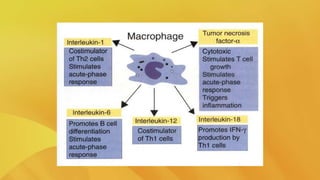
 Cell rarely secrete only one cytokine at a time e.g. macrophages secrete at least
five: IL-1, IL-6, IL-12, IL-18, and TNF-
 They affect a wide variety of cells and organs
 Many different cytokines may have similar effect (redundancy) e.g. IL-1, TNF-,
TNF-, IL-6, all have pyrogenic effect
 Types and Groups:
1. Interleukins: cytokines that regulate the interaction between lymphocytes and other
leukocytes. They are numbered sequentially in order of their discovery, IL- 1 – IL-30
• 2-Interferons
•
– Antiviral cytokines produced in response to immune stimulation and virus infection
– Interferes with viral RNA and protein synthesis
•
– There are 2types: type I and type II
•
– Type I: interferon alpha (IFN-a) and interferon beta (IFN-b) (antiviral)
•
– Type II: interferon gamma (IFN-g) (immune activation)
•
– Some interferon are important in maintenance of pregnancy (e.g. type I IFN-d)
• 3-Tumor Necrotic Factors (TNFs)
•
– Derived from macrophages and T-cells
• They destroy tumor cells
•
• They are important in acute inflammatory reactions especially TNF-a
•
• They play dominant role in immune regulation and inflammation
• 4-Growth Factors
•
– Colony stimulating factors
•
– Control leukocyte production by regulating stem cell growth
•
– Make immune cells available for body defence
•
• 5-Chemokines
•
– Regulates leukocyte circulation and migration (chemotaxis) during inflammation
– They also activate leukocytes
•
– Example: Interleukin-8 (CXCL-8)
Functions of Cytokines
 Cytokines are produced by antigenic stimuli acting through the T-cell and B-cell
receptors
 Antigen-antibody complex acting through Fc receptors
 Super antigens acting through the T-cell receptors
 Pathogen-associated molecules such as lipopolysaccharides acting through toll-like
receptors
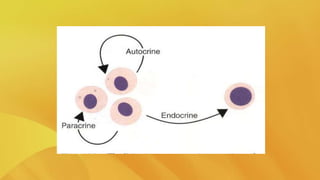
Pattern of Cytokine activities
Autocrine: they bind to receptors on the cell that produced them.
Paracrine: they bind only to receptors on cells in close proximity to the cell of
origin
Endocrine: they spread throughout the body thereby affecting cells in distant
location from the source of production
L4 cytokines
L4 cytokines
L4 cytokines
L4 cytokines
L4 cytokines
L4 cytokines
L4 cytokines
L4 cytokines
L4 cytokines
L4 cytokines

L4 cytokines

  • 1.
  • 2.
     Proteins secretedby the cells of the immune system that regulate the immune response by communicating among cells  Characteristics:  Cell rarely secrete only one cytokine at a time e.g. macrophages secrete at least five: IL-1, IL-6, IL-12, IL-18, and TNF-  They affect a wide variety of cells and organs  Many different cytokines may have similar effect (redundancy) e.g. IL-1, TNF-, TNF-, IL-6, all have pyrogenic effect  Types and Groups: 1. Interleukins: cytokines that regulate the interaction between lymphocytes and other leukocytes. They are numbered sequentially in order of their discovery, IL- 1 – IL-30
  • 3.
    • 2-Interferons • – Antiviralcytokines produced in response to immune stimulation and virus infection – Interferes with viral RNA and protein synthesis • – There are 2types: type I and type II • – Type I: interferon alpha (IFN-a) and interferon beta (IFN-b) (antiviral) • – Type II: interferon gamma (IFN-g) (immune activation) • – Some interferon are important in maintenance of pregnancy (e.g. type I IFN-d) • 3-Tumor Necrotic Factors (TNFs) • – Derived from macrophages and T-cells • They destroy tumor cells • • They are important in acute inflammatory reactions especially TNF-a • • They play dominant role in immune regulation and inflammation
  • 4.
    • 4-Growth Factors • –Colony stimulating factors • – Control leukocyte production by regulating stem cell growth • – Make immune cells available for body defence • • 5-Chemokines • – Regulates leukocyte circulation and migration (chemotaxis) during inflammation – They also activate leukocytes • – Example: Interleukin-8 (CXCL-8)
  • 5.
    Functions of Cytokines Cytokines are produced by antigenic stimuli acting through the T-cell and B-cell receptors  Antigen-antibody complex acting through Fc receptors  Super antigens acting through the T-cell receptors  Pathogen-associated molecules such as lipopolysaccharides acting through toll-like receptors Pattern of Cytokine activities Autocrine: they bind to receptors on the cell that produced them. Paracrine: they bind only to receptors on cells in close proximity to the cell of origin Endocrine: they spread throughout the body thereby affecting cells in distant location from the source of production