1
PRODUCTION PLANNING AND CONTROL
CHAPTER 1: INTRODUCTION
Several different terms are used such as:
• operations management, production and operation management,
production planning and control, manufacturing system and
management, etc.
Originally applied primarily in manufacturing companies – focus on
production management. These approaches and tool later applied to
service organisations – focus on managing an organisation’s operation.
Operations management:
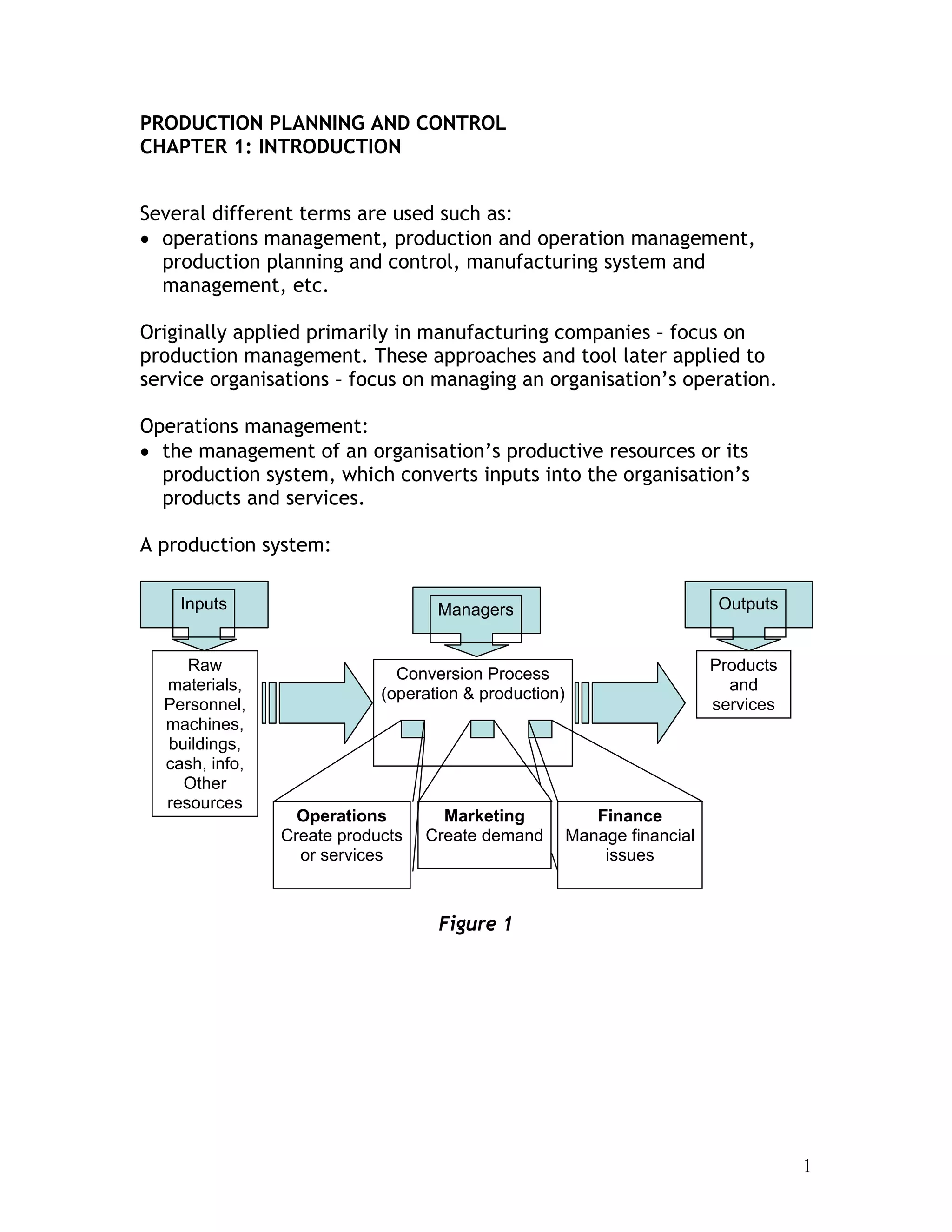
• the management of an organisation’s productive resources or its
production system, which converts inputs into the organisation’s
products and services.
A production system:
Figure 1
Conversion Process
(operation & production)
Operations
Create products
or services
Marketing
Create demand
Finance
Manage financial
issues
Managers
Raw
materials,
Personnel,
machines,
buildings,
cash, info,
Other
resources
Products
and
services
Inputs Outputs
2
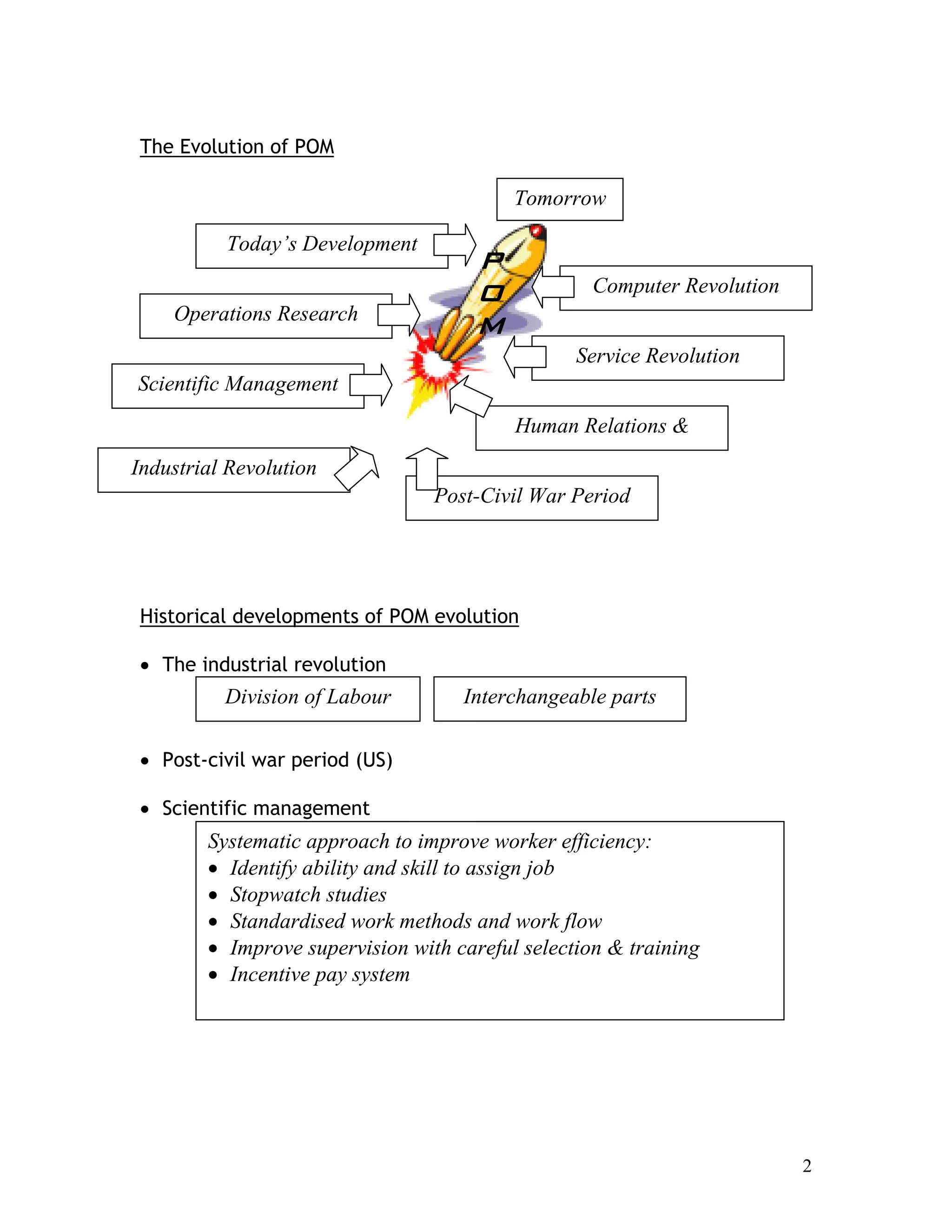
The Evolution of POM
Historical developments of POM evolution
• The industrial revolution
• Post-civil war period (US)
• Scientific management
Division of Labour Interchangeable parts
Systematic approach to improve worker efficiency:
• Identify ability and skill to assign job
• Stopwatch studies
• Standardised work methods and work flow
• Improve supervision with careful selection & training
• Incentive pay system
Tomorrow
Today’s Development
Computer Revolution
Service Revolution
Operations Research
Scientific Management
Industrial Revolution
Human Relations &
Post-Civil War Period
P
O
M
3
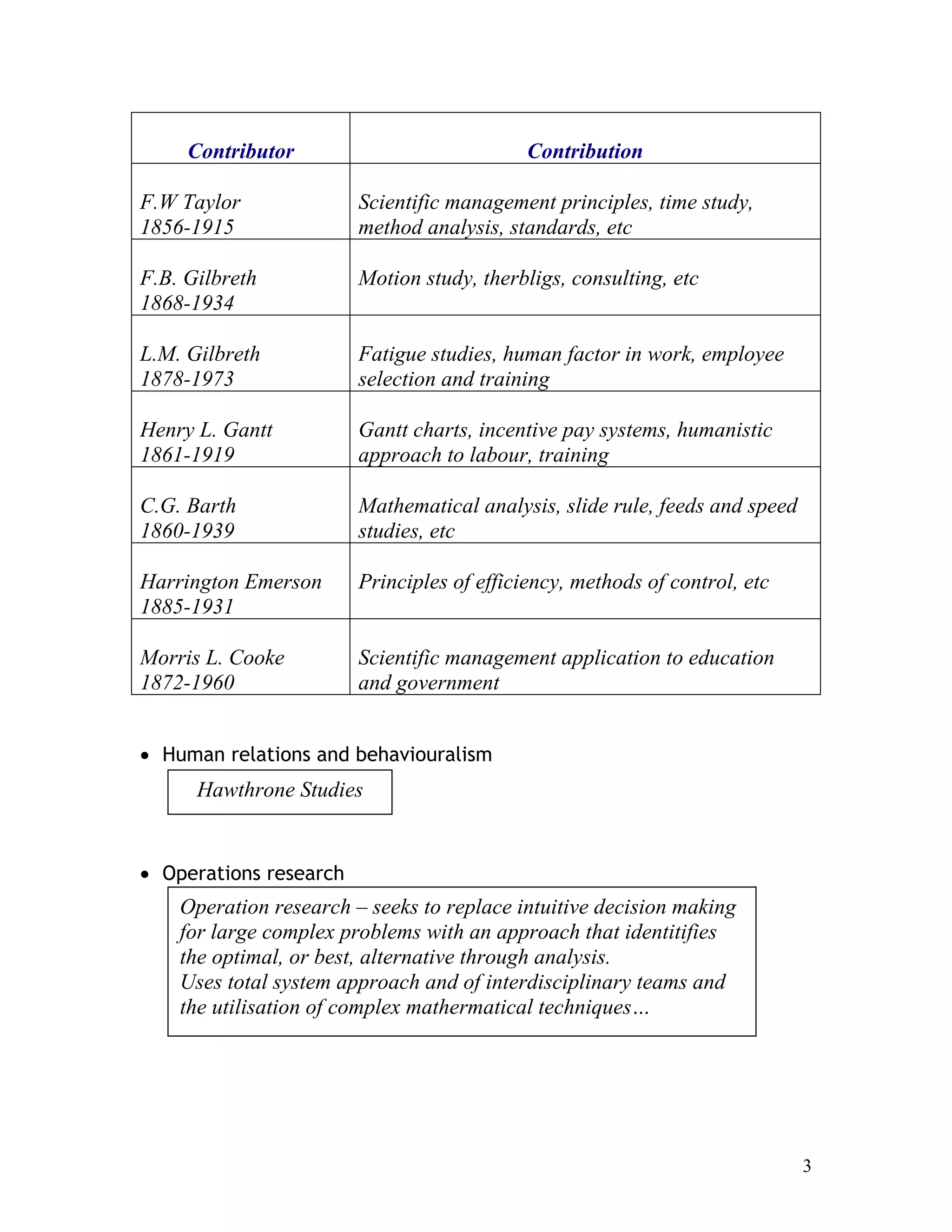
Contributor Contribution
F.W Taylor
1856-1915
Scientific management principles, time study,
method analysis, standards, etc
F.B. Gilbreth
1868-1934
Motion study, therbligs, consulting, etc
L.M. Gilbreth
1878-1973
Fatigue studies, human factor in work, employee
selection and training
Henry L. Gantt
1861-1919
Gantt charts, incentive pay systems, humanistic
approach to labour, training
C.G. Barth
1860-1939
Mathematical analysis, slide rule, feeds and speed
studies, etc
Harrington Emerson
1885-1931
Principles of efficiency, methods of control, etc
Morris L. Cooke
1872-1960
Scientific management application to education
and government
• Human relations and behaviouralism
• Operations research
Hawthrone Studies
Operation research – seeks to replace intuitive decision making
for large complex problems with an approach that identitifies
the optimal, or best, alternative through analysis.
Uses total system approach and of interdisciplinary teams and
the utilisation of complex mathermatical techniques…
4
• Service revolution
- e.g. Airlines, Entertaiment, Telecommunication, Food services,
Banks, etc.
• Computer revolution
- the usage of computers and software, Internet, e-mail, e-business,
etc.
Factors affecting operations management
• Reality of global competition
• Quality, customer service, and cost challenges
• Rapid expansion of advanced technologies
• Continued growth of the service sector
• Scarcity of operations resources
• Social-resplonsibility issues
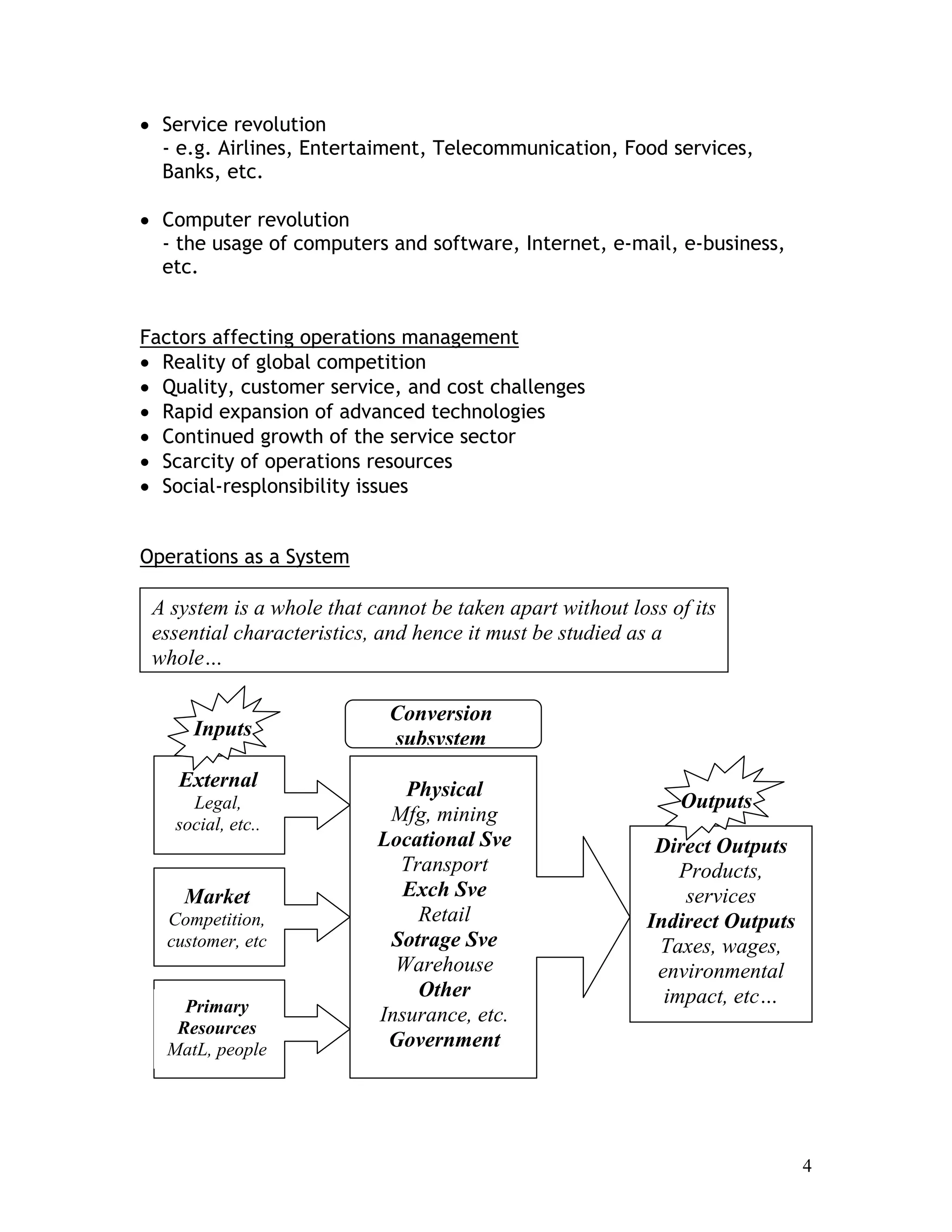
Operations as a System
A system is a whole that cannot be taken apart without loss of its
essential characteristics, and hence it must be studied as a
whole…
Direct Outputs
Products,
services
Indirect Outputs
Taxes, wages,
environmental
impact, etc…
External
Legal,
social, etc..
Market
Competition,
customer, etc
Primary
Resources
MatL, people
Physical
Mfg, mining
Locational Sve
Transport
Exch Sve
Retail
Sotrage Sve
Warehouse
Other
Insurance, etc.
Government
Inputs
Outputs
Conversion
subsystem
5
Decision making in POM
Assignment 1
Find at least three (3) entry-level jobs (in Malaysia) at three (3) different
companies which are related to the production and operations
management function. Describe the jobs and how they are related to the
production and operation management. Describe the companies,
mentioning what type of prodcution system they are, primary inputs,
conversion subsystem and outputs. You could search for the jobs at
Jobstreet (www.jobstreet.com) or JobsDB (www.jobsdb.com).
[][][]
Strategic
Decision
Operating
Decision
Control
Decision
Decisions about products, processes, and
facilities. These decisions are of strategic
importance and have long-term significance for
the organisation
Decisions about planning production to meet
demand. These decisions are necessary if the
ongoing production of goods and services is to
satisfy the demands of the market and provide
profit for the company
Decisions about planning and controlling
operations. These decisions concern with the
day-to-day activities of workers, quality of
products and service, production and overhead
costs, and maintenance of equipment.
6
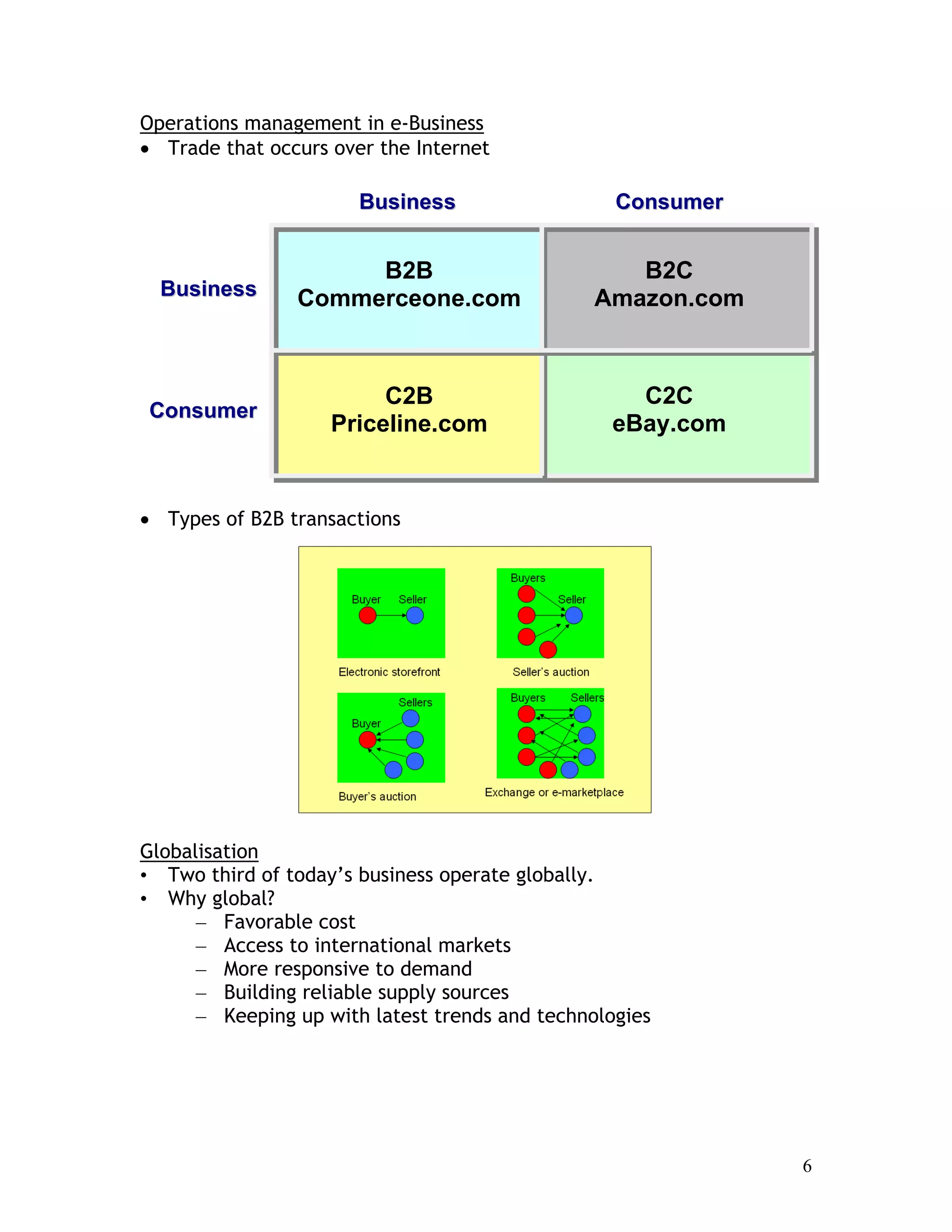
Operations management in e-Business
• Trade that occurs over the Internet
• Types of B2B transactions
Globalisation
• Two third of today’s business operate globally.
• Why global?
– Favorable cost
– Access to international markets
– More responsive to demand
– Building reliable supply sources
– Keeping up with latest trends and technologies
BBuussiinneessss
CCoonnssuummeerr
BBuussiinneessss CCoonnssuummeerr
B2B
Commerceone.com
B2C
Amazon.com
C2B
Priceline.com
C2C
eBay.com
7
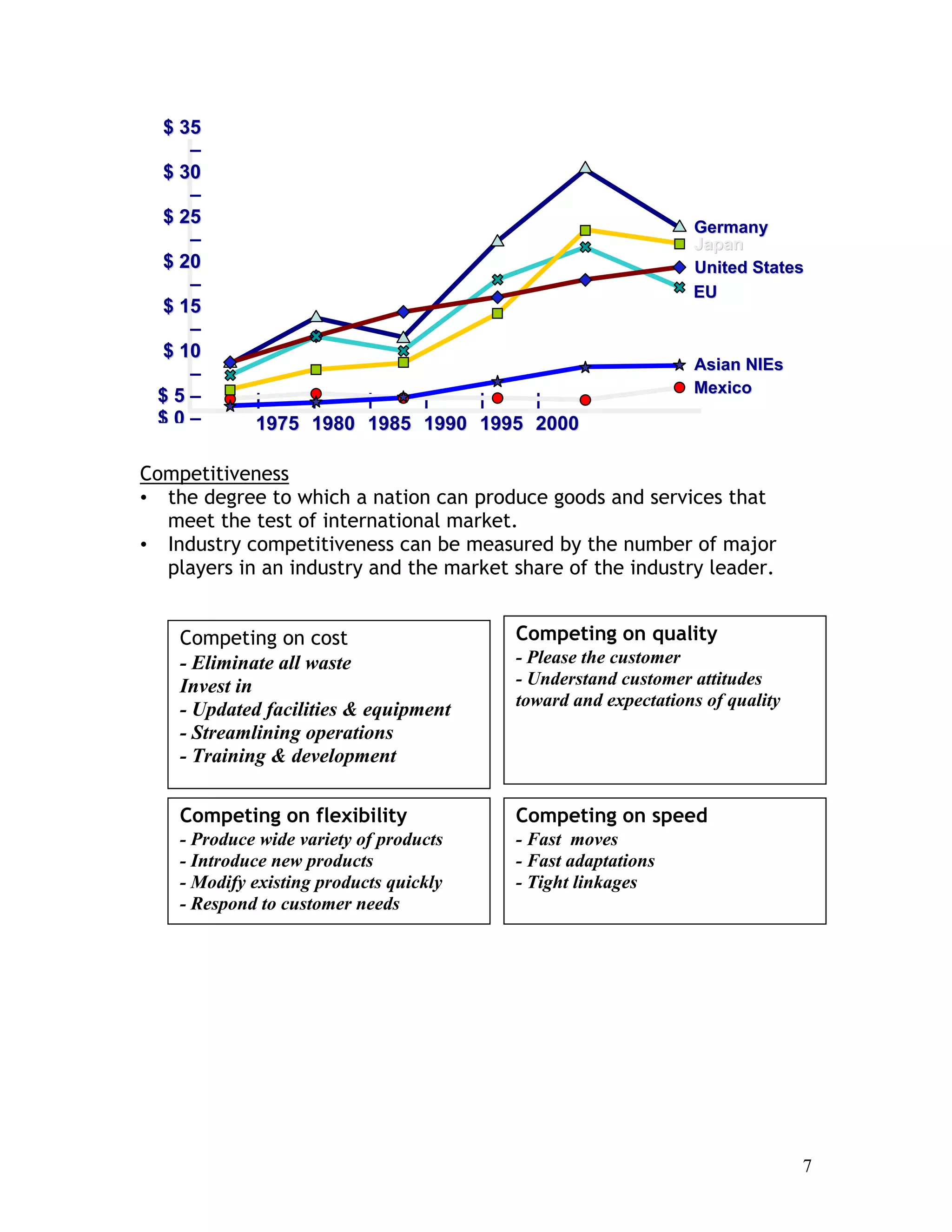
Competitiveness
• the degree to which a nation can produce goods and services that
meet the test of international market.
• Industry competitiveness can be measured by the number of major
players in an industry and the market share of the industry leader.
| | | | | |
11997755 11998800 11998855 11999900 11999955 22000000
$$ 3355
–
$$ 3300
–
$$ 2255
–
$$ 2200
–
$$ 1155
–
$$ 1100
–
$$ 55 –
$$ 00 –
GGeerrmmaannyy
JJaappaann
UUnniitteedd SSttaatteess
EEUU
AAssiiaann NNIIEEss
MMeexxiiccoo
Competing on quality
- Please the customer
- Understand customer attitudes
toward and expectations of quality
Competing on speed
- Fast moves
- Fast adaptations
- Tight linkages
Competing on flexibility
- Produce wide variety of products
- Introduce new products
- Modify existing products quickly
- Respond to customer needs
Competing on cost
- Eliminate all waste
Invest in
- Updated facilities & equipment
- Streamlining operations
- Training & development
8
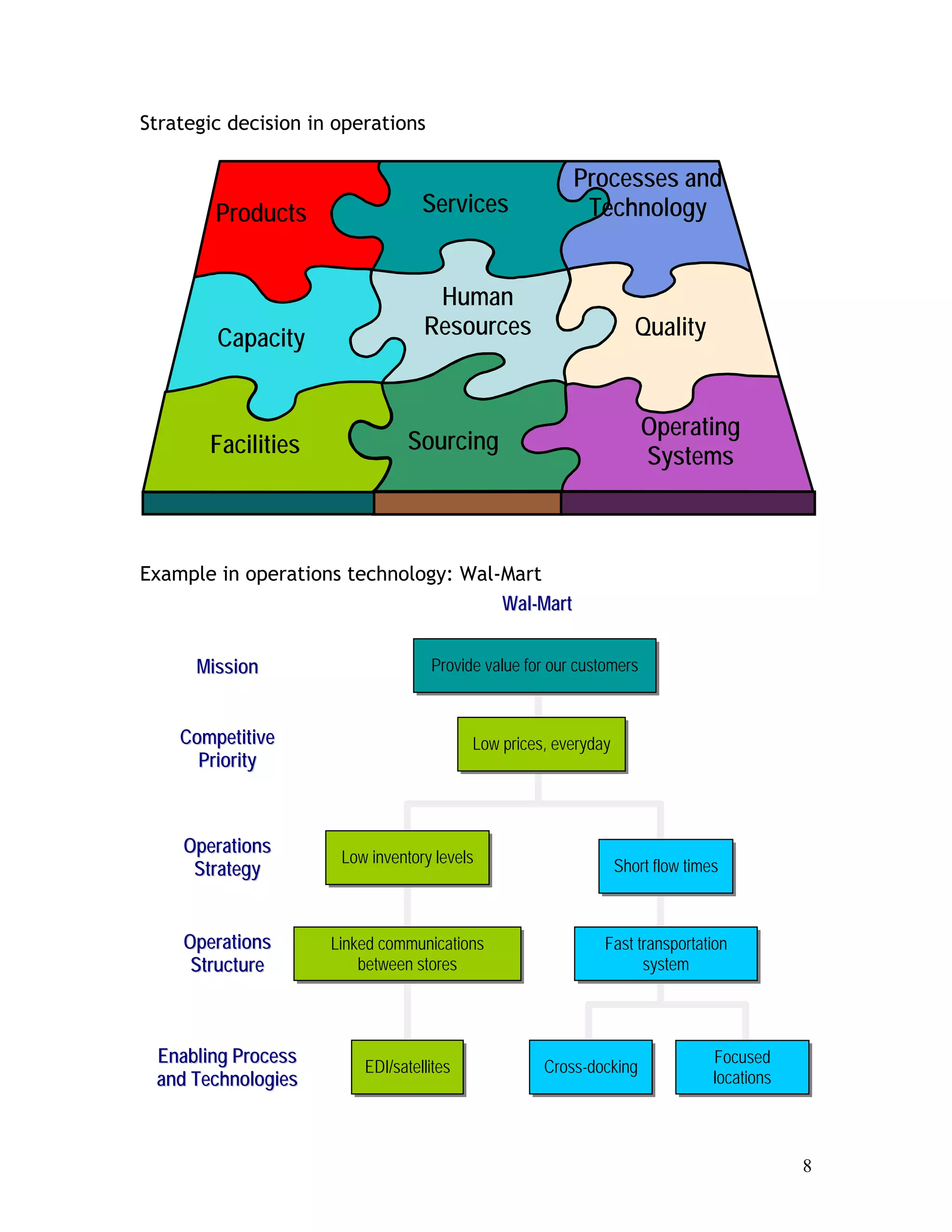
Strategic decision in operations
Example in operations technology: Wal-Mart
Products
Processes and
Technology
Capacity
Human
Resources Quality
Facilities Sourcing
Services
Operating
Systems
Provide value for our customers
Low prices, everyday
Low inventory levels
Linked communications
between stores
Short flow times
Fast transportation
system
Cross-docking
Focused
locations
EDI/satellites
WWaall--MMaarrtt
MMiissssiioonn
CCoommppeettiittiivvee
PPrriioorriittyy
OOppeerraattiioonnss
SSttrraatteeggyy
OOppeerraattiioonnss
SSttrruuccttuurree
EEnnaabblliinngg PPrroocceessss
aanndd TTeecchhnnoollooggiieess
9
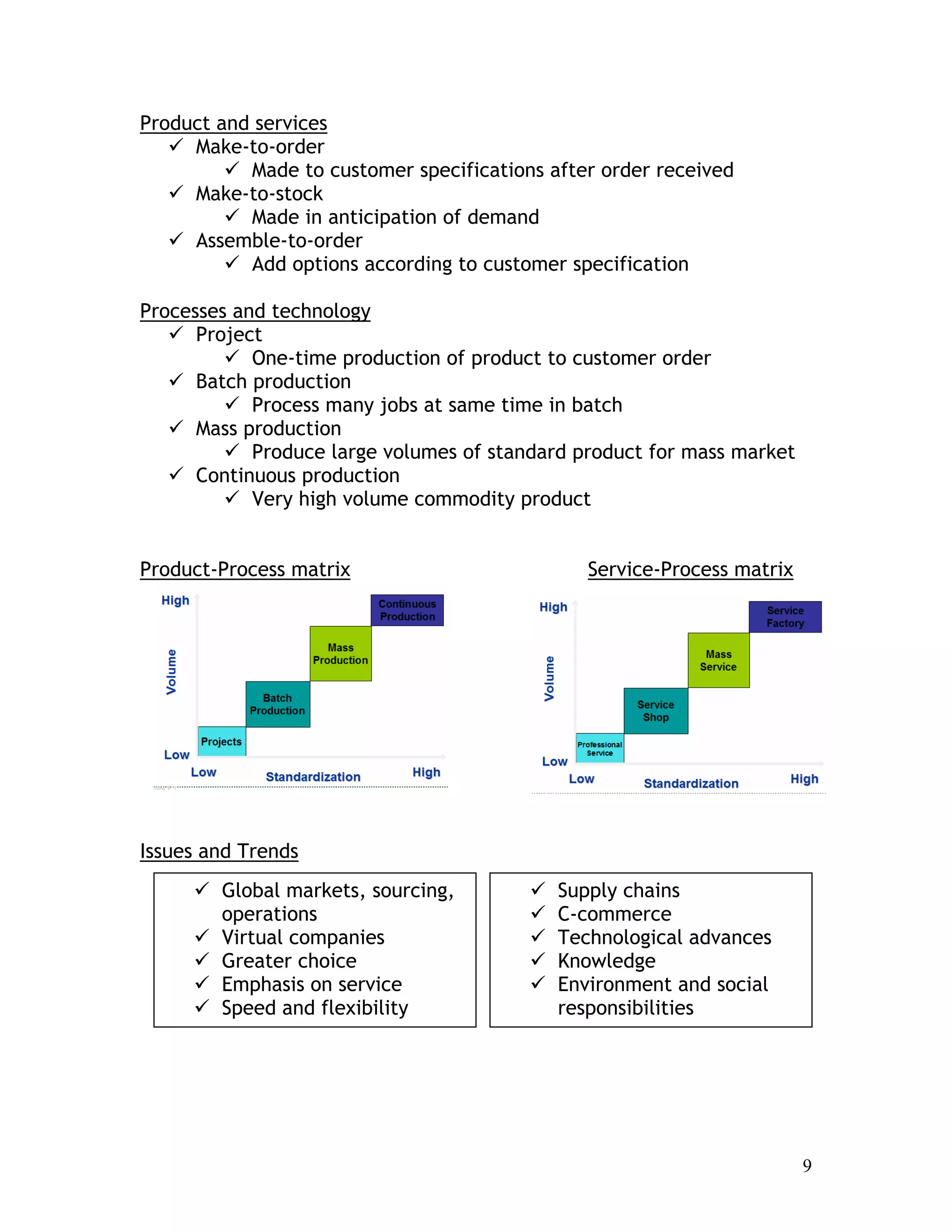
Product and services
Make-to-order
Made to customer specifications after order received
Make-to-stock
Made in anticipation of demand
Assemble-to-order
Add options according to customer specification
Processes and technology
Project
One-time production of product to customer order
Batch production
Process many jobs at same time in batch
Mass production
Produce large volumes of standard product for mass market
Continuous production
Very high volume commodity product
Product-Process matrix Service-Process matrix
Issues and Trends
Global markets, sourcing,
operations
Virtual companies
Greater choice
Emphasis on service
Speed and flexibility
Supply chains
C-commerce
Technological advances
Knowledge
Environment and social
responsibilities

L2

  • 1.
    1 PRODUCTION PLANNING ANDCONTROL CHAPTER 1: INTRODUCTION Several different terms are used such as: • operations management, production and operation management, production planning and control, manufacturing system and management, etc. Originally applied primarily in manufacturing companies – focus on production management. These approaches and tool later applied to service organisations – focus on managing an organisation’s operation. Operations management: • the management of an organisation’s productive resources or its production system, which converts inputs into the organisation’s products and services. A production system: Figure 1 Conversion Process (operation & production) Operations Create products or services Marketing Create demand Finance Manage financial issues Managers Raw materials, Personnel, machines, buildings, cash, info, Other resources Products and services Inputs Outputs
  • 2.
    2 The Evolution ofPOM Historical developments of POM evolution • The industrial revolution • Post-civil war period (US) • Scientific management Division of Labour Interchangeable parts Systematic approach to improve worker efficiency: • Identify ability and skill to assign job • Stopwatch studies • Standardised work methods and work flow • Improve supervision with careful selection & training • Incentive pay system Tomorrow Today’s Development Computer Revolution Service Revolution Operations Research Scientific Management Industrial Revolution Human Relations & Post-Civil War Period P O M
  • 3.
    3 Contributor Contribution F.W Taylor 1856-1915 Scientificmanagement principles, time study, method analysis, standards, etc F.B. Gilbreth 1868-1934 Motion study, therbligs, consulting, etc L.M. Gilbreth 1878-1973 Fatigue studies, human factor in work, employee selection and training Henry L. Gantt 1861-1919 Gantt charts, incentive pay systems, humanistic approach to labour, training C.G. Barth 1860-1939 Mathematical analysis, slide rule, feeds and speed studies, etc Harrington Emerson 1885-1931 Principles of efficiency, methods of control, etc Morris L. Cooke 1872-1960 Scientific management application to education and government • Human relations and behaviouralism • Operations research Hawthrone Studies Operation research – seeks to replace intuitive decision making for large complex problems with an approach that identitifies the optimal, or best, alternative through analysis. Uses total system approach and of interdisciplinary teams and the utilisation of complex mathermatical techniques…
  • 4.
    4 • Service revolution -e.g. Airlines, Entertaiment, Telecommunication, Food services, Banks, etc. • Computer revolution - the usage of computers and software, Internet, e-mail, e-business, etc. Factors affecting operations management • Reality of global competition • Quality, customer service, and cost challenges • Rapid expansion of advanced technologies • Continued growth of the service sector • Scarcity of operations resources • Social-resplonsibility issues Operations as a System A system is a whole that cannot be taken apart without loss of its essential characteristics, and hence it must be studied as a whole… Direct Outputs Products, services Indirect Outputs Taxes, wages, environmental impact, etc… External Legal, social, etc.. Market Competition, customer, etc Primary Resources MatL, people Physical Mfg, mining Locational Sve Transport Exch Sve Retail Sotrage Sve Warehouse Other Insurance, etc. Government Inputs Outputs Conversion subsystem
  • 5.
    5 Decision making inPOM Assignment 1 Find at least three (3) entry-level jobs (in Malaysia) at three (3) different companies which are related to the production and operations management function. Describe the jobs and how they are related to the production and operation management. Describe the companies, mentioning what type of prodcution system they are, primary inputs, conversion subsystem and outputs. You could search for the jobs at Jobstreet (www.jobstreet.com) or JobsDB (www.jobsdb.com). [][][] Strategic Decision Operating Decision Control Decision Decisions about products, processes, and facilities. These decisions are of strategic importance and have long-term significance for the organisation Decisions about planning production to meet demand. These decisions are necessary if the ongoing production of goods and services is to satisfy the demands of the market and provide profit for the company Decisions about planning and controlling operations. These decisions concern with the day-to-day activities of workers, quality of products and service, production and overhead costs, and maintenance of equipment.
  • 6.
    6 Operations management ine-Business • Trade that occurs over the Internet • Types of B2B transactions Globalisation • Two third of today’s business operate globally. • Why global? – Favorable cost – Access to international markets – More responsive to demand – Building reliable supply sources – Keeping up with latest trends and technologies BBuussiinneessss CCoonnssuummeerr BBuussiinneessss CCoonnssuummeerr B2B Commerceone.com B2C Amazon.com C2B Priceline.com C2C eBay.com
  • 7.
    7 Competitiveness • the degreeto which a nation can produce goods and services that meet the test of international market. • Industry competitiveness can be measured by the number of major players in an industry and the market share of the industry leader. | | | | | | 11997755 11998800 11998855 11999900 11999955 22000000 $$ 3355 – $$ 3300 – $$ 2255 – $$ 2200 – $$ 1155 – $$ 1100 – $$ 55 – $$ 00 – GGeerrmmaannyy JJaappaann UUnniitteedd SSttaatteess EEUU AAssiiaann NNIIEEss MMeexxiiccoo Competing on quality - Please the customer - Understand customer attitudes toward and expectations of quality Competing on speed - Fast moves - Fast adaptations - Tight linkages Competing on flexibility - Produce wide variety of products - Introduce new products - Modify existing products quickly - Respond to customer needs Competing on cost - Eliminate all waste Invest in - Updated facilities & equipment - Streamlining operations - Training & development
  • 8.
    8 Strategic decision inoperations Example in operations technology: Wal-Mart Products Processes and Technology Capacity Human Resources Quality Facilities Sourcing Services Operating Systems Provide value for our customers Low prices, everyday Low inventory levels Linked communications between stores Short flow times Fast transportation system Cross-docking Focused locations EDI/satellites WWaall--MMaarrtt MMiissssiioonn CCoommppeettiittiivvee PPrriioorriittyy OOppeerraattiioonnss SSttrraatteeggyy OOppeerraattiioonnss SSttrruuccttuurree EEnnaabblliinngg PPrroocceessss aanndd TTeecchhnnoollooggiieess
  • 9.
    9 Product and services Make-to-order Madeto customer specifications after order received Make-to-stock Made in anticipation of demand Assemble-to-order Add options according to customer specification Processes and technology Project One-time production of product to customer order Batch production Process many jobs at same time in batch Mass production Produce large volumes of standard product for mass market Continuous production Very high volume commodity product Product-Process matrix Service-Process matrix Issues and Trends Global markets, sourcing, operations Virtual companies Greater choice Emphasis on service Speed and flexibility Supply chains C-commerce Technological advances Knowledge Environment and social responsibilities