Chapter III
Introduction to Internet
SLIDE PRESENT
CHAPTER I : USING OF COMPUTER TECHNOLOGY
CHAPTER II : INTRODUCE TO SOFTWARE
CHAPTER III: INTRODUCE TO INTERNET
CHAPTER IV: BUSINESS COMPUTING
CHAPTER V : INTRODUCE TO e-GOV, etc
Contents
Introduction to Intenet
Internet History
Internet Evolution
Internet Pioneer
Internet Growth
Lecture‟s Material
The Future of Internet
Internet Application
Internet Trends
Internet & Cloud Computing
Internet User
Contents 1 Contents 2
Do You Ever Heard This ?
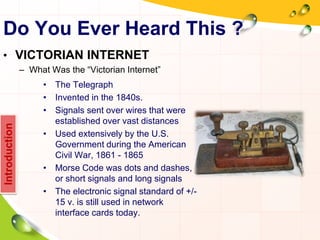
• VICTORIAN INTERNET
– What Was the “Victorian Internet”
• The Telegraph
• Invented in the 1840s.
• Signals sent over wires that were
established over vast distances
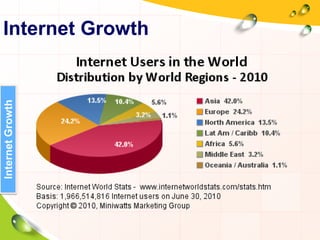
• Used extensively by the U.S.
Government during the American
Civil War, 1861 - 1865
• Morse Code was dots and dashes,
or short signals and long signals
• The electronic signal standard of +/-
15 v. is still used in network
interface cards today.
Introduction
What Is Internet?
• Internet can be defined as:
– A network of networks, joining many government,
university and private computers together and providing
an infrastructure for the use of E-mail, bulletin boards, file
archives, hypertext documents, databases and other
computational resources
– The vast collection of computer networks which form and
act as a single huge network for transport of data and
messages across distances which can be anywhere from
the same office to anywhere in the world.
– The largest network of networks in the world.
– Uses TCP/IP protocols and packet switching .
– Runs on any communications substrate.
Introduction
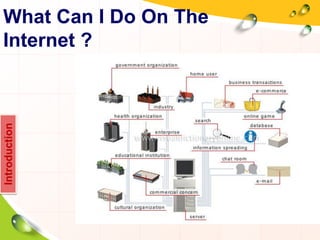
What Can I Do On The
Internet ?
• Get Information
• Send and receive email and chat
• Join discussion groups and message
boards
• Get or exchange software and files
• Explore the World Wide Web
• Publish your own material on the web
Introduction
What Can I Do On The
Internet ?
Introduction
Who Owns The Internet?
• No organization, corporation, or
government owns or runs the Internet.
• Organizations work together to oversee
and standardize what happens on the
internet
• The equipment, the computers, cables,
routers, and so on, are owned by
government and private organizations.
Introduction
Does The Internet Create
Immediately?
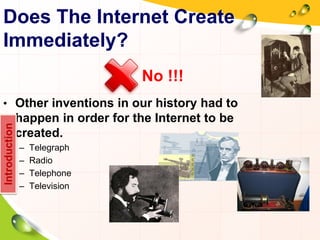
• Other inventions in our history had to
happen in order for the Internet to be
created.
– Telegraph
– Radio
– Telephone
– Television
Introduction
No !!!
History of the Internet
• Brief History of the Internet
– 1968 - DARPA (Defense Advanced Research Projects
Agency) contracts with BBN (Bolt, Beranek & Newman)
to create ARPAnet
– 1970 - First five nodes: UCLA, Stanford, UC Santa
Barbara, U of Utah, and BBN
– 1974 - TCP specification by Vint Cerf
– 1984 – On January 1, the Internet with its 1000 hosts
converts en masse to using TCP/IP for its messaging
InternetHistory
A Brief History of the Internet:
The Precursors I
“Computers,” so to speak, have been around for
thousands of years. So have networks (social
networks, that is). It‟s only recently that they
have come together so forcefully, altering social
life as we knew it basically overnight.
From the earliest abacus to the jacquard loom
that led to punch card technology, computers
that became permanently networked emerged in
the 1960s. (click here for interactive abacus)
InternetHistory
A Brief History of the Internet:
The Precursors II
Computers were an integral part of World War II. Their
adoption as military technology created the first steps
into computer networking, creating the first pattern of the
Internet in the late 1960s.
Technology development and the dependence on
computers in both academic and business institutions in
the 1980s increased public awareness and access to
computers generally
1991, when Tim Berners-Lee introduced HTML, the
World Wide Web (WWW), and Mosaic (which became
Netscape Navigator).
InternetHistory
1958: ARPA, the Advanced Research Projects
Agency, is created by the U.S. Defense
Department in response to the 1957 Sputnik
launch.
1962: IPTO, the Information processing Techniques
Office, a branch of ARPA, creates the
ARPANET under the leadership of Joseph
Licklider (MIT), a minor program designed to
stimulate research in interactive computing.
A Brief History of the
Internet: The Timeline
InternetHistory
1969: The ARPANET utilizes “packet switching”
technology developed in part by Paul Baran
of the RAND Corporation. The first 5
nodes in the network link UCLA, UCSB,
Stanford, and Univ. of Utah and BBN
1972-4: The network expands to 15 nodes, and
standardization of communication protocols
ensues – TCP, or “transmission control
protocol”, is developed and by 1978 the IP
(inter-networking protocol) is added by Vint
Cerf of Stanford, creating the network
standard used today, TCP/IP. In 1974, the
UNIX operating system is released by Bell labs, and
set widely at universities. This begins the open source
movement”.
A Brief History of the
Internet
InternetHistory
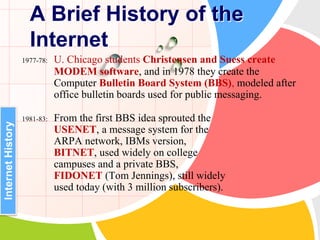
1977-78: U. Chicago students Christensen and Suess create
MODEM software, and in 1978 they create the
Computer Bulletin Board System (BBS), modeled after
office bulletin boards used for public messaging.
1981-83: From the first BBS idea sprouted the
USENET, a message system for the
ARPA network, IBMs version,
BITNET, used widely on college
campuses and a private BBS,
FIDONET (Tom Jennings), still widely
used today (with 3 million subscribers).
A Brief History of the
Internet
InternetHistory
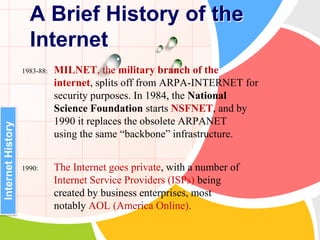
1983-88: MILNET, the military branch of the
internet, splits off from ARPA-INTERNET for
security purposes. In 1984, the National
Science Foundation starts NSFNET, and by
1990 it replaces the obsolete ARPANET
using the same “backbone” infrastructure.
1990: The Internet goes private, with a number of
Internet Service Providers (ISPs) being
created by business enterprises, most
notably AOL (America Online).
A Brief History of the
Internet
InternetHistory
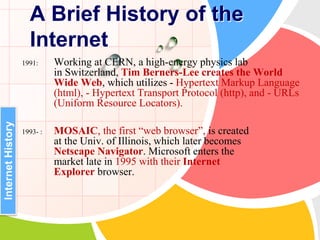
1991: Working at CERN, a high-energy physics lab
in Switzerland, Tim Berners-Lee creates the World
Wide Web, which utilizes - Hypertext Markup Language
(html), - Hypertext Transport Protocol (http), and - URLs
(Uniform Resource Locators).
1993- : MOSAIC, the first “web browser”, is created
at the Univ. of Illinois, which later becomes
Netscape Navigator. Microsoft enters the
market late in 1995 with their Internet
Explorer browser.
A Brief History of the
Internet
InternetHistory
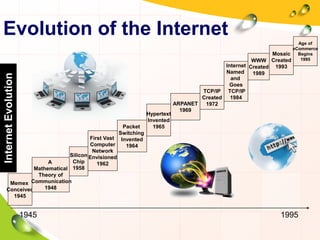
Evolution of the Internet
InternetEvolution
1945 1995
Memex
Conceived
1945
WWW
Created
1989
Mosaic
Created
1993
A
Mathematical
Theory of
Communication
1948
Packet
Switching
Invented
1964
Silicon
Chip
1958
First Vast
Computer
Network
Envisioned
1962
ARPANET
1969
TCP/IP
Created
1972
Internet
Named
and
Goes
TCP/IP
1984
Hypertext
Invented
1965
Age of
eCommerce
Begins
1995
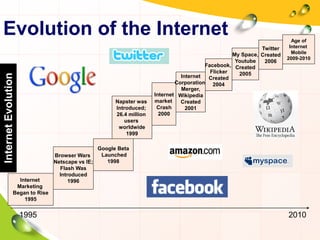
Evolution of the Internet
InternetEvolution
1995 2010
Internet
Marketing
Began to Rise
1995
Facebook,
Flicker
Created
2004
Twitter
Created
2006
Google Beta
Launched
1998
Browser Wars
Netscape vs IE;
Flash Was
Introduced
1996
Internet
market
Crash
2000
Internet
Corporation
Merger,
Wikipedia
Created
2001
Napster was
Introduced;
26.4 million
users
worldwide
1999
Age of
Internet
Mobile
2009-2010
My Space,
Youtube
Created
2005
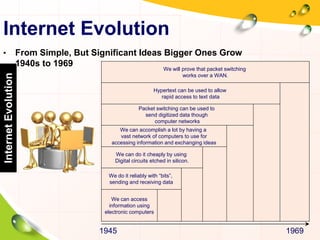
Internet Evolution
• From Simple, But Significant Ideas Bigger Ones Grow
1940s to 1969
1945 1969
We can access
information using
electronic computers
We do it reliably with “bits”,
sending and receiving data
We can do it cheaply by using
Digital circuits etched in silicon.
We can accomplish a lot by having a
vast network of computers to use for
accessing information and exchanging ideas
We will prove that packet switching
works over a WAN.
Packet switching can be used to
send digitized data though
computer networks
Hypertext can be used to allow
rapid access to text data
InternetEvolution
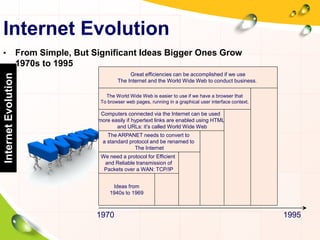
Internet Evolution
• From Simple, But Significant Ideas Bigger Ones Grow
1970s to 1995
1970 1995
Ideas from
1940s to 1969
We need a protocol for Efficient
and Reliable transmission of
Packets over a WAN: TCP/IP
The ARPANET needs to convert to
a standard protocol and be renamed to
The Internet
Computers connected via the Internet can be used
more easily if hypertext links are enabled using HTML
and URLs: it‟s called World Wide Web
The World Wide Web is easier to use if we have a browser that
To browser web pages, running in a graphical user interface context.
Great efficiencies can be accomplished if we use
The Internet and the World Wide Web to conduct business.
InternetEvolution
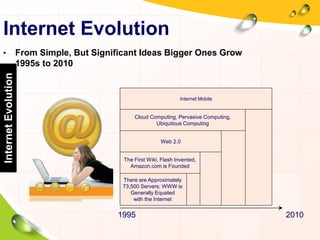
Internet Evolution
• From Simple, But Significant Ideas Bigger Ones Grow
1995s to 2010
1995 2010
There are Approximately
73,500 Servers; WWW is
Generally Equated
with the Internet
The First Wiki, Flash Invented,
Amazon.com is Founded
Web 2.0
Cloud Computing, Pervasive Computing,
Ubiquitous Computing
Internet Mobile
InternetEvolution
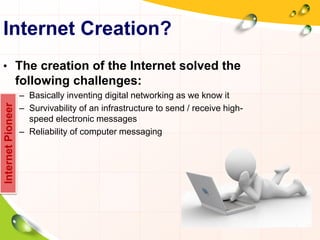
Internet Creation?
• The creation of the Internet solved the
following challenges:
– Basically inventing digital networking as we know it
– Survivability of an infrastructure to send / receive high-
speed electronic messages
– Reliability of computer messaging
InternetPioneer
Internet Creation?
• Tribute to the Internet Pioneers
– The Internet we know and love today, would not exist
without the hard work of a lot of bright people.
– The technologies and standards they created make
today‟s Internet and World Wide Web possible.
– They deserve recognition and our gratitude for changing
the world with the Internet.
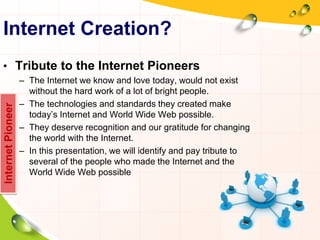
– In this presentation, we will identify and pay tribute to
several of the people who made the Internet and the
World Wide Web possible
InternetPioneer
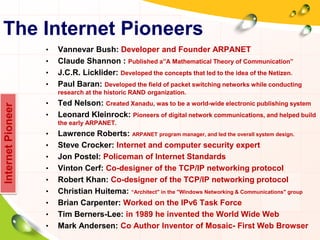
The Internet Pioneers
• Vannevar Bush: Developer and Founder ARPANET
• Claude Shannon : Published a”A Mathematical Theory of Communication”
• J.C.R. Licklider: Developed the concepts that led to the idea of the Netizen.
• Paul Baran: Developed the field of packet switching networks while conducting
research at the historic RAND organization.
• Ted Nelson: Created Xanadu, was to be a world-wide electronic publishing system
• Leonard Kleinrock: Pioneers of digital network communications, and helped build
the early ARPANET.
• Lawrence Roberts: ARPANET program manager, and led the overall system design.
• Steve Crocker: Internet and computer security expert
• Jon Postel: Policeman of Internet Standards
• Vinton Cerf: Co-designer of the TCP/IP networking protocol
• Robert Khan: Co-designer of the TCP/IP networking protocol
• Christian Huitema: “Architect" in the "Windows Networking & Communications" group
• Brian Carpenter: Worked on the IPv6 Task Force
• Tim Berners-Lee: in 1989 he invented the World Wide Web
• Mark Andersen: Co Author Inventor of Mosaic- First Web Browser
InternetPioneer
What Is WWW?
• WWW stands for World Wide Web
– is a system of interlinked hypertext documents accessed
via the Internet;
– With a web browser, one can view web pages that may
contain text, images, videos, and other multimedia and
navigate between them by using hyperlinks;
InternetPioneer
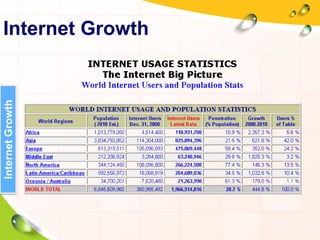
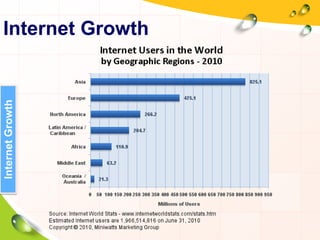
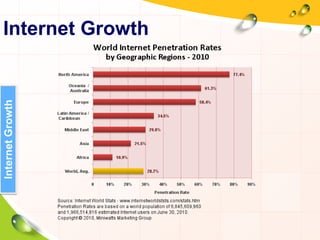
Internet Growth
• Iinternet statistics:
– 1977: 111 hosts on Internet
– 1981: 213 hosts
– 1983: 562 hosts
– 1984: 1,000 hosts
– 1986: 5,000 hosts
– 1987: 10,000 hosts
– 1989: 100,000 hosts
– 1992: 1,000,000 hosts
– 2001: 150 – 175 million hosts
– 2002: over 200 million hosts
– By 2010, about 80% of the planet will be on the Internet
InternetGrowth
Internet Growth
InternetGrowth
Internet Growth
InternetGrowth
Internet Growth
InternetGrowth
Internet Growth
InternetGrowth
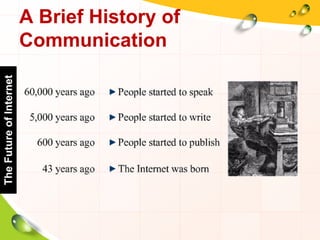
A Brief History of
Communication
TheFutureofInternet
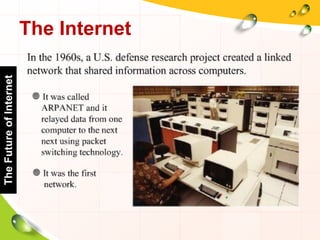
The Internet
TheFutureofInternet
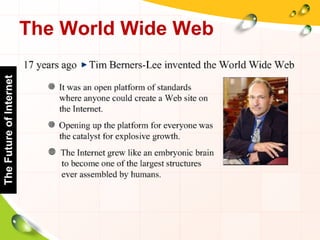
The World Wide Web
TheFutureofInternet
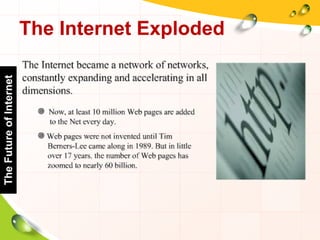
The Internet Exploded
TheFutureofInternet
It Exploded in All Directions
TheFutureofInternet
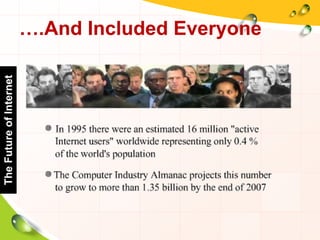
….And Included Everyone
TheFutureofInternet
The Internet is Changing
TheFutureofInternet
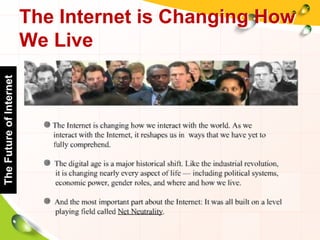
The Internet is Changing How
We Live
TheFutureofInternet
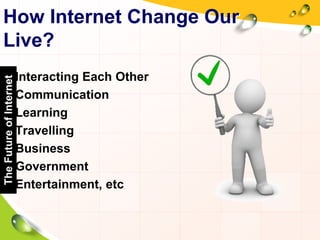
How Internet Change Our
Live?
• Interacting Each Other
• Communication
• Learning
• Travelling
• Business
• Government
• Entertainment, etc
TheFutureofInternet
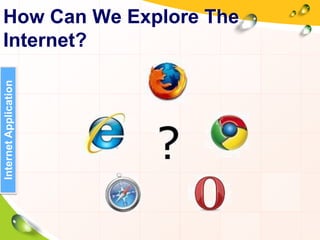
How Can We Explore The
Internet?
InternetApplication
Search Engine
InternetApplication
Electronic Mail
InternetApplication
Gmail
Yahoo!Mail
Hotmail
PlasaMail
Social Networking
InternetApplication
Photo Sharing
InternetApplication
Video Sharing
InternetApplication
Online Chatting
InternetApplication
Document Sharing
InternetApplication
Online Storage
InternetApplication
Online Collaboration
InternetApplication
Blogging
InternetApplication
Electronic Commerce
InternetApplication
Internet Trend
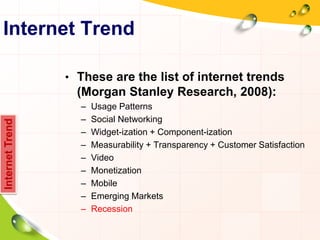
• These are the list of internet trends
(Morgan Stanley Research, 2008):
– Usage Patterns
– Social Networking
– Widget-ization + Component-ization
– Measurability + Transparency + Customer Satisfaction
– Video
– Monetization
– Mobile
– Emerging Markets
– Recession
InternetTrend
Internet Trend
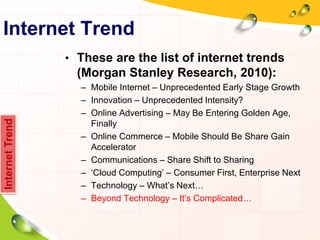
• These are the list of internet trends
(Morgan Stanley Research, 2010):
– Mobile Internet – Unprecedented Early Stage Growth
– Innovation – Unprecedented Intensity?
– Online Advertising – May Be Entering Golden Age,
Finally
– Online Commerce – Mobile Should Be Share Gain
Accelerator
– Communications – Share Shift to Sharing
– „Cloud Computing‟ – Consumer First, Enterprise Next
– Technology – What‟s Next…
– Beyond Technology – It‟s Complicated…
InternetTrend
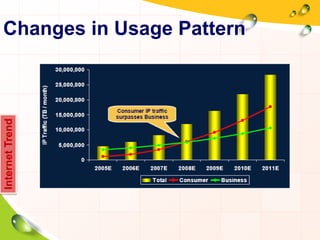
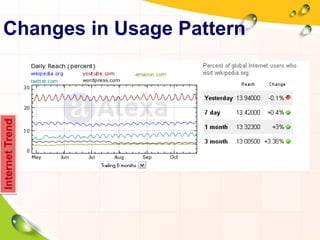
Changes in Usage Pattern
InternetTrend
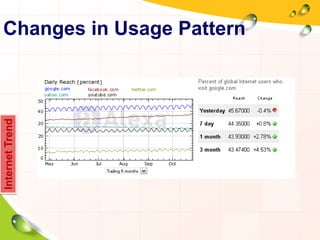
Changes in Usage Pattern
InternetTrend
Changes in Usage Pattern
InternetTrend
Changes in Usage Pattern
InternetTrend
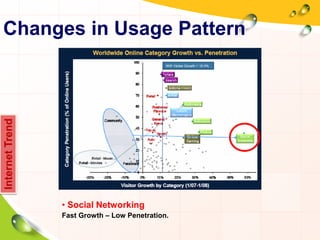
• Social Networking
Fast Growth – Low Penetration.
Changes in Usage Pattern
InternetTrend
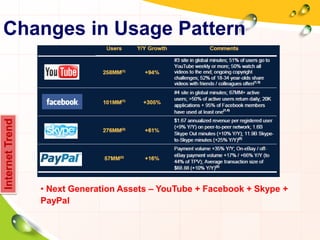
• Next Generation Assets – YouTube + Facebook + Skype +
PayPal
Changes in Usage Pattern
InternetTrend
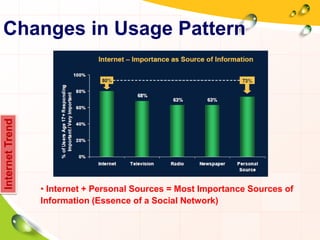
• Internet + Personal Sources = Most Importance Sources of
Information (Essence of a Social Network)
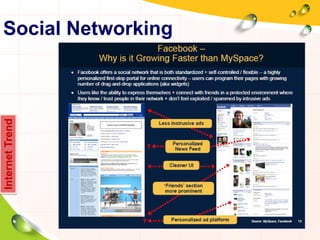
Social Networking
InternetTrend
Social Networking
InternetTrend
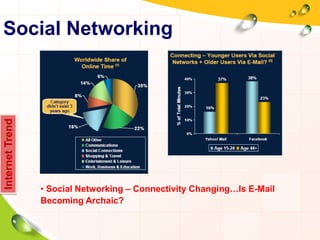
• Social Networking – Connectivity Changing…Is E-Mail
Becoming Archaic?
Social Networking
InternetTrend
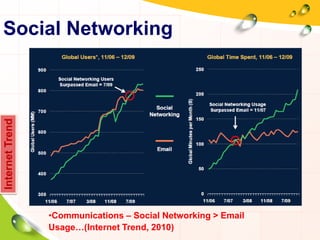
•Communications – Social Networking > Email
Usage…(Internet Trend, 2010)
InternetTrend
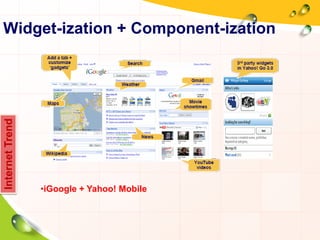
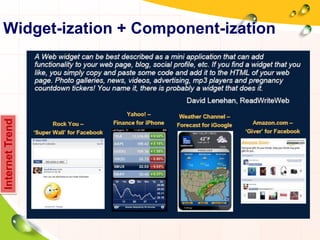
•iGoogle + Yahoo! Mobile
Widget-ization + Component-ization
InternetTrend
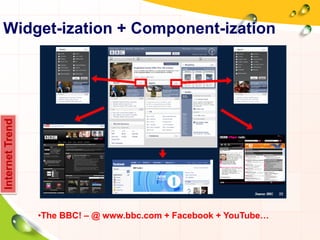
•The BBC! – @ www.bbc.com + Facebook + YouTube…
Widget-ization + Component-ization
InternetTrend
InternetTrend
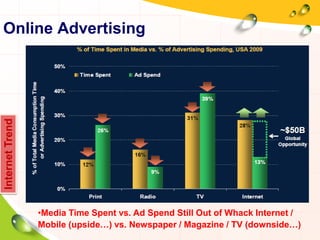
•Media Time Spent vs. Ad Spend Still Out of Whack Internet /
Mobile (upside…) vs. Newspaper / Magazine / TV (downside…)
Online Advertising
InternetTrend
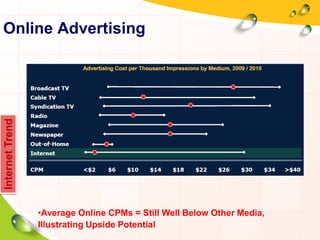
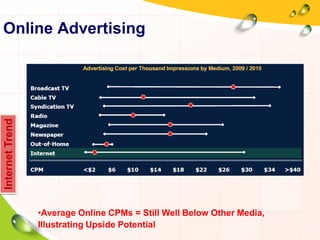
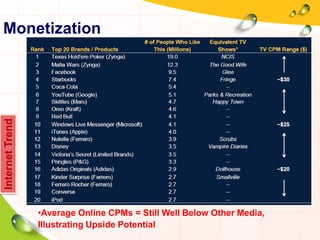
•Average Online CPMs = Still Well Below Other Media,
Illustrating Upside Potential
Online Advertising
InternetTrend
•Average Online CPMs = Still Well Below Other Media,
Illustrating Upside Potential
Online Advertising
InternetTrend
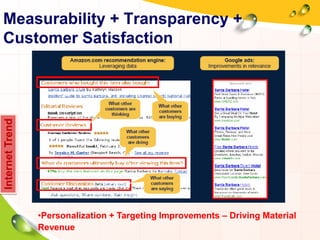
•Personalization + Targeting Improvements – Driving Material
Revenue
Measurability + Transparency +
Customer Satisfaction
InternetTrend
•Yahoo! Display + Home Page Growth Accelerating Showing
Online Targeting / Personalization Improving
Measurability + Transparency +
Customer Satisfaction
InternetTrend
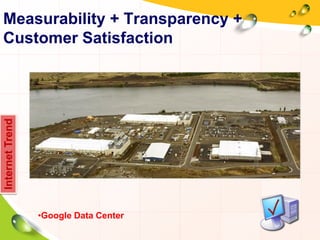
•Google Data Center
Measurability + Transparency +
Customer Satisfaction
InternetTrend
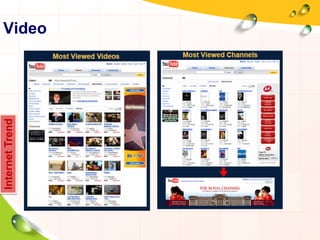
Video
InternetTrend
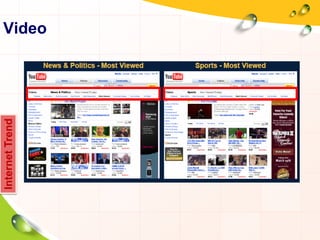
Video
InternetTrend
Video
InternetTrend
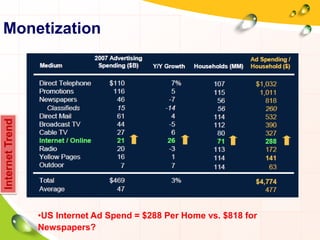
Monetization
•US Internet Ad Spend = $288 Per Home vs. $818 for
Newspapers?
InternetTrend
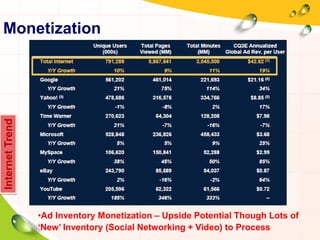
Monetization
•Ad Inventory Monetization – Upside Potential Though Lots of
„New‟ Inventory (Social Networking + Video) to Process
InternetTrend
•Average Online CPMs = Still Well Below Other Media,
Illustrating Upside Potential
Monetization

Introduce to internet1

  • 1.
  • 2.
    SLIDE PRESENT CHAPTER I: USING OF COMPUTER TECHNOLOGY CHAPTER II : INTRODUCE TO SOFTWARE CHAPTER III: INTRODUCE TO INTERNET CHAPTER IV: BUSINESS COMPUTING CHAPTER V : INTRODUCE TO e-GOV, etc
  • 3.
    Contents Introduction to Intenet InternetHistory Internet Evolution Internet Pioneer Internet Growth Lecture‟s Material The Future of Internet Internet Application Internet Trends Internet & Cloud Computing Internet User Contents 1 Contents 2
  • 5.
    Do You EverHeard This ? • VICTORIAN INTERNET – What Was the “Victorian Internet” • The Telegraph • Invented in the 1840s. • Signals sent over wires that were established over vast distances • Used extensively by the U.S. Government during the American Civil War, 1861 - 1865 • Morse Code was dots and dashes, or short signals and long signals • The electronic signal standard of +/- 15 v. is still used in network interface cards today. Introduction
  • 6.
    What Is Internet? •Internet can be defined as: – A network of networks, joining many government, university and private computers together and providing an infrastructure for the use of E-mail, bulletin boards, file archives, hypertext documents, databases and other computational resources – The vast collection of computer networks which form and act as a single huge network for transport of data and messages across distances which can be anywhere from the same office to anywhere in the world. – The largest network of networks in the world. – Uses TCP/IP protocols and packet switching . – Runs on any communications substrate. Introduction
  • 7.
    What Can IDo On The Internet ? • Get Information • Send and receive email and chat • Join discussion groups and message boards • Get or exchange software and files • Explore the World Wide Web • Publish your own material on the web Introduction
  • 8.
    What Can IDo On The Internet ? Introduction
  • 9.
    Who Owns TheInternet? • No organization, corporation, or government owns or runs the Internet. • Organizations work together to oversee and standardize what happens on the internet • The equipment, the computers, cables, routers, and so on, are owned by government and private organizations. Introduction
  • 10.
    Does The InternetCreate Immediately? • Other inventions in our history had to happen in order for the Internet to be created. – Telegraph – Radio – Telephone – Television Introduction No !!!
  • 11.
    History of theInternet • Brief History of the Internet – 1968 - DARPA (Defense Advanced Research Projects Agency) contracts with BBN (Bolt, Beranek & Newman) to create ARPAnet – 1970 - First five nodes: UCLA, Stanford, UC Santa Barbara, U of Utah, and BBN – 1974 - TCP specification by Vint Cerf – 1984 – On January 1, the Internet with its 1000 hosts converts en masse to using TCP/IP for its messaging InternetHistory
  • 12.
    A Brief Historyof the Internet: The Precursors I “Computers,” so to speak, have been around for thousands of years. So have networks (social networks, that is). It‟s only recently that they have come together so forcefully, altering social life as we knew it basically overnight. From the earliest abacus to the jacquard loom that led to punch card technology, computers that became permanently networked emerged in the 1960s. (click here for interactive abacus) InternetHistory
  • 13.
    A Brief Historyof the Internet: The Precursors II Computers were an integral part of World War II. Their adoption as military technology created the first steps into computer networking, creating the first pattern of the Internet in the late 1960s. Technology development and the dependence on computers in both academic and business institutions in the 1980s increased public awareness and access to computers generally 1991, when Tim Berners-Lee introduced HTML, the World Wide Web (WWW), and Mosaic (which became Netscape Navigator). InternetHistory
  • 14.
    1958: ARPA, theAdvanced Research Projects Agency, is created by the U.S. Defense Department in response to the 1957 Sputnik launch. 1962: IPTO, the Information processing Techniques Office, a branch of ARPA, creates the ARPANET under the leadership of Joseph Licklider (MIT), a minor program designed to stimulate research in interactive computing. A Brief History of the Internet: The Timeline InternetHistory
  • 15.
    1969: The ARPANETutilizes “packet switching” technology developed in part by Paul Baran of the RAND Corporation. The first 5 nodes in the network link UCLA, UCSB, Stanford, and Univ. of Utah and BBN 1972-4: The network expands to 15 nodes, and standardization of communication protocols ensues – TCP, or “transmission control protocol”, is developed and by 1978 the IP (inter-networking protocol) is added by Vint Cerf of Stanford, creating the network standard used today, TCP/IP. In 1974, the UNIX operating system is released by Bell labs, and set widely at universities. This begins the open source movement”. A Brief History of the Internet InternetHistory
  • 16.
    1977-78: U. Chicagostudents Christensen and Suess create MODEM software, and in 1978 they create the Computer Bulletin Board System (BBS), modeled after office bulletin boards used for public messaging. 1981-83: From the first BBS idea sprouted the USENET, a message system for the ARPA network, IBMs version, BITNET, used widely on college campuses and a private BBS, FIDONET (Tom Jennings), still widely used today (with 3 million subscribers). A Brief History of the Internet InternetHistory
  • 17.
    1983-88: MILNET, themilitary branch of the internet, splits off from ARPA-INTERNET for security purposes. In 1984, the National Science Foundation starts NSFNET, and by 1990 it replaces the obsolete ARPANET using the same “backbone” infrastructure. 1990: The Internet goes private, with a number of Internet Service Providers (ISPs) being created by business enterprises, most notably AOL (America Online). A Brief History of the Internet InternetHistory
  • 18.
    1991: Working atCERN, a high-energy physics lab in Switzerland, Tim Berners-Lee creates the World Wide Web, which utilizes - Hypertext Markup Language (html), - Hypertext Transport Protocol (http), and - URLs (Uniform Resource Locators). 1993- : MOSAIC, the first “web browser”, is created at the Univ. of Illinois, which later becomes Netscape Navigator. Microsoft enters the market late in 1995 with their Internet Explorer browser. A Brief History of the Internet InternetHistory
  • 19.
    Evolution of theInternet InternetEvolution 1945 1995 Memex Conceived 1945 WWW Created 1989 Mosaic Created 1993 A Mathematical Theory of Communication 1948 Packet Switching Invented 1964 Silicon Chip 1958 First Vast Computer Network Envisioned 1962 ARPANET 1969 TCP/IP Created 1972 Internet Named and Goes TCP/IP 1984 Hypertext Invented 1965 Age of eCommerce Begins 1995
  • 20.
    Evolution of theInternet InternetEvolution 1995 2010 Internet Marketing Began to Rise 1995 Facebook, Flicker Created 2004 Twitter Created 2006 Google Beta Launched 1998 Browser Wars Netscape vs IE; Flash Was Introduced 1996 Internet market Crash 2000 Internet Corporation Merger, Wikipedia Created 2001 Napster was Introduced; 26.4 million users worldwide 1999 Age of Internet Mobile 2009-2010 My Space, Youtube Created 2005
  • 21.
    Internet Evolution • FromSimple, But Significant Ideas Bigger Ones Grow 1940s to 1969 1945 1969 We can access information using electronic computers We do it reliably with “bits”, sending and receiving data We can do it cheaply by using Digital circuits etched in silicon. We can accomplish a lot by having a vast network of computers to use for accessing information and exchanging ideas We will prove that packet switching works over a WAN. Packet switching can be used to send digitized data though computer networks Hypertext can be used to allow rapid access to text data InternetEvolution
  • 22.
    Internet Evolution • FromSimple, But Significant Ideas Bigger Ones Grow 1970s to 1995 1970 1995 Ideas from 1940s to 1969 We need a protocol for Efficient and Reliable transmission of Packets over a WAN: TCP/IP The ARPANET needs to convert to a standard protocol and be renamed to The Internet Computers connected via the Internet can be used more easily if hypertext links are enabled using HTML and URLs: it‟s called World Wide Web The World Wide Web is easier to use if we have a browser that To browser web pages, running in a graphical user interface context. Great efficiencies can be accomplished if we use The Internet and the World Wide Web to conduct business. InternetEvolution
  • 23.
    Internet Evolution • FromSimple, But Significant Ideas Bigger Ones Grow 1995s to 2010 1995 2010 There are Approximately 73,500 Servers; WWW is Generally Equated with the Internet The First Wiki, Flash Invented, Amazon.com is Founded Web 2.0 Cloud Computing, Pervasive Computing, Ubiquitous Computing Internet Mobile InternetEvolution
  • 24.
    Internet Creation? • Thecreation of the Internet solved the following challenges: – Basically inventing digital networking as we know it – Survivability of an infrastructure to send / receive high- speed electronic messages – Reliability of computer messaging InternetPioneer
  • 25.
    Internet Creation? • Tributeto the Internet Pioneers – The Internet we know and love today, would not exist without the hard work of a lot of bright people. – The technologies and standards they created make today‟s Internet and World Wide Web possible. – They deserve recognition and our gratitude for changing the world with the Internet. – In this presentation, we will identify and pay tribute to several of the people who made the Internet and the World Wide Web possible InternetPioneer
  • 26.
    The Internet Pioneers •Vannevar Bush: Developer and Founder ARPANET • Claude Shannon : Published a”A Mathematical Theory of Communication” • J.C.R. Licklider: Developed the concepts that led to the idea of the Netizen. • Paul Baran: Developed the field of packet switching networks while conducting research at the historic RAND organization. • Ted Nelson: Created Xanadu, was to be a world-wide electronic publishing system • Leonard Kleinrock: Pioneers of digital network communications, and helped build the early ARPANET. • Lawrence Roberts: ARPANET program manager, and led the overall system design. • Steve Crocker: Internet and computer security expert • Jon Postel: Policeman of Internet Standards • Vinton Cerf: Co-designer of the TCP/IP networking protocol • Robert Khan: Co-designer of the TCP/IP networking protocol • Christian Huitema: “Architect" in the "Windows Networking & Communications" group • Brian Carpenter: Worked on the IPv6 Task Force • Tim Berners-Lee: in 1989 he invented the World Wide Web • Mark Andersen: Co Author Inventor of Mosaic- First Web Browser InternetPioneer
  • 27.
    What Is WWW? •WWW stands for World Wide Web – is a system of interlinked hypertext documents accessed via the Internet; – With a web browser, one can view web pages that may contain text, images, videos, and other multimedia and navigate between them by using hyperlinks; InternetPioneer
  • 28.
    Internet Growth • Iinternetstatistics: – 1977: 111 hosts on Internet – 1981: 213 hosts – 1983: 562 hosts – 1984: 1,000 hosts – 1986: 5,000 hosts – 1987: 10,000 hosts – 1989: 100,000 hosts – 1992: 1,000,000 hosts – 2001: 150 – 175 million hosts – 2002: over 200 million hosts – By 2010, about 80% of the planet will be on the Internet InternetGrowth
  • 29.
  • 30.
  • 31.
  • 32.
  • 34.
    A Brief Historyof Communication TheFutureofInternet
  • 35.
  • 36.
    The World WideWeb TheFutureofInternet
  • 37.
  • 38.
    It Exploded inAll Directions TheFutureofInternet
  • 39.
  • 40.
    The Internet isChanging TheFutureofInternet
  • 41.
    The Internet isChanging How We Live TheFutureofInternet
  • 42.
    How Internet ChangeOur Live? • Interacting Each Other • Communication • Learning • Travelling • Business • Government • Entertainment, etc TheFutureofInternet
  • 43.
    How Can WeExplore The Internet? InternetApplication
  • 44.
  • 45.
  • 46.
  • 47.
  • 48.
  • 49.
  • 50.
  • 51.
  • 52.
  • 53.
  • 54.
  • 55.
    Internet Trend • Theseare the list of internet trends (Morgan Stanley Research, 2008): – Usage Patterns – Social Networking – Widget-ization + Component-ization – Measurability + Transparency + Customer Satisfaction – Video – Monetization – Mobile – Emerging Markets – Recession InternetTrend
  • 56.
    Internet Trend • Theseare the list of internet trends (Morgan Stanley Research, 2010): – Mobile Internet – Unprecedented Early Stage Growth – Innovation – Unprecedented Intensity? – Online Advertising – May Be Entering Golden Age, Finally – Online Commerce – Mobile Should Be Share Gain Accelerator – Communications – Share Shift to Sharing – „Cloud Computing‟ – Consumer First, Enterprise Next – Technology – What‟s Next… – Beyond Technology – It‟s Complicated… InternetTrend
  • 57.
    Changes in UsagePattern InternetTrend
  • 58.
    Changes in UsagePattern InternetTrend
  • 59.
    Changes in UsagePattern InternetTrend
  • 60.
    Changes in UsagePattern InternetTrend • Social Networking Fast Growth – Low Penetration.
  • 61.
    Changes in UsagePattern InternetTrend • Next Generation Assets – YouTube + Facebook + Skype + PayPal
  • 62.
    Changes in UsagePattern InternetTrend • Internet + Personal Sources = Most Importance Sources of Information (Essence of a Social Network)
  • 63.
  • 64.
    Social Networking InternetTrend • SocialNetworking – Connectivity Changing…Is E-Mail Becoming Archaic?
  • 65.
    Social Networking InternetTrend •Communications –Social Networking > Email Usage…(Internet Trend, 2010)
  • 66.
    InternetTrend •iGoogle + Yahoo!Mobile Widget-ization + Component-ization
  • 67.
    InternetTrend •The BBC! –@ www.bbc.com + Facebook + YouTube… Widget-ization + Component-ization
  • 68.
  • 69.
    InternetTrend •Media Time Spentvs. Ad Spend Still Out of Whack Internet / Mobile (upside…) vs. Newspaper / Magazine / TV (downside…) Online Advertising
  • 70.
    InternetTrend •Average Online CPMs= Still Well Below Other Media, Illustrating Upside Potential Online Advertising
  • 71.
    InternetTrend •Average Online CPMs= Still Well Below Other Media, Illustrating Upside Potential Online Advertising
  • 72.
    InternetTrend •Personalization + TargetingImprovements – Driving Material Revenue Measurability + Transparency + Customer Satisfaction
  • 73.
    InternetTrend •Yahoo! Display +Home Page Growth Accelerating Showing Online Targeting / Personalization Improving Measurability + Transparency + Customer Satisfaction
  • 74.
    InternetTrend •Google Data Center Measurability+ Transparency + Customer Satisfaction
  • 75.
  • 76.
  • 77.
  • 78.
    InternetTrend Monetization •US Internet AdSpend = $288 Per Home vs. $818 for Newspapers?
  • 79.
    InternetTrend Monetization •Ad Inventory Monetization– Upside Potential Though Lots of „New‟ Inventory (Social Networking + Video) to Process
  • 80.
    InternetTrend •Average Online CPMs= Still Well Below Other Media, Illustrating Upside Potential Monetization