Introduction to the Internet A Historical Perspective CIS 101
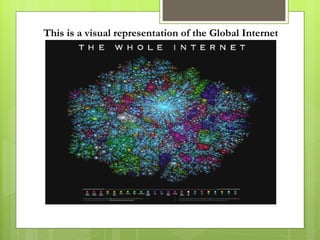
This is a visual representation of the Global Internet
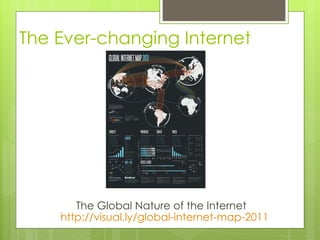
The Ever-changing Internet The Global Nature of the Internet http://visual.ly/global-internet-map-2011
What is the Internet? WWW Video conferencing E-commerce Email Social Networking A communication infrastructure Usefulness is in exchanging information
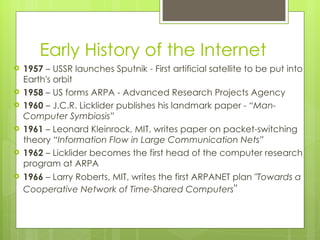
Early History of the Internet 1957  – USSR launches Sputnik - First artificial satellite to be put into Earth's orbit 1958  – US forms ARPA - Advanced Research Projects Agency 1960  – J.C.R. Licklider publishes his landmark paper -  “Man-Computer Symbiosis” 1961  – Leonard Kleinrock, MIT, writes paper on packet-switching theory  “Information Flow in Large Communication Nets” 1962  – Licklider becomes the first head of the computer research program at ARPA 1966  – Larry Roberts, MIT, writes the first ARPANET plan  "Towards a Cooperative Network of Time-Shared Computers "
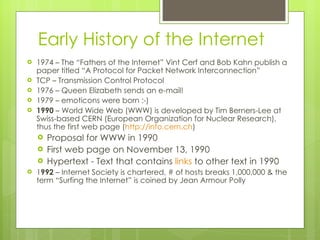
Early History of the Internet 1974 – The “Fathers of the Internet” Vint Cerf and Bob Kahn publish a paper titled “A Protocol for Packet Network Interconnection” TCP – Transmission Control Protocol 1976 – Queen Elizabeth sends an e-mail! 1979 – emoticons were born :-) 1990  – World Wide Web (WWW) is developed by Tim Berners-Lee at Swiss-based CERN (European Organization for Nuclear Research), thus the first web page ( http://info.cern.ch ) Proposal for WWW in 1990 First web page on November 13, 1990 Hypertext - Text that contains  links  to other text in 1990 1 992  – Internet Society is chartered, # of hosts breaks 1,000,000 & the term “Surfing the Internet” is coined by Jean Armour Polly
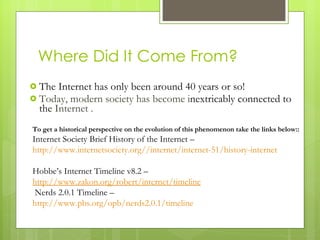
Where Did It Come From? The Internet has only been around 40 years or so!  Today, modern society has become i nextricably connected to  the  Internet . To get a historical perspective on the evolution of this phenomenon take the links below:: Internet Society Brief History of the Internet – http://www.internetsociety.org//internet/internet-51/history-internet  http://www.isoc.org/internet/history/brief.shtml Hobbe’s Internet Timeline v8.2 – http://www.zakon.org/robert/internet/timeline Nerds 2.0.1 Timeline – http://www.pbs.org/opb/nerds2.0.1/timeline
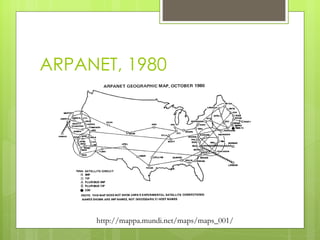
ARPANET, 1980 http://mappa.mundi.net/maps/maps_001/
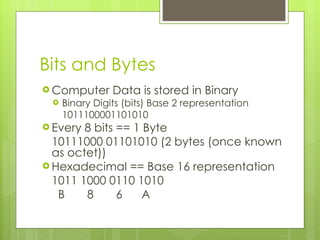
Bits and Bytes Computer Data is stored in Binary Binary Digits (bits) Base 2 representation 1011100001101010 Every 8 bits == 1 Byte 10111000 01101010 (2 bytes (once known as octet)) Hexadecimal == Base 16 representation 1011 1000 0110 1010   B  8  6  A
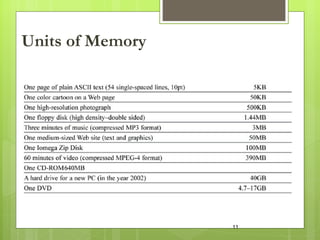
Bits and Bytes Kilobyte (2^10=1024 Bytes, 10^3=1000 Bytes in networking) Megabyte (2^20 Bytes, 10^6 in Networking) Gigabyte (2^30 Bytes, 10^9 in Networking) Terabyte (2^40, 10^12) Petabyte (2^50, 10^15)
Units of Memory
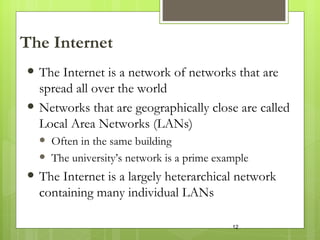
The Internet is a network of networks that are spread all over the world Networks that are geographically close are called Local Area Networks (LANs) Often in the same building The university’s network is a prime example The Internet is a largely heterarchical network containing many individual LANs The Internet
TCP/IP Protocol TCP/IP is the underlying protocol of the Internet It defines how data travels TCP - Guarantees the delivery of packets Delivers and reassembles packets in order to be viewed by recipient IP - Defines the way packets travel across the Internet  Sends packets to correct destination A packet is the unit of data that is routed between an origin and a destination on the Internet.(1500 bytes)
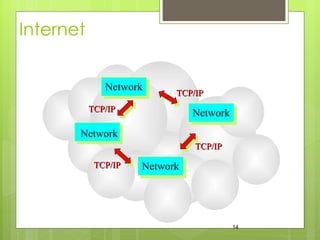
Network Network Network TCP/IP TCP/IP TCP/IP TCP/IP Network Internet
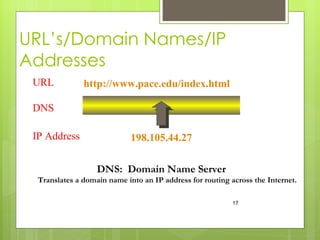
Defining the World Wide Web URL:  Uniform Resource Locator  i.e, http://www.pace.edu/index.html includes protocol, domain name, and file Domain Name:  An address for an entity on the WWW www.pace.edu
A domain name is simply an alias for an IP address IP address is a unique 32 bit number that identifies a specific system on the Internet i.e., - 198.105.44.27= pace.edu The reason we use domain names is because they are easy to remember.  Analogous to phone system 1-800-dominos vs. 1-800-366-4667 IP Addresses
http://www.pace.edu/index.html 198.105.44.27 URL DNS IP Address URL’s/Domain Names/IP Addresses DNS:  Domain Name Server Translates a domain name into an IP address for routing across the Internet.

Introduction to the Internet

  • 1.
    Introduction to theInternet A Historical Perspective CIS 101
  • 2.
    This is avisual representation of the Global Internet
  • 3.
    The Ever-changing InternetThe Global Nature of the Internet http://visual.ly/global-internet-map-2011
  • 4.
    What is theInternet? WWW Video conferencing E-commerce Email Social Networking A communication infrastructure Usefulness is in exchanging information
  • 5.
    Early History ofthe Internet 1957 – USSR launches Sputnik - First artificial satellite to be put into Earth's orbit 1958 – US forms ARPA - Advanced Research Projects Agency 1960 – J.C.R. Licklider publishes his landmark paper - “Man-Computer Symbiosis” 1961 – Leonard Kleinrock, MIT, writes paper on packet-switching theory “Information Flow in Large Communication Nets” 1962 – Licklider becomes the first head of the computer research program at ARPA 1966 – Larry Roberts, MIT, writes the first ARPANET plan "Towards a Cooperative Network of Time-Shared Computers "
  • 6.
    Early History ofthe Internet 1974 – The “Fathers of the Internet” Vint Cerf and Bob Kahn publish a paper titled “A Protocol for Packet Network Interconnection” TCP – Transmission Control Protocol 1976 – Queen Elizabeth sends an e-mail! 1979 – emoticons were born :-) 1990 – World Wide Web (WWW) is developed by Tim Berners-Lee at Swiss-based CERN (European Organization for Nuclear Research), thus the first web page ( http://info.cern.ch ) Proposal for WWW in 1990 First web page on November 13, 1990 Hypertext - Text that contains links to other text in 1990 1 992 – Internet Society is chartered, # of hosts breaks 1,000,000 & the term “Surfing the Internet” is coined by Jean Armour Polly
  • 7.
    Where Did ItCome From? The Internet has only been around 40 years or so! Today, modern society has become i nextricably connected to the Internet . To get a historical perspective on the evolution of this phenomenon take the links below:: Internet Society Brief History of the Internet – http://www.internetsociety.org//internet/internet-51/history-internet http://www.isoc.org/internet/history/brief.shtml Hobbe’s Internet Timeline v8.2 – http://www.zakon.org/robert/internet/timeline Nerds 2.0.1 Timeline – http://www.pbs.org/opb/nerds2.0.1/timeline
  • 8.
  • 9.
    Bits and BytesComputer Data is stored in Binary Binary Digits (bits) Base 2 representation 1011100001101010 Every 8 bits == 1 Byte 10111000 01101010 (2 bytes (once known as octet)) Hexadecimal == Base 16 representation 1011 1000 0110 1010 B 8 6 A
  • 10.
    Bits and BytesKilobyte (2^10=1024 Bytes, 10^3=1000 Bytes in networking) Megabyte (2^20 Bytes, 10^6 in Networking) Gigabyte (2^30 Bytes, 10^9 in Networking) Terabyte (2^40, 10^12) Petabyte (2^50, 10^15)
  • 11.
  • 12.
    The Internet isa network of networks that are spread all over the world Networks that are geographically close are called Local Area Networks (LANs) Often in the same building The university’s network is a prime example The Internet is a largely heterarchical network containing many individual LANs The Internet
  • 13.
    TCP/IP Protocol TCP/IPis the underlying protocol of the Internet It defines how data travels TCP - Guarantees the delivery of packets Delivers and reassembles packets in order to be viewed by recipient IP - Defines the way packets travel across the Internet Sends packets to correct destination A packet is the unit of data that is routed between an origin and a destination on the Internet.(1500 bytes)
  • 14.
    Network Network NetworkTCP/IP TCP/IP TCP/IP TCP/IP Network Internet
  • 15.
    Defining the WorldWide Web URL: Uniform Resource Locator i.e, http://www.pace.edu/index.html includes protocol, domain name, and file Domain Name: An address for an entity on the WWW www.pace.edu
  • 16.
    A domain nameis simply an alias for an IP address IP address is a unique 32 bit number that identifies a specific system on the Internet i.e., - 198.105.44.27= pace.edu The reason we use domain names is because they are easy to remember. Analogous to phone system 1-800-dominos vs. 1-800-366-4667 IP Addresses
  • 17.
    http://www.pace.edu/index.html 198.105.44.27 URLDNS IP Address URL’s/Domain Names/IP Addresses DNS: Domain Name Server Translates a domain name into an IP address for routing across the Internet.