IOSR Journal of Electronics and Communication Engineering (IOSR-JECE)
e-ISSN: 2278-2834,p- ISSN: 2278-8735.Volume 8, Issue 1 (Sep. - Oct. 2013), PP 61-66
www.iosrjournals.org
www.iosrjournals.org 61 | Page
Moving Object Tracking Distance and Velocity Determination
based on Background Subtraction Algorithm
B.Tharanidevi1
, R.Vadivu2
, K.B.Sethupathy3
1
(Department of ECE, Bharathiyar Institute of Engineering for Women, India)
2
(Department of ECE, Bharathiyar Institute of Engineering for Women, India)
3
(Department of ECE, Bharathiyar Institute of Engineering for Women, India)
Abstract: Currently, both the market and the academic communities have required applications based on
image and video processing with several real-time constraints. On the other hand, detection of moving objects is
a very important task in mobile robotics and surveillance applications. The project is proposes an efficient
motion detection and object velocity determination based on background subtraction using dynamic threshold
and morphological process. These methods are used effectively for object detection and most of previous
methods depend on the assumption that the background is static over short time periods. In dynamic threshold
based object detection, morphological process and filtering also used effectively for unwanted pixel removal
from the background. Then object is detected in a sequence of frames with respect to the frame rate that the
video is recorded. A simulation result proves that the proposed method is effective for background subtraction
for object detection compared to several competitive methods proposed in the literature and determination. The
method is able to identify moving persons, track them and provide unique tag for the tracked persons. The
background subtraction algorithm can also be used to detect multiple objects. The algorithms developed can
also be used for other applications (real time, object classification, etc.).
Keywords: Object tracking, Frame separation, Background Subtraction Algorithm, Object detection.
I. INTRODUCTION
Object tracking in a complex environment has long been an interesting and challenging problem. This
project deals with the single object tracking, background subtraction, and object detection. Detection of moving
objects is a very important task in mobile robotics and surveillance applications.
1.1 Motivation
The motivation behind this project is to develop software for tracking, the major application in security,
surveillance and vision analysis. The developed software must be capable of tracking any single object moving
in the frame and to simulate on software. This system might be useful for extending in real-time surveillance or
object classification.
1.2 Goal
Goal of this project is to develop an algorithm for tracking an object and determining the frame
subtraction and object detection. Algorithms can be extended for real time applications.
II. RELATED WORK
2.1 Pre-processing
The pre-processing performs some steps to improve the image quality. Few algorithms are explained
and filtering is done by using median filter and morphological filter.
2.2 Median Filter
In signal processing, it is often desirable to be able to perform some kind of noise reduction on an
image or signal. The median filter is a nonlinear digital filtering technique, often used to remove noise. Such
noise reduction is a typical pre-processing step to improve the results of later processing (for example, edge
detection on an image). Median filtering is very widely used in digital image processing because, under certain
conditions, it preserves edges while removing noise. The median filter is a classical noise removal filter. Noise
is removed by calculating the median from all its box elements and stores the value to the central element. If we
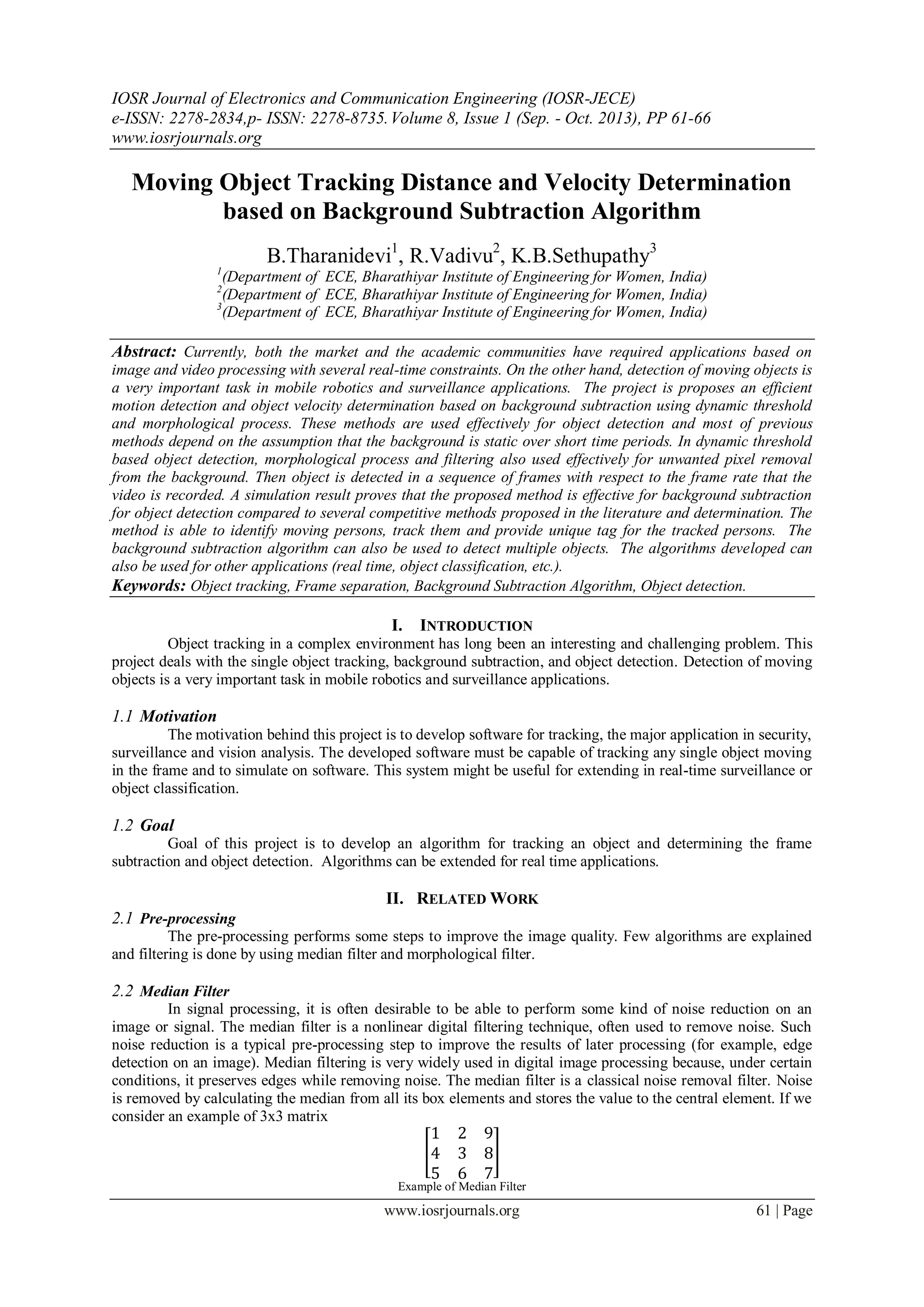
consider an example of 3x3 matrix
1 2 9
4 3 8
5 6 7
Example of Median Filter
Moving Object Tracking Distance and Velocity Determination based on Background Subtraction
www.iosrjournals.org 62 | Page
The median filter sorts the elements in a given matrix and median value is assigned to the central pixel.
Sorted elements 1, 2, 3, 4, 5, 6, 7, 8, 9 and median 5 will assign to the central element. Similar box scan is
performed over the whole image and reduces noise. Execution time is more compared to mean filter, since the
algorithm involves with sorting techniques. But it removes the small pixel noise.
2.1 Morphological Process
Morphological operations are applied on segmented binary image for smoothening the foreground
region. It processes the image based on shapes and it performs on image using structuring element. The
structuring elements will be created with specified shapes (disk, line, square) which contains 1‟s and 0‟s value
where ones are represents the neighborhood pixels. Dilation and erosion process will be used to enhance
(smoothening) the object region by removing the unwanted pixels from outside region of foreground object.
After this process, the pixels are applied for connected component analysis and then analysis the object region
for counting the objects.
2.2 Connected Component Analysis
The output of the change detection module is the binary image that contains only two labels, i.e., „0‟
and „255‟, representing as „background‟ and „foreground‟ pixels respectively, with some noise. The goal of the
connected component analysis is to detect the large sized connected foreground region or object. This is one of
the important operations in motion detection. The pixels that are collectively connected can be clustered into
changing or moving objects by analyzing their connectivity.
III. SEGMENTATION
Segmentation is the process of dividing digital image into multiple regions. Segmentation shows the
objects and boundaries in an image. Each Pixel in the region has some similar characteristics like color,
intensity, etc. Few methods for segmenting the images are explained below.
3.1 Background Subtraction Algorithm
Background subtraction is a computational vision process of extracting foreground objects in a
particular scene. A foreground object can be described as an object of attention which helps in reducing the
amount of data to be processed as well as provide important information to the task under consideration. Often,
the foreground object can be thought of as a coherently moving object in a scene. We must emphasize the word
coherent here because if a person is walking in front of moving leaves, the person forms the foreground object
while leaves though having motion associated with them are considered background due to its repetitive
behavior. In some cases, distance of the moving object also forms a basis for it to be considered a background,
e.g. if in a scene one person is close to the camera while there is a person far away in background, in this case
the nearby person is considered as foreground while the person far away is ignored due to its small size and the
lack of information that it provides. Identifying moving objects from a video sequence is a fundamental and
critical task in many computer-vision applications. A common approach is to perform background subtraction,
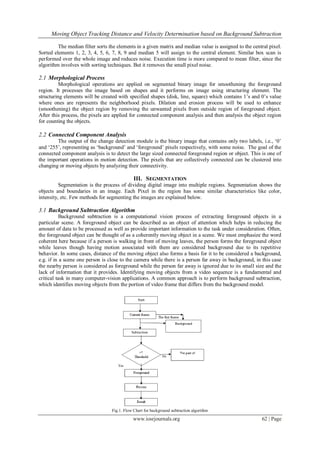
which identifies moving objects from the portion of video frame that differs from the background model.
Fig.1. Flow Chart for background subtraction algorithm
Moving Object Tracking Distance and Velocity Determination based on Background Subtraction
www.iosrjournals.org 63 | Page
Single background model is used to separate the background and foreground objects.
Fig.2. Single background Method
It is a statically method of separation. In this a set of frames (previous frames) are taken and the calculation is
done for separation. The separation is performed by calculating the mean and variance at each pixel position. If
we take N frames with pixel value P and intensity I.
Mean,µ =
1
p
[I(i)]
p
i=1
(1)
Variance, σ=
1
𝑝
[I i − µ]
𝑝
𝑖=1
(2)
Now after calculating the variance of each pixel, a threshold function is used to separate the foreground and
background objects. Figure 2 shows the single Gaussian background method while testing.
3.1 Frame Difference
Frame difference calculates the difference between two frames at every pixel position and store the
absolute difference. It is used to visualize the moving objects in a sequence of frames. Let us consider an
example, if we take a sequence of frames, the present frame and the next frame are taken into consideration at
every calculation and the frames are shifted (after calculation the next frame becomes present frame and the
frame that comes in sequence becomes next frame).
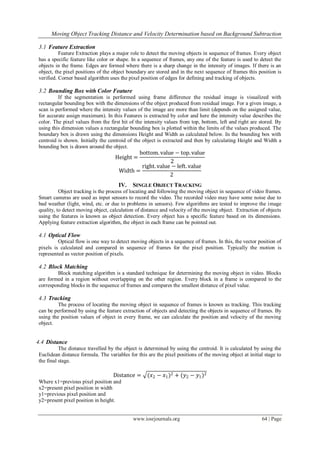
Fig.3. Frame difference between 2 frames
Frame difference is calculated step by step as shown in the fig 4. Let be the current frame and be the previous
frame. Now is subtracted from. Result should be the pixel variation between two adjacent frames.
Fig.4. Flow chart for frame difference method
𝑓𝑘−1
𝑓𝑘
Subtract
Binarization
Process
Result
Start
Moving Object Tracking Distance and Velocity Determination based on Background Subtraction
www.iosrjournals.org 64 | Page
3.1 Feature Extraction
Feature Extraction plays a major role to detect the moving objects in sequence of frames. Every object
has a specific feature like color or shape. In a sequence of frames, any one of the feature is used to detect the
objects in the frame. Edges are formed where there is a sharp change in the intensity of images. If there is an
object, the pixel positions of the object boundary are stored and in the next sequence of frames this position is
verified. Corner based algorithm uses the pixel position of edges for defining and tracking of objects.
3.2 Bounding Box with Color Feature
If the segmentation is performed using frame difference the residual image is visualized with
rectangular bounding box with the dimensions of the object produced from residual image. For a given image, a
scan is performed where the intensity values of the image are more than limit (depends on the assigned value,
for accurate assign maximum). In this Features is extracted by color and here the intensity value describes the
color. The pixel values from the first hit of the intensity values from top, bottom, left and right are stored. By
using this dimension values a rectangular bounding box is plotted within the limits of the values produced. The
boundary box is drawn using the dimensions Height and Width as calculated below. In the bounding box with
centroid is shown. Initially the centroid of the object is extracted and then by calculating Height and Width a
bounding box is drawn around the object.
Height =
bottom. value − top.value
2
Width =
right.value − left. value
2
IV. SINGLE OBJECT TRACKING
Object tracking is the process of locating and following the moving object in sequence of video frames.
Smart cameras are used as input sensors to record the video. The recorded video may have some noise due to
bad weather (light, wind, etc. or due to problems in sensors). Few algorithms are tested to improve the image
quality, to detect moving object, calculation of distance and velocity of the moving object. Extraction of objects
using the features is known as object detection. Every object has a specific feature based on its dimensions.
Applying feature extraction algorithm, the object in each frame can be pointed out.
4.1 Optical Flow
Optical flow is one way to detect moving objects in a sequence of frames. In this, the vector position of
pixels is calculated and compared in sequence of frames for the pixel position. Typically the motion is
represented as vector position of pixels.
4.2 Block Matching
Block matching algorithm is a standard technique for determining the moving object in video. Blocks
are formed in a region without overlapping on the other region. Every block in a frame is compared to the
corresponding blocks in the sequence of frames and compares the smallest distance of pixel value.
4.3 Tracking
The process of locating the moving object in sequence of frames is known as tracking. This tracking
can be performed by using the feature extraction of objects and detecting the objects in sequence of frames. By
using the position values of object in every frame, we can calculate the position and velocity of the moving
object.
4.4 Distance
The distance travelled by the object is determined by using the centroid. It is calculated by using the
Euclidean distance formula. The variables for this are the pixel positions of the moving object at initial stage to
the final stage.
Distance = (𝑥2 − 𝑥1)2 + (𝑦2 − 𝑦1)2
Where x1=previous pixel position and
x2=present pixel position in width
y1=previous pixel position and
y2=present pixel position in height.
Moving Object Tracking Distance and Velocity Determination based on Background Subtraction
www.iosrjournals.org 65 | Page
4.5 Velocity
The velocity of moving object is calculated by the distance it travelled with respect to the time.
Euclidean distance formula is used to calculate the distance between the sequences of frames.
By using the values of distance with respect to frame rate, the velocity of the object is defined. The
defined velocity is of 2-dimension (since camera is static).Velocity of moving object is determined using the
distance travelled by the centroid to the frame rate of the video. The velocity of moving object in the sequence
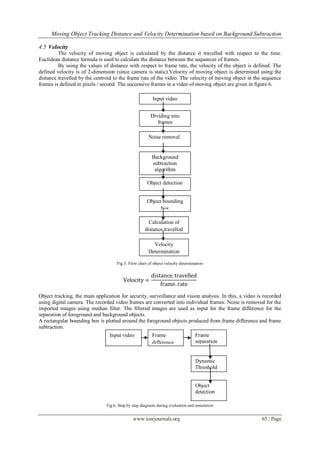
frames is defined in pixels / second. The successive frames in a video of moving object are given in figure 6.
Fig.5. Flow chart of object velocity determination
Velocity =
distance. travelled
frame. rate
Object tracking, the main application for security, surveillance and vision analysis. In this, a video is recorded
using digital camera. The recorded video frames are converted into individual frames. Noise is removed for the
imported images using median filter. The filtered images are used as input for the frame difference for the
separation of foreground and background objects.
A rectangular bounding box is plotted around the foreground objects produced from frame difference and frame
subtraction.
Fig.6. Step by step diagrams during evaluation and simulation
Input video
Dividing into
frames
Noise removal
Background
subtraction
algorithm
Object detection
Object bounding
box
Calculation of
distance travelled
Velocity
Determination
Input video Frame
difference
Frame
separation
Dynamic
Threshold
Object
detection
Moving Object Tracking Distance and Velocity Determination based on Background Subtraction
www.iosrjournals.org 66 | Page
Figure 5 shows the step by step process of tracking moving object detection. From this figure it is clear that the
inputs and the output produced at each step.
V. CONCLUSION AND FUTURE WORKS
Tracking of moving object is a major application in security, surveillance and vision analysis. In this, a
video is recorded using digital camera. The recorded video frames are converted into individual frames. Noise is
removed for the imported images using median filter and morphological filter. The filtered images are used as
input for the frame difference for the separation of foreground and background objects. The background
subtraction using dynamic threshold and morphological process. In dynamic threshold based object detection,
morphological process and filtering also used effectively for unwanted pixel removal from the background.
These methods are used effectively for object detection and most of previous methods depend on the assumption
that the background is static over short time periods. These algorithms can also be extended for the use of real-
time applications and object classifications. Future work as will extensions of the algorithm to include a
kinematic the smooth movement of objects, CC analysis, Object boundary box, distance and velocity
determination.
REFERENCES
[1] Lingfei Meng, Student Member, IEEE, and John P. Kerekes, Senior Member, IEEE,” Object Tracking Using High Resolution
Satellite Imagery”. IEEE Journal of selected topics in applied earth observations and remote sensing,2012 vol.5.
[2] M. Presnar, A. Raisanen, D. Pogorzala, J. Kerekes, and A. Rice, “Dynamic scene generation, multimodal sensor design, and target
tracking demonstration for hyperspectral/polarimetric performance-driven sensing,” in Proc. SPIE, 2010, vol. 7672.
[3] G.Marchisio, F.Pacifici, and C. Padwick, “On the relative predictive value of the new spectral bands in the Worldview-2 sensor,” in
Proc.2010 IEEE Int. Geoscience and Remote Sensing Symp., Jul.2010.
[4] TTI-Chicago, Chicago, IL, USA Minglun Gong, “Realtime background subtraction from dynamic scenes". Computer Vision, 2009
IEEE 12th International Conference.
[5] Yangquan Yu, Chunguang Zhou, Lan Huang.”A Moving Target Detection Algorithm Based on the Dynamic Background “.2009
IEEE.
[6] D. Lenhart, S. Hinz, J. Leitloff, and U. Stilla, “Automatic traffic monitoring based on aerial image sequences,” Pattern Recognit.
Image Anal., vol. 18, 2008.
[7] S. Hinz, D. Weihing, S. Suchandt, and R. Bamler, “Detection and velocity estimation of moving vehicles in high-resolution space
borne synthetic aperture radar data,” in Proc. 2008 Computer Vision and Pattern Recognition Workshops, Jun. 2008.
[8] S. Zhang, H. Yao, S. Liu, X. Chen, and W. Gao, “A covariance-based method for dynamic background subtraction,” in Proc. IEEE
Int. Conf. Pattern Recognition (ICPR), Dec. 2008.
[9] A.Yilmaz,O.Javed, and M. Shah, “Object tracking: A survey,” ACM Comput. Surv., vol. 38, Dec. 2006.
[10] Parameswaran, V Ramesh, V. Zoghlami, I. “Fast Crowd Segmentation Using Shape Indexing” 2007 IEEE
[11] Tao Zhao Intuitive Surg. Inc., Sunnyvale, CA Nevatia, R.;Bo Wu “Segmentation and Tracking of Multiple humans in crowded
environments” volume:30 2007.IEEE Computer society.
[12] S. Hinz, R. Bamler, and U. Stilla, “Theme issue:” Airborne and spaceborne traffic monitoring,” ISPRS J. Photogramm. Remote
Sens., vol. 61, no. 3–4, 2006.
[13] J.Kerekes,M.Muldowney,K.Strackerhan, L. Smith, and B. Leahy,“Vehicle tracking with multi-temporal hyperspectral imagery,” in
Proc.SPIE, 2006, vol. 6233, p. 62330C.

L0816166

  • 1.
    IOSR Journal ofElectronics and Communication Engineering (IOSR-JECE) e-ISSN: 2278-2834,p- ISSN: 2278-8735.Volume 8, Issue 1 (Sep. - Oct. 2013), PP 61-66 www.iosrjournals.org www.iosrjournals.org 61 | Page Moving Object Tracking Distance and Velocity Determination based on Background Subtraction Algorithm B.Tharanidevi1 , R.Vadivu2 , K.B.Sethupathy3 1 (Department of ECE, Bharathiyar Institute of Engineering for Women, India) 2 (Department of ECE, Bharathiyar Institute of Engineering for Women, India) 3 (Department of ECE, Bharathiyar Institute of Engineering for Women, India) Abstract: Currently, both the market and the academic communities have required applications based on image and video processing with several real-time constraints. On the other hand, detection of moving objects is a very important task in mobile robotics and surveillance applications. The project is proposes an efficient motion detection and object velocity determination based on background subtraction using dynamic threshold and morphological process. These methods are used effectively for object detection and most of previous methods depend on the assumption that the background is static over short time periods. In dynamic threshold based object detection, morphological process and filtering also used effectively for unwanted pixel removal from the background. Then object is detected in a sequence of frames with respect to the frame rate that the video is recorded. A simulation result proves that the proposed method is effective for background subtraction for object detection compared to several competitive methods proposed in the literature and determination. The method is able to identify moving persons, track them and provide unique tag for the tracked persons. The background subtraction algorithm can also be used to detect multiple objects. The algorithms developed can also be used for other applications (real time, object classification, etc.). Keywords: Object tracking, Frame separation, Background Subtraction Algorithm, Object detection. I. INTRODUCTION Object tracking in a complex environment has long been an interesting and challenging problem. This project deals with the single object tracking, background subtraction, and object detection. Detection of moving objects is a very important task in mobile robotics and surveillance applications. 1.1 Motivation The motivation behind this project is to develop software for tracking, the major application in security, surveillance and vision analysis. The developed software must be capable of tracking any single object moving in the frame and to simulate on software. This system might be useful for extending in real-time surveillance or object classification. 1.2 Goal Goal of this project is to develop an algorithm for tracking an object and determining the frame subtraction and object detection. Algorithms can be extended for real time applications. II. RELATED WORK 2.1 Pre-processing The pre-processing performs some steps to improve the image quality. Few algorithms are explained and filtering is done by using median filter and morphological filter. 2.2 Median Filter In signal processing, it is often desirable to be able to perform some kind of noise reduction on an image or signal. The median filter is a nonlinear digital filtering technique, often used to remove noise. Such noise reduction is a typical pre-processing step to improve the results of later processing (for example, edge detection on an image). Median filtering is very widely used in digital image processing because, under certain conditions, it preserves edges while removing noise. The median filter is a classical noise removal filter. Noise is removed by calculating the median from all its box elements and stores the value to the central element. If we consider an example of 3x3 matrix 1 2 9 4 3 8 5 6 7 Example of Median Filter
  • 2.
    Moving Object TrackingDistance and Velocity Determination based on Background Subtraction www.iosrjournals.org 62 | Page The median filter sorts the elements in a given matrix and median value is assigned to the central pixel. Sorted elements 1, 2, 3, 4, 5, 6, 7, 8, 9 and median 5 will assign to the central element. Similar box scan is performed over the whole image and reduces noise. Execution time is more compared to mean filter, since the algorithm involves with sorting techniques. But it removes the small pixel noise. 2.1 Morphological Process Morphological operations are applied on segmented binary image for smoothening the foreground region. It processes the image based on shapes and it performs on image using structuring element. The structuring elements will be created with specified shapes (disk, line, square) which contains 1‟s and 0‟s value where ones are represents the neighborhood pixels. Dilation and erosion process will be used to enhance (smoothening) the object region by removing the unwanted pixels from outside region of foreground object. After this process, the pixels are applied for connected component analysis and then analysis the object region for counting the objects. 2.2 Connected Component Analysis The output of the change detection module is the binary image that contains only two labels, i.e., „0‟ and „255‟, representing as „background‟ and „foreground‟ pixels respectively, with some noise. The goal of the connected component analysis is to detect the large sized connected foreground region or object. This is one of the important operations in motion detection. The pixels that are collectively connected can be clustered into changing or moving objects by analyzing their connectivity. III. SEGMENTATION Segmentation is the process of dividing digital image into multiple regions. Segmentation shows the objects and boundaries in an image. Each Pixel in the region has some similar characteristics like color, intensity, etc. Few methods for segmenting the images are explained below. 3.1 Background Subtraction Algorithm Background subtraction is a computational vision process of extracting foreground objects in a particular scene. A foreground object can be described as an object of attention which helps in reducing the amount of data to be processed as well as provide important information to the task under consideration. Often, the foreground object can be thought of as a coherently moving object in a scene. We must emphasize the word coherent here because if a person is walking in front of moving leaves, the person forms the foreground object while leaves though having motion associated with them are considered background due to its repetitive behavior. In some cases, distance of the moving object also forms a basis for it to be considered a background, e.g. if in a scene one person is close to the camera while there is a person far away in background, in this case the nearby person is considered as foreground while the person far away is ignored due to its small size and the lack of information that it provides. Identifying moving objects from a video sequence is a fundamental and critical task in many computer-vision applications. A common approach is to perform background subtraction, which identifies moving objects from the portion of video frame that differs from the background model. Fig.1. Flow Chart for background subtraction algorithm
  • 3.
    Moving Object TrackingDistance and Velocity Determination based on Background Subtraction www.iosrjournals.org 63 | Page Single background model is used to separate the background and foreground objects. Fig.2. Single background Method It is a statically method of separation. In this a set of frames (previous frames) are taken and the calculation is done for separation. The separation is performed by calculating the mean and variance at each pixel position. If we take N frames with pixel value P and intensity I. Mean,µ = 1 p [I(i)] p i=1 (1) Variance, σ= 1 𝑝 [I i − µ] 𝑝 𝑖=1 (2) Now after calculating the variance of each pixel, a threshold function is used to separate the foreground and background objects. Figure 2 shows the single Gaussian background method while testing. 3.1 Frame Difference Frame difference calculates the difference between two frames at every pixel position and store the absolute difference. It is used to visualize the moving objects in a sequence of frames. Let us consider an example, if we take a sequence of frames, the present frame and the next frame are taken into consideration at every calculation and the frames are shifted (after calculation the next frame becomes present frame and the frame that comes in sequence becomes next frame). Fig.3. Frame difference between 2 frames Frame difference is calculated step by step as shown in the fig 4. Let be the current frame and be the previous frame. Now is subtracted from. Result should be the pixel variation between two adjacent frames. Fig.4. Flow chart for frame difference method 𝑓𝑘−1 𝑓𝑘 Subtract Binarization Process Result Start
  • 4.
    Moving Object TrackingDistance and Velocity Determination based on Background Subtraction www.iosrjournals.org 64 | Page 3.1 Feature Extraction Feature Extraction plays a major role to detect the moving objects in sequence of frames. Every object has a specific feature like color or shape. In a sequence of frames, any one of the feature is used to detect the objects in the frame. Edges are formed where there is a sharp change in the intensity of images. If there is an object, the pixel positions of the object boundary are stored and in the next sequence of frames this position is verified. Corner based algorithm uses the pixel position of edges for defining and tracking of objects. 3.2 Bounding Box with Color Feature If the segmentation is performed using frame difference the residual image is visualized with rectangular bounding box with the dimensions of the object produced from residual image. For a given image, a scan is performed where the intensity values of the image are more than limit (depends on the assigned value, for accurate assign maximum). In this Features is extracted by color and here the intensity value describes the color. The pixel values from the first hit of the intensity values from top, bottom, left and right are stored. By using this dimension values a rectangular bounding box is plotted within the limits of the values produced. The boundary box is drawn using the dimensions Height and Width as calculated below. In the bounding box with centroid is shown. Initially the centroid of the object is extracted and then by calculating Height and Width a bounding box is drawn around the object. Height = bottom. value − top.value 2 Width = right.value − left. value 2 IV. SINGLE OBJECT TRACKING Object tracking is the process of locating and following the moving object in sequence of video frames. Smart cameras are used as input sensors to record the video. The recorded video may have some noise due to bad weather (light, wind, etc. or due to problems in sensors). Few algorithms are tested to improve the image quality, to detect moving object, calculation of distance and velocity of the moving object. Extraction of objects using the features is known as object detection. Every object has a specific feature based on its dimensions. Applying feature extraction algorithm, the object in each frame can be pointed out. 4.1 Optical Flow Optical flow is one way to detect moving objects in a sequence of frames. In this, the vector position of pixels is calculated and compared in sequence of frames for the pixel position. Typically the motion is represented as vector position of pixels. 4.2 Block Matching Block matching algorithm is a standard technique for determining the moving object in video. Blocks are formed in a region without overlapping on the other region. Every block in a frame is compared to the corresponding blocks in the sequence of frames and compares the smallest distance of pixel value. 4.3 Tracking The process of locating the moving object in sequence of frames is known as tracking. This tracking can be performed by using the feature extraction of objects and detecting the objects in sequence of frames. By using the position values of object in every frame, we can calculate the position and velocity of the moving object. 4.4 Distance The distance travelled by the object is determined by using the centroid. It is calculated by using the Euclidean distance formula. The variables for this are the pixel positions of the moving object at initial stage to the final stage. Distance = (𝑥2 − 𝑥1)2 + (𝑦2 − 𝑦1)2 Where x1=previous pixel position and x2=present pixel position in width y1=previous pixel position and y2=present pixel position in height.
  • 5.
    Moving Object TrackingDistance and Velocity Determination based on Background Subtraction www.iosrjournals.org 65 | Page 4.5 Velocity The velocity of moving object is calculated by the distance it travelled with respect to the time. Euclidean distance formula is used to calculate the distance between the sequences of frames. By using the values of distance with respect to frame rate, the velocity of the object is defined. The defined velocity is of 2-dimension (since camera is static).Velocity of moving object is determined using the distance travelled by the centroid to the frame rate of the video. The velocity of moving object in the sequence frames is defined in pixels / second. The successive frames in a video of moving object are given in figure 6. Fig.5. Flow chart of object velocity determination Velocity = distance. travelled frame. rate Object tracking, the main application for security, surveillance and vision analysis. In this, a video is recorded using digital camera. The recorded video frames are converted into individual frames. Noise is removed for the imported images using median filter. The filtered images are used as input for the frame difference for the separation of foreground and background objects. A rectangular bounding box is plotted around the foreground objects produced from frame difference and frame subtraction. Fig.6. Step by step diagrams during evaluation and simulation Input video Dividing into frames Noise removal Background subtraction algorithm Object detection Object bounding box Calculation of distance travelled Velocity Determination Input video Frame difference Frame separation Dynamic Threshold Object detection
  • 6.
    Moving Object TrackingDistance and Velocity Determination based on Background Subtraction www.iosrjournals.org 66 | Page Figure 5 shows the step by step process of tracking moving object detection. From this figure it is clear that the inputs and the output produced at each step. V. CONCLUSION AND FUTURE WORKS Tracking of moving object is a major application in security, surveillance and vision analysis. In this, a video is recorded using digital camera. The recorded video frames are converted into individual frames. Noise is removed for the imported images using median filter and morphological filter. The filtered images are used as input for the frame difference for the separation of foreground and background objects. The background subtraction using dynamic threshold and morphological process. In dynamic threshold based object detection, morphological process and filtering also used effectively for unwanted pixel removal from the background. These methods are used effectively for object detection and most of previous methods depend on the assumption that the background is static over short time periods. These algorithms can also be extended for the use of real- time applications and object classifications. Future work as will extensions of the algorithm to include a kinematic the smooth movement of objects, CC analysis, Object boundary box, distance and velocity determination. REFERENCES [1] Lingfei Meng, Student Member, IEEE, and John P. Kerekes, Senior Member, IEEE,” Object Tracking Using High Resolution Satellite Imagery”. IEEE Journal of selected topics in applied earth observations and remote sensing,2012 vol.5. [2] M. Presnar, A. Raisanen, D. Pogorzala, J. Kerekes, and A. Rice, “Dynamic scene generation, multimodal sensor design, and target tracking demonstration for hyperspectral/polarimetric performance-driven sensing,” in Proc. SPIE, 2010, vol. 7672. [3] G.Marchisio, F.Pacifici, and C. Padwick, “On the relative predictive value of the new spectral bands in the Worldview-2 sensor,” in Proc.2010 IEEE Int. Geoscience and Remote Sensing Symp., Jul.2010. [4] TTI-Chicago, Chicago, IL, USA Minglun Gong, “Realtime background subtraction from dynamic scenes". Computer Vision, 2009 IEEE 12th International Conference. [5] Yangquan Yu, Chunguang Zhou, Lan Huang.”A Moving Target Detection Algorithm Based on the Dynamic Background “.2009 IEEE. [6] D. Lenhart, S. Hinz, J. Leitloff, and U. Stilla, “Automatic traffic monitoring based on aerial image sequences,” Pattern Recognit. Image Anal., vol. 18, 2008. [7] S. Hinz, D. Weihing, S. Suchandt, and R. Bamler, “Detection and velocity estimation of moving vehicles in high-resolution space borne synthetic aperture radar data,” in Proc. 2008 Computer Vision and Pattern Recognition Workshops, Jun. 2008. [8] S. Zhang, H. Yao, S. Liu, X. Chen, and W. Gao, “A covariance-based method for dynamic background subtraction,” in Proc. IEEE Int. Conf. Pattern Recognition (ICPR), Dec. 2008. [9] A.Yilmaz,O.Javed, and M. Shah, “Object tracking: A survey,” ACM Comput. Surv., vol. 38, Dec. 2006. [10] Parameswaran, V Ramesh, V. Zoghlami, I. “Fast Crowd Segmentation Using Shape Indexing” 2007 IEEE [11] Tao Zhao Intuitive Surg. Inc., Sunnyvale, CA Nevatia, R.;Bo Wu “Segmentation and Tracking of Multiple humans in crowded environments” volume:30 2007.IEEE Computer society. [12] S. Hinz, R. Bamler, and U. Stilla, “Theme issue:” Airborne and spaceborne traffic monitoring,” ISPRS J. Photogramm. Remote Sens., vol. 61, no. 3–4, 2006. [13] J.Kerekes,M.Muldowney,K.Strackerhan, L. Smith, and B. Leahy,“Vehicle tracking with multi-temporal hyperspectral imagery,” in Proc.SPIE, 2006, vol. 6233, p. 62330C.