Object Tracking
Presentation prepared by:
Muhammad Ahmad Amin
MS(SE) - 4
Introduction to Object tracking
Applications Of Object tracking
Object Representation
Object Detection
Steps in Object tracking
Object tracking Algorithm’s
Methodologies
Comparison
Conclusion
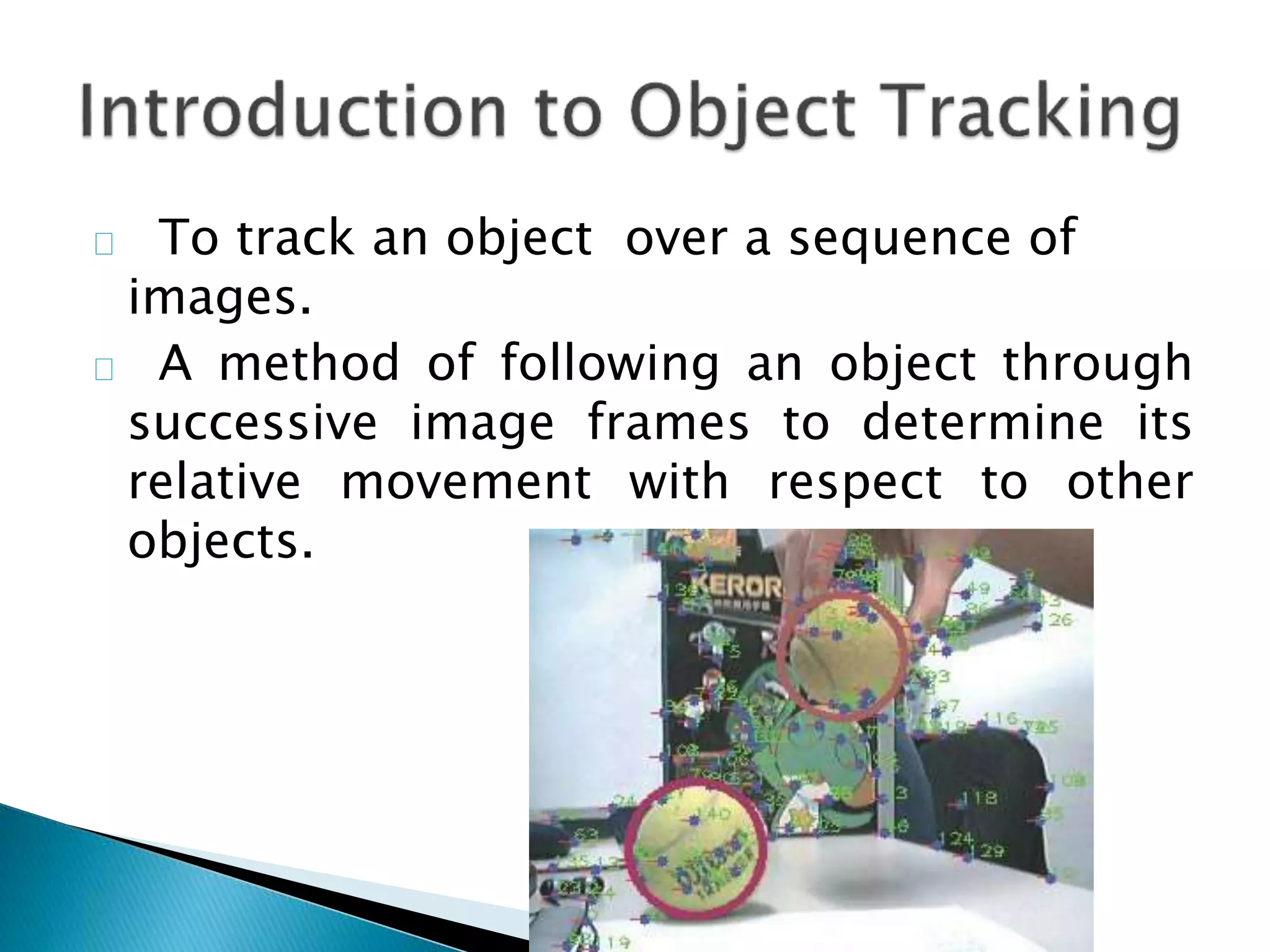
To track an object over a sequence of
images.
A method of following an object through
successive image frames to determine its
relative movement with respect to other
objects.
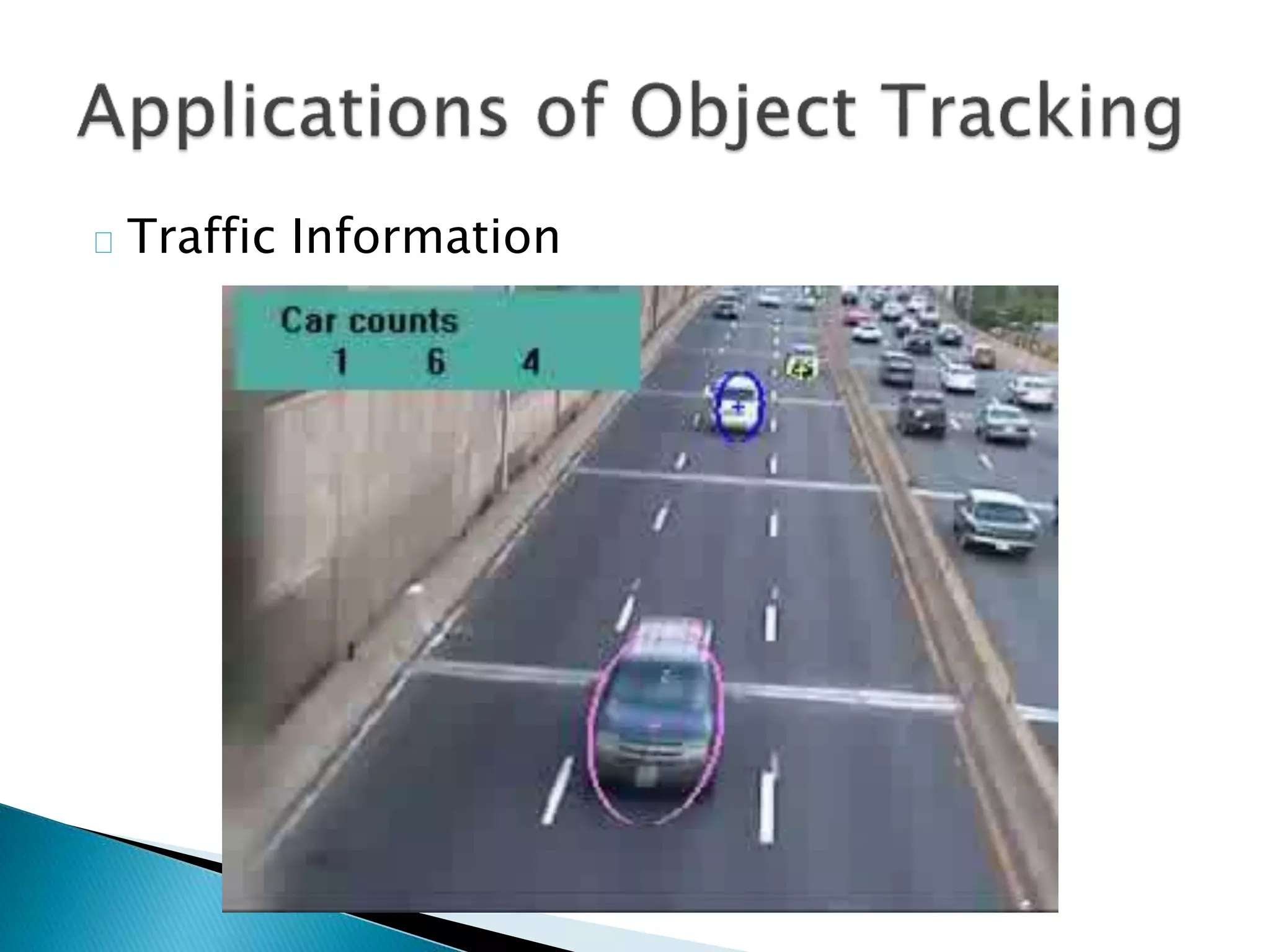
Traffic Information
In a tracking scenario, an object can be defined as
anything that is of interest for further analysis. Objects
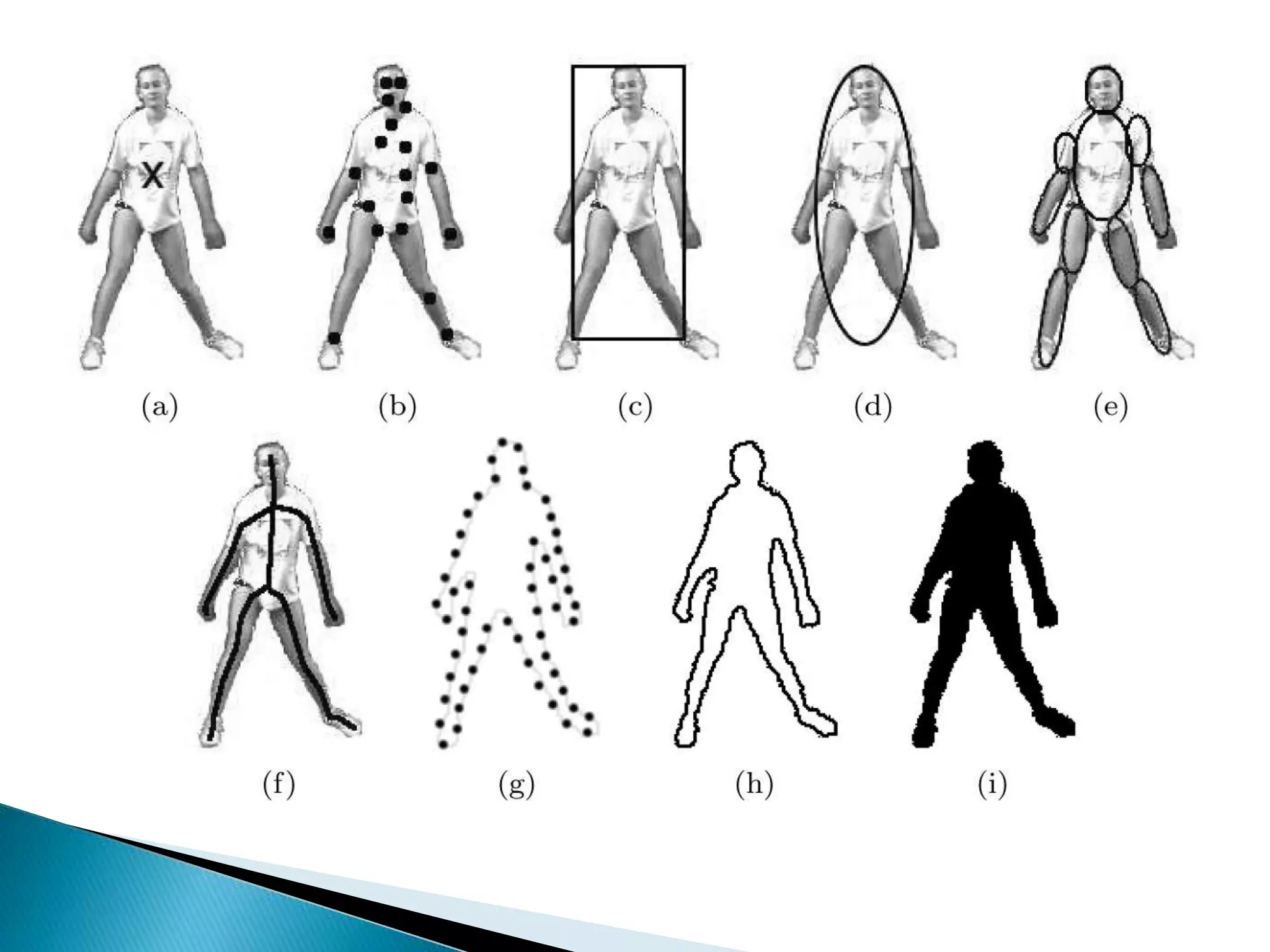
can be represented by their shapes. Object shape
representations commonly employed for tracking are:
Points: The object is represented by a point, that is,
centroid or set of points. Point representation is suitable
for tracking objects that occupy small regions in an image.
Primitive geometric shapes: Object shape is
represented by a rectangle, ellipse etc. these are suitable
for representing simple rigid objects and non rigid objects.
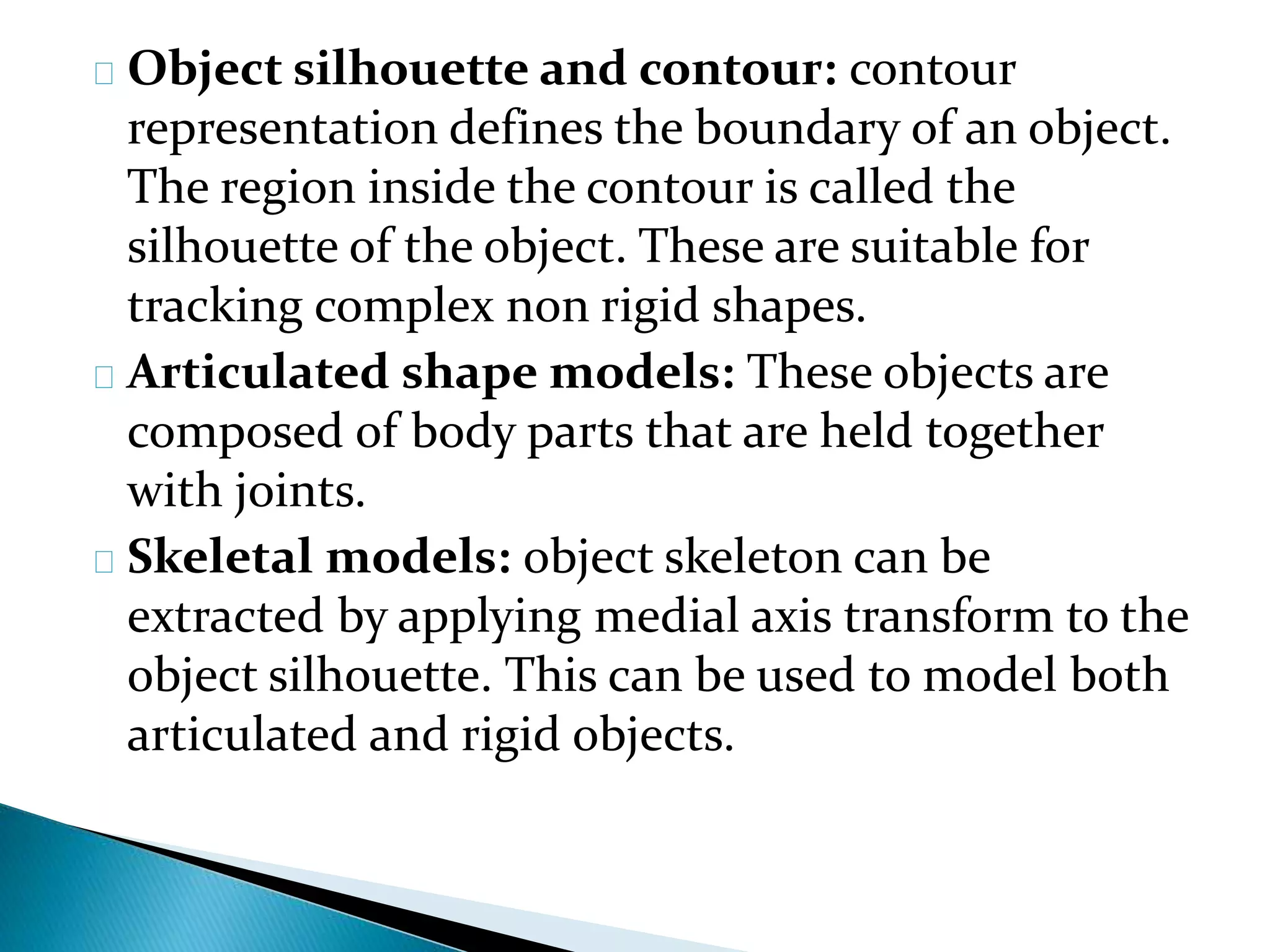
Object silhouette and contour: contour
representation defines the boundary of an object.
The region inside the contour is called the
silhouette of the object. These are suitable for
tracking complex non rigid shapes.
Articulated shape models: These objects are
composed of body parts that are held together
with joints.
Skeletal models: object skeleton can be
extracted by applying medial axis transform to the
object silhouette. This can be used to model both
articulated and rigid objects.
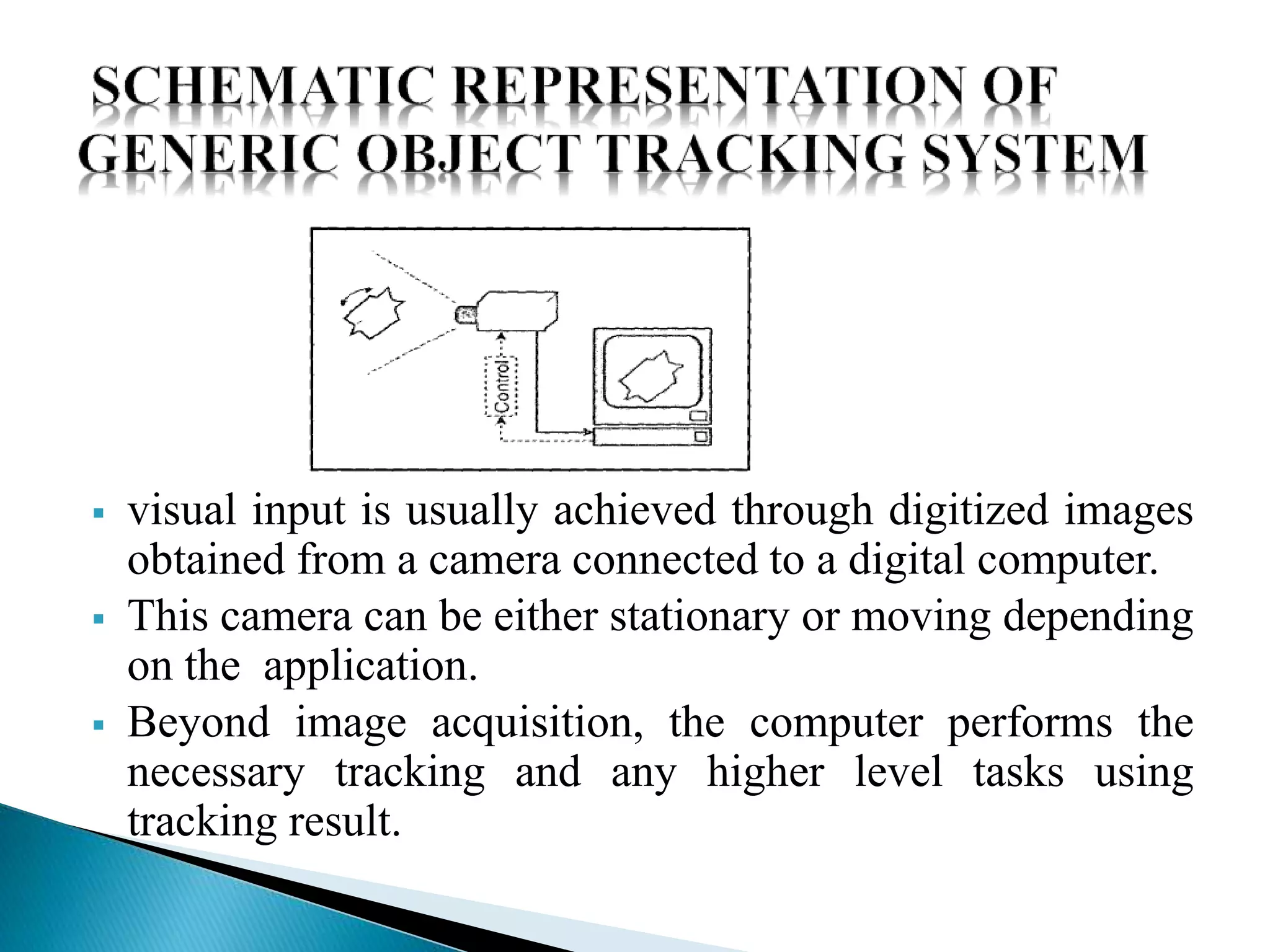
 visual input is usually achieved through digitized images
obtained from a camera connected to a digital computer.
 This camera can be either stationary or moving depending
on the application.
 Beyond image acquisition, the computer performs the
necessary tracking and any higher level tasks using
tracking result.
Every tracking method requires an object detection
mechanism either in every frame or when the object
first appears in the video.
Challenges of moving object detection:
• Loss of information caused by the 3D world on a 2D
image
• Noise in images
• Complex object motion
• Non-rigid or articulated nature of objects
• Partial or full object occlusions
• Complex object shapes
• Scene illumination changes
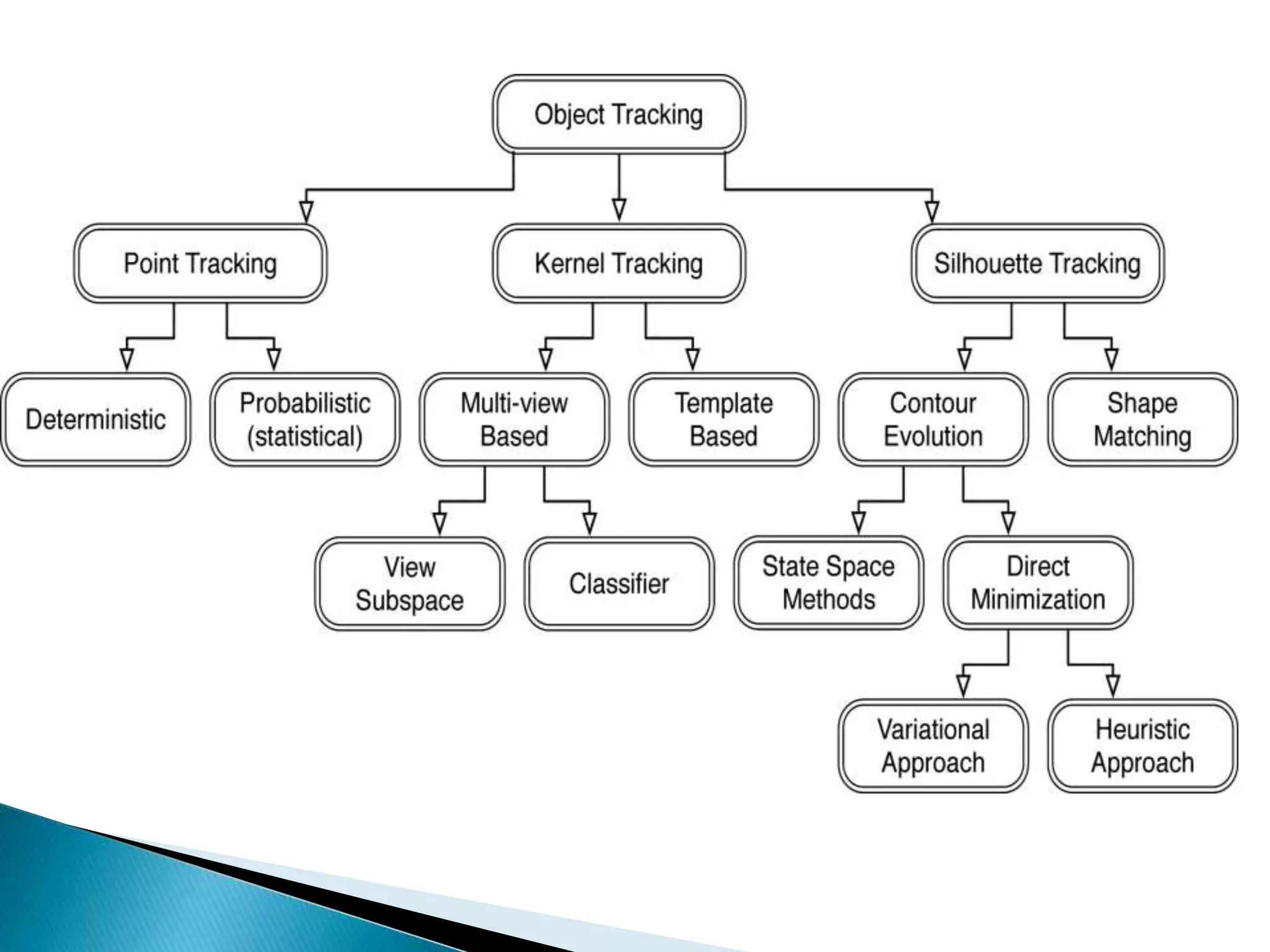
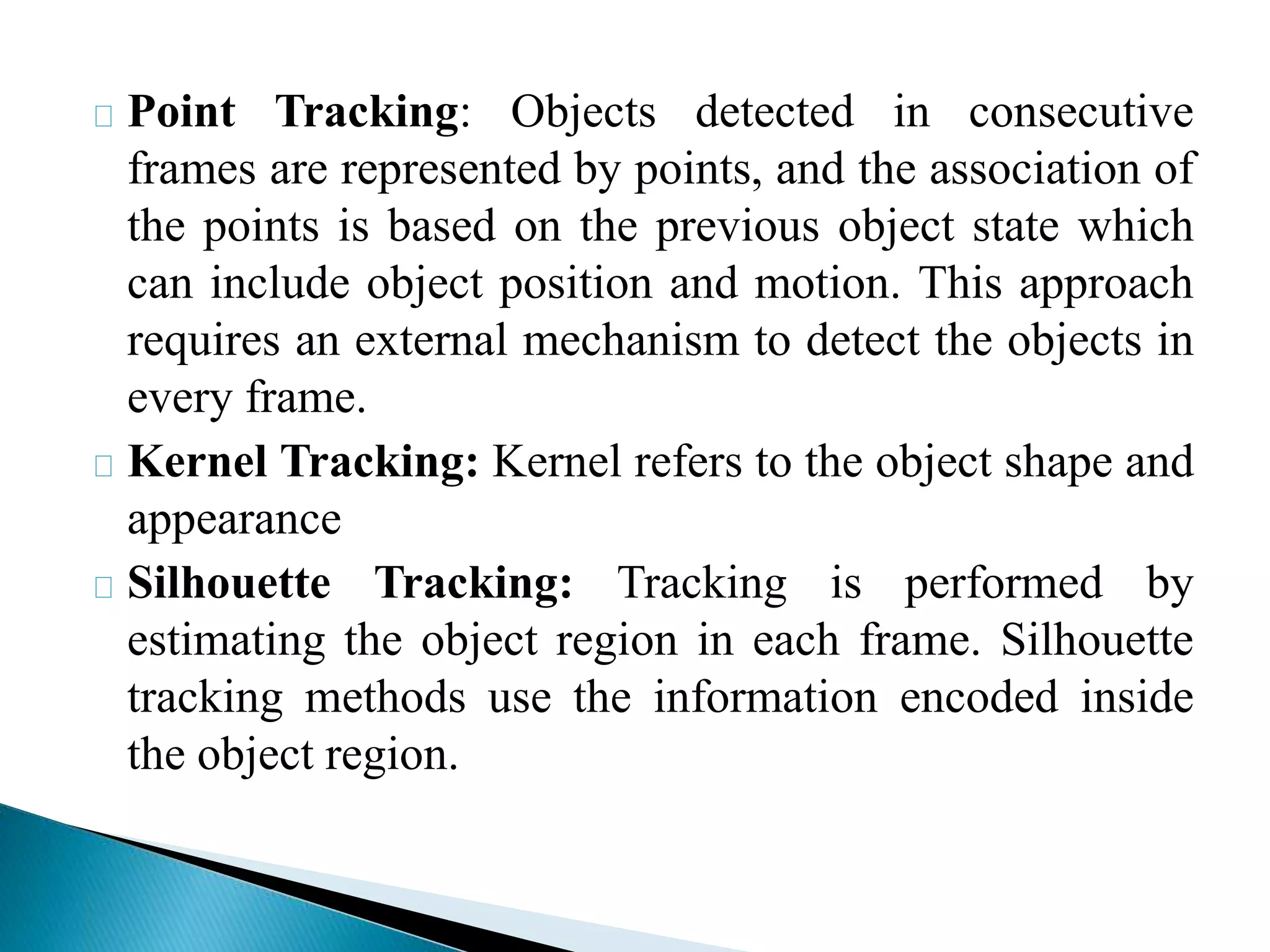
Point Tracking: Objects detected in consecutive
frames are represented by points, and the association of
the points is based on the previous object state which
can include object position and motion. This approach
requires an external mechanism to detect the objects in
every frame.
Kernel Tracking: Kernel refers to the object shape and
appearance
Silhouette Tracking: Tracking is performed by
estimating the object region in each frame. Silhouette
tracking methods use the information encoded inside
the object region.
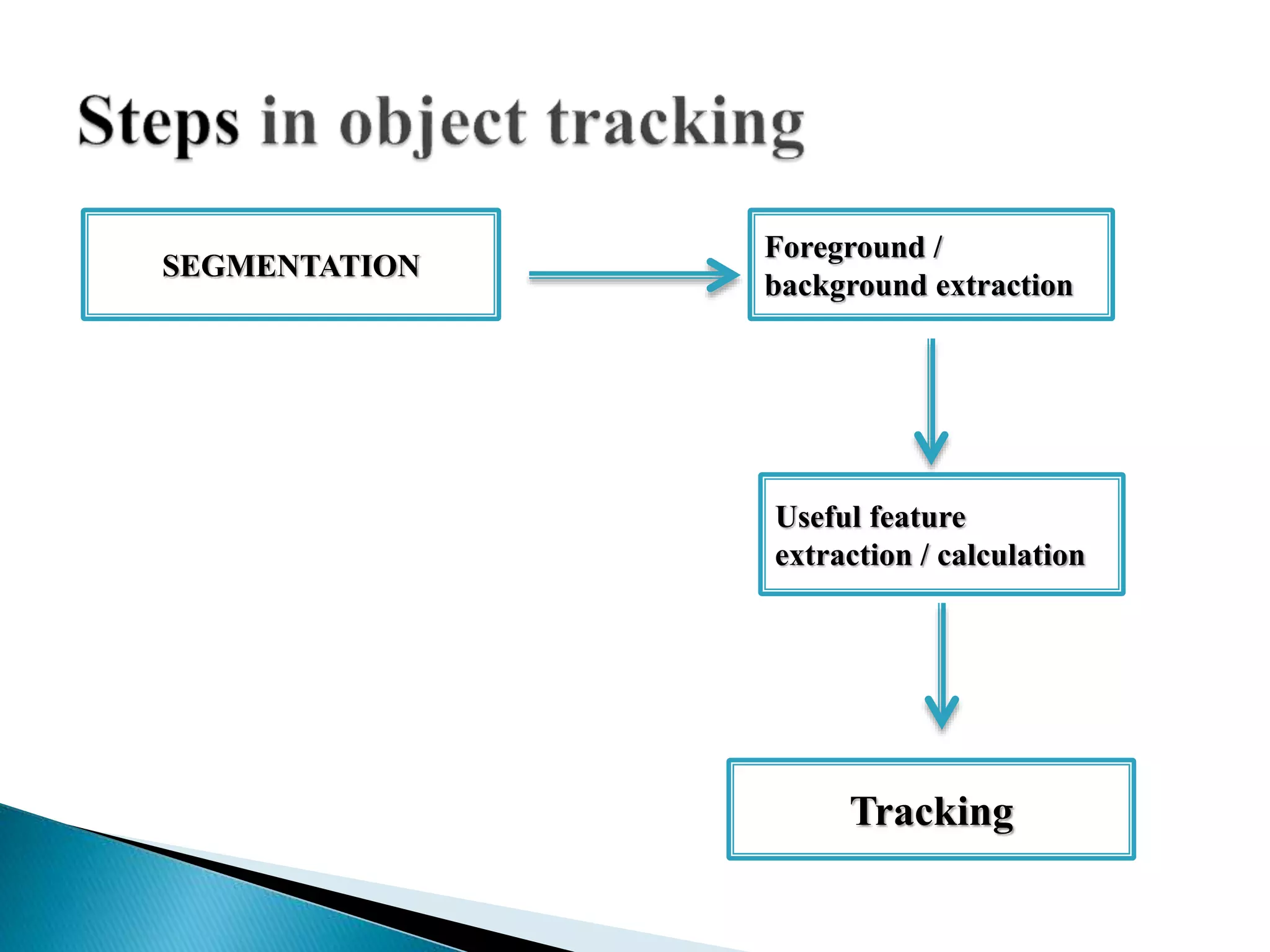
SEGMENTATION
Foreground /
background extraction
Useful feature
extraction / calculation
Tracking
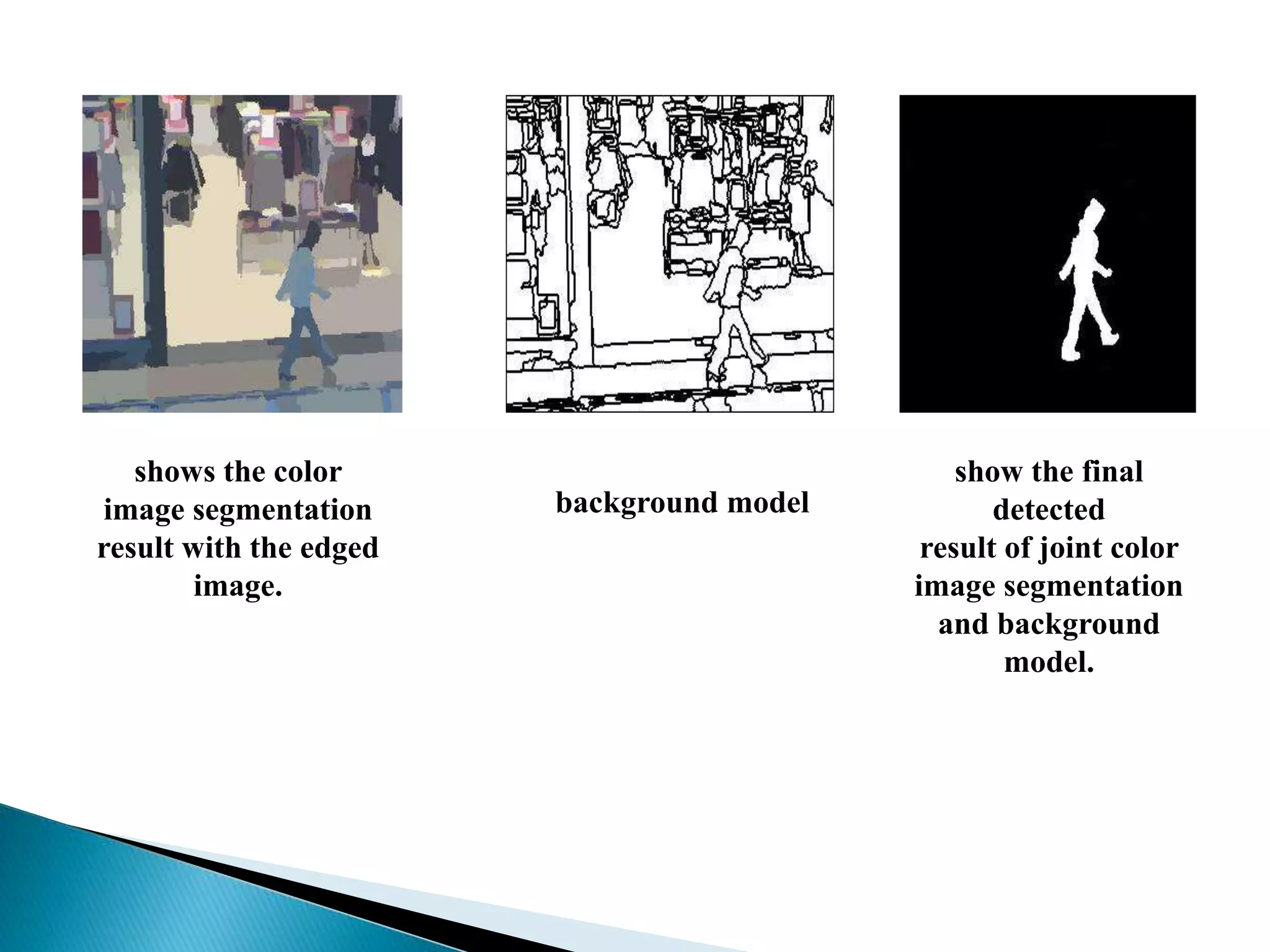
shows the color
image segmentation
result with the edged
image.
show the final
detected
result of joint color
image segmentation
and background
model.
background model
Segmentation is the process of identifying components
of the image. Segmentation involves operations such as
boundary detection, connected component labeling,
thresholding etc. Boundary detection finds out edges in
the image. Thresholding is the process of reducing the
grey levels in the image
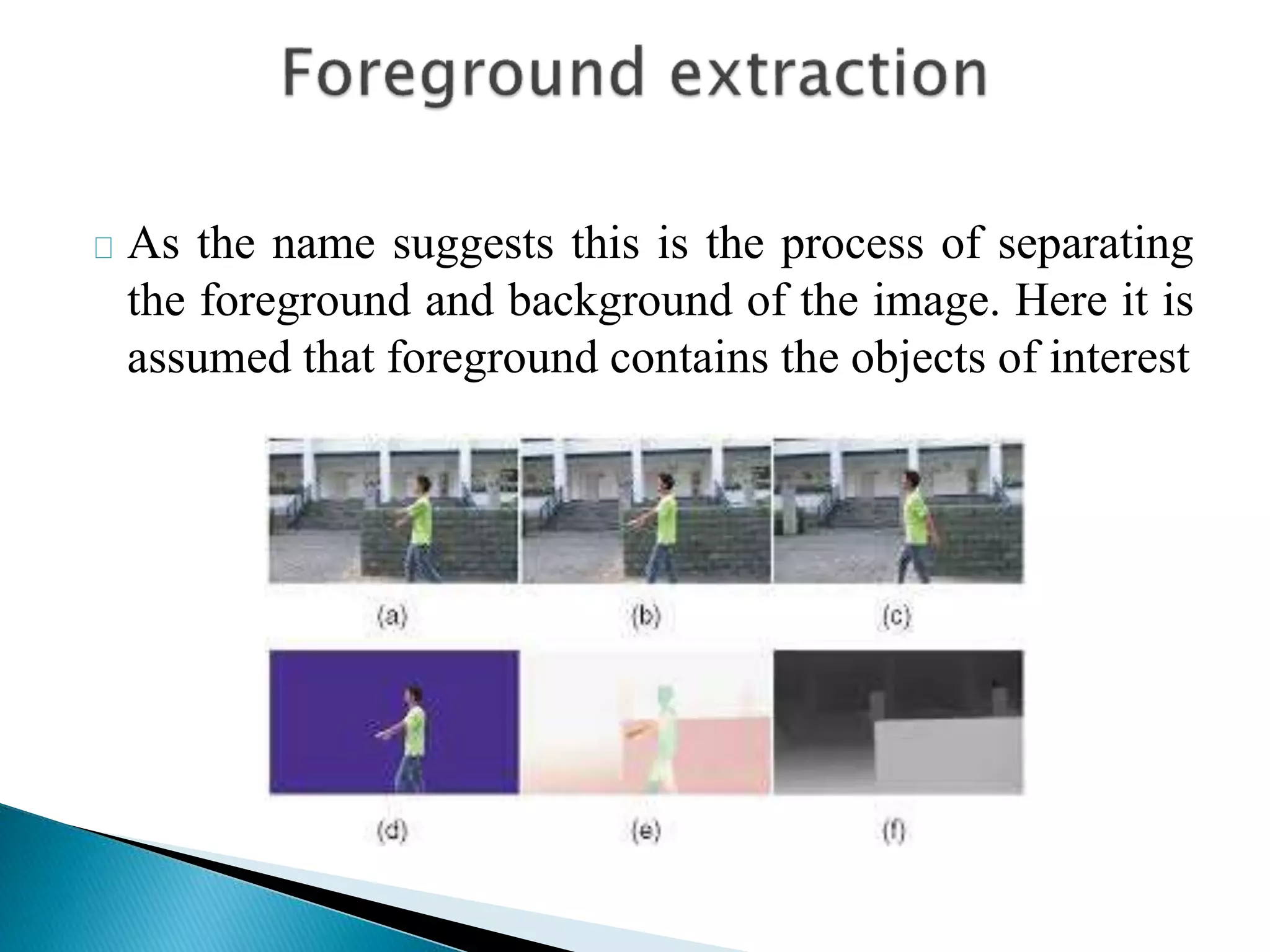
As the name suggests this is the process of separating
the foreground and background of the image. Here it is
assumed that foreground contains the objects of interest
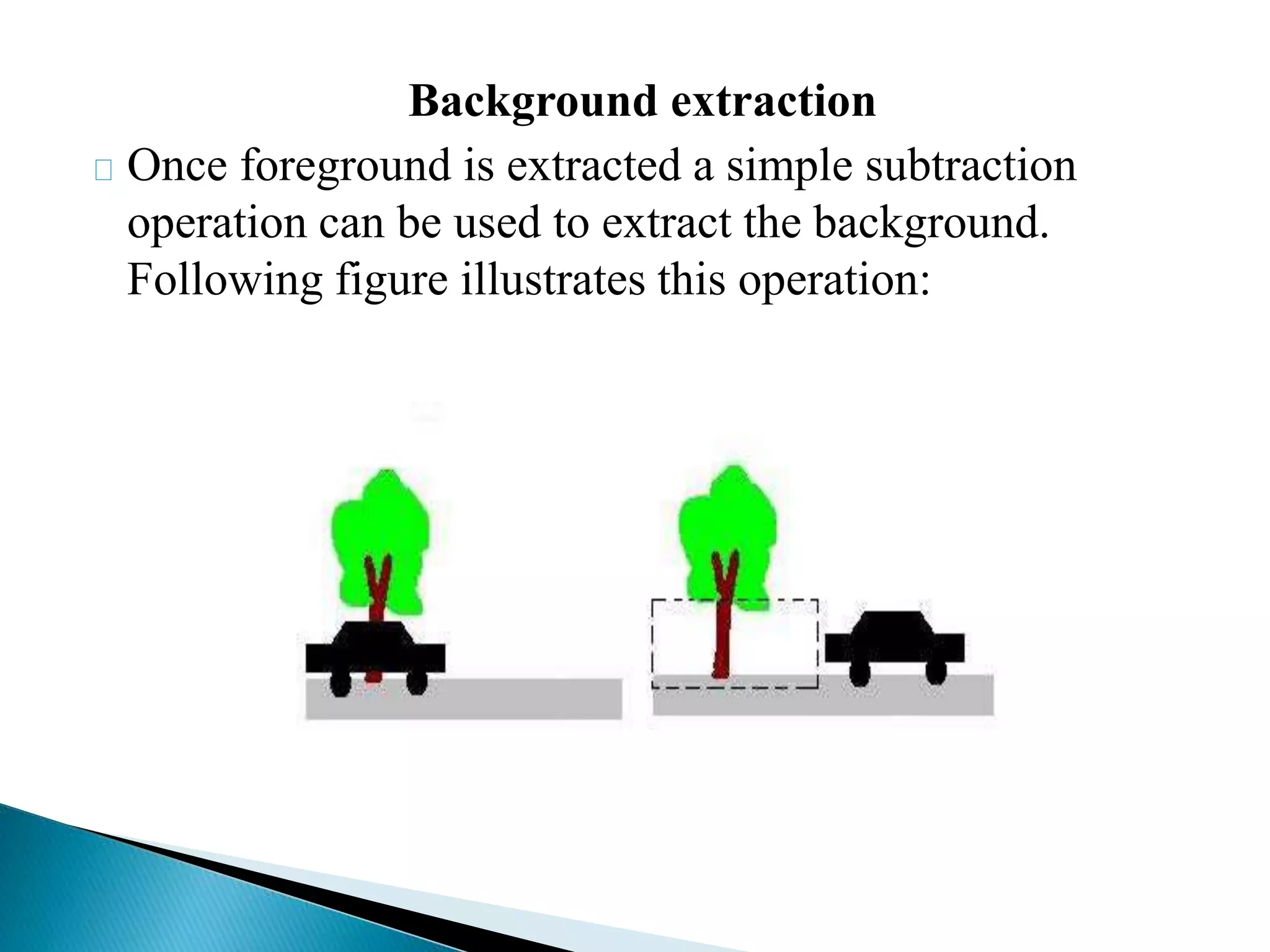
Background extraction
Once foreground is extracted a simple subtraction
operation can be used to extract the background.
Following figure illustrates this operation:
Camera model is an important aspect of any object-tracking
algorithm. All the existing objects tracking systems use a
preset camera model. In words camera model is directly
derived from the domain knowledge. Some of the common
camera models are –
1. Single fixed camera
Example: Road traffic tracking system
2. Multiple fixed cameras
Example: Simple surveillance system
3. Single moving camera
Example: Animation and video compression systems
4. Multiple moving cameras
Example: Robot navigation system
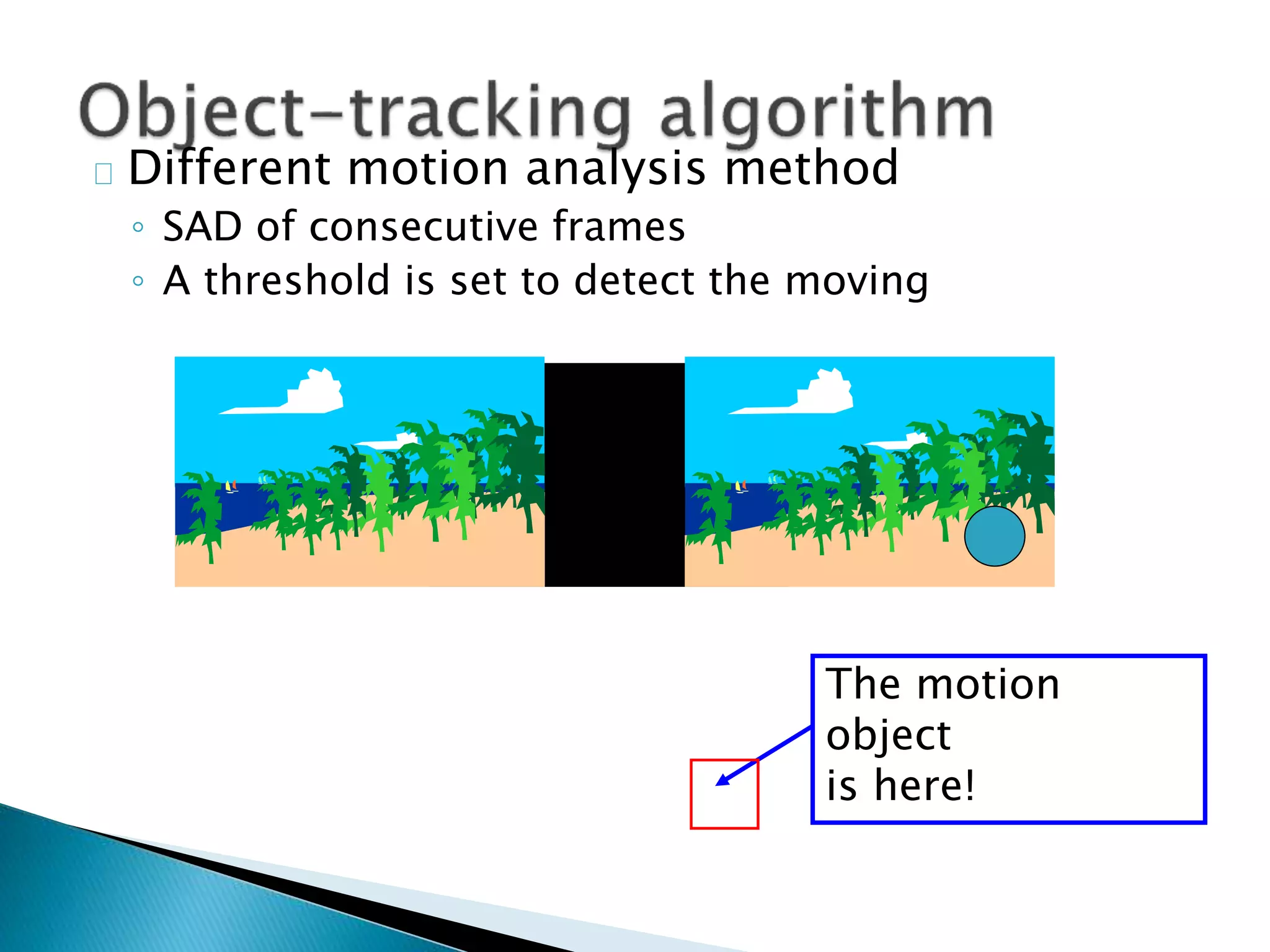
Different motion analysis method
◦ SAD of consecutive frames
◦ A threshold is set to detect the moving
The motion
object
is here!
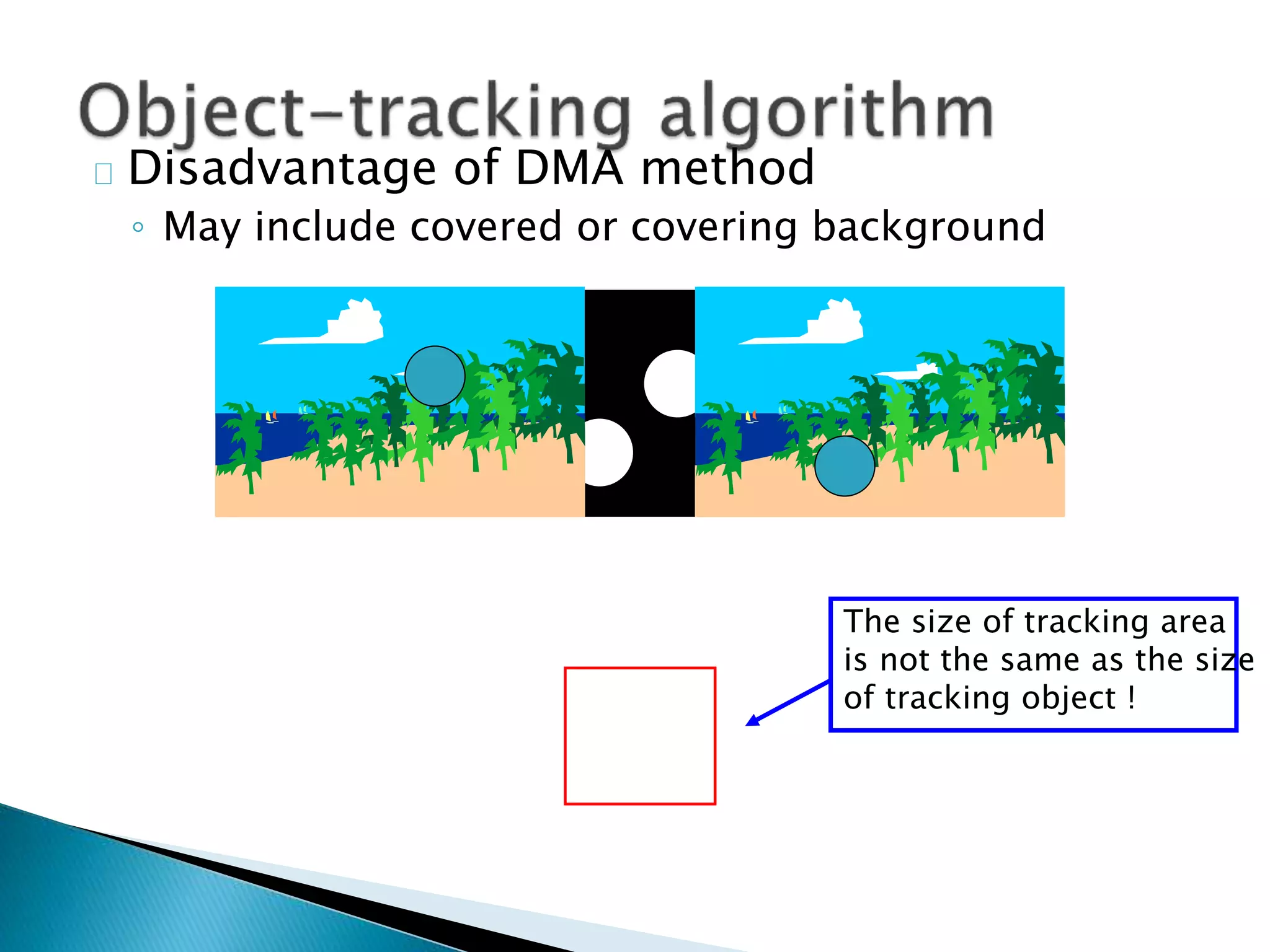
Disadvantage of DMA method
◦ May include covered or covering background
The size of tracking area
is not the same as the size
of tracking object !
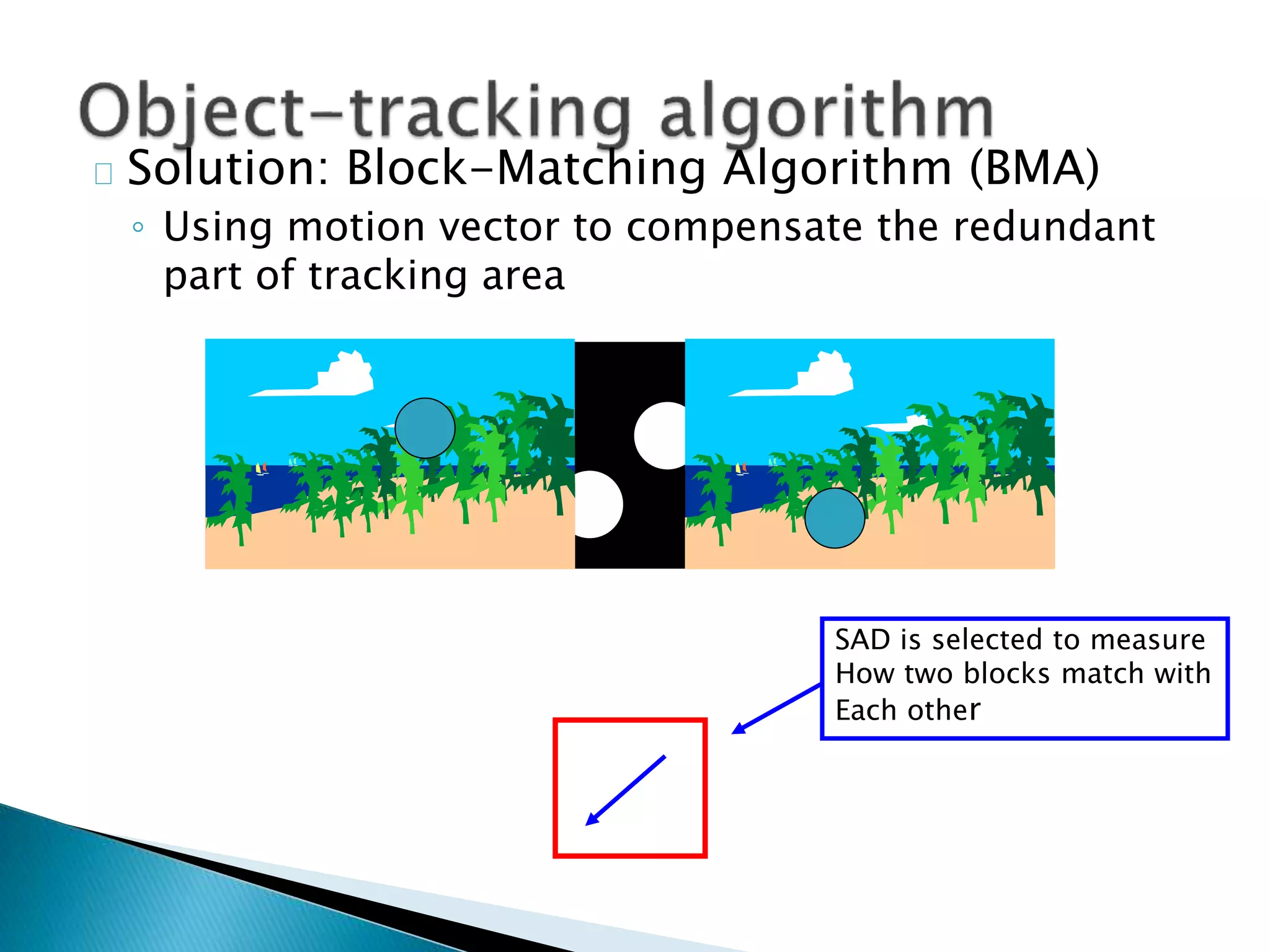
Solution: Block-Matching Algorithm (BMA)
◦ Using motion vector to compensate the redundant
part of tracking area
SAD is selected to measure
How two blocks match with
Each other
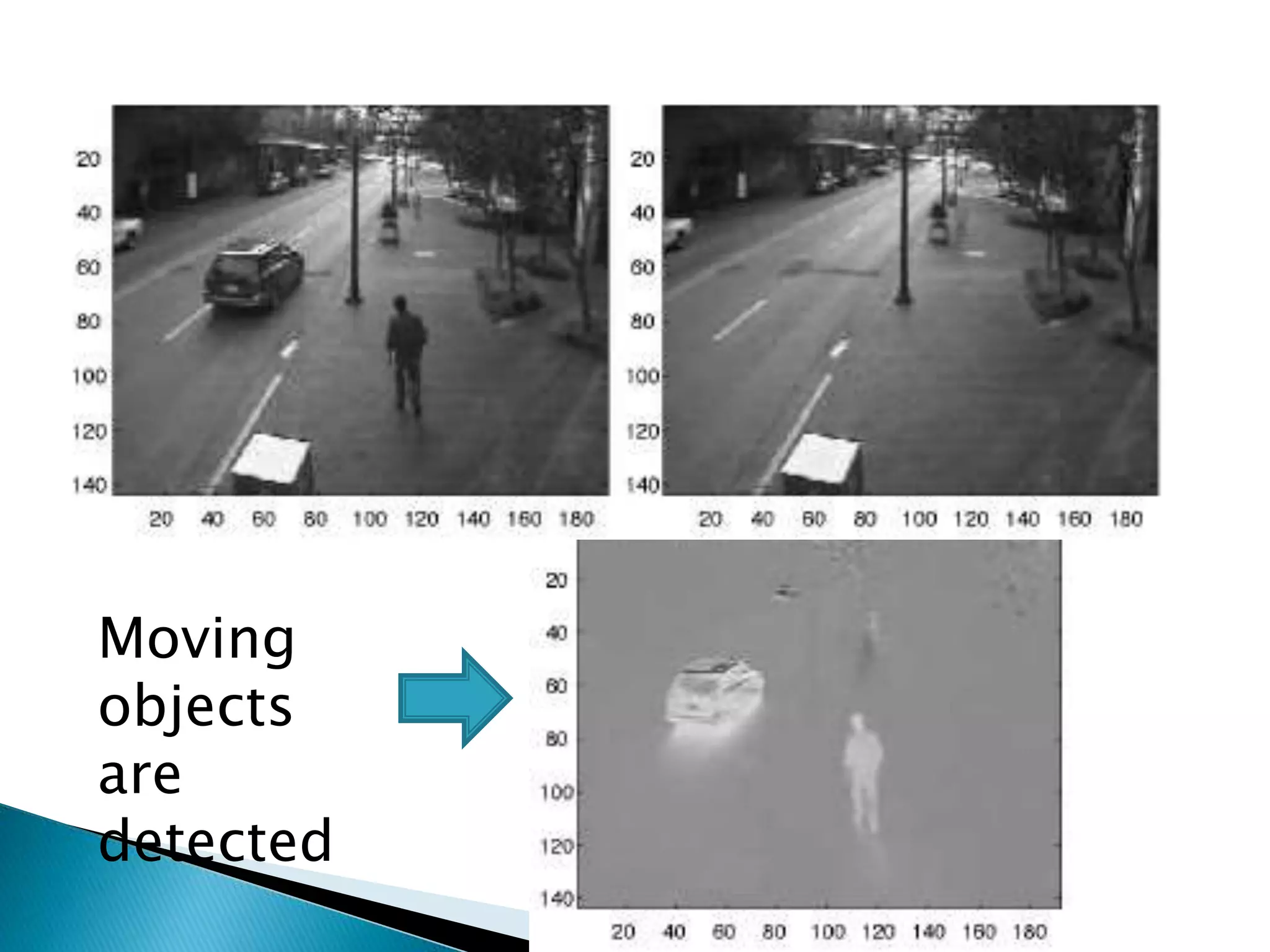
= Image subtraction
D(t)=I(ti) – I(tj)
 Gives an image frame with changed and
unchanged regions
Ideal Case for no motion: I(ti) = I(tj),
D(t)=0
Moving
objects
are
detected
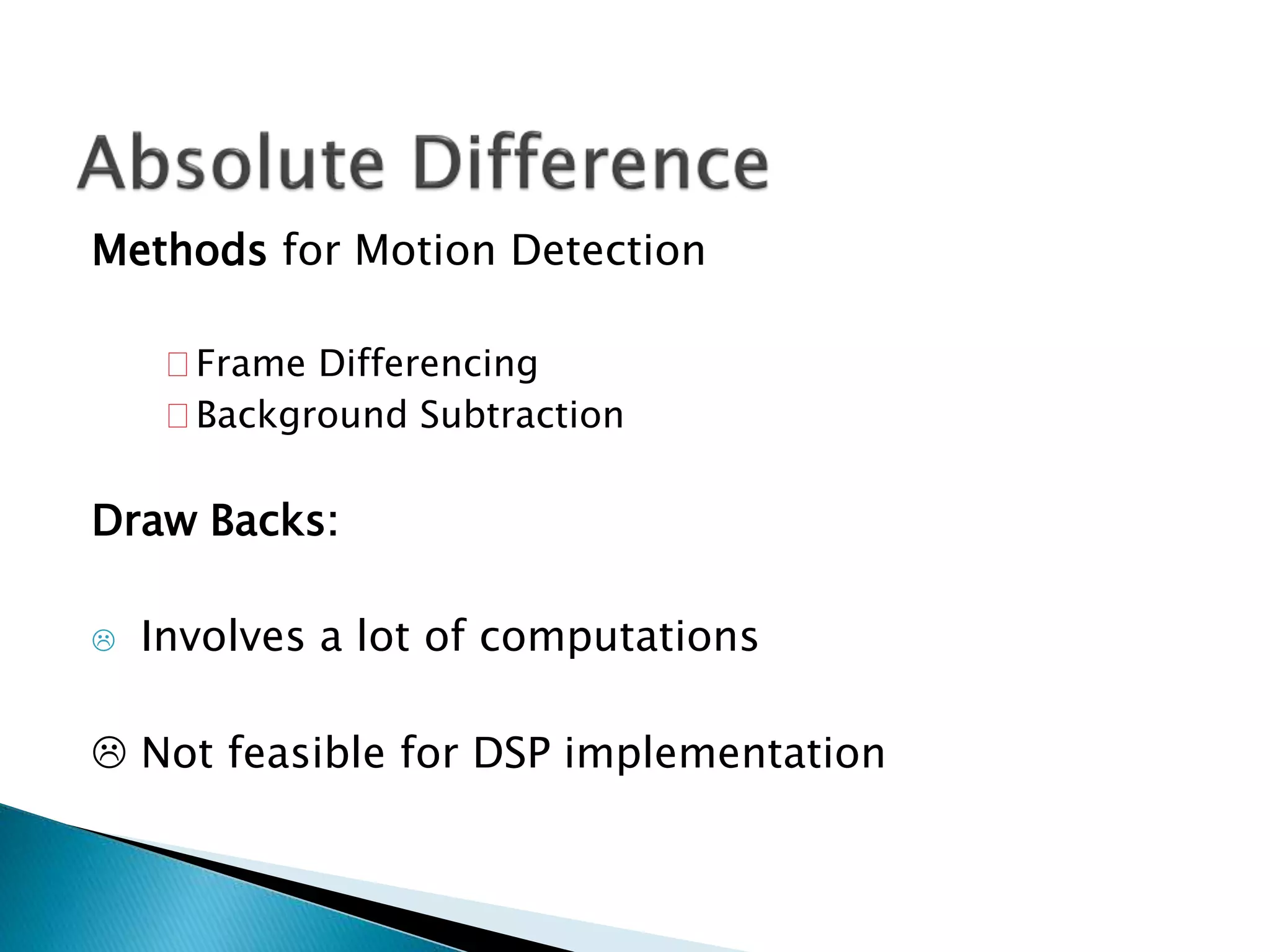
Methods for Motion Detection
Frame Differencing
Background Subtraction
Draw Backs:
 Involves a lot of computations
 Not feasible for DSP implementation
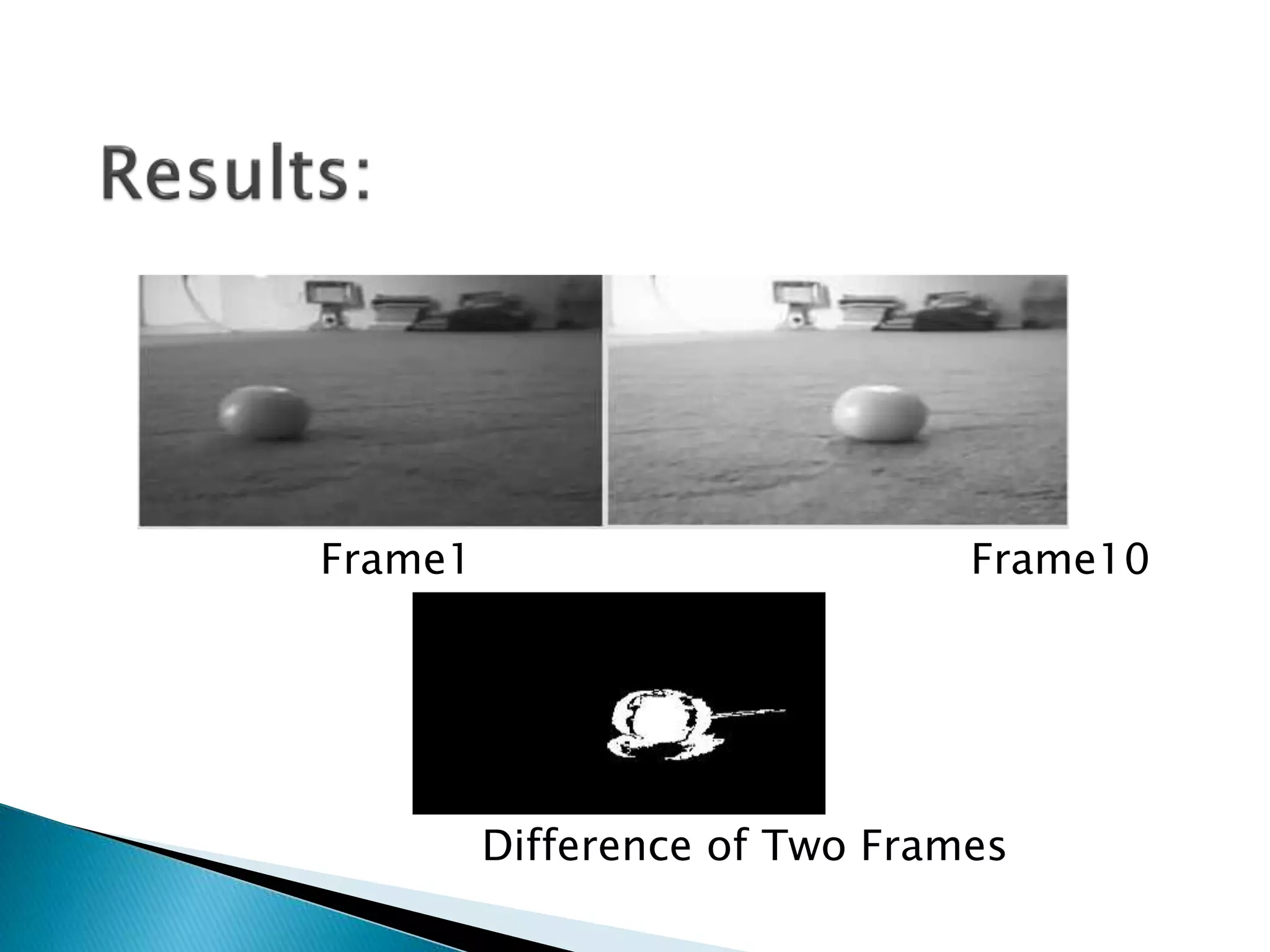
Frame1 Frame10
Difference of Two Frames
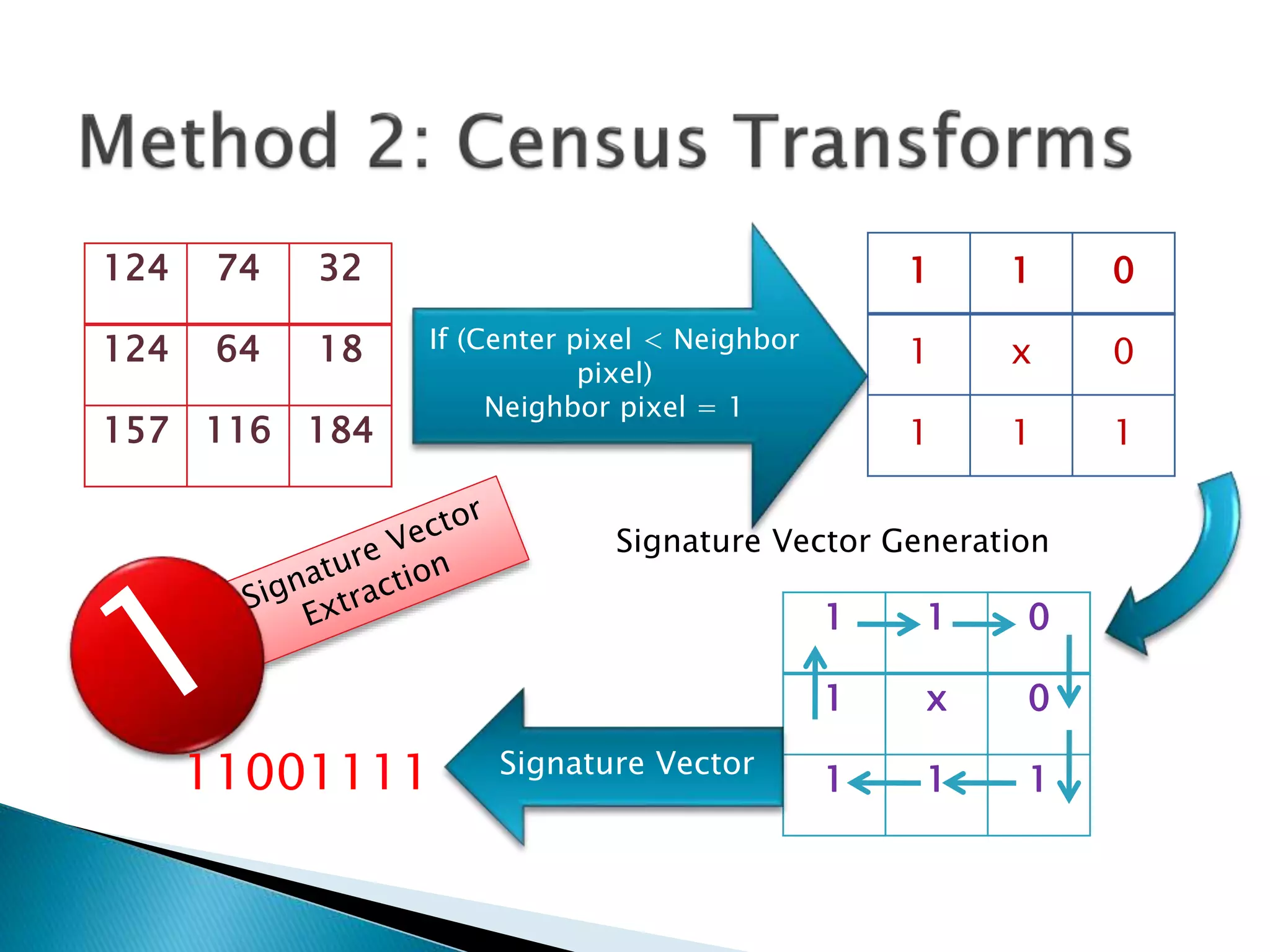
124 74 32
124 64 18
157 116 184
1 1 0
1 x 0
1 1 1
1 1 0
1 x 0
1 1 1
If (Center pixel < Neighbor
pixel)
Neighbor pixel = 1
Signature Vector11001111
Signature Vector Generation
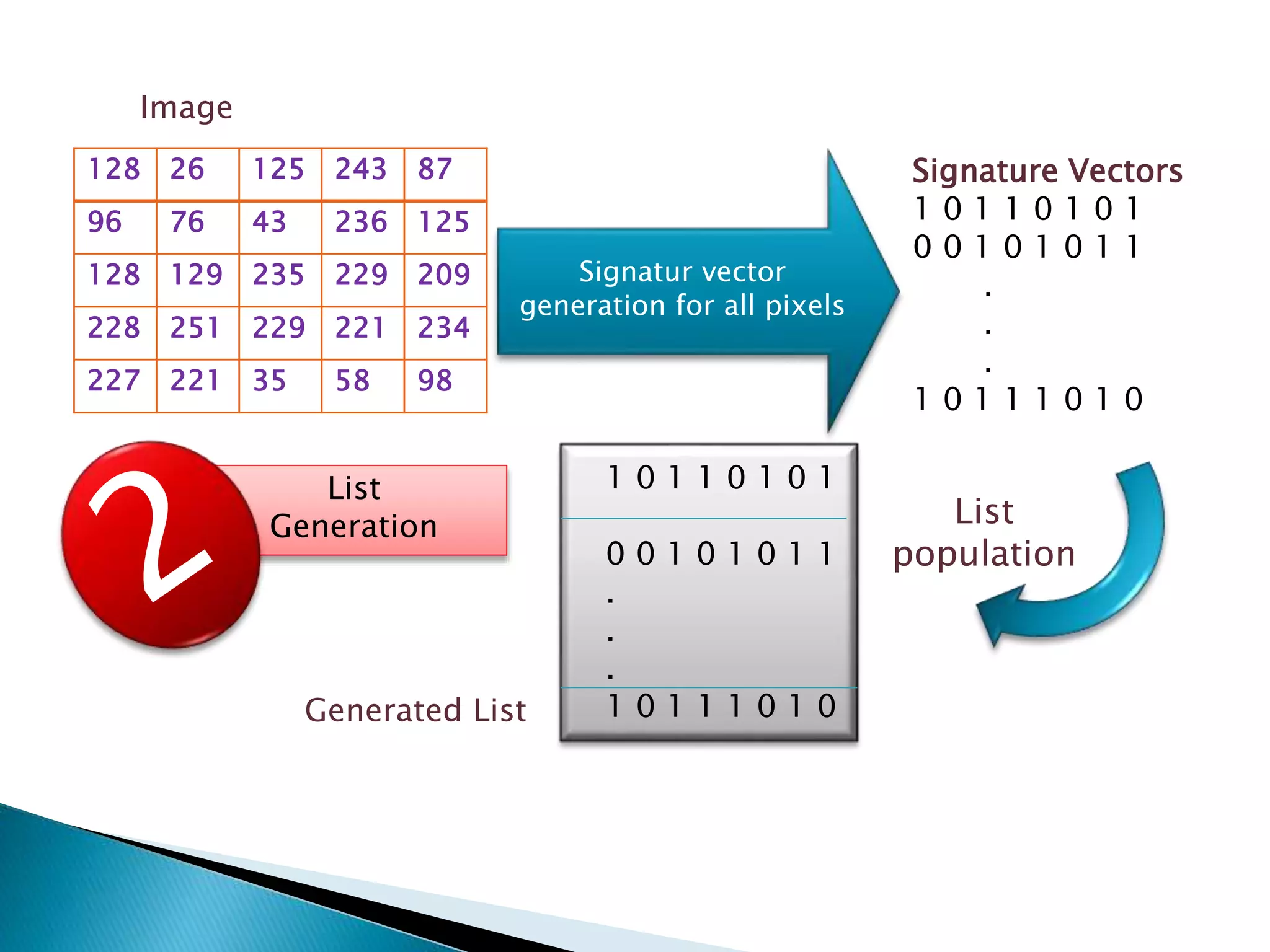
List
Generation
128 26 125 243 87
96 76 43 236 125
128 129 235 229 209
228 251 229 221 234
227 221 35 58 98
Image
Signatur vector
generation for all pixels
Signature Vectors
1 0 1 1 0 1 0 1
0 0 1 0 1 0 1 1
.
.
.
1 0 1 1 1 0 1 0
List
population
1 0 1 1 0 1 0 1
0 0 1 0 1 0 1 1
.
.
.
1 0 1 1 1 0 1 0Generated List
Advantages:
 Compare only two values 0 or 1.
 Similar Illumination Variation for pixel and
neighbouring pixels
Draw Backs:
 As we only deal with only 0`s and 1`s, this
method is sensitive to noise.
 Calculate, store and match process 
computationally Expensive
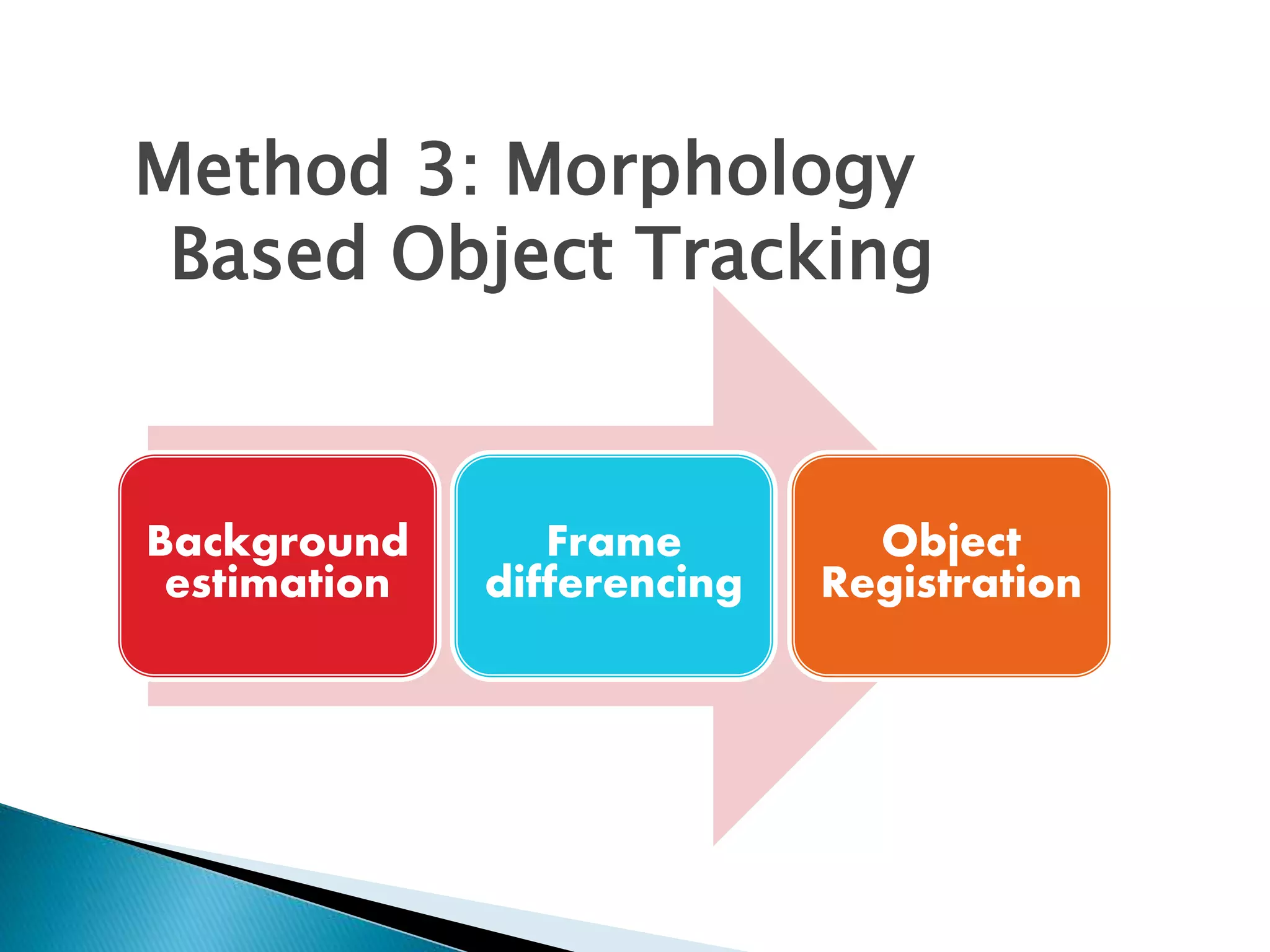
Background
estimation
Frame
differencing
Object
Registration
Method 3: Morphology
Based Object Tracking
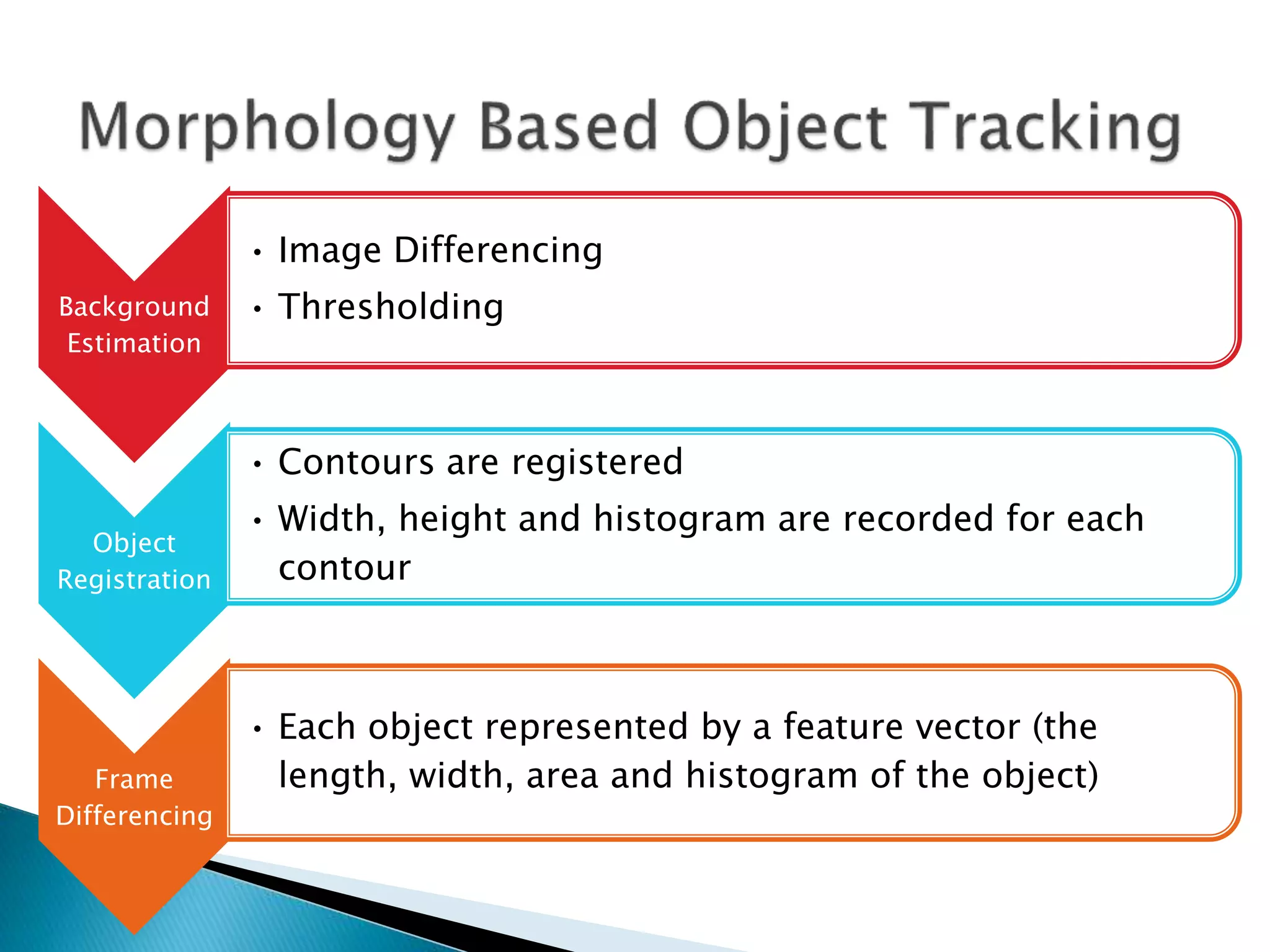
Background
Estimation
• Image Differencing
• Thresholding
Object
Registration
• Contours are registered
• Width, height and histogram are recorded for each
contour
Frame
Differencing
• Each object represented by a feature vector (the
length, width, area and histogram of the object)
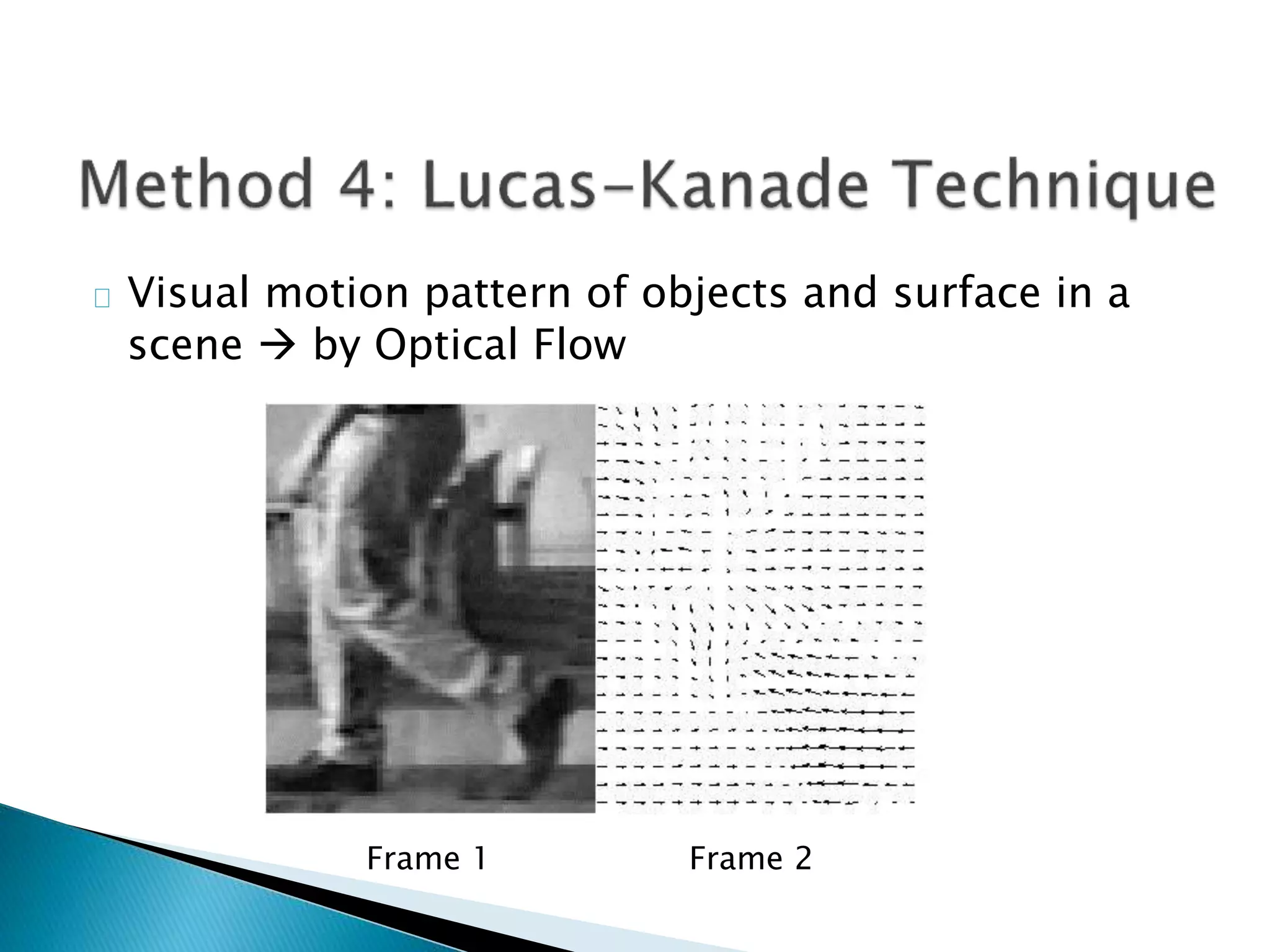
Visual motion pattern of objects and surface in a
scene  by Optical Flow
Frame 1 Frame 2
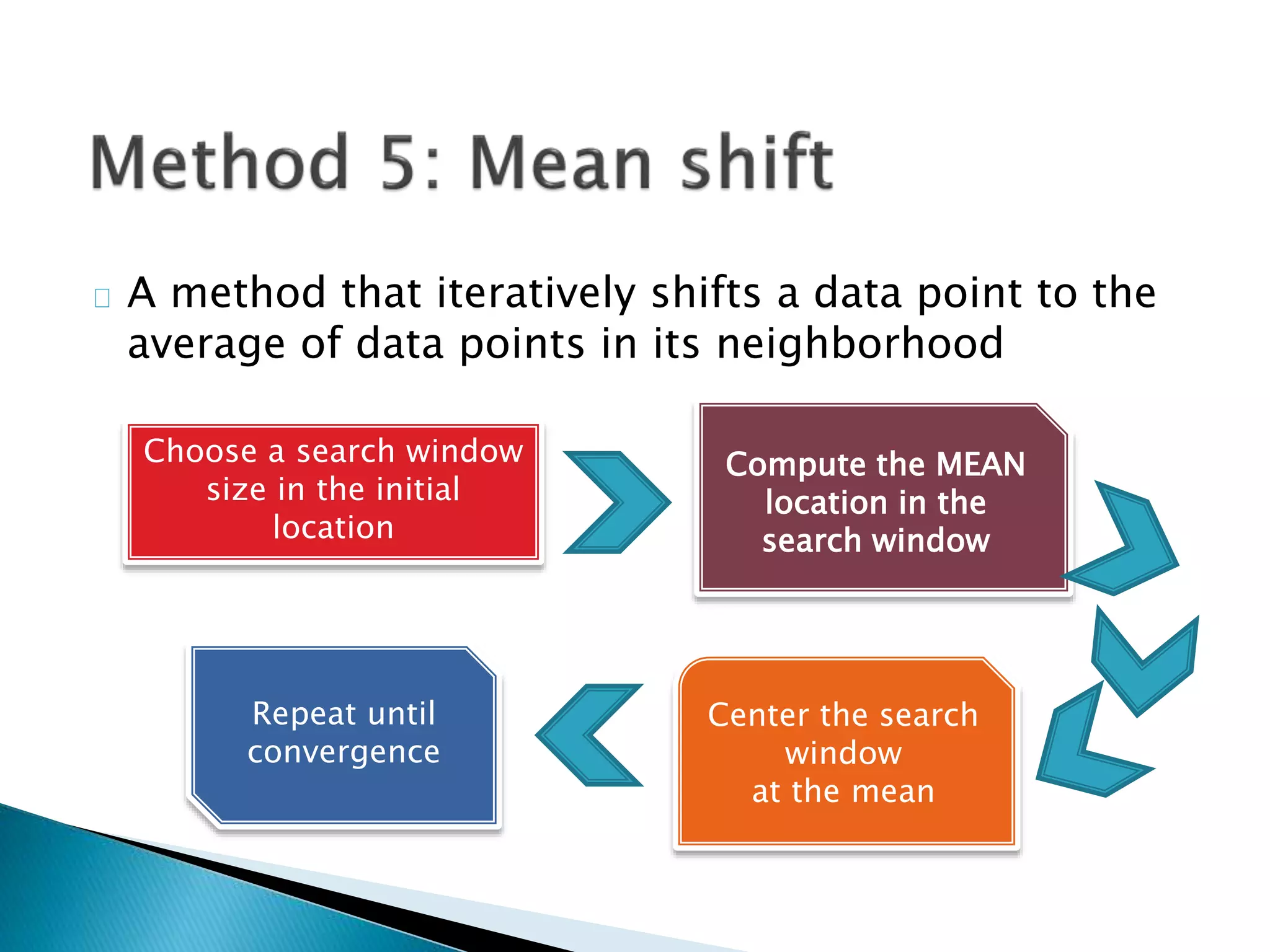
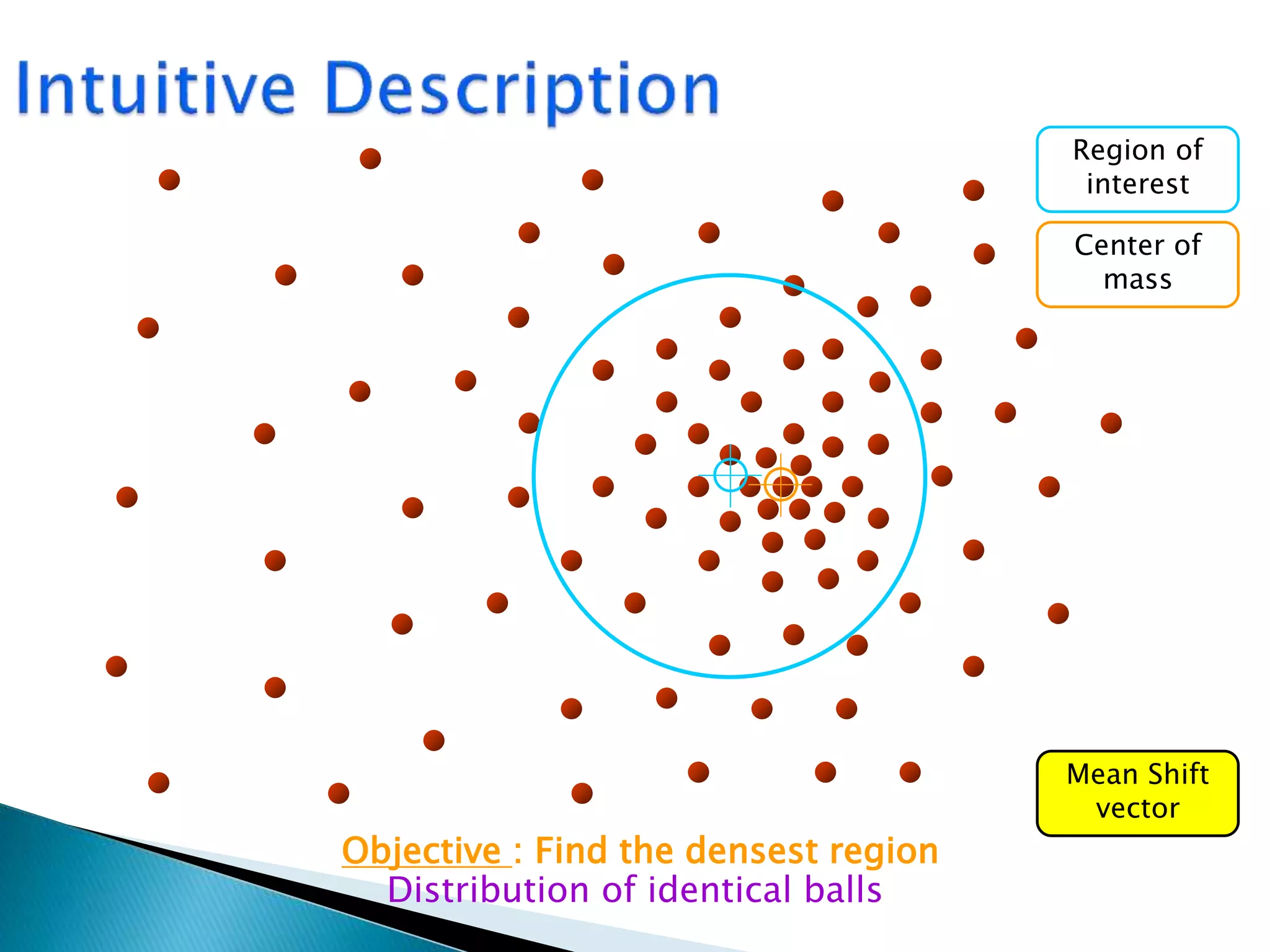
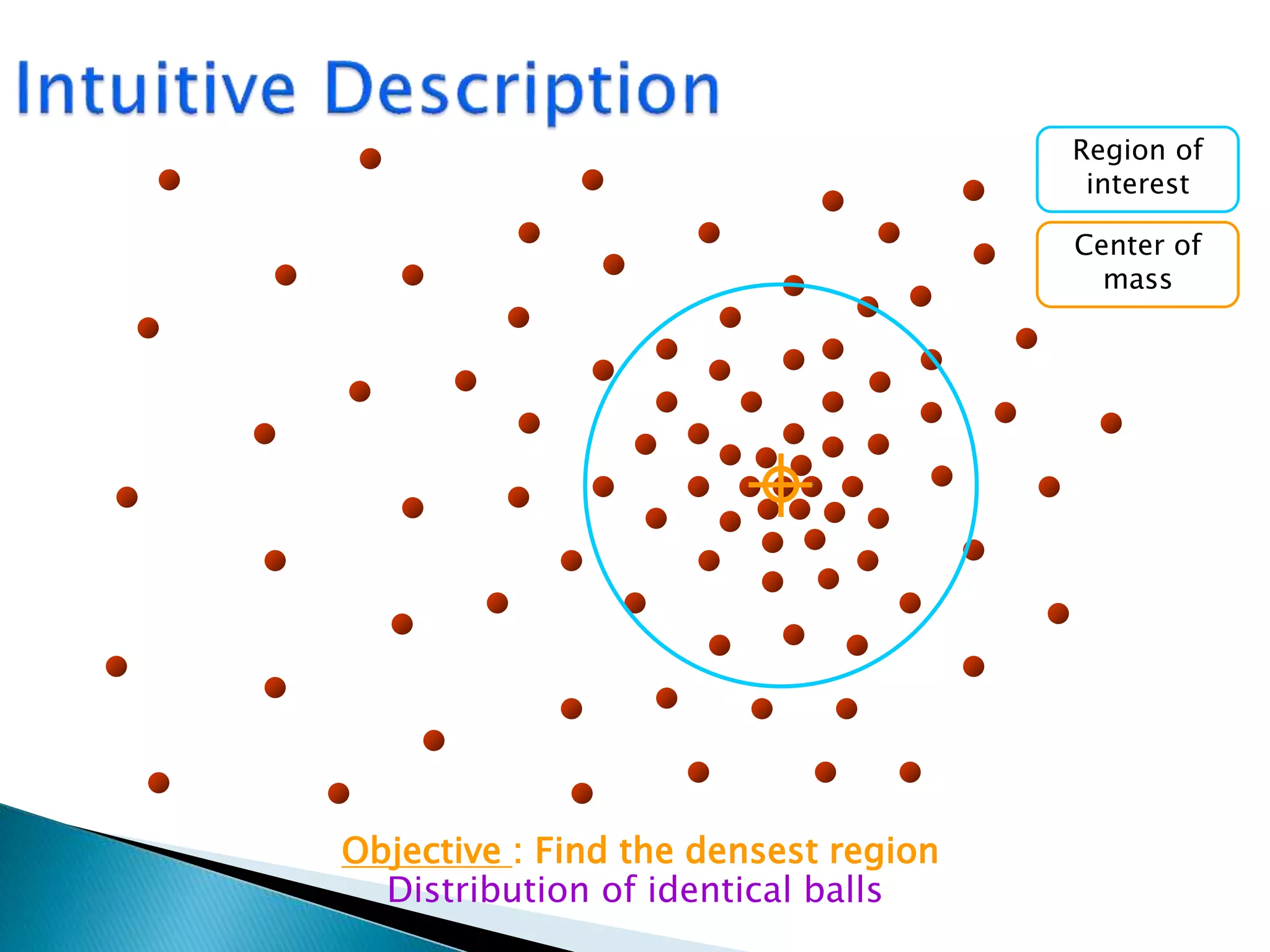
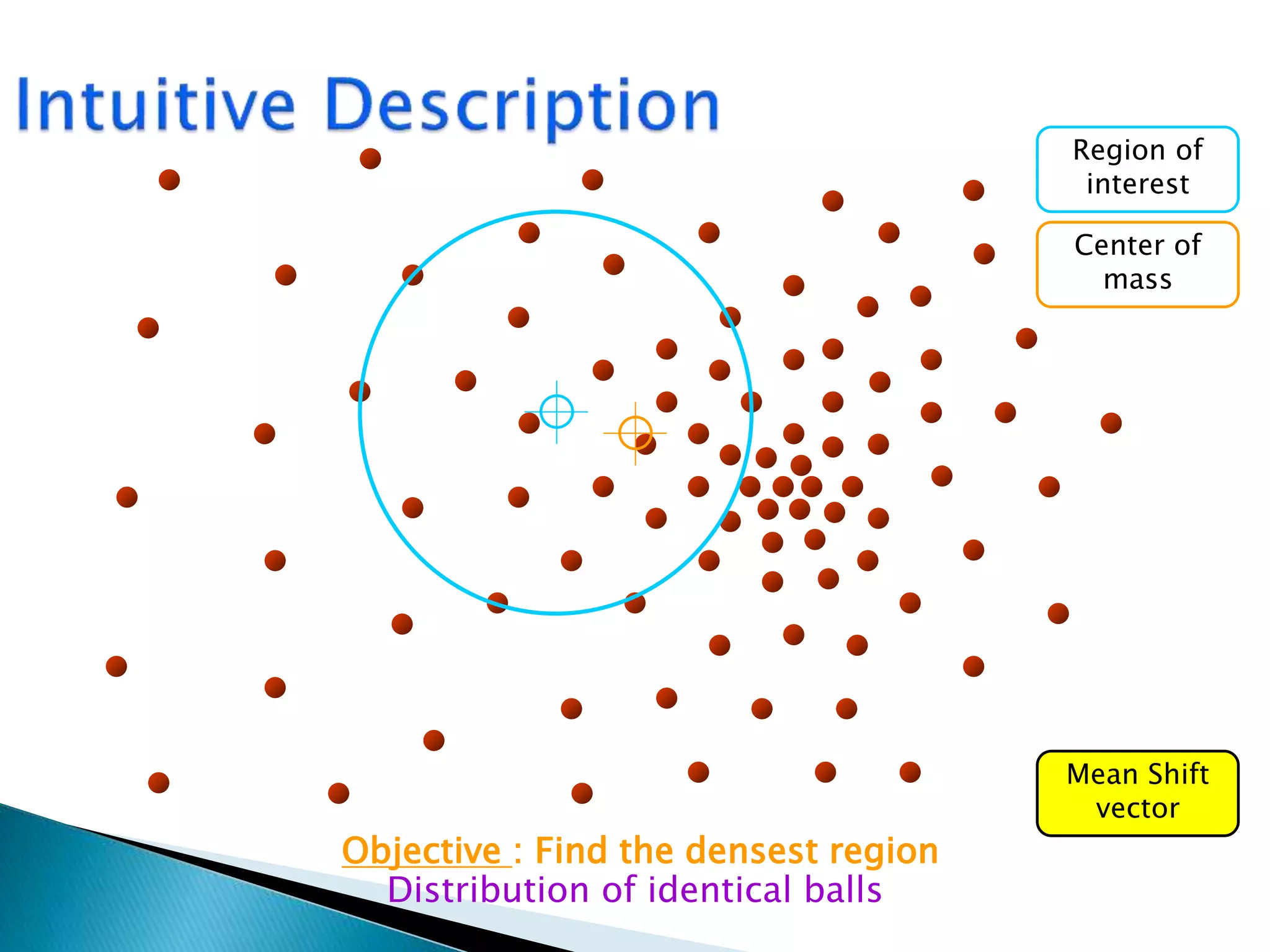
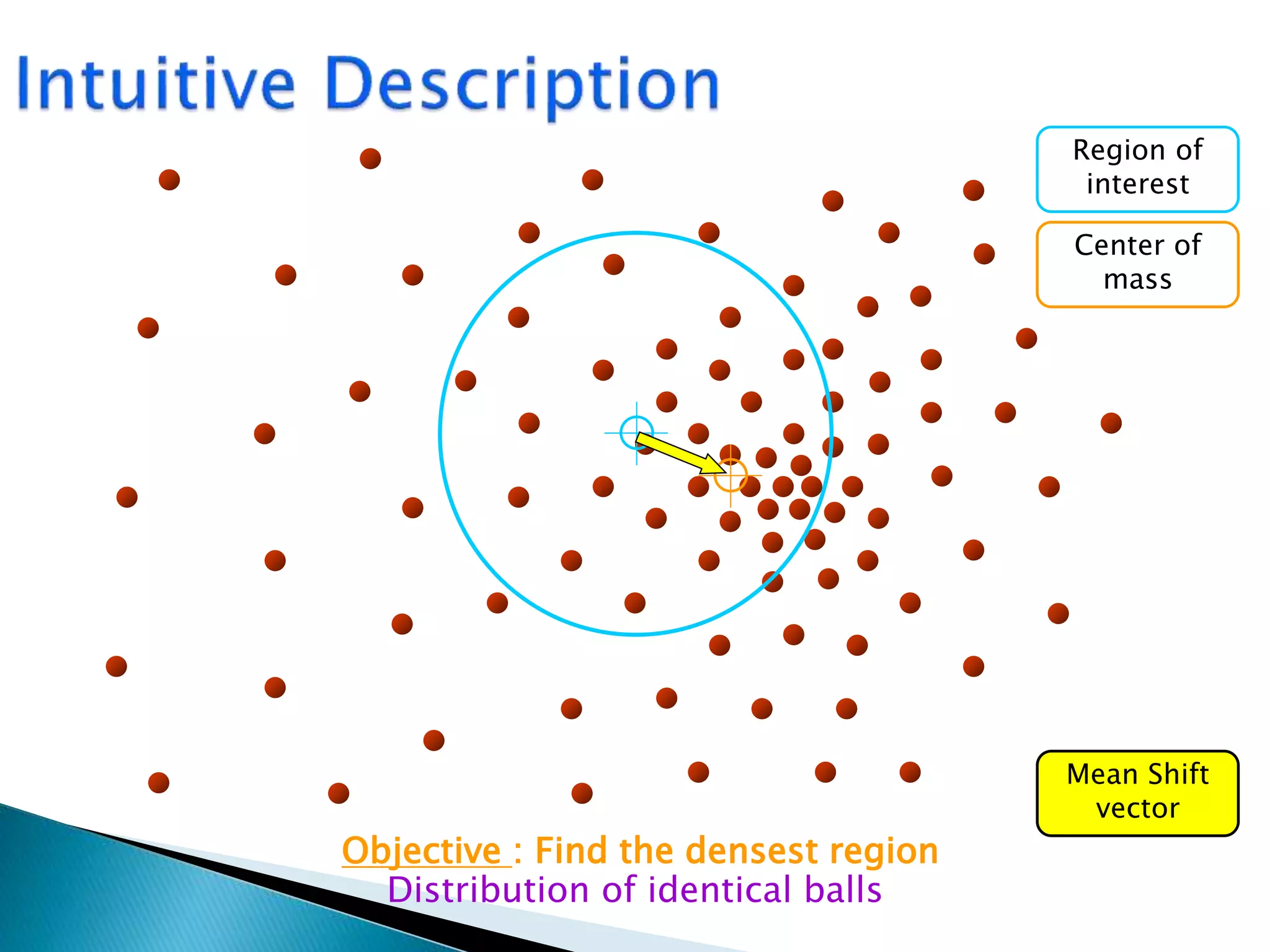
A method that iteratively shifts a data point to the
average of data points in its neighborhood
Choose a search window
size in the initial
location
Compute the MEAN
location in the
search window
Center the search
window
at the mean
Repeat until
convergence
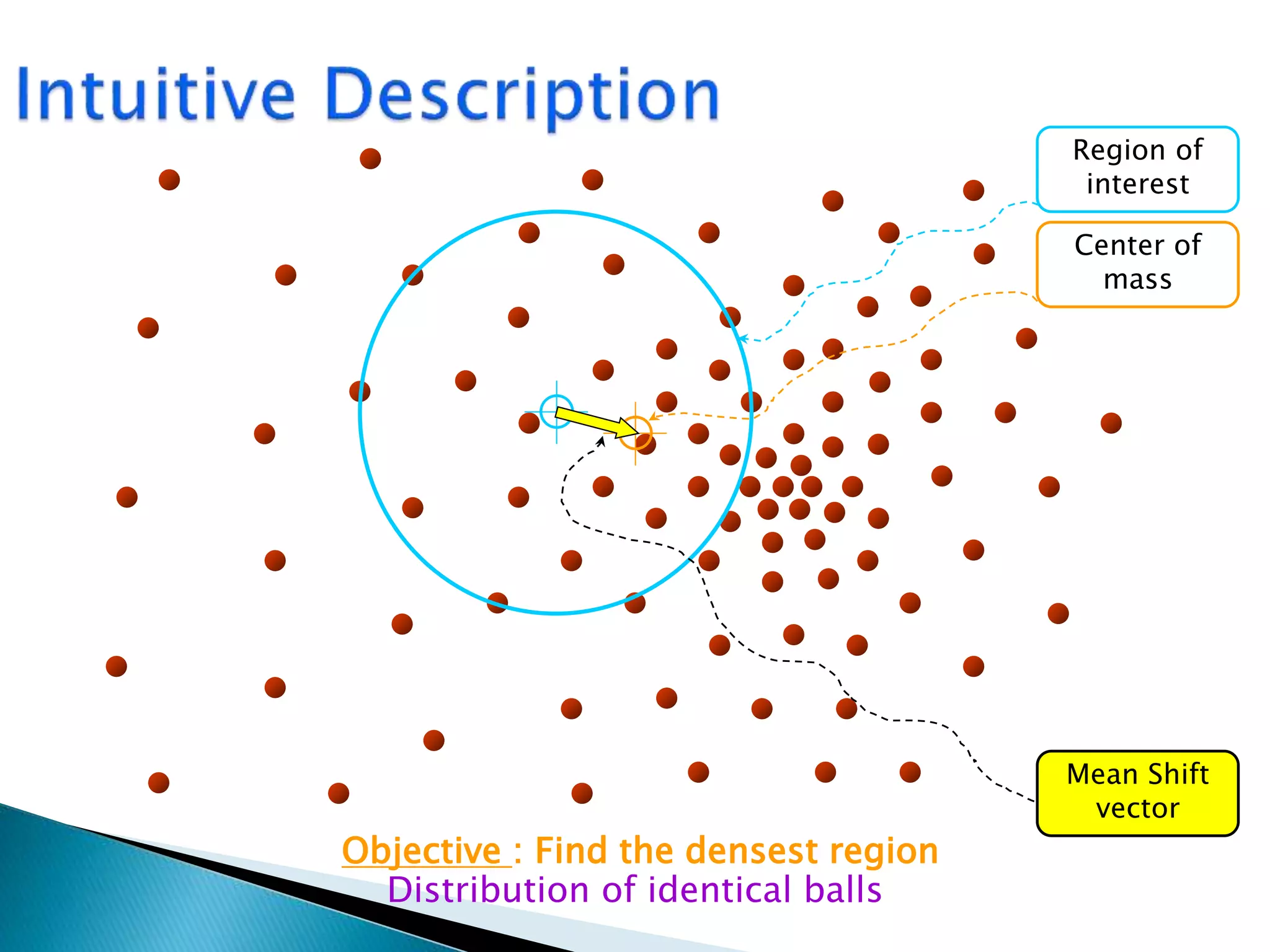
Distribution of identical balls
Region of
interest
Center of
mass
Mean Shift
vector
Objective : Find the densest region
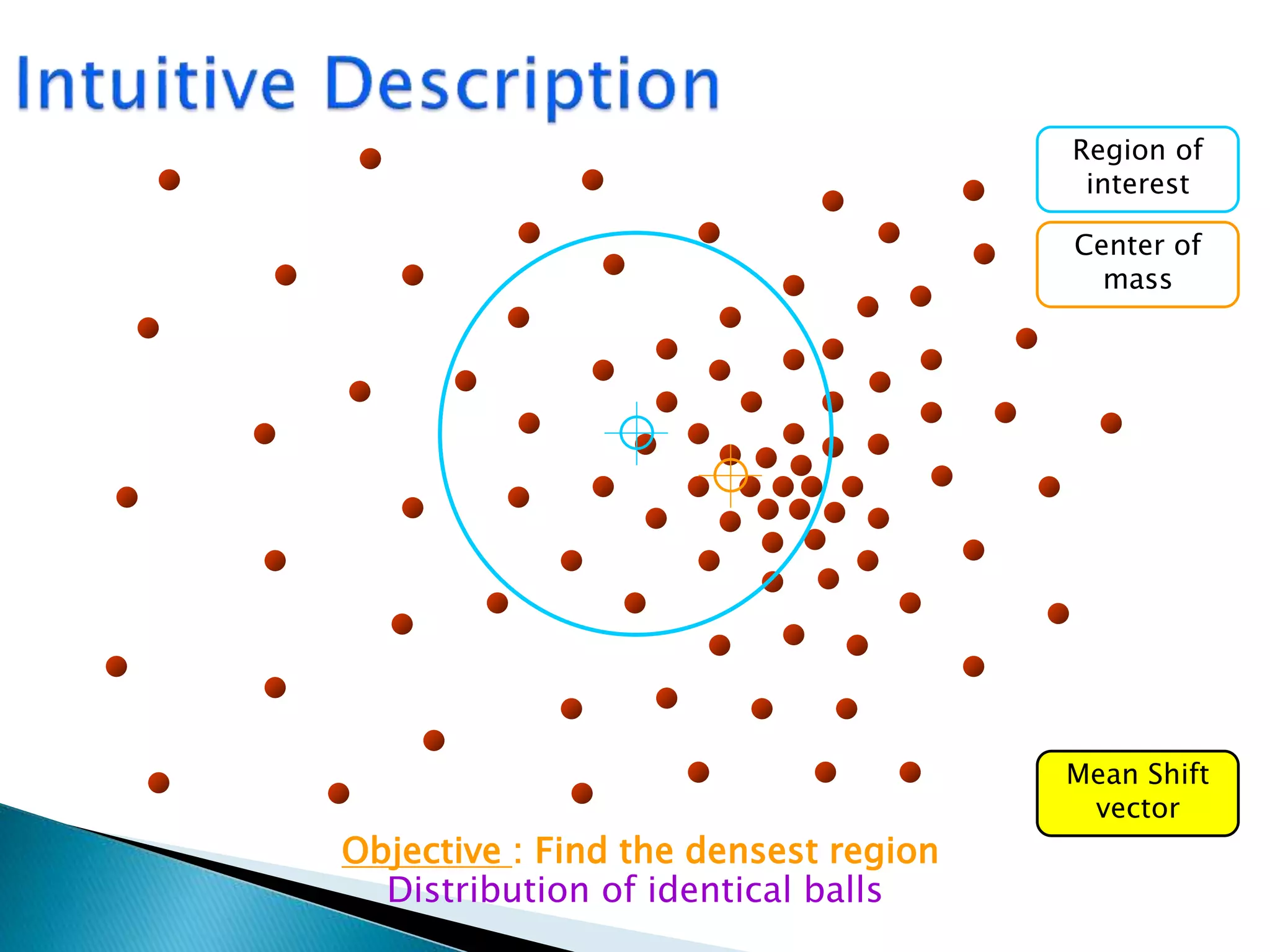
Distribution of identical balls
Region of
interest
Center of
mass
Mean Shift
vector
Objective : Find the densest region
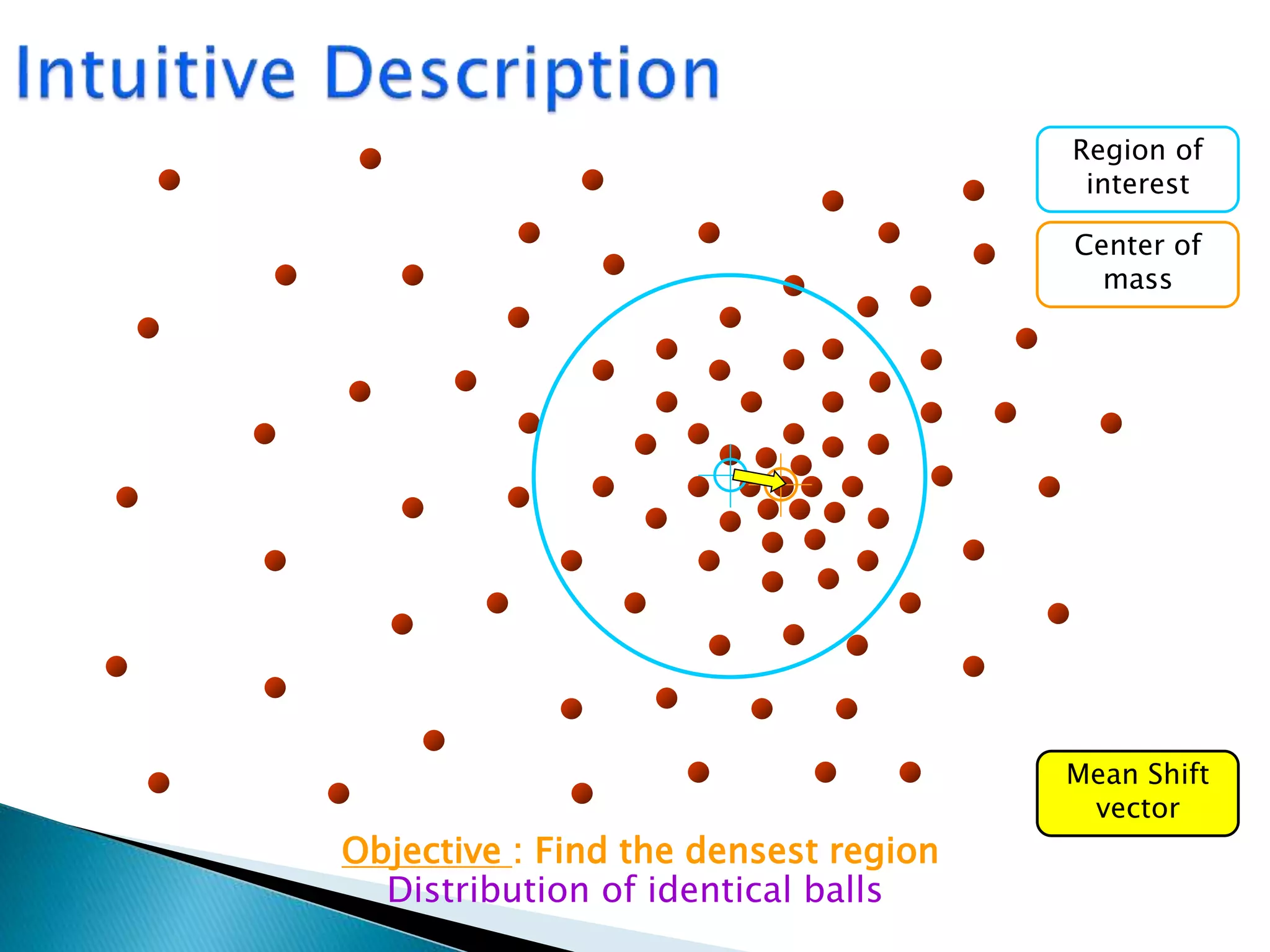
Distribution of identical balls
Region of
interest
Center of
mass
Mean Shift
vector
Objective : Find the densest region
Distribution of identical balls
Region of
interest
Center of
mass
Mean Shift
vector
Objective : Find the densest region
Distribution of identical balls
Region of
interest
Center of
mass
Mean Shift
vector
Objective : Find the densest region
Distribution of identical balls
Region of
interest
Center of
mass
Mean Shift
vector
Objective : Find the densest region
Distribution of identical balls
Region of
interest
Center of
mass
Objective : Find the densest region
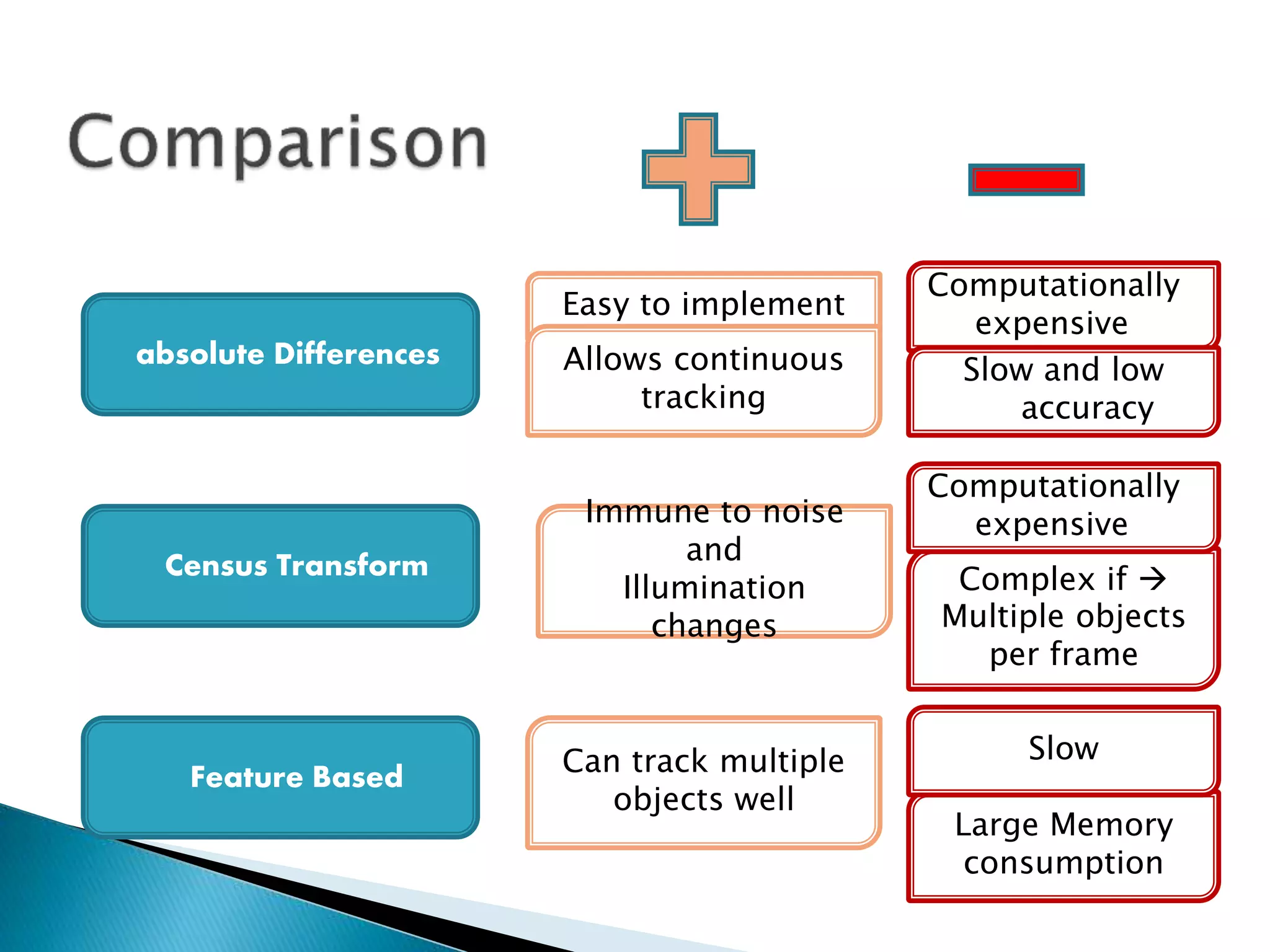
absolute Differences
Easy to implement
Allows continuous
tracking
Computationally
expensive
Slow and low
accuracy
Census Transform
Immune to noise
and
Illumination
changes
Complex if 
Multiple objects
per frame
Computationally
expensive
Feature Based Can track multiple
objects well
Large Memory
consumption
Slow
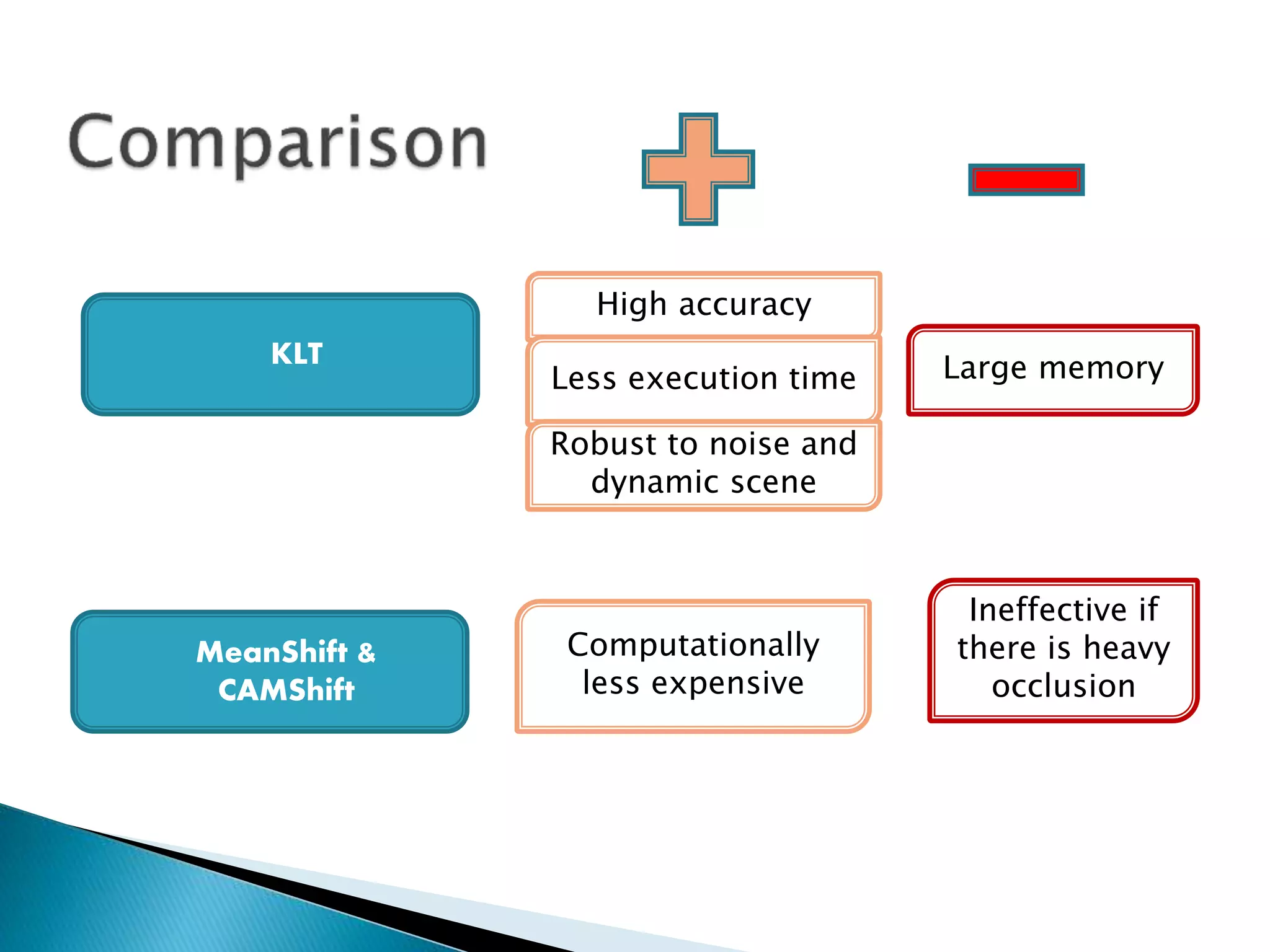
KLT
High accuracy
Less execution time Large memory
MeanShift &
CAMShift
Ineffective if
there is heavy
occlusion
Robust to noise and
dynamic scene
Computationally
less expensive
Object tracking means tracing the progress of objects as they
move about in visual scene.
Object tracking, thus, involves processing spatial as well as
temporal changes.
Significant progress has been made in object tracking.
Taxonomy of moving object detection is been proposed.
Performance of various object detection is also compared.
http://www.mathworks.in/help/vision/examples/motion
-based-multiple-object-tracking.html
http://opencv-srf.blogspot.in/
http://unoccio.blogspot.in/2009/03/fast-color-based-
object-tracking-using.html
www.slideshare.com
http://www.mathworks.in/help/vision/ug/track-an-
object-using-correlation.html
http://www.codeproject.com/Articles/139628/Detect-
and-Track-Objects-in-Live-Webcam-Video-base
http://scien.stanford.edu/pages/labsite/2002/ee392j/sebe
_report.pdf
Object tracking

Object tracking

  • 2.
    Object Tracking Presentation preparedby: Muhammad Ahmad Amin MS(SE) - 4
  • 3.
    Introduction to Objecttracking Applications Of Object tracking Object Representation Object Detection Steps in Object tracking Object tracking Algorithm’s Methodologies Comparison Conclusion
  • 4.
    To track anobject over a sequence of images. A method of following an object through successive image frames to determine its relative movement with respect to other objects.
  • 5.
  • 8.
    In a trackingscenario, an object can be defined as anything that is of interest for further analysis. Objects can be represented by their shapes. Object shape representations commonly employed for tracking are: Points: The object is represented by a point, that is, centroid or set of points. Point representation is suitable for tracking objects that occupy small regions in an image. Primitive geometric shapes: Object shape is represented by a rectangle, ellipse etc. these are suitable for representing simple rigid objects and non rigid objects.
  • 10.
    Object silhouette andcontour: contour representation defines the boundary of an object. The region inside the contour is called the silhouette of the object. These are suitable for tracking complex non rigid shapes. Articulated shape models: These objects are composed of body parts that are held together with joints. Skeletal models: object skeleton can be extracted by applying medial axis transform to the object silhouette. This can be used to model both articulated and rigid objects.
  • 11.
     visual inputis usually achieved through digitized images obtained from a camera connected to a digital computer.  This camera can be either stationary or moving depending on the application.  Beyond image acquisition, the computer performs the necessary tracking and any higher level tasks using tracking result.
  • 12.
    Every tracking methodrequires an object detection mechanism either in every frame or when the object first appears in the video. Challenges of moving object detection: • Loss of information caused by the 3D world on a 2D image • Noise in images • Complex object motion • Non-rigid or articulated nature of objects • Partial or full object occlusions • Complex object shapes • Scene illumination changes
  • 14.
    Point Tracking: Objectsdetected in consecutive frames are represented by points, and the association of the points is based on the previous object state which can include object position and motion. This approach requires an external mechanism to detect the objects in every frame. Kernel Tracking: Kernel refers to the object shape and appearance Silhouette Tracking: Tracking is performed by estimating the object region in each frame. Silhouette tracking methods use the information encoded inside the object region.
  • 15.
    SEGMENTATION Foreground / background extraction Usefulfeature extraction / calculation Tracking
  • 16.
    shows the color imagesegmentation result with the edged image. show the final detected result of joint color image segmentation and background model. background model
  • 17.
    Segmentation is theprocess of identifying components of the image. Segmentation involves operations such as boundary detection, connected component labeling, thresholding etc. Boundary detection finds out edges in the image. Thresholding is the process of reducing the grey levels in the image
  • 18.
    As the namesuggests this is the process of separating the foreground and background of the image. Here it is assumed that foreground contains the objects of interest
  • 19.
    Background extraction Once foregroundis extracted a simple subtraction operation can be used to extract the background. Following figure illustrates this operation:
  • 20.
    Camera model isan important aspect of any object-tracking algorithm. All the existing objects tracking systems use a preset camera model. In words camera model is directly derived from the domain knowledge. Some of the common camera models are – 1. Single fixed camera Example: Road traffic tracking system 2. Multiple fixed cameras Example: Simple surveillance system 3. Single moving camera Example: Animation and video compression systems 4. Multiple moving cameras Example: Robot navigation system
  • 22.
    Different motion analysismethod ◦ SAD of consecutive frames ◦ A threshold is set to detect the moving The motion object is here!
  • 23.
    Disadvantage of DMAmethod ◦ May include covered or covering background The size of tracking area is not the same as the size of tracking object !
  • 24.
    Solution: Block-Matching Algorithm(BMA) ◦ Using motion vector to compensate the redundant part of tracking area SAD is selected to measure How two blocks match with Each other
  • 26.
    = Image subtraction D(t)=I(ti)– I(tj)  Gives an image frame with changed and unchanged regions Ideal Case for no motion: I(ti) = I(tj), D(t)=0
  • 27.
  • 28.
    Methods for MotionDetection Frame Differencing Background Subtraction Draw Backs:  Involves a lot of computations  Not feasible for DSP implementation
  • 29.
  • 30.
    124 74 32 12464 18 157 116 184 1 1 0 1 x 0 1 1 1 1 1 0 1 x 0 1 1 1 If (Center pixel < Neighbor pixel) Neighbor pixel = 1 Signature Vector11001111 Signature Vector Generation
  • 31.
    List Generation 128 26 125243 87 96 76 43 236 125 128 129 235 229 209 228 251 229 221 234 227 221 35 58 98 Image Signatur vector generation for all pixels Signature Vectors 1 0 1 1 0 1 0 1 0 0 1 0 1 0 1 1 . . . 1 0 1 1 1 0 1 0 List population 1 0 1 1 0 1 0 1 0 0 1 0 1 0 1 1 . . . 1 0 1 1 1 0 1 0Generated List
  • 32.
    Advantages:  Compare onlytwo values 0 or 1.  Similar Illumination Variation for pixel and neighbouring pixels Draw Backs:  As we only deal with only 0`s and 1`s, this method is sensitive to noise.  Calculate, store and match process  computationally Expensive
  • 33.
  • 34.
    Background Estimation • Image Differencing •Thresholding Object Registration • Contours are registered • Width, height and histogram are recorded for each contour Frame Differencing • Each object represented by a feature vector (the length, width, area and histogram of the object)
  • 35.
    Visual motion patternof objects and surface in a scene  by Optical Flow Frame 1 Frame 2
  • 36.
    A method thatiteratively shifts a data point to the average of data points in its neighborhood Choose a search window size in the initial location Compute the MEAN location in the search window Center the search window at the mean Repeat until convergence
  • 37.
    Distribution of identicalballs Region of interest Center of mass Mean Shift vector Objective : Find the densest region
  • 38.
    Distribution of identicalballs Region of interest Center of mass Mean Shift vector Objective : Find the densest region
  • 39.
    Distribution of identicalballs Region of interest Center of mass Mean Shift vector Objective : Find the densest region
  • 40.
    Distribution of identicalballs Region of interest Center of mass Mean Shift vector Objective : Find the densest region
  • 41.
    Distribution of identicalballs Region of interest Center of mass Mean Shift vector Objective : Find the densest region
  • 42.
    Distribution of identicalballs Region of interest Center of mass Mean Shift vector Objective : Find the densest region
  • 43.
    Distribution of identicalballs Region of interest Center of mass Objective : Find the densest region
  • 44.
    absolute Differences Easy toimplement Allows continuous tracking Computationally expensive Slow and low accuracy Census Transform Immune to noise and Illumination changes Complex if  Multiple objects per frame Computationally expensive Feature Based Can track multiple objects well Large Memory consumption Slow
  • 45.
    KLT High accuracy Less executiontime Large memory MeanShift & CAMShift Ineffective if there is heavy occlusion Robust to noise and dynamic scene Computationally less expensive
  • 46.
    Object tracking meanstracing the progress of objects as they move about in visual scene. Object tracking, thus, involves processing spatial as well as temporal changes. Significant progress has been made in object tracking. Taxonomy of moving object detection is been proposed. Performance of various object detection is also compared.
  • 47.