DISASTER
RECOVERY PLAN
MANAGING INFORMATION SYSTEMS IN ORGANIZATIONS
Prepared by: Jan Wong Download at: www.slideshare.net/janwong
DISASTER RECOVERY
IS A CHALLENGE FOR
ORGANIZATIONS.
BUSINESS CONTINUITY IS AT STAKE.
IT IS NOT POSSIBLE
TO PROTECT AGAINST
EVERY RISK!
IT IS NOT POSSIBLE
TO PROTECT AGAINST
EVERY RISK!
THAT’S WHY COMPANIES USES A RISK MANAGEMENT
APPROACH
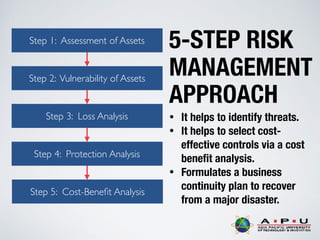
Step 1: Assessment of Assets
Step 2: Vulnerability of Assets
Step 3: Loss Analysis
Step 4: Protection Analysis
Step 5: Cost-Benefit Analysis
Step 1: Assessment of Assets
Step 2: Vulnerability of Assets
Step 3: Loss Analysis
Step 4: Protection Analysis
Step 5: Cost-Benefit Analysis
• It helps to identify threats.
• It helps to select cost-
effective controls via a cost
benefit analysis.
• Formulates a business
continuity plan to recover
from a major disaster.
5-STEP RISK
MANAGEMENT
APPROACH
Step 1: Assessment of Assets
Step 2: Vulnerability of Assets
Step 3: Loss Analysis
Step 4: Protection Analysis
Step 5: Cost-Benefit Analysis
STEP 1
Determine the value and
importance of assets such as
data, hardware, software and
networks.
“List down all assets and its
value including even staff,
facilities, business information,
cost of replacement and loss
of use.”
Step 1: Assessment of Assets
Step 2: Vulnerability of Assets
Step 3: Loss Analysis
Step 4: Protection Analysis
Step 5: Cost-Benefit Analysis
STEP 2
Recorded the weaknesses in
the current protection system
in view of all potential threats.
“List down all potential threats
that can happen to the assets
by reviewing current systems.”
Step 1: Assessment of Assets
Step 2: Vulnerability of Assets
Step 3: Loss Analysis
Step 4: Protection Analysis
Step 5: Cost-Benefit Analysis
STEP 3
Assess the probability of
damage and specify the
tangible and intangible losses
that may result.
“List down the cost of damage
to the assets.”
Step 1: Assessment of Assets
Step 2: Vulnerability of Assets
Step 3: Loss Analysis
Step 4: Protection Analysis
Step 5: Cost-Benefit Analysis
STEP 4
Provide a description of
available controls that should
be considered, their probability
of successful defence and
costs.
“List down all assets and its
value.”
Step 1: Assessment of Assets
Step 2: Vulnerability of Assets
Step 3: Loss Analysis
Step 4: Protection Analysis
Step 5: Cost-Benefit Analysis
STEP 5
Compare cost and benefits.
Consider the likelihood of
damage occurring and the
successful protection from that
damage. Finally, decide which
controls to install.
“Compare the cost required
and the benefits to decide.”
Step 1: Assessment of Assets
Step 2: Vulnerability of Assets
Step 3: Loss Analysis
Step 4: Protection Analysis
Step 5: Cost-Benefit Analysis
IF YOU CAN’T
CONTROL THEM,
BACK UP!
SYSTEM FAILURE CAN CAUSE MINOR IRRITATIONS TO
BUSINESS CLOSEDOWN.
TYPES OF
BACKUP
METHODS
TO ENSURE BUSINESS CONTINUITY
3
TYPES OF BACKUP METHODS
3
1. CONTINUOUS BACKUP
• Periodic in partial data increments
• Can be local / remote
2. FULL BACKUP
• Periodic in complete data copy
• Can be local / remote
3. MIRROR BACKUP
• Instant replica of data
• Can be local / remote
DISASTER
RECOVERY
CONCEPTS
TO ENSURE BUSINESS CONTINUITY
2
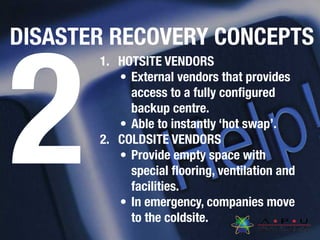
DISASTER RECOVERY CONCEPTS
2
1. HOTSITE VENDORS
• External vendors that provides
access to a fully configured
backup centre.
• Able to instantly ‘hot swap’.
2. COLDSITE VENDORS
• Provide empty space with
special flooring, ventilation and
facilities.
• In emergency, companies move
to the coldsite.
Questions, anyone?

L008 Disaster Recovery Plan (2016)

  • 1.
    DISASTER RECOVERY PLAN MANAGING INFORMATIONSYSTEMS IN ORGANIZATIONS Prepared by: Jan Wong Download at: www.slideshare.net/janwong
  • 2.
    DISASTER RECOVERY IS ACHALLENGE FOR ORGANIZATIONS. BUSINESS CONTINUITY IS AT STAKE.
  • 3.
    IT IS NOTPOSSIBLE TO PROTECT AGAINST EVERY RISK!
  • 4.
    IT IS NOTPOSSIBLE TO PROTECT AGAINST EVERY RISK! THAT’S WHY COMPANIES USES A RISK MANAGEMENT APPROACH
  • 5.
    Step 1: Assessmentof Assets Step 2: Vulnerability of Assets Step 3: Loss Analysis Step 4: Protection Analysis Step 5: Cost-Benefit Analysis
  • 6.
    Step 1: Assessmentof Assets Step 2: Vulnerability of Assets Step 3: Loss Analysis Step 4: Protection Analysis Step 5: Cost-Benefit Analysis • It helps to identify threats. • It helps to select cost- effective controls via a cost benefit analysis. • Formulates a business continuity plan to recover from a major disaster. 5-STEP RISK MANAGEMENT APPROACH
  • 7.
    Step 1: Assessmentof Assets Step 2: Vulnerability of Assets Step 3: Loss Analysis Step 4: Protection Analysis Step 5: Cost-Benefit Analysis STEP 1 Determine the value and importance of assets such as data, hardware, software and networks. “List down all assets and its value including even staff, facilities, business information, cost of replacement and loss of use.”
  • 8.
    Step 1: Assessmentof Assets Step 2: Vulnerability of Assets Step 3: Loss Analysis Step 4: Protection Analysis Step 5: Cost-Benefit Analysis STEP 2 Recorded the weaknesses in the current protection system in view of all potential threats. “List down all potential threats that can happen to the assets by reviewing current systems.”
  • 9.
    Step 1: Assessmentof Assets Step 2: Vulnerability of Assets Step 3: Loss Analysis Step 4: Protection Analysis Step 5: Cost-Benefit Analysis STEP 3 Assess the probability of damage and specify the tangible and intangible losses that may result. “List down the cost of damage to the assets.”
  • 10.
    Step 1: Assessmentof Assets Step 2: Vulnerability of Assets Step 3: Loss Analysis Step 4: Protection Analysis Step 5: Cost-Benefit Analysis STEP 4 Provide a description of available controls that should be considered, their probability of successful defence and costs. “List down all assets and its value.”
  • 11.
    Step 1: Assessmentof Assets Step 2: Vulnerability of Assets Step 3: Loss Analysis Step 4: Protection Analysis Step 5: Cost-Benefit Analysis STEP 5 Compare cost and benefits. Consider the likelihood of damage occurring and the successful protection from that damage. Finally, decide which controls to install. “Compare the cost required and the benefits to decide.”
  • 12.
    Step 1: Assessmentof Assets Step 2: Vulnerability of Assets Step 3: Loss Analysis Step 4: Protection Analysis Step 5: Cost-Benefit Analysis
  • 13.
    IF YOU CAN’T CONTROLTHEM, BACK UP! SYSTEM FAILURE CAN CAUSE MINOR IRRITATIONS TO BUSINESS CLOSEDOWN.
  • 14.
    TYPES OF BACKUP METHODS TO ENSUREBUSINESS CONTINUITY 3
  • 15.
    TYPES OF BACKUPMETHODS 3 1. CONTINUOUS BACKUP • Periodic in partial data increments • Can be local / remote 2. FULL BACKUP • Periodic in complete data copy • Can be local / remote 3. MIRROR BACKUP • Instant replica of data • Can be local / remote
  • 16.
  • 17.
    DISASTER RECOVERY CONCEPTS 2 1.HOTSITE VENDORS • External vendors that provides access to a fully configured backup centre. • Able to instantly ‘hot swap’. 2. COLDSITE VENDORS • Provide empty space with special flooring, ventilation and facilities. • In emergency, companies move to the coldsite.
  • 18.