ISINFORMATION SYSTEMS
BY: JAN WONG
HELLO AND
WELCOME TO
Chapter Four:
PROGRAMMING
LANGUAGE
“How does information system work?”
Programming
languages are just
like all the human
languages out there.
Don’t be confused,
It’s just a form of communication with the computer.
There can be different
languages to convey
the same messages
for a similar outcome.
This means,
It comes down to the programmer’s preference.
• Knowledge
• Experience
• Ease-of-use
• Design requirements
• Client requirements
• Continuity & support
• Need
It comes down to the programmer’s preference.
ISWhat is a computer program?
What is a computer program?
“Set of instructions that directs a computer to
perform tasks, called a programming language.”
Every language has its own syntax
(grammar) and commentary rules.
What is a computer program?
“Set of instructions that directs a computer to
perform tasks, called a programming language.”
Machine
Code
Node.JS PHP Pascal ASP ASP.NET JAVA
Ruby Python
Objective-
C
C C++ COBOL Fortran
Assembly
Visual
Basic
Prolog JavaScript C# Perl Scala
ISHow does it work?
How does it work?
“It communicates with the computer’s hardware(s) and tells it
what to compute by providing the necessary data and sequence.”
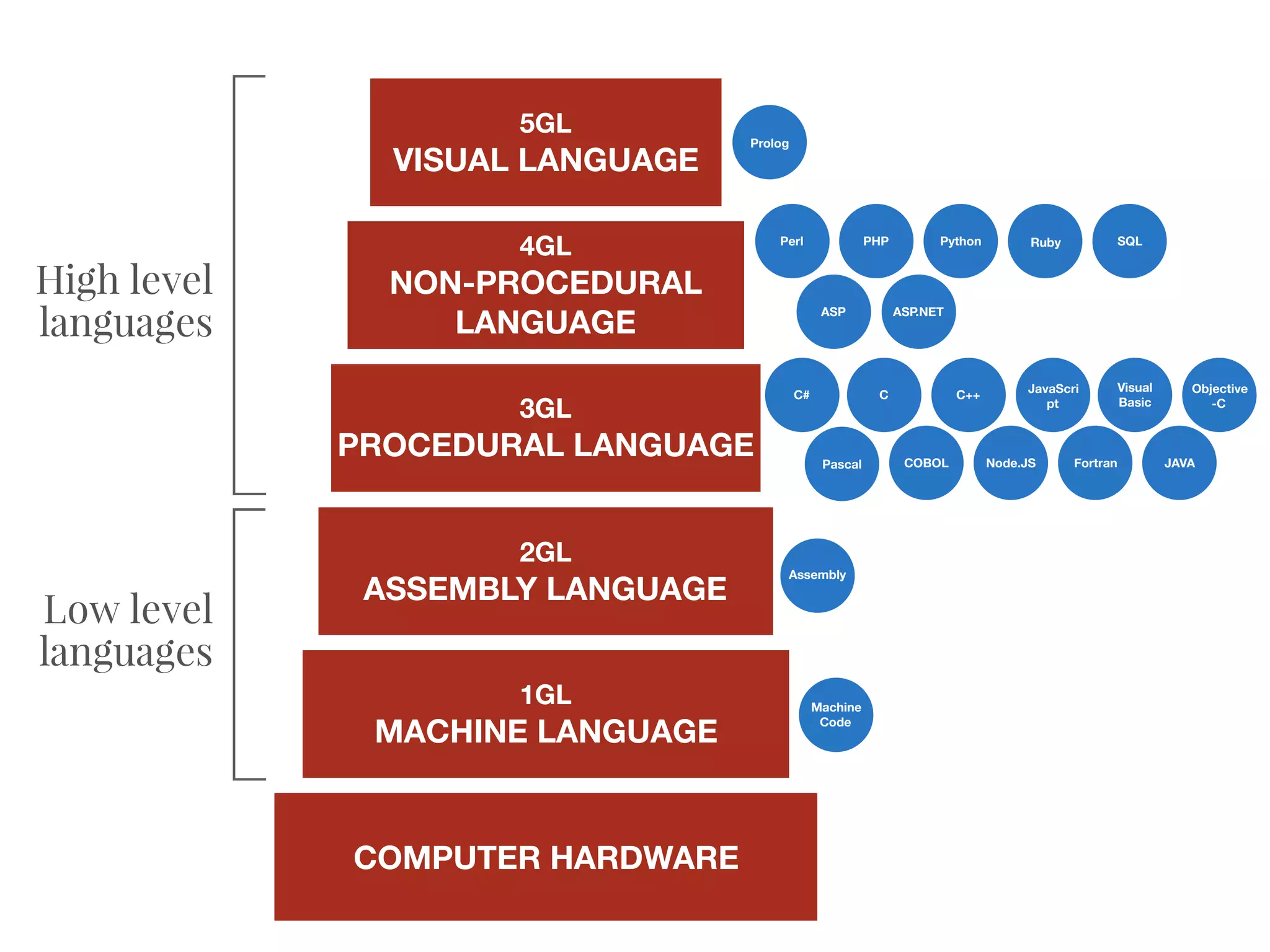
COMPUTER HARDWARE
1GL
MACHINE LANGUAGE
2GL
ASSEMBLY LANGUAGE
3GL
PROCEDURAL LANGUAGE
4GL
NON-PROCEDURAL
LANGUAGE
5GL
VISUAL LANGUAGE
Machine
Code
Node.JS
PHP
Pascal
ASP ASP.NET
JAVA
RubyPython
Objective
-C
C C++
COBOL Fortran
Assembly
Visual
Basic
Prolog
JavaScri
pt
C#
Perl SQL
Low level
languages
High level
languages
COMPUTER HARDWARE
1GL
MACHINE LANGUAGE
2GL
ASSEMBLY LANGUAGE
3GL
PROCEDURAL LANGUAGE
4GL
NON-PROCEDURAL
LANGUAGE
5GL
VISUAL LANGUAGE
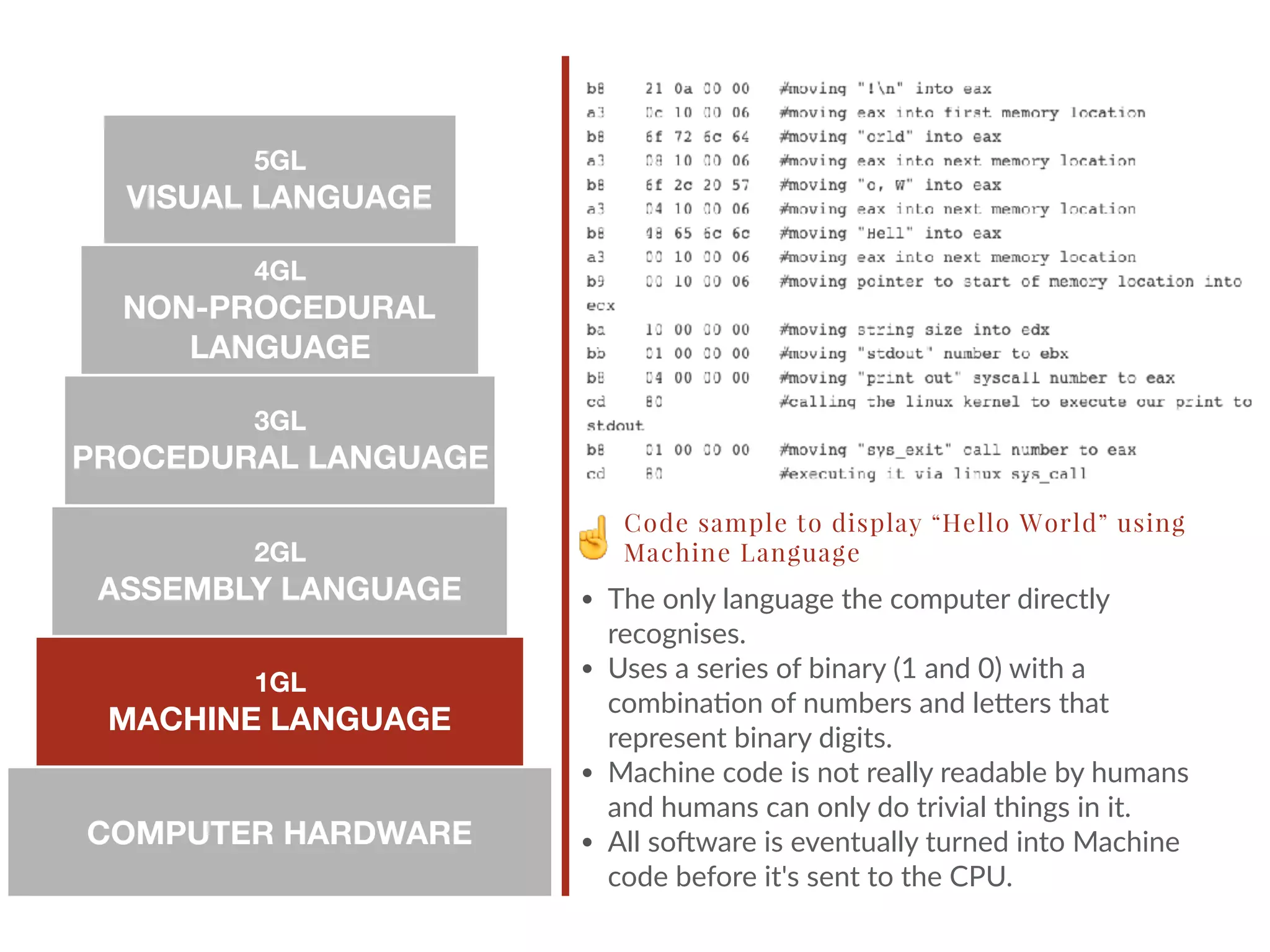
• The only language the computer directly
recognises.
• Uses a series of binary (1 and 0) with a
combina>on of numbers and le?ers that
represent binary digits.
• Machine code is not really readable by humans
and humans can only do trivial things in it.
• All soCware is eventually turned into Machine
code before it's sent to the CPU.
Code sample to display “Hello World” using
Machine Language
COMPUTER HARDWARE
1GL
MACHINE LANGUAGE
2GL
ASSEMBLY LANGUAGE
3GL
PROCEDURAL LANGUAGE
4GL
NON-PROCEDURAL
LANGUAGE
5GL
VISUAL LANGUAGE
• Syntax made out of symbolic instruc>on codes,
meaningful abbrevia>ons and codes.
• This is the language that will get you the highest
performing and most efficient soCware that is
s>ll human-readable.
• It’s so complex to write in that it only makes
sense to use it for small parts of a programme
that are performance-sensi>ve.
• Typically found in opera>ng systems and 3D
game engines.
Code sample to display “Hello World” using
Assembly Language
COMPUTER HARDWARE
1GL
MACHINE LANGUAGE
2GL
ASSEMBLY LANGUAGE
3GL
PROCEDURAL LANGUAGE
4GL
NON-PROCEDURAL
LANGUAGE
5GL
VISUAL LANGUAGE
• Uses series of English-like words to write
instruc>ons.
• Requires a compiler to convert source code into
machine language before execu>ng it.
• The C language maps closely to Assembly
Language hence has best performance in 3GL.
• iOS apps are wri?en in Objec>ve-C and Android
apps in Java.
Code sample to display “Hello World” using C
Code sample to display “Hello World” using Java
COMPUTER HARDWARE
1GL
MACHINE LANGUAGE
2GL
ASSEMBLY LANGUAGE
3GL
PROCEDURAL LANGUAGE
4GL
NON-PROCEDURAL
LANGUAGE
5GL
VISUAL LANGUAGE
• Uses series of English-like instruc>ons usually
within a visual environment allowing data
retrieval from database.
• Useful for genera>ng report, processing data,
performing computa>ons and upda>ng files.
• SQL is popular as it is used specifically for data
retrieval from a DBMS.
• PHP is largely popular for building the backend
of websites; even Facebook and WordPress uses
it.
• Python is great for AI tasks due to a compact
syntax.
Code sample to display “Hello World” using PHP
Code sample to display “Hello World” using
Node.JS
Code sample to display “Hello World” using
Python
COMPUTER HARDWARE
1GL
MACHINE LANGUAGE
2GL
ASSEMBLY LANGUAGE
3GL
PROCEDURAL LANGUAGE
4GL
NON-PROCEDURAL
LANGUAGE
5GL
VISUAL LANGUAGE
• Visual graphical interface for crea>ng source
code.
• Designed to make the computer solve a given
problem without the programmer (unlike 4GL
that has specific instruc>ons / procedures).
• Usually used within Ar>ficial Intelligence (AI)
systems.
Code sample to display “Hello World” using
Prolog
ISWhere and how do you
write codes?
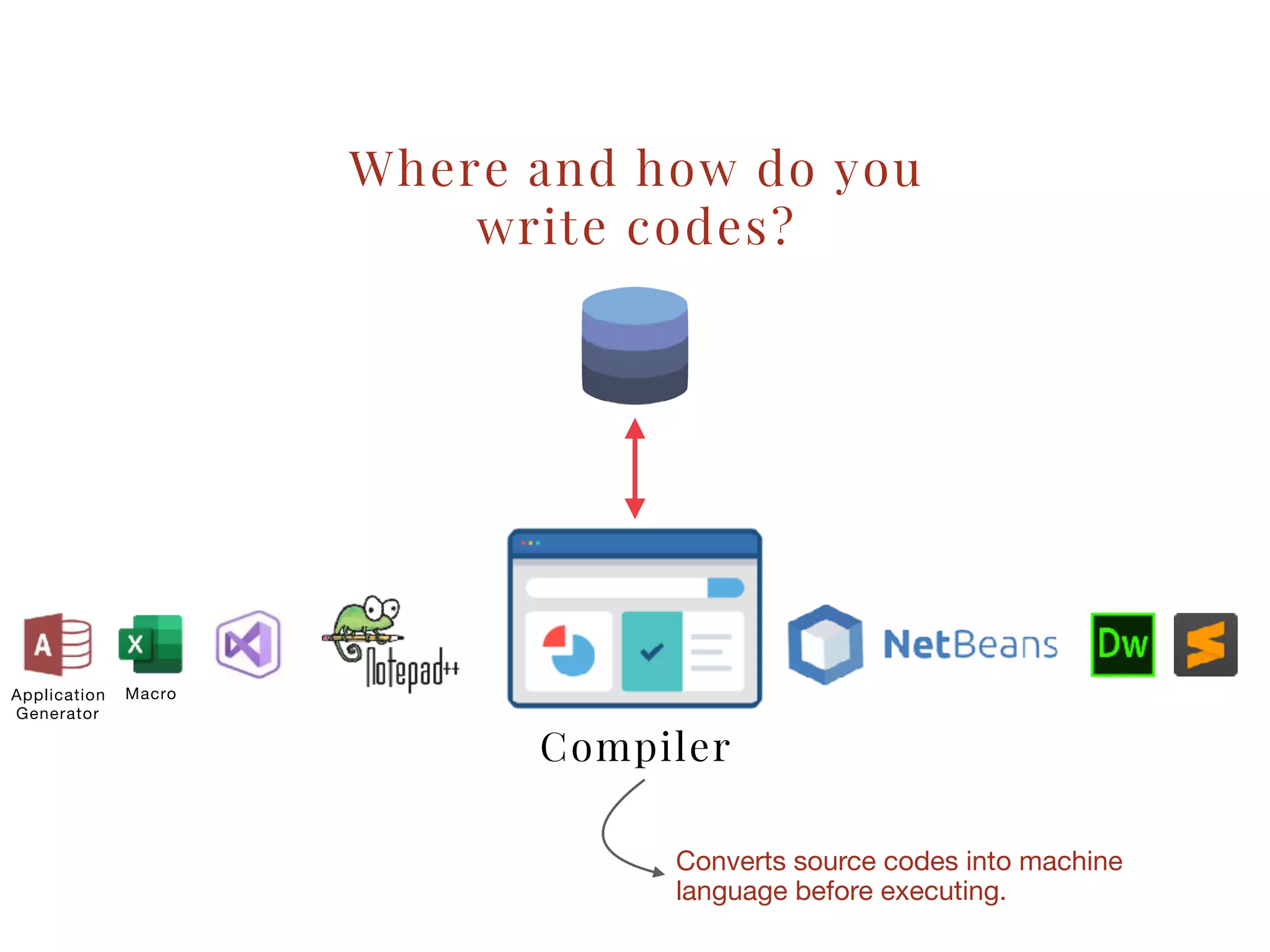
Where and how do you
write codes?
Compiler
Converts source codes into machine
language before executing.
Application
Generator
Macro
ISWeb Page Development
The web displays websites
using Hypertext Markup
Language (HTML) and
Cascading Style Sheets (CSS).
Did you know?
However, they are dumb; there is no processing involved.
HTML and CSS are not
considered as
programming languages.
Did you know?
They rely on additional components to be interactive.
HTML and CSS are not considered
as programming languages.
They rely on additional components to be interactive.
Script
Interpreted program
that runs on client
Applet
Compiled program
that runs on client
Servlet
Applet that 

runs on server
ActiveX Control
Small program that
runs on client
Counter
Tracks number of
visitors to website
Cookies
Stores user
information for
server reference
Image Map
Graphic image that
points to URL
Processing
Forms
Collects data from
visitors
Programming
Languages
(You should know
this by now)
AJAX
Asynchronous
Javascript & XML to
provide immediate
response
ISWhen does programming
happen?
5 steps of SDLC.
1. Planning
4. Implementation
5. Operation,
Support & Security
3. Design
2. Analysis
IMPLEMENTATION
Phase four:
Step 1:
Analyze
Requirements
Step 2:
Design
Solution
Step 3:
Validate
Design
Step 4:
Implement
Design
Step 5:
Test
Solution
Step 6:
Document
Solution
Making sure
Detailed / Physical
design is clear.
Starts preparing
coding framework
and pseudocode.
Checks if framework
is suitable for the
system.
Starts developing the
required features.
Quality checks to
ensure features are
working as intended.
Produces both technical
& user manuals for
future reference.

IS L04 Programming Language

  • 1.
    ISINFORMATION SYSTEMS BY: JANWONG HELLO AND WELCOME TO Chapter Four: PROGRAMMING LANGUAGE “How does information system work?”
  • 2.
    Programming languages are just likeall the human languages out there. Don’t be confused, It’s just a form of communication with the computer.
  • 3.
    There can bedifferent languages to convey the same messages for a similar outcome. This means, It comes down to the programmer’s preference.
  • 4.
    • Knowledge • Experience •Ease-of-use • Design requirements • Client requirements • Continuity & support • Need It comes down to the programmer’s preference.
  • 5.
    ISWhat is acomputer program?
  • 6.
    What is acomputer program? “Set of instructions that directs a computer to perform tasks, called a programming language.” Every language has its own syntax (grammar) and commentary rules.
  • 7.
    What is acomputer program? “Set of instructions that directs a computer to perform tasks, called a programming language.” Machine Code Node.JS PHP Pascal ASP ASP.NET JAVA Ruby Python Objective- C C C++ COBOL Fortran Assembly Visual Basic Prolog JavaScript C# Perl Scala
  • 8.
  • 9.
    How does itwork? “It communicates with the computer’s hardware(s) and tells it what to compute by providing the necessary data and sequence.”
  • 10.
    COMPUTER HARDWARE 1GL MACHINE LANGUAGE 2GL ASSEMBLYLANGUAGE 3GL PROCEDURAL LANGUAGE 4GL NON-PROCEDURAL LANGUAGE 5GL VISUAL LANGUAGE Machine Code Node.JS PHP Pascal ASP ASP.NET JAVA RubyPython Objective -C C C++ COBOL Fortran Assembly Visual Basic Prolog JavaScri pt C# Perl SQL Low level languages High level languages
  • 11.
    COMPUTER HARDWARE 1GL MACHINE LANGUAGE 2GL ASSEMBLYLANGUAGE 3GL PROCEDURAL LANGUAGE 4GL NON-PROCEDURAL LANGUAGE 5GL VISUAL LANGUAGE • The only language the computer directly recognises. • Uses a series of binary (1 and 0) with a combina>on of numbers and le?ers that represent binary digits. • Machine code is not really readable by humans and humans can only do trivial things in it. • All soCware is eventually turned into Machine code before it's sent to the CPU. Code sample to display “Hello World” using Machine Language
  • 12.
    COMPUTER HARDWARE 1GL MACHINE LANGUAGE 2GL ASSEMBLYLANGUAGE 3GL PROCEDURAL LANGUAGE 4GL NON-PROCEDURAL LANGUAGE 5GL VISUAL LANGUAGE • Syntax made out of symbolic instruc>on codes, meaningful abbrevia>ons and codes. • This is the language that will get you the highest performing and most efficient soCware that is s>ll human-readable. • It’s so complex to write in that it only makes sense to use it for small parts of a programme that are performance-sensi>ve. • Typically found in opera>ng systems and 3D game engines. Code sample to display “Hello World” using Assembly Language
  • 13.
    COMPUTER HARDWARE 1GL MACHINE LANGUAGE 2GL ASSEMBLYLANGUAGE 3GL PROCEDURAL LANGUAGE 4GL NON-PROCEDURAL LANGUAGE 5GL VISUAL LANGUAGE • Uses series of English-like words to write instruc>ons. • Requires a compiler to convert source code into machine language before execu>ng it. • The C language maps closely to Assembly Language hence has best performance in 3GL. • iOS apps are wri?en in Objec>ve-C and Android apps in Java. Code sample to display “Hello World” using C Code sample to display “Hello World” using Java
  • 14.
    COMPUTER HARDWARE 1GL MACHINE LANGUAGE 2GL ASSEMBLYLANGUAGE 3GL PROCEDURAL LANGUAGE 4GL NON-PROCEDURAL LANGUAGE 5GL VISUAL LANGUAGE • Uses series of English-like instruc>ons usually within a visual environment allowing data retrieval from database. • Useful for genera>ng report, processing data, performing computa>ons and upda>ng files. • SQL is popular as it is used specifically for data retrieval from a DBMS. • PHP is largely popular for building the backend of websites; even Facebook and WordPress uses it. • Python is great for AI tasks due to a compact syntax. Code sample to display “Hello World” using PHP Code sample to display “Hello World” using Node.JS Code sample to display “Hello World” using Python
  • 15.
    COMPUTER HARDWARE 1GL MACHINE LANGUAGE 2GL ASSEMBLYLANGUAGE 3GL PROCEDURAL LANGUAGE 4GL NON-PROCEDURAL LANGUAGE 5GL VISUAL LANGUAGE • Visual graphical interface for crea>ng source code. • Designed to make the computer solve a given problem without the programmer (unlike 4GL that has specific instruc>ons / procedures). • Usually used within Ar>ficial Intelligence (AI) systems. Code sample to display “Hello World” using Prolog
  • 16.
    ISWhere and howdo you write codes?
  • 17.
    Where and howdo you write codes? Compiler Converts source codes into machine language before executing. Application Generator Macro
  • 18.
  • 19.
    The web displayswebsites using Hypertext Markup Language (HTML) and Cascading Style Sheets (CSS). Did you know? However, they are dumb; there is no processing involved.
  • 20.
    HTML and CSSare not considered as programming languages. Did you know? They rely on additional components to be interactive.
  • 21.
    HTML and CSSare not considered as programming languages. They rely on additional components to be interactive. Script Interpreted program that runs on client Applet Compiled program that runs on client Servlet Applet that runs on server ActiveX Control Small program that runs on client Counter Tracks number of visitors to website Cookies Stores user information for server reference Image Map Graphic image that points to URL Processing Forms Collects data from visitors Programming Languages (You should know this by now) AJAX Asynchronous Javascript & XML to provide immediate response
  • 22.
  • 23.
    5 steps ofSDLC. 1. Planning 4. Implementation 5. Operation, Support & Security 3. Design 2. Analysis
  • 24.
    IMPLEMENTATION Phase four: Step 1: Analyze Requirements Step2: Design Solution Step 3: Validate Design Step 4: Implement Design Step 5: Test Solution Step 6: Document Solution Making sure Detailed / Physical design is clear. Starts preparing coding framework and pseudocode. Checks if framework is suitable for the system. Starts developing the required features. Quality checks to ensure features are working as intended. Produces both technical & user manuals for future reference.