L-7
Population Forecasting
Methods
Environmental engineering-I
Contents
• Population forecasting methods
1)
2)
3)
4)
5)
6)
7)
8)
9)

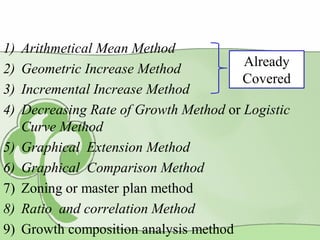
Arithmetical Mean Method
Already
Geometric Increase Method
Covered
Incremental Increase Method
Decreasing Rate of Growth Method or Logistic
Curve Method
Graphical Extension Method
Graphical Comparison Method
Zoning or master plan method
Ratio and correlation Method
Growth composition analysis method
4.

Decreasing Rate of Growth Method or
Logistic Curve Method

• Rate of increase of population never remains
constant.
• Population of the city grows until it reaches
saturation, which is established by limit of
economic opportunity.
• Thus all populations grow according to the
logistic or S-curve.
5. Graphical Extension Method
• A curve is drawn between population P and
time T, with the help of previous census data
so that the shape of population curve is
obtained up to the present period.
• From extended part of the curve population at
the end of any future decade can be obtained.
6. Graphical Comparison Method
• It assumes that the city under consideration
will develop as similar cities developed in the
past.
• The method consists of plotting the curves of
cities hat, one or more decades ago, had
reached the present population of the city
under consideration.
• Difficult to find the identical cities with
respect to population growth
7. Zoning or master plan method
•
•

City is divided into various zones by town planner
Industrial
Commercial
Residential and
Other zones
Population density is expressed as no of
people/hectare
• Future development is allowed to take place as per
master plan
S.
No.

Area type

Persons per
hectare

1

Residential – single
family units

15 - 80

2

Residential – multiple
family units

80 - 250

3

apartments

250 - 2500

4

Commercial area

40 - 75

5

Industrial area

15 - 40
8.

Ratio and correlation Method

• Population growth of a small town or city is
related with growth of big cities or state or
country.
• Ratio of local to national or state population is
worked out in last 2 to 4 decades.
• These ratios may be used to predict the
population.
• Method takes into account national and
regional factors affecting population growth.
9. Growth composition analysis method
•
-

Population of city changes due to
Birth
Death and
Migration

Pn = P +Natural increase + Migration
Natural increase =T[IBP – IDP]
T= design forecast period
P= present population
IB= avg. birth rate/yr and ID= avg. death rate/yr
Factors affecting population growth
• Economic factors : - New industries,
discovery of oil or minerals.
• Development programmes: - of national
importance such as river valley project.
• Social facilities: -Educational, medical and
recreational facilities.
• Communication links: - Connectivity of
the town with other cities and mandies
(Markets) of agro products
• Tourism: - Tourists facilities, religious
places and historical buildings.
• Community life: - Living habits, social
customs and general education in the
community.
• Unforeseen factors: - Earthquakes,
Floods, Epidemics, Frequent famines etc.
Objective Questions
1. In _________method population growth of a
small town or area is related to big towns or
big areas. (Ratio and
Correlation/Graphical/Zoning/Logistic)
2. Difference between birth rate and death rate
give ________ _________.
3. ____________ affects growth of population.
(River valley project/tourist
places/unforeseen factors/ all of above)
Theory Questions
Q1. Enlist all the methods of population forecasting
and explain Ratio and correlation method. (May
2011, 5 marks)
OR
Enlist all the methods of population forecasting and
explain any two methods.
Q2. Explain factors affecting population growth.

L 7 population forecasting

  • 1.
  • 2.
  • 3.
    1) 2) 3) 4) 5) 6) 7) 8) 9) Arithmetical Mean Method Already GeometricIncrease Method Covered Incremental Increase Method Decreasing Rate of Growth Method or Logistic Curve Method Graphical Extension Method Graphical Comparison Method Zoning or master plan method Ratio and correlation Method Growth composition analysis method
  • 4.
    4. Decreasing Rate ofGrowth Method or Logistic Curve Method • Rate of increase of population never remains constant. • Population of the city grows until it reaches saturation, which is established by limit of economic opportunity. • Thus all populations grow according to the logistic or S-curve.
  • 6.
    5. Graphical ExtensionMethod • A curve is drawn between population P and time T, with the help of previous census data so that the shape of population curve is obtained up to the present period. • From extended part of the curve population at the end of any future decade can be obtained.
  • 8.
    6. Graphical ComparisonMethod • It assumes that the city under consideration will develop as similar cities developed in the past. • The method consists of plotting the curves of cities hat, one or more decades ago, had reached the present population of the city under consideration. • Difficult to find the identical cities with respect to population growth
  • 10.
    7. Zoning ormaster plan method • • City is divided into various zones by town planner Industrial Commercial Residential and Other zones Population density is expressed as no of people/hectare • Future development is allowed to take place as per master plan
  • 11.
    S. No. Area type Persons per hectare 1 Residential– single family units 15 - 80 2 Residential – multiple family units 80 - 250 3 apartments 250 - 2500 4 Commercial area 40 - 75 5 Industrial area 15 - 40
  • 12.
    8. Ratio and correlationMethod • Population growth of a small town or city is related with growth of big cities or state or country. • Ratio of local to national or state population is worked out in last 2 to 4 decades. • These ratios may be used to predict the population. • Method takes into account national and regional factors affecting population growth.
  • 13.
    9. Growth compositionanalysis method • - Population of city changes due to Birth Death and Migration Pn = P +Natural increase + Migration Natural increase =T[IBP – IDP] T= design forecast period P= present population IB= avg. birth rate/yr and ID= avg. death rate/yr
  • 14.
    Factors affecting populationgrowth • Economic factors : - New industries, discovery of oil or minerals. • Development programmes: - of national importance such as river valley project. • Social facilities: -Educational, medical and recreational facilities. • Communication links: - Connectivity of the town with other cities and mandies (Markets) of agro products
  • 15.
    • Tourism: -Tourists facilities, religious places and historical buildings. • Community life: - Living habits, social customs and general education in the community. • Unforeseen factors: - Earthquakes, Floods, Epidemics, Frequent famines etc.
  • 16.
    Objective Questions 1. In_________method population growth of a small town or area is related to big towns or big areas. (Ratio and Correlation/Graphical/Zoning/Logistic) 2. Difference between birth rate and death rate give ________ _________. 3. ____________ affects growth of population. (River valley project/tourist places/unforeseen factors/ all of above)
  • 17.
    Theory Questions Q1. Enlistall the methods of population forecasting and explain Ratio and correlation method. (May 2011, 5 marks) OR Enlist all the methods of population forecasting and explain any two methods. Q2. Explain factors affecting population growth.