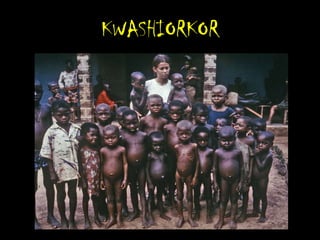
KWASHIORKOR
Introduction A dietary history of a monotonous
single cereal-based diet with
inclusion of animal-source foods
less than once per week will
raise suspicion of kwashiorkor.
Diets based on corn, cassava, and
rice are those most commonly
associated with kwashiorkor.
Cessation of breast-feeding in the
few months before presentation
is a common finding. There may be
a history of preceding diarrhea
or measles infection.
Kwashiorkor edema starts in the
feet and develops over a few
days.
Alternative Names:
• Protein malnutrition; Protein-calorie
malnutrition; Malignant malnutrition
Definition of Kwashiorkor:
• Kwashiorkor is a form
of malnutrition that occurs when there
is not enough protein in the diet.
Signs and tests
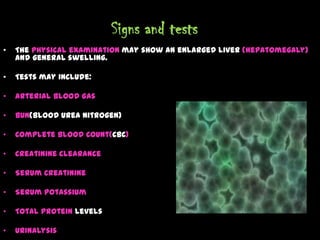
• The physical examination may show an enlarged liver (hepatomegaly)
and general swelling.
• Tests may include:
• Arterial Blood Gas
• BUN(Blood Urea Nitrogen)
• Complete Blood Count(CBC)
• Creatinine Clearance
• Serum Creatinine
• Serum Potassium
• Total Protein Levels
• Urinalysis
What is Kwashiorkor?
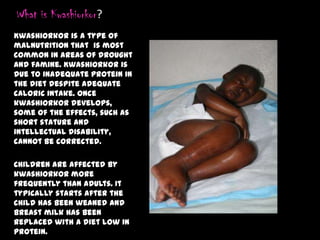
Kwashiorkor is a type of
malnutrition that is most
common in areas of drought
and famine. Kwashiorkor is
due to inadequate protein in
the diet despite adequate
caloric intake. Once
kwashiorkor develops,
some of the effects, such as
short stature and
intellectual disability,
cannot be corrected.
Children are affected by
kwashiorkor more
frequently than adults. It
typically starts after the
child has been weaned and
breast milk has been
replaced with a diet low in
protein.
What are the symptoms of Kwashiorkor?
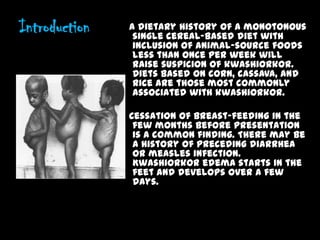
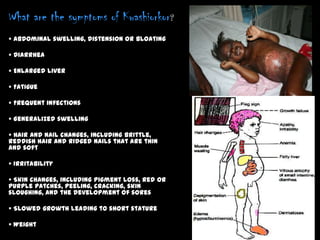
 Abdominal swelling, distension or bloating
 Diarrhea
 Enlarged liver
 Fatigue
 Frequent infections
 Generalized swelling
 Hair and nail changes, including brittle,
reddish hair and ridged nails that are thin
and soft
 Irritability
 Skin changes, including pigment loss, red or
purple patches, peeling, cracking, skin
sloughing, and the development of sores
 Slowed growth leading to short stature
 Weight
How is Kwashiorkor treated?
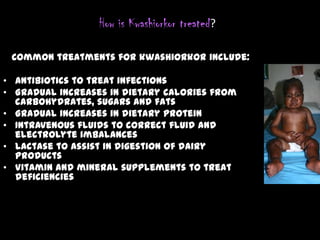
Common treatments for kwashiorkor include:
• Antibiotics to treat infections
• Gradual increases in dietary calories from
carbohydrates, sugars and fats
• Gradual increases in dietary protein
• Intravenous fluids to correct fluid and
electrolyte imbalances
• Lactase to assist in digestion of dairy
products
• Vitamin and mineral supplements to treat
deficiencies
What are the potential complications of Kwashiorkor?
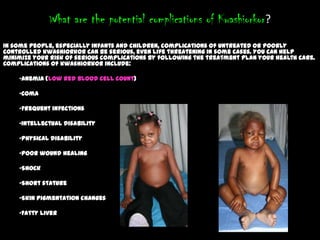
In some people, especially infants and children, complications of untreated or poorly
controlled kwashiorkor can be serious, even life threatening in some cases. You can help
minimize your risk of serious complications by following the treatment plan your health care.
Complications of kwashiorkor include:
•Anemia (low red blood cell count)
•Coma
•Frequent infections
•Intellectual disability
•Physical disability
•Poor wound healing
•Shock
•Short stature
•Skin pigmentation changes
•Fatty liver
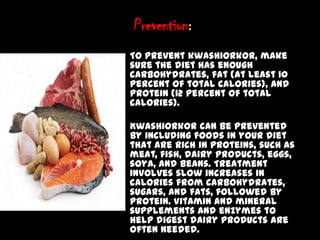
Prevention:
• To prevent kwashiorkor, make
sure the diet has enough
carbohydrates, fat (at least 10
percent of total calories), and
protein (12 percent of total
calories).
• Kwashiorkor can be prevented
by including foods in your diet
that are rich in proteins, such as
meat, fish, dairy products, eggs,
soya, and beans. Treatment
involves slow increases in
calories from carbohydrates,
sugars, and fats, followed by
protein. Vitamin and mineral
supplements and enzymes to
help digest dairy products are
often needed.
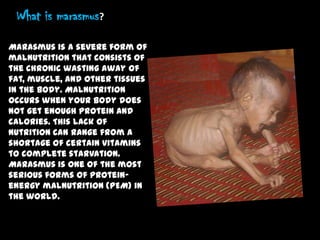
What is marasmus?
Marasmus is a severe form of
malnutrition that consists of
the chronic wasting away of
fat, muscle, and other tissues
in the body. Malnutrition
occurs when your body does
not get enough protein and
calories. This lack of
nutrition can range from a
shortage of certain vitamins
to complete starvation.
Marasmus is one of the most
serious forms of protein-
energy malnutrition (PEM) in
the world.
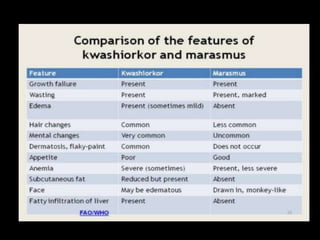
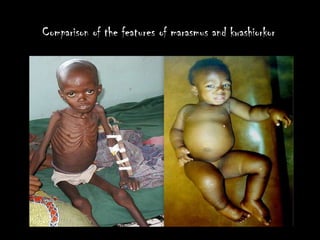
Comparison of the features of marasmus and kwashiorkor

Kwashiorkor

  • 1.
  • 2.
    Introduction A dietaryhistory of a monotonous single cereal-based diet with inclusion of animal-source foods less than once per week will raise suspicion of kwashiorkor. Diets based on corn, cassava, and rice are those most commonly associated with kwashiorkor. Cessation of breast-feeding in the few months before presentation is a common finding. There may be a history of preceding diarrhea or measles infection. Kwashiorkor edema starts in the feet and develops over a few days.
  • 3.
    Alternative Names: • Proteinmalnutrition; Protein-calorie malnutrition; Malignant malnutrition Definition of Kwashiorkor: • Kwashiorkor is a form of malnutrition that occurs when there is not enough protein in the diet.
  • 4.
    Signs and tests •The physical examination may show an enlarged liver (hepatomegaly) and general swelling. • Tests may include: • Arterial Blood Gas • BUN(Blood Urea Nitrogen) • Complete Blood Count(CBC) • Creatinine Clearance • Serum Creatinine • Serum Potassium • Total Protein Levels • Urinalysis
  • 5.
    What is Kwashiorkor? Kwashiorkoris a type of malnutrition that is most common in areas of drought and famine. Kwashiorkor is due to inadequate protein in the diet despite adequate caloric intake. Once kwashiorkor develops, some of the effects, such as short stature and intellectual disability, cannot be corrected. Children are affected by kwashiorkor more frequently than adults. It typically starts after the child has been weaned and breast milk has been replaced with a diet low in protein.
  • 6.
    What are thesymptoms of Kwashiorkor?  Abdominal swelling, distension or bloating  Diarrhea  Enlarged liver  Fatigue  Frequent infections  Generalized swelling  Hair and nail changes, including brittle, reddish hair and ridged nails that are thin and soft  Irritability  Skin changes, including pigment loss, red or purple patches, peeling, cracking, skin sloughing, and the development of sores  Slowed growth leading to short stature  Weight
  • 7.
    How is Kwashiorkortreated? Common treatments for kwashiorkor include: • Antibiotics to treat infections • Gradual increases in dietary calories from carbohydrates, sugars and fats • Gradual increases in dietary protein • Intravenous fluids to correct fluid and electrolyte imbalances • Lactase to assist in digestion of dairy products • Vitamin and mineral supplements to treat deficiencies
  • 8.
    What are thepotential complications of Kwashiorkor? In some people, especially infants and children, complications of untreated or poorly controlled kwashiorkor can be serious, even life threatening in some cases. You can help minimize your risk of serious complications by following the treatment plan your health care. Complications of kwashiorkor include: •Anemia (low red blood cell count) •Coma •Frequent infections •Intellectual disability •Physical disability •Poor wound healing •Shock •Short stature •Skin pigmentation changes •Fatty liver
  • 9.
    Prevention: • To preventkwashiorkor, make sure the diet has enough carbohydrates, fat (at least 10 percent of total calories), and protein (12 percent of total calories). • Kwashiorkor can be prevented by including foods in your diet that are rich in proteins, such as meat, fish, dairy products, eggs, soya, and beans. Treatment involves slow increases in calories from carbohydrates, sugars, and fats, followed by protein. Vitamin and mineral supplements and enzymes to help digest dairy products are often needed.
  • 10.
    What is marasmus? Marasmusis a severe form of malnutrition that consists of the chronic wasting away of fat, muscle, and other tissues in the body. Malnutrition occurs when your body does not get enough protein and calories. This lack of nutrition can range from a shortage of certain vitamins to complete starvation. Marasmus is one of the most serious forms of protein- energy malnutrition (PEM) in the world.
  • 12.
    Comparison of thefeatures of marasmus and kwashiorkor