PROTEIN ENERGY MALNUTRITION
Abdelaziz Elamin
MD, PhD, FRCPCH
Professor of Child Health
College of Medicine
Sultan Qaboos University
Muscat, Oman
azizmin@hotmail.com
HUMAN NUTRITION
Nutrients are substances that are
crucial for human life, growth & well-
being.
Macronutrients (carbohydrates,
lipids, proteins & water) are needed
for energy and cell multiplication &
repair.
Micronutrients are trace elements &
vitamins, which are essential for
metabolic processes.
HUMAN NUTRITION/2
Obesity & under-nutrition are the 2
ends of the spectrum of malnutrition.
A healthy diet provides a balanced
nutrients that satisfy the metabolic
needs of the body without excess or
shortage.
Dietary requirements of children
vary according to age, sex &
development.
Assessment of Nutr status
Direct
Clinical
Anthropometric
Dietary
Laboratory
Indirect
Health statistics
Ecological variables
Clinical Assessment
Useful in severe forms of PEM
Based on thorough physical
examination for features of PEM &
vitamin deficiencies.
Focuses on skin, eye, hair, mouth &
bones.
Chronic illnesses & goiter to be
excluded
Clinical Assessment/2
ADVANTAGES
Fast & Easy to perform
Inexpensive
Non-invasive
LIMITATIONS
Did not detect early cases
Trained staff needed
ANTHROPOMETRY
Objective with high specificity &
sensitivity
Measuring Ht, Wt, MAC, HC, skin fold
thickness, waist & hip ratio & BMI
Reading are numerical & gradable on
standard growth charts
Non-expensive & need minimal
training
ANTHROPOMETRY/2
LIMITATIONS
Inter-observers’ errors in
measurement
Limited nutritional diagnosis
Problems with reference
standards
Arbitrary statistical cut-off levels
for abnormality
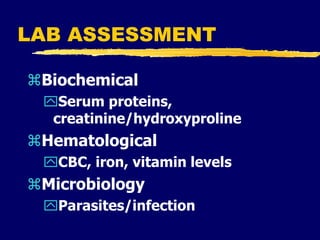
LAB ASSESSMENT
Biochemical
Serum proteins,
creatinine/hydroxyproline
Hematological
CBC, iron, vitamin levels
Microbiology
Parasites/infection
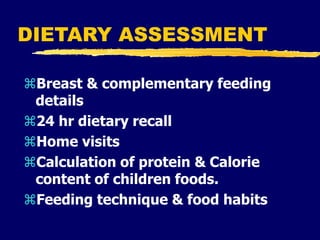
DIETARY ASSESSMENT
Breast & complementary feeding
details
24 hr dietary recall
Home visits
Calculation of protein & Calorie
content of children foods.
Feeding technique & food habits
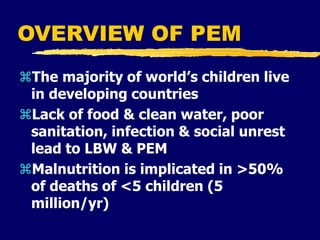
OVERVIEW OF PEM
The majority of world’s children live
in developing countries
Lack of food & clean water, poor
sanitation, infection & social unrest
lead to LBW & PEM
Malnutrition is implicated in >50%
of deaths of <5 children (5
million/yr)
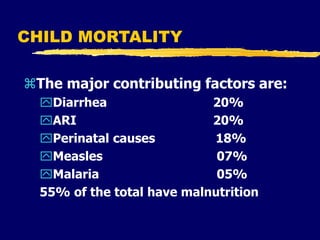
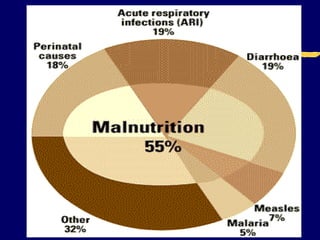
CHILD MORTALITY
The major contributing factors are:
Diarrhea 20%
ARI 20%
Perinatal causes 18%
Measles 07%
Malaria 05%
55% of the total have malnutrition
EPIDEMIOLOGY
The term protein energy malnutrition
has been adopted by WHO in 1976.
Highly prevalent in developing
countries among <5 children; severe
forms 1-10% & underweight 20-
40%.
All children with PEM have
micronutrient deficiency.
PEM
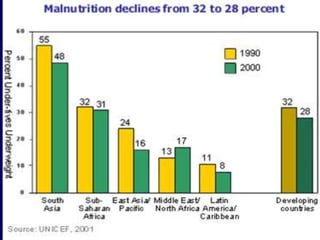
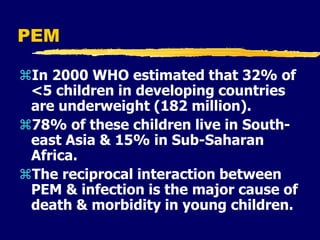
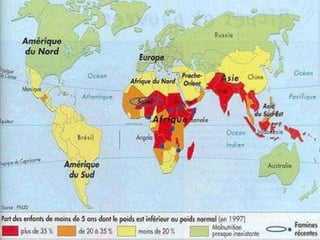
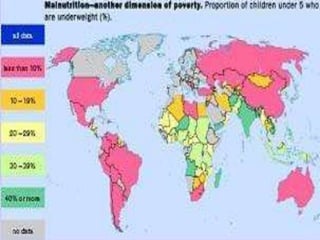
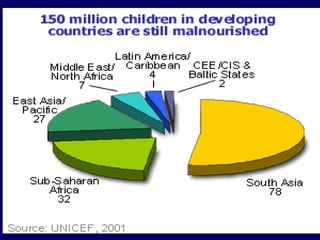
In 2000 WHO estimated that 32% of
<5 children in developing countries
are underweight (182 million).
78% of these children live in South-
east Asia & 15% in Sub-Saharan
Africa.
The reciprocal interaction between
PEM & infection is the major cause of
death & morbidity in young children.
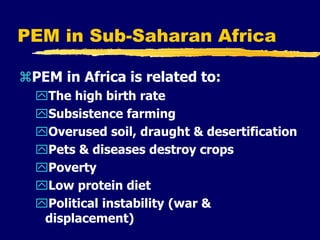
PEM in Sub-Saharan Africa
PEM in Africa is related to:
The high birth rate
Subsistence farming
Overused soil, draught & desertification
Pets & diseases destroy crops
Poverty
Low protein diet
Political instability (war &
displacement)
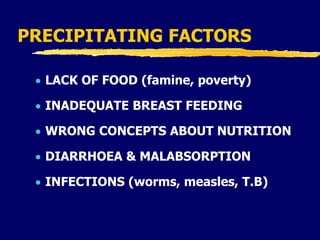
PRECIPITATING FACTORS
 LACK OF FOOD (famine, poverty)
 INADEQUATE BREAST FEEDING
 WRONG CONCEPTS ABOUT NUTRITION
 DIARRHOEA & MALABSORPTION
 INFECTIONS (worms, measles, T.B)
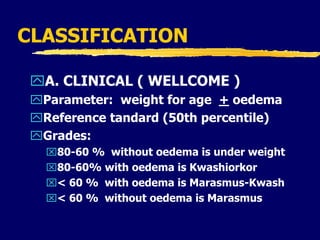
CLASSIFICATION
A. CLINICAL ( WELLCOME )
Parameter: weight for age + oedema
Reference tandard (50th percentile)
Grades:
80-60 % without oedema is under weight
80-60% with oedema is Kwashiorkor
< 60 % with oedema is Marasmus-Kwash
< 60 % without oedema is Marasmus
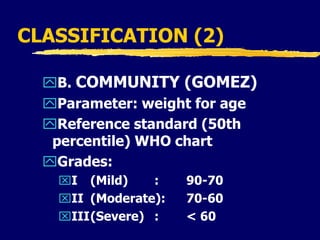
CLASSIFICATION (2)
B. COMMUNITY (GOMEZ)
Parameter: weight for age
Reference standard (50th
percentile) WHO chart
Grades:
I (Mild) : 90-70
II (Moderate): 70-60
III(Severe) : < 60
ADVANTAGES
 SIMPLICITY (no lab tests needed)
 REPRODUCIBILITY
 COMPARABILITY
 ANTHROPOMETRY+CLINICAL
SIGN USED FOR ASSESSMENT
DISADVANTAGES
 AGE MAY NOT BE KNOWN
 HEIGHT NOT CONSIDERED
 CROSS SECTIONAL
 CAN’T TELL ABOUT CHRONICITY
 WHO STANDARDS MAY NOT
REPRESENT LOCAL COMMUNITY
STANDARD
KWASHIORKOR
Cecilly Williams, a British nurse, had
introduced the word Kwashiorkor to
the medical literature in 1933. The
word is taken from the Ga language
in Ghana & used to describe the
sickness of weaning.
ETIOLOGY
Kwashiorkor can occur in infancy but
its maximal incidence is in the 2nd yr
of life following abrupt weaning.
Kwashiorkor is not only dietary in
origin. Infective, psycho-socical, and
cultural factors are also operative.
ETIOLOGY (2)
Kwashiorkor is an example of lack of
physiological adaptation to
unbalanced deficiency where the body
utilized proteins and conserve S/C fat.
One theory says Kwash is a result of
liver insult with hypoproteinemia and
oedema. Food toxins like aflatoxins
have been suggested as precipitating
factors.
CLINICAL PRESENTATION
Kwash is characterized by certain
constant features in addition to a
variable spectrum of symptoms and
signs.
Clinical presentation is affected by:
•The degree of deficiency
•The duration of deficiency
The speed of onset
The age at onset
Presence of conditioning factors
Genetic factors
CONSTANT FEATURES OF KWASH
OEDEMA
PSYCHOMOTOR CHANGES
GROWTH RETARDATION
MUSCLE WASTING
USUALLY PRESENT SIGNS
MOON FACE
HAIR CHANGES
SKIN DEPIGMENTATION
ANAEMIA
OCCASIONALLY PRESENT SIGNS
HEPATOMEGALY
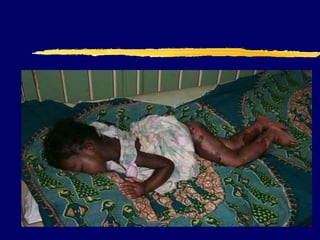
FLAKY PAINT DERMATITIS
CARDIOMYOPATHY & FAILURE
DEHYDRATION (Diarrh. & Vomiting)
SIGNS OF VITAMIN DEFICIENCIES
 SIGNS OF INFECTIONS
DD of Kwash Dermatitis
Acrodermatitis Entropathica
Scurvy
Pellagra
Dermatitis Herpitiformis
MARASMUS
The term marasmus is derived from
the Greek marasmos, which means
wasting.
Marasmus involves inadequate
intake of protein and calories and is
characterized by emaciation.
Marasmus represents the end result
of starvation where both proteins
and calories are deficient.
MARASMUS/2
Marasmus represents an adaptive
response to starvation, whereas
kwashiorkor represents a
maladaptive response to starvation
In Marasmus the body utilizes all fat
stores before using muscles.
EPIDEMIOLOGY & ETIOLOGY
Seen most commonly in the first year
of life due to lack of breast feeding
and the use of dilute animal milk.
Poverty or famine and diarrhoea are
the usual precipitating factors
Ignorance & poor maternal nutrition
are also contributory
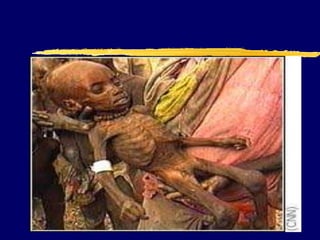
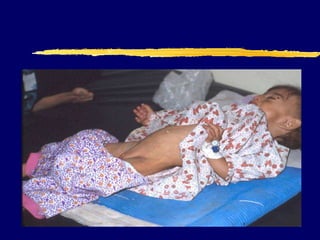
Clinical Features of Marasmus
Severe wasting of muscle & s/c fats
Severe growth retardation
Child looks older than his age
No edema or hair changes
Alert but miserable
Hungry
Diarrhoea & Dehydration
CLINICAL ASSESSMENT
Interrogation & physical exam
including detailed dietary history.
Anthropometric measurements
Team approach with involvement of
dieticians, social workers &
community support groups.
Investigations for PEM
Full blood counts
Blood glucose profile
Septic screening
Stool & urine for parasites & germs
Electrolytes, Ca, Ph & ALP, serum
proteins
CXR & Mantoux test
Exclude HIV & malabsorption
NON-ROUTINE TESTS
Hair analysis
Skin biopsy
Urinary creatinine over proline ratio
Measurement of trace elements
levels, iron, zinc & iodine
Complications of P.E.M
Hypoglycemia
Hypothermia
Hypokalemia
Hyponatremia
Heart failure
Dehydration & shock
Infections (bacterial, viral & thrush)
TREATMENT
Correction of water & electrolyte
imbalance
Treat infection & worm infestations
Dietary support: 3-4 g protein & 200 Cal
/kg body wt/day + vitamins & minerals
Prevention of hypothermia
Counsel parents & plan future care
including immunization & diet
supplements
KEY POINT FEEDING
Continue breast feeding
Add frequent small feeds
Use liquid diet
Give vitamin A & folic acid on
admission
With diarrhea use lactose-free or
soya bean formula
PROGNOSIS
Kwash & Marasmus-Kwash have
greater risk of morbidity & mortality
compared to Marasmus and under
weight
Early detection & adequate treatment
are associated with good outcome
Late ill-effects on IQ, behavior &
cognitive functions are doubtful and
not proven
THANKS YOU

Good

  • 1.
    PROTEIN ENERGY MALNUTRITION AbdelazizElamin MD, PhD, FRCPCH Professor of Child Health College of Medicine Sultan Qaboos University Muscat, Oman azizmin@hotmail.com
  • 2.
    HUMAN NUTRITION Nutrients aresubstances that are crucial for human life, growth & well- being. Macronutrients (carbohydrates, lipids, proteins & water) are needed for energy and cell multiplication & repair. Micronutrients are trace elements & vitamins, which are essential for metabolic processes.
  • 3.
    HUMAN NUTRITION/2 Obesity &under-nutrition are the 2 ends of the spectrum of malnutrition. A healthy diet provides a balanced nutrients that satisfy the metabolic needs of the body without excess or shortage. Dietary requirements of children vary according to age, sex & development.
  • 4.
    Assessment of Nutrstatus Direct Clinical Anthropometric Dietary Laboratory Indirect Health statistics Ecological variables
  • 5.
    Clinical Assessment Useful insevere forms of PEM Based on thorough physical examination for features of PEM & vitamin deficiencies. Focuses on skin, eye, hair, mouth & bones. Chronic illnesses & goiter to be excluded
  • 6.
    Clinical Assessment/2 ADVANTAGES Fast &Easy to perform Inexpensive Non-invasive LIMITATIONS Did not detect early cases Trained staff needed
  • 7.
    ANTHROPOMETRY Objective with highspecificity & sensitivity Measuring Ht, Wt, MAC, HC, skin fold thickness, waist & hip ratio & BMI Reading are numerical & gradable on standard growth charts Non-expensive & need minimal training
  • 8.
    ANTHROPOMETRY/2 LIMITATIONS Inter-observers’ errors in measurement Limitednutritional diagnosis Problems with reference standards Arbitrary statistical cut-off levels for abnormality
  • 9.
  • 10.
    DIETARY ASSESSMENT Breast &complementary feeding details 24 hr dietary recall Home visits Calculation of protein & Calorie content of children foods. Feeding technique & food habits
  • 12.
    OVERVIEW OF PEM Themajority of world’s children live in developing countries Lack of food & clean water, poor sanitation, infection & social unrest lead to LBW & PEM Malnutrition is implicated in >50% of deaths of <5 children (5 million/yr)
  • 13.
    CHILD MORTALITY The majorcontributing factors are: Diarrhea 20% ARI 20% Perinatal causes 18% Measles 07% Malaria 05% 55% of the total have malnutrition
  • 15.
    EPIDEMIOLOGY The term proteinenergy malnutrition has been adopted by WHO in 1976. Highly prevalent in developing countries among <5 children; severe forms 1-10% & underweight 20- 40%. All children with PEM have micronutrient deficiency.
  • 17.
    PEM In 2000 WHOestimated that 32% of <5 children in developing countries are underweight (182 million). 78% of these children live in South- east Asia & 15% in Sub-Saharan Africa. The reciprocal interaction between PEM & infection is the major cause of death & morbidity in young children.
  • 21.
    PEM in Sub-SaharanAfrica PEM in Africa is related to: The high birth rate Subsistence farming Overused soil, draught & desertification Pets & diseases destroy crops Poverty Low protein diet Political instability (war & displacement)
  • 22.
    PRECIPITATING FACTORS  LACKOF FOOD (famine, poverty)  INADEQUATE BREAST FEEDING  WRONG CONCEPTS ABOUT NUTRITION  DIARRHOEA & MALABSORPTION  INFECTIONS (worms, measles, T.B)
  • 23.
    CLASSIFICATION A. CLINICAL (WELLCOME ) Parameter: weight for age + oedema Reference tandard (50th percentile) Grades: 80-60 % without oedema is under weight 80-60% with oedema is Kwashiorkor < 60 % with oedema is Marasmus-Kwash < 60 % without oedema is Marasmus
  • 24.
    CLASSIFICATION (2) B. COMMUNITY(GOMEZ) Parameter: weight for age Reference standard (50th percentile) WHO chart Grades: I (Mild) : 90-70 II (Moderate): 70-60 III(Severe) : < 60
  • 25.
    ADVANTAGES  SIMPLICITY (nolab tests needed)  REPRODUCIBILITY  COMPARABILITY  ANTHROPOMETRY+CLINICAL SIGN USED FOR ASSESSMENT
  • 26.
    DISADVANTAGES  AGE MAYNOT BE KNOWN  HEIGHT NOT CONSIDERED  CROSS SECTIONAL  CAN’T TELL ABOUT CHRONICITY  WHO STANDARDS MAY NOT REPRESENT LOCAL COMMUNITY STANDARD
  • 27.
    KWASHIORKOR Cecilly Williams, aBritish nurse, had introduced the word Kwashiorkor to the medical literature in 1933. The word is taken from the Ga language in Ghana & used to describe the sickness of weaning.
  • 28.
    ETIOLOGY Kwashiorkor can occurin infancy but its maximal incidence is in the 2nd yr of life following abrupt weaning. Kwashiorkor is not only dietary in origin. Infective, psycho-socical, and cultural factors are also operative.
  • 29.
    ETIOLOGY (2) Kwashiorkor isan example of lack of physiological adaptation to unbalanced deficiency where the body utilized proteins and conserve S/C fat. One theory says Kwash is a result of liver insult with hypoproteinemia and oedema. Food toxins like aflatoxins have been suggested as precipitating factors.
  • 30.
    CLINICAL PRESENTATION Kwash ischaracterized by certain constant features in addition to a variable spectrum of symptoms and signs. Clinical presentation is affected by: •The degree of deficiency •The duration of deficiency The speed of onset The age at onset Presence of conditioning factors Genetic factors
  • 31.
    CONSTANT FEATURES OFKWASH OEDEMA PSYCHOMOTOR CHANGES GROWTH RETARDATION MUSCLE WASTING
  • 32.
    USUALLY PRESENT SIGNS MOONFACE HAIR CHANGES SKIN DEPIGMENTATION ANAEMIA
  • 33.
    OCCASIONALLY PRESENT SIGNS HEPATOMEGALY FLAKYPAINT DERMATITIS CARDIOMYOPATHY & FAILURE DEHYDRATION (Diarrh. & Vomiting) SIGNS OF VITAMIN DEFICIENCIES  SIGNS OF INFECTIONS
  • 34.
    DD of KwashDermatitis Acrodermatitis Entropathica Scurvy Pellagra Dermatitis Herpitiformis
  • 36.
    MARASMUS The term marasmusis derived from the Greek marasmos, which means wasting. Marasmus involves inadequate intake of protein and calories and is characterized by emaciation. Marasmus represents the end result of starvation where both proteins and calories are deficient.
  • 37.
    MARASMUS/2 Marasmus represents anadaptive response to starvation, whereas kwashiorkor represents a maladaptive response to starvation In Marasmus the body utilizes all fat stores before using muscles.
  • 38.
    EPIDEMIOLOGY & ETIOLOGY Seenmost commonly in the first year of life due to lack of breast feeding and the use of dilute animal milk. Poverty or famine and diarrhoea are the usual precipitating factors Ignorance & poor maternal nutrition are also contributory
  • 39.
    Clinical Features ofMarasmus Severe wasting of muscle & s/c fats Severe growth retardation Child looks older than his age No edema or hair changes Alert but miserable Hungry Diarrhoea & Dehydration
  • 42.
    CLINICAL ASSESSMENT Interrogation &physical exam including detailed dietary history. Anthropometric measurements Team approach with involvement of dieticians, social workers & community support groups.
  • 43.
    Investigations for PEM Fullblood counts Blood glucose profile Septic screening Stool & urine for parasites & germs Electrolytes, Ca, Ph & ALP, serum proteins CXR & Mantoux test Exclude HIV & malabsorption
  • 44.
    NON-ROUTINE TESTS Hair analysis Skinbiopsy Urinary creatinine over proline ratio Measurement of trace elements levels, iron, zinc & iodine
  • 45.
    Complications of P.E.M Hypoglycemia Hypothermia Hypokalemia Hyponatremia Heartfailure Dehydration & shock Infections (bacterial, viral & thrush)
  • 46.
    TREATMENT Correction of water& electrolyte imbalance Treat infection & worm infestations Dietary support: 3-4 g protein & 200 Cal /kg body wt/day + vitamins & minerals Prevention of hypothermia Counsel parents & plan future care including immunization & diet supplements
  • 47.
    KEY POINT FEEDING Continuebreast feeding Add frequent small feeds Use liquid diet Give vitamin A & folic acid on admission With diarrhea use lactose-free or soya bean formula
  • 48.
    PROGNOSIS Kwash & Marasmus-Kwashhave greater risk of morbidity & mortality compared to Marasmus and under weight Early detection & adequate treatment are associated with good outcome Late ill-effects on IQ, behavior & cognitive functions are doubtful and not proven
  • 49.